Book Appointment Now

Dental Tourism in Argentina: Prices, Safety, and Planning
 By
By
Dental tourism in Argentina can be worth investigating when a written treatment plan survives careful checks. Price alone gives you very little protection. You need to verify the dentist, the office, the proposed materials, the visit sequence, and the plan for problems after you return home.
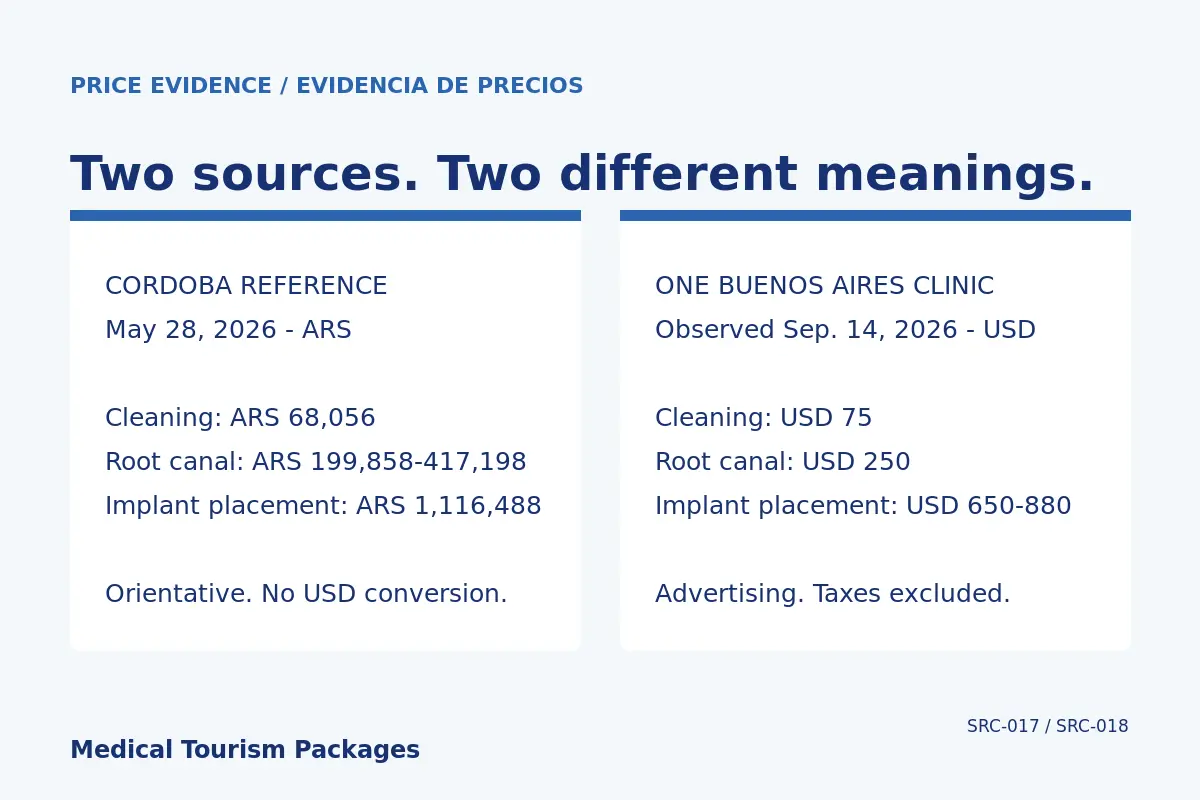
The available price evidence has strict limits. A Córdoba professional schedule provides nonbinding reference fees in Argentine pesos. One Buenos Aires clinic also publishes a USD price list. Neither source represents an Argentina-wide average.
This guide shows what those sources say and how to build a safer planning file. It does not recommend a provider or determine whether treatment is suitable for you.
What does dental tourism in Argentina involve?
Dental tourism means traveling outside your home country for dental care. Common possibilities include examinations, cleanings, root canal treatment, crowns, veneers, orthodontics, and implant treatment. Your diagnosis determines which options belong in your plan.
Simple labels can hide meaningful differences. A “crown” price may depend on material and laboratory work. An “implant” line may cover placement but exclude the abutment, crown, imaging, grafting, or sedation. Orthodontic prices may cover an initial phase while excluding replacement components or later controls.
Ask for procedure codes, tooth numbers, material or implant identifiers, and the planned number of visits. The quote should state what happens if the clinical findings change after an in-person examination.
How much does dental work cost in Argentina?
Two dated snapshots give planning anchors. Use them to start a conversation. They cannot settle a budget.
One Buenos Aires clinic’s advertised USD prices
The following prices appeared on one clinic website when MTP checked it on September 14, 2026. The page displays no publication date. It says taxes are excluded and prices may change without notice. These are direct USD quotations, so no exchange-rate conversion was used.
| Procedure | Advertised price |
|---|---|
| Cleaning | USD 75 |
| Root canal treatment | USD 250 |
| Crown, depending on material | USD 550 to 610 |
| Veneer | USD 550 |
| Orthodontics, described as an average | USD 3,600 |
| Implant placement, depending on implant type | USD 650 to 880 |
This is single-provider marketing evidence. It does not establish the typical price in Buenos Aires or Argentina. The implant line appears to describe placement. Confirm whether the final restoration and every related service are included.
Córdoba professional reference fees in ARS
The Córdoba dental college published an orientative schedule dated May 28, 2026. It says professionals and patients remain free to agree on fees. The schedule lists a consultation at ARS 47,154 and cleaning at ARS 68,056.
Root canal references range from ARS 199,858 to ARS 417,198 by canal count. Crown references range from ARS 571,243 to ARS 592,999 by material. Veneer references are ARS 372,577 or ARS 434,275 by material.
The first-year orthodontic reference is ARS 2,606,005. Placement of one implant is listed at ARS 1,116,488. The implant code does not establish that a crown is included.
Keep these figures in ARS when planning. The BCRA reference rate is based on reports from financial institutions, not a fixed sale price. Any USD conversion should identify the rate used, transaction date, and the clinic’s written basis.
What should a complete quote show?
Request one itemized document that states:
- the diagnosis, alternatives, tooth numbers, and procedure codes;
- imaging, laboratory work, temporary restorations, and final restorations;
- the brand and model of any implanted device or material;
- anesthesia, medication, facility, and professional fees;
- taxes, deposits, cancellation terms, and refund conditions;
- the quote currency, validity date, and exchange-rate basis;
- each expected visit and the conditions that could add visits;
- included follow-up and the response to a complication at home.
Do not calculate savings from an unmatched home-country estimate. Compare both quotes line by line after the same diagnosis and imaging review.
How do you verify a dentist and dental office?
Argentina maintains two useful federal networks. REFES covers functioning public and private health establishments reported by the jurisdictions. REFEPS covers registered health professionals.
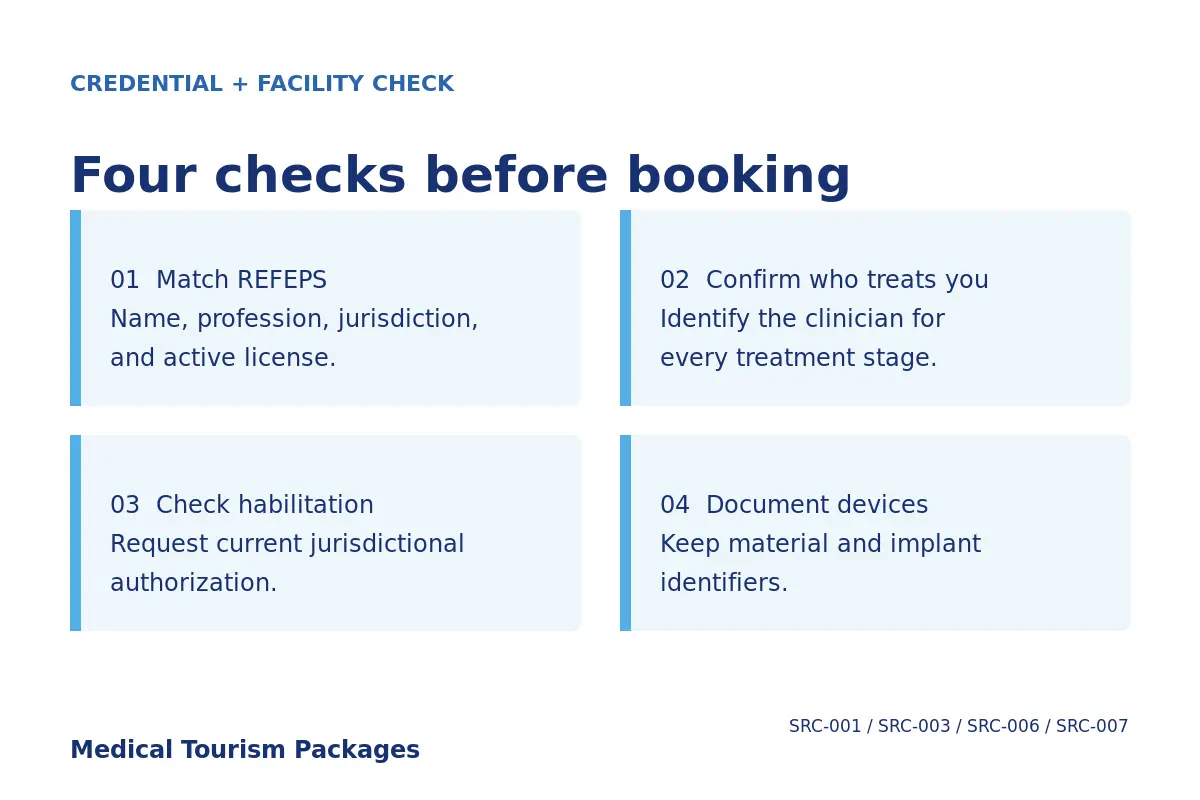
Search REFEPS and compare the professional’s full name, profession, jurisdiction, and license details with your treatment plan. A current national resolution expressly includes dentists and provides for the generated license record to be entered in REFEPS.
A registry match confirms professional registration. It cannot show whether the dentist is the right clinician for your case. Ask who will perform each stage and which specialty credential supports complex work.
Use AOA specialty certification as an additional credential check alongside the dentist’s active license. The Argentine Dental Association may certify selected specialties, including oral and maxillofacial surgery, endodontics, pediatric dentistry, and periodontics. This certification route is available only to AOA members. Recertification is voluntary and follows a five-year cycle for specialty titles issued by the association.
For the office, request its current jurisdictional habilitation. The official CABA process requires habilitation for a dental office and lists supporting items such as a plan, a biomedical-waste agreement, professional authorizations, and equipment documents where applicable.
What infection-control and device questions matter?
CDC guidance says all dental settings should apply Standard Precautions. Its dental checklist covers areas such as hand hygiene, sterilization, injection safety, environmental cleaning, and dental-unit water quality.
Ask the office to explain its instrument flow from contaminated to sterile areas. Request the sterilization monitoring process and the policy for single-use items. If an implant or other device is planned, ask for the sealed product details and a copy of its label for your records.
ANMAT’s medical-product scope includes products used in dental prevention, diagnosis, treatment, and rehabilitation. Its framework also includes dental-product adverse-event surveillance and device traceability.
These questions do not amount to a clinical audit. They help you collect evidence for your treating dentist and future follow-up team.
Is dental tourism in Argentina safe?
No opened source provides an Argentina-specific complication rate for dental tourists. A claim that a particular percentage of patients have a safe or successful trip would lack support.
CDC identifies infection, antimicrobial-resistant infection, communication gaps, and continuity problems among medical-tourism risks. Risk varies with the patient, procedure, destination, and facility.
A 2025 systematic review reported pooled patient-level prevalence of peri-implant mucositis at 46% and peri-implantitis at 21% across international clinical studies. These figures are neither Argentina-specific nor acute travel-complication rates.
A destination guide cannot estimate your personal risk from those four dimensions. Ask your dentist for an individualized assessment.
How should you plan treatment and the return trip?
Start with a remote records review, then expect the plan to remain provisional until an in-person examination. Send current radiographs only through a secure channel approved by the receiving practice. Include your medical history, medications, allergies, prior dental work, and treating clinicians’ contact details.
Ask for a visit sequence with decision points. Some treatment plans may require healing or laboratory stages. The opened authoritative sources do not provide a universal safe-to-fly interval for dental work. Your treating dentist must set the timing from the procedure, anesthesia, symptoms, and complication risk.
CDC advises medical travelers to obtain complete records before returning and arrange follow-up at home. Your discharge file should include the diagnosis, procedures performed, radiographs, prescriptions, material or implant identifiers, operative notes, and an urgent-contact pathway.
Choose accommodation based on reliable transport to the office and follow-up visits. Neighborhood popularity does not prove clinical quality. Keep schedule flexibility in case the in-person findings alter the plan.
Can you pay in USD, use insurance, or claim an HSA or FSA expense?
The single clinic price page advertises cash in USD, EUR, or ARS, wire transfers, cards, PayPal, and travelers checks. This does not establish that other offices accept the same methods. Confirm the payee, fees, refund route, card currency, and receipt before sending funds.
IRS Publication 502 includes treatment and prevention of dental disease among medical expenses. Its examples include cleanings, X-rays, fillings, braces, extractions, and dentures. Cosmetic procedures generally fall outside the rule, and teeth whitening is excluded.
Publication 502 addresses US medical-expense deductions. It does not guarantee HSA, FSA, or insurance reimbursement. Ask your administrator for a written decision based on the diagnosis, procedure, foreign provider, and required documentation.
Travel health insurance and dental-benefit coverage solve different problems. Confirm whether your travel policy covers complications related to planned treatment. Keep the policy wording and claims contacts with your clinical records.
What entry requirements should travelers check?
An Argentine consular page updated February 25, 2026 lists US passport holders as visa-exempt tourists for stays up to 90 days. An official Canadian consular page also states visa-free tourism for up to 90 days.
Argentina has a separate temporary medical-treatment residence route under Article 24(g) for foreign patients requiring treatment in a public or private institution. Its documentation differs from ordinary tourist entry.
Current Argentine law requires foreign entrants to declare their purpose and have health insurance. A consular clarification dated February 10, 2026 says coverage must extend through the full stay. Recheck the official rules before departure because entry requirements can change.
A practical decision checklist
Move forward with planning only when you can answer these questions:
- Does the diagnosis match the proposed procedures and tooth numbers?
- Does REFEPS match the dentist and jurisdiction?
- Can the office provide current habilitation evidence?
- Are specialty credentials relevant and verifiable?
- Does the itemized quote identify all materials, stages, taxes, and exclusions?
- Is the exchange-rate basis written and dated?
- Are complication contacts and home follow-up agreed before travel?
- Has your dentist set the return-flight timing?
- Do entry and health-insurance documents cover the whole stay?
Medical Tourism Packages can help coordinate the planning file and travel logistics. MTP does not provide medical advice, select treatment, audit clinical quality, supervise care, or guarantee an outcome.
For broader destination planning, read our medical tourism guide to Argentina. You can also compare the planning questions in our dental guides to Colombia, Panama, and Mexico.
Frequently asked questions about dental tourism in Argentina
These answers summarize the verified evidence and its limits. A dentist must apply it to your diagnosis.
How much does dental tourism cost in Argentina?
One Buenos Aires clinic advertised cleaning at USD 75, root canal treatment at USD 250, crowns at USD 550 to 610, a veneer at USD 550, orthodontics at an average USD 3,600, and implant placement at USD 650 to 880 when checked on September 14, 2026. The page excludes taxes and can change prices. It is a single-provider snapshot. It does not represent a national average.
How can I verify an Argentine dentist?
Search REFEPS and match the name, profession, jurisdiction, and license information to the plan. Ask for relevant specialty evidence and identify who performs each stage. Registration verifies a credential record. It cannot establish personal suitability.
How can I check the dental office?
Request the current jurisdictional habilitation. In CABA, dental offices require habilitation and may need supporting waste, professional, plan, and equipment documentation. Ask for infection-control and sterilization procedures as a separate check.
Is dental tourism in Argentina safe?
No Argentina-specific dental-tourism complication rate was found. CDC identifies infection, resistant infection, communication, and continuity concerns for medical travelers. Personal risk requires a dentist-led assessment.
How long should I stay before flying home?
There is no verified universal interval for dental procedures in the opened guidance. Your treating dentist should set it after considering the procedure, anesthesia, symptoms, and need for review. Obtain complete records and arrange follow-up at home.
Can I use an HSA, FSA, or insurance?
Some disease-related dental expenses fall within IRS medical-expense guidance, while cosmetic care and teeth whitening do not. Publication 502 does not guarantee plan reimbursement. Ask the administrator and insurer in writing before payment.
Sources and references
- SRC-001 to SRC-004: Argentina’s REFES and REFEPS registers, current national professional search, CABA dental-office habilitation, and RM 1086/19 facility guidance, checked September 14, 2026.
- SRC-005 to SRC-008: ANMAT’s medical-product definition, ANMAT device rules, Resolution 674/2026, and AOA specialty certification, checked September 14, 2026.
- SRC-009 to SRC-011: CDC medical-tourism guidance, CDC Yellow Book guidance, and the CDC dental infection-prevention checklist, checked September 14, 2026.
- SRC-012: IRS Publication 502, 2025 edition.
- SRC-013 to SRC-016: US-passport tourism guidance, Canadian-passport tourism guidance, Article 24(g) medical-treatment residence, current migration law, and the full-stay health-insurance notice, checked September 14, 2026.
- SRC-017: Córdoba’s May 2026 orientative dental fee schedule. It is nonbinding and not a national average.
- SRC-018: One Buenos Aires clinic’s public price list, observed September 14, 2026. It is single-provider advertising, excludes taxes, may change, and is withheld here under this article’s neutrality policy.
- SRC-019: BCRA retail exchange-rate methodology. No numeric exchange rate or ARS/USD conversion was used.
- SRC-020: 2025 systematic review of peri-implant disease prevalence. The pooled patient-level estimates are international, not Argentina-specific or acute travel-complication rates.