Book Appointment Now

Dental Implants in Argentina: Cost and Safety
 By
By
Argentina can be worth comparing for dental implants, but the country alone does not determine quality or value. Compare a written treatment plan, the dentist’s credentials, the implant system, and the follow-up plan.
Current public price evidence is limited. We found one detailed 2026 quote, not a national average. Use it as a question-building example, not as a promised price.
This guide explains costs, safety evidence, verification, travel planning, and the questions to ask before paying or flying.
How much do dental implants cost in Argentina?
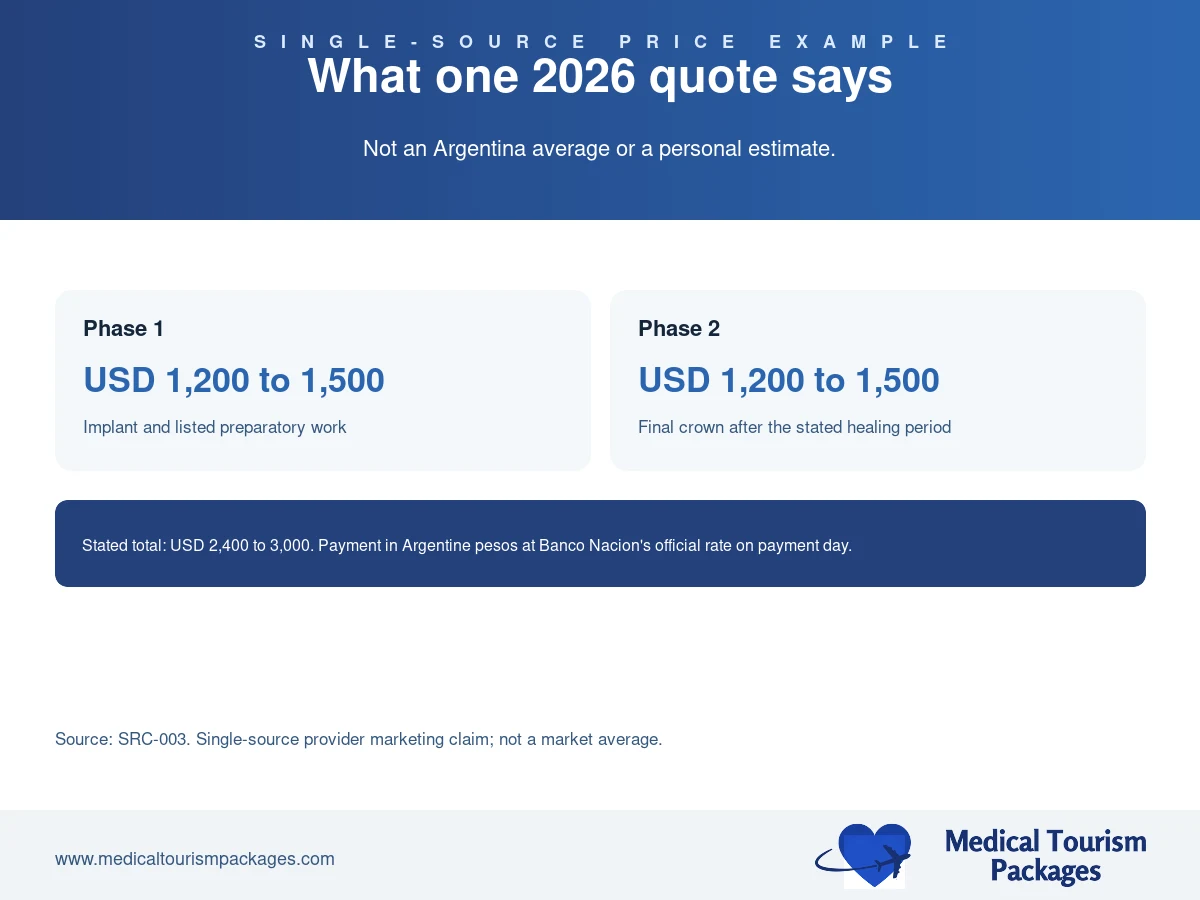
One Buenos Aires provider published a 2026 price of USD 2,400 to 3,000 for one completed implant and crown. The quote divides treatment into two phases of USD 1,200 to 1,500 each. It says payment is made in Argentine pesos using Banco Nacion’s official exchange rate on the payment day.
That figure is a single provider’s marketing claim. It is not a verified Argentina average, a package price, or a personal estimate. The actual total can change with imaging, extractions, grafting, materials, anesthesia, temporary teeth, and follow-up.
Ask for a dated, itemized quote in USD and Argentine pesos. It should name the exchange-rate source and the date or rule used for conversion. Ask what happens if the treatment plan changes after scans or surgery.
What should a dental implant quote include?
A dental implant system may include the implant body, an abutment, a screw, and the final crown, bridge, or denture. A low headline price may cover only part of that system.
Request written answers for:
- examinations and three-dimensional imaging;
- the implant, abutment, screw, and final restoration;
- extraction, grafting, sedation, temporary teeth, and laboratory work;
- the implant brand, model, lot details, and replacement-component availability;
- the number of expected visits and the trigger for each phase;
- medicines, emergency care, and routine follow-up;
- remake, complication, cancellation, and refund terms;
- taxes, payment fees, and the currency-conversion rule.
Keep the quote and consent documents. Do not rely on a price shared only in a message or call.
Which implant treatment are you comparing?
“Dental implant” can describe different scopes. One missing tooth, several implants supporting a bridge, and a full-arch restoration are not comparable purchases.
Placement and loading may be immediate, early, or conventional. The appropriate sequence depends on patient and site factors. It is not possible to infer your schedule from a destination page.
Ask the dentist to identify the proposed restoration and each treatment phase. A complete plan should also explain alternatives, including doing nothing or using a non-implant option when appropriate.
Are dental implants in Argentina safe?
No country label makes implant treatment safe. Risk depends on the patient, clinician, facility, device, procedure, and continuity of care.
The U.S. Food and Drug Administration lists infection, injury to nearby structures, sinus problems, loosening, and implant failure among possible complications. It also identifies general health, smoking, and oral hygiene as relevant considerations.
International evidence helps explain long-term risk, but it does not measure Argentina specifically. A 2025 meta-analysis pooled 102 studies and 13,030 patients. It estimated peri-implant mucositis prevalence at 46% and peri-implantitis prevalence at 21%. These are inflammatory-disease prevalence estimates, not implant-failure rates.
A 2024 meta-analysis of 32 observational studies associated smoking with higher early implant failure. Its implant-level odds ratio was 2.59. An association does not prove that smoking caused every failure.
This review found no authoritative public source reporting Argentina-specific rates of success, infection, revision, or failure. If a provider discusses outcomes, ask how each outcome is defined and how many documented cases its figures cover.
How can you verify a dentist, facility, and implant system?
Use independent public records before accepting a clinic’s claims.
- Search the dentist in Argentina’s Federal Network of Health Professionals Registries, or REFEPS. Confirm the name, profession, registration, and reporting jurisdiction.
- Ask which authority recognizes any claimed specialty. Certification and recertification routes depend on the license, training, examination, and jurisdiction.
- Check the exact treatment site in the Federal Registry of Health Establishments, or REFES. Confirm that the address and facility type match the quote.
- Ask for the implant manufacturer, model, and registration evidence. ANMAT treats unregistered medical products as illegitimate and provides product-control routes. This does not mean every implant can be traced publicly by unit.
- Obtain the consent form, records policy, emergency contact, and follow-up arrangement before paying.
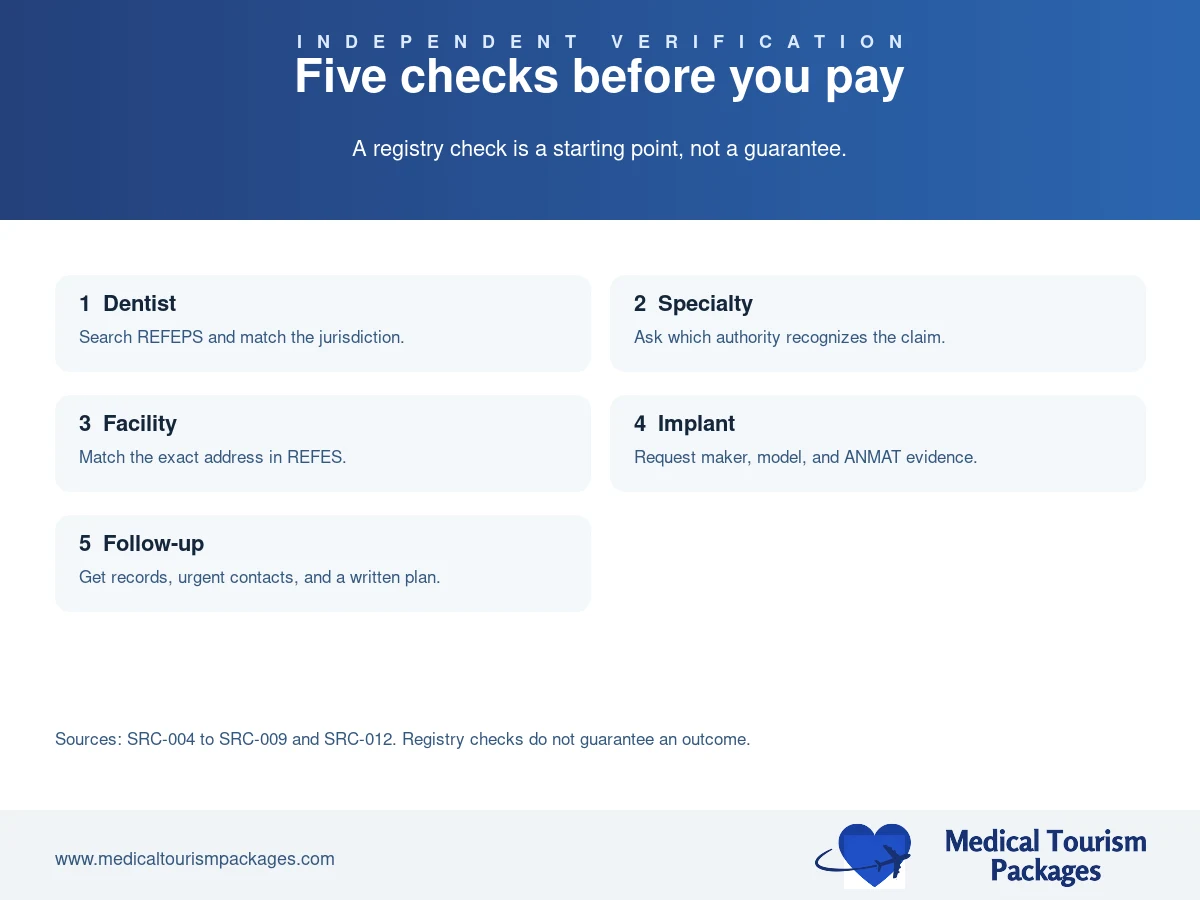
Registry presence is a basic check, not a guarantee of results. Save screenshots or dated records because registrations and facility details can change.
Who may be a candidate for dental implants?
Only a qualified dentist with appropriate imaging and health history can assess candidacy. Important considerations include bone and gum conditions, oral hygiene, smoking, diabetes, medicines, and the ability to complete follow-up.
Ask how your health affects healing and whether another treatment is safer. Seek a second opinion when the proposal is extensive, irreversible, or materially different from advice you received at home.
How should you plan treatment and follow-up?
Traveling for dental care means managing routine clinical risks from a distance. The U.S. Centers for Disease Control and Prevention advises medical travelers to clarify what is included, arrange follow-up, and obtain complete records before returning home.
Before departure, request:
- the treatment report and imaging in a usable digital format;
- implant brand, model, size, and available lot information;
- medicine names, doses, and allergy notes;
- a named contact for urgent questions;
- written signs that require urgent assessment;
- a plan for routine care and complications after you return;
- confirmation of who pays for extra travel or corrective work.
Do not assume a local dentist will accept another clinic’s warranty or can source every component.
How long should you stay before flying home?
No authoritative dental-specific minimum flight interval was found in this research. Your dentist should decide based on the procedure, healing, complications, sedation, and planned review.
Do not book a non-changeable return flight around a generic online timeline. Ask what examination must happen before clearance and what would delay travel.
What entry and health-insurance documents should you check?
Current Argentine consular guidance says ordinary U.S. and Canadian passport holders can visit without a tourist visa for up to 90 days. Argentina also describes an extension process for a similar period while tourist status remains valid. Verify the rules again before travel.
The cited visa exemptions cover tourism and do not by themselves establish the correct category for planned dental care. Confirm the applicable category with an Argentine consulate. Argentine law provides for a declaration about travel purpose and health insurance, but the official records checked on September 14, 2026 did not show that requirement in force. This guide therefore does not treat it as a current entry requirement. Check current requirements before travel.
Ask whether a travel or medical-travel policy covers planned treatment and related complications. Read the policy wording and obtain written confirmation.
For broader destination planning, read our Argentina medical tourism guide.
Will insurance, an HSA, or an FSA pay?
Coverage depends on the plan and expense. IRS Publication 502 includes artificial teeth and treatment of dental disease among medical expenses. It also limits which travel costs qualify.
HSA distributions may be tax-free when used for qualified medical expenses. IRS Publication 969 says HSA holders must keep records sufficient to show that distributions were exclusively for qualified medical expenses, were not reimbursed from another source, and were not also taken as an itemized deduction. Confirm eligibility with the account administrator before paying. The same caution applies to an FSA or private dental plan.
Medicare usually does not cover care outside the United States, except in narrow situations.
These are general U.S. rules, not tax or benefits advice. Ask your insurer or administrator for a written decision about the exact treatment and provider.
Is Argentina the cheapest or best country for dental implants?
There is not enough comparable current evidence here to rank Argentina, Colombia, Mexico, or Panama by price or quality. “Cheapest” can also omit imaging, grafting, temporary work, travel, follow-up, and corrective care.
Compare the same clinical scope and the same evidence. Our country guides can help you organize questions for Colombia, Mexico, and Panama. Do not treat older prices on those pages as current quotations.
The better choice is the plan you can verify, understand, afford, and follow through. Start with our dental implant planning hub for the broader comparison process.
A practical decision checklist
Before sending a deposit, make sure you have:
- a diagnosis and treatment plan based on current imaging;
- independently checked dentist and facility records;
- the exact implant system and restoration scope;
- a dated, itemized quote with currency and conversion terms;
- a written schedule that allows for clinical changes;
- complete complication, follow-up, and records plans;
- current entry, insurance, and payment documents;
- a second opinion for extensive or unclear treatment.
MTP can help you organize provider questions and travel logistics. It does not replace clinical advice or independent verification. Ask MTP to help organize your next steps.
Frequently asked questions about dental implants in Argentina
These short answers preserve the limits of the verified evidence. A dentist must still assess your health and treatment plan.
How much is one dental implant in Argentina?
One Buenos Aires provider published USD 2,400 to 3,000 in 2026 for one completed implant and crown, split into two USD 1,200 to 1,500 phases. Payment was stated in Argentine pesos at Banco Nacion's official rate on payment day. This is one marketing claim, not a national average or personal quote.
Are dental implants in Argentina safe?
Safety cannot be inferred from the country. Check the dentist, facility, implant registration, health assessment, consent, and follow-up plan. Infection, nearby-structure injury, sinus problems, loosening, and failure are recognized risks. No authoritative Argentina-specific outcome rate was found.
How do I check an Argentine dentist's credentials?
Search REFEPS for the dentist's profession, registration, and jurisdiction. Ask which authority recognizes any claimed specialty. Then verify the exact treatment site in REFES. Registry presence is a basic check, not a promise of results.
How soon can I fly after a dental implant?
This research found no authoritative dental-specific minimum interval. The treating dentist should decide after considering the procedure, healing, complications, sedation, and planned review. Keep travel flexible until the required examination is complete.
Can insurance, an HSA, or an FSA pay for implants abroad?
It depends on the plan and expense. IRS guidance includes artificial teeth and treatment of dental disease as medical expenses, while travel costs have limits. Publication 969 requires HSA holders to keep records supporting qualified distributions. Ask the insurer or administrator for a written decision. Medicare usually excludes foreign care outside narrow exceptions.
Is Argentina the best or cheapest country for dental implants?
Current comparable evidence is insufficient to rank Argentina against Colombia, Mexico, or Panama. Compare the same treatment scope, device, credentials, travel, follow-up, and complication terms. The lowest headline price may omit important costs.
Sources and references
- SRC-001: U.S. FDA, Dental Implants: What You Should Know, accessed September 14, 2026.
- SRC-002: International Team for Implantology consensus on placement and loading protocols, accessed September 14, 2026.
- SRC-003: One Buenos Aires provider's public 2026 price list, accessed September 14, 2026. Single-source marketing claim; provider withheld under this article's neutrality policy.
- SRC-004 to SRC-009: Argentina REFEPS, specialist certification, recertification rules, REFES, ANMAT product controls, and SRC-009 ANMAT registration framework, accessed September 14, 2026.
- SRC-010: 2025 systematic review and meta-analysis of peri-implant diseases, accessed September 14, 2026.
- SRC-011: 2024 systematic review and meta-analysis of smoking and early implant failure, accessed September 14, 2026.
- SRC-012: CDC Yellow Book, Medical Tourism, accessed September 14, 2026.
- SRC-013 to SRC-016: Argentina consular entry guidance, Canadian-passport guidance, tourist extension guidance, and current migration law, accessed September 14, 2026.
- SRC-017 to SRC-019: IRS Publication 502, IRS Form 8889 instructions, and Medicare coverage abroad, accessed September 14, 2026.
- SRC-020: IRS Publication 969, Health Savings Accounts and Other Tax-Favored Health Plans, accessed September 14, 2026.