Book Appointment Now

Dental Tourism in Colombia: Costs, Safety, and Complete Guide
 By
By
Dental tourism means traveling to another country to receive dental care at lower costs. Colombia has become a leading destination for this practice, attracting over 20,000 patients annually from the United States, Canada, and Europe. Dental services account for 23.5% of the country’s total medical tourism industry, which has experienced a 22.9% growth rate.
The country offers dental procedures at 50-80% less than U.S. prices. A full set of dental implants that costs $40,000 in the United States might run $12,000-$15,000 in Colombia. Root canals, crowns, veneers, and cosmetic dentistry follow similar savings patterns.
Colombia has invested heavily in modern dental infrastructure. Major cities like Bogotá, Medellín, and Cartagena host clinics with advanced technology and internationally trained dentists. Many Colombian dentists completed their education in the United States or Europe and hold memberships in international dental organizations. The Colombian government actively promotes medical tourism through ProColombia, providing quality certifications and supporting clinic accreditations.
This guide breaks down everything you need to know. You’ll learn exact cost comparisons, how to verify a clinic’s credentials, what cities offer the best care, and how to plan your trip.
Why is Colombia Popular for Dental Tourism?
Colombia’s dental tourism success stems from a combination of rigorous professional standards, modern infrastructure, and government support that creates a compelling value proposition for international patients.
- Mandatory dental education requirements: Colombian dentists must complete rigorous five-year university programs accredited by the Ministry of National Education, followed by one year of mandatory government service. They undergo continuous licensing requirements and many pursue additional certifications from U.S. or European institutions.
- Premium global materials: Clinics use the same dental materials found in North American and European practices. Implants come from brands like Straumann and Nobel Biocare. Crowns and veneers use materials from manufacturers like Ivoclar Vivadent.
- Tourism growth exceeding traditional exports: Medical tourism now generates more revenue than several of Colombia’s traditional export sectors. The industry has outpaced coffee and flower exports in growth rate, showing the country’s commitment to healthcare services.
- Government-backed programs: The Colombian government actively promotes medical tourism through ProColombia, the official trade promotion agency. They provide quality certifications, support clinic accreditations, and market the country’s healthcare services internationally.
How Much Can You Save with Dental Tourism in Colombia?
Patients typically save 50-80% on dental procedures in Colombia compared to prices in the United States or Canada. Dental tourists spent approximately $500 million in Colombia during 2022.
Colombia vs United States Costs
| Procedure | Colombia Price | US Price | Savings % |
| Single Implant | $800-$1,200 | $3,000-$5,000 | 70-75% |
| All-on-4 | $6,000-$9,000 | $25,000-$40,000 | 75-80% |
| Porcelain Veneer | $300-$600 | $1,000-$2,500 | 70-80% |
| Zirconia Crown | $400-$750 | $1,800-$3,000 | 75-80% |
| Root Canal | $190-$400 | $1,000-$2,000 | 75-85% |
| Teeth Whitening | $150-$300 | $400-$800 | 60-70% |
Colombia vs Canada Costs
| Procedure | Colombia Price | Canada Price | Savings % |
| Single Implant | $800-$1,200 | $2,500-$4,000 | 65-70% |
| All-on-4 | $6,000-$9,000 | $20,000-$35,000 | 70-75% |
| Porcelain Veneer | $300-$600 | $900-$2,000 | 65-75% |
| Zirconia Crown | $400-$750 | $1,600-$2,800 | 70-80% |
Colombia competes with several established dental tourism markets in the Americas. Mexico attracts higher patient volumes due to its proximity to the United States. Costa Rica markets its concentration of U.S.-trained dentists and English-speaking staff. Brazil operates the largest medical tourism market in Latin America at $3.1 billion annually. Panama leverages its dollarized economy and leading dentists in Panama, though its dental prices typically run 10-15% higher than Colombia’s rates.
Patients considering implant procedures may also want to compare dental implants in Panama and smile correction options in Panama alongside Colombian options.
What Dental Procedures are Available in Colombia?
Colombia’s dental implant market alone generates $110 million annually. Dental procedures represent the dominant financial component of the country’s medical tourism sector.
Most Common Treatments:
- Dental Implants: Single-tooth replacements and multiple implant procedures using titanium posts that fuse with the jawbone. Clinics offer brands like Nobel Biocare, Straumann, and Osstem with warranties ranging from 5 years to lifetime coverage.
- Porcelain Veneers: Thin ceramic shells bonded to the front of teeth to correct color, shape, and alignment issues. Patients typically receive dental veneers in Colombia for 6-10 teeth in a single treatment plan. Many clinics use Digital Smile Design software that creates 3D simulations before treatment begins.
- Full Mouth Restorations: Complete dental rehabilitation combining implants, crowns, bridges, and veneers to restore function and aesthetics. All-on-4 implant procedures in Cali start at $6,300 per arch.
- Zirconia Crowns: High-strength ceramic crowns that provide durability and natural appearance for damaged or decayed teeth. Zirconia offers better strength than traditional porcelain for back teeth.
- Root Canal Treatments: Endodontic procedures that remove infected pulp from inside the tooth and seal the canal. Colombian endodontists use rotary instruments and digital imaging for precision.
Colombian dental clinics report implant success rates between 95-97%, matching international standards. Healing rates reach 86.5% for patients who follow post-operative protocols. Minor complications occur in 26.64% of cases but remain manageable issues like temporary swelling or sensitivity that resolve within 30 days.
For implant cases requiring bone grafting, clinics employ qualified oral surgeons alongside the restorative dentist.
How Do You Plan a Dental Tourism Trip to Colombia?
The dental tourism process in Colombia follows a structured approach:
- Free online consultation with photos/X-rays: Submit current dental photographs and any existing X-rays through the clinic’s secure portal. Within 2-3 business days, you receive a detailed treatment proposal outlining procedures needed, materials used, timeline, and itemized costs.
- Travel arrangements: Clinics coordinate airport pickup, ground transportation, and appointment scheduling. Many provide translators who accompany you to all dental visits.
- Accommodation: Established clinics maintain relationships with nearby hotels offering discounted rates for dental patients in secure neighborhoods. Vacation rentals through platforms like Airbnb provide another option for longer stays.
- Transportation: Most clinics include complimentary transportation for international patients, covering airport pickup, transfers to appointments, and return to the airport after treatment.
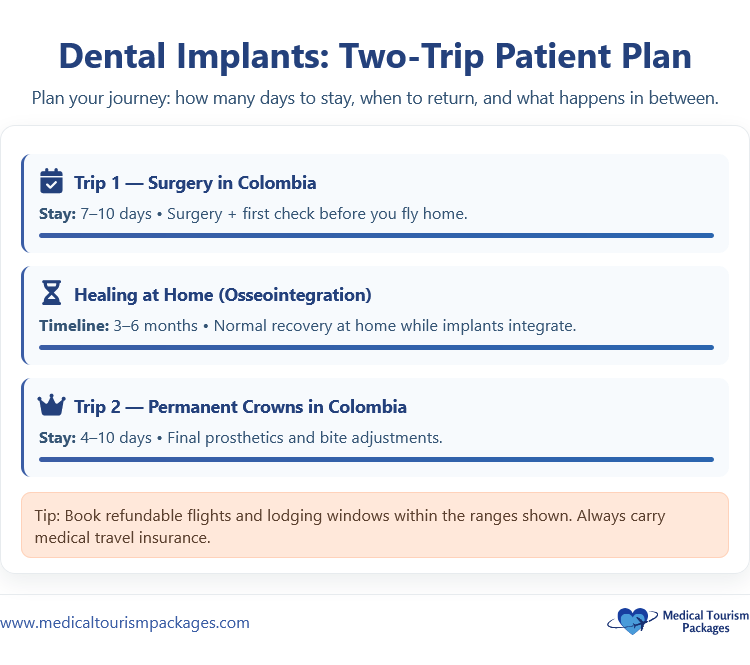
Treatment timelines: Veneers and crowns require 4-7 days in Colombia. Dental implants follow a two-phase model. Phase I (surgery and initial healing) takes 7-10 days, then you return home for 3-6 months of osseointegration before Phase II (crown placement) requiring another 4-10 day visit. Similar timelines apply for veneer procedures available in Panama.
How Safe Is Dental Care in Colombia and What Qualifications Do Dentists Have?
All dental clinics must obtain mandatory Habilitación certification under Resolution 3100 from Colombia’s Ministry of Health. This certification verifies compliance with seven core standards: staff qualifications and licensing, infrastructure meeting health facility requirements, properly maintained equipment, approved medications and medical devices, documented clinical processes and protocols, complete patient records management, and vetted third-party service providers. For a broader look at the country’s safety record for medical tourism in Colombia, see our dedicated guide.
The National Institute for Food and Drug Surveillance (INVIMA) functions as Colombia’s equivalent to the FDA, approving all dental materials and devices before clinical use. Certified clinics must maintain modern technology including digital radiography, CAD/CAM systems, and intraoral scanners.
Colombian dentists complete a rigorous five-year dental program at accredited universities, followed by one year of mandatory social service in underserved communities. All dentists must obtain and maintain a professional license card (tarjeta profesional) issued by the Ministry of Education. Many dentists at tourism-focused clinics pursue additional certification from the American Dental Association or complete advanced training programs in the United States or Europe. Dentists at high-volume tourism clinics typically speak conversational to fluent English, especially in major cities. Browse our directory of top-rated dentists in Colombia to review credentials and specialties.
Risks to consider: Minor complications occur in 26.64% of cases, including temporary swelling, sensitivity, or bruising. Colombia’s public health system provides emergency care to all individuals, but routine dental follow-ups are not covered for international patients. Most domestic health insurance plans do not cover procedures performed abroad, making international medical travel insurance essential. Colombian law allows patients 10 years to file malpractice claims, but pursuing legal action from another country involves complex jurisdictional issues.
How Do You Choose a Dental Clinic in Colombia?
Selecting the right dental clinic requires verifying credentials, technology standards, and insurance coverage to ensure both quality care and financial protection.
- Voluntary international credentials: Look for Global Healthcare Accreditation, ISO certifications, or memberships in international dental organizations beyond mandatory Colombian requirements.
- Professional liability insurance: Verify the clinic carries malpractice insurance that covers international patients. Request documentation of coverage limits and policy details.
- Premium implant brands: Clinics using Straumann, Nobel Biocare, or Zimmer Biomet implants provide products with extensive clinical research and global warranty support.
- Advanced technology: Quality clinics invest in digital radiography, cone beam CT scanners, CAD/CAM milling systems, and intraoral scanners.
- Habilitación certification: Confirm the clinic holds current certification from Colombia’s Ministry of Health and verify it through official government databases.
- INVIMA approval: Check that all dental materials, implants, and devices used by the clinic have INVIMA registration.
- JCI accreditation: Approximately 9 Colombian healthcare institutions hold Joint Commission International accreditation, the gold standard for international healthcare quality.
- ADA certification: Some Colombian dentists hold American Dental Association credentials or completed training programs at U.S. dental schools.
- JCI-accredited hospital affiliations: Clinics affiliated with JCI-accredited hospitals can provide surgical backup and emergency care if complications arise.
Which Colombian Cities Are Best for Dental Tourism?
| Factor | Bogotá | Medellín | Cartagena | Cali |
| Airport | El Dorado (BOG) – primary hub with most international flights | José María Córdova (MDE) – direct US connections | Rafael Núñez (CTG) – direct US flights plus cruise port | Alfonso Bonilla Aragón (CLO) – major hub connections |
| Climate | Cool year-round (50-68°F) at 8,660 ft elevation | Pleasant spring-like climate year-round | Tropical Caribbean coastal environment | Warm tropical climate with vibrant salsa culture |
| Specialty Focus | Complex surgical specialties, full arch reconstructions, multi-specialty cases | Aesthetic dentistry, Digital Smile Design, cosmetic procedures | High-end aesthetic specialties for upscale clientele | Value leader for restorative work, All-on-4, root canals |
| Cost Level | Moderate-highest (10-20% above other cities but 60-75% below US) | Moderate (50-70% below US/Canadian prices) | Moderate-high (premium pricing but below US/Canadian) | Lowest cost level (up to 88% savings on some procedures) |
| Key Advantages | Largest multi-specialty clinics, most experienced specialists, best international connectivity | Medical capital reputation, cutting-edge innovation, 3D printing technology | Caribbean coastal recovery, beach access, colonial charm | Most affordable, excellent for full-mouth restoration |
| Recommended Neighborhoods | Zona Rosa, Chapinero | El Poblado | Walled City (Centro Histórico), Bocagrande | Granada, San Antonio |
What Are the Travel Requirements for Dental Tourism in Colombia?
US and Canadian citizens do not need a visa for dental tourism stays in Colombia. They receive automatic entry for up to 90 days with a valid passport and proof of return travel. EU citizens also receive 90-day visa-free entry upon arrival. This timeframe provides sufficient duration to complete both phases of implant treatment.
Direct flights connect major North American cities to Bogotá, Medellín, Cartagena, and Cali from hubs like Miami, Fort Lauderdale, New York, Houston, and Toronto. Airlines operating these routes include Avianca, American Airlines, Delta, United, and JetBlue, with flight times ranging from 3.5 to 6 hours. Round-trip fares typically range from $300 to $600 for economy class when booked in advance.
How can you pay?
Colombian dental clinics typically accept cash in Colombian pesos, along with major credit and debit cards like Visa and Mastercard. Larger clinics catering to international patients can process international cards and sometimes facilitate bank transfers for high-value treatments.
Most clinics operate on an out-of-pocket payment model since international insurance rarely covers elective dental tourism. US and Canadian dental insurance plans rarely cover elective procedures performed internationally, as most policies restrict benefits to domestic providers within their networks. Some specialized international health insurance plans may offer partial reimbursement for major work performed abroad, but these remain uncommon. The vast majority of dental tourists pay cash out-of-pocket for Colombian procedures. Even without insurance coverage, the significant cost savings typically make treatment cost-effective compared to paying US prices with insurance.
Some patients use third-party medical financing companies or credit options available in their home countries to fund treatments and pay the clinic directly upfront. The Canadian government recommends purchasing international health insurance and travel insurance that covers medical complications, though routine dental procedures usually fall outside these policies.
What are the Advantages of Dental Tourism in Colombia?
Colombia allows patients to combine necessary dental work with meaningful cultural tourism experiences, from smile correction treatments in Colombia to full-mouth restorations. Colombia’s dental tourism infrastructure supports international patients with bilingual staff, modern facilities, and post-treatment follow-up. Medellín and Bogotá are the primary dental tourism cities, with Cartagena offering additional options.
Quality-related benefits include:
- Rigorous clinical training: Colombian dentists complete mandatory university programs and residencies equivalent to North American standards
- Premium materials: Clinics use the same implant brands, ceramics, and dental materials available in US and Canadian practices
- High success rates: Colombian dental implants achieve 95-97% success rates matching international benchmarks
- Labor-based savings: Cost differences stem from lower operating expenses and wages, not compromised quality or inferior techniques
What are the Disadvantages of Dental Tourism in Colombia?
Key challenges include:
- Two-phase implant returns: Full dental implant treatment requires a second trip 3-6 months after initial placement for final restoration attachment
- Extended stay complications: Studies show a 26.64% complication rate among dental tourists that may require unplanned extended stays for corrections or revisions
- Limited legal recourse: International patients face complex cross-border legal processes if malpractice disputes arise, with Colombian and home-country jurisdictions creating challenging navigation
Post-return complications present the most significant logistical challenge for dental tourists. US and Canadian emergency dentists typically provide only stabilizing care for failed foreign dental work, leaving patients financially responsible for corrections. Liability insurance rarely covers complications from procedures performed abroad, creating gaps in financial protection. International travel insurance with medical coverage becomes essential, though most policies exclude routine dental work and only cover emergency complications.
What Aftercare Do Colombian Dental Clinics Provide?
Most Colombian dental tourism clinics offer free online consultations for post-treatment follow-up after patients return home. This remote support allows dentists to assess healing progress through photos and video calls, addressing concerns without requiring additional travel. The first critical follow-up appointment typically occurs during the initial 7-10 day stay before patients depart Colombia.
Warranty policies vary by clinic and procedure type, with many practices offering 1-5 year guarantees on implants and restorative work. These warranties generally require patients to return to Colombia for corrections, though some clinics coordinate with partner dentists in North America for assessment of warranty-covered issues.
Patients who undergo implant placement must return to Colombia for Phase II treatment once osseointegration completes after 3-6 months. Clinics maintain remote consultation availability between visits to monitor healing and address minor concerns through digital communication. Professional liability insurance carried by reputable Colombian clinics provides some protection if complications arise from practitioner error, though enforcement across international borders remains challenging.
How Does Dental Tourism in Colombia Compare to Other Destinations?
| Factor | Mexico | Costa Rica | Colombia |
| Annual Volume | 1.2-3 million dental tourists | Established market with steady volume | Targeted growth market with lower current volume |
| Competitive Advantage | Proximity to US border and massive scale | US/European-trained dentists, eco-tourism | Advanced quality standards and complex procedure specialization |
| Savings Level | Very high (60-85% below US prices) | Moderate (40-70% below US prices) | Substantial (50-80% below US prices) |
| Dentist Training | Variable across regions | Many US or European-trained practitioners | Mandatory clinical service requirements and domestic university programs |
| Quality Control | Variable across border regions and resort areas | Mature medical tourism infrastructure | Mandatory university training and standardized certification |
| Specialty Focus | High-volume general dentistry and basic procedures | Dental care combined with eco-tourism recovery | Complex aesthetic work and full-mouth restorative cases |
| Reputation | Established volume leader | Long-established dental tourism excellence | Emerging quality leader with growing international recognition |
| Government Support | Limited coordination | Mature infrastructure and established policies | Active growth programs and developing tourism frameworks |
Is Dental Tourism in Colombia Right for You?
Determining whether Colombian dental tourism fits your needs requires honest assessment of your clinical requirements, financial situation, time availability, and comfort level with international medical travel.
Ideal candidates for Colombian dental tourism:
- Cost-conscious patients: Those seeking substantial savings of 50-80% on major dental procedures compared to North American pricing
- Complex restorative cases: Patients requiring full-mouth rehabilitation, multiple implants, or extensive reconstructive work
- Aesthetic dentistry seekers: Individuals interested in smile makeovers, veneer treatments, or advanced cosmetic procedures
- Deferred care patients: People who have postponed necessary dental treatment due to prohibitive costs in their home country
- Time-flexible travelers: Those able to commit 7-10 days for initial treatment and potential follow-up visits
Essential considerations before booking:
- International insurance: Secure comprehensive travel and medical insurance that covers emergency dental complications abroad
- Liability verification: Confirm the clinic carries professional liability insurance and understand coverage limitations
- Treatment timeline: Accept the two-phase requirement for implants, necessitating a second trip after 3-6 months
- Complication awareness: Recognize the 26.64% complication rate that may require extended stays or additional procedures
- Financial preparedness: Understand you bear financial responsibility for treating complications after returning home
- Consultation first: Always schedule free initial consultations with multiple clinics to compare treatment plans and verify credentials before committing. You can request a free consultation through our team.
Frequently Asked Questions
What is dental tourism in Colombia and why is it popular?
Dental tourism is traveling abroad for dental care at lower costs. Colombia attracts 20,000+ patients a year, with dental services making up 23.5% of its medical tourism sector (growing 22.9%). The draw: 50–80% savings vs. U.S./Canada, modern clinics in cities like Bogotá, Medellín, Cartagena, and strong government support via ProColombia for quality and accreditation.
How much can I save on dental procedures in Colombia?
Typical savings are 50–80% versus U.S./Canada. Examples: single implant $800–$1,200 (vs. $3,000–$5,000 US); All-on-4 $6,000–$9,000 (vs. $25,000–$40,000); veneers $300–$600 (vs. $1,000–$2,500); zirconia crowns $400–$750 (vs. $1,800–$3,000); root canals $190–$400 (vs. $1,000–$2,000); whitening $150–$300 (vs. $400–$800). A full-mouth implant case that’s ~$40,000 in the U.S. can be ~$12,000–$15,000 in Colombia.
What dental procedures are commonly offered?
Popular treatments include dental implants (brands like Straumann, Nobel Biocare, Osstem), porcelain veneers (often 6–10 teeth with Digital Smile Design), full-mouth restorations (including All-on-4 from about $6,300 per arch in Cali), zirconia crowns, and root canals using rotary instruments and digital imaging. Colombia’s implant market alone is ~$110M annually.
Is dental care in Colombia safe, and what are the risks?
Yes. Certified clinics meet Habilitacion standards (Resolution 3100) covering staff licensing, facilities, equipment, protocols, records, and validated suppliers. Materials/devices are INVIMA-approved, and many dentists have U.S./European training. Reported implant success is 95–97%, with minor, manageable complications in 26.64% of cases (e.g., swelling/sensitivity within ~30 days). Risks include the need for follow-up trips, potential extended stays, limited legal recourse across borders, and typically no domestic insurance coverage for corrections back home.
How do I choose a reputable dental clinic in Colombia?
Verify Habilitación status, confirm INVIMA-registered materials, and look for voluntary credentials (Global Healthcare Accreditation, ISO, memberships). Ask for malpractice insurance proof, check use of premium implant brands (Straumann, Nobel Biocare, Zimmer Biomet), and ensure advanced tech (CBCT, CAD/CAM, intraoral scanners). JCI-accredited hospital affiliations and ADA-linked training add extra assurance.
What does the treatment timeline look like for visitors?
Most clinics start with a free online consult (photos/X-rays) and send a plan in 2–3 business days. Veneers/crowns take ~4–7 days in-country. Implants run in two phases: Phase I surgery and initial healing (7–10 days in Colombia), then 3–6 months for osseointegration at home, and Phase II crown/bridge placement (another 4–10 days in Colombia). Many clinics include airport pickup, appointment transfers, and hotel partnerships.
Which Colombian cities are best for dental tourism, and how do they differ?
Bogotá: Largest multi-specialty centers and complex cases; costs ~10–20% above other cities but still 60–75% below U.S. Medellín: Cosmetic focus, Digital Smile Design, innovative tech. Cartagena: Premium aesthetic care with Caribbean recovery. Cali: Value leader for All-on-4/restorative work (up to ~88% savings). Popular neighborhoods: Zona Rosa/Chapinero (Bogotá), El Poblado (Medellín), Centro Histórico/Bocagrande (Cartagena), Granada/San Antonio (Cali).
What are the entry and flight logistics for U.S., Canadian, and EU patients?
U.S., Canadian, and EU citizens typically receive visa-free entry for up to 90 days with a valid passport and return ticket, enough time even for two implant phases. Direct flights link major hubs (Miami, Fort Lauderdale, New York, Houston, Toronto) to Bogotá, Medellín, Cartagena, and Cali via Avianca, American, Delta, United, and JetBlue. Typical round-trip economy fares: ~$300–$600; flight times ~3.5–6 hours.
How do payments and insurance work for dental treatment in Colombia?
Clinics accept cash (USD/COP), major cards (Visa/Mastercard), and sometimes bank transfers for larger cases. Most care is out-of-pocket because U.S./Canadian plans rarely reimburse procedures done abroad. Some patients use third-party medical financing from their home country. Travel/medical insurance is recommended for emergencies, but routine dental work is usually excluded.
What aftercare and warranties do Colombian clinics provide?
Clinics typically include a critical in-person follow-up during your initial 7–10 day stay, plus remote check-ins (photos/video) after you return home. Warranties often span 1–5 years depending on procedure and materials; most require returning to Colombia for corrections, though some coordinate with partner dentists for assessments. Implant patients must return for Phase II after 3–6 months of healing.
How does Colombia compare with Mexico and Costa Rica for dental tourism?
Mexico leads in volume (1.2–3M dental tourists) with strong border convenience and very high savings. Costa Rica emphasizes U.S./European-trained dentists and eco-tourism with mature infrastructure. Colombia delivers substantial savings (50–80%), rigorous standardized training, strong government support, and specialization in complex aesthetic and full-mouth restorative cases, an emerging quality leader with growing international recognition.