Book Appointment Now

Medical Tourism in Argentina: A Guide for American Medical Tourists
 By
By
Medical tourism in Argentina gives US patients three visa-free months and peso prices at a dated dollar rate.
A Córdoba clinic’s list of 4 August 2026 priced rhinoplasty at ARS 3,000,000. That is about USD 1,976 at the BCRA retail rate of ARS 1,517.89 dated 11 August 2026. Check doctors in REFEPS, facilities in REFES, and accreditation in the ITAES and JCI directories.
Medical Tourism Packages coordinates treatment in Buenos Aires and Córdoba. It checks each provider’s REFEPS license, REFES registration, and accreditation claim before it sends a quote.
What Is Medical Tourism in Argentina?
Medical tourism in Argentina means traveling there for planned care. The CDC groups that care worldwide into cosmetic surgery, dental care, fertility treatment, cancer care, and organ transplantation. A US patient gets a visa-free stay of up to three months. Prices are quoted in pesos. The provider check runs through two federal registers, REFES for facilities and REFEPS for professionals.
No national dataset in the sources for this guide counts inbound medical travelers or ranks what they buy. The CDC list above is a worldwide grouping from a page last reviewed in April 2025. Argentina’s foreign ministry announced a bilingual, validated directory of international-medicine services in 2026. That directory is an export-promotion effort and says nothing about patient numbers or outcomes.
Why Do Patients Travel to Argentina for Treatment?
Lower cost, procedures unavailable at home, shared language or culture, and privacy are the CDC’s four reasons for care abroad. No Argentina-specific survey of patient motivation exists in the sources for this guide, so this page claims none.
Which Procedures Do Medical Tourists Get in Argentina?
Rhinoplasty, breast augmentation, liposuction, bariatric surgery, IVF, and dental implants were advertised on the price pages sampled for this guide. Those pages are provider marketing and show availability only. Three durability facts matter before you compare prices.
- Breast implants are not lifetime devices. The FDA says the chance of complications rises the longer they stay in place, and some patients need further surgery. That FDA page is current as of January 2025.
- Botulinum toxin results last about three to four months, according to one professional society page.
- Dental implants are placed in stages, and integration can take up to several months.
See our dental implant packages in Latin America and bariatric surgery in Latin America for regional pricing.
Does Argentina Have Universal Healthcare?
No, for visitors. Argentina registers public and private facilities in one federal register, and its dispute-mediation decree names entities under the national health-insurance laws and the prepaid-medicine law. Whether care is universal for residents is a question the sources for this guide leave open. A visiting patient arrives uncovered. A foreigner without permanent residence must show valid health insurance covering the service, or prepay, before scheduled care. That rule applies at nationally run facilities. It comes from Resolution 1066/2026, published on 11 August 2026, the only source for it in this guide.
Is Health Care in Argentina Free for Visitors?
No, for scheduled care at nationally run facilities. Resolution 1066/2026 requires a foreign patient without permanent residence to present valid health insurance covering the service or to prepay. Emergency care is exempt. Evaluation, diagnosis, stabilization, and immediate treatment of a condition with certain and imminent risk to life carry no prepayment requirement. The resolution governs facilities administered by the national state only, so provincial, municipal, and private facilities fall outside it. It is a payment rule and says nothing about visas.
Is Medical Care Good in Argentina?
No national dataset in the sources for this guide reports outcomes for foreign patients treated in Argentina. That includes mortality, infection, readmission, and revision rates. Quality is therefore a check on the specific facility and clinician. Accreditation adds one signal, and the CDC states that it does not guarantee a good outcome. The verification section below explains how to run those checks.
What Should You Know About Hospitals in Argentina?
Hospitals in Argentina are authorized by their province and listed in the federal establishment register, REFES. REFES covers public and private facilities, with and without inpatient beds. No official ranking of them exists in the sources for this guide. This page therefore explains how to check a hospital and names none. Private facilities sit in REFES beside public ones, and the national prepayment rule for foreigners does not govern them. Each private provider sets its own payment terms, as the private-healthcare section below explains.
Are Hospitals in Argentina Accredited?
Yes, some are, through two routes a patient can check. The first is ITAES, the Argentine institute that accredits health establishments. Its live directory showed 56 accredited entries on 8 September 2026. Four of those entries carry addresses in Bolivia or Paraguay. The 56 is therefore a regional directory total, and this guide does not present it as an Argentina count.
The second route is Joint Commission International. Its finder lists accredited organizations, but the results load dynamically, so no Argentina count can be read from the page. No count of ISO-certified Argentine healthcare organizations was found either. Ask any facility that claims ISO certification for the standard, scope, certificate number, dates, and issuing body.
Which Cities Do Medical Tourists Use in Argentina?
Buenos Aires and Córdoba are the two cities with verified evidence in this guide. Buenos Aires has the international airport, Ezeiza. It also supplies the dental price snapshot below, and Córdoba supplies the five surgical snapshots. Mendoza and Rosario have no verified price table in the sources for this guide.
How Does the Healthcare System in Argentina Work for a Foreign Patient?
Argentina’s provinces license facilities and professionals and report them to the federal registers REFES and REFEPS. ANMAT regulates medicines and medical devices nationally. The patient-rights law, Ley 26.529, governs consent and records.
No single national list certifies a provider as suitable for an international patient. Four separate checks apply: facility registration, professional license, specialist recognition, and voluntary accreditation. The registers cover the first two, and none of the four is evidence of a clinical outcome.
What Is Private Healthcare in Argentina Like for Visitors?
Private healthcare in Argentina runs on provider-set terms for a visitor. One Córdoba clinic accepts debit cards, credit cards, bank checks, and obras sociales. One Buenos Aires dental group charges different cash and card prices. No national deposit percentage, cancellation window, refund rule, or financing term was found. Ask each provider for those terms in writing. The UK Foreign Office says medical facilities are good but can be expensive, and public hospitals tend to be crowded.
Who Regulates Medicines and Implants in Argentina?
ANMAT regulates medicines, medical products, and biomedical technologies within its national remit. It runs HELENA, the electronic register of medical products. It also runs ARGOS, the system for adverse-event reports and field-safety corrective actions. Ask for four things on any implant: the manufacturer, the model, the lot or serial number, and the ANMAT registration.
What Rights Do Patients Have in Argentina?
Informed consent, written consent for surgery, revocable consent, and a copy of your record are patient rights under Ley 26.529. Consent must cover your health status, the proposed procedure, expected benefits, risks, alternatives, and the consequences of declining. Written consent is required for hospitalization, surgery, and invasive or risky procedures. You can revoke consent, with exceptions for public-health emergencies and for emergencies with grave danger to you. A copy of your record must be provided within 48 hours of a request, sooner in an emergency. That figure comes from one official guidance page.
Age rules apply to aesthetic surgery. A person under 18 is a minor. People aged 13 to 16 can decide on non-invasive treatment that does not compromise their health. People aged 16 to 18 are treated as adults for care of their own bodies. Non-reparative aesthetic surgery that can compromise health requires being over 18 or parental authorization. Ley 27.553 permits teleassistance nationwide, subject to authorization and to the privacy and patient-rights laws.
How Much Does Medical Tourism Cost in Argentina?
USD 1,976 to 4,612 covers five surgeries on one Córdoba clinic’s list dated 4 August 2026. The list prices rhinoplasty at ARS 3,000,000, liposuction at ARS 4,450,000, and breast augmentation with implants at ARS 5,950,000. Gastric sleeve or bypass is ARS 6,450,000 and IVF is ARS 7,000,000. The dollar figures use the BCRA retail seller reference of ARS 1,517.89 per USD, dated 11 August 2026.
Three caveats apply. The prices are one provider’s advertised reference prices for Argentine residents, and nobody has negotiated them as quotes. They exclude taxes and move with the dollar quotation. The provider publishes no dollar conversion, so each USD figure is this guide’s own calculation.
The dental figure is separate. One Buenos Aires dental page prices an implant post at ARS 480,000 cash or ARS 600,000 by card. That is about USD 316 or USD 395. The page carries no date, so the price is treated as stale. The crown and the 3D scan are quoted separately, and follow-up during integration is included.
| Procedure and city | Advertised price (ARS, list date) | Indicative USD at ARS 1,517.89 (11 August 2026) | Scope note |
|---|---|---|---|
| Rhinoplasty, Córdoba | ARS 3,000,000, 4 August 2026 | USD 1,976.43 | Resident list, taxes excluded, subject to the dollar quotation |
| Breast augmentation with implants, Córdoba | ARS 5,950,000, 4 August 2026 | USD 3,919.92 | No itemized statement of anesthesia, operating room, tests, garments, medicines, or revision care |
| Liposuction, Córdoba | ARS 4,450,000, 4 August 2026 | USD 2,931.70 | Taxes excluded; no complete inclusion schedule |
| Gastric sleeve or bypass, Córdoba | ARS 6,450,000 each, 4 August 2026 | USD 4,249.32 | Sleeve and bypass listed separately at the same price; assessment and long-term follow-up unstated |
| IVF, Córdoba | ARS 7,000,000, 4 August 2026 | USD 4,611.66 | Medicines, laboratory techniques, cryostorage, and later transfers unstated |
| Dental implant post, Buenos Aires area | ARS 480,000 cash or ARS 600,000 card, undated | USD 316.23 cash or USD 395.29 card | Post only; crown and 3D scan quoted separately; follow-up during integration included |
Rate: BCRA retail seller reference, ARS 1,517.89 per USD, 11 August 2026. The surgical prices are one provider’s list for Argentine residents, dated 4 August 2026, and exclude taxes. The dental price is undated.
What Is Included in an Argentina Price?
The sampled surgical list includes no itemized statement of anesthesia, operating room, tests, garments, medicines, or revision care. The dental page quotes the crown and 3D scan separately and includes follow-up during integration. A list price therefore tells you little about the total. Ask for a written quote that states:
- the legal contracting entity
- the currency, the exchange source, and its timestamp
- the tax treatment
- deposit and refund triggers
- professional fees, anesthesia, and the operating room
- implants or medicines
- laboratory and imaging
- accommodation, transfers, and interpreters
- follow-up, complications, and who pays for a revision
No national deposit or cancellation norm was found, so those terms come from the contract alone.
Is Argentina the Cheapest Country for Medical Tourism?
No source in this guide’s evidence ranks Argentina as the cheapest country, and the verified figures support no percentage-saving claim. Inclusions, technique, tax, and currency method differ across markets, so the numbers are never like-for-like. A fair comparison needs written, current, like-for-like quotes. It also needs a contingency budget for extra accommodation, changed flights, complications, and care at home.
How Does Argentina Compare With the United States for Medical Tourism?
Argentina and the United States use different price bases in the evidence opened for this guide. Argentina’s sampled prices are quoted in pesos, and the Córdoba list ties its prices to the dollar quotation. Its entry rules provide for a sworn declaration of health insurance once the implementing rules are issued. Its provider check runs through REFEPS and REFES. No single country is best for medical tourism, and this guide gives no ranking. The table below sets one procedure, rhinoplasty, side by side across the two markets. Mexico’s entry rules, prices, and border logistics are in our guide to medical tourism in Mexico.
| Market | Published amount | Basis | Caveat |
|---|---|---|---|
| United States | USD 7,637 average | Surgeon fee only; anesthesia and facility excluded | No statistics year stated |
| Argentina (Córdoba) | ARS 3,000,000, about USD 1,976.43 at ARS 1,517.89 | Resident list dated 4 August 2026, taxes excluded | One provider; USD is this guide’s calculation at the 11 August 2026 rate |
This table is never like-for-like and carries no savings percentage. See medical tourism in Colombia and the Panama guide for American medical tourists for those markets.
How Should You Compare Argentina With Other Medical Tourism Destinations?
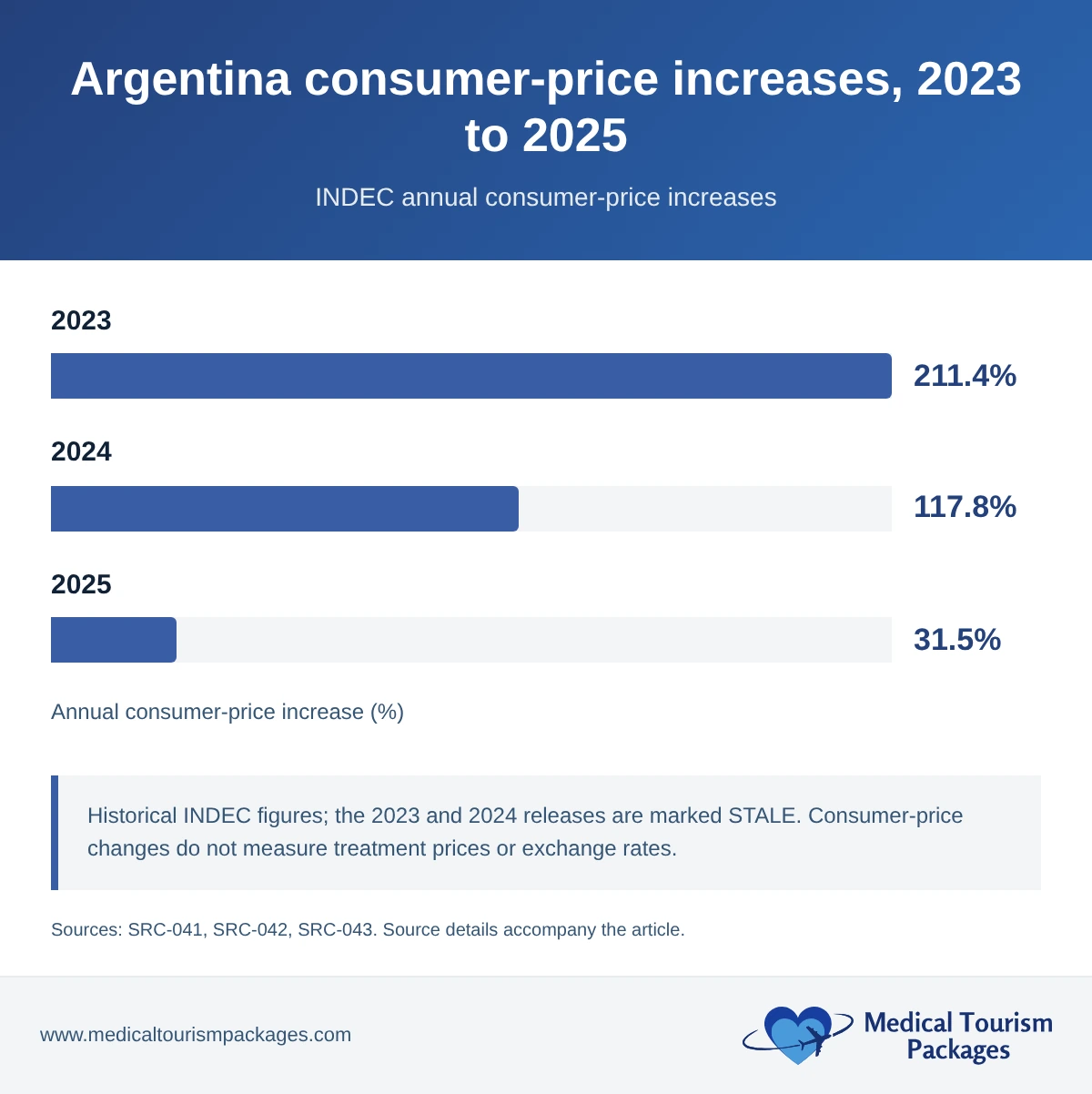
Compare destinations by procedure, written quote, price basis, and inclusions. A Córdoba resident list dated 4 August 2026 prices rhinoplasty at ARS 3,000,000. That is about USD 1,976 at the BCRA rate of 11 August 2026. The Argentina figure remains a resident list and provides no patient quote. Argentina’s peso prices also move with inflation, which ran 211.4% in 2023, 117.8% in 2024, and 31.5% in 2025. Mexico’s own rules and prices are in our Mexico medical tourism guide.
How Do You Verify a Hospital and Doctor in Argentina?
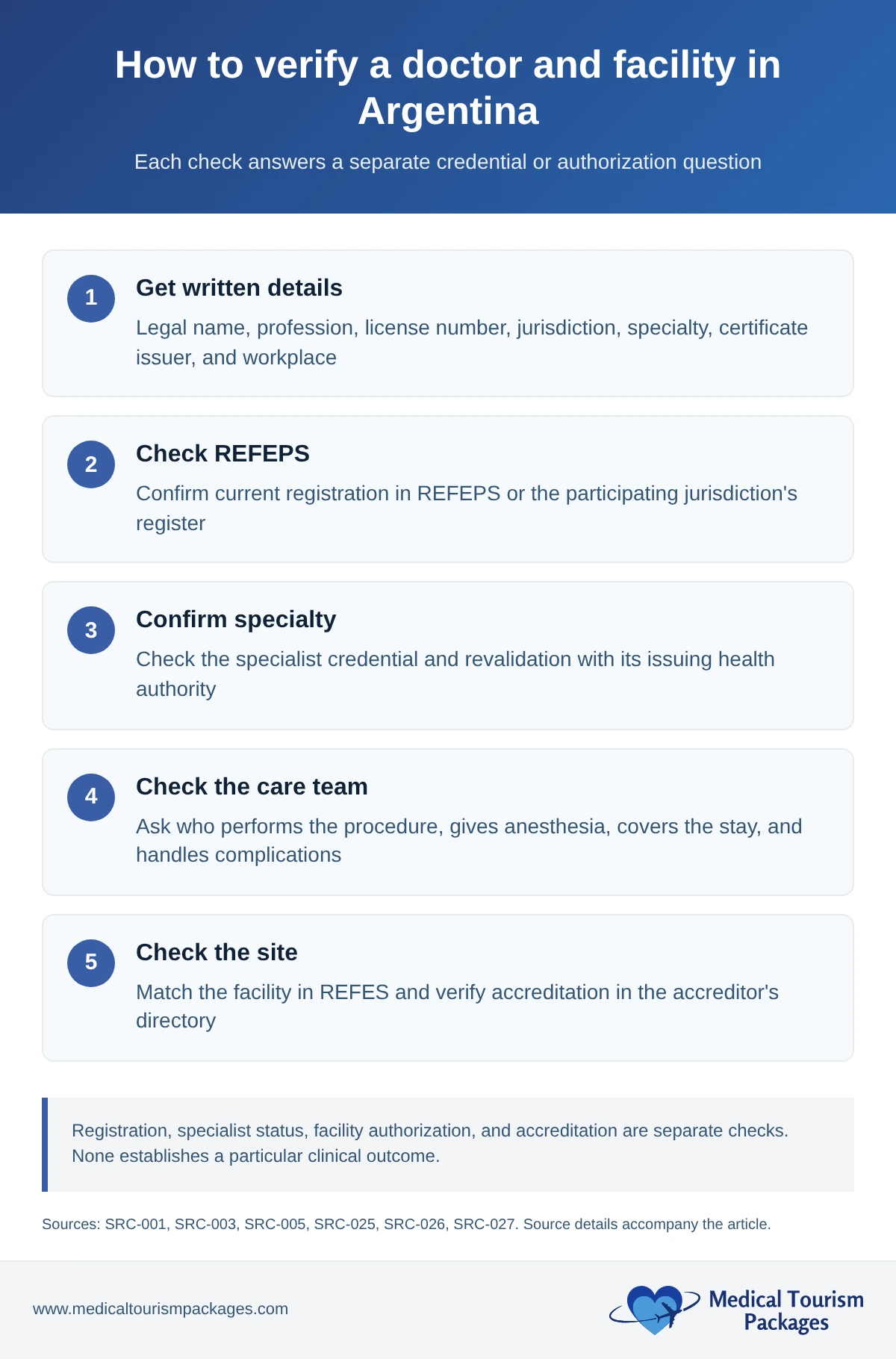
Verify a doctor in REFEPS, the federal register of health professionals. Verify a hospital in REFES, the federal register of health establishments. The REFEPS digital credential shows profession, license number, issuing jurisdiction, original registration date, and license status. It has the same validity as the physical credential under Resolution 3320/2024.
How Do You Check a Doctor’s License in REFEPS?
Obtain the doctor’s full legal name, profession, license number, and licensing jurisdiction in writing. Then check the current status in REFEPS or in the participating jurisdiction’s register. The digital credential depends on two things: the jurisdiction’s participation and an active registration reported to REFEPS. A social-media profile, a membership badge, or an overseas fellowship is no substitute for an active local license. Ask who will personally operate, give the anesthesia, cover the inpatient stay, and handle complications.
How Do You Confirm a Specialist Certificate?
Confirm it with the issuing health authority. The national specialist certificate authorizes a physician or dentist to advertise as a specialist in a recognized specialty. That authorization is limited to Buenos Aires City, national agencies, and jurisdictions that recognize it. Revalidation requires a current national license and a Ministry-recognized specialty. No source in this guide establishes that medical-society membership alone confers a legal specialist credential. “Board-certified” without the authority, specialty, jurisdiction, license status, and revalidation status is a red flag.
How Do You Check a Facility in REFES and Its Accreditation?
Search the exact legal facility name and address in REFES. Ask the facility which provincial authority issued its current authorization. Then match any ITAES or JCI claim by legal name, address, scope, and validity in the accreditor’s live directory. Verify the operating site itself, and do not stop at a consulting office or a brand name. Ask for written arrangements for emergency transfer, blood products, intensive care, infection management, and revision care. Accreditation alone leaves those questions open.
How Do You Check an Implant or Device With ANMAT?
Request the manufacturer, model, lot or serial number, and ANMAT registration evidence for any implant or device. Then check the product in HELENA, ANMAT’s electronic register of medical products. Check for any safety action in ARGOS, ANMAT’s system for adverse-event reports and field-safety corrective actions.
What Are the Warning Signs of an Unsafe Provider in Argentina?
A provider who will not identify the licensed treating clinician or the legal facility is a signal to stop. So is a guarantee or pressure for immediate payment. Other signs:
- No itemized contract: the provider refuses to itemize the quote.
- No device details: the provider will not give the manufacturer, model, lot, and ANMAT registration.
- No home review: the provider discourages a review by your own clinician.
- No written plan: the provider gives no written complication or revision plan.
- A rushed itinerary: the schedule ignores the no-fly guidance after surgery.
- Testimonials as evidence: success stories stand in for outcome figures with a denominator.
- A borrowed accreditation count: the provider quotes a directory total that includes other countries.
- “Board-certified” with no authority named: the provider cannot say who certified the specialty.
What Are the Entry Rules for US Patients?
Visa-free entry and a three-month stay are the entry rules for US patients. US ordinary-passport holders enter without a tourist visa and may stay up to three months. DNU 366/2025, published on 29 May 2025, adds a sworn declaration of the purpose of entry and of holding health insurance. It applies once its implementing rules are issued, so confirm the current rule before travel. Visa-free entry is no entitlement to admission, and it does not settle whether your treatment fits the declared purpose. Recheck passport validity, carrier rules, transit-country rules, and current migration instructions before you pay and before you fly.
Do You Need a Visa for Medical Treatment in Argentina?
No tourist visa is required for US ordinary passports. An Argentine consular page updated 25 February 2026 confirms no tourist or transit visa for up to 90 days. The reciprocity fee has been suspended since 24 March 2016.
Treatment beyond a tourist stay has its own category. The transitory medical-treatment residence allows up to one year, renewable. It requires regular entry and a clinical history naming the condition and the treatment. A private physician’s signature on that history must be certified before the Ministry of Health.
How Long Can You Stay in Argentina for Treatment?
Up to three months as a tourist, extendable once for a similar period if requested before the stay ends. An expired stay cannot be extended. The medical-treatment residence allows up to one year, renewable. Recovery, complications, and staged dental work can push a stay past the tourist window. Implant integration alone can take several months.
What Documents Should You Carry?
Your passport, proof of health coverage, the facility acceptance letter, and your itemized quote are the core documents. The full list:
- your passport and any transit documents
- written confirmation of the immigration category for the trip’s purpose and length
- proof of health coverage meeting the entry rule, with exclusions checked in writing
- the facility acceptance letter and a clinical summary
- prescriptions using generic names
- the itemized quote and payment evidence
- accommodation and return travel bookings, plus funds for a longer stay
- the documents and signature formalities Migraciones specifies, if you apply for treatment residence
- a calendar reminder to apply for any extension before your stay expires
Do You Need Health Insurance for Treatment in Argentina?
Yes, on two counts. DNU 366/2025 provides for a sworn declaration of holding health insurance at entry, once its implementing rules are issued. Resolution 1066/2026 requires valid insurance covering the service, or prepayment, before scheduled care at nationally run facilities. That rule applies to foreign patients without permanent residence. Private facilities set their own terms.
No universally available complication policy for medical tourism in Argentina was found. Get the full wording of any policy in writing before you rely on it. Check that it covers elective treatment abroad, pre-existing conditions, planned-procedure exclusions, complications, and revision surgery. Check also an extended stay, companion costs, evacuation, repatriation, claims jurisdiction, and direct payment. This guide answers the rule and recommends no policy.
Will Medicare or US Insurance Pay for Treatment in Argentina?
No, in most cases. Medicare usually does not cover health care outside the United States, with some exceptions. Travel insurance does not necessarily include health insurance. Whether a private US insurer pays is outside the evidence for this guide, so ask your insurer in writing. The UK Foreign Office says to check before travel that your insurance covers local treatment or unexpected medical evacuation.
Can You Use an HSA or FSA for Treatment in Argentina?
Yes, for qualified medical expenses. HSA distributions used for qualified medical expenses are tax-free, as long as the expense arose after the account was established. Health FSA distributions reimburse qualified expenses incurred during the period of coverage. Cosmetic surgery qualifies only when it corrects a congenital abnormality, an accident or trauma injury, or a disfiguring disease. Transport to another city qualifies only if the trip is primarily for and essential to medical care. Eligibility depends on the expense and on your plan, and this guide gives no tax advice.
How Does the Exchange Rate Affect What You Pay in Argentina?
The exchange rate moves the dollar cost of every peso quote. The sampled Argentine providers quote in pesos, and the Córdoba list ties its prices to the dollar quotation. The BCRA retail reference stood at ARS 1,517.89 per USD on 11 August 2026. The central bank calculates that reference from reporting entities in Buenos Aires City and does not set it. The BCRA page renders the value dynamically, and this guide confirmed the figure through the BCRA statistics API.
A quote should therefore state six things:
- the payment currency
- the exchange source and its timestamp
- who bears conversion and card fees
- whether the price changes with the dollar
- whether taxes are included
- what happens on delay or cancellation
Can You Pay in US Dollars in Argentina?
No national rule says whether a provider accepts US dollars. It is a contract term to confirm in writing. The sampled price pages quote in pesos. One accepts debit cards, credit cards, and bank checks. One charges ARS 480,000 in cash against ARS 600,000 by card for the same implant post, on an undated page. ATM withdrawals from foreign accounts carry low limits per withdrawal and per day. Non-Argentine cards can incur substantial service charges.
How Fast Do Prices Change in Argentina?
211.4% in 2023, 117.8% in 2024, and 31.5% in 2025 are INDEC’s accumulated consumer-price increases. The 2023 and 2024 reports are dated January 2024 and January 2025. The 2025 report is dated 13 January 2026. Those figures show the direction of change, and nothing about the exchange rate or medical-price inflation on your booking date. That is why an Argentina quote needs the six items listed above, plus an expiry date and a repricing clause.
How Does a Medical Trip to Argentina Work?
What Should You Do Before Booking?
See a travel-medicine specialist 4 to 6 weeks before departure, as the CDC recommends. Send your records through an agreed secure channel and confirm who has reviewed them. Ley 27.553 permits teleassistance platforms nationwide, subject to authorization and to the privacy and patient-rights laws. Then obtain these items in writing:
- the diagnosis and the procedure variant
- an itemized quote
- the medication plan
- the candidacy conditions
- the consent materials
- the expected stay and the no-fly date
- the follow-up schedule
- the emergency plan
- the cancellation terms
- who pays for a complication or a revision
Candidacy is set by a licensed clinician using your history, examination, and risks. No country-level rule makes a traveler a candidate. No standard cooling-off period or uniform body-mass or smoking threshold was found, so ask each provider for its own criteria. The ADA says health matters more than age for dental implants. It adds that diabetes, leukemia, and tobacco use can slow healing.
How Do You Get From the Airport to Your Clinic in Buenos Aires?
Most international flights land at Ezeiza, 32 km and about 50 minutes from the city center. Aeroparque handles domestic and some regional flights, about 25 minutes from the main hotels. Taxis, remises, transfers, and public transport are the stated options. Those are tourism-board estimates, and a medical transfer can take longer with traffic and mobility needs. Choose recovery lodging for step-free access, proximity to the treating facility, transport, and a written emergency route. The UK advisory reports seasonal flooding in the northern provinces and flash floods in Buenos Aires province. It reports fires throughout the country and names no months. English cannot be assumed in a medical setting. The UK Foreign Office keeps a list of providers where some staff speak English. Use an interpreter who is independent of the consent decision when your understanding is uncertain.
When Can You Fly Home After Surgery in Argentina?
Ten days after chest or abdominal surgery is the CDC’s minimum before flying. Facial cosmetic procedures need 7 to 10 days, per the CDC citing the American Society of Plastic Surgeons. Those are general minimums, they give no personalized clearance, and complications extend the stay. Dental implants can need staged visits, because integration may take several months. A cheap post is no evidence that the restoration fits in one trip.
What Records Should You Take Home?
The operative report, discharge summary, imaging and laboratory results, device labels, medication list, and invoices are the core records. Add pathology where applicable, complication instructions, and clinician contacts. Add a copy of your record, which official guidance says must be provided within 48 hours of a request. The CDC advises requesting records in English and arranging follow-up before you travel.
Is Medical Tourism in Argentina Safe?
No country-wide safety rate for foreign elective patients exists in the sources reviewed for this guide. Safety in Argentina therefore depends on the procedure, the licensed clinician, and the authorized facility. It also depends on infection control, anesthesia and emergency capability, aftercare, and travel timing.
The UK Foreign Office advises against travel to no part of Argentina and says to be particularly cautious in Rosario. US readers should also read the State Department’s Argentina travel advisory, which this guide does not quote.
What Are the Risks of Medical Tourism?
Infection is the most common complication among medical tourists, according to the CDC. The CDC also flags antimicrobial-resistant pathogens, bloodborne infections, and thrombosis linked to immobility and air travel. A 2023 systematic review of 44 studies covered 589 patients with complications after cosmetic procedures abroad. Infection was the most prevalent complication, followed by wound dehiscence, seroma or hematoma, and tissue necrosis. The review covers selected published cases with no denominator, and it says nothing specific about Argentina.
Ask the practitioner for their own figures before consent: numerator, denominator, case definition, follow-up completeness, and time horizon. Ask whether the figure covers all patients or only respondents, and who audited it.
Is Medical Tourism Legal?
Yes. Argentina has an official transitory residence category for medical treatment at a public or private facility. Its foreign ministry promotes a national directory of international-medicine services. US tax law treats legal non-cosmetic operations as medical expenses. No source states legality in those exact terms. The answer rests on those three facts and claims nothing beyond them.
What Recourse Do You Have If Something Goes Wrong?
Revocable consent, an optional federal mediation procedure, and the contract itself are the recourse routes in the sources. Consent under Ley 26.529 is revocable. The optional federal PROMESA mediation under Decree 379/2025 applies to disputes with entities under laws 23.660, 23.661, and 26.682. Those are the national health-insurance laws and the prepaid-medicine law. Participation requires legal representation, and the decree dates from June 2025. No official foreign-patient malpractice portal or guaranteed cross-border enforcement mechanism was found. The practical route depends on the contracting entity, the licensing jurisdiction, insurer involvement, the facility location, and the contract terms. An independent Argentine lawyer should assess a high-value contract or an actual dispute.
What Questions Do Medical Tourists Ask Most Often About Argentina?
These answers bring together the practical questions travelers ask about entry, costs, provider checks, insurance, and follow-up.
Do US citizens need a visa for medical treatment in Argentina?
No tourist visa is required for US ordinary passports. An Argentine consular page updated 25 February 2026 states up to 90 days for US citizens, with the reciprocity fee suspended. The tourist stay is up to three months, with one extension requested before it expires. A 2025 decree adds a sworn declaration of purpose and health insurance once its implementing rules are issued.
Is health care in Argentina free for tourists?
No, for scheduled care at nationally run facilities. A foreigner without permanent residence must show valid insurance covering the service or prepay. Evaluation, diagnosis, stabilization, and immediate treatment of a condition with imminent risk to life are exempt. Whether residents get free care is outside the evidence for this guide.
How do you verify a doctor and hospital in Argentina?
Check the doctor’s license status, number, and jurisdiction in REFEPS, the federal register of health professionals. Confirm the specialist certificate with the issuing health authority and ask about revalidation. Check the facility in REFES, the federal register of health establishments. Then match any ITAES or JCI claim by name and address in the accreditor’s live directory.
How much does treatment cost in Argentina?
One Córdoba list dated 4 August 2026 priced rhinoplasty at ARS 3,000,000 and IVF at ARS 7,000,000. That is about USD 1,976 and USD 4,612 at the BCRA rate of ARS 1,517.89 dated 11 August 2026. Both are one provider’s resident list prices and exclude taxes. An undated Buenos Aires dental page priced an implant post at ARS 480,000 cash.
Does Medicare or US insurance cover treatment in Argentina?
Medicare usually does not cover care outside the United States, with some exceptions. Travel insurance does not necessarily include health insurance. HSA and FSA distributions cover qualified medical expenses. Cosmetic surgery qualifies only when it corrects a congenital abnormality, an accident or trauma injury, or a disfiguring disease. Ask your private insurer in writing before you book.
When can you fly home after surgery in Argentina?
Ten days after chest or abdominal surgery is the CDC’s minimum before flying. Facial cosmetic procedures need 7 to 10 days, per the CDC citing the American Society of Plastic Surgeons. Those are general minimums, and complications extend the stay. Dental implants may need staged visits, because integration can take several months.
Ready to Plan Your Medical Trip to Argentina?
Ready to compare treatment options in Argentina? Medical Tourism Packages can request itemized quotes in pesos and dollars, with the exchange rate and date stated. We can confirm the clinician’s REFEPS license and the facility’s REFES registration. We can plan your stay around the no-fly window. Contact us with your procedure and travel dates. We will send you a written plan to review with your own doctor.
Sources and references
- Ministerio de Salud de la Nación, Registros Federales de Referencia de Establecimientos y Profesionales de la Salud
- Ministerio de Salud de la Nación, Resolución 1066/2026, texto
- ITAES, Acreditados
- Joint Commission International, Find Accredited International Organizations
- US Centers for Disease Control and Prevention, Medical Tourism, CDC Yellow Book 2026
- A Córdoba clinic’s published plastic-surgery price list for Argentine residents, dated 4 August 2026
- A Buenos Aires dental group’s published implant price page, undated, retrieved 8 September 2026
- US Food and Drug Administration, What to Know About Breast Implants
- American Society of Plastic Surgeons, Botulinum Toxin Results
- American Dental Association, MouthHealthy, Implants
- Dirección Nacional de Migraciones, Visas de ingreso (tabla por país)
- Dirección Nacional de Migraciones, Turistas
- Ente de Turismo de la Ciudad de Buenos Aires, ¿Cómo llegar a Buenos Aires?
- Banco Central de la República Argentina, Principales variables
- Banco Central de la República Argentina, Tipo de cambio minorista
- American Society of Plastic Surgeons, How much does rhinoplasty cost?
- ANMAT, ¿Qué es la ANMAT?
- ANMAT, Productos médicos
- Ministerio de Salud de la Nación, Matrícula Digital de Profesionales de la Salud
- Ministerio de Salud de la Nación, Certificado de especialista sin examen
- Ministerio de Salud de la Nación, Revalidación de Certificados de especialistas para Médicos y Odontólogos, Modalidad de Renovación Automática
- Annals of Plastic Surgery (2023), via PubMed, Complications of Medical Tourism in Aesthetic Surgery: A Systematic Review
- argentina.gob.ar normativa, Ley 26.529, Derechos del Paciente, texto
- argentina.gob.ar, Mi historia clínica
- argentina.gob.ar normativa, Decreto 379/2025, texto
- argentina.gob.ar, Capacidad de las personas menores de edad
- argentina.gob.ar normativa, Ley 27.553, Recetas electrónicas o digitales, texto actualizado
- Medicare.gov, Travel outside the U.S.
- US Internal Revenue Service, Publication 969 (2025), Health Savings Accounts and Other Tax-Favored Health Plans
- US Internal Revenue Service, Publication 502 (2025), Medical and Dental Expenses
- Consulado General de Argentina en Chicago, Países que no requieren visa para viajar a la Argentina por turismo
- Boletín Oficial de la República Argentina, Decreto 366/2025 (DNU)
- Dirección Nacional de Migraciones, Obtener una residencia transitoria por tratamiento médico
- Argentina TradeNet, Ministerio de Relaciones Exteriores, Health from Argentina: Servicios de Medicina Internacional
- INDEC, Índice de precios al consumidor, diciembre de 2023
- INDEC, Índice de precios al consumidor, diciembre de 2024
- INDEC, Índice de precios al consumidor, diciembre de 2025
- UK Foreign, Commonwealth and Development Office, Safety and security, Argentina travel advice
- UK Foreign, Commonwealth and Development Office, Health, Argentina travel advice