Book Appointment Now



Bariatric Surgery in Argentina: Costs, Safety, and Planning
 By
By
Bariatric surgery in Argentina can merit consideration, but reliable national price and outcomes data remain limited. The strongest current price evidence is only one resident list price.
That example was ARS 6,450,000 plus taxes in Córdoba on August 4, 2026. It equals about USD 4,249 at a later BCRA retail reference rate.
This figure is not a national range, package quote, or guaranteed foreign-patient price. Request a personalized written quote before comparing countries.
What does bariatric surgery cost in Argentina?
The available 2026 evidence supports one price example, not an Argentina market average.
The provider’s resident list covered several bariatric operations at the same listed price. It excluded taxes and warned that exchange rates could change the amount.
The conversion used ARS 1,517.89 per US dollar on August 11, 2026. That date came one week after the price publication.
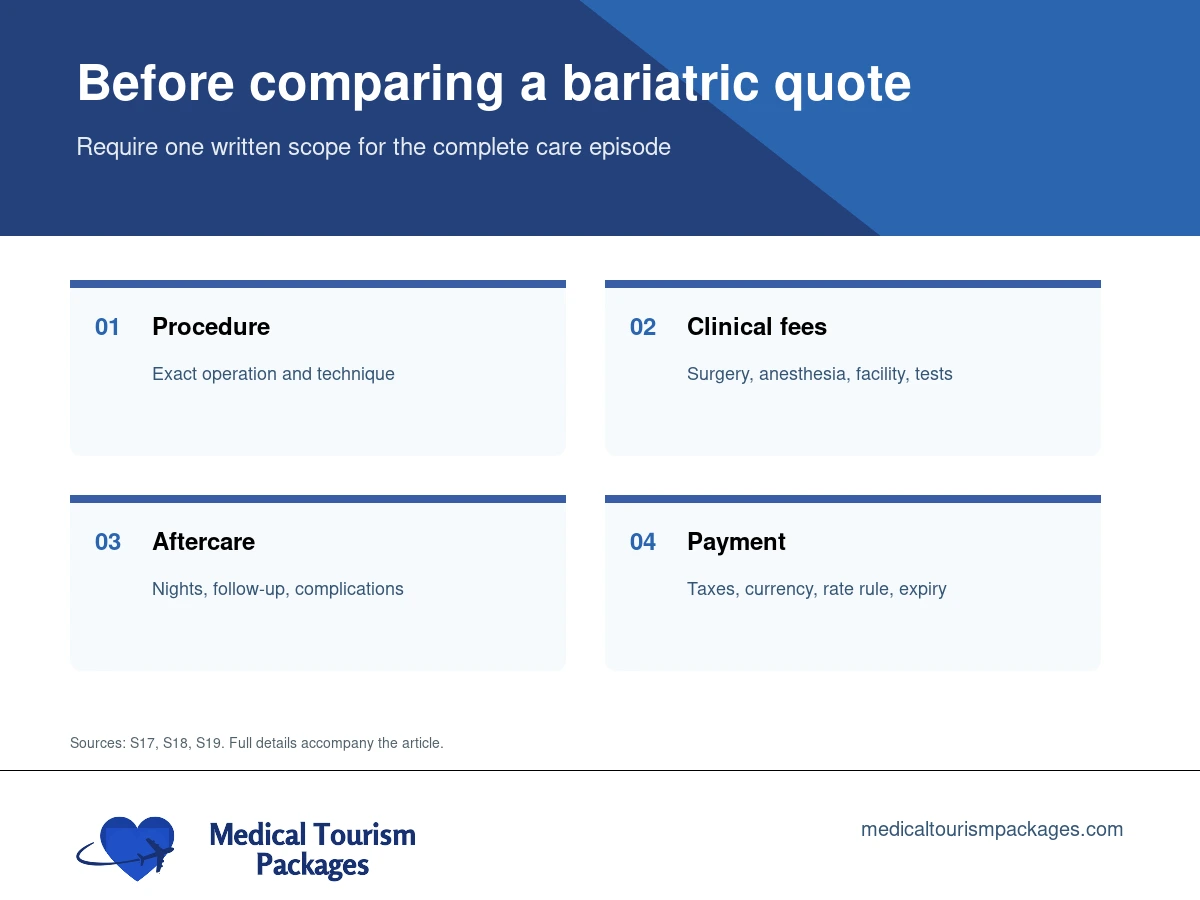
A useful written quote should identify:
- The procedure and surgical technique
- Surgeon, anesthesia, facility, and operating-room fees
- Tests, medicines, and medical products
- Hospital nights and extra-night rates
- Nutrition and psychological support
- Follow-up schedule and remote access
- Revision or complication costs
- Taxes, currency, exchange-rate rule, and quote expiry
No opened source confirmed citywide prices for Buenos Aires, Rosario, or Mendoza. No authoritative source confirmed foreign-patient deposits or accepted payment methods.
Compare the complete episode, not a headline number. Include flights, lodging, extra nights, medicines, and care after returning home.
How do bariatric procedures differ?
Sleeve gastrectomy and gastric bypass are established options, but they change the digestive system differently.
A sleeve removes most of the stomach and cannot be reversed. A bypass creates a small pouch and reroutes part of the small intestine. Reversal is difficult.
Mini bypass, revision surgery, bands, balloons, and other procedures need separate evaluation. Their benefits, risks, durability, and follow-up needs differ.
Ask why one operation fits your medical history. Also ask how the team manages nutrition, medicines, pregnancy planning, weight regain, and later endoscopy.
MTP’s bariatric surgery overview explains the broader treatment category. It should not replace individual medical advice.
Who may qualify for surgery?
Clinical candidacy is personal and should not be confused with an Argentine insurance-coverage rule.
Current international guidance recommends surgery at BMI 35 or above regardless of related conditions. It allows consideration between BMI 30 and 34.9 with metabolic disease.
Argentina’s mandatory-benefits criteria use different thresholds. They include ages 18 to 70, BMI above 40, or BMI above 35 with listed conditions.
The coverage rules also require prior supervised treatment, acceptable surgical risk, consent, and psychological stability. These requirements govern mandatory benefits. They do not automatically decide a foreign self-pay patient’s candidacy.
Ask the surgeon which clinical guideline applies. The answer should address your diagnoses, prior treatments, medications, and previous abdominal operations.
How do I verify an Argentine team and facility?
Verify the professional, bariatric team, operating facility, and medical products as separate records.
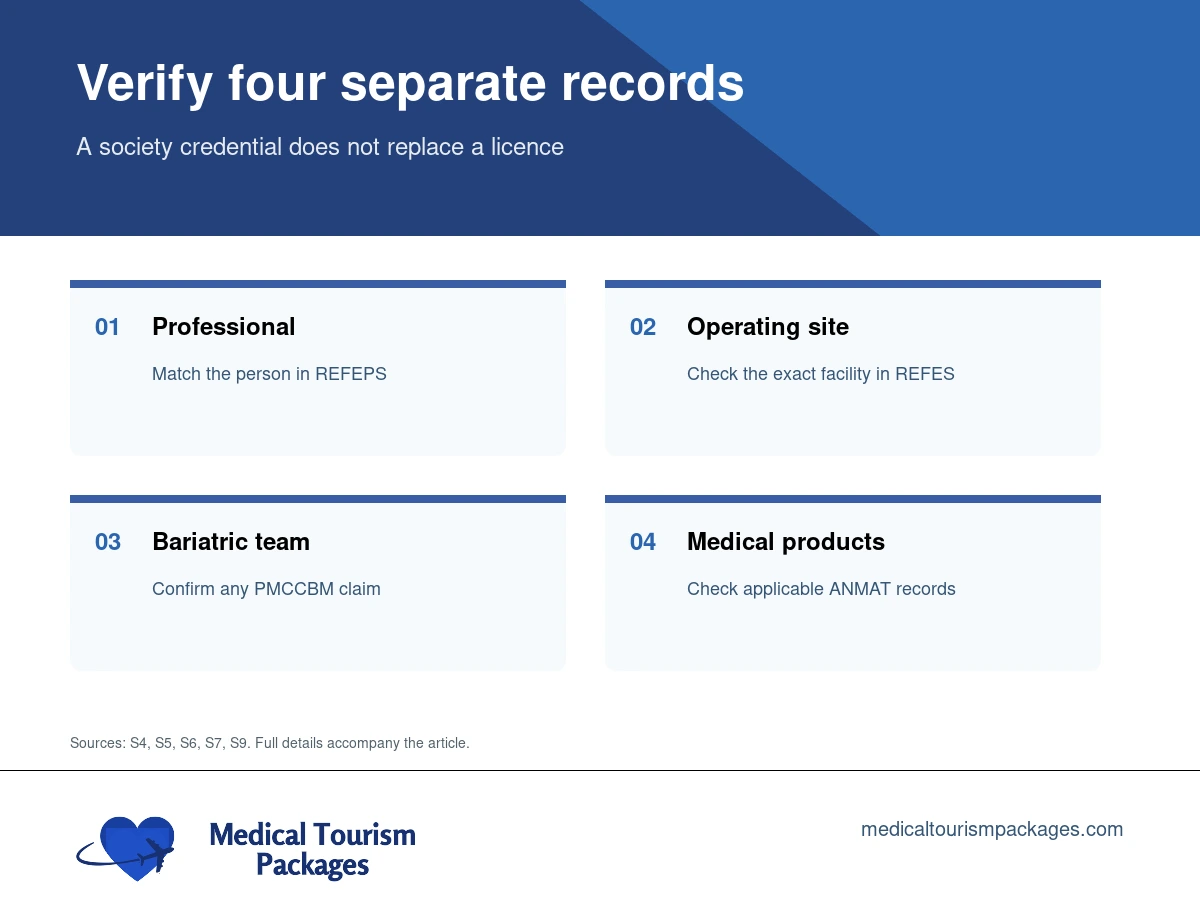
Start with REFEPS, Argentina’s federal network of licensed health professionals. Match the full name, profession, licence jurisdiction, and current status.
Next, check the exact operating site in REFES. Facility registration follows the relevant provincial jurisdiction.
If a team claims PMCCBM accreditation, search the program directory. This SACO and AAC program sets voluntary bariatric-team requirements. It is not official specialty certification.
AAC also provides an MAAC credential checker. Treat society credentials as supporting evidence, not a replacement for licensure.
Ask for the exact model and registration of any device. ANMAT provides medical-product registration and safety-reporting systems.
Save screenshots or PDFs of every check. Repeat them shortly before surgery because people, sites, and registrations can change.
Is bariatric surgery in Argentina safe?
No current national Argentina complication rate was found, so safety cannot be reduced to one countrywide percentage.
General risks include bleeding, infection, leaks, diarrhea, blood clots, and nutrient deficiencies. Risk differs by procedure, patient, team, and follow-up.
Ask each team for its own recent, procedure-specific results. Request the denominator, measurement period, revision definition, readmissions, and follow-up completeness.
Argentina’s official care standard expects evaluation, preparation, surgery, postoperative care, and longer-term follow-up. It also expects multidisciplinary participation.
Written consent must explain the procedure, expected benefits, risks, alternatives, and consequences. Patients can also request their clinical record.
Before paying, identify the emergency contact and receiving hospital. Also decide who manages problems after you return home.
How long should I stay before flying?
The CDC says to avoid air travel for ten days after abdominal surgery. Personal surgical clearance may require longer.
Travel over four hours can increase blood-clot risk. Obesity and recent surgery add further risk.
Do not build the trip around the earliest possible flight. Build it around an agreed discharge and clearance plan.
Get written instructions for hydration, movement, compression, medicines, wound care, and urgent symptoms. Ask whether a clinician will remain available across time zones.
The CDC recommends a travel-medicine consultation four to six weeks before travel. Bring operative notes, imaging, laboratory results, and a current medicine list home.
What travel and payment rules matter?
Entry, insurance, payment, and tax rules must be checked again before booking.
US citizens generally need no tourist visa for visits of 90 days or less. Canadian citizens generally need no tourist visa. Argentina describes tourist stays of up to three months.
Argentine law provides for a declaration about travel purpose and health insurance, but the official records checked on September 14, 2026 did not show that requirement in force. This guide therefore does not treat it as a current entry requirement. Check current requirements before travel.
Medicare usually does not cover care outside the United States. Ask your specific private insurer whether foreign elective care is covered and request its answer in writing. No source reviewed here established coverage or reimbursement by a particular private insurer.
Some qualified medical and travel expenses may receive US tax treatment. HSA or FSA reimbursement depends on whether the expense qualifies and on the applicable plan rules. Confirm with the administrator and a tax professional before paying.
How should I compare Argentina with other destinations?
Compare verified care pathways rather than country labels or unverified savings claims.
Review our guides for Argentina medical travel, Colombia, Mexico, and Panama.
For each option, compare the same procedure, quote scope, hospital capability, complication pathway, and follow-up duration. Reverify every price and credential before relying on it.
Questions to resolve before choosing
- Which procedure is proposed, and why?
- Who performs surgery and anesthesia?
- Where will surgery occur?
- Which registry confirms each licence?
- What is included and excluded?
- Which currency and rate govern payment?
- What results does this team document?
- Who handles complications after discharge?
- When will the team clear air travel?
- Who provides long-term nutrition and laboratory monitoring?
Frequently asked questions
These answers summarize the strongest available evidence. They cannot decide individual candidacy or replace a written clinical plan.
Get help organizing a verified consultation
MTP can help organize questions, records, and written quote comparisons. It does not replace independent medical, legal, insurance, or tax advice.
Contact Medical Tourism Packages to discuss your planning needs.
Sources and references
- Argentina obesity coverage rule
- Argentina bariatric care standard
- REFES and REFEPS
- National health-professional search
- PMCCBM requirements
- PMCCBM directory
- Argentine Association of Surgery credential checker
- ANMAT medical products
- Argentina Patient Rights Law
- CDC medical tourism guidance
- CDC travel blood-clot guidance
- NIDDK bariatric procedure types
- NIDDK bariatric side effects
- ASMBS and IFSO indications
- A Córdoba clinic’s resident price list, August 4, 2026
- BCRA retail exchange-rate method
- BCRA average retail rate reported on August 11, 2026
- US entry information for Argentina
- Canadian entry information for Argentina
- Argentina tourist-entry rules
- Argentina migration decree 366/2025
- Medicare abroad
- IRS Publication 502
- IRS Form 8889 instructions
- IRS Publication 969