Book Appointment Now

Hair Transplant in Argentina: Cost in US Dollars, FUE and FUT Methods, and How to Verify a Surgeon
 By
By
A hair transplant in Argentina costs USD 2,500 to 5,000 in one Buenos Aires clinic’s April 2026 quote. The quote is in US dollars with no stated exchange rate. The United States range is USD 3,919 to 10,640.
One Buenos Aires clinic quotes USD 2,500 to 5,000. A Córdoba clinic starts FUE at ARS 3,300,000 as of June 2026, with no stated exchange rate. Argentine law reserves surgery for registered physicians. REFEPS and REFES let you check a physician’s license and a facility’s registration.
MTP coordinates the inquiry, the written quote, and the trip. The medical decisions belong to the licensed physician you verify. Below are prices in US dollars with their exchange-rate basis, and what FUE, FUT, DHI, and robotic mean. You will also find who may make the incisions, the REFEPS and REFES checks, graft survival data, and candidacy. The guide closes with the trip, flight timing, payment, insurance, and entry rules.
What Does a Hair Transplant in Argentina Involve?
A hair transplant in Argentina moves follicular units from a donor area of your scalp to the thinning areas. The harvest is by FUE punch or by FUT strip. SACPER, the Argentine plastic-surgery society, describes FUE as an outpatient procedure under local anesthesia. You return the day after surgery for a check and a hair wash.
Buenos Aires has a published USD quote. Córdoba has a published price in pesos. Our hub page calls the same procedure “hair implants” and compares hair implant packages across Latin America.
No Argentine registry reports how many foreign patients choose FUE, FUT, DHI, or a robot. The foreign ministry’s Health From Argentina directory publishes no procedure volumes.
What Is the Difference Between FUE, FUT, DHI, and Robotic FUE?
FUE removes each follicular unit with a small round punch and leaves small round scars. FUT removes a strip of donor scalp and leaves one linear scar. DHI is an implantation label that names no harvesting method. Robotic FUE means a robot assists the surgeon with the excision step.
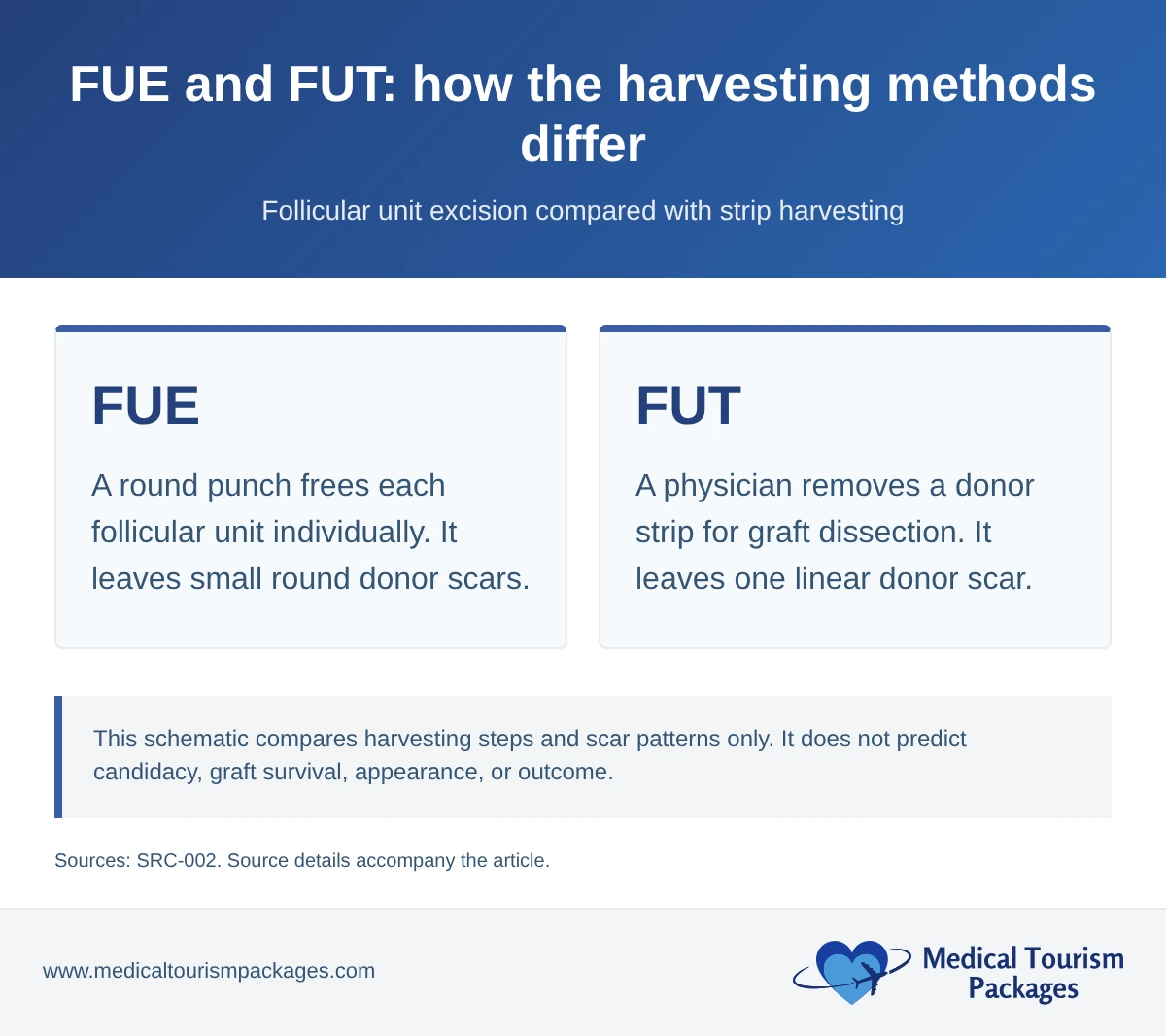
| Label | How the graft is harvested | Donor scar | What the label tells you | ISHRS position |
|---|---|---|---|---|
| FUE | A small round punch cuts around each follicular unit | Small round scars, almost always | The harvesting method | Surgery; a licensed physician must make the incision |
| FUT | A strip of donor scalp is removed and dissected into grafts | One linear scar in the donor area | The harvesting method | Surgery; strip excision is a physician’s act |
| DHI | The label does not say; ask which harvesting method is used | Depends on the harvesting method | Immediate implantation, or the sharp-implanter technique | Denied as a transplant method; it should not be marketed as one |
| Robotic FUE | A robot assists the excision under a surgeon’s direction | As FUE | Which tool assists; nothing about outcomes | Surgery; the robot does not extract the units itself |
Motorized FUE without suction made up 75.1% of FUE methods in the ISHRS 2025 member census. Robotic-assisted FUE made up 1.3%. Those international member-survey figures describe neither Argentina nor the procedures foreign patients buy.
Is DHI a Separate Hair Transplant Method?
No. The ISHRS says DHI describes either immediate implantation after extraction or the sharp-implanter technique. It denies that DHI is a hair-transplant method and says it should not be marketed as one. A DHI quote must therefore state the actual donor-harvesting method and who makes the implanter incisions.
Can PRP Improve Graft Survival?
No, the evidence is too thin to promise it. A 2025 review found only 3 eligible studies covering 217 participants. They reported higher density, better follicle survival, and earlier growth with PRP, with wide differences in preparation and protocol. Treat PRP as an optional add-on. An Argentine directory lists USD 160 as the average price of a general PRP session, dated September 8, 2026. The figure is in USD with no stated exchange rate. No source prices PRP as a hair-transplant add-on.
How Much Does a Hair Transplant Cost in Argentina in US Dollars?
A hair transplant in Argentina costs USD 2,500 to 5,000 in the Buenos Aires quote. The same page’s table prints USD 2,500 to 3,600. The Córdoba starting price is in pesos. Both prices are single-provider marketing claims, and neither is an Argentine average.
| Location | Quoted price and date | Currency and exchange-rate basis | What the source says is included | Evidence quality |
|---|---|---|---|---|
| Buenos Aires | USD 2,500 to 5,000 in the article; USD 2,500 to 3,600 in its table; April 16, 2026 | USD quoted directly; no exchange rate given | Specialist-physician surgery and postoperative follow-up; nothing else itemized | One clinic’s marketing claim |
| Córdoba | FUE from ARS 3,300,000; June 18, 2026 | ARS; the clinic states no rate. Official selling rate that day ARS 1,470 per USD; parallel selling rate ARS 1,475 | Nothing itemized | One clinic’s starting price; marketing claim |
| Rosario | No verifiable price found | No exchange basis available | No verifiable inclusions | Coverage gap |
| Mendoza | No verifiable price found | No exchange basis available | No verifiable inclusions | Coverage gap |
No ARS-to-USD conversion is printed, because no cited page prints one. A written quote must state the billing currency, price-lock date, exchange-rate source, deposit, refund terms, and card fee. It must list every inclusion and exclusion.
How Much Does a Hair Transplant Cost per Graft in Argentina?
No current Argentine source gives a verifiable price per graft, and the same gap covers DHI-only, FUT-only, and robotic-only prices. The nearest whole-procedure figures are a clinic chain’s USD 1,000 to 3,500, updated August 2026. A directory lists an average of USD 2,000, dated September 8, 2026. Both figures are in USD with no stated exchange rate. Turkey has a per-graft figure of USD 0.69 in a London clinic’s survey of 87 Istanbul clinics. That is a competing clinic’s marketing claim and says nothing about Argentina.
The “how much do 3,000, 5,000, or 7,000 grafts cost” questions have one workable answer in Argentina. Ask the clinic to state the graft plan in writing and price the whole procedure with every inclusion. Treat any survival promise tied to the graft count as a claim to test against the results section below.
How Does Argentina Compare With the United States and Turkey?
The United States range is USD 3,919 to 10,640 in a July 2026 financing-site study. The Buenos Aires quote is USD 2,500 to 5,000. Turkey is USD 2,300 to 3,500 on a booking platform’s listing updated August 31, 2026. That listing says most packages include a hotel, transfers, blood tests, and medication.
| Country | Range | Date | Evidence |
|---|---|---|---|
| United States | USD 3,919 to 10,640 | July 24, 2026 | Financing-site study; cost factors listed, no package |
| Argentina | USD 2,500 to 5,000 and USD 2,500 to 3,600; FUE from ARS 3,300,000; USD 1,000 to 3,500; USD 2,000 average | April 16, 2026; June 18, 2026; August 31, 2026; September 8, 2026 | Clinic marketing claims and a directory average; USD figures quoted with no stated rate; no national average |
| Turkey, booking platform | USD 2,300 to 3,500 | August 31, 2026 | Median of 2025 and 2026 invoices; advertiser disclosure; Turkey sample size unstated |
| Turkey, clinic survey | Average USD 1,840 (GBP 1,464) for 2,800 grafts; lowest USD 1,050; highest USD 3,150 | July 10, 2026 | London clinic’s survey of 87 Istanbul clinics; marketing claim; the page’s own conversion |
The table is not quality-adjusted, because the sources use different techniques, package definitions, and graft assumptions. The US range lists technique, graft count, anesthesia, location, supplies, appointments, and surgeon fee as cost factors. It describes no package. A compiled Argentine span of USD 1,000 to 5,000 restates the same clinic figures and adds no national average. That span is in USD with no stated rate.
Our pages on hair implants in Colombia, a hair transplant in Panama, and hair implant procedures in Mexico carry their own prices.
What Does the Exchange Rate Do to an Argentine Quote?
A USD display price fixes nothing unless the contract states settlement in USD and the payment rails. An ARS quote moves with the rate. The official selling rate was ARS 1,470 per USD on June 18, 2026. The parallel rate was ARS 1,475. Both are point-in-time rates and must not be reused for a later payment. The central bank moved to a floating band and removed the individual access limit in April 2025. Old conversions are therefore unsafe. Foreign-issued Visa cards get a preferential rate slightly below the MEP rate while the program lasts. Get the final ARS or USD amount from the clinic and your card issuer before paying.
How Does a Hair Transplant Work?
A hair transplant works by harvesting follicular units from the donor scalp and placing them into recipient-site incisions. The harvest is by punch in FUE or by strip in FUT. A session commonly lasts 4 to 8 hours.
- Scalp examination, with a blood test or scalp biopsy when the cause of loss is unclear.
- Local anesthesia, with no hospital stay.
- Donor harvest and recipient-site creation, both surgical steps.
- A control visit and hair wash the day after surgery.
- Shedding of the transplanted hair 2 to 8 weeks after surgery, which is the expected course.
- Results between 6 and 9 months, with some patients waiting 12.
How Long Does a Hair Transplant Take to Show Results?
Six to nine months is the usual wait for visible results. Some patients need 12 months. The transplanted hair sheds 2 to 8 weeks after surgery as part of the expected course.
Is Argentina a Good Country for a Hair Transplant?
Yes, when three conditions hold. The operating physician holds a current license, called a matrícula. The facility is habilitated. The quote states its currency and inclusions. No Argentine registry publishes procedure volumes or foreign-patient results. So Argentina cannot be ranked against Turkey or the United States on outcomes.
Argentina has a verifiable medical-practice law and federal registers of professionals and facilities. Its foreign ministry promotes health services officially. This guide applies five criteria to any country.
- A licensed physician controls every incision.
- The license and the facility can be checked in a registry.
- Written informed consent comes before surgery.
- The quote states its currency and inclusions.
- A care pathway exists after you fly home.
The “is Turkey better than the US” question gets the same answer: apply the five criteria. This guide makes no claim about Turkish outcomes.
Which City in Argentina Should You Consider?
Buenos Aires has two airports and a published USD quote. Córdoba has a published ARS starting price. Rosario and Mendoza have no verifiable price or facility evidence in this guide. A City of Buenos Aires facility falls under the city’s own habilitation process. A facility elsewhere is checked with its province and in REFES.
Who Is Allowed to Perform Your Hair Transplant in Argentina?
Only a physician with a current license, the matrícula, may practice medicine under Argentina’s medical-practice law, Ley 17.132. The same law makes the physician responsible for supervising auxiliaries. It prohibits delegating functions inherent to the medical profession to auxiliary staff.
The ISHRS classifies every incision to remove or receive tissue as surgery for a licensed physician, including robotic operation. That position is a professional standard with no force in Argentine law.
The law’s first article limits its scope to the Capital Federal and the former territory of Tierra del Fuego. You must also check the rules of the province or the City of Buenos Aires where surgery will occur. Provincial rules for Córdoba, Santa Fe, and Mendoza are outside this guide.
Ask in writing who makes every donor and recipient incision and who administers the anesthesia. Ask who is present if a robot is used. Then compare each named professional with REFEPS. The “is Turkey risky” question has the same answer for Argentina. The law places every medical act with the physician.
How Do You Verify a Hair Transplant Surgeon and Clinic in Argentina?
Search REFEPS for the physician and REFES for the clinic. REFEPS is the Federal Network of Health Professional Registries. Its National Health Professionals Search accepts a DNI, a license number, or a surname and name. REFES is the Federal Register of Health Establishments, reached through the SISA portal. Then confirm the facility with the province or City of Buenos Aires that issued its habilitation.
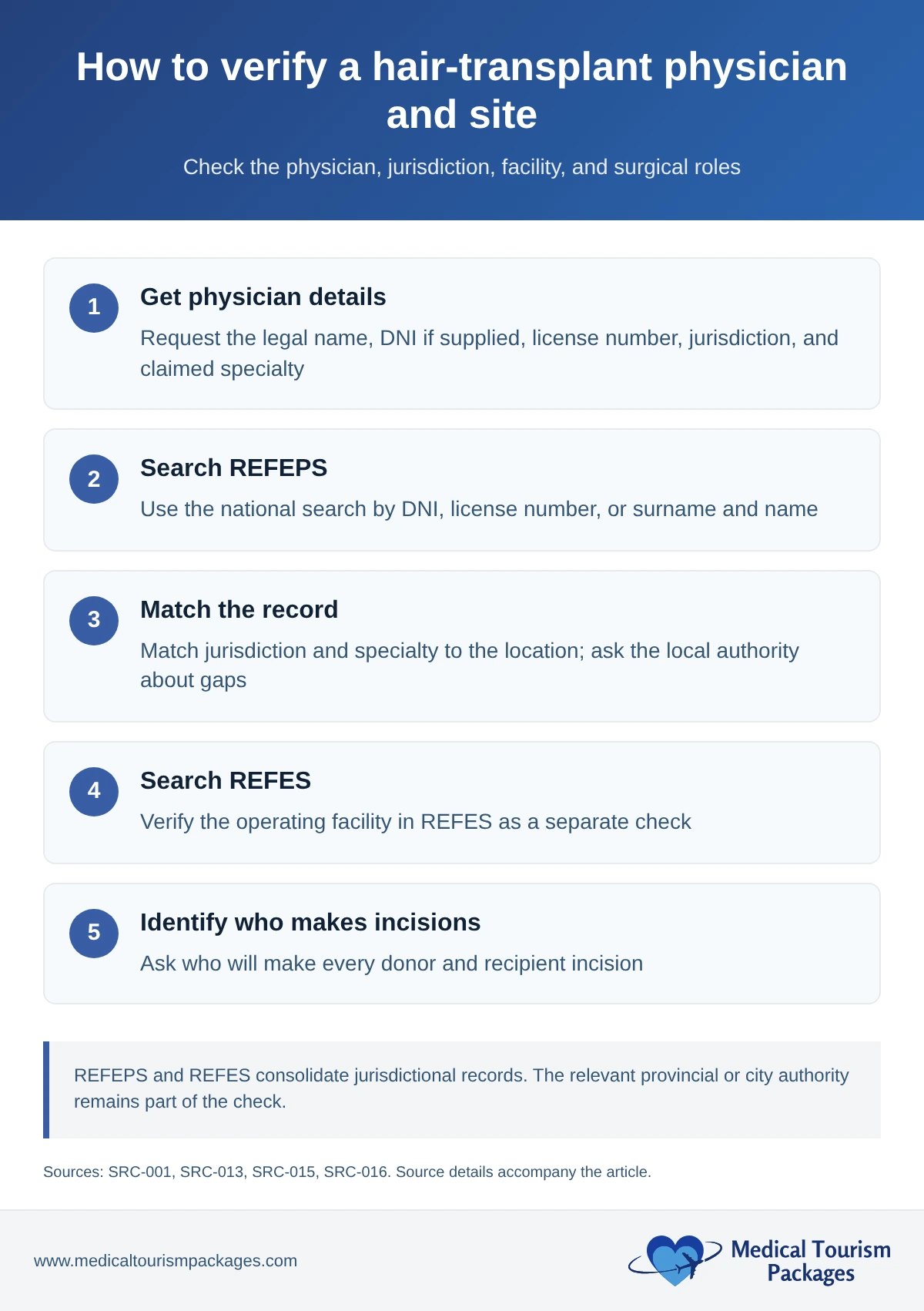
REFEPS articulates the professional registers of all provinces, with data reported by colleges and ministries nationwide. REFES includes every functioning public and private health establishment under its jurisdiction’s regulation. It does not replace the local habilitation.
What Does a Physician Search in REFEPS Show?
The result shows the professional’s current federal authorizations, associated specialties, and reported disqualifications. Argentina distinguishes the basic license from authorization to advertise as a specialist. The specialist authorization lasts 5 years. Revalidation every 5 years needs proof of practice plus an interview or examination. Revalidation requires a Ministry-recognized specialty, the certificate being renewed, supporting documents, and a current national license. No government-recognized specialty titled “hair-transplant surgeon” was found, so ask which specialty the practitioner claims.
- Obtain the full legal name, DNI, license number, issuing jurisdiction, and claimed specialty in writing.
- Search REFEPS with the national tool.
- Match the jurisdiction and specialty to the procedure location; confirm with the provincial college if anything is missing.
- Verify the facility separately in REFES.
- Ask who makes every incision.
How Do You Check the Clinic’s Habilitation in REFES?
Ask for the facility’s exact legal name, street address, habilitation number, category of authorization, and issuing jurisdiction in writing. Then search that identity in REFES through SISA. Confirm the same address and category with the issuing jurisdiction. The SISA landing page does not display the establishment search, so you must find it inside the system. Absence, a different legal name, a mismatched address, or a refusal is a reason to pause.
What Do SACPER Membership, ITAES, JCI, and ISO Prove?
They add information and replace neither government check. SACPER’s own member search says membership is not indispensable for practicing plastic surgery. It presents membership as evidence of training and current certification. SACPER also publishes FUE patient information and membership requirements.
ITAES accreditation is an external peer evaluation that the establishment requests and pays for, distinct from state inspection. Its programs include ambulatory facilities. Its accredited list includes entries outside Argentina, so no Argentina-only count exists. JCI’s directory has a country filter but exposed no stable Argentina count. ISO has no count and no registry here; check the certificate, scope, site, certification body, and expiry date.
How Do You Check the Devices and Medicines Used?
Request the commercial name and Argentine authorization status of any device, implantable product, medicine, or injectable proposed. Then verify it in the ANMAT medical-products category or the ANMAT medicines category. ANMAT regulates devices used in human medicine and publishes a database of authorized medicines.
What Are the Red Flags?
The first red flag is a seller who withholds the name and active license of any physician making incisions. The others follow.
- Extraction or recipient-site incision is delegated to a technician; the ISHRS treats those steps as surgery.
- The facility cannot be matched in REFES and with the local health authority.
- “DHI” is sold as a proprietary method with no harvesting method stated.
- The provider promises an infallible result, a fixed cure date, or a statistic without a denominator. The medical-practice law prohibits all three.
- Consent is presented only after payment, or it omits alternatives, risks, and the consequences of declining.
- The quote omits currency, rate basis, or inclusions.
- There is no named contact or records pathway after you return home.
What Graft Survival and Long-Term Results Can You Expect?
84.98% is the pooled graft survival for micrografts in a meta-analysis of studies published between 1980 and 2018. The pooled figure is 93.11% when micrografts and minigrafts are combined. None of those studies is specific to Argentina, FUE, or medical tourists.
A long-term FUT study of 112 patients compared photographs at 1 year and 4 years. Transplanted-hair density showed a moderate reduction in 55.35% of patients at the 4-year review. A slight reduction appeared in 27.67%, a great reduction in 8.03%, and no change in 8.92%. The authors concluded that grafts may not last permanently for every patient.
The longest follow-up in this guide is 4 years. The “10 years” and “20 years” questions therefore have no sourced answer here. A defensible survival quote must define what it counts: visible hair, grafts, density, or satisfaction. It must also state the assessment time. No source gives a longevity figure separately for FUE, DHI-labeled implantation, or robotic FUE. Argentine law prohibits publishing false therapeutic successes or fictitious statistics. A survival percentage with no definition is a claim to test.
What Are the Published Complication Rates?
1.4% to 2.0% is the minor infection range in a 2026 scoping review of 117 studies. Folliculitis ranged from 1.1% to 12.1%. Necrosis was reported at 0.03% in one study. Differences between studies prevented a pooled estimate.
A 2024 review of 43 publications reported overall complication rates of 1.2% and 4.7% in two large series. Bleeding requiring intervention reached 8%, persistent numbness 11%, and infection 11%. Hypertrophic scarring or keloid after FUT reached 15.1%. No Argentine registry reports procedure-specific complications, revisions, infections, or mortality, and the figures do not predict an individual’s risk.
Who Is a Good Candidate for a Hair Transplant?
A good candidate has enough healthy donor hair and can grow hair in the thinning area. The loss pattern is clear and stable, the scalp is healthy, and the expectations are realistic. A clinical review lists five reasons to defer or avoid surgery.
- No donor area unaffected by alopecia.
- Active cicatricial alopecia.
- Rapid, unstable loss.
- Body dysmorphic disorder.
- Medical conditions that compromise surgical outcomes.
The same review advises considering transplantation only after age 25. Earlier surgery can consume donor supply before the pattern is clear. That is a planning recommendation with no statutory force in Argentina. No hair-transplant-specific Argentine legal age, BMI, cooling-off rule, or regret rate was found.
Argentine law requires written informed consent for surgery. Consent follows clear information on the procedure, benefits, risks, alternatives, and consequences of declining. You can revoke consent, and the revocation goes in the clinical record. The consultation record should cover your loss pattern, donor adequacy, scalp disease, prior surgery, medicines, and health risks. It should also state your expectations, the technique, who performs each step, and the plan for ongoing native-hair loss.
What Does the Trip Involve and When Can You Fly Home?
The trip involves a consultation and written quote before travel, the procedure day, and a check the next day. SACPER describes FUE as outpatient surgery under local anesthesia, with a check and hair wash the day after. No source in this guide gives a safe day count between an uncomplicated hair transplant and a commercial flight. Keep the return date changeable until the operating physician has examined both sites and given written clearance. No source gives a typical number of trips or a minimum stay for Argentina.
One Argentine clinic advertises a virtual consultation and a personalized quote before travel, which is its own marketing claim. Teleassistance is recognized in the medical-practice law only for authorized practices under approved protocols. Send records only through the provider’s secure channel, because health information may be shared only with your authorization. Request a written preliminary plan with the diagnosis to confirm in person, the technique, the graft plan, and the anesthesia. It should name the physician for each step and state the price currency, exclusions, cancellation rules, and aftercare contacts.
Visitors encounter Rioplatense Spanish. No source confirms that English interpretation is standard, so ask for the interpreter’s name and availability. Seasons vary by region, and no source ties a season to prices or recovery. Agree an escalation plan before you fly. It names the operating physician, an Argentine emergency contact, your home clinician, and the records channel. It also says who pays for local care or return travel, because complications can be early or late.
Which Buenos Aires Airport Will You Use?
Aeroparque Jorge Newbery, in Palermo, serves national and regional traffic. Ezeiza, formally Aeropuerto Internacional Ministro Pistarini, sits southwest of the city. Neither is medically preferred, and no source names a preferred district. Choose lodging by door-to-door time to the facility, elevator access, flexible cancellation, and pharmacy access.
What Records Should You Take Home?
Take home the full clinical record, which you own under Argentine law. You can request an authenticated copy. The official explainer says the copy must be supplied within 48 hours of the request, sooner in an emergency. Request the consultation findings, diagnosis, operative note, anesthetic record, and graft count and method. Add prescriptions, product details, consent, photographs, and postoperative instructions. A habeas-data action is available if access is refused or delayed.
Can You Pay in US Dollars, and Does Insurance Cover a Hair Transplant?
Yes, at least one Buenos Aires clinic quotes directly in USD. A Córdoba clinic quotes in ARS. It lists cash, debit card, credit card, Mercado Pago, bank deposit, checks, and several cryptocurrencies. It does not say which are open to a foreign payer.
The Buenos Aires source advertises interest-free installments but publishes no deposit, cancellation schedule, foreign-card terms, or cash-USD policy. Treat financing, card acceptance, wire, deposit, refund, and chargeback rights as unresolved until a signed quote states them.
Does US Health Insurance, an HSA, or an FSA Cover It?
No. The Aesthetic Society says insurance usually does not cover hair transplantation because it is elective cosmetic surgery. IRS Publication 502 lists hair transplant among expenses that cannot be included and refers it to the cosmetic-surgery rule. Publication 969 makes HSA distributions and FSA reimbursements tax free only for qualified medical expenses. The Publication 502 exception covers surgery for a deformity from a congenital abnormality, an accident, or a disfiguring disease. No source here supports plan-specific exceptions after trauma, burns, surgery, or disease. Get a written determination from your plan administrator or a tax professional first.
Will Travel Insurance Cover a Complication?
No, unless you buy a policy that says so in writing. The Australian government’s medical-tourism guidance says travel insurance may not cover issues caused by the procedure. Non-disclosure of the procedure may void the policy. It tells patients to buy a specialized policy and ask about post-operative care, complications, and evacuation. The guidance is Australian and applies to US and Canadian patients by analogy. No currently sold complication policy with explicit cover for an elective hair transplant in Argentina was verified.
What Are the Entry Rules for US and Canadian Patients?
US citizens do not need a tourist visa for a stay of up to 90 days. The Argentine Consulate in New York says so. The Toronto consulate lists Canada as visa-free for up to 90 days, on a page last revised in 2024.
Tourist status is an authorized stay of up to 3 months, extendable once for a similar period. The extension must be requested within the 10 days before expiry. An expired stay cannot be renewed and requires an exit authorization. A transitory residence for medical treatment exists and lasts up to 1 year. It requires a signed and certified clinical record. It is a general route whose paperwork may be disproportionate for a short elective visit.
The Migration Law, Ley 25.871, requires a sworn declaration of purpose and health insurance. The declaration becomes exigible once its implementation is regulated, and that step was not identified. A Ministry of Health notice dated August 11, 2026 covers nationally administered hospitals. Foreigners without permanent residence must present valid health insurance or prepay ordinary care there, and emergency care remains guaranteed. That rule is no proof that any policy covers a private hair transplant. Reconfirm with the airline and the consulate before departure.
Is a Hair Transplant in Argentina Right for You?
Yes, when four things are true. A REFEPS-listed physician will make every incision. The facility appears in REFES and with its issuing jurisdiction. The written quote states currency, rate basis, and inclusions. You can keep the return date flexible until the physician clears you to fly.
- Candidacy confirmed in person.
- Consent information received before payment.
- Escalation plan and records pathway agreed.
- Insurance and HSA or FSA position confirmed in writing.
- Entry rules reconfirmed.
What Questions Do Medical Tourists Ask Most Often About Hair Transplants in Argentina?
These answers cover the practical questions travelers ask before comparing a hair transplant in Argentina, including costs, provider checks, travel, and follow-up.
How much does a hair transplant cost in Argentina in US dollars?
A Buenos Aires clinic quotes USD 2,500 to 5,000 in an April 2026 article, and its own table prints USD 2,500 to 3,600. A Córdoba clinic starts FUE at ARS 3,300,000 as of June 2026, when the official rate was ARS 1,470 per USD. Both are single-clinic quotes with no stated exchange rate, and no per-graft price exists.
How do you verify a hair transplant surgeon and clinic in Argentina?
Search the physician by name, DNI, or license number in the national REFEPS tool. Search the facility in REFES through SISA and confirm it with the issuing jurisdiction. Check the specialist claim separately, because the license and the specialist authorization are distinct. Society membership and accreditation add information and replace neither government check.
Is a hair transplant in Argentina safe?
No Argentine registry publishes a complication rate. International reviews report minor infection at 1.4% to 2.0% and folliculitis at 1.1% to 12.1%. Two large series showed overall complication rates of 1.2% and 4.7%. Safety rests on licensed-physician control of every incision, a habilitated facility, and written informed consent before surgery.
How long do you need to stay in Argentina before flying home?
No independent source gives a universal safe-flight interval. SACPER describes FUE as an outpatient procedure with a control visit and hair wash the day after surgery. Keep the departure changeable until the operating physician gives written clearance. Confirm insurance for postoperative complications before you leave, because travel policies may exclude them.
Can you pay in US dollars, and does insurance, an HSA, or an FSA apply?
Yes, one clinic quotes in USD and another in ARS, so the contract must state the settlement currency. US insurance usually treats a hair transplant as elective cosmetic surgery. IRS Publication 502 excludes it unless the deformity exception applies. HSA or FSA funds are tax-favored only for qualified medical expenses, so get a written determination first.
Do US and Canadian citizens need a visa for a hair transplant in Argentina?
No. US citizens need no tourist visa for a stay of up to 90 days. The Toronto consulate lists Canada as visa-free for the same period. Tourist status can be extended once for a similar period. A medical-treatment residence exists as a general route with heavier paperwork, so reconfirm the rules with the consulate before departure.
Ready to Compare a Hair Transplant in Argentina?
Ready to compare a hair transplant in Argentina with your other options? Send us your hair-loss photos and your questions. We coordinate the consultation, the written quote in the currency you choose, and the trip details. We ask each provider for the physician license and facility habilitation details. You can check both in REFEPS and REFES.
Contact us to start.
Sources and references
- SRC-001: ISHRS Position Statement on Qualifications for Scalp Surgery, International Society of Hair Restoration Surgery.
- SRC-002: Surgical Treatments, patients section, International Society of Hair Restoration Surgery.
- SRC-003: What is the best FUE procedure?, International Society of Hair Restoration Surgery.
- SRC-004: 2025 ISHRS Practice Census Results, International Society of Hair Restoration Surgery.
- SRC-005: Contemporary Management of Alopecia: A Systematic Review and Meta-analysis for Surgeons, Aesthetic Plastic Surgery, 2020.
- SRC-006: Longevity of Hair Follicles after Follicular Unit Transplant Surgery, Journal of Cutaneous and Aesthetic Surgery, 2020.
- SRC-007: Efficacy of Platelet-Rich Plasma as an Adjunct to Hair Transplantation: A Systematic Review, Cureus, 2025.
- SRC-008: Hair loss: Diagnosis and treatment, Hair transplant, American Academy of Dermatology.
- SRC-009: Hair Transplantation, StatPearls, NCBI Bookshelf, updated August 2, 2025.
- SRC-010: Safety Considerations in Hair Restoration Procedures, Journal of Craniofacial Surgery, online August 13, 2026.
- SRC-011: A Scoping Review on Complications in Modern Hair Transplantation: More than Just Splitting Hairs, Aesthetic Plastic Surgery, online August 23, 2024.
- SRC-012: Ley 17.132, Arte de curar, texto actualizado, Argentina.gob.ar, Ministerio de Justicia.
- SRC-013: Registros Federales de Referencia de Establecimientos y Profesionales de la Salud, Argentina.gob.ar, Ministerio de Salud.
- SRC-014: Sistema Integrado de Información Sanitaria Argentino, SISA, Ministerio de Salud de la Nación.
- SRC-015: Buscador Nacional de Profesionales de la Salud, Argentina.gob.ar, Ministerio de Salud.
- SRC-016: Salud simplifica el acceso al Buscador Nacional de Profesionales de Salud, Argentina.gob.ar, Ministerio de Salud, April 2026.
- SRC-017: Habilitación de establecimientos de salud, Gobierno de la Ciudad de Buenos Aires.
- SRC-018: Acreditados, ITAES.
- SRC-019: Evaluación de calidad, ITAES.
- SRC-020: Principios y características, ITAES.
- SRC-021: Find Accredited International Organizations, The Joint Commission, archived copy dated July 14, 2026.
- SRC-022: Productos médicos, Argentina.gob.ar, ANMAT.
- SRC-023: Medicamentos, Argentina.gob.ar, ANMAT.
- SRC-024: Procedimientos, hair micro-transplant section, SACPER.
- SRC-025: Asociate, membership requirements, SACPER.
- SRC-026: Buscador de cirujanos certificados, SACPER.
- SRC-027: Revalidación de certificados de especialistas para médicos y odontólogos, modalidad automática, Argentina.gob.ar, Ministerio de Salud.
- SRC-028: Ley 26.529, Derechos del Paciente, texto actualizado, Argentina.gob.ar, Ministerio de Justicia.
- SRC-029: Mi historia clínica, Argentina.gob.ar.
- SRC-031: A Buenos Aires hair clinic’s marketing article comparing Turkey and Argentina, dated April 16, 2026.
- SRC-032: A Córdoba clinic’s hair-transplant price page, dated June 18, 2026.
- SRC-033: Dólar blue hoy: a cuánto cotiza el jueves 18 de junio, La Nación, June 18, 2026.
- SRC-034: How Much Does a Hair Transplant Cost?, CareCredit, July 24, 2026.
- SRC-035: Hair Transplantation, Associated Costs, The Aesthetic Society.
- SRC-038: Tipo de cambio para tarjetas emitidas en el exterior, Visa Argentina.
- SRC-039: Inicio de la Fase 3 del programa económico, Banco Central de la República Argentina, April 11, 2025.
- SRC-040: Publication 502 (2025), Medical and Dental Expenses, Internal Revenue Service.
- SRC-041: Publication 969 (2025), Health Savings Accounts and Other Tax-Favored Health Plans, Internal Revenue Service.
- SRC-042: Medical tourism, Smartraveller, Australian Government, archived copy dated February 14, 2026.
- SRC-043: Visas, Consulado General de la República Argentina en Nueva York.
- SRC-044: Visas, Consulado General de la República Argentina en Toronto, last revised May 9, 2024.
- SRC-045: Turistas, Argentina.gob.ar, Dirección Nacional de Migraciones.
- SRC-046: Obtener una residencia transitoria por tratamiento médico, Argentina.gob.ar, Dirección Nacional de Migraciones.
- SRC-047: Ley 25.871, Migraciones, texto actualizado, Argentina.gob.ar, Ministerio de Justicia.
- SRC-048: Los hospitales nacionales comenzarán a cobrarles a los extranjeros no residentes en el país, Argentina.gob.ar, Ministerio de Salud, August 11, 2026.
- SRC-049: Aeroparque Jorge Newbery, Argentina.gob.ar, Transporte.
- SRC-050: Aeropuerto Internacional de Ezeiza, Argentina.gob.ar, Transporte.
- SRC-051: Preguntas frecuentes, argentina.travel.
- SRC-052: Health From Argentina: Directorio de Servicios de Medicina Internacional, Cancillería Argentina.
- SRC-053: A medical-tourism booking platform’s Turkey hair-transplant listing, updated August 31, 2026.
- SRC-054: A London hair-transplant clinic’s blog survey of 87 Istanbul clinics, updated July 10, 2026.
- SRC-055: A hair-clinic chain’s Argentine article on hair implant prices, published April 21, 2026 and updated August 31, 2026.
- SRC-056: An Argentine aesthetic-treatment directory’s hair implant price page, updated September 8, 2026.
- SRC-057: The same Argentine aesthetic-treatment directory’s platelet-rich plasma price page, updated September 8, 2026.
- SRC-058: An independent Spanish-language guide to hair implants in Argentina, published July 28, 2026 with prices rechecked September 1, 2026.