Book Appointment Now

Dental Implants in Mexico: Cost, Process, Best Clinics, and Safety Guide
 By
By
Dental implants in Mexico cost 50% to 80% less than in the United States, using the same premium brands and 3D imaging found in top US clinics.
A single implant costs $650 to $1,000 in Mexico, versus $3,000 to $5,000 in the US, and a full-arch All-on-4 costs $6,000 to $10,000, versus $20,000 to $35,000. Top clinics in Tijuana, Los Algodones, Cancún, and Mexico City use Straumann and Nobel Biocare implants with ISO 9001 certification.
Medical Tourism Packages connects you with pre-vetted dental clinics across Mexico, each verified for Cédula Profesional licensing, ISO 9001 certification, and premium implant brands. Below, you will find verified cost comparisons, the best implant cities, safety and success-rate data, the full two-trip treatment timeline, and answers to common questions about dental implants in Mexico.
What Are Dental Implants, and Why Choose Mexico?
Dental implants are titanium posts placed in your jawbone to replace missing tooth roots. In Mexico, the same procedure costs 50% to 80% less than in the United States. Clinics in cities like Tijuana and Cancún use the same premium implant brands and 3D imaging found in top US practices.
Once the bone fuses with the titanium through a process called osseointegration, the implant anchors a crown, bridge, or denture. Unlike dentures that sit on the gums, implants become part of your jaw. They prevent bone loss and help maintain your facial structure.
US implant prices push many patients abroad. A single implant runs $3,000 to $5,000 in the United States, and most dental insurance caps benefits at $1,000 to $2,000 a year. That barely covers one tooth. In Mexico, the same implant costs $650 to $1,000, which makes full treatment affordable for many people who would otherwise go without.
Mexico has built mature infrastructure for medical tourism in Mexico. Top clinics offer bilingual coordinators, recovery-focused hotels, private transport, and dedicated patient managers who handle logistics from airport pickup to scheduling. This support is concentrated in Tijuana, Los Algodones, Cancún, Puerto Vallarta, and Mexico City.
How Are Dental Implants in Mexico Different from the US?
Dental implants in Mexico differ from US implants in service and price, not in the core procedure. The surgery follows the same biological principles, uses the same brands, and meets the same surgical standards at properly vetted clinics. The differences below explain why Americans and Canadians travel south.
Top Mexican clinics differ from US practices in five practical ways:
- Lower cost: Verified savings of 50% to 80%, with full-arch work costing a fraction of US prices.
- Same premium brands: Many clinics use Straumann and Nobel Biocare implants, the same systems used in elite US offices.
- On-site labs: In-house CAD/CAM labs design and mill permanent restorations within days, not weeks.
- All-inclusive packages: Treatment, hotel, and transport are bundled by a bilingual coordinator.
- Geographic proximity: Border cities are drivable from California and Arizona, and resort cities are a 2 to 3 hour flight from most US cities.
How Much Do Dental Implants Cost in Mexico Compared to the US and Canada?
Dental implants cost $650 to $1,000 per single tooth in Mexico, versus $3,000 to $5,000 in the United States. A full-arch All-on-4 costs $6,000 to $10,000 in Mexico, compared to $20,000 to $35,000 in the US. That is 50% to 80% in savings on the same procedure.
Here is how Mexico prices compare to US costs by procedure:
| Procedure Type | US Cost | Mexico Cost | Savings |
|---|---|---|---|
| Single Implant | $3,000-$5,000 | $650-$1,000 | 67-87% |
| Mini Implant | $500-$1,500 | $200-$420 | 60-80% |
| All-on-4 (Full Arch) | $20,000-$35,000 | $6,000-$10,000 | 50-83% |
| Full Mouth (Both Arches) | $40,000-$70,000 | $12,000-$20,000 | 50-70% |
In the US, upgrading from acrylic to zirconia adds $5,000 to $10,000 per arch. In Mexico, that upgrade costs only $600 to $800, so premium zirconia in Mexico can cost less than base acrylic in the US.
How Do Mexico Prices Compare to Other Countries?
Mexico prices are among the lowest in the Americas, beaten only by Colombia on single implants. Mexico, Colombia, Costa Rica, and Panama all offer large savings over the US, though Mexico adds the advantage of drivable border access for US patients. Patients weighing destinations often compare Mexico with dental implants in Costa Rica, where prices run slightly higher but quality is comparable.
Here is how All-on-4 and single-implant costs compare across four destinations:
| Country | Single Implant | All-on-4 (Full Arch) |
|---|---|---|
| Mexico | $650-$1,000 | $6,000-$10,000 |
| Colombia | $700-$1,200 | $7,000-$11,000 |
| Costa Rica | $750-$900 | $8,500-$12,750 |
| Panama | $1,500-$2,100 | $10,000-$15,000 |
| United States | $3,000-$5,000 | $20,000-$35,000 |
What Does a Full All-on-4 Trip Cost?
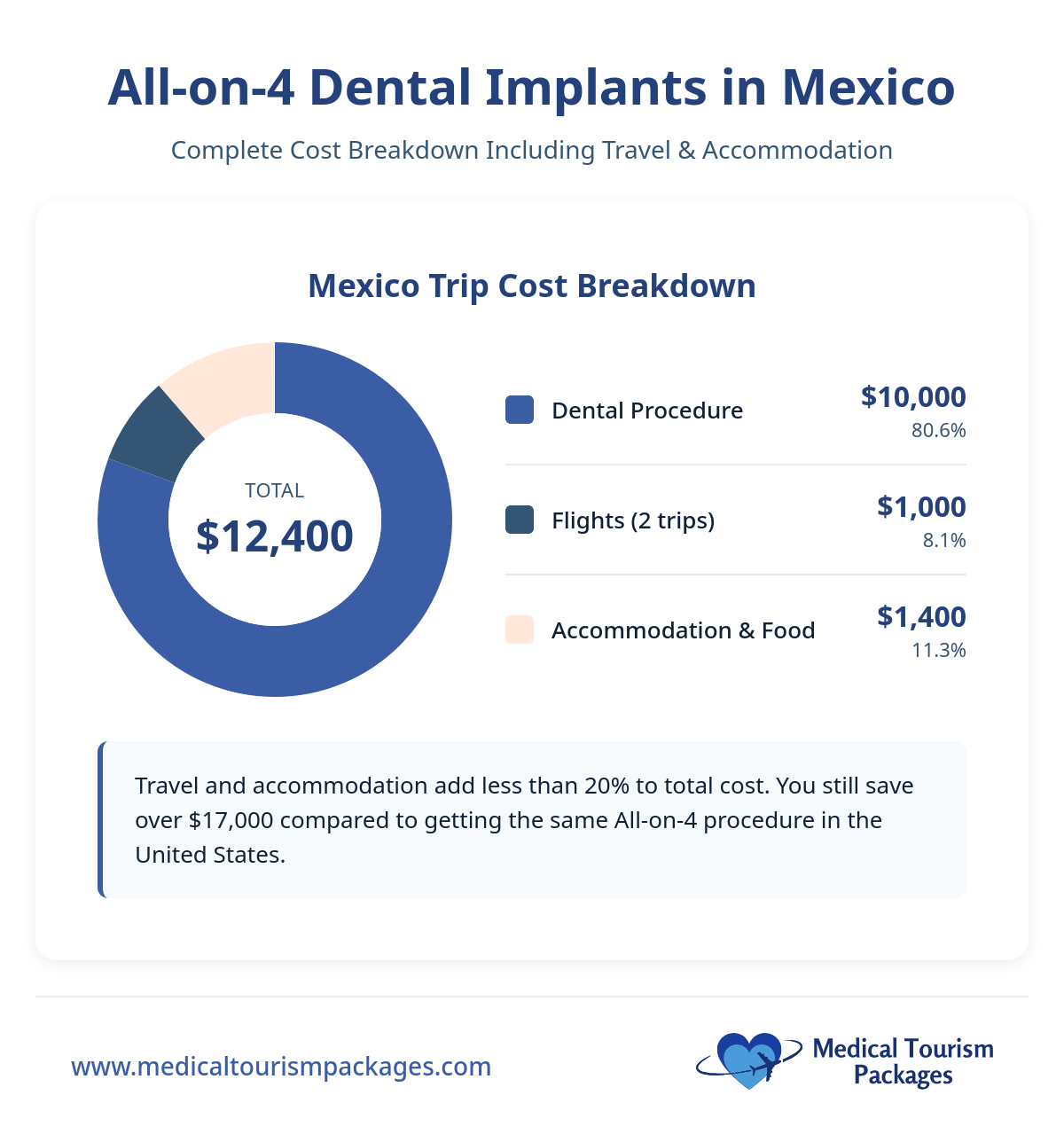
A full All-on-4 trip costs about $11,400 in Mexico, including treatment and travel. The procedure runs around $9,000, two round-trip flights add about $1,000, and two week-long hotel stays with meals add about $1,400. The same arch costs $20,000 to $35,000 in the US, treatment only.
The dental work makes up roughly 80% of the total trip cost. Flights account for about 10%, and accommodation makes up the rest. Because two trips are required over several months, budget for two sets of flights and hotel stays.
How Do Prices Vary by Mexican City?
Prices vary by city based on overhead and location. Border cities offer the lowest prices, while resort cities sit toward the upper end of the same range. All sit within the $6,000 to $10,000 All-on-4 range.
- Border cities (Tijuana, Los Algodones): Lowest prices, with All-on-4 near the bottom of the range around $6,000 to $7,500.
- Resort cities (Cancún, Puerto Vallarta): Higher overhead pushes All-on-4 toward the upper end, around $9,000 to $10,000.
What Types of Dental Implants Are Available in Mexico?
Mexican clinics offer three main implant types: traditional single implants, full-arch All-on-4 or All-on-6, and mini implants. Each suits a different need, from replacing one tooth to restoring a full jaw or stabilizing loose dentures.
Here is how the three implant types compare:
| Implant Type | What It Is | Mexico Cost | Best For |
|---|---|---|---|
| Traditional Single | One titanium post, abutment, and crown per missing tooth | $650-$1,000 per tooth | A few missing teeth with good bone density |
| All-on-4 / All-on-6 | Four or six angled implants supporting a full-arch bridge of 10-12 teeth | $6,000-$10,000 per arch | Full-arch restoration, avoiding extensive bone grafting |
| Mini Implants | Smaller posts under 3mm for denture stabilization | $200-$420 each | Stabilizing loose dentures, not fixed bridges |
Single implants carry a 97% survival rate at 10 years, according to the long-term Brånemark follow-up. The Malo Clinic long-term study reports 91% to 93% implant survival for All-on-4 at 10 to 18 years. Nobel Biocare pioneered the All-on-4 technique, and All-on-6 adds $2,000 to $3,000 for softer bone or a heavy bite. Mini implants suit denture stabilization but are not built for heavy chewing.
What Materials and Brands Do Mexican Clinics Use?
Top Mexican clinics use globally recognized implant brands like Straumann and Nobel Biocare. Straumann uses a Roxolid titanium-zirconium alloy with strong long-term survival. Nobel Biocare is the original All-on-4 pioneer with an official presence in Mexico. Brand choice matters more than most patients realize.
A globally recognized brand means any US dentist can identify your implant and order compatible parts. Obscure or no-name implants trap you into returning to Mexico for all future service, because US dentists cannot order matching components. Always ask for the implant brand in writing before surgery.
For the prosthesis, you choose between acrylic and zirconia. Acrylic is lightweight and easy to repair but stains over time. Zirconia is a premium ceramic that resists stains and lasts longer. In Mexico, zirconia costs only $600 to $800 more than acrylic, which makes the premium option affordable.
Which Mexican Cities Are Best for Dental Implants?
The best cities for dental implants in Mexico are Tijuana, Los Algodones, Cancún, Puerto Vallarta, and Mexico City. Border cities offer the lowest prices and drivable access. Resort cities offer recovery comfort. Mexico City and its Polanco district offer large clinics with hospital backstops nearby.
Here is how the top implant cities compare:
| City | Location | Key Advantages | Best For |
|---|---|---|---|
| Tijuana | Border (next to San Diego) | Drive-in access, fast border passes (15-30 min vs 2-4 hrs), lowest prices, easy warranty returns | Cost-focused patients, warranty access |
| Los Algodones | Border (near Yuma, AZ) | Walk-over access, 600+ dentists in “Molar City,” popular with snowbirds | Arizona and California residents, retirees |
| Cancún | Resort destination | Luxury recovery, beachfront hotels, clinic-arranged transport, JCI hospital nearby | Patients combining treatment with a vacation |
| Puerto Vallarta | Resort destination | Similar to Cancún, less crowded, Pacific coast alternative | Vacation-focused recovery |
| Mexico City | Capital (Polanco district) | Large modern clinics, multiple JCI hospitals as backstop, frequent US flights | Patients wanting hospital-grade support nearby |
Los Algodones is home to Dr. Isaías Íñiguez, described as the only AACD-accredited dentist in Mexico. Border cities make warranty claims practical, because a return visit is a short drive rather than an expensive flight.
Which Cities Have a JCI-Accredited Hospital Backstop?
Mexico City and Cancún have JCI-accredited hospitals that serve as an emergency backstop. Mexico has 8 JCI-accredited hospitals overall. Dental implant work itself happens in specialized clinics, not these hospitals, but a nearby accredited hospital adds reassurance for complex cases.
In Mexico City, ABC Medical Center (JCI-accredited since 2008, affiliated with Houston Methodist) and Médica Sur (JCI-accredited since 2014, part of the Mayo Clinic Care Network) provide hospital-grade care. In Cancún, Hospital Galenia has held JCI accreditation since 2012. These hospitals are not where you get implants, but they offer a safety net if a serious complication ever arises during your stay.
How Do You Choose a Safe Dental Clinic and Dentist in Mexico?
You choose a safe clinic by verifying the dentist’s license, confirming the implant brand in writing, and checking for 3D imaging and on-site labs. Top implant dentists in Tijuana and Cancún perform All-on-4 hundreds of times a year. Always get a second opinion from your US dentist before committing.
What Certifications Should You Verify?
You should verify the dentist’s Cédula Profesional and the clinic’s ISO 9001 certification at minimum. These two credentials confirm a valid license and audited quality systems. Other memberships add signal but are not the same as clinic accreditation.
- Cédula Profesional: The mandatory license issued by Mexico’s Ministry of Education. Verify it free at the Registro Nacional de Profesionistas.
- ISO 9001: A third-party audit of the clinic’s quality management and sterilization systems. The strongest single quality signal.
- ADM (Mexican Dental Association): Membership requires ongoing education. A positive signal.
- ADA International Membership: Shows commitment to US standards, but it is NOT clinic accreditation. Beware misleading “ADA-accredited” claims.
- AACD (American Academy of Cosmetic Dentistry): A rare, rigorous credential. Dr. Isaías Íñiguez in Los Algodones is the only AACD-accredited dentist in Mexico.
To verify a license, visit Mexico’s National Registry (Registro Nacional de Profesionistas) and enter the dentist’s name or Cédula number. If a clinic refuses to provide this, walk away.
What Questions Should You Ask Before Booking?
You should ask seven questions before booking, covering the surgeon, the implant brand, imaging, and the warranty. Clear answers signal a transparent clinic. Evasive answers are a red flag.
- What is the full name and Cédula Profesional number of my surgeon? (Refusal is a red flag.)
- What implant brand will I receive, in writing? (Demand specifics, not “it depends on stock.”)
- Do you use 3D CBCT scans or only 2D X-rays? (2D only means walk away.)
- Do you have an on-site CAD/CAM lab, or do you use external labs?
- What is your implant success rate and your annual All-on-4 volume?
- What does your warranty cover, and does it include my travel costs? (The answer will be no, which forces honesty.)
- Can I speak directly with the surgeon, not just the coordinator?
How Do You Spot Fake Reviews and Red Flags?
You spot fake reviews by looking for specific details and balance. Legitimate reviews name the surgeon, list real costs and timelines, and mention minor negatives. Fake reviews use generic praise without substance. Cross-reference Google, Facebook, RealSelf, and medical tourism forums.
Watch for these warning signs when researching a clinic:
- “Permanent teeth in 3 days” claims, which skip the required 3 to 6 month healing period.
- Only 2D X-rays, with no 3D CBCT scanning.
- Refusal to disclose the implant brand or the surgeon’s license number.
- Prices far below the normal range, or aggressive upselling.
- Repeated complaints across reviews about hidden fees or poor follow-up.
What Does the Dental Implant Process and Timeline Look Like in Mexico?
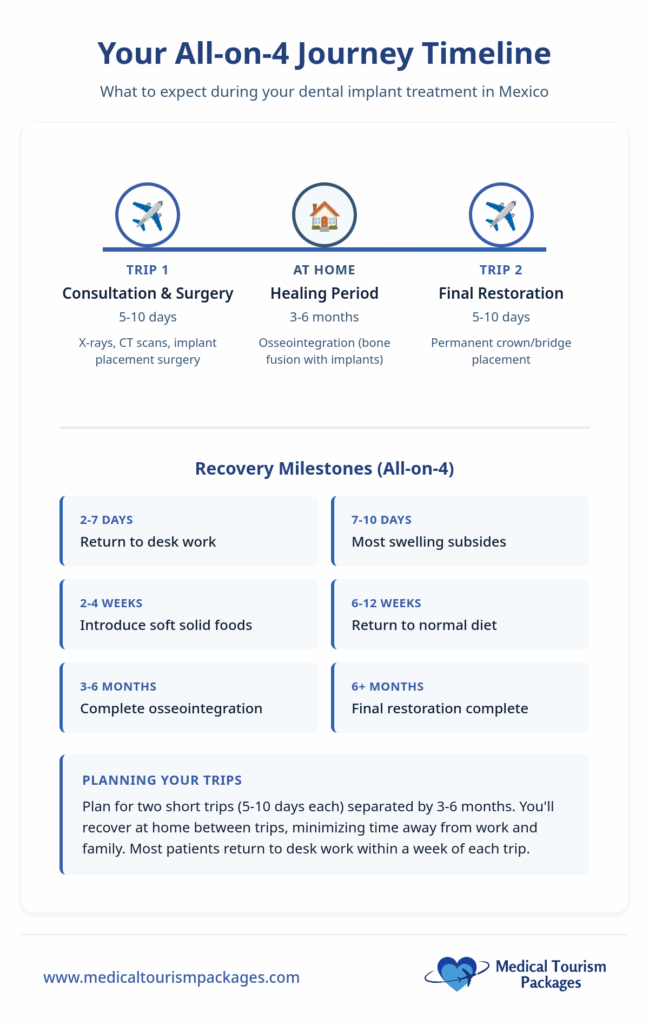
The dental implant process in Mexico takes two trips over 3 to 6 months. Trip 1 covers the consultation, scans, and surgery. A healing period at home follows. Trip 2 places the permanent restoration. Each trip lasts about 5 to 10 days.
The process follows the same biology as US procedures: titanium post placement, a 3 to 6 month osseointegration period for bone fusion, then permanent restoration. A 3D Cone Beam CT scan is the critical first step. It maps your jawbone, bone density, and nerve locations. If a clinic offers only 2D X-rays, treat that as a major red flag.
What Should You Do Before Traveling?
You should secure travel documents, consult your US dentist, and buy travel insurance before you go. Confirm that your home dentist will provide records and post-trip check-ups. Stock your home with soft foods for recovery.
- Secure travel documents: A valid US passport or passport card is required. For stays over 7 days, get the Forma Migratoria Múltiple (FMM) tourist permit (about $35, valid 180 days).
- Consult your US dentist: Ask for pre-trip records and confirm post-operative check-ups. If they refuse foreign-work follow-up, find a new dentist first.
- Ask which implant brands they service: This tells you which brand to demand in Mexico.
- Buy medical travel insurance: Policies like Medical Travel Shield cover return travel if complications arise, filling the warranty gap.
- Prepare a soft-food plan: Stock yogurt, mashed potatoes, protein shakes, and soups for recovery.
What Happens During Surgery and the Two Trips?
During surgery, you receive local anesthesia with optional sedation. The surgeon places the implants, and for full-arch cases attaches a temporary bridge the same day. Single implants take 1 to 2 hours, while All-on-4 takes 3 to 5 hours total, according to clinical procedure data.
The two-trip timeline breaks down as follows:
- Trip 1 (5-10 days): Consultation and 3D scans (days 1-2), surgery with a temporary prosthesis (days 3-5), and recovery monitoring before flying home (days 6-10).
- Healing phase (3-6 months at home): Osseointegration, where the jawbone fuses with the implants. Rushing this step is a primary cause of implant failure.
- Trip 2 (5-10 days): Abutment placement (days 1-3), the in-house CAD/CAM lab mills the permanent prosthesis (days 4-9), and final fitting (day 10).
On-site CAD/CAM labs deliver permanent restorations in days. US clinics that outsource to external labs may take weeks.
What Is Recovery and Follow-Up Like?
Recovery is quick for the soft-tissue phase but the bone takes months to fully fuse. Most patients return to a desk job within a week. A soft-food diet protects healing implants, especially after All-on-4.
| Recovery Milestone | Single Implant | All-on-4 (Full Arch) |
|---|---|---|
| Return to Work | 1-3 days | 2-7 days (desk job) |
| Return to Normal Diet | 7-10 days | 6-12 weeks soft food |
| Full Osseointegration | 3-6 months | 4-6 months |
| Final Restoration (Trip 2) | 4-6 months | 4-6 months |
After you return home, implants need the same care as natural teeth: brushing, flossing, and cleanings every 6 months. Your US dentist can handle routine maintenance and minor adjustments if you chose a globally recognized brand. Major repairs by another dentist usually void the warranty, so warranty-covered fixes require a return to the Mexican clinic at your own travel expense.
Is It Safe to Get Dental Implants in Mexico?
Yes, dental implants at properly vetted Mexican clinics are as safe as US procedures. The surgical principles, technology, and materials are identical. Safety depends almost entirely on which clinic you choose, so verify certifications rather than picking on price alone.
Reputable clinics with ISO 9001 certification follow international sterilization protocols. Sterilization standards do vary between clinics, so confirm ISO 9001 certification rather than assuming every office meets the same bar. Single-tooth implants carry a 97% survival rate at 10 years, according to the long-term Brånemark follow-up. For full-arch work, the Malo Clinic long-term study reports 91% to 93% implant survival at 10 to 18 years.
High case volume helps outcomes. A surgeon placing All-on-4 several times a week builds refined technique compared to a US dentist who performs it occasionally. The key factors are surgeon expertise, premium implant brands, 3D CBCT planning, and your own compliance with aftercare. Like many countries, Mexico ranks lower on the Global Peace Index 2024, so stay within the established medical districts of cities like Tijuana, Cancún, and Mexico City, where clinics serving international patients operate.
What Happens If Something Goes Wrong?
If something goes wrong, Mexico offers CONAMED, a free government arbitration system for medical disputes. CONAMED is the National Commission for Medical Arbitration. It is accessible to foreign patients, offers conciliation and binding arbitration, and can award compensation, typically faster than US malpractice litigation.
One of the biggest fears about dental tourism is having no recourse if a problem arises. CONAMED directly addresses that fear with a structured, no-cost process designed to protect patients. For minor issues after you return home, contact your Mexican clinic for remote triage first. For severe infection or bleeding, seek US emergency care, then notify the clinic.
How Do Payment, Insurance, and Warranties Work for Dental Implants in Mexico?
Payment, insurance, and warranties work differently for dental implants in Mexico than at home. You usually pay the clinic upfront, then seek partial reimbursement from a US PPO plan. Warranties cover parts but not your travel costs. Planning for each gap protects your budget.
Does US Insurance Reimburse Mexican Dental Work?
Yes, many US PPO plans reimburse Mexican dental work as out-of-network care. Plans from Aetna, Cigna, Delta Dental, and UnitedHealthcare often reimburse 50% to 80% of the Mexican cost, not the US cost. You pay the clinic in full, then submit an itemized bill and X-rays.
Consider a $1,000 implant in Mexico with a 60% reimbursement. You receive $600 back, netting $400 out of pocket. The same implant in the US might cost $5,000, leaving more out of pocket after insurance than your entire Mexico trip. The main challenge is cash flow, since you need the full amount upfront and then wait 4 to 8 weeks for reimbursement. Clinics accept cash, credit cards (with a 3% to 5% fee), and wire transfers, usually with a 25% to 50% deposit. Always request an itemized receipt in English with procedure codes.
What Do Warranties Cover (and Not Cover)?
Warranties cover material defects and implant failure, but not your travel costs. Reputable clinics offer 5 to 10 year warranties on implants and 2 to 5 year warranties on crowns and bridges. The clinic replaces failed parts free, but you pay to return.
- Covered: Implant integration failure, prosthetic material failure, and manufacturing defects.
- Not covered: Your travel costs, damage from neglect (smoking, poor hygiene, grinding without a night guard), repairs by other dentists, and natural complications like gum disease.
- The warranty gap: A free repair can still cost $1,000 or more in flights and hotels. This makes border cities like Tijuana and Los Algodones strategically better, since a return is a drive, not a flight.
- Travel insurance: Policies like Medical Travel Shield cover return travel for medically necessary repairs, filling the gap regardless of clinic location.
Who Is a Good Candidate for Dental Implants in Mexico?
A good candidate has enough healthy bone, controlled medical conditions, and has finished jaw growth. Age alone does not disqualify you. Patients in their 70s, 80s, and 90s receive implants successfully, and Los Algodones is popular with snowbird retirees.
Moderate to severe bone loss may require bone grafting before placement, which can add a third trip and extend treatment to 8 to 12 months. All-on-4 and All-on-6 angle the implants to avoid weak bone, often removing the need for grafting. A 3D CBCT scan at your consultation reveals whether you have enough bone, and many clinics offer free virtual consultations using your uploaded X-rays.
Controlled diabetes, osteoporosis, heart disease, and high blood pressure do not prevent treatment, though uncontrolled conditions raise risk. Patients on bisphosphonates like Fosamax usually need a 3 to 6 month pause before surgery, and blood-thinner users need coordination with their physician. There is no upper age limit, but the lower limit is the completion of jaw growth, typically age 18 to 21.
Frequently Asked Questions About Dental Implants in Mexico
Can I get dental implants in Mexico if I have diabetes or other medical conditions?
Yes, if your conditions are controlled and cleared by your doctor. Clinics typically ask for medical clearance confirming stable diabetes (often HbA1c under 7%), heart disease, hypertension, or osteoporosis. Bisphosphonates usually require a 3 to 6 month pause before surgery. Blood thinners must be coordinated with your prescribing physician. Bring a full medical history and medication list.
How long should I plan to stay in Mexico for dental implant treatment?
Plan two trips over 3 to 6 months. Trip 1 (about 5 to 10 days) covers consultation, CBCT scans, surgery with a temporary prosthesis, and monitored recovery while osseointegration begins. Trip 2 (about 3 to 10 days) covers abutment placement, lab work, and final fitting. Single implants typically need 3 to 5 days per trip, while All-on-4 needs 7 to 10 days.
What happens if I experience pain or complications after returning to the US?
Contact your Mexican clinic right away for remote triage. Minor issues like swelling or loose temporaries are managed with self-care guidance or a referred US dentist. Warranty-covered problems like implant failure require returning to Mexico, where the clinic covers the procedure but not travel. Medical travel insurance can cover return travel. For severe infection or bleeding, seek US emergency care first.
Do Mexican dentists speak English, and will I need a translator?
At clinics serving US patients, a translator is not typically needed. Coordinators are bilingual and handle logistics, and surgeons commonly speak professional-level English. You will receive explanations, consent forms, plans, and cost breakdowns in English. Verify this during your initial inquiry, and speak directly with the surgeon to ensure clear communication for complex decisions.
Can I finance my dental implant treatment in Mexico?
Yes. Options may include CareCredit at participating clinics, personal loans, 0% APR intro credit cards, home equity lines, and HSA or FSA funds. Some clinics partner with lenders offering 0% promos for 6 to 18 months or longer terms at about 15% to 25% APR. Expect a 25% to 50% deposit at booking, with the balance before surgery. Insurance reimbursements typically process in 4 to 8 weeks.
What documents do I need to bring to my dental appointment in Mexico?
Bring a US passport or passport card, recent dental records and X-rays if available, a full medication list with dosages, and a medical clearance letter for chronic conditions. Include insurance policy details and claim forms, plus payment methods. For stays over 7 days, obtain the FMM tourist permit (about $35). If you lack records, top clinics will take a 3D CBCT scan during consultation.
How do I know if a Mexican dental clinic is legitimate and safe?
Verify three things: the dentist’s Cédula Profesional license via Mexico’s Ministry of Education site, ISO 9001 certification for quality and sterilization, and written confirmation of implant brands such as Straumann or Nobel Biocare. Cross-check reviews on Google, Facebook, RealSelf, and forums. Red flags include refusing to share the Cédula number, using only 2D X-rays, or promising permanent teeth in 3 days. Request a video call with the surgeon before booking.
Is it better to get All-on-4 or traditional implants in Mexico?
It depends on your case, not just price. All-on-4 suits full-arch restoration, helps avoid extensive grafting when bone is limited, and costs $6,000 to $10,000 per arch in Mexico. Traditional implants are best for a few missing teeth with good bone and cost $650 to $1,000 per implant. If you are advised All-on-4 but only need 3 to 4 implants, seek a second opinion.
Ready to Start Your Dental Implants Journey in Mexico?
Medical Tourism Packages coordinates your entire dental implant journey in Mexico. We connect you with pre-vetted clinics, verify Cédula Profesional licenses, ISO 9001 certification, and premium implant brands, and arrange travel, recovery hotels, and bilingual support. We also help with US dentist coordination and insurance reimbursement.
Contact our dental tourism team for a free consultation and a transparent, personalized quote.