Book Appointment Now



Orthopedic Surgery in Costa Rica: Complete Guide to Costs and Top Surgeons
 By
By
Orthopedic surgery in Costa Rica costs 60 to 84 percent less than in the United States, with JCI-accredited San José hospitals and surgeons trained in the U.S., Canada, and Europe.
Knee replacement runs $8,000 to $14,900 and hip replacement $10,000 to $14,900 at Hospital CIMA San José and Hospital Clínica Bíblica, both JCI-accredited. Surgeons such as Dr. Oscar Longino Soto Oeding have performed 3,000-plus procedures using Zimmer Biomet, Stryker, and DePuy Synthes implants.
Our network connects you with vetted, JCI-accredited orthopedic hospitals in the San José metro area, each verified for accreditation, implant standards, and international patient support. Below you will find procedure cost tables for knee, hip, and ACL surgery, hospital comparisons, a Costa Rica versus Curaçao breakdown, recovery timelines, and answers to common patient questions.
What Is Orthopedic Surgery in Costa Rica?
Orthopedic surgery in Costa Rica treats bones, joints, ligaments, tendons, and muscles for medical tourists who want lower costs without lower quality. Common procedures include knee replacement, hip replacement, spinal fusion, ACL reconstruction, and rotator cuff repair.
Most orthopedic care for international patients runs through three San José hospitals: Hospital CIMA San José in Escazú, Hospital Clínica Bíblica downtown, and Hospital La Católica in Guadalupe. Two of these hold JCI (Joint Commission International) accreditation, and all stock the same implant brands used in U.S. operating rooms.
The appeal is simple. Patients save 60 percent or more versus U.S. prices while surgeons trained in the United States, Canada, and Europe perform the work. Costs typically run 60 to 84 percent below U.S. prices, even after you add flights and a recovery hotel.
Why Should You Choose Costa Rica for Orthopedic Surgery?
You should choose Costa Rica because it pairs JCI-accredited hospitals with short flights, fast scheduling, and savings of 60 to 84 percent. The country also has a stable healthcare system built to handle foreign patients from start to finish. For full travel planning, see our guide for American medical tourists in Costa Rica.
Here are the main reasons patients pick Costa Rica for orthopedic care:
- Large savings: Knee and hip replacements cost 60 to 84 percent less than in the United States, even after travel costs.
- Short flights: Direct flights from major U.S. hubs take 3 to 6 hours, with little time zone change.
- JCI accreditation: Hospital CIMA San José and Hospital Clínica Bíblica meet the same JCI safety standards as leading U.S. facilities.
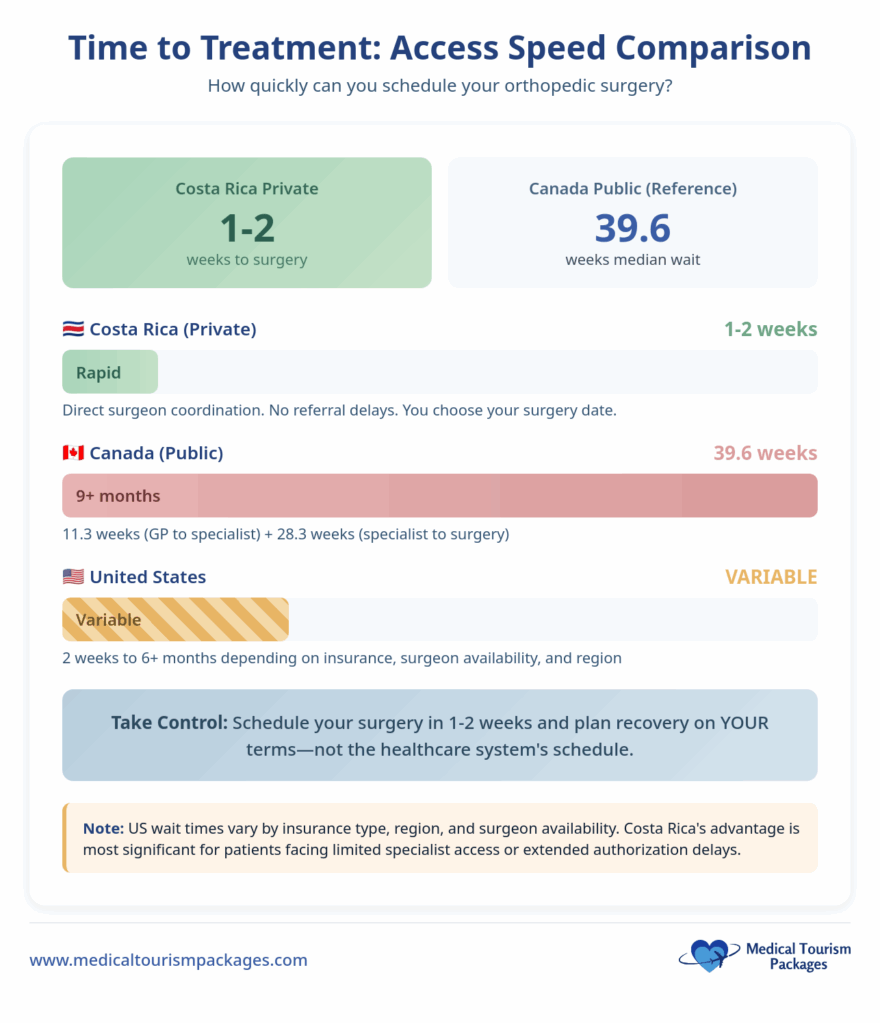
- Fast scheduling: Surgery is often booked within 1 to 2 weeks of consultation, a strong draw for Canadian patients facing long public waits.
- Tourism infrastructure: English-speaking coordinators, recovery hotels, and post-operative physical therapy are built for international patients.
What Types of Orthopedic Surgeries Are Available in Costa Rica?
Costa Rican JCI-accredited hospitals offer the full range of orthopedic procedures using FDA-approved implants from Zimmer Biomet, Stryker, and DePuy Synthes. The four main categories cover joints, spine, sports injuries, and trauma.
The most common procedures fall into these categories:
- Joint replacement: Total hip replacement, total knee replacement, partial knee replacement, hip resurfacing, and revision joint surgery, using ceramic and titanium implants.
- Spine surgery: Spinal fusion (cervical, thoracic, lumbar), herniated disc treatment, spinal stenosis decompression, and minimally invasive spine techniques.
- Sports medicine: ACL reconstruction, rotator cuff repair, meniscus repair, arthroscopic shoulder surgery, and labral tear repair.
- Trauma and reconstruction: Fracture repair with internal fixation, corrective osteotomy, and non-union fracture treatment. Elective cases suit medical tourists best.
How Much Does Orthopedic Surgery Cost in Costa Rica?
Orthopedic surgery in Costa Rica costs 60 to 84 percent less than in the United States. Knee replacement runs $8,000 to $14,900, hip replacement runs $10,000 to $14,900, and these prices include surgeon fees, anesthesia, hospital stay, and standard post-operative care.
Here is how core orthopedic procedures compare to U.S. prices:
| Procedure | Costa Rica Cost (USD) | U.S. Cost (USD) | Savings |
|---|---|---|---|
| Total Knee Replacement | $8,000–$14,900 | $20,000–$50,000 | 26–84% |
| Total Hip Replacement | $10,000–$14,900 | $25,000–$55,000 | 40–82% |
| Spinal Fusion | $9,500–$15,700 | ~$110,000 | up to 86% |
| ACL Reconstruction | $3,300–$8,900 | $12,500–$22,000 | 60–75% |
| Rotator Cuff Repair | $5,980–$8,900 | $9,000–$13,500 | 34–50% |
Knee and hip prices follow verified medical-tourism figures from MedicalTourismCo and Medical Tourism Packages. Spinal fusion, ACL, and rotator cuff figures come from medical-tourism aggregators such as MedicalTourismCo and Lyfboat, so always request an itemized quote, since pre-operative testing, medications, flights, and recovery lodging are billed separately.
How Much Does Knee Replacement Cost in Costa Rica?
Knee replacement costs $8,000 to $14,900 in Costa Rica versus $20,000 to $50,000 in the United States, a saving of 26 to 84 percent. The price includes the surgeon, anesthesia, hospital stay, and standard aftercare at a JCI-accredited San José hospital.
Here is the knee replacement breakdown:
| Item | Costa Rica | United States |
|---|---|---|
| Total knee replacement (surgical package) | $8,000–$14,900 | $20,000–$50,000 |
| Typical savings vs U.S. | 26–84% (roughly $12,000–$35,000 less) | |
| Hospital stay | About 2 days, then outpatient rehab | |
Implant survival is strong. According to the UK National Joint Registry, knee implants show 96.7 percent survival at 10 years and 95.4 percent at 15 years. For deeper detail, see our guide to knee replacement surgery in Costa Rica.
How Much Does Hip Replacement Cost in Costa Rica?
Hip replacement costs $10,000 to $14,900 in Costa Rica versus $25,000 to $55,000 in the United States, a saving of 40 to 82 percent. That can mean $15,000 to $40,000 less for the same titanium or ceramic implant brands.
Here is the hip replacement breakdown:
| Item | Costa Rica | United States |
|---|---|---|
| Total hip replacement (surgical package) | $10,000–$14,900 | $25,000–$55,000 |
| Typical savings vs U.S. | 40–82% (roughly $15,000–$40,000 less) | |
| Hospital stay | About 2 days, then outpatient rehab | |
Hip implants last well. A multi-registry meta-analysis reports average survivorship above 92 percent at 30 years, and 93.6 percent at 20 years. For procedure-specific detail, see our guide to hip replacement surgery in Costa Rica.
How Much Does ACL Reconstruction Cost in Costa Rica vs the USA?
ACL reconstruction costs roughly $3,300 to $8,900 in Costa Rica versus $12,500 to $22,000 in the United States, a saving of 60 to 75 percent. This sports-medicine procedure usually needs 1 to 2 hospital days plus 2 to 3 weeks of local rehab.
Here is the ACL reconstruction comparison:
| Item | Costa Rica | United States |
|---|---|---|
| ACL reconstruction | $3,300–$8,900 | $12,500–$22,000 |
| Hospital stay | 1–2 days, outpatient in most cases | |
| Local rehab before flying | About 2–3 weeks | |
ACL and rotator cuff figures come from medical-tourism sources such as Lyfboat and Health-Tourism, so confirm the exact price in your written quote.
Which Are the Best Hospitals for Orthopedic Surgery in Costa Rica?
The best hospitals are Hospital CIMA San José and Hospital Clínica Bíblica, both JCI-accredited, plus Hospital La Católica, which holds local accreditation. All three sit in the San José metro area and run dedicated orthopedic departments.
Here is how the three leading orthopedic hospitals compare:
| Hospital | Location | Accreditation | Key Features |
|---|---|---|---|
| Hospital CIMA San José | Escazú | JCI accredited (since 2008); 103 beds | Consultative ties with Harvard and Cleveland Clinic; joint replacement, spine, sports medicine; robotic surgery suite |
| Hospital Clínica Bíblica | San José downtown | JCI accredited (since 2007); 96 beds | Home to Dr. Oscar Longino Soto Oeding; total joint replacement and arthroscopic surgery; robotic surgery suite |
| Hospital La Católica | Guadalupe | Locally accredited (not JCI); 60 beds | Medical tourism coordination; English-speaking patient liaisons; 1.5T MRI and 64-slice CT |
All three run modern operating rooms with laminar airflow to lower infection risk and stock FDA-approved implants. If you want JCI accreditation specifically, choose Hospital CIMA San José or Hospital Clínica Bíblica.
Who Are the Top Orthopedic Surgeons in Costa Rica?
Top orthopedic surgeons in Costa Rica train at recognized institutions in the United States, Canada, and Europe. The most cited is Dr. Oscar Longino Soto Oeding at Hospital Clínica Bíblica, who has performed more than 3,000 orthopedic procedures.
Dr. Soto Oeding specializes in total joint replacement and sports medicine, and holds International Affiliate Membership in the American Academy of Orthopaedic Surgeons (AAOS). About 30 percent of his patients travel from outside Costa Rica. Hospital CIMA’s orthopedics clinic also maintains consultative relationships with Harvard-affiliated hospitals and Cleveland Clinic.
Before you commit, verify these credentials for any surgeon:
- Where they completed medical school, residency, and fellowship training.
- Yearly volume for your exact procedure (aim for 50 or more cases a year).
- Full surgical privileges at a JCI-accredited hospital.
- Their plan for monitoring you and handling complications after you fly home.
How Does Costa Rica Compare to Curaçao for Orthopedic Surgery?
Costa Rica offers two JCI-accredited hospitals and U.S. academic affiliations, while Curaçao offers English as a working language and European-trained surgeons. Both are safe Caribbean-region options, but Costa Rica has more frequent direct U.S. flights and deeper medical tourism infrastructure.
Here is how the two destinations compare for joint replacement:
| Factor | Costa Rica | Curaçao |
|---|---|---|
| JCI-accredited hospitals | Yes (CIMA San José, Clínica Bíblica) | Not publicly confirmed |
| Surgeon training | U.S., Canada, Europe | European-trained specialists |
| Implant brands | Zimmer Biomet, Stryker, DePuy Synthes | Zimmer Biomet (Vanguard knee) |
| Working language | Spanish, with English coordinators | Dutch and English |
| Direct U.S. flights | Frequent (Miami, NY, Houston, LA) | Fewer routes |
If JCI accreditation, named academic affiliations, and easy direct flights matter most, Costa Rica is the stronger pick. If you want English as the primary working language, the Curaçao International Clinic is worth comparing on price and surgeon background.
How Safe Is Orthopedic Surgery in Costa Rica?
Yes, orthopedic surgery in Costa Rica is safe at JCI-accredited hospitals, which meet the same standards as top U.S. facilities. According to the UK National Joint Registry, knee implants survive about 96 percent at 10 years, and hip implants exceed 92 percent at 30 years per multi-registry data.
JCI accreditation requires strict infection control, sterilization, and surgical safety protocols. Hospital CIMA San José and Hospital Clínica Bíblica run operating rooms with laminar airflow systems, keep on-site intensive care, and maintain blood banks. These safeguards help keep outcomes in line with international benchmarks.
What Are the Steps to Getting Orthopedic Surgery in Costa Rica?
You get orthopedic surgery in Costa Rica through six steps, from consultation to flying home. The full journey usually spans 6 to 12 weeks, including the 3 to 4 week recovery stay before air travel.
Follow these six steps:
- 1. Research and consult: Pick a JCI-accredited hospital and book a video consultation ($50–$100). Send your medical history and recent imaging for a written treatment plan.
- 2. Medical clearance: Get clearance from your home physician 2 to 4 weeks out. Bring an EKG if over 50, a blood panel, current imaging, and a passport valid 6 months.
- 3. Travel to Costa Rica: Fly into Juan Santamaría International Airport. Arrive 24 to 48 hours early for final testing and to shake off travel fatigue.
- 4. Surgery and hospital stay: Joint replacements take 1.5 to 3 hours, spinal fusion 3 to 6 hours. Hospital stays run 2 to 3 days for joints and 3 to 5 days for spine. Physical therapy starts on day 1 or 2.
- 5. Recovery in Costa Rica: Stay in a recovery hotel and attend outpatient therapy 3 to 5 times a week. Your surgeon checks the wound and removes sutures at 10 to 14 days.
- 6. Return home: Wait at least 3 to 4 weeks before flying to lower clot risk. Get a “fit to fly” letter and full medical records before you leave.
How Long Do You Need to Stay in Costa Rica After Surgery?
You need to stay 3 to 4 weeks in Costa Rica after major orthopedic surgery before flying home. The extended stay reduces the risk of deep vein thrombosis (blood clots) tied to long-haul flights after joint or spine procedures.
Here are recovery timelines by procedure:
| Procedure | Hospital Stay | Walk Independently | Return to Work | Full Recovery | Minimum Before Flying |
|---|---|---|---|---|---|
| Hip Replacement | 2–3 days | 1–2 weeks | 6–8 weeks | 3–6 months | 3–4 weeks |
| Knee Replacement | 2–3 days | 2–3 weeks | 6–8 weeks | 3–6 months | 3–4 weeks |
| Spinal Surgery | 3–5 days | 1–2 weeks | 4–6 weeks | 3–4 months | 3–4 weeks |
Physical therapy drives recovery and costs far less here, about $30 to $50 a session versus $150 to $200 in the United States. Therapy follows AAOS-style phases: gentle motion in week one, strength building through week four, and functional training to week twelve. Never book a return flight until your surgeon clears you.
What Are the Advantages and Disadvantages of Orthopedic Surgery in Costa Rica?
The main advantage is large savings with JCI-quality care, and the main disadvantage is the extended stay and harder follow-up across borders. Weighing both helps you decide if traveling for surgery fits your situation.
Key advantages include:
- Cost savings: 60 to 84 percent less than U.S. prices without cutting quality.
- Fast access: Surgery in 1 to 2 weeks versus long public waits in Canada.
- JCI quality: Two San José hospitals meet the same standards as U.S. facilities.
- Trained surgeons: Many hold U.S., Canadian, or European training and AAOS membership.
The main disadvantages are practical:
- Language gaps: Nurses and therapists may have limited English, and some discharge papers come in Spanish.
- Follow-up coordination: Some home physicians decline care for surgeries done abroad, and records do not always transfer cleanly.
- Extended stay cost: The 3 to 4 week stay adds $2,000 to $4,000 in recovery lodging plus time away from work and family.
Who Is a Good Candidate for Orthopedic Surgery in Costa Rica?
You are a good candidate if you need elective orthopedic surgery, can stay 3 to 4 weeks, and have a home physician willing to follow up. Emergency cases and complex revisions are usually better handled at home.
Good candidates usually share these traits:
- Chronic, elective conditions such as osteoarthritis, degenerative disc disease, or sports injuries.
- Reasonable health with well-controlled chronic conditions.
- Ability to stay abroad 3 to 4 weeks with flexible timing.
- A home-country physician confirmed to provide follow-up care.
You are not a good candidate if you have emergency fractures or dislocations, complex revision needs requiring subspecialty care, severe heart disease or poorly controlled diabetes, or no home physician for follow-up.
What Are the Potential Risks and Complications?
All surgery carries risk, and medical travel adds distance and coordination challenges. The most cited orthopedic risks are deep joint infection, blood clots, implant loosening over time, and the need for revision surgery.
Travel introduces specific concerns to plan for:
- Deep vein thrombosis: Long flights raise clot risk, which is why the 3 to 4 week minimum stay exists.
- Distance from your surgeon: Complications can arise after you fly home, away from the surgical team.
- Insurance gaps: Most U.S. plans exclude complications from surgery abroad.
If you develop fever, severe pain, wound drainage, chest pain, or breathing trouble after returning home, seek urgent local care and contact your Costa Rican surgeon. Many hospitals offer remote consultations and financial guarantees for revision surgery if you return, though travel costs are yours. Budget for medical travel insurance with complication and evacuation coverage, usually $200 to $500.
What Should You Know About Traveling to Costa Rica for Surgery?
You can travel to Costa Rica without a visa as a U.S., Canadian, or most European citizen, staying up to 180 days. Direct flights land at Juan Santamaría International Airport, about 20 minutes from San José metro hospitals.
Here are flight times and rough roundtrip costs from major U.S. cities:
| Origin City | Airlines | Flight Time | Approx. Roundtrip |
|---|---|---|---|
| Miami | American, Avianca | 3.0 hrs | $280–$500 |
| Houston | United | 3.75 hrs | $300–$550 |
| New York (JFK) | JetBlue | 5.5 hrs | $350–$650 |
| Los Angeles | United, Delta, American | 5.75 hrs | $300–$550 |
Costa Rica uses the colón (CRC), but private hospitals quote and accept payment in U.S. dollars, and cards are widely taken. Keep your passport valid for at least 6 months and buy refundable tickets when possible, since surgery dates can shift.
Is Costa Rica Right for Your Orthopedic Surgery?
Costa Rica is right for you if savings of 60 to 84 percent, JCI-accredited hospitals, and fast scheduling outweigh the extended stay and cross-border follow-up. It works best for planned, elective procedures with solid recovery support.
Before deciding, confirm that your savings stay large after recovery lodging, that you will use only JCI-accredited facilities, that your surgeon has strong credentials and high case volume, and that your home physician has agreed to follow-up care. Also make sure you can commit 4 to 6 weeks total without major hardship.
Ready to Explore Your Orthopedic Surgery Options in Costa Rica?
Medical Tourism Packages coordinates your full orthopedic surgery journey to Costa Rica. We connect you with JCI-accredited hospitals such as Hospital CIMA San José and Hospital Clínica Bíblica, arrange travel and recovery lodging, and provide bilingual support through treatment and rehab.
Contact us today for a free consultation and a personalized orthopedic surgery cost breakdown for Costa Rica.
Frequently Asked Questions About Orthopedic Surgery in Costa Rica
How much cheaper is orthopedic surgery in Costa Rica compared to the United States?
Orthopedic surgery in Costa Rica is typically 60 to 84 percent cheaper than in the U.S. Knee replacement runs $8,000 to $14,900 versus $20,000 to $50,000, and hip replacement runs $10,000 to $14,900 versus $25,000 to $55,000. That can save you $15,000 to $40,000 per joint.
What do the quoted prices include, and what extra costs should I budget for?
Quoted surgical prices generally include surgeon fees, anesthesia, hospital stay, and standard post-operative care at JCI-accredited facilities. Plan extra for recovery lodging ($2,000 to $4,000 for 3 to 4 weeks), flights, medications, physical therapy, and pre-operative testing, which are billed separately.
Are Costa Rican orthopedic surgeons qualified to perform complex procedures?
Yes. Leading surgeons train at recognized institutions in the U.S., Canada, and Europe. For example, Dr. Oscar Longino Soto Oeding at Hospital Clínica Bíblica has performed 3,000-plus orthopedic procedures and holds AAOS International Affiliate Membership. Verify training, annual case volume (aim for 50-plus), and JCI hospital privileges.
Which Costa Rican hospitals should I consider for orthopedic surgery?
Consider Hospital CIMA San José (Escazú; JCI-accredited since 2008; Harvard and Cleveland Clinic ties) and Hospital Clínica Bíblica (JCI-accredited since 2007; home to Dr. Soto Oeding). Hospital La Católica (Guadalupe) is locally accredited, not JCI, but strong on medical tourism coordination. All stock FDA-approved implants.
Do Costa Rican hospitals use the same implants as hospitals in the United States?
Yes. JCI-accredited hospitals in Costa Rica use FDA-approved implants from Zimmer Biomet, Stryker, and DePuy Synthes, the same brands used in U.S. operating rooms. The UK National Joint Registry reports knee implant survival of 96.7 percent at 10 years. Request brand, model, and lot numbers and keep your implant ID card.
How does Costa Rica compare to Curaçao for knee replacement?
Costa Rica offers two JCI-accredited hospitals, U.S. academic affiliations, and frequent direct flights from Miami, Houston, New York, and Los Angeles. Curaçao’s clinics use English as a working language and European-trained surgeons but have no publicly confirmed JCI accreditation. For accreditation and flight access, Costa Rica is the stronger choice.
Will my insurance cover orthopedic surgery in Costa Rica?
Most U.S. insurance plans do not cover elective procedures performed abroad and may exclude complications from international surgery. Some international policies or certain Medicare Advantage plans offer limited benefits, so verify with your insurer. Many patients pay out of pocket and buy medical travel insurance ($200 to $500) with complication and evacuation coverage.
How long do I need to stay in Costa Rica after orthopedic surgery?
Plan a minimum 3 to 4 week stay before flying home to reduce blood clot (DVT) risk after major procedures. Hospitalization runs 2 to 3 days for joint replacements and 3 to 5 days for spinal surgery, with the rest spent in a recovery hotel. Do not book a return flight until your surgeon issues written “fit to fly” clearance.
What happens if I have complications after returning home?
Contact your Costa Rican surgeon right away, since most JCI hospitals offer video and WhatsApp follow-ups. Seek urgent local care for red-flag symptoms such as fever, chest pain, shortness of breath, severe pain, or wound drainage. Many facilities offer financial guarantees for revision surgery if you return, though travel costs are yours.
Can I travel alone for orthopedic surgery in Costa Rica?
It is possible, but bringing a companion is strongly recommended because mobility is limited early on. If you must travel solo, choose a recovery facility with 24-hour nursing and full support. Specialized centers in Escazú offer this care, usually $500 to $1,000 per week.