Reservar cita



Cirugía Ortopédica en Costa Rica: Guía completa de costos y mejores cirujanos
 Por
Por
La cirugía ortopédica en Costa Rica cuesta entre un 60 y un 84 por ciento menos que en Estados Unidos, y cuenta con hospitales de San José acreditados por la JCI y cirujanos capacitados en Estados Unidos, Canadá y Europa.
El costo de un reemplazo de rodilla oscila entre $8,000 y $14,900, y el de un reemplazo de cadera, entre $10,000 y $14,900 en el Hospital CIMA San José y en el Hospital Clínica Bíblica, ambos acreditados por la JCI. Cirujanos como el Dr. Oscar Longino Soto Oeding han realizado más de 3,000 procedimientos utilizando implantes de Zimmer Biomet, Stryker y DePuy Synthes.
Nuestra red te conecta con hospitales ortopédicos acreditados por la JCI y cuidadosamente seleccionados en el área metropolitana de San José, cada uno de los cuales ha sido verificado en cuanto a su acreditación, los estándares de implantes y la atención a pacientes internacionales. A continuación encontrarás tablas con los costos de los procedimientos de cirugía de rodilla, cadera y ligamento cruzado anterior (LCA), comparativas de hospitales, un desglose comparativo entre Costa Rica y Curazao, tiempos de recuperación y respuestas a las preguntas más comunes de los pacientes.
¿Qué es la cirugía ortopédica en Costa Rica?
La cirugía ortopédica en Costa Rica trata los huesos, las articulaciones, los ligamentos, los tendones y los músculos de los turistas médicos que buscan costos más bajos sin sacrificar la calidad. Entre los procedimientos más comunes se encuentran el reemplazo de rodilla, el reemplazo de cadera, la fusión espinal, la reconstrucción del ligamento cruzado anterior (LCA) y la reparación del manguito rotador.
La mayor parte de la atención ortopédica para pacientes internacionales se brinda en tres hospitales de San José: Hospital CIMA San José en Escazú, Hospital Clínica Bíblica en el centro de la ciudad y Hospital La Católica en Guadalupe. Dos de ellos cuentan con la acreditación de la JCI (Joint Commission International), y todos disponen de las mismas marcas de implantes que se utilizan en los quirófanos de Estados Unidos.
El atractivo es sencillo. Los pacientes ahorran un 60 por ciento o más en comparación con los precios de Estados Unidos, mientras que los cirujanos, capacitados en Estados Unidos, Canadá y Europa, realizan la intervención. Los costos suelen ser entre un 60 y un 84 por ciento más bajos que los precios de Estados Unidos, incluso después de sumar los vuelos y el hotel para la recuperación.
¿Por qué deberías elegir Costa Rica para una cirugía ortopédica?
Deberías elegir Costa Rica porque combina hospitales acreditados por la JCI con vuelos cortos, agendación rápida y ahorros del 60 al 84 por ciento. El país también cuenta con un sistema de salud estable, diseñado para atender a pacientes extranjeros de principio a fin. Para una planificación completa del viaje, consulta nuestra guía para turistas médicos estadounidenses en Costa Rica.
Estas son las principales razones por las que los pacientes eligen Costa Rica para recibir atención ortopédica:
- Grandes ahorros: Las cirugías de reemplazo de rodilla y cadera cuestan entre un 60 y un 84 por ciento menos que en Estados Unidos, incluso sumando los gastos de viaje.
- Vuelos cortos: Los vuelos directos desde los principales aeropuertos de conexión de EE. UU. duran entre 3 y 6 horas, con una diferencia de huso horario mínima.
- Acreditación de la JCI: El Hospital CIMA San José y el Hospital Clínica Bíblica cumplen con los mismos estándares de seguridad de la JCI que los principales centros de salud de Estados Unidos.
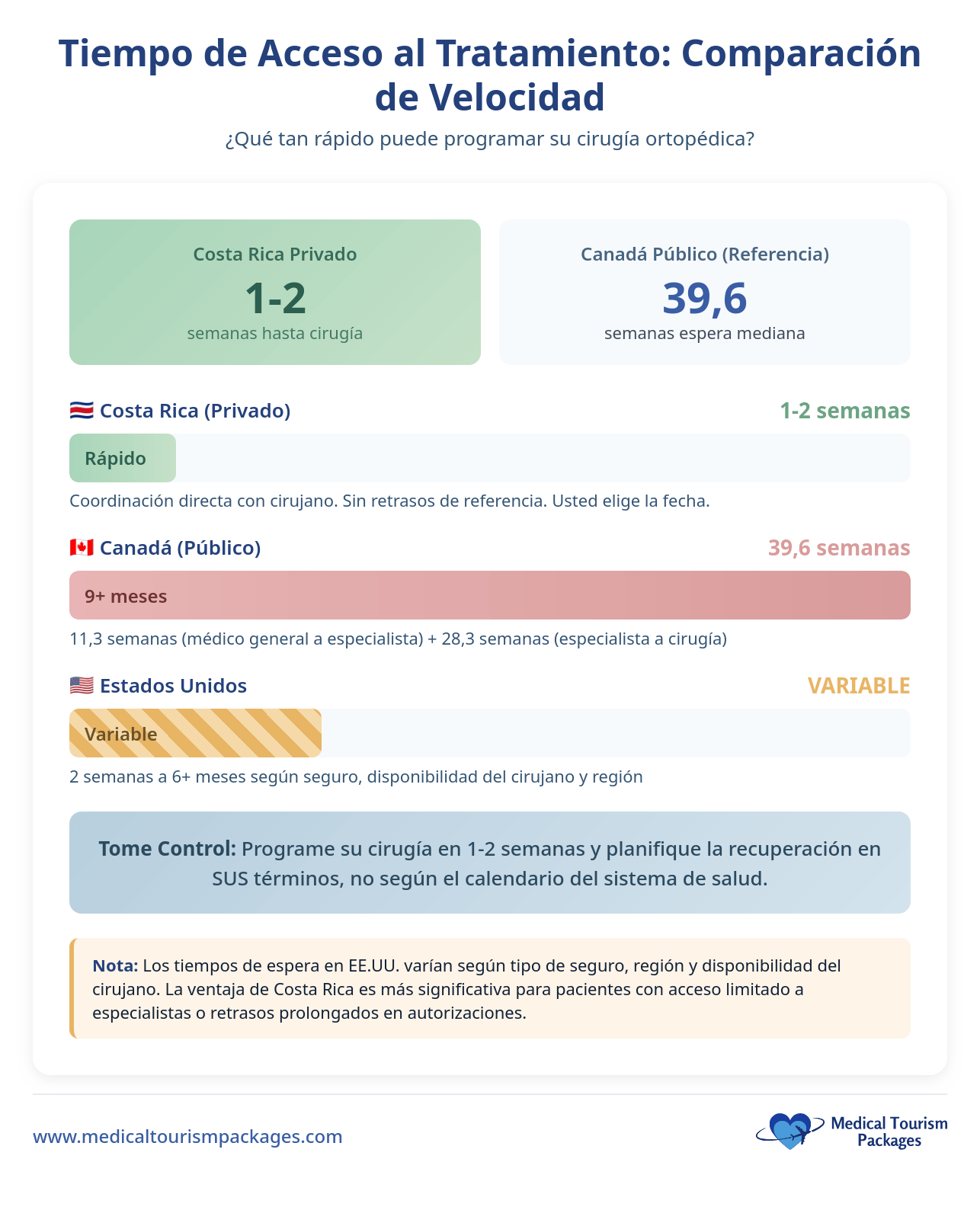
- Agendación rápida: La cirugía suele programarse entre 1 y 2 semanas después de la consulta, lo que resulta muy atractivo para los pacientes canadienses que se enfrentan a largas esperas en el sistema público.
- Infraestructura turística: Se cuenta con coordinadores que hablan inglés, hoteles de recuperación y servicios de fisioterapia posoperatoria, todo ello diseñado para pacientes internacionales.
¿Qué tipos de cirugías ortopédicas están disponibles en Costa Rica?
Los hospitales costarricenses acreditados por la JCI ofrecen una gama completa de procedimientos ortopédicos utilizando implantes aprobados por la FDA de Zimmer Biomet, Stryker y DePuy Synthes. Las cuatro categorías principales abarcan articulaciones, columna vertebral, lesiones deportivas y traumatología.
Los procedimientos más comunes se clasifican en las siguientes categorías:
- Reemplazo articular: Reemplazo total de cadera, reemplazo total de rodilla, reemplazo parcial de rodilla, recubrimiento de cadera y cirugía de revisión articular, utilizando implantes de cerámica y titanio.
- Cirugía de columna: Fusión espinal (cervical, torácica, lumbar), tratamiento de hernias discales, descompresión por estenosis espinal y técnicas mínimamente invasivas para la columna.
- Medicina deportiva: Reconstrucción del ligamento cruzado anterior (LCA), reparación del manguito rotador, reparación de menisco, cirugía artroscópica de hombro y reparación de desgarro del labrum.
- Traumatología y reconstrucción: Tratamiento de fracturas con fijación interna, osteotomía correctiva y tratamiento de fracturas sin unión. Los casos electivos son los más adecuados para los turistas médicos.
¿Cuánto cuesta la cirugía ortopédica en Costa Rica?
La cirugía ortopédica en Costa Rica cuesta entre un 60 y un 84 por ciento menos que en Estados Unidos. El reemplazo de rodilla cuesta entre $8,000 y $14,900, el de cadera entre $10,000 y $14,900, y estos precios incluyen los honorarios del cirujano, la anestesia, la estancia hospitalaria y la atención posoperatoria estándar.
A continuación se muestra una comparación entre los precios de los procedimientos ortopédicos más comunes y los de Estados Unidos:
| Procedimiento | Costa Rica Costo (USD) | Costo en EE. UU. (USD) | Ahorro |
|---|---|---|---|
| Sustitución total de rodilla | $8,000–$14,900 | $20,000–$50,000 | 26–84% |
| Prótesis total de cadera | $10 000–$14 900 | $25,000–$55,000 | 40–82% |
| Fusión espinal | $9,500–$15,700 | ~$110,000 | hasta 86% |
| Reconstrucción del LCA | $3,300–$8,900 | $12,500–$22,000 | 60-75% |
| Reparación del manguito de los rotadores | $5,980–$8,900 | $9,000–$13,500 | 34-50% |
Los precios de las cirugías de rodilla y cadera se basan en cifras verificadas de turismo médico proporcionadas por MedicalTourismCo y Medical Tourism Packages. Las cifras sobre la fusión espinal, el ligamento cruzado anterior (LCA) y el manguito rotador provienen de agregadores de turismo médico como MedicalTourismCo y Lyfboat, por lo que siempre debes solicitar una cotización detallada, ya que los exámenes preoperatorios, los medicamentos, los vuelos y el alojamiento durante la recuperación se facturan por separado.
¿Cuánto cuesta un reemplazo de rodilla en Costa Rica?
El costo de un reemplazo de rodilla oscila entre $8,000 y $14,900 en Costa Rica, frente a los $20,000 a $50,000 en Estados Unidos, lo que representa un ahorro del 26 al 84 por ciento. El precio incluye los honorarios del cirujano, la anestesia, la estancia hospitalaria y el cuidado posoperatorio estándar en un hospital de San José acreditado por la JCI.
A continuación se presenta el desglose de la artroplastia de rodilla:
| Artículo | Costa Rica | Estados Unidos |
|---|---|---|
| Prótesis total de rodilla (paquete quirúrgico) | $8,000–$14,900 | $20,000–$50,000 |
| Ahorros típicos en comparación con EE. UU. | 26–84% (aproximadamente entre $12 000 y $35 000 menos) | |
| Hospitalización | Alrededor de 2 días, y luego rehabilitación ambulatoria | |
La supervivencia de los implantes es alta. Según el Registro Nacional de Articulaciones del Reino Unido, los implantes de rodilla presentan una supervivencia del 96,7 por ciento a los 10 años y del 95,4 por ciento a los 15 años. Para obtener más detalles, consulte nuestra guía sobre la cirugía de reemplazo de rodilla en Costa Rica.
¿Cuánto cuesta un reemplazo de cadera en Costa Rica?
El costo de un implante de cadera oscila entre $10,000 y $14,900 en Costa Rica, frente a los $25,000 a $55,000 en Estados Unidos, lo que representa un ahorro del 40 al 82 por ciento. Esto puede significar entre $15,000 y $40,000 menos por las mismas marcas de implantes de titanio o cerámica.
A continuación te presento el desglose de la cirugía de reemplazo de cadera:
| Artículo | Costa Rica | Estados Unidos |
|---|---|---|
| Prótesis total de cadera (paquete quirúrgico) | $10 000–$14 900 | $25,000–$55,000 |
| Ahorros típicos en comparación con EE. UU. | 40–82% (aproximadamente entre $15 000 y $40 000 menos) | |
| Hospitalización | Alrededor de 2 días, y luego rehabilitación ambulatoria | |
Los implantes de cadera tienen una buena durabilidad. Un metaanálisis de varios registros indica una supervivencia promedio superior al 92 por ciento a los 30 años y del 93,6 por ciento a los 20 años. Para obtener detalles específicos sobre el procedimiento, consulte nuestra guía sobre la cirugía de reemplazo de cadera en Costa Rica.
¿Cuánto cuesta una reconstrucción del ligamento cruzado anterior (LCA) en Costa Rica en comparación con los Estados Unidos?
La reconstrucción del ligamento cruzado anterior (LCA) cuesta aproximadamente entre $3,300 y $8,900 en Costa Rica, frente a los $12,500 a $22,000 en Estados Unidos, lo que supone un ahorro del 60 al 75 por ciento. Este procedimiento de medicina deportiva suele requerir de 1 a 2 días de hospitalización, además de 2 a 3 semanas de rehabilitación local.
A continuación se presenta la comparación de las técnicas de reconstrucción del ligamento cruzado anterior (LCA):
| Artículo | Costa Rica | Estados Unidos |
|---|---|---|
| Reconstrucción del ligamento cruzado anterior | $3,300–$8,900 | $12,500–$22,000 |
| Hospitalización | 1–2 días; en la mayoría de los casos, de forma ambulatoria | |
| Rehabilitación local antes de volar | Alrededor de 2 a 3 semanas | |
Las cifras relativas a la ligadura cruzada anterior (LCA) y el manguito rotador provienen de fuentes de turismo médico como Lyfboat y Health-Tourism, así que confirma el precio exacto en tu cotización por escrito.
¿Cuáles son los mejores hospitales para cirugía ortopédica en Costa Rica?
Los mejores hospitales son el Hospital CIMA San José y el Hospital Clínica Bíblica, ambos acreditados por la JCI, además del Hospital La Católica, que cuenta con acreditación local. Los tres se encuentran en el área metropolitana de San José y cuentan con departamentos especializados en ortopedia.
A continuación se presenta una comparación entre los tres principales hospitales ortopédicos:
| Hospital | Ubicación | Acreditación | Características principales |
|---|---|---|---|
| Hospital CIMA San José | Escazú | Acreditado por la JCI (desde 2008); 103 camas | Vínculos de colaboración con Harvard y la Clínica Cleveland; reemplazo de articulaciones, columna vertebral, medicina deportiva; sala de cirugía robótica |
| Hospital Clínica Bíblica | Centro de San José | Acreditado por la JCI (desde 2007); 96 camas | Centro donde ejerce el Dr. Oscar Longino Soto Oeding; reemplazo total de articulaciones y cirugía artroscópica; sala de cirugía robótica |
| Hospital La Católica | Guadalupe | Acreditado a nivel local (no por la JCI); 60 camas | Coordinación de turismo médico; coordinadores de pacientes que hablan inglés; resonancia magnética de 1,5 T y tomografía computarizada de 64 cortes |
Los tres cuentan con quirófanos modernos con flujo de aire laminar para reducir el riesgo de infección y disponen de implantes aprobados por la FDA. Si buscas específicamente la acreditación de la JCI, elige el Hospital CIMA San José o el Hospital Clínica Bíblica.
¿Quiénes son los mejores cirujanos ortopédicos de Costa Rica?
Los mejores cirujanos ortopédicos de Costa Rica se capacitan en instituciones reconocidas de Estados Unidos, Canadá y Europa. El más citado es el Dr. Oscar Longino Soto Oeding del Hospital Clínica Bíblica, quien ha realizado más de 3.000 procedimientos ortopédicos.
El Dr. Soto Oeding se especializa en reemplazo total de articulaciones y medicina deportiva, y es miembro afiliado internacional de la Academia Estadounidense de Cirujanos Ortopédicos (AAOS). Alrededor del 30 por ciento de sus pacientes viajan desde fuera de Costa Rica. La clínica de ortopedia del Hospital CIMA también mantiene relaciones de consulta con hospitales afiliados a Harvard y con la Clínica Cleveland.
Antes de tomar una decisión, verifica estas credenciales de cualquier cirujano:
- Donde completaron sus estudios de medicina, su residencia y su especialización.
- Volumen anual de tu procedimiento específico (intenta alcanzar 50 casos o más al año).
- Privilegios quirúrgicos completos en un hospital acreditado por la JCI.
- Su plan para darte seguimiento y atender cualquier complicación después de que regreses a casa en avión.
¿En qué se diferencian Costa Rica y Curazao en cuanto a la cirugía ortopédica?
Costa Rica cuenta con dos hospitales acreditados por la JCI y afiliaciones académicas con Estados Unidos, mientras que Curazao ofrece el inglés como idioma de trabajo y cirujanos formados en Europa. Ambas son opciones seguras en la región del Caribe, pero Costa Rica cuenta con vuelos directos a Estados Unidos más frecuentes y una infraestructura de turismo médico más sólida.
A continuación se presenta una comparación entre los dos destinos para la cirugía de reemplazo articular:
| Factor | Costa Rica | Curaçao |
|---|---|---|
| Hospitales acreditados por la JCI | Sí (CIMA San José, Clínica Bíblica) | No se ha confirmado públicamente |
| Formación de cirujanos | EE. UU., Canadá, Europa | Especialistas formados en Europa |
| Marcas de implantes | Zimmer Biomet, Stryker, DePuy Synthes | Zimmer Biomet (rodilla Vanguard) |
| Idioma de trabajo | Español, con coordinadores de inglés | Neerlandés e inglés |
| Vuelos directos a EE. UU. | Con frecuencia (Miami, Nueva York, Houston, Los Ángeles) | Menos rutas |
Si lo que más te importa es la acreditación de la JCI, las afiliaciones académicas reconocidas y la facilidad para encontrar vuelos directos, Costa Rica es la mejor opción. Si prefieres que el inglés sea el idioma principal de trabajo, vale la pena comparar la Clínica Internacional de Curazao en cuanto a precio y experiencia de los cirujanos.
¿Es segura la cirugía ortopédica en Costa Rica?
Sí, la cirugía ortopédica en Costa Rica es segura en los hospitales acreditados por la JCI, que cumplen con los mismos estándares que los centros médicos de mayor prestigio de Estados Unidos. Según el Registro Nacional de Articulaciones del Reino Unido, la tasa de supervivencia de los implantes de rodilla es de aproximadamente el 96 por ciento a los 10 años, y la de los implantes de cadera supera el 92 por ciento a los 30 años, según datos de múltiples registros.
La acreditación de la JCI exige protocolos estrictos de control de infecciones, esterilización y seguridad quirúrgica. El Hospital CIMA San José y el Hospital Clínica Bíblica cuentan con quirófanos equipados con sistemas de flujo de aire laminar, disponen de unidades de cuidados intensivos en el propio centro y mantienen bancos de sangre. Estas medidas de seguridad contribuyen a que los resultados se mantengan en línea con los estándares internacionales.
¿Cuáles son los pasos para someterse a una cirugía ortopédica en Costa Rica?
El proceso de una cirugía ortopédica en Costa Rica consta de seis pasos, desde la consulta hasta el vuelo de regreso a casa. El proceso completo suele durar entre 6 y 12 semanas, incluyendo la estancia de recuperación de 3 a 4 semanas antes del viaje en avión.
Sigue estos seis pasos:
- 1. Investiga y consulta: Elige un hospital acreditado por la JCI y reserva una consulta por video ($50–$100). Envía tu historial médico y tus imágenes médicas recientes para recibir un plan de tratamiento por escrito.
- 2. Autorización médica: Obtén la autorización de tu médico de cabecera entre 2 y 4 semanas antes. Trae un electrocardiograma si tienes más de 50 años, un perfil sanguíneo, imágenes médicas recientes y un pasaporte válido por 6 meses.
- 3. Viaje a Costa Rica: Vuela al Aeropuerto Internacional Juan Santamaría. Llega entre 24 y 48 horas antes para realizar las pruebas finales y recuperarte del cansancio del viaje.
- 4. Cirugía y estancia hospitalaria: Las cirugías de reemplazo articular duran entre 1,5 y 3 horas, mientras que las de fusión espinal duran entre 3 y 6 horas. La estancia hospitalaria es de 2 a 3 días para las articulaciones y de 3 a 5 días para la columna vertebral. La fisioterapia comienza el primer o segundo día.
- 5. Recuperación en Costa Rica: Alójese en un hotel de recuperación y asista a terapia ambulatoria de 3 a 5 veces por semana. Su cirujano revisará la herida y le retirará los puntos entre 10 y 14 días después de la cirugía.
- 6. Regreso a casa: Espera al menos de 3 a 4 semanas antes de volar para reducir el riesgo de coágulos. Obtén una carta que certifique que estás “apto para volar” y tu expediente médico completo antes de partir.
¿Cuánto tiempo debe permanecer en Costa Rica después de la cirugía?
Debes permanecer entre 3 y 4 semanas en Costa Rica después de una cirugía ortopédica mayor antes de volar de regreso a casa. Esta estancia prolongada reduce el riesgo de trombosis venosa profunda (coágulos sanguíneos) asociada a los vuelos de larga distancia después de procedimientos en las articulaciones o la columna vertebral.
A continuación se presentan los plazos de recuperación según el procedimiento:
| Procedimiento | Estancia en el hospital | Caminar con independencia | Vuelta al trabajo | Recuperación total | Mínimo antes de volar |
|---|---|---|---|---|---|
| Prótesis de cadera | 2-3 días | 1–2 semanas | 6–8 semanas | 3–6 meses | 3–4 semanas |
| Reemplazo de rodilla | 2-3 días | 2-3 semanas | 6–8 semanas | 3–6 meses | 3–4 semanas |
| Cirugía de la columna vertebral | 3-5 días | 1–2 semanas | 4-6 semanas | 3–4 meses | 3–4 semanas |
La fisioterapia es clave para la recuperación y cuesta mucho menos aquí: entre $30 y $50 por sesión, en comparación con los $150 a $200 que cuesta en Estados Unidos. La terapia sigue las fases al estilo de la AAOS: movimientos suaves durante la primera semana, fortalecimiento muscular hasta la cuarta semana y entrenamiento funcional hasta la duodécima semana. Nunca reserves un vuelo de regreso hasta que tu cirujano te dé el alta.
¿Cuáles son las ventajas y desventajas de la cirugía ortopédica en Costa Rica?
La principal ventaja es el gran ahorro que supone recibir atención médica con la calidad de JCI, y la principal desventaja es la estancia prolongada y el seguimiento más complicado al cruzar la frontera. Sopesar ambos aspectos te ayudará a decidir si viajar para someterte a una cirugía es lo más adecuado para tu situación.
Las principales ventajas incluyen:
- Ahorro de costos: entre un 60 y un 84 por ciento menos que los precios de EE. UU., sin sacrificar la calidad.
- Acceso rápido: Cirugía en 1 o 2 semanas frente a largas esperas en el sistema público de Canadá.
- Calidad JCI: Dos hospitales de San José cumplen con los mismos estándares que los centros de salud de EE. UU.
- Cirujanos capacitados: Muchos cuentan con formación en Estados Unidos, Canadá o Europa y son miembros de la AAOS.
Las principales desventajas son de carácter práctico:
- Barreras lingüísticas: Es posible que el nivel de inglés de las enfermeras y los terapeutas sea limitado, y algunos documentos de alta están en español.
- Coordinación de seguimiento: Algunos médicos de cabecera se niegan a atender a pacientes que se han sometido a cirugías en el extranjero, y los expedientes médicos no siempre se transfieren sin problemas.
- Costo de una estancia prolongada: Una estancia de 3 a 4 semanas implica un gasto adicional de $2,000 a $4,000 en alojamiento durante la recuperación, además del tiempo que se pasa lejos del trabajo y de la familia.
¿Quién es un buen candidato para la cirugía ortopédica en Costa Rica?
Eres un buen candidato si necesitas una cirugía ortopédica electiva, puedes quedarte de 3 a 4 semanas y cuentas con un médico de cabecera dispuesto a darte seguimiento. Los casos de emergencia y las revisiones complejas suelen tratarse mejor en tu país de origen.
Los buenos candidatos suelen tener estas características:
- Afecciones crónicas y no urgentes, como la osteoartritis, la enfermedad degenerativa discal o las lesiones deportivas.
- Estado de salud aceptable, con enfermedades crónicas bien controladas.
- Disponibilidad para permanecer en el extranjero entre 3 y 4 semanas, con horarios flexibles.
- Se ha confirmado que un médico del país de origen se encargará de la atención de seguimiento.
No eres un buen candidato si tienes fracturas o luxaciones de emergencia, necesidades complejas de revisión que requieran atención de una subespecialidad, una enfermedad cardíaca grave o diabetes mal controlada, o si no cuentas con un médico de cabecera para el seguimiento.
¿Cuáles son los posibles riesgos y complicaciones?
Toda cirugía conlleva riesgos, y el turismo médico añade la distancia y los desafíos de coordinación. Los riesgos ortopédicos más mencionados son la infección articular profunda, los coágulos sanguíneos, el aflojamiento del implante con el tiempo y la necesidad de una cirugía de revisión.
Viajar conlleva algunos aspectos específicos que hay que tener en cuenta a la hora de planificarlo:
- Trombosis venosa profunda: Los vuelos largos aumentan el riesgo de coágulos, por lo que se recomienda una estancia mínima de 3 a 4 semanas.
- Distancia con respecto a su cirujano: Pueden surgir complicaciones después de que regrese a casa en avión, lejos del equipo quirúrgico.
- Lagunas en el seguro: La mayoría de los planes de EE. UU. excluyen las complicaciones derivadas de una cirugía en el extranjero.
Si presentas fiebre, dolor intenso, supuración de la herida, dolor en el pecho o dificultad para respirar después de regresar a casa, busca atención médica urgente en tu localidad y comunícate con tu cirujano de Costa Rica. Muchos hospitales ofrecen consultas a distancia y garantías financieras para una cirugía de revisión en caso de que regreses, aunque los gastos de viaje corren por tu cuenta. Prevé en tu presupuesto un seguro médico de viaje que cubra complicaciones y evacuación, cuyo costo suele oscilar entre $200 y $500.
¿Qué debe saber sobre viajar a Costa Rica para someterse a una intervención quirúrgica?
Si eres ciudadano de Estados Unidos, Canadá o de la mayoría de los países europeos, puedes viajar a Costa Rica sin visa y quedarte hasta 180 días. Los vuelos directos aterrizan en el Aeropuerto Internacional Juan Santamaría, a unos 20 minutos de los hospitales del área metropolitana de San José.
A continuación se presentan los horarios de los vuelos y los costos aproximados de los viajes de ida y vuelta desde las principales ciudades de EE. UU.:
| Ciudad de origen | Compañías aéreas | Tiempo de vuelo | Aprox. ida y vuelta |
|---|---|---|---|
| Miami | American, Avianca | 3,0 horas | $280–$500 |
| Houston | United | 3,75 horas | $300–$550 |
| Nueva York (JFK) | JetBlue | 5,5 horas | $350–$650 |
| Los Angeles | United, Delta, American | 5,75 horas | $300–$550 |
En Costa Rica se usa el colón (CRC), pero los hospitales privados cotizan y aceptan pagos en dólares estadounidenses, y se aceptan tarjetas de crédito en muchos lugares. Asegúrate de que tu pasaporte tenga una vigencia de al menos 6 meses y compra boletos reembolsables cuando sea posible, ya que las fechas de las cirugías pueden cambiar.
¿Es Costa Rica el lugar adecuado para su cirugía ortopédica?
Costa Rica es la opción ideal para ti si los ahorros de entre el 60 y el 84 por ciento, los hospitales acreditados por la JCI y la rapidez en la programación de citas son más importantes que la estancia prolongada y el seguimiento transfronterizo. Es la mejor opción para procedimientos planificados y electivos que cuenten con un sólido apoyo para la recuperación.
Antes de tomar una decisión, asegúrate de que tus ahorros sigan siendo suficientes después de la estancia de recuperación, de que solo utilices centros acreditados por la JCI, de que tu cirujano cuente con sólidas credenciales y un alto volumen de casos, y de que tu médico de cabecera haya aceptado encargarse del seguimiento. Además, asegúrate de poder dedicar entre 4 y 6 semanas en total sin que esto te suponga un gran inconveniente.
¿Listo para explorar sus opciones de cirugía ortopédica en Costa Rica?
Paquetes de Turismo Médico coordina todo el proceso de su cirugía ortopédica en Costa Rica. Lo ponemos en contacto con hospitales acreditados por la JCI, como el Hospital CIMA San José y el Hospital Clínica Bíblica, organizamos el viaje y el alojamiento durante la recuperación, y le brindamos apoyo bilingüe durante el tratamiento y la rehabilitación.
Contáctenos hoy mismo para una consulta gratuita y un desglose personalizado de los costos de la cirugía ortopédica en Costa Rica.
Preguntas frecuentes sobre la cirugía ortopédica en Costa Rica
¿Cuánto más barata es la cirugía ortopédica en Costa Rica en comparación con los Estados Unidos?
La cirugía ortopédica en Costa Rica suele ser entre un 60 y un 84 por ciento más barata que en EE. UU. Una artroplastia de rodilla cuesta entre $8,000 y $14,900, frente a $20,000 a $50,000, y la artroplastia de cadera cuesta entre $10,000 y $14,900, frente a $25,000 a $55,000. Esto puede representarle un ahorro de $15,000 a $40,000 por articulación.
¿Qué incluyen los precios ofertados y qué costos adicionales debo tener en cuenta?
Los precios de las cirugías cotizados suelen incluir los honorarios del cirujano, la anestesia, la estancia hospitalaria y la atención posoperatoria estándar en centros acreditados por la JCI. Prevea un presupuesto adicional para el alojamiento durante la recuperación (de $2,000 a $4,000 por 3 a 4 semanas), vuelos, medicamentos, fisioterapia y exámenes preoperatorios, los cuales se facturan por separado.
¿Están cualificados los cirujanos ortopédicos costarricenses para realizar intervenciones complejas?
Sí. Los cirujanos más destacados se capacitan en instituciones reconocidas de Estados Unidos, Canadá y Europa. Por ejemplo, el Dr. Oscar Longino Soto Oeding del Hospital Clínica Bíblica ha realizado más de 3,000 procedimientos ortopédicos y es miembro afiliado internacional de la AAOS. Verifique su formación, el volumen anual de casos (lo ideal es que sea de más de 50) y que cuente con privilegios hospitalarios de la JCI.
¿Qué hospitales costarricenses debo considerar para una cirugía ortopédica?
Considere el Hospital CIMA San José (Escazú; acreditado por la JCI desde 2008; vínculos con Harvard y la Clínica Cleveland) y el Hospital Clínica Bíblica (acreditado por la JCI desde 2007; donde ejerce el Dr. Soto Oeding). El Hospital La Católica (Guadalupe) cuenta con acreditación local, no de la JCI, pero destaca por su coordinación en materia de turismo médico. Todos disponen de implantes aprobados por la FDA.
¿Utilizan los hospitales costarricenses los mismos implantes que los hospitales de Estados Unidos?
Sí. Los hospitales acreditados por la JCI en Costa Rica utilizan implantes aprobados por la FDA de Zimmer Biomet, Stryker y DePuy Synthes, las mismas marcas que se utilizan en los quirófanos de Estados Unidos. El Registro Nacional de Articulaciones del Reino Unido informa que la supervivencia de los implantes de rodilla es del 96,7 por ciento a los 10 años. Solicita la marca, el modelo y los números de lote, y conserva tu tarjeta de identificación del implante.
¿En qué se diferencia Costa Rica de Curazao en lo que respecta a la artroplastia de rodilla?
Costa Rica ofrece dos hospitales acreditados por la JCI, afiliaciones académicas con instituciones estadounidenses y vuelos directos frecuentes desde Miami, Houston, Nueva York y Los Ángeles. Las clínicas de Curazao utilizan el inglés como idioma de trabajo y cuentan con cirujanos formados en Europa, pero no tienen una acreditación de la JCI confirmada públicamente. En cuanto a la acreditación y la accesibilidad aérea, Costa Rica es la mejor opción.
¿Cubrirá mi seguro la cirugía ortopédica en Costa Rica?
La mayoría de los planes de seguro de EE. UU. no cubren los procedimientos electivos realizados en el extranjero y pueden excluir las complicaciones derivadas de una cirugía internacional. Algunas pólizas internacionales o ciertos planes de Medicare Advantage ofrecen beneficios limitados, así que verifique con su aseguradora. Muchos pacientes pagan de su propio bolsillo y contratan un seguro médico de viaje ($200 a $500) con cobertura para complicaciones y evacuación.
¿Cuánto tiempo debo permanecer en Costa Rica después de una cirugía ortopédica?
Planea una estancia mínima de 3 a 4 semanas antes de volar de regreso a casa para reducir el riesgo de coágulos sanguíneos (TVP) después de procedimientos quirúrgicos importantes. La hospitalización dura de 2 a 3 días para los reemplazos articulares y de 3 a 5 días para la cirugía de columna, y el resto del tiempo se pasa en un hotel de recuperación. No reserves un vuelo de regreso hasta que tu cirujano te entregue por escrito la autorización de que estás “en condiciones de volar”.
¿Qué ocurre si tengo complicaciones al volver a casa?
Comunícate de inmediato con tu cirujano de Costa Rica, ya que la mayoría de los hospitales acreditados por la JCI ofrecen seguimiento por video y WhatsApp. Busca atención médica local de urgencia si presentas síntomas de alerta, como fiebre, dolor en el pecho, dificultad para respirar, dolor intenso o supuración de la herida. Muchos centros ofrecen garantías financieras para una cirugía de revisión en caso de que regreses, aunque los gastos de viaje corren por tu cuenta.
¿Puedo viajar solo para realizarme una cirugía ortopédica en Costa Rica?
Es posible, pero se recomienda encarecidamente llevar a un acompañante ya que la movilidad es limitada al principio. Si debe viajar solo, elija un centro de recuperación con atención de enfermería las 24 horas y apoyo integral. Los centros especializados en Escazú ofrecen esta atención, por lo general a un costo de entre $500 y $1,000 por semana.