Book Appointment Now




Hip Replacement Surgery in Costa Rica: Complete Guide for Medical Tourists
 By
By
Hip replacement surgery in Costa Rica costs $10,000 to $14,900, about 40 to 82 percent less than the United States, at JCI-accredited hospitals near San José.
A typical all-inclusive package runs near $13,600 versus $25,000 to $55,000 in the US. JCI-accredited Hospital Clínica Bíblica and Hospital CIMA San José use the same FDA-approved implants from Zimmer Biomet, Stryker, and DePuy Synthes found in American operating rooms.
Our network connects you with experienced orthopedic surgeons at JCI-accredited hospitals in the San José area, each verified for accreditation and surgical volume. Below, you will find cost comparisons, hospital and surgeon profiles, implant brand details, recovery timelines, safety data, and answers to the questions patients ask most about hip replacement in Costa Rica.
What Is Hip Replacement Surgery?
Hip replacement surgery removes the damaged ball-and-socket parts of your hip joint and replaces them with artificial components. The medical term is total hip arthroplasty (THA). It relieves chronic pain and restores mobility.
The surgery treats the joint where your thighbone (femur) meets your pelvis. Surgeons replace the femoral head (the ball) and the acetabulum (the socket). The new parts are made from metal, ceramic, and medical-grade plastic.
Most patients consider hip replacement after other treatments stop working. Common conditions that lead to surgery include:
- Severe osteoarthritis
- Rheumatoid arthritis
- Avascular necrosis (loss of blood supply to the bone)
- Post-traumatic arthritis from injuries
- Hip fractures that cannot heal properly
When physical therapy, medication, and activity changes no longer help, hip replacement offers a lasting solution. Registry data from eight national joint registries shows artificial hips last more than 92 percent of patients past 30 years, with most regaining pain-free movement.
Why Choose Costa Rica for Hip Replacement?
Costa Rica offers hip replacement for $10,000 to $14,900, with a typical all-inclusive package near $13,600. That is roughly 60 percent or more below the United States range of $25,000 to $55,000. JCI-accredited hospitals near San José deliver care that matches top US medical centers.
Lower cost does not mean lower quality. Costa Rica’s leading hospitals hold Joint Commission International (JCI) accreditation, the global gold standard for hospital safety. JCI accreditation requires strict infection control and surgical safety protocols that match leading US facilities.
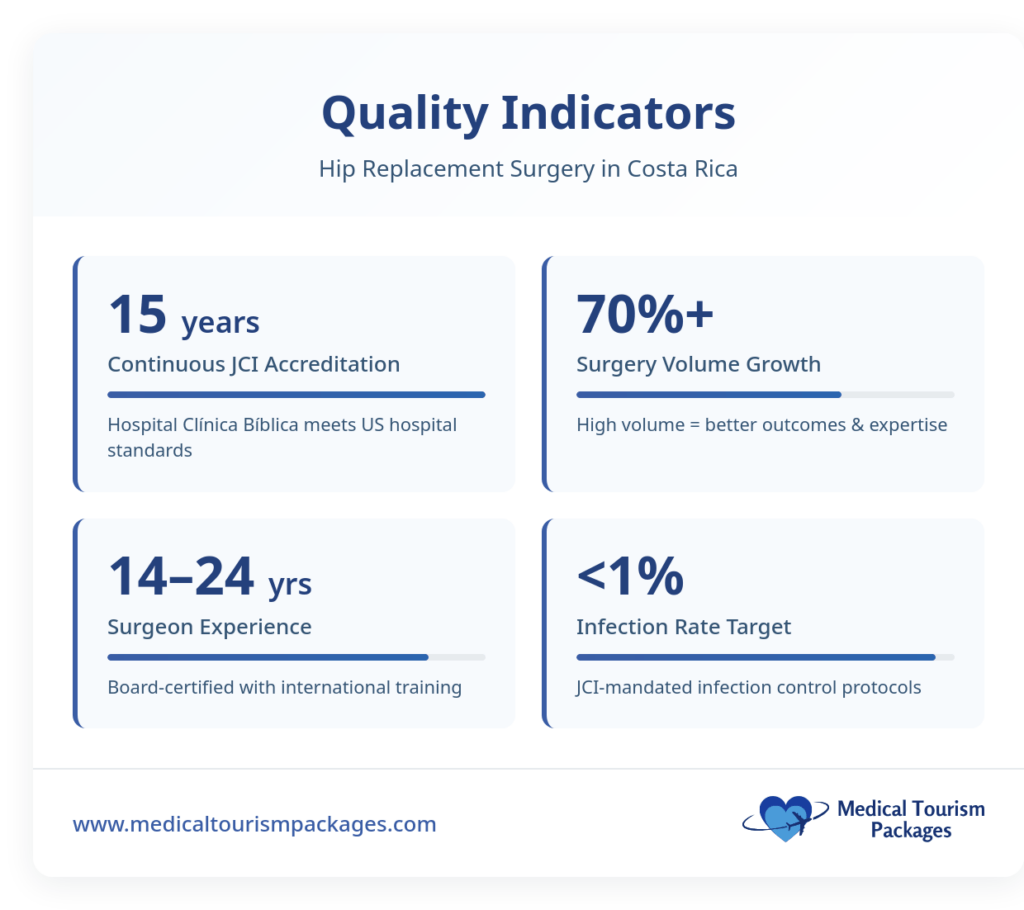
Hospital Clínica Bíblica in San José has held JCI accreditation since 2007. This long track record shows a sustained commitment to quality and safe surgical outcomes. The hospital also has a location in Santa Ana.
For broader trip planning, read our guide for American medical tourists in Costa Rica.
How Much Does Hip Replacement Cost in Costa Rica?
Hip replacement in Costa Rica costs $10,000 to $14,900, with a typical all-inclusive package near $13,600. This covers surgery, hospital fees, surgeon fees, anesthesia, the implant, post-operative care, and initial rehabilitation. US patients pay $25,000 to $55,000 for the same procedure.
The package compares to fragmented US billing this way:
| Component | Costa Rica (Bundled) | United States (Separate Billing) |
|---|---|---|
| Total Package | $10,000–$14,900 | $25,000–$55,000 |
| Facility / Hospital Fees | Included | $15,000–$40,000 |
| Surgeon Fees | Included | $3,000–$15,000 |
| Implant Cost | Included | $4,000–$7,000 |
| Anesthesia & Post-Op Care | Included | Varies (separate billing) |
Costa Rican hospitals quote one transparent, bundled price with no surprise charges. The savings come from lower administrative overhead, streamlined operations, and lower malpractice insurance costs, not from cutting corners on care.
How Does Costa Rica Compare to Other Countries?
Costa Rica’s hip replacement price sits in the same band as Mexico, Colombia, and Panama, and all four save 40 to 85 percent against the US. Costa Rica stands out for its two JCI-accredited hospitals and strong recovery infrastructure near San José.
Here is how hip replacement cost compares across destinations:
| Country | Hip Replacement Cost (USD) | Savings vs US |
|---|---|---|
| Costa Rica | $10,000–$14,900 | 40–82% |
| Mexico | $9,000–$15,000 | 40–84% |
| Colombia | $8,000–$14,000 | 44–85% |
| Panama | $10,000–$20,000 | 20–82% |
| United States | $25,000–$55,000 |
For a same-procedure comparison, see our guide to hip replacement in Panama. For other joints, read about orthopedic surgery in Costa Rica.
Which Are the Best Hospitals for Hip Replacement in Costa Rica?
The best hospitals are Hospital Clínica Bíblica and Hospital CIMA San José, both JCI-accredited, plus Hospital La Católica, locally accredited with strong orthopedics. All three sit in the Central Valley near San José.
These three hospitals compare as follows:
| Hospital | Accreditation | US Affiliation | Notable Feature |
|---|---|---|---|
| Hospital Clínica Bíblica | JCI since 2007 | Longest JCI record in Costa Rica; robotic surgery suite | |
| Hospital CIMA San José | JCI since 2008 | International Hospital Corporation (Dallas) | Adjacent orthopedic clinics in Escazú; on-site insurance department |
| Hospital La Católica | Local (ISO certified) | 1.5T MRI, dedicated rehabilitation facilities |
Hospital CIMA San José sits in Escazú beside leading orthopedic clinics, which makes consultations, surgery, and follow-up easy to coordinate. Hospital La Católica holds local and ISO certifications and runs modern surgical suites with on-site rehabilitation.
Who Are the Leading Hip Replacement Surgeons in Costa Rica?
The leading hip replacement surgeons in Costa Rica include Dr. Fabricio Picado Chaves, Dr. Daniel Alcázar De La Torre, and Dr. Álvaro José Barrenechea Coto. They hold 14 to 24 years of orthopedic experience and board certifications.
| Surgeon | Years of Experience | Key Credentials |
|---|---|---|
| Dr. Fabricio Picado Chaves | 24 years | Orthopedics & Traumatology; AAOS member |
| Dr. Daniel Alcázar De La Torre | 19 years | Orthopedic Surgery; international training |
| Dr. Álvaro José Barrenechea Coto | 14 years | Orthopedic Surgery; global organization member |
Many of these surgeons trained at recognized institutions abroad. Active membership in groups such as the American Academy of Orthopaedic Surgeons (AAOS) keeps them current with new techniques. When choosing a surgeon, ask about annual hip replacement volume, because high-volume surgeons have lower complication rates.
What Types of Hip Replacement Procedures and Implants Are Available in Costa Rica?
Costa Rican orthopedic centers offer all standard hip replacement procedures, including total hip replacement and hip resurfacing. Surgeons choose the best procedure type, surgical approach, and implant based on your age, bone quality, and activity level.
What Procedure Types and Surgical Approaches Exist?
Two procedure types and three surgical approaches cover most patients. Your surgeon matches the technique to your joint and goals.
The two main procedure types are:
- Total Hip Replacement (THR): Replaces both the ball and socket with artificial parts. This is the standard procedure for severe arthritis or joint damage.
- Hip Resurfacing: Caps the femoral head instead of removing it, which preserves more bone. It can suit younger, active patients with good bone quality.
Surgeons use three common approaches:
- Direct Anterior Approach (DAA): A minimally invasive technique from the front that often allows faster recovery with less muscle trauma.
- Direct Lateral Approach: A side-entry approach with clear visualization of the joint.
- Posterior Approach: The traditional technique from behind that most surgeons know well.
Which Implant Brands Do Costa Rican Hospitals Use?
Costa Rican hospitals use the same FDA-approved hip implants found in US operating rooms, including Zimmer Biomet, Stryker, and DePuy Synthes (Johnson & Johnson). These three brands lead the global hip implant market.
You are getting the same hardware US patients receive, at a lower price. The three major implant makers and their materials are:
- Zimmer Biomet: The top global hip implant maker; offers metal, ceramic, and highly cross-linked plastic bearing options.
- Stryker: A leading brand known for ceramic-on-plastic systems and robotic-assisted hip implant platforms.
- DePuy Synthes: The Johnson & Johnson orthopedic brand, widely used for both total replacement and resurfacing components.
Costa Rica’s implant supply chain is also growing locally. In September 2025, Zimmer Biomet announced a new manufacturing plant in Grecia, Costa Rica, to produce knee and hip implant components. Your surgeon recommends a specific brand and material based on your age and activity needs.
For other procedures available abroad, see our orthopedic surgeries page.
Is Hip Replacement in Costa Rica Safe?
Yes, hip replacement in Costa Rica is safe at JCI-accredited, high-volume hospitals. According to a systematic review in the National Library of Medicine, high-volume hospitals report lower surgical-site infection and dislocation rates than low-volume centers. Periprosthetic joint infection runs about 1 to 2 percent overall.
The main risks of any hip replacement are infection, hip dislocation, blood clots, and implant wear over time. JCI-accredited hospitals in Costa Rica use strict infection-control protocols:
- Sterile operating room procedures
- Prophylactic antibiotics before surgery
- Advanced air filtration systems
- Strict post-operative wound care
Hospital and surgeon volume matter most for your outcome. The American Academy of Orthopaedic Surgeons (AAOS) reports that high-volume centers achieve lower complication rates because surgeons refine technique and hospitals standardize care. Choosing a JCI-accredited hospital with an experienced, high-volume surgeon substantially reduces your risk.
What Are the Main Steps to Getting Hip Replacement in Costa Rica?
The process takes about 4 to 5 weeks from arrival to flying home. It follows a structured timeline that ensures safe surgery and adequate recovery before a long flight.
Your hip replacement journey follows these steps:
- Submit medical records: Send your medical history, X-rays, MRI scans, medication list, and allergies. Your surgeon reviews your candidacy remotely.
- Pre-operative testing (1 to 3 days): Complete in-person exams in Costa Rica, including updated imaging, blood work, and a cardiac check.
- Surgery day: The procedure takes 1 to 2 hours under general or spinal anesthesia.
- Hospital stay (2 to 3 days): Receive 24-hour nursing, pain management, and early walking in a private recovery room.
- Recovery in Costa Rica (3 to 4 weeks): Attend physical therapy 3 to 5 times per week, with wound care and follow-up visits.
- Return-home clearance (day 25 and after): Your surgeon clears you to fly once healing is confirmed.
What Travel Documents Do You Need?
US and Canadian citizens need only a valid passport and proof of return travel. You receive a tourist entry stamp on arrival, valid for up to 90 days, with no advance visa application required. That window easily covers the 4 to 5 week treatment period.
What Is Recovery Like After Hip Replacement in Costa Rica?
Recovery follows a predictable timeline, and most patients regain full function within 3 to 6 months. Early walking begins within 24 to 48 hours of surgery. You stay in Costa Rica for 3 to 4 weeks of concentrated rehabilitation before flying home.
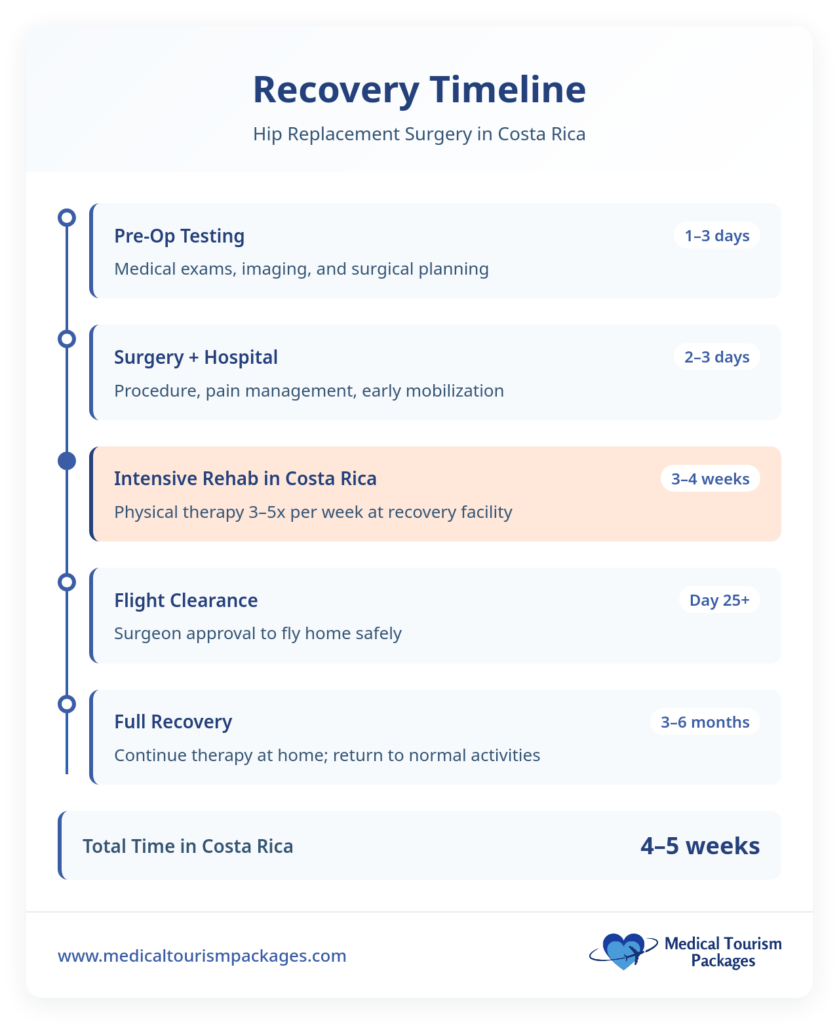
The recovery timeline breaks into four phases, per AAOS OrthoInfo:
| Phase | Time Range | Objectives | Restrictions |
|---|---|---|---|
| 1. Hospital stay & early mobilization | Days 1–3 | Pain control; walk with assistance; learn hip precautions | No bending past 90 degrees; no crossing legs |
| 2. Outpatient rehabilitation | Weeks 1–6 | Daily physical therapy; progressive weight-bearing | Continue hip precautions; wound care |
| 3. Strength building | Weeks 6–12 | Transition off assistive devices | Avoid impact activities; continue PT |
| 4. Return to function | Months 3–6 | Resume most normal activities | No running or jumping; annual follow-up |
The 3 to 4 week stay in Costa Rica gives you concentrated rehabilitation with your surgical team nearby if any complication arises. This structured setting lowers fall and infection risk and builds proper movement patterns for long-term joint health.
What Are the Advantages and Disadvantages of Hip Replacement in Costa Rica?
The main advantage is saving $15,000 or more at JCI-accredited hospitals near San José. The main disadvantage is the 4 to 5 week stay away from home and limited US insurance coverage. The table below weighs both sides.
| Factor | Advantage | Disadvantage |
|---|---|---|
| Cost | $10,000–$14,900 all-inclusive; save 40–82% vs US | Usually paid out of pocket; most US plans exclude it |
| Quality | JCI-accredited hospitals; FDA-approved implants | You must vet hospital and surgeon volume yourself |
| Travel | Short flights from US (Miami 3 hours) | Long flight is restricted until day 25 or later |
| Recovery | Concentrated rehab with team nearby | 3–4 week stay away from home and family |
| Follow-up | Telemedicine and shared records after you return | Revision care, if ever needed, is handled at home |
How Do You Choose the Right Hospital and Surgeon in Costa Rica?
You choose a JCI-accredited hospital with a long accreditation history and a surgeon who performs at least 50 hip replacements per year. These two factors affect your outcome most. The table below shows what to verify and why.
| Criteria | Why It Matters |
|---|---|
| JCI accreditation | Ensures safety and infection-control standards matching top US hospitals |
| High annual hip volume | Surgeons with 50+ cases per year have lower complication rates |
| Surgical approach proficiency | Confirm experience with minimally invasive techniques if you want one |
| Hospital patient volume | Higher volume correlates with better outcomes and fewer dislocations |
Ask each surgeon for specific evidence of their hip replacement volume and their complication and revision rates. Reputable surgeons expect informed patients to ask these questions, so do not hesitate.
What Questions Do Patients Ask Most About Hip Replacement in Costa Rica?
How much does hip replacement cost in Costa Rica?
Hip replacement costs $10,000 to $14,900 in Costa Rica, with a typical all-inclusive package near $13,600. That is 40 to 82 percent less than the $25,000 to $55,000 US range. The price covers surgery, hospital stay, surgeon fees, anesthesia, the implant, and initial rehabilitation.
Is hip replacement safe in Costa Rica?
Yes, hip replacement is safe at JCI-accredited, high-volume hospitals in Costa Rica. According to AAOS data, high-volume centers report lower complication and dislocation rates. Periprosthetic joint infection runs about 1 to 2 percent overall. Choose a JCI hospital and an experienced surgeon to minimize risk.
Is the hip implant the same quality as in the US?
Yes. Costa Rican hospitals use the same FDA-approved implants as US hospitals, from Zimmer Biomet, Stryker, and DePuy Synthes. These three brands lead the global hip implant market. Zimmer Biomet is even building a hip and knee implant plant in Grecia, Costa Rica.
How long do I need to stay in Costa Rica after hip replacement?
You should plan to stay 3 to 4 weeks after surgery, about 4 to 5 weeks total including pre-operative testing. This allows adequate healing before a long flight. Your surgeon typically clears you for travel around day 25 once healing is confirmed.
Will my US insurance cover hip replacement in Costa Rica?
Most US insurance plans do not cover international procedures. Some employers and insurers offer medical tourism benefits, so check your plan. Many patients pay out of pocket because the $13,600 package often costs less than a US deductible and out-of-pocket maximum combined.
How soon can I fly after hip replacement?
Most patients can fly after 3 to 4 weeks, often around day 25. Your surgeon evaluates your healing and blood clot risk first. You may need compression stockings and should stand and walk periodically during the flight to lower clot risk.
Can I travel alone for hip replacement surgery?
You can, but we recommend bringing a companion. You will need help with daily tasks during early recovery, especially the first week after surgery. A companion can assist with transportation to physical therapy and provide support throughout your 3 to 4 week stay.
What if I have complications after returning home?
Before you leave Costa Rica, you receive detailed medical records and your surgeon’s contact information. You can follow up by phone or telemedicine and arrange ongoing care with an orthopedic surgeon at home. Most routine follow-up after the first month happens remotely.
Do Costa Rican surgeons speak English?
Most surgeons at JCI-accredited hospitals such as Hospital CIMA San José and Hospital Clínica Bíblica speak English, with staff English fluency around 90 percent. Hospitals also provide bilingual coordinators to assist with communication throughout your treatment and recovery.
Ready to Start Your Hip Replacement Journey in Costa Rica?
Medical Tourism Packages coordinates your entire hip replacement journey in Costa Rica. We connect you with JCI-accredited hospitals and experienced orthopedic surgeons, arrange travel and accommodations, and provide bilingual support throughout your treatment and 3 to 4 week recovery.
Contact us today for a free consultation and a personalized quote for your hip replacement in Costa Rica.