Book Appointment Now


Full Body MRI in Latin America: 2026 Cost by Country
 By
By
A full body MRI package in Latin America costs $400-1,000 USD. That is 60-90% less than premium US screening programs, and most centers book within the same week.
Packages cost $400-800 in Mexico, $450-750 in Colombia, $500-900 in Costa Rica and $500-850 in Panama. US programs charge $2,499-3,999. Each package covers the scan, a radiologist reading and an English report.
Our coordinators arrange scans with accredited partner centers in Mexico, Colombia, Costa Rica, Panama and Argentina. Below you will find 2026 prices by country and what each scan includes. You will also see how to add a scan to a trip you have planned. Our full body MRI packages in Latin America page shows what each visit includes and how to book.
How Much Does a Full Body MRI Cost in Latin America?
A full body MRI package costs $400-1,000 USD in Latin America. That is 60-90% less than premium US screening programs, which charge $2,499-3,999.
How Do Prices Compare by Country?
Prices vary by country based on facility type, technology level, and local costs. Mexico offers the lowest prices. Brazil provides the most advanced technology.
| Country | Full Body MRI Cost (USD) | Savings vs US | Additional Benefits |
|---|---|---|---|
| Mexico | $400-800 | 68-84% | No visa required, close proximity |
| Costa Rica | $500-900 | 64-80% | Established tourism infrastructure |
| Brazil | $500-750 | Most advanced technology available | |
| Colombia | $450-750 | 70-82% | Excellent value, top-ranked facilities |
| Panama | $500-850 | 66-80% | USD currency, US-trained doctors |
| United States (premium screening programs) | $2,499-3,999 | Baseline | Insurance complications, long waits |
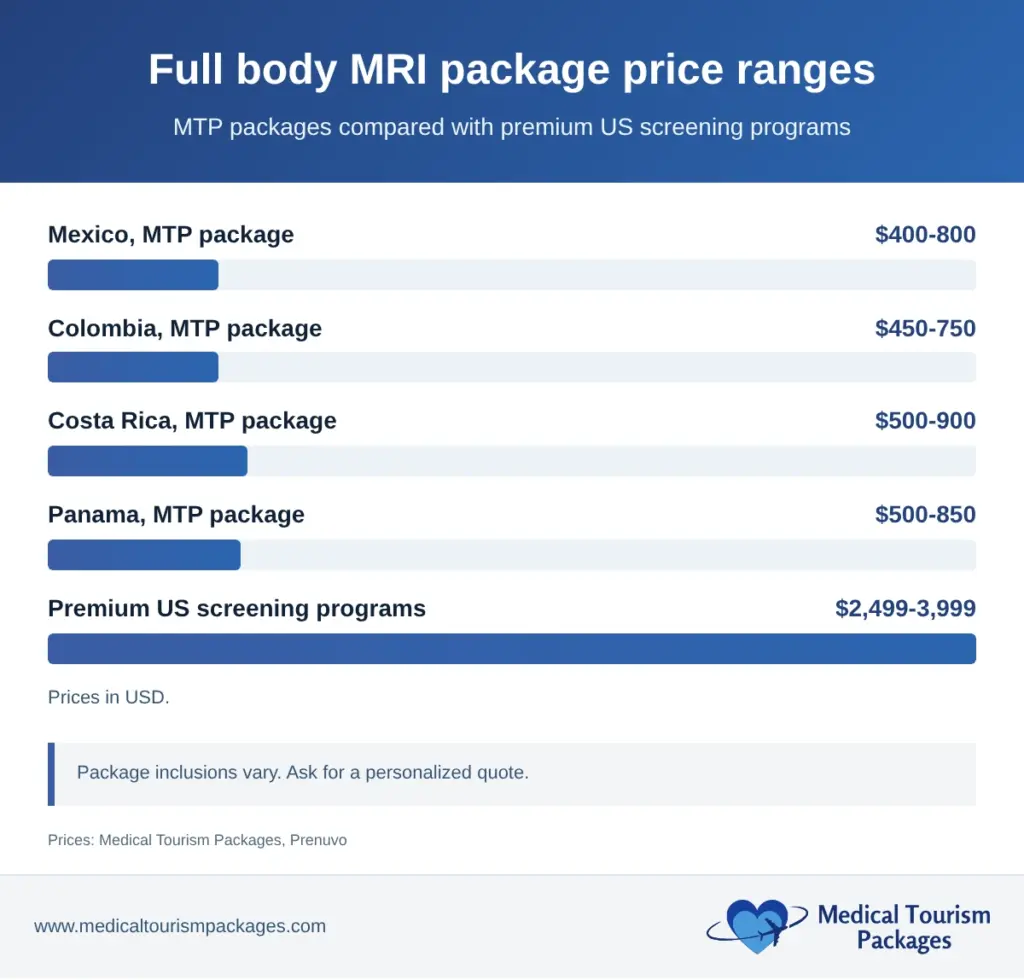
Price factors include facility type, scanner strength (1.5T vs. 3T), and city location. Major cities like Mexico City and Sao Paulo cost more than smaller markets. For country-specific pricing, see our Mexico MRI guide.
How Much Do Premium US Screening Programs Charge in 2026?
Premium US screening programs charge $2,499-3,999 USD in 2026. The low end is Prenuvo’s Whole Body Scan. The high end is its Executive membership, and that price varies by location. Every Latin American package in the table above costs less than the low end.
The gap widens at package level. Our Colombian executive health check adds bloodwork, a cardiac evaluation, VO2 max testing and a specialist consult to the MRI. Packages start around $500, below the premium US scan tier alone.
How Much Does a Full Body MRI Cost in Canada?
Canada’s public system charges nothing for a medically necessary MRI. Patients pay in waiting time. The median wait for an MRI scan reached 18.1 weeks in 2025, according to the Fraser Institute’s Waiting Your Turn survey. The same survey puts CT scans at 8.8 weeks and ultrasounds at 5.4 weeks.
A screening scan for a healthy adult isn’t covered, so Canadians pay at private clinics. Private clinics charge $1,750-2,850 USD (CAD 2,500-4,000) for a full scan. Latin American packages cost $400-1,000 and book within the same week.
What’s Included in a Medical Tourism MRI Visit?
Standard services typically include the MRI scan and radiologist interpretation. You also receive a pre-scan consultation and written reports in English. Digital images come on CD/USB or secure download. Follow-up consultation is available virtually.
You can add airport transfers, hotel booking and an interpreter. A personal medical tourism coordinator can help with all of it. The package usually leaves out travel insurance, extra procedures, prescription drugs and longer hospital stays.
What Payment Options Are Available?
Most facilities accept major credit cards including Visa, MasterCard, and American Express. Wire transfers work for advance payments. Cash payments often receive 5-10% discounts. You can also use a medical credit card such as CareCredit if you qualify.
U.S. health insurance rarely covers elective procedures abroad. You may use HSA or FSA funds for qualified expenses. The procedure may be tax-deductible if medical expenses exceed 7.5% of your adjusted gross income. All reputable facilities provide upfront quotes with no hidden fees.
Get your exact MRI price within one business day
Tell us which scan you need and where you would like it. We confirm your exact price and an available appointment within one business day, usually for the same week.
- A personalized quote based on your scan and destination
- Same-week appointments at accredited imaging centers
- Your radiologist report in English, explained in plain language
- Help with flights, hotel, airport pickup, and your full itinerary
- Option to add other procedures or check-ups to the same trip
Free quote, no obligation. Prefer to chat? Message us on WhatsApp.
Make the trip count: pair your MRI with an executive health check
If you are flying for a scan, you can cover everything in the same two or three days: full body MRI, complete blood panel, cardiac evaluation, and a specialist consultation to walk you through every result. Packaged together, it often costs less than a single full body MRI in the US.
We arrange these packages with partners across Latin America, and our most complete program runs in Colombia. Mention the package when you contact us and we will quote both together.
Should You Add a Full Body MRI to Your Latin America Trip?
You should add a full body MRI to your trip when you want premium screening at local prices.
The scan takes one morning. Most centers book within the same week, and you need no referral. A package costs $400-1,000 USD. Premium US screening programs charge $2,499-3,999.
Adding the scan makes sense when:
- You are already visiting for a holiday, business, family, or another treatment.
- You want the full executive health check while you are there: MRI, bloodwork, cardiac evaluation and VO2 max testing, run in one morning.
- You want a same-week slot with no referral.
Skipping it makes sense when:
- Your doctor ordered a diagnostic MRI and insurance covers it.
- Your case needs contrast, sedation, or follow-up care close to home.
- A basic scan-only screening near you meets your needs.
The section above sets out United States and Canada pricing in full.
What Is a Full Body MRI and Why Get One in Latin America?
A full body MRI uses magnetic fields and radio waves to create detailed images. The scan shows organs, bones, and soft tissues without radiation. The process takes 30-90 minutes depending on areas examined.
These scans can show tumors, both harmless and cancerous. They can also show problems in major blood vessels, such as aneurysms or narrowed arteries. Other findings include brain conditions such as stroke, and bone, joint or disk problems. Most people have at least one finding, and most findings are harmless. Your doctor can help you decide if the scan suits you. Latin America offers the same technology at 60-90% lower cost. Most centers book appointments within days.
Why Has Latin America Become a Medical Imaging Hub?
Latin America became a medical imaging hub through heavy investment in technology and infrastructure. Brazil accounts for 46.4% of total regional healthcare spending. The diagnostic imaging market grows at 6.3% annually through 2033.
| Country | Top Medical Cities | JCI-Accredited Organizations | Primary Advantages |
|---|---|---|---|
| Brazil | Sao Paulo, Rio de Janeiro | 75 | Most advanced technology, highest specialist concentration |
| Mexico | Tijuana, Mexico City, Guadalajara | 19 | Closest to US, lowest costs, no visa required |
| Costa Rica | San Jose, Escazu | 2 | Established reputation, English-speaking staff |
| Colombia | Bogota, Medellin, Cartagena | 11 | Excellent value, 24 top-ranked hospitals in region |
| Panama | Panama City | 2 | US-trained doctors, USD currency, familiar standards |
Patients in Mexico City often get scanned the same week. Results come back the same day at some centers and within 3 to 5 days at others, with English-language reports. For Colombia-specific options, see our Colombia MRI guide.
What MRI Technology Is Available?
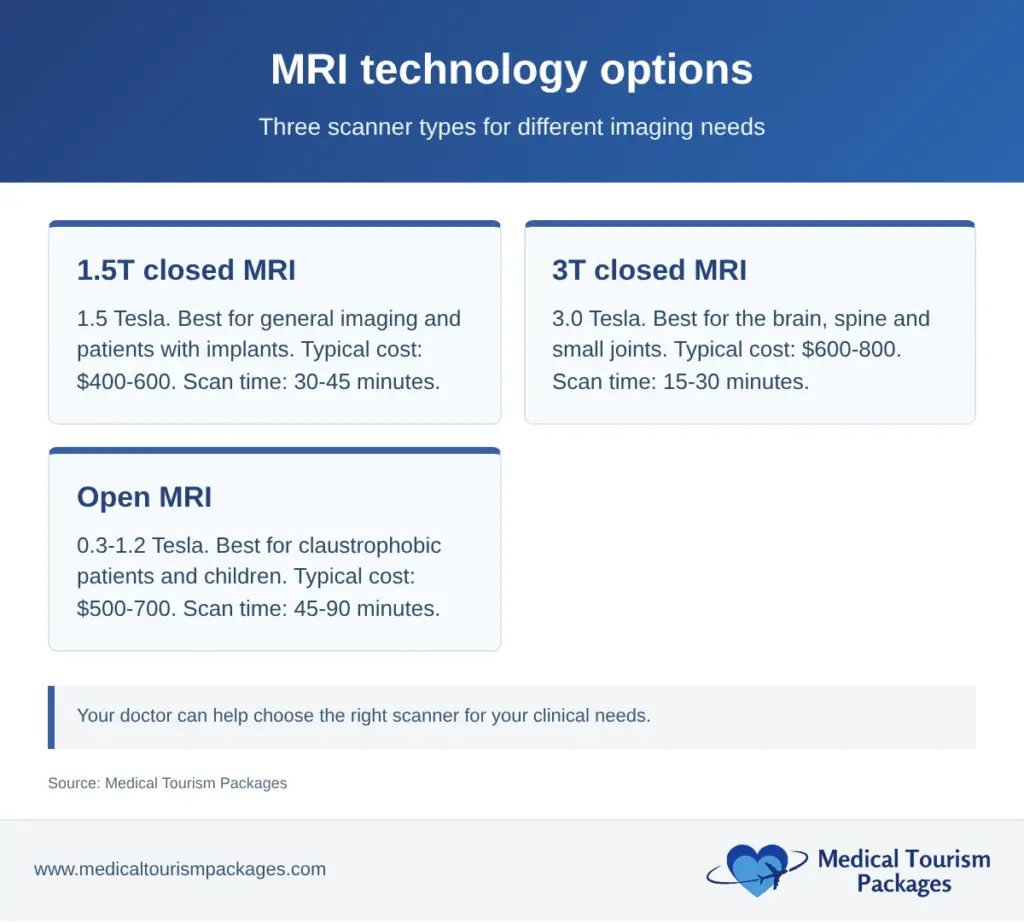
Three main MRI types are available across Latin America. Each offers specific advantages for different clinical needs. The same GE, Siemens, and Philips machines used at Mayo Clinic operate in these facilities.
| MRI Type | Magnetic Strength | Best For | Typical Cost | Scan Time |
|---|---|---|---|---|
| 1.5T Closed | 1.5 Tesla | General imaging, patients with implants | $400-600 | 30-45 minutes |
| 3T Closed | 3.0 Tesla | Brain, spine, small joints | $600-800 | 15-30 minutes |
| Open MRI | 0.3-1.2 Tesla | Claustrophobic patients, children | $500-700 | 45-90 minutes |
Facilities like Medica Sur in Mexico City have both 1.5T and 3T scanners. Doctors choose the best option for each patient. Machines use GE’s SIGNA series with AI-powered reconstruction. Siemens’ MAGNETOM platform with BioMatrix technology is also common. Philips’ helium-free systems round out the equipment roster.
Are Full Body MRI Scans Safe in Latin America?
Yes, full body MRI scans are safe at JCI-accredited facilities in Latin America. These hospitals meet the same standards as top U.S. medical centers. Many facilities exceed U.S. safety requirements for infection control and equipment maintenance.
What Does JCI Accreditation Mean for Patients?
JCI accreditation means a hospital passed rigorous safety audits. It costs facilities around $46,000 annually to maintain. The certification covers patient safety, infection control, and clinical protocols.
Brazil leads Latin America with 75 JCI-accredited organizations. Mexico has 19, Colombia has 11, Costa Rica has 2, and Panama has 2. Notable facilities include CIMA Hospital in San Jose, Costa Rica. Fundacion Cardioinfantil in Bogota, Colombia also holds the certification. For Panama-specific options, see our full body MRI scan in Panama guide. These hospitals meet the same standards as top U.S. medical centers.
What Qualifications Do Latin American Radiologists Have?
Many radiologists at top facilities trained at U.S. or European institutions. At Medica Sur in Mexico City, several radiologists completed fellowships at Johns Hopkins and Harvard Medical School. Colombian radiologists must complete a four-year residency plus ongoing education. Read our safety tips for medical travelers in Colombia.
Language barriers are minimal at premier facilities. Most doctors speak English fluently. Many facilities provide bilingual reports. Dedicated international patient coordinators handle scheduling and results explanation.
What Safety Protocols Are in Place?
Pre-scan safety screenings are thorough at all locations. You’ll complete metal detection and detailed medical history forms. Qualified technicians review all contraindications before scanning.
Infection control measures often exceed U.S. hospital standards. Facilities use UV sanitization systems and HEPA air filtration. Strict equipment sterilization protocols are standard. Emergency departments and intensive care units are on-site at major hospitals.
What Are the Technology Specifications?
MRI machines at top Latin American hospitals are often newer than U.S. equipment. Preventive maintenance follows manufacturer specifications. Many facilities use the same service contracts as U.S. hospitals.
Technical capabilities match what you’d find anywhere:
- Image resolution: Up to 0.5mm slice thickness
- Scan time: 15-45 minutes per body region
- Advanced features: Motion correction, noise reduction, contrast enhancement
- AI integration: Automated image analysis and quality control
How Fast Can You Get a Full Body MRI in Latin America?
You can get a full body MRI in Latin America within the same week. Same-week appointments are common at most facilities. Some hospitals accommodate same-day urgent requests.
How Quickly Can You Get an Appointment?
Appointment speed in Latin America far exceeds U.S. and Canadian wait times. Direct-pay systems eliminate insurance processing delays. Dedicated medical tourism departments serve international patients quickly.
| Region | Average Wait Time | Same-Week Availability | Emergency Scheduling |
|---|---|---|---|
| United States | Varies | Rare | 1-3 days |
| Canada | 18.1 weeks (median, 2025) | Very rare | 2-5 days |
| Latin America | Within the same week | Common | Same day possible |
Major facilities offer online booking with real-time availability. Many hospitals in Mexico City, Bogota, and Panama City provide 24/7 scheduling support. English-speaking coordinators work around your travel schedule. For Costa Rica-specific facility details and pricing, see our Costa Rica MRI guide.
How Long Does the Scan Take?
Full body MRI scans typically take 30-60 minutes, similar to U.S. facilities. Patient comfort measures often exceed what you’d find at home. Music systems let you choose your own playlist. Two-way intercom systems provide constant contact with technicians.
Additional comfort features include adjustable temperature and soft LED lighting. For claustrophobic patients, facilities offer anti-anxiety medication with medical supervision. Open MRI alternatives exist in Mexico City, Sao Paulo, and San Jose. Family members can often stay in the scanning room.
How Are Results Delivered?
Results are typically available the same day at some centers and within 3 to 5 days at others. Urgent cases can be rushed if needed. You’ll receive detailed reports from board-certified radiologists. Patient-friendly summaries explain findings in plain English.
Digital images come on CD/USB or secure download. DICOM files work with any medical facility worldwide. Many facilities offer telemedicine follow-up consultations. You can discuss results via video call after returning home.
How Do You Plan a Medical Tourism MRI Trip?
You plan a medical tourism MRI trip by selecting a facility, arranging travel, and coordinating with your home doctor. A medical tourism facilitator can handle appointment scheduling, travel logistics, and local support. Allow 2 to 3 days: arrive day 1, scan day 2, depart day 3. Your results consult can happen by video call once you are home.
What Travel Documents Do You Need?
Travel document requirements vary by country. Most Latin American destinations don’t require visas for U.S. citizens. Brazil is the exception, requiring a $160 visa applied 2+ weeks ahead.
| Country | Visa Required | Passport Validity | Additional Requirements |
|---|---|---|---|
| Mexico | No (180 days) | 6 months | FMM tourist card |
| Costa Rica | No (90 days) | 6 months | Return ticket proof |
| Brazil | Yes ($160) | 6 months | Apply 2+ weeks ahead |
| Colombia | No (90 days) | 6 months | Health insurance recommended |
| Panama | No (90 days) | 3 months | Medical appointment documentation |
Keep copies of your medical appointment confirmation and hotel reservations. Travel insurance with medical coverage is recommended. Some border officials may ask about your visit purpose.
How Do You Choose the Right Facility?
You choose the right facility by checking accreditation, equipment, and patient reviews. Start with JCI-accredited hospitals only. This ensures safety standards match U.S. levels.
Must-haves: JCI or equivalent accreditation, English-speaking staff and reports, modern 3T equipment, clear upfront pricing, and verified patient reviews.
Red flags: Cash-only payments, no international accreditation, poor communication, prices far below market rates, and unverifiable doctor credentials.
Where Should You Stay?
You should stay near your medical facility to minimize travel stress. In Mexico City, the Polanco and Santa Fe districts are near major hospitals. Sao Paulo’s Jardins and Vila Madalena neighborhoods offer easy access to medical centers.
San Jose’s Escazu area is close to CIMA Hospital. Bogota’s Zona Rosa and Usaquen districts are near top clinics. Panama City’s Punta Pacifica area surrounds Hospital Punta Pacifica. Look for hotels with hospital shuttle service and English-speaking staff.
What If You’re Claustrophobic?
If you’re claustrophobic, discuss open MRI options when booking. Facilities in Mexico City, Sao Paulo, and San Jose offer open scanners. These have limitations: longer scan times (45-90 vs. 30-60 minutes) and lower image quality.
Alternative solutions include wide-bore MRI with larger openings. Sedation options with mild anti-anxiety medication require medical clearance. Preparation techniques like meditation and breathing exercises help many patients.
What Happens After Your MRI Scan?
After your MRI scan, some centers report the same day. Others take 3 to 5 days. You can review findings with the radiologist via telemedicine. Then share records with your home doctor for follow-up care.
How Do You Understand Your MRI Report?
You understand your MRI report by focusing on the impression and recommendations sections. The report includes clinical history, technique details, findings, and conclusions. Don’t panic if findings mention “incidental findings” – these are common and often insignificant.
Request a patient-friendly explanation during your follow-up consultation. Many facilities provide simplified summaries. Key questions to ask: Are any findings concerning? What follow-up is recommended? Should I see a specialist at home?
How Do You Share Results With Your Home Doctor?
You share results with your home doctor using DICOM files and English reports. Most U.S. doctors accept foreign MRI reports from JCI-accredited facilities. DICOM files on CD/USB work with any medical imaging system.
Schedule follow-up with your home doctor before traveling. Some U.S. specialists prefer their own imaging for surgical planning. Discuss this possibility to avoid duplicate scans. Signed authorization is needed to transfer records.
What Legal Protections Do Patients Have?
Patients have legal protections through facility policies and country regulations. Medical malpractice laws vary between countries. JCI-accredited facilities maintain professional liability insurance and follow international protocols.
Patient rights typically include informed consent, medical records access, and privacy protection. U.S. Embassy services help with medical emergencies abroad. Keep embassy contact information and insurance cards accessible during travel.
Frequently Asked Questions
Where can I get a full body MRI scan in Latin America?
You can get a full body MRI in Costa Rica (San Jose), Colombia (Bogota, Medellin) and Panama (Panama City). Mexico (Mexico City, Tijuana) and Brazil (Sao Paulo) also offer scans. Costa Rica has 2 JCI-accredited organizations, Colombia has 11, and Panama has 2.
How much does a full body MRI cost in Central America?
A full body MRI package costs $500-900 USD in Costa Rica and $500-850 in Panama. Costa Rica packages save 64-80% against premium US screening programs. Panama packages save 66-80%. Costa Rica has JCI-accredited hospitals with English-speaking staff.
What are the best full body MRI facilities in Colombia with English-speaking staff?
The best facilities include Fundacion Cardioinfantil in Bogota, Hospital Pablo Tobon Uribe in Medellin, and Fundacion Valle del Lili in Cali. All are JCI-accredited with English-speaking radiologists and international-patient departments.
Will my insurance cover a full body MRI scan in Colombia?
Most U.S. insurance plans will not cover elective procedures abroad. You can use HSA/FSA funds for the expense. It may be tax-deductible if medical expenses exceed 7.5% of your adjusted gross income.
What are the regulations for full body MRI scans in Costa Rica, Panama, and Colombia?
Each country requires licensed radiologists and follows international MRI safety standards. JCI-accredited hospitals match U.S. safety benchmarks. Americans receive 90-day visa-free stays in all three countries.
How can tourists find affordable full body MRI scans in these countries?
Tourists can find affordable scans by choosing JCI-accredited centers that bundle services. Colombia offers strong value at $450-750 USD. Costa Rica has mature medical-tourism support at $500-900. Panama uses the U.S. dollar, and packages there cost $500-850.
What’s the difference between a full body MRI and a standard MRI?
The difference is that a full body MRI captures multiple regions in one 30-90 minute session. A standard MRI targets one area (knee, brain) in 15-45 minutes. Full-body scans are comprehensive but may miss subtle findings better seen on focused studies.
How should I prepare for a full body MRI scan in Latin America?
You should prepare by completing medical-history forms, removing all metal, and fasting if contrast is required. Wear metal-free clothing. Ensure your passport has 3-6 months validity. Arrive early for safety screening.
Are there risks or side effects from full body MRI scans?
Risks are minimal because MRI uses no ionizing radiation. Possible issues include claustrophobia, loud noises, and rare contrast allergies. Patients with pacemakers may need 1.5T scanners instead of 3T for safety.
How do waiting times compare in Costa Rica, Panama, and Colombia?
Waiting times are short in all three countries, where most scans book within the same week. Canada’s median MRI wait was 18.1 weeks in 2025. Many facilities accommodate same-day emergencies.
How do private vs. public healthcare MRI costs compare?
Private full body MRI packages cost $450-750 USD in Colombia, $500-900 in Costa Rica and $500-850 in Panama. Each package covers the scan, a radiologist reading and an English report.
What are best practices for choosing an MRI facility in these countries?
Best practices include confirming JCI accreditation, verifying English-speaking staff, and checking scanner model. Read verified reviews. Insist on transparent pricing. Choose centers with international-patient units and on-site emergency care.
How do I compare facilities across Costa Rica, Panama, and Colombia for specific conditions?
You compare by matching scanner type to your needs. Select 3T scanners for neurological issues (widely available in Bogota). Use 1.5T for general screenings. Search for open MRI in San Jose or Bogota if claustrophobic. Colombia offers dedicated cardiac-MRI programs.
How Do You Schedule a Full Body MRI in Latin America?
Medical Tourism Packages connects you with JCI-accredited facilities across Latin America. We handle appointment coordination, travel documentation, and local support so you can focus on your health.
Contact us today for a free consultation and personalized quote.