Book Appointment Now




What is a Medical Tourism Facilitator? Your Complete Guide to Safe Medical Travel
 By
By
A medical tourism facilitator coordinates every aspect of international healthcare travel in a $56.19 billion industry, connecting patients with JCI-accredited hospitals for 40-70% savings on procedures.
Medical tourism facilitators handle hospital selection, travel logistics, translation, and post-operative follow-up. Top platforms like Bookimed (900,000 patients, 25 countries) and PlacidWay (1,500 facilities, 50 countries) charge a percentage built into your package or a flat fee of $1,500-$5,000 per trip, while patients still save 40-70% vs. U.S. prices.
Our vetted network includes GHA CMTP-certified facilitators with ISO 22525:2020 compliance, each screened for partnerships with JCI-accredited facilities across India, Thailand, Turkey, and Mexico. Below, you’ll find a breakdown of facilitator types, pricing models, credential verification, red flags to avoid, and answers to common patient questions.
What Does a Medical Tourism Facilitator Do?
A medical tourism facilitator coordinates every step of international healthcare travel. Facilitators handle hospital selection, appointment scheduling, travel logistics, medical translation, and post-operative follow-up. The global medical tourism market reached $56.19 billion in 2026, with 97.2% of patients citing trust as their primary decision factor.
What Services Do Facilitators Provide Before You Travel?
Facilitators provide hospital research, cost estimates, virtual consultations, and travel planning before your trip. Pre-travel coordination includes reviewing medical records, verifying surgeon credentials, arranging visa documentation, and securing appointments at JCI-accredited facilities in destinations like India, Turkey, and Mexico.
- Medical record review: Facilitators collect X-rays, lab results, and treatment history to share with overseas specialists
- Virtual consultations: Video calls with hospital teams to discuss treatment options and timelines
- Cost estimates: Detailed price breakdowns covering procedure fees, hospital stays, and travel expenses
- Travel planning: Flight bookings, hotel reservations, airport transfers, and visa assistance
- Insurance coordination: Helping patients secure travel medical insurance and verify coverage limits
Online platforms influence 40% of medical tourists’ decisions. Platforms like Bookimed and PlacidWay let patients compare hospitals, read verified reviews, and request quotes before committing.
What Support Do You Get During Your Medical Stay?
You get 24/7 emergency contacts, medical translation, ground transportation, and hospital liaison support during your stay. A dedicated medical travel coordinator accompanies you to appointments, translates medical terminology, and handles unexpected schedule changes or complications.
- Airport pickup and transfers: Door-to-door transportation between hotel, hospital, and airport
- Medical translation: Professional interpreters for consultations, consent forms, and discharge instructions
- 24/7 emergency line: Around-the-clock access to your coordinator for urgent medical needs
- Accommodation management: Recovery-friendly hotels near the hospital with meal arrangements
- Payment processing: Secure handling of hospital deposits and final payments
How Do Facilitators Help After Treatment and Recovery?
Facilitators help after treatment by coordinating follow-up care between your overseas surgeon and home doctors. They arrange telemedicine check-ins, transfer medical records, and monitor recovery milestones. Nearly 87% of U.S. hospitals now offer telemedicine services, making cross-border follow-up practical.
Post-operative support typically lasts 3 to 12 months (three to twelve months). Your facilitator ensures discharge summaries, imaging files, and medication lists reach your local physician. If complications arise, they help arrange return visits or connect you with affiliated specialists closer to home.
What Are the Different Types of Medical Tourism Facilitators?
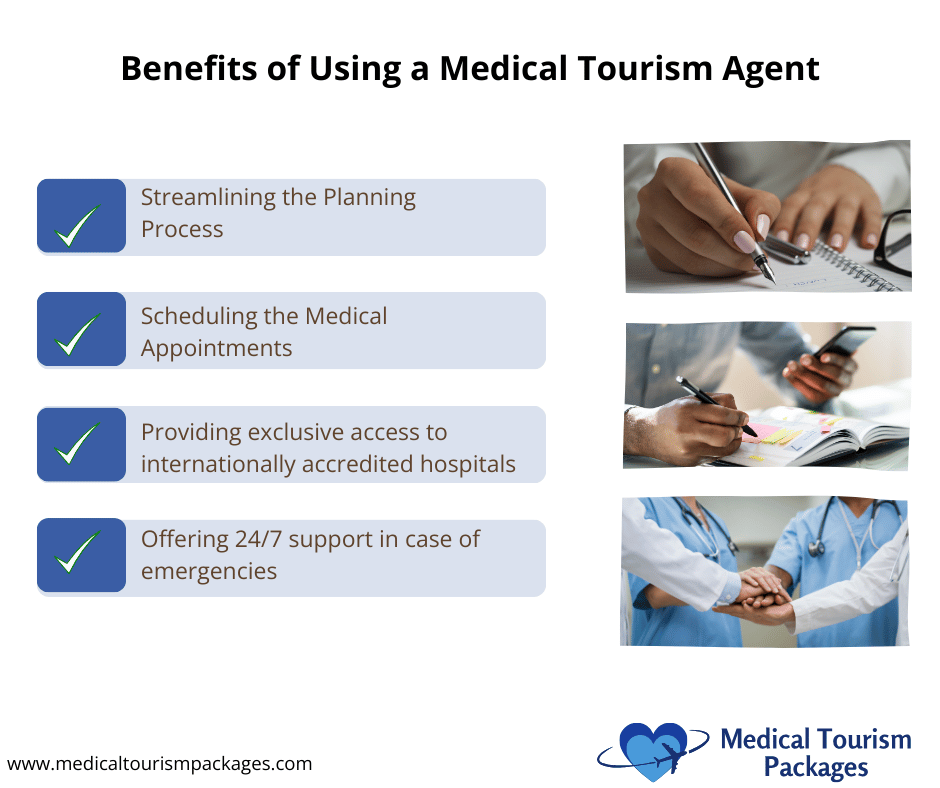
The different types of medical tourism facilitators are full-service independents, hospital-based international departments, online platforms, and specialty facilitators. Each type serves different patient needs, budgets, and comfort levels. Choosing the right type depends on your procedure complexity and travel experience.
Some facilitators work on the business side, coordinating care for employers and insurers; see our B2B logistics service.
How Do Full-Service Independent Facilitators Operate?
Full-service independent facilitators operate as standalone companies that manage every aspect of your medical trip. They maintain relationships with multiple hospitals across several countries. This gives patients access to a wider network than any single hospital offers.
Independent facilitators are typically paid 7.5% to 30% by partner hospitals, with that fee already built into the price you see. They handle everything from initial consultation to post-operative care, acting as a single point of contact throughout the journey. Ask any facilitator how they are compensated so there are no payment surprises.
What Are Hospital-Based International Patient Departments?
Hospital-based international patient departments are in-house coordination teams at major medical centers. Hospitals like Bumrungrad Hospital in Thailand, Apollo Hospitals in India, and Fortis Healthcare facilities operate dedicated departments for foreign patients.
Bumrungrad Hospital serves 520,000 international patients annually from 190 countries. These departments charge $500 to $1,500 (five hundred to fifteen hundred dollars) for coordination. The trade-off is limited choice. Hospital departments only refer to their own facility and affiliated surgeons.
How Do Online Platform Facilitators Like Bookimed or PlacidWay Work?
Online platform facilitators like Bookimed and PlacidWay work as digital marketplaces connecting patients with hospitals worldwide. Bookimed ranks as the number one medical tourism company in 2026 with 915 verified TrustPilot reviews and 900,000 patients served across 25 countries.
PlacidWay connects patients with 1,500 facilities in 50 countries. FlytoDoc takes a different approach, charging physicians EUR 50 per month with no commissions on medical fees. Patients pay doctors directly, removing the middleman markup. The Better by MTA platform uses Mastercard virtual card technology for secure cross-border payments, connecting 1.3 million healthcare seekers annually.
What Are Specialty Facilitators for Dental and Wellness Tourism?
Specialty facilitators for dental and wellness tourism focus on one procedure category or treatment type. Dental tourism facilitators coordinate care in destinations like Mexico, where 1 to 1.5 million Americans cross the border annually for dental treatment. Los Algodones alone has 350 dental offices.
Wellness tourism facilitators arrange retreats, longevity treatments, and regenerative medicine programs. Specialty facilitators offer deeper expertise in their niche. They know the best providers, typical recovery timelines, and realistic outcomes for specific procedures.
How Much Do Medical Tourism Facilitators Charge?
Medical tourism facilitators are paid in one of two ways: a 7.5% to 30% percentage that the hospital pays them out of your bundled package price, or a flat $1,500 to $5,000 fee that you pay directly. The first model is most common, and as a patient you never write the facilitator a separate check. The second model gives you more transparency about what you are paying for coordination versus medical care.
What Is the Commission-Based Payment Model?
In the commission model, the hospital pays the facilitator a percentage of your procedure cost and that fee is already baked into the bundled price you are quoted. As a patient you do not write a separate check. The percentage typically ranges from 7.5% to 30% depending on the facilitator’s volume and your procedure. Ask for a written breakdown so you know exactly what is included.
| Facilitator Type | Commission Range | Example on $25,000 Procedure |
|---|---|---|
| High-volume established facilitator | 7.5%-15% | $1,875-$3,750 |
| Mid-size facilitator | 15%-20% | $3,750-$5,000 |
| Small or niche facilitator | 20%-30% | $5,000-$7,500 |
A procedure costing $25,000 locally may be quoted at $30,000 to $35,000 for international patients. The markup covers the facilitator’s share of coordination work. Patients still save 40% to 70% compared to U.S. prices even after this fee is included.
What Is the Fee-for-Service Model?
In the fee-for-service model you pay the facilitator a flat fee separate from your hospital bill. Fees typically range from $1,500 to $5,000 per trip. This model offers more transparency because you see exactly what you are paying for coordination versus medical care.
| Fee Model | Cost Range | What Is Included |
|---|---|---|
| Basic coordination | $1,500-$2,500 | Hospital selection, appointment booking, travel planning |
| Full-service package | $2,500-$5,000 | All coordination plus on-site support, translation, follow-up |
| Platform subscription (FlytoDoc) | EUR 50/month | Direct doctor access, no commission, AI translation |
How Do Payment Methods Compare for International Medical Trips?
Payment methods for international medical trips compare across safety, fees, and dispute options. Credit cards offer the best buyer protection. Bank transfers cost less but provide limited recourse. The Better by MTA platform now uses Mastercard virtual card technology for secure payments.
| Payment Method | Transaction Fee | Dispute Protection | Best For |
|---|---|---|---|
| Credit card | 3% foreign transaction | Strong (chargeback rights) | Deposits under $15,000 |
| Escrow service | 2%-5% | Strong (funds held until delivery) | Payments over $15,000 |
| Bank wire transfer | 1%-2% | Limited | Established hospital relationships |
| Mastercard virtual card (Better by MTA) | Varies | Strong | Platform-coordinated trips |
| Cryptocurrency | 0.5%-1% | None | Privacy-focused patients |
Cryptocurrency adoption has reached 11.5% among travel agencies. Stablecoins account for over 60% of crypto payment volume. However, crypto offers zero dispute protection, making it risky for large medical payments.
What Credentials and Certifications Should a Medical Tourism Facilitator Have?
A medical tourism facilitator should have GHA Certified Medical Travel Professional (CMTP) designation, ISO 22525:2020 compliance, and partnerships with JCI-accredited hospitals. These three credentials verify that the facilitator meets international quality, safety, and service standards. About 63.3% of medical tourists say accreditation influenced their provider choice.
What Is the GHA Certified Medical Travel Professional (CMTP) Credential?
The GHA Certified Medical Travel Professional (CMTP) is the gold standard credential for medical tourism facilitators since 2012. GHA transitioned to Standards 5.0, accredited by ISQua (International Society for Quality in Health Care). Training includes 12 on-demand courses and 248 continuing education videos.
GHA launched the Advanced CMTP-RN for nurses in August 2025. This specialized track is approved by ANA Massachusetts for continuing nursing education credits. The Advanced CMTP-MD for physicians launches in early 2026. GHA recommends 5 hours of annual continuing education through its E-Library subscription.
How Does ISO 22525:2020 Apply to Medical Tourism Facilitators?
ISO 22525:2020 applies to medical tourism facilitators by setting service requirements for healthcare travel coordination. The full title is “Tourism and related services, Medical tourism, Service requirements.” It covers quality management, licensed medical personnel, risk management, and patient rights.
Organizational certification costs $5,000 to $15,000 (five thousand to fifteen thousand dollars). ISO 22525 does not apply to medical spas, wellness spas, or thalassotherapy centers. It specifically targets facilitators and healthcare providers in medical tourism. This standard gives patients a verifiable benchmark for service quality.
What Are the Red Flags That Signal an Unqualified Facilitator?
The red flags that signal an unqualified facilitator include missing credentials, pressure tactics, hidden fees, and refusal to provide patient references. The 2025 DOJ healthcare fraud takedown charged 324 defendants in connection with $14.6 billion in alleged fraud, the largest in U.S. history.
- No verifiable certification: Cannot show GHA CMTP or ISO 22525 credentials
- No hospital accreditation proof: Partner hospitals lack JCI or equivalent accreditation
- Pressure to pay upfront: Demands full payment before sharing hospital details or contracts
- No written contract: Refuses to provide detailed service agreements with refund terms
- No patient references: Cannot provide recent, verifiable patient testimonials
- Vague pricing: Gives estimates without itemized cost breakdowns
- No liability insurance: Does not carry professional liability coverage
- No physical office: Operates without a registered business address
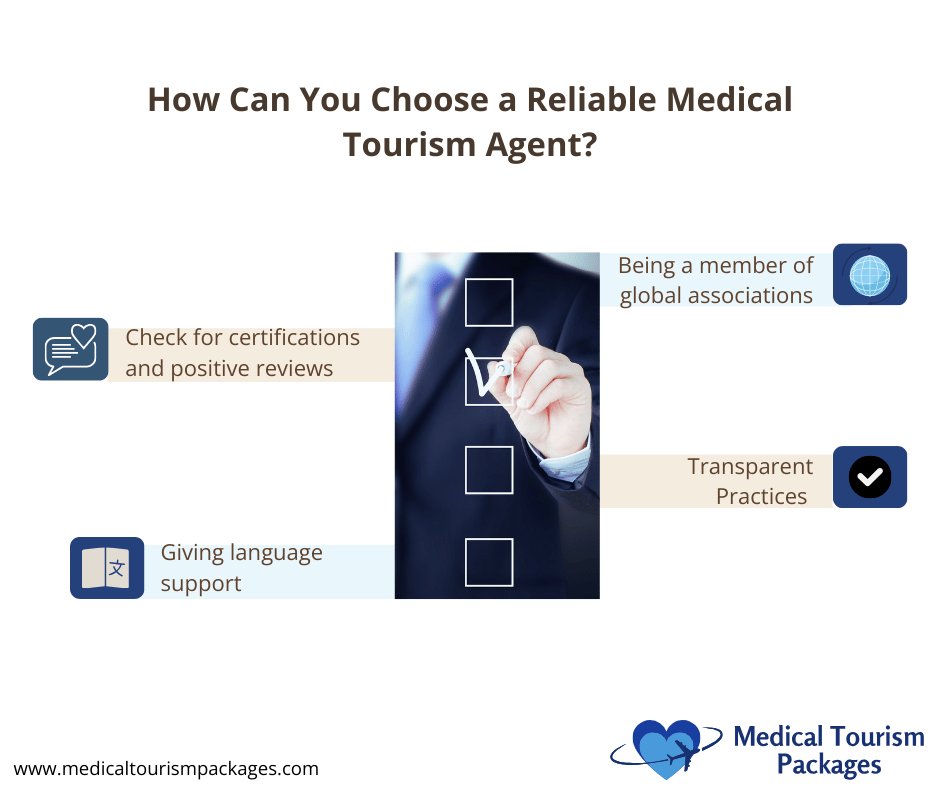
How Do You Choose a Medical Tourism Facilitator?
You choose a medical tourism facilitator by verifying credentials, checking hospital accreditations, requesting patient references, and reviewing the contract terms. Start with the GHA directory at globalhealthcareaccreditation.com and confirm JCI-accredited hospital partnerships at jointcommissioninternational.org. Over 1,000 healthcare organizations in 70 countries hold JCI accreditation. For destination-specific guidance, see how medical tourism agents in Colombia connect patients with accredited facilities at 30-80% less than U.S. costs.
What Questions Should You Ask a Facilitator Before Committing?
You should ask a facilitator about their certifications, hospital partnerships, experience with your procedure, pricing structure, and complication policies before committing. These questions reveal whether the facilitator is qualified or just a middleman collecting commissions.
- What certifications do you hold? (Look for GHA CMTP or ISO 22525)
- Which hospitals do you partner with, and are they JCI-accredited?
- How many patients have you coordinated for my specific procedure?
- What is your fee structure, commission-based or fee-for-service?
- What happens if I experience complications after returning home?
- Can you provide three recent patient references I can contact?
- Do you carry professional liability insurance?
- What is your refund policy if I cancel or if the procedure is postponed?
How Do You Verify a Facilitator’s Hospital Network and Accreditations?
You verify a facilitator’s hospital network by checking JCI accreditation status online at jointcommissioninternational.org. Cross-reference every hospital name the facilitator mentions. Confirm that the accreditation is current, not expired.
- JCI verification: Search the hospital name at jointcommissioninternational.org/who-is-jci-accredited
- GHA verification: Check the facilitator at globalhealthcareaccreditation.com
- Business registration: Confirm the company is registered in its stated country
- Better Business Bureau: Check BBB ratings and complaint history for U.S.-based facilitators
- TrustPilot reviews: Read independently verified patient reviews (not testimonials on the facilitator’s own website)
What Should a Legitimate Facilitator Contract Include?
A legitimate facilitator contract should include itemized costs, service descriptions, refund policies, complication protocols, and liability terms. Written contracts protect both patient and facilitator. Never proceed without a signed agreement.
- Itemized cost breakdown: Separate line items for procedure, hospital, travel, and facilitation fees
- Service scope: Exact list of what the facilitator will and will not do
- Refund and cancellation policy: Clear terms for cancellations, delays, or procedure changes
- Complication protocol: Who pays and what happens if post-operative issues arise
- Liability limits: The facilitator’s responsibility versus the hospital’s responsibility
- Data privacy terms: How your medical records are stored and shared
Where Do Medical Tourism Facilitators Operate in the USA?
Medical tourism facilitators in the USA operate primarily in Florida, Texas, California, and New York. These states have large immigrant populations, international airports, and proximity to popular medical tourism destinations like Mexico, Colombia, Costa Rica, and Panama. If you are considering Panama specifically, our guide on working with a medical tourism agent in Panama covers hospital options, cost savings, and how agents coordinate your care at JCI-accredited facilities.
U.S.-based facilitators serve about 1.4 million Americans who travel abroad for medical care each year. These patients spend roughly $8.5 billion abroad annually. U.S. national health spending reached $5.6 trillion in 2025, with 27 million Americans remaining uninsured. High domestic costs drive demand for international healthcare coordination.
What Is the Difference Between a Medical Tourism Facilitator, Broker, and Travel Agent?
The difference between a medical tourism facilitator, broker, and travel agent is scope of service, medical expertise, and accountability. A facilitator manages the full medical journey. A broker connects patients with hospitals for a referral fee. A regular travel agent books flights and hotels without medical coordination.
How Does a Facilitator Differ from a Medical Tourism Broker?
A facilitator differs from a medical tourism broker in accountability and service depth. Facilitators provide end-to-end care coordination. Brokers make introductions between patients and hospitals, then step back. The facilitator stays involved throughout treatment and recovery.
| Feature | Facilitator | Broker | Travel Agent |
|---|---|---|---|
| Medical expertise | Yes, specialized training | Limited | None |
| Hospital vetting | Verifies JCI accreditation | Lists available hospitals | Not applicable |
| On-site support | 24/7 during treatment | Rarely | No |
| Post-op follow-up | 3-12 months coordination | None | None |
| Payment model | Built-in fee or flat service fee | Referral fee only | Booking commission |
| Credentials | GHA CMTP, ISO 22525 | Business license only | IATA/CLIA travel certifications |
Why Isn’t a Regular Travel Agent Enough for Medical Trips?
A regular travel agent is not enough for medical trips because they lack medical expertise, hospital relationships, and clinical coordination skills. Travel agents book flights and hotels. They cannot evaluate surgeon credentials, verify hospital accreditations, or manage post-operative complications.
Medical trips require understanding of procedure timelines, recovery requirements, and emergency protocols. A patient recovering from cardiac surgery in India needs different support than a leisure traveler. Facilitators with GHA CMTP credentials train specifically for these situations.
When Should You Use a Facilitator vs. Booking Directly with a Hospital?
You should use a facilitator when traveling for the first time, seeking complex procedures, or visiting unfamiliar destinations. Booking directly with a hospital works best for experienced medical travelers who have researched a specific facility and can manage logistics independently.
Hospital international departments like those at Bumrungrad Hospital or Apollo Hospitals provide coordination for direct bookings. However, they only offer their own facility. A facilitator compares options across multiple hospitals and countries, potentially finding better matches for your specific condition and budget.
Is Using a Medical Tourism Facilitator Safe?
Yes, using a medical tourism facilitator is safe when the facilitator holds verified credentials like GHA CMTP and partners with JCI-accredited hospitals. Safety risks increase with unqualified facilitators. The 2025 DOJ fraud takedown charged $14.6 billion in healthcare fraud, showing that scams exist but are being prosecuted.
What Safety Standards Do Reputable Facilitators Uphold?
Reputable facilitators uphold JCI hospital accreditation standards, GHA Standards 5.0 for medical travel, and ISO 22525:2020 service requirements. These frameworks cover quality management, infection prevention, risk protocols, and patient rights. More than 1,000 healthcare organizations in over 70 countries hold the JCI Gold Seal of Approval.
In Turkey, the government now requires all medical tourists to register through the HealthTurkiye portal. TUSKA accreditation became mandatory, with full compliance required by end of 2026. Mandatory complication insurance for surgical procedures adds another layer of protection for patients choosing Turkey.
What Legal Protections Do You Have as a Patient?
You have legal protections through written contracts, local consumer laws, and international healthcare standards as a medical tourism patient. Three new U.S. state privacy laws took effect January 1, 2026. Indiana, Kentucky, and Rhode Island now require opt-in consent for sensitive health data.
Penalties reach up to $7,500 per violation in Indiana and Kentucky, and $10,000 per violation in Rhode Island. These laws apply to facilitators handling patient health records, genetic data, and biometric information. Reputable facilitators update their data practices to comply with these requirements.
How Do Facilitators Handle Complications and Medical Emergencies?
Facilitators handle complications and medical emergencies through pre-arranged protocols with partner hospitals, 24/7 emergency lines, and telemedicine follow-up coordination. Quality facilitators define complication procedures in the patient contract before travel.
- On-site emergencies: Immediate hospital readmission through the partner facility’s emergency department
- Post-return complications: Telemedicine consultations with the overseas surgical team
- Record transfer: Rapid sharing of operative notes and imaging with local emergency rooms
- Return visit coordination: Arranging flights and hospital admission for revision procedures
- Insurance claims: Helping patients file travel medical insurance claims for complication-related costs
Cosmetic surgery complications can be costly. In the UK, 28 patients died following cosmetic procedures in Turkey since 2019. Botched procedures cost the NHS about GBP 15,000 each, with some reaching GBP 100,000. Working with a qualified facilitator who vets surgeon credentials reduces these risks.
Frequently Asked Questions About Medical Tourism Facilitators
What is a medical tourism facilitator?
A medical tourism facilitator is a company or individual that coordinates international healthcare travel. Services include hospital selection, surgeon vetting, travel logistics, medical translation, payment processing, and post-operative follow-up. The global medical tourism market reached $56.19 billion in 2026, with qualified facilitators holding GHA CMTP or ISO 22525 credentials.
What are the main responsibilities of a medical tourism facilitator?
The main responsibilities include pre-travel medical record review, virtual surgeon consultations, cost estimates, visa assistance, flight and hotel bookings, airport transfers, medical translation, payment processing, 24/7 emergency support during treatment, and post-operative follow-up care coordination with home country doctors for 3 to 12 months.
How is a medical tourism facilitator different from a regular travel agent?
A medical tourism facilitator specializes in healthcare coordination with medical knowledge, hospital relationships, and GHA CMTP or ISO 22525 credentials. Travel agents book flights and hotels. Facilitators manage medical records, coordinate with surgical teams, provide medical translation, handle post-operative complications, and monitor recovery for months after treatment.
How can I find a reputable medical tourism facilitator?
You can find reputable facilitators by verifying GHA CMTP certification at globalhealthcareaccreditation.com, confirming JCI-accredited hospital partnerships at jointcommissioninternational.org, checking Better Business Bureau ratings, reading verified TrustPilot reviews, requesting three recent patient references, and confirming they carry professional liability insurance and ISO 22525 compliance.
What are the potential risks of using a medical tourism facilitator?
The potential risks include unqualified facilitators lacking GHA CMTP credentials, fee-driven referrals that favor profit over patient fit, hidden costs creating payment surprises (57.7% of patients cite this concern), limited international legal recourse, and inadequate post-operative follow-up. The 2025 DOJ takedown charged $14.6 billion in healthcare fraud. Written contracts and credential verification reduce these risks.
How much does a medical tourism facilitator typically charge?
Most facilitators are paid 7.5% to 30% by the partner hospital (built into your package price) or charge $1,500 to $5,000 in direct fees. Platform facilitators like FlytoDoc charge physicians EUR 50 per month with no patient fees. Overall, facilitation costs represent about 10% to 20% of your total medical travel budget.
What qualifications should I look for in a medical tourism facilitator?
Look for GHA Certified Medical Travel Professional (CMTP) designation, ISO 22525:2020 compliance, partnerships with JCI-accredited hospitals (1,000+ organizations in 70 countries hold JCI accreditation), professional liability insurance, formal business registration, multilingual staff, transparent pricing with itemized breakdowns, and verifiable patient references from the past 12 months.
How do medical tourism facilitators ensure patient safety?
Facilitators ensure safety by partnering exclusively with JCI-accredited hospitals, vetting surgeon credentials and board certifications, arranging pre-operative medical assessments, providing 24/7 emergency contacts and medical translation, establishing complication protocols in written contracts, and coordinating post-operative telemedicine follow-up. Nearly 87% of U.S. hospitals now offer telemedicine services.
Are medical tourism facilitators legitimate?
Yes, legitimate medical tourism facilitators with proper credentials are trustworthy professionals. Quality facilitators hold GHA CMTP certification, ISO 22525 compliance, and verifiable JCI-accredited hospital partnerships. Verify credentials directly through GHA and JCI websites. However, scammers exist, making credential verification and written contracts essential before booking any medical travel.
Do I need a medical tourism facilitator or can I book directly?
You can book directly through hospital international departments at facilities like Bumrungrad Hospital or Apollo Hospitals. However, facilitators provide hospital vetting, travel coordination, 24/7 emergency support, and post-operative follow-up that hospitals may not offer. First-time medical travelers and patients seeking complex procedures benefit most from facilitator coordination.
Ready to Work with a Trusted Medical Tourism Facilitator?
Medical Tourism Packages coordinates medical travel to Colombia, Panama, Costa Rica, Mexico, and Argentina.
Contact us today for a free consultation and personalized medical tourism package.