Book Appointment Now

Rhinoplasty in Argentina: Cost, Safety, and Recovery
 By
By
One Argentina provider lists rhinoplasty at USD 3,000, dated June 18, 2026. This is a reference price, not a personal quote. It is also a single-source marketing claim.
The provider quotes directly in US dollars. No peso conversion was made. Its exchange-rate basis is undisclosed.
A useful decision needs more than a price. Check the surgeon, operating facility, written inclusions, recovery schedule, and care after you return home.
This guide explains those checks for US and Canadian patients. It does not recommend a surgeon or facility. Your treating clinicians must decide whether surgery and travel are appropriate.
How Much Does Rhinoplasty Cost in Argentina?
The current verified reference price is USD 3,000 from one Argentina provider. It was published on June 18, 2026. The final amount depends on your anatomy, goals, technique, and operating plan.
The listed price includes the surgical team, anesthesia, surgery room, recovery room, supplies, disposable materials, and postoperative consultations. Prescribed medication is excluded. Accommodation, transfers, and bilingual support are optional.
| Price point | Amount and date | What it means |
|---|---|---|
| Argentina reference price | USD 3,000, June 18, 2026 | Single provider marketing claim; direct USD quote; exchange basis undisclosed |
| US reference | USD 7,637, page accessed September 14, 2026 | ASPS partial average; anesthesia, facilities, and related expenses excluded; statistics year unstated |
The two figures are not like-for-like totals. They cannot support a reliable savings percentage.
Published peso prices need extra care. One 2026 aggregator supplied a peso amount and a dollar approximation without a dated rate. That conversion was excluded from this guide.
What Must a Written Quote Include?
A written quote should make every clinical and financial boundary visible.
- Your surgeon’s full licensed name and specialty.
- The exact operating facility and planned anesthesia.
- Surgeon, anesthesiologist, assistant, facility, and supply fees.
- Tests, medicines, splints, grafts, or devices.
- Local follow-up and the last planned in-person review.
- Revision policy and responsibility for complications.
- Currency, quote date, validity window, and exchange-rate basis.
- Taxes, card charges, deposit terms, refund rules, and refund currency.
- Accommodation, transfers, translation, and companion costs.
The published USD 3,000 price does not disclose deposit or refund terms. Ask for those terms before sending money.
What Is Rhinoplasty, and Which Approach May Be Used?
Rhinoplasty changes the shape of the nose, its function, or both. It can reshape bone, cartilage, skin, or a combination.
Closed rhinoplasty uses incisions inside the nose. Open rhinoplasty adds a small incision across the columella. The surgeon chooses the access based on anatomy and the planned changes.
Functional septorhinoplasty can combine reshaping with work on the septum. Its goal may include improved airflow. Coverage and medical-necessity decisions still require records and prior approval.
The verified source pack did not establish Argentina-specific revision methods or price premiums. Ask how the proposed plan addresses prior surgery, functional goals, and possible revision.
This guide covers surgical rhinoplasty. Injectable procedures were outside the verified evidence scope.
Does Piezoelectric Rhinoplasty Improve Recovery?
Piezoelectric tools may improve some early recovery measures during bony work. They do not guarantee a better final result.
A 2026 review included 19 randomized studies and 905 patients. Some swelling, bruising, and pain measurements favored piezoelectric osteotomy during the first week.
The review does not prove that piezo fits every operation. It also does not establish superior final appearance. Ask which steps need bone work and why the proposed tool fits them.
Who May Be a Candidate for Rhinoplasty?
A candidate generally has completed facial growth, is physically healthy, does not smoke, and has realistic goals. The source gives no universal age cutoff.
The consultation should cover your medical history, medicines, prior nasal surgery, breathing concerns, and expectations. The surgeon should examine the inside and outside of your nose.
A bleeding disorder may affect eligibility. The opened ASPS candidate page also lists not smoking as a general criterion. Only a clinician who evaluates you can give medical clearance.
Is Rhinoplasty in Argentina Safe?
Every rhinoplasty carries risk. No current Argentina-specific complication rate was found in the opened sources.
Recognized risks include bleeding, infection, anesthesia problems, breathing difficulty, scarring, septal perforation, altered sensation, and another operation.
A systematic review of 36 studies reported wide ranges. The need for revision ranged from 0% to 10.9%, and infection ranged from 0% to 4%. These studies used different patients, techniques, and follow-up periods.
Those endpoints cannot predict your outcome. They also cannot rate an Argentine surgeon or facility. Ask for the surgeon’s own definitions, follow-up period, complication policy, and audited data.
How Do You Verify the Surgeon and Facility?
Use separate checks for legal authorization, specialty status, facility registration, and accreditation.
- Search the surgeon in REFEPS by full name or license number. Confirm current authorization, specialty, and any recorded disqualification.
- Search the operating facility in REFES. Confirm the address and facility type.
- Check SACPER membership if the surgeon claims it. SACPER says membership is not legally required.
- Verify any ITAES claim in the ITAES directory. Treat accreditation as an extra quality check.
- Ask for the exact ANMAT registration when a manufactured implant or device is proposed.
REFES presence is not an accreditation. SACPER membership is not the legal license. A directory entry also cannot guarantee an outcome.
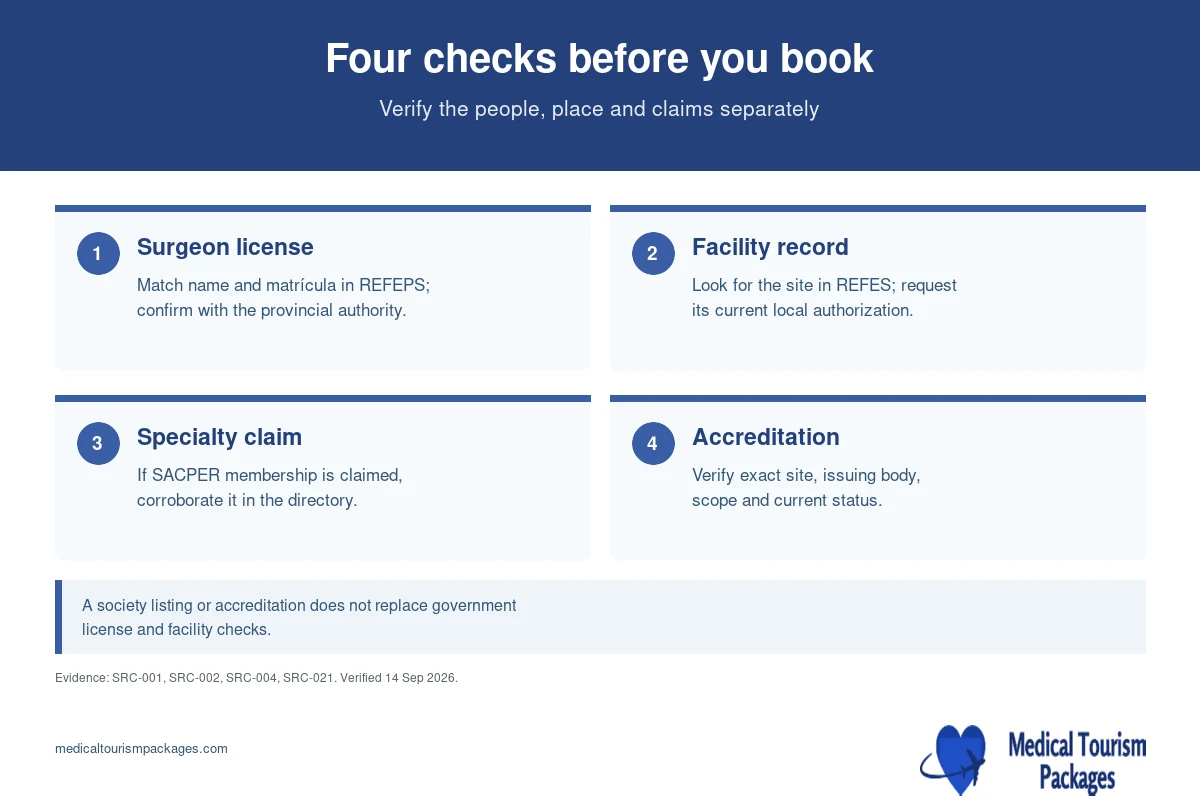
Match every name and address across the quote, consent form, and clinical record. Pause if the seller will not identify the operating team or location.
What Should You Plan Before and After Surgery?
Start with records review, then complete the in-person examination before surgery. The surgeon may need photographs, breathing assessment, tests, and medication changes.
Get the following items before paying the balance:
- written procedure and anesthesia plan;
- itemized quote and cancellation terms;
- surgeon and facility verification;
- emergency contact and complication pathway;
- local follow-up dates;
- home-clinician handoff;
- complete medical records in English;
- travel insurance and medical-evacuation terms.
CDC advises medical travelers to arrange follow-up at home and obtain complete records in English. Ask who will answer questions after you leave Argentina.
Argentina requires written informed consent for surgery. Read it before sedation. Confirm risks, alternatives, expected benefits, and the effects of declining treatment.
How Long Should You Stay Before Flying Home?
Plan to remain through your local review and individualized flight clearance.
CDC cites a 7 to 10 day wait after cosmetic procedures to the face, eyelids, or nose. One hospital’s septorhinoplasty instructions use two weeks.
Neither period guarantees fitness to fly. Swelling, bleeding, infection, breathing, blood-clot risk, airline rules, and trip length can change the plan.
Mayo Clinic says a nasal splint is often used for about one week. Swelling can continue for months. Your return flight should not mark the end of follow-up.
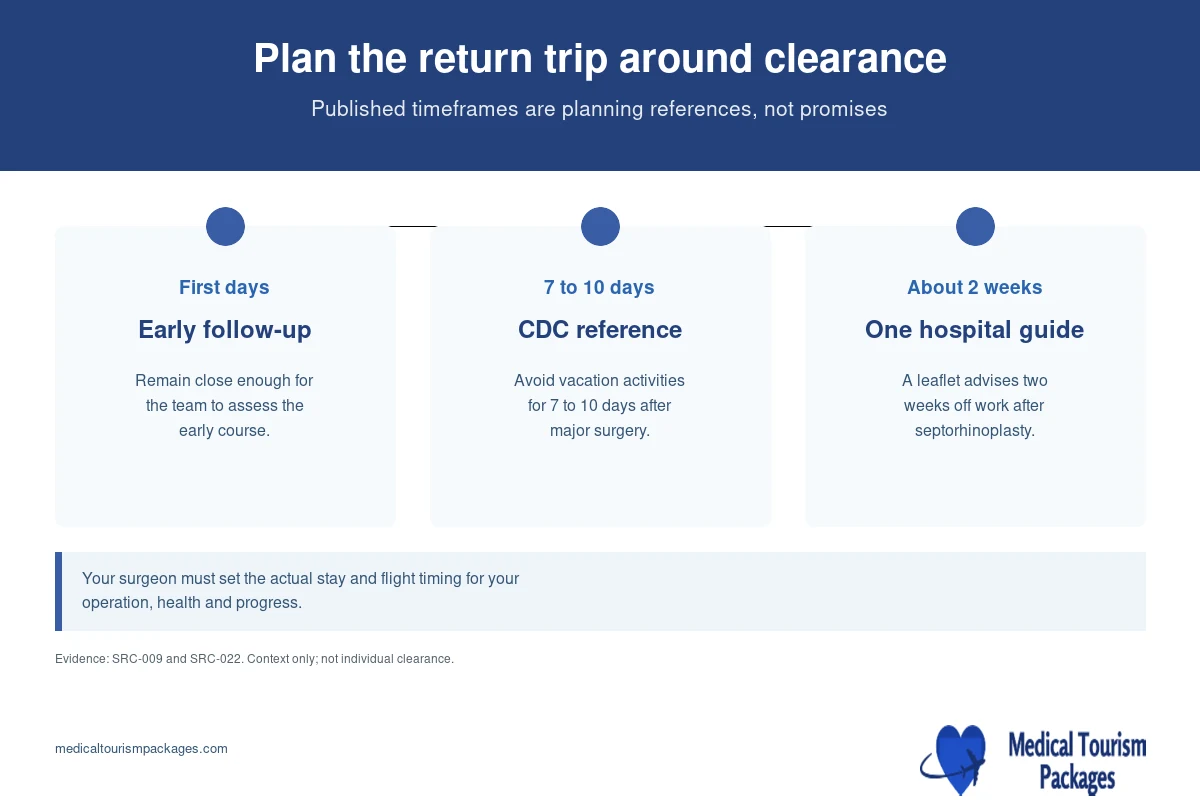
Choose flexible travel and accommodation. CDC warns that typical vacation activities during recovery can delay or impede healing. Keep emergency and home-clinician contacts available.
What Are the Entry and Insurance Rules?
Argentina may authorize tourist stays for up to three months. An extension may cover a similar period. Entry remains a border decision, so confirm nationality-specific rules before booking.
Argentina also has temporary residence for medical treatment. It can run for up to one year and requires supporting documents. Most short elective trips may not need this route.
Argentine law provides for an entry declaration about health-insurance coverage, but the requirement depends on implementation rules that this article does not confirm are currently in force. Check current proof requirements with Migraciones or an Argentine consulate before travel.
Many overseas providers require upfront cash or card payment. US insurance may not be accepted directly. Obtain a written coverage decision before assuming reimbursement.
IRS guidance generally excludes appearance-only cosmetic surgery from qualified medical expenses. Narrow exceptions can apply to qualifying functional or reconstructive care. Ask your insurer, plan administrator, and tax professional.
How Can Medical Tourism Packages Coordinate the Next Step?
Medical Tourism Packages can help organize records, quote questions, register checks, travel timing, and aftercare planning.
The first useful output is an itemized plan. It should identify the clinicians, facility, procedure, currency, inclusions, and follow-up.
Ask MTP to help you prepare and compare a written rhinoplasty plan.
You can also review our rhinoplasty overview, Argentina medical tourism guide, and country guides for Colombia, Panama, and Mexico.
Frequently asked questions about rhinoplasty in Argentina
These answers summarize the practical checks in this guide. Your surgeon, insurer, plan administrator, airline, and immigration authority must confirm the parts they control.
How much does rhinoplasty cost in Argentina?
One Argentina provider published a USD 3,000 reference price on June 18, 2026. It is a single-source marketing claim, quoted directly in dollars, with no disclosed peso exchange basis. Obtain an individualized, itemized quote.
Is rhinoplasty in Argentina safe?
Every rhinoplasty carries risk, and no current Argentina-specific rate was found. A 36-study review reported a need for revision from 0% to 10.9% and infection from 0% to 4%, with varied patients and methods.
How do I verify the surgeon and clinic?
Check the surgeon’s authorization and specialty in REFEPS, the facility in REFES, any SACPER membership in its directory, and each accreditation claim with its issuer. Match every name and address to the quote.
How long should I stay before flying home?
CDC cites 7 to 10 days after cosmetic procedures to the face or nose. One septorhinoplasty instruction uses two weeks. Stay through local follow-up and fly only after individual clearance.
Can US insurance or an HSA pay for rhinoplasty abroad?
Appearance-only surgery is generally excluded from qualified medical expenses. Functional or reconstructive facts may change coverage or tax treatment. Get written decisions from the insurer and plan administrator before paying.
What is the difference between open, closed, functional, and piezo rhinoplasty?
Closed surgery uses internal incisions. Open surgery adds a columellar incision. Functional surgery may address breathing and the septum. Piezoelectric tools perform selected bony work. The surgeon chooses from your anatomy and goals.
Sources and references
- SRC-001: Argentina Ministry of Health, REFEPS search update
- SRC-002: Argentina Ministry of Health, REFES and REFEPS
- SRC-003: ANMAT medical products
- SRC-004: SACPER certified-surgeon directory
- SRC-005: Argentina Law 26.529 on patient rights
- SRC-006: Argentina tourist-entry documents
- SRC-007: Argentina medical-treatment temporary residence
- SRC-008: Argentina migration law, current text
- SRC-009: CDC Yellow Book 2026, medical tourism
- SRC-010: ASPS rhinoplasty cost
- SRC-011: ASPS rhinoplasty risks
- SRC-012: ASPS rhinoplasty candidates
- SRC-013: Mayo Clinic rhinoplasty guide
- SRC-014: Systematic review of rhinoplasty adverse events
- SRC-015: 2026 piezoelectric rhinoplasty systematic review
- SRC-016: an Argentina provider’s reference price page, June 2026; single-source marketing claim; full URL retained in the internal source register
- SRC-017: an Argentina price aggregator, May 2026; unsupported peso-to-dollar conversion rejected; full URL retained in the internal source register
- SRC-018: IRS Publication 502
- SRC-019: IRS Publication 969
- SRC-020: US Department of State, Argentina travel guidance
- SRC-021: ITAES accredited-organization directory
- SRC-022: Septorhinoplasty aftercare guidance