Book Appointment Now



Blepharoplasty in Argentina: Cost, Options, and Travel
 By
By
Blepharoplasty reshapes selected upper or lower eyelid tissues.
The right plan matches your eye anatomy and goals with the exact operation, anesthesia, quote, recovery support, and follow-up you need before arranging medical travel to Argentina.
Medical Tourism Packages helps you organize consultations, records, personalized quotes, appointments, and travel. Your surgeon decides whether surgery fits, which tissues need treatment, and when you can travel.
You receive one coordinated path from your first consultation through follow-up at home.
What Is Blepharoplasty in Argentina?
Blepharoplasty is eyelid surgery that can treat the upper eyelids, lower eyelids, or both. The operation may remove or reposition skin, muscle, and fat according to the problem being treated.
Start with the MTP eye-lift and blepharoplasty guide for the wider procedure picture. Our plastic surgery guide to Argentina covers cosmetic-surgery planning. The Argentina medical tourism guide explains the wider travel and care context.
ISAPS estimated 16,142 eyelid procedures in Argentina during 2024. This is a survey estimate of activity. It does not measure results or identify international patients.
Which Blepharoplasty Option May Fit Your Eyes?
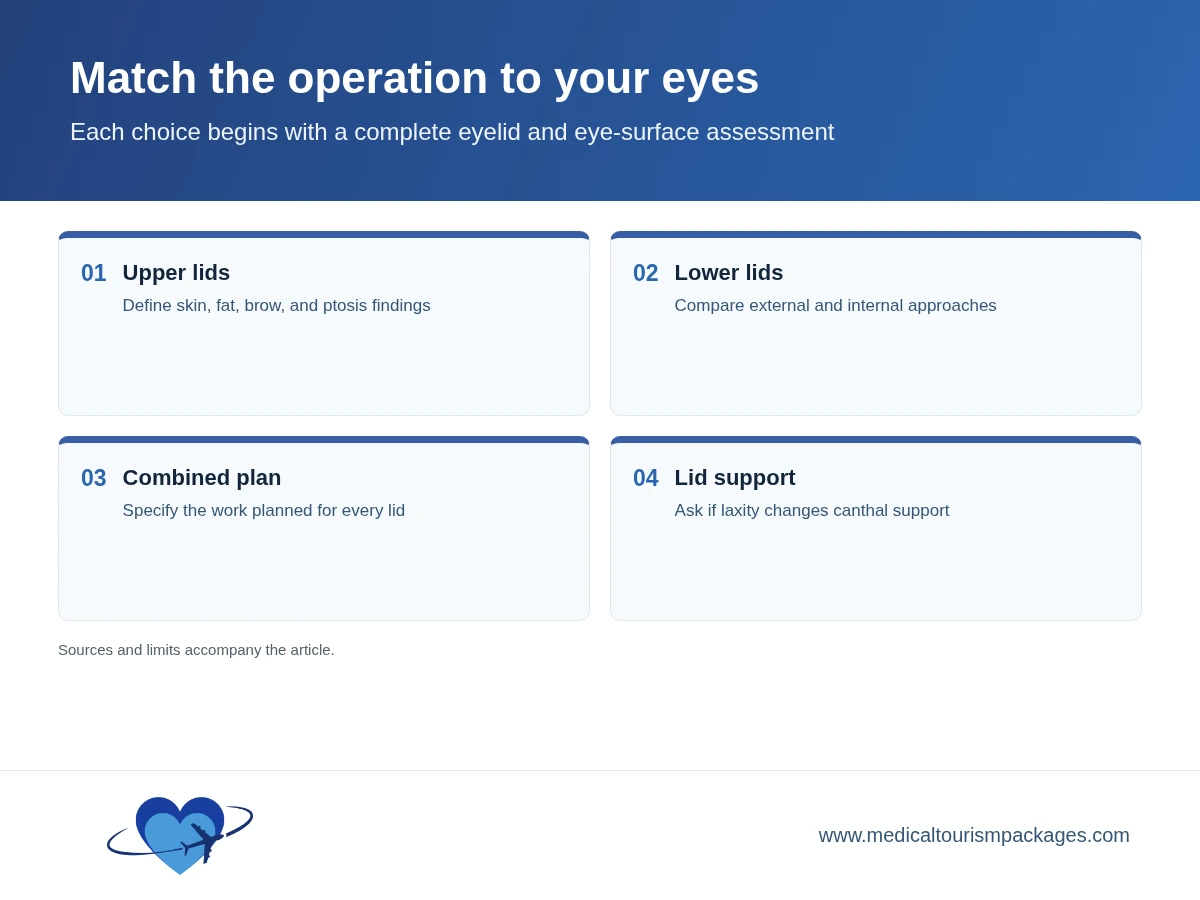
Your examination determines whether the plan should address upper lids, lower lids, both areas, or a different cause of eyelid change. Brow position, eyelid muscle function, dry eye, lower-lid support, and previous eye treatment can change that decision.
What Does Upper Blepharoplasty Address?
Upper blepharoplasty treats selected skin and tissue through an incision placed in the eyelid crease. It may fit excess upper-lid skin or fullness after the surgeon checks the brow and eyelid-lifting muscle.
A drooping appearance can come from the brow or from true eyelid ptosis. Those findings can require a different or additional operation. Ask the surgeon to name the cause and the proposed correction.
What Does Lower Blepharoplasty Address?
Lower blepharoplasty treats selected lower-lid skin, fat, or contour concerns. An external incision can address skin and tissue, while a transconjunctival incision inside the lid can remove or reposition fat without removing skin.
The best approach depends on skin excess, fat position, the lid-cheek contour, lid support, and eye-surface health. Published reviews do not establish one technique as best for everyone.
When Are Upper and Lower Surgery Combined?
Combined blepharoplasty treats both eyelid regions in one operative plan. A combined label does not explain the scope by itself.
Ask for a written plan for each lid. It should show which tissue will be removed, preserved, or repositioned and how each eye will be assessed for symmetry.
When May Canthopexy or Canthoplasty Enter the Plan?
Canthopexy or canthoplasty may enter a lower-lid plan when examination finds laxity or a risk of poor lid position. The surgeon should explain why support is needed in your anatomy.
These procedures are not automatic additions. Ask what examination finding supports the recommendation and how it changes the risks, recovery, and quote.
Which Anesthesia May Be Used?
The anesthesia plan depends on the operation, your health, and the facility. ASPS lists intravenous sedation and general anesthesia among eyelid-surgery options. Your written quote must name the full anesthesia arrangement.
Ask who administers anesthesia, where monitoring occurs, and what happens if the operation changes. The plan should also explain discharge support and the first clinical contact after surgery.
How Much Does Blepharoplasty Cost in Argentina?
There is no verified national Argentina price range in this evidence pack. A useful comparison starts with itemized quotes for the same eyelids, technique, anesthesia, facility, and follow-up.
Upper, lower, and combined surgery have different scopes. Canthal support, another eyelid procedure, or more complex anesthesia can also change the total.
| Quote item | What to confirm |
|---|---|
| Surgical plan | Upper, lower, combined, ptosis work, and any canthal support |
| Professional fees | Surgeon, assistant, anesthesia professional, and postoperative reviews |
| Facility | Operating room, recovery area, supplies, and unexpected observation |
| Testing and medicines | Eye testing, medical clearance, prescriptions, and wound-care supplies |
| Follow-up | Scheduled checks in Argentina, remote contact, and record transfer |
| Financial terms | Currency, quote expiry, deposit, balance date, refunds, and revision terms |
| Travel budget | Flights, lodging, local transport, companion support, and flexible return plans |
ASPS lists surgeon, facility, anesthesia, medicines, and tests as common cost components. Request the currency and validity window on every Argentina quote. Keep treatment costs separate from flights and lodging so comparisons remain clear.
Will Insurance Cover Eyelid Surgery Abroad?
Cosmetic blepharoplasty is usually outside health-plan coverage. A functional upper-lid case may receive consideration when excess tissue affects vision and the policy’s documentation rules are met.
Ask your insurer before booking. Confirm overseas coverage, prior authorization, visual-field requirements, claim documents, complications, and follow-up in writing. An overseas quote does not establish medical necessity or coverage.
Who May Be a Candidate for Blepharoplasty?
A possible candidate has a concern that matches an eyelid operation and can undergo surgery safely. General guidance favors good health, no condition that impairs healing, no serious eye disease, no smoking, and realistic goals.
Your consultation should cover:
- dry eye, irritation, contact-lens use, and trouble closing the eyes;
- glaucoma, retinal disease, thyroid eye disease, or prior eye treatment;
- previous eyelid, brow, laser, or facial procedures;
- vision changes, asymmetry, brow position, and eyelid ptosis;
- medicines, supplements, allergies, smoking, and anesthesia history;
- the exact change you want and the limits you can accept.
There is no single best age. The decision comes from anatomy, symptoms, health, goals, and a complete eye and facial assessment.
Should You Choose an Oculofacial or Plastic Surgeon?
Choose the professional whose current license, training, eyelid experience, and proposed plan fit your case. Eye-specific symptoms or complex eyelid function make ophthalmic and oculofacial assessment especially relevant. Facial plastic-surgery experience can also be relevant to cosmetic planning.
Ask both types of surgeon the same questions:
- How often do you perform my exact upper, lower, or combined operation?
- How will you assess dry eye, lid closure, ptosis, brow position, and lower-lid support?
- Who manages an urgent eye symptom during recovery?
- Which hospital or facility will be used, and who provides anesthesia?
- How do you plan follow-up after I leave Argentina?
A specialty label alone does not answer these questions. Ask for the surgeon’s Argentine registration details and the written operative plan.
How Do You Check the Surgeon and Facility in Argentina?
Use three checks before paying a deposit: professional authorization, relevant experience, and the operating facility. Keep the results with your records.
- Search the surgeon in Argentina’s REFEPS by name or registration number. Ask the relevant jurisdiction about any unclear result.
- Use the appropriate specialty source as a second check. SACPER can corroborate plastic-surgery membership, while eye-focused training and experience need separate confirmation.
- Confirm the facility in REFES and ask how the surgical-safety checklist is used. A register entry does not measure outcomes.
Argentine patient law supports written surgical consent and access to your clinical record. Read the consent before surgery and request your operative note, medication list, discharge instructions, and follow-up summary.
What Risks Should You Discuss Before Eyelid Surgery?
Blepharoplasty can affect comfort, lid position, eye closure, and vision. Recognized risks include bleeding, infection, dry eye, incomplete closure, lower-lid turning or pulling, scarring, persistent pain, anesthesia problems, revision, and vision change.
Blindness is a rare but serious risk. Your plan should name the emergency contact, the facility that can assess an eye urgently, and the steps your companion should take.
| Question | Why it matters |
|---|---|
| How will you test eye surface and lid closure? | Dryness or incomplete closure can affect the operation and aftercare. |
| How will you assess lower-lid support? | Laxity can change the lower-lid plan. |
| What symptoms require urgent care? | Vision loss, double vision, bleeding, severe swelling, or severe pain need prompt assessment. |
| Who can examine me after hours? | International patients need a reachable clinical route. |
| What care is available after I return home? | Early continuity prevents confusion when symptoms change. |
How Should You Plan Recovery and the Flight Home?
Plan travel around recovery milestones and written clinical clearance. Early healing may include swelling, bruising, irritation, dryness, and discomfort, with instructions for eye care, medicines, activity, and follow-up.
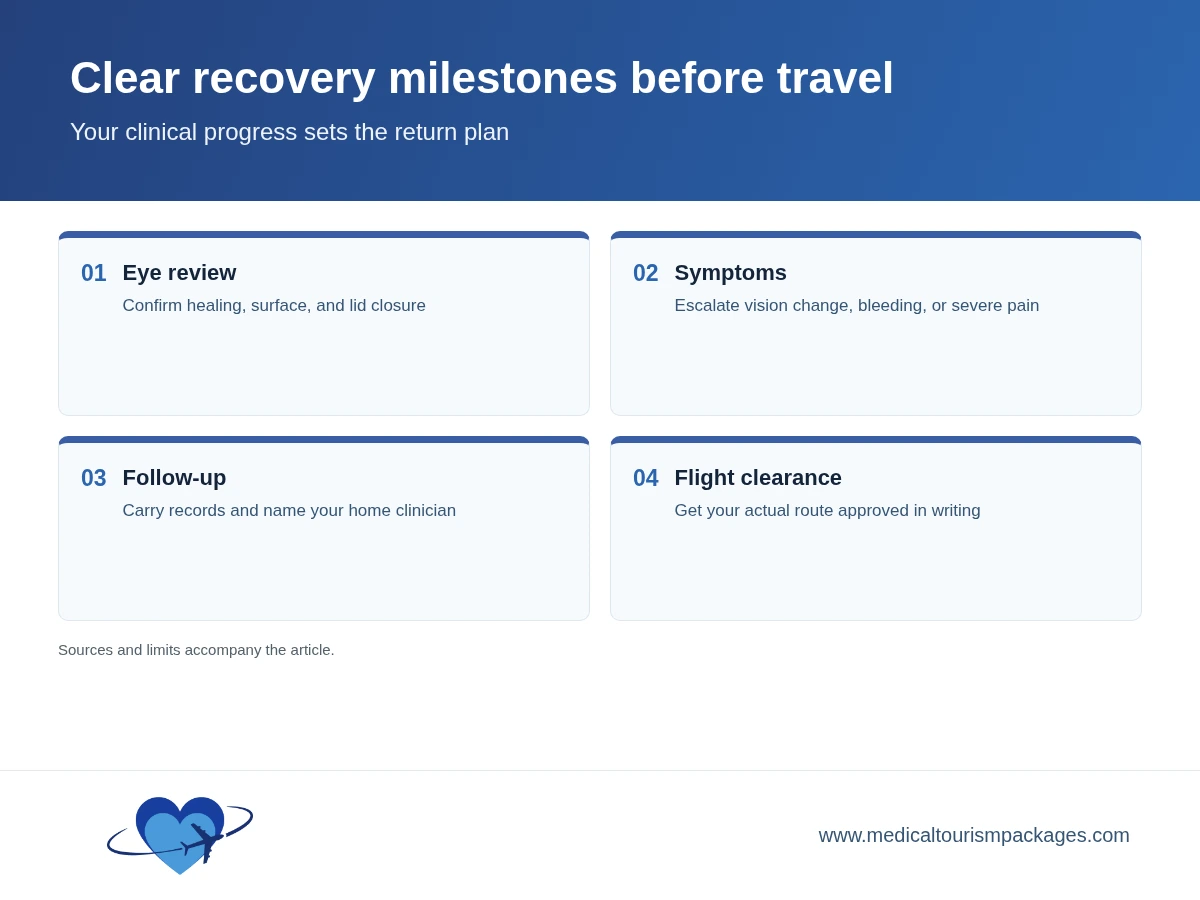
Before departure, confirm that:
- the surgeon has examined healing and eye function;
- urgent symptoms are absent or have been assessed;
- you understand medicines, eye care, activity, and sun protection;
- you have the operative note and discharge instructions;
- a clinician at home has agreed to provide follow-up;
- the surgical team has cleared your actual flight route in writing.
Surgery and air travel each add blood-clot risk. Eye symptoms, anesthesia, other procedures, health conditions, and the flight route can also change clearance. Keep your return booking flexible.
Seek urgent assessment for loss of vision, double vision, bleeding, severe swelling, or severe pain. Contact the surgical team promptly for any concern, including worsening dryness, difficulty closing the eye, fever, or drainage.
Check current entry rules for your passport with Argentina’s migration authority before booking. Travel rules and airline requirements can change.
How Long Can Blepharoplasty Results Last?
Results can be long-lasting, but the face and eyelids continue to age. Sun exposure, smoking, eye health, anatomy, healing, and the chosen operation can affect the result.
No surgeon can guarantee symmetry, a fixed lifespan, or freedom from revision. Ask which change the operation can reasonably make and which concern may need a different treatment.
How Does MTP Coordinate Blepharoplasty in Argentina?
MTP coordinates the practical steps around your clinical plan. We help organize consultation records, questions, an itemized quote, appointment dates, travel details, and follow-up contacts.
Your treating surgeon remains responsible for diagnosis, candidacy, technique, anesthesia, prescriptions, recovery, and flight clearance. We keep those clinical decisions connected to the trip you are planning.
What Should You Send for a Useful First Consultation?
Send clear photos requested by the clinical team, your goals, eye history, surgery history, medicines, allergies, and travel constraints. Include any recent eye reports when relevant.
List the questions that matter most: upper or lower scope, brow or ptosis findings, dry-eye risk, canthal support, anesthesia, quote inclusions, urgent care, follow-up, and travel clearance.
Ready to Request a Personalized Plan?
Request a free consultation and personalized quote. MTP can coordinate your records, consultation, quote, dates, and travel planning. The clinical team will confirm candidacy, the operation, anesthesia, recovery, and follow-up before you commit.
What Do Patients Ask About Blepharoplasty in Argentina?
These answers cover the decisions international patients commonly make before eyelid surgery. Your surgeon must confirm every clinical detail from an examination.
These answers cover the decisions international patients commonly make before eyelid surgery. Your surgeon must confirm every clinical detail from an examination.
How much does blepharoplasty cost in Argentina?
There is no verified national price in this evidence pack. Compare itemized quotes for the same eyelids, technique, anesthesia, facility, tests, medicines, follow-up, currency, and financial terms.
What is the difference between upper and lower blepharoplasty?
Upper surgery treats selected upper-lid skin and tissue. Lower surgery may treat skin, fat, contour, and lid support through an external or internal incision, according to the anatomy found during examination.
How long does blepharoplasty recovery take?
Recovery has no universal schedule. Plan around swelling, bruising, eye comfort, wound checks, activity instructions, follow-up, and your surgeon's written clearance for each next step.
How long do blepharoplasty results last?
Results can be long-lasting, but natural aging continues and no fixed duration is guaranteed. Anatomy, healing, health, sun exposure, smoking, and the operation can affect the result.
Is blepharoplasty covered by insurance?
Cosmetic surgery is usually excluded. A functional upper-lid case may be considered under a policy's visual-field, documentation, network, and overseas-care rules, which must be confirmed before booking.
When can I fly after blepharoplasty in Argentina?
No single interval fits every patient. Fly only after the surgeon reviews healing and eye function, urgent symptoms are absent or assessed, follow-up is arranged, and your actual route receives written clearance.
Sources and references
- ISAPS International Survey on Aesthetic/Cosmetic Procedures Performed in 2024
- ASPS eyelid surgery procedure steps
- ASPS eyelid surgery candidates
- ASPS eyelid surgery risks and safety
- ASPS eyelid surgery recovery
- ASPS eyelid surgery cost
- AAO EyeWiki upper eyelid blepharoplasty
- Lower eyelid blepharoplasty review
- Argentina national health-professional search
- Argentina surgical-safety guidance
- Argentina patient-rights law
- CDC Yellow Book medical tourism guidance