Book Appointment Now

All-On-4 Dental Implants in Mexico: Costs, Procedure, and Medical Tourism Guide
 By
By
All-On-4 dental implants in Mexico cost $6,000 to $10,000 per arch, saving patients 50 to 83 percent compared to US prices of $20,000 to $35,000 per arch.
COFEPRIS-licensed clinics in Tijuana, Los Algodones, and Cancun place All-On-4 implants using Nobel Biocare and Straumann systems. Costs run $6,000 to $10,000 per arch (50 to 83 percent less than the US average of $20,000 to $35,000), with same-day temporary teeth.
Featured clinics include Trust Dental Care and New Age Dental Clinic in Tijuana, Sani Dental Group in Los Algodones, and Cancun Cosmetic Dentistry, all COFEPRIS-licensed with ADA membership and Nobel Biocare or Straumann implant credentials. Below, you will find cost comparisons by city, clinic profiles, safety standards, the two-trip treatment timeline, and answers to the most common questions about All-On-4 implants in Mexico.
What Are All-On-4 Dental Implants?
All-On-4 dental implants are a full-arch restoration that uses four titanium implants to support a fixed bridge of teeth. The technique replaces every tooth in one jaw and avoids bone grafting in most patients, according to the Malo Clinic protocol.
Two implants go straight into the front of the jaw. The other two tilt at a 30 to 45 degree angle in the back, following the Nobel Biocare protocol. This angled placement uses denser bone and supports a full bridge with just four anchors.
How Does the All-On-4 Technique Differ from Traditional Implants?
The All-On-4 technique differs by using only four implants per jaw instead of eight to ten. Traditional full-mouth implants place one implant per missing tooth. All-On-4 tilts the back implants to skip bone grafting, which most patients with bone loss would otherwise need.
This design saves money, time, and surgery. Traditional implants often require a bone graft, then months of healing before the implants are placed. All-On-4 places the implants and a temporary bridge in a single visit, so you leave with fixed teeth the same day.
How Do All-On-4 Implants Compare to Traditional Dentures?
All-On-4 implants stay fixed in your mouth, while traditional dentures sit on the gums and can slip. The implants fuse to your jawbone, so they do not move when you eat or speak. Dentures rest on top of the gums and need adhesive to hold.
Fixed implants also protect your jawbone. Removable dentures let the bone shrink over time, which changes your facial shape and loosens the fit. Because All-On-4 implants stimulate the bone like natural roots, they help keep your jaw strong and your face fuller.
Who Is a Good Candidate for All-On-4 Dental Implants?
You are a good candidate for All-On-4 if you have lost most teeth or need a full extraction. The standard eligibility criteria require enough bone in the front of the jaw, good general health, and ideally non-smoker status for the best healing results.
You may be a good candidate if you meet these conditions:
- Tooth loss: You are missing most teeth or face a full extraction in one or both jaws.
- Anterior bone: You have enough bone in the front jaw region to anchor the implants.
- General health: You are in good general health with controlled chronic conditions.
- Smoking status: You do not smoke, or you can stop during healing, since smoking raises failure risk.
- Failed dentures: You wear loose dentures and want a fixed, stable solution.
Conservative options should be considered first. Many patients try conventional removable dentures, implant-supported overdentures, or All-on-6 before choosing All-On-4. A dentist confirms your fit using a panoramic X-ray, a CBCT scan, a medical history review, and a periodontal assessment.
How Much Do All-On-4 Dental Implants Cost in Mexico?
All-On-4 dental implants cost $6,000 to $10,000 per arch in Mexico, compared to $20,000 to $35,000 per arch in the United States. This saves you 50 to 83 percent, according to MedicalTourismCo and Massey Dentistry 2025 pricing data.
What Do All-On-4 Implants Cost in Tijuana, Cancun, and Los Algodones?
All-On-4 costs fall within $6,000 to $10,000 per arch across the top dental cities in Mexico. Los Algodones offers the most competitive entry pricing, while Tijuana and Cancun sit in a similar range based on clinic tier and material choice.
Here is how All-On-4 prices compare across the three main dental cities:
| City | Cost Per Arch (USD) | Access Method | Best For |
|---|---|---|---|
| Los Algodones | $6,000–$9,500 | Drive from Yuma, AZ (20 min) | Most competitive pricing |
| Tijuana | $6,500–$10,000 | Drive from San Diego (30 min) | Western US patients, no flight |
| Cancun | $7,000–$10,000 | Direct flights from US cities | Resort amenities during recovery |
Most clinics quote a per-arch price. A full-mouth restoration treats both jaws and roughly doubles the figures above. Always ask for a dated, itemized quote in US dollars that lists the implant brand, the prosthesis material, and the written warranty.
How Do Mexico Costs Compare to US and Canadian Prices?
Mexico costs 50 to 83 percent less than the United States for the same All-On-4 procedure. A single arch runs $6,000 to $10,000 in Mexico versus $20,000 to $35,000 in the US, using the same implant brands found in American clinics.
This table compares per-arch All-On-4 pricing across North America and nearby destinations:
| Country | Cost Per Arch (USD) | Savings vs US |
|---|---|---|
| Mexico | $6,000–$10,000 | 50–83% |
| United States | $20,000–$35,000 | Baseline |
| Canada | $20,000–$35,000 | Baseline |
| Colombia | $7,000–$11,000 | Comparable to Mexico |
| Costa Rica | $8,500–$12,750 | Lower savings than Mexico |
The savings come from lower labor and facility costs in Mexico, not lower-grade materials. The implants are made by the same global manufacturers used in the US. Many US patients recover the full cost of the trip on a single arch. For a complete overview of healthcare travel logistics, costs, and hospital options, read our guide to medical tourism in Mexico.
What Materials and Implant Brands Affect the Price?
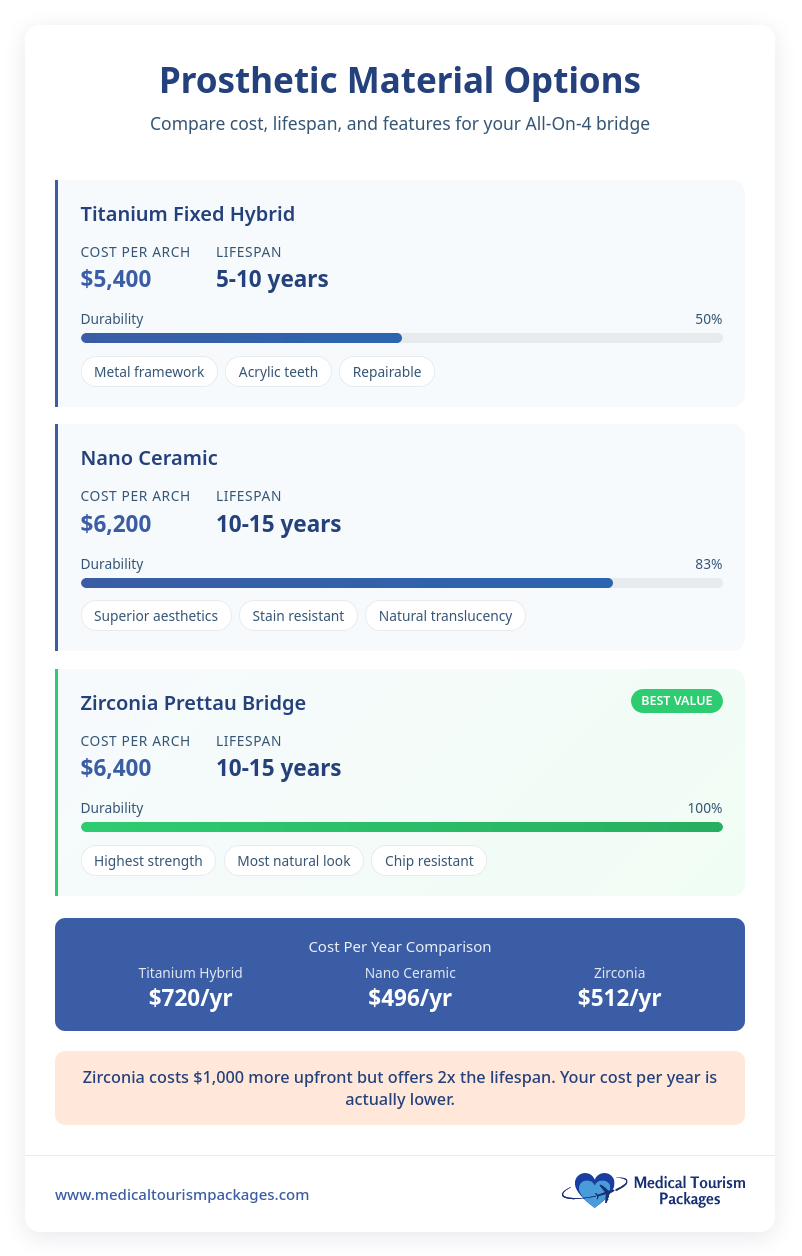
The implant brand and the bridge material drive most of the price difference. Premium implants from Straumann and Nobel Biocare cost more than budget brands. The final bridge material, whether titanium hybrid, nano ceramic, or zirconia, also changes the per-arch price.
Prosthesis material is the biggest cost variable in All-On-4 pricing:
| Prosthesis Material | Cost Per Arch (USD) | Lifespan | Best For |
|---|---|---|---|
| Titanium Hybrid (acrylic) | $6,000–$7,000 | 5–10 years | Budget-focused patients |
| Nano Ceramic | $7,500–$8,500 | 10–15 years | Balance of cost and durability |
| Zirconia Prettau Bridge | $8,500–$10,000 | 10–15 years | Best long-term value and looks |
Bone grafting, a sinus lift, or IV sedation can add to your quote. Bone grafting adds about $200 to $400 per site, and certified IV sedation adds about $400 to $500. Ask which items are included before you compare clinic prices.
Which Dental Clinics Offer All-On-4 Implants in Mexico?
Several established clinics offer All-On-4 implants in Tijuana, Los Algodones, and Cancun. Top names include Trust Dental Care and New Age Dental Clinic in Tijuana, Sani Dental Group in Los Algodones, and Cancun Cosmetic Dentistry. All are COFEPRIS-licensed with ADA membership. Learn more about what to look for when evaluating dental implant options and package inclusions before choosing a clinic.
What Are the Top COFEPRIS-Licensed Clinics for All-On-4 in Mexico?
The top clinics are COFEPRIS-licensed and hold professional memberships such as ADA or the Asociación Dental Mexicana. JCI does not accredit standalone dental clinics, so COFEPRIS licensing plus association membership and implant-brand certification are the real quality markers to check.
This table profiles leading All-On-4 clinics across the three main dental cities:
| Clinic | City | Accreditation / Membership | Notable Feature |
|---|---|---|---|
| Trust Dental Care | Tijuana (Zona Río) | COFEPRIS, ADA member | 4.7-star rating, 300+ reviews, digital CBCT workflow |
| New Age Dental Clinic | Tijuana (Zona Río) | COFEPRIS, ADA member | 4.95 rating across 446 reviews |
| Sani Dental Group | Los Algodones | COFEPRIS, ADA member | Founded 1985, 35+ dentists, lifetime implant guarantee |
| Cancun Cosmetic Dentistry | Cancun | COFEPRIS, ADA and ABOI certified | 25+ years, full-arch and smile makeover focus |
| Cancun Dental Specialists | Cancun | COFEPRIS, ADA member | Navident surgical guidance, 3D CBCT, full digital workflow |
These clinics serve thousands of US and Canadian patients each year. Many run a full digital workflow, from a 3D scan to a final bridge, using the same equipment found in American practices. Always confirm a clinic’s current COFEPRIS status directly before you book.
What Dental Qualifications Should You Look For in a Mexican Clinic?
You should look for COFEPRIS licensing, professional association membership, and recognized implant-brand certification. Mexican dental specialists hold a Cédula Profesional, the national license to practice. Strong clinics add ADA or Asociación Dental Mexicana membership and Nobel Biocare or Straumann training credentials.
Look for these credentials when you vet a clinic:
- COFEPRIS license: The mandatory federal health registration for any legal dental clinic in Mexico.
- Cédula Profesional: The national professional license each treating dentist must hold.
- Association membership: ADA, ABOI, or Asociación Dental Mexicana membership shows ongoing standards.
- Implant-brand certification: Nobel Biocare or Straumann training centers verify implant expertise.
- Digital workflow: CBCT scanning and guided surgery improve implant placement accuracy.
What Are Red Flags That Signal a Low-Quality All-On-4 Provider?
Red flags include no verifiable COFEPRIS license, no written warranty, and prices far below the $6,000 per arch floor. A quality clinic shares its credentials, names the implant brand, and gives an itemized quote in US dollars before you travel.
Avoid a clinic that shows any of these warning signs:
- No COFEPRIS proof: The clinic cannot or will not show its federal license number.
- Vague implant brand: Staff will not name the implant manufacturer or show packaging.
- No written warranty: The clinic offers no documented guarantee on implants or the bridge.
- Pressure tactics: You feel rushed to pay a deposit before reviewing a treatment plan.
- Prices too good: Quotes well below $6,000 per arch often hide low-grade materials or hidden fees.
Is All-On-4 Treatment in Mexico Safe?
Yes, All-On-4 treatment in Mexico is safe at COFEPRIS-licensed clinics that use proven implant brands. These clinics use the same Nobel Biocare and Straumann implants found in the US. Choosing a licensed, well-reviewed clinic is the most important safety step.
What Success Rates Do All-On-4 Procedures Achieve in Mexico?
All-On-4 procedures achieve high long-term success. According to the Malo Clinic longitudinal study, implant survival reaches 91 to 93 percent at 10 to 18 years, and prosthesis survival reaches 98.8 percent at 18 years. These outcomes depend on proper care and follow-up.
Success depends on the same factors worldwide, not on the country alone. A skilled surgeon, quality implants, and good aftercare drive these results. The implants used at top Mexican clinics are identical to those used in American practices, so material quality is not a safety gap.
How Does COFEPRIS Oversight Protect Dental Patients in Mexico?
COFEPRIS oversight protects patients by requiring every dental clinic to register, meet equipment standards, and keep complete patient records. COFEPRIS is Mexico’s federal health authority, similar in role to a US state dental board. Each clinic must name a licensed dentist as its Responsible Sanitary Officer.
COFEPRIS sets the legal baseline, but it is not a quality ranking. For added safety, choose clinics that also hold ADA or Asociación Dental Mexicana membership. Be aware that legal recourse from abroad is limited, so a written, clinic-level warranty matters for international patients.
What Are the Advantages and Disadvantages of Getting All-On-4 in Mexico?
The main advantage is saving 50 to 83 percent on the same procedure, while the main disadvantage is the travel and limited legal recourse abroad. Weighing both sides helps you decide if Mexico fits your situation, budget, and comfort with travel.
This table weighs the key factors for All-On-4 in Mexico:
| Factor | Advantage | Disadvantage |
|---|---|---|
| Cost | 50–83% savings versus the US | Travel and lodging add to the total |
| Speed | Same-day temporary teeth on surgery day | A second trip is needed for the final bridge |
| Materials | Same Nobel Biocare and Straumann implants as the US | You must confirm the brand per clinic |
| Access | Border driving from San Diego or Yuma, no flight | Cancun requires a flight |
| Recourse | Warranties offered at established clinics | Legal claims from abroad are difficult |
What Are the Best Cities in Mexico for All-On-4 Implants?
The best cities for All-On-4 are Los Algodones, Tijuana, and Cancun. Border patients from Western states drive to Los Algodones or Tijuana without a flight. Cancun suits patients who want direct flights and resort recovery. Each city has many COFEPRIS-licensed clinics.
Why Do Most US and Canadian Patients Choose Tijuana or Los Algodones?
Most US and Canadian patients choose Tijuana or Los Algodones because they can drive across the border and skip a flight. Tijuana is a 30-minute drive from San Diego. Los Algodones is a 20-minute drive from Yuma, Arizona, with clinics steps from the crossing.
Los Algodones holds the world’s highest concentration of dental clinics. A town of about 5,500 people hosts more than 350 dental practices within a few blocks, according to local tourism data. This dense competition keeps prices low and quality high, which is why patients call it Molar City.
Tijuana’s clinics cluster in Zona Río, the city’s medical and business district. Most All-On-4 clinics sit 15 to 20 minutes from the San Ysidro or Otay Mesa crossings. This makes Tijuana the easiest option for patients from California and the wider Western US.
What Should You Know About Getting All-On-4 in Cancun?
Cancun suits patients who prefer a direct flight and resort recovery over a border drive. Direct flights run from Miami in about 2.75 hours, Houston in 2.5 hours, and New York in 4.25 hours. Many clinics sit in or near the Hotel Zone for easy access.
Cancun clinics such as Cancun Cosmetic Dentistry and Cancun Dental Specialists use full digital workflows and US-level equipment. The Hotel Zone and downtown Cancun are safe for tourists, and clinics often partner with nearby hotels. This makes Cancun a strong choice for East Coast and Midwest patients.
How Do Tijuana, Los Algodones, and Cancun Compare for All-On-4?
Tijuana and Los Algodones favor border drivers, while Cancun favors flyers who want resort recovery. Each city has COFEPRIS-licensed clinics within the $6,000 to $10,000 per-arch range, so the choice mainly comes down to your home location and travel style.
This table compares the three cities for All-On-4 patients:
| City | Access | Recommended Area | Best Fit Patient |
|---|---|---|---|
| Los Algodones | 20-min drive from Yuma, AZ | Dental district by the crossing | Budget-focused, Western US |
| Tijuana | 30-min drive from San Diego | Zona Río | California and Western US drivers |
| Cancun | Direct US flights, 2.5–4.75 hrs | Hotel Zone | East Coast, Midwest, resort seekers |
Patients who want another option closer to the US may also consider dental implants in Costa Rica, where costs run $8,500 to $12,750 per arch at English-speaking clinics with US-trained dentists.
What Is the Patient Journey Timeline for All-On-4 Treatment in Mexico?
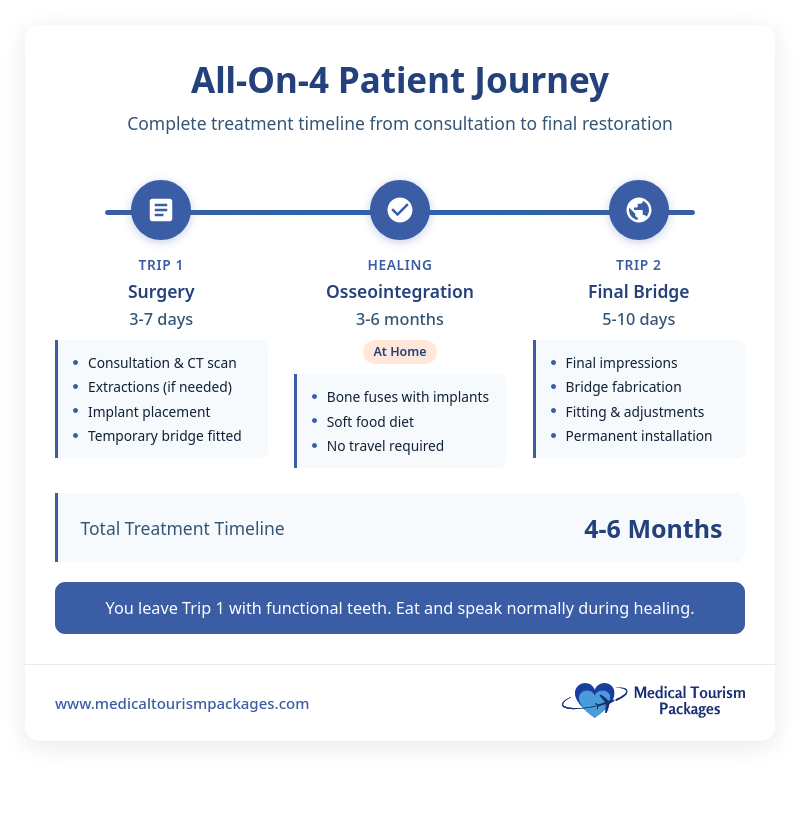
The All-On-4 journey takes 4 to 6 months across two trips. Trip one places the implants and a temporary bridge over 3 to 7 days. After 3 to 6 months of healing at home, trip two fits your permanent bridge over 5 to 10 days.
How Does the Initial Consultation and Planning Process Work?
The planning process starts with a remote consultation and a 3D scan once you arrive. The dentist reviews your medical history, takes a CBCT scan, and builds a digital surgical plan. This confirms whether you can get same-day teeth before surgery is scheduled.
The consultation and planning stage follows these steps:
- Remote review: You email X-rays and photos for a preliminary quote before travel.
- In-person exam: The dentist checks your teeth, gums, and bone on arrival.
- CBCT scan: A 3D scan maps your bone for precise implant placement.
- Surgical plan: Digital planning sets the implant angles and confirms same-day teeth eligibility.
- Final quote: You receive an itemized, written quote in US dollars before any surgery.
What Happens During the All-On-4 Surgery Day in Mexico?
During the surgery day, the dentist removes any failing teeth, places four titanium implants, and attaches a temporary fixed bridge. The procedure takes 3 to 5 hours under local anesthesia, IV sedation, or general anesthesia. You leave the same day with working teeth.
The surgery day usually moves through these stages:
- Anesthesia: You choose local anesthesia, IV sedation, or general anesthesia with the surgeon.
- Extractions: The dentist removes any remaining failing teeth.
- Implant placement: Four titanium implants are set, with the back two angled 30 to 45 degrees.
- Temporary bridge: A provisional fixed bridge attaches to the implants the same day.
- Recovery briefing: Staff review soft-food rules, medication, and aftercare before you leave.
What Is the Recovery Process After All-On-4 Surgery?
Recovery runs in four phases over 3 to 6 months while the implants fuse to your bone. You wear a temporary bridge during healing, then return for the permanent one. Most patients manage mild discomfort for 2 to 3 days with prescribed medication.
This table outlines the four clinical recovery phases, per the American Academy of Implant Dentistry guidance and the Malo Clinic longitudinal study:
| Phase | Day Range | Objective | Restrictions |
|---|---|---|---|
| 1. Initial healing | Days 1–14 | Manage swelling on a soft-food diet | No hard food, no biting with front teeth |
| 2. Soft tissue maturation | Days 15–90 | Gradually add textured foods | Keep avoiding hard food on the temporary bridge |
| 3. Osseointegration | Days 30–180 | Implants fuse with the jawbone | Avoid extreme bite force |
| 4. Final prosthesis | Days 120–180 | Permanent bridge is attached | Routine hygiene and follow-up |
What Documents, Tests, and Logistics Should You Prepare Before Traveling?
You should prepare a valid passport, recent dental records, and a list of medications before you travel. US and Canadian citizens need no visa for visits up to 180 days. Costs are quoted in US dollars, though Mexico’s local currency is the Mexican Peso.
Gather these items before your trip:
- Passport: Valid and not expiring within 6 months of arrival.
- FMM tourist card: The Forma Migratoria Múltiple you complete on entry.
- Dental records: Recent X-rays, a panoramic image, and a medication list.
- Payment: A card for established clinics; cash is common in Los Algodones.
- Transport plan: A border-crossing or airport-transfer plan, since you cannot drive right after surgery.
Plan your recovery logistics in advance. After surgery you cannot drive yourself, so arrange a clinic transfer or a travel companion. For emergencies in Mexico, dial 911. US citizens can reach the 24-hour emergency line at +1-888-407-4747.
How Do You Choose the Right All-On-4 Clinic in Mexico?
You choose the right clinic by verifying COFEPRIS licensing, reading recent patient reviews, and confirming the implant brand and warranty in writing. Compare itemized quotes in US dollars from two or three clinics. A strong clinic answers every question before you commit.
How Do You Verify a Clinic’s Credentials Before Traveling?
You verify credentials by requesting the clinic’s COFEPRIS license number and confirming its association memberships. Ask for the treating dentist’s Cédula Profesional and any Nobel Biocare or Straumann certifications. Cross-check the clinic against independent review sites before you book a flight or drive.
Verify these credentials before you travel:
- COFEPRIS license: Request the registration number and confirm it is current.
- Dentist license: Ask for the treating dentist’s Cédula Profesional.
- Reviews: Read recent Google and independent reviews from US and Canadian patients.
- Implant proof: Confirm the implant brand and request the warranty in writing.
- Before-and-after cases: Ask to see All-On-4 cases the clinic has completed.
What Questions Should You Ask During a Remote Consultation?
During a remote consultation you should ask about the total price, the implant brand, the warranty, and the number of trips. A good clinic gives clear answers and an itemized quote in US dollars. These questions reveal both transparency and clinical quality.
Ask each of these questions during a remote consultation:
- Total cost: What is the full per-arch price, and what does it include?
- Implant brand: Which implant system do you use, Nobel Biocare or Straumann?
- Warranty: What guarantee covers the implants and the bridge, and for how long?
- Trips and timing: How many visits are needed, and how long is each?
- Aftercare: How do you handle problems once I return home?
How Do Payment Plans and Financing Work for All-On-4 in Mexico?
Payment plans vary by clinic, and most accept credit cards or cash for All-On-4 in Mexico. Established clinics in Tijuana, Cancun, and Los Algodones take major cards, while smaller Los Algodones offices often prefer cash. Some clinics offer staged payments tied to each trip.
Because the procedure spans two trips, many clinics split payment into a surgery-day portion and a final-bridge portion. Ask whether your clinic offers in-house financing or works with a US dental-loan provider. Confirm the currency, since quotes are in US dollars even though local prices use the Mexican Peso.
Frequently Asked Questions About All-On-4 in Mexico
How Long Do All-On-4 Implants Last?
The titanium implants can last decades with proper care. According to the Malo Clinic longitudinal study, implant survival reaches 91 to 93 percent at 10 to 18 years. The prosthetic bridge typically lasts 10 to 15 years before it needs replacement, depending on the material.
Is the All-On-4 Procedure Painful?
No. You receive local anesthesia, IV sedation, or general anesthesia during surgery, so you feel no pain. Most patients have mild discomfort for 2 to 3 days afterward. Prescribed medication manages it well, and many return to light activity within a few days.
Can I Eat Normally with All-On-4 Implants?
Yes. After full healing at 3 to 6 months, you can eat most foods normally. During recovery you follow a soft-food diet, then add textured foods over time. Once your permanent bridge is fitted, avoid very hard items like ice or hard candy to protect it.
Do I Need to Speak Spanish for Treatment in Mexico?
No. Top clinics in Tijuana, Cancun, and Los Algodones have English-speaking staff and dentists. They serve thousands of US and Canadian patients each year. All consultations, treatment plans, and aftercare instructions are provided in English, so language is not a barrier.
How Soon Can I Fly After All-On-4 Surgery?
Wait at least 3 to 5 days before flying after All-On-4 surgery. Cabin pressure changes can affect early healing. Your surgeon confirms when air travel is safe for you. Border patients who drive from San Diego or Yuma can usually cross back within a day or two.
What Happens If I Have Problems After Returning Home?
Contact your Mexican clinic right away if you have problems after returning home. Many issues can be guided remotely by video or phone. For warranty repairs to the implants or bridge, you usually return to Mexico, so confirm the written warranty terms before treatment.
Are Materials in Mexico the Same Quality as the US?
Yes. Top clinics use the same implant brands as US practices. Nobel Biocare and Straumann implants are identical worldwide, since these are global manufacturers. The lower price reflects lower labor and facility costs in Mexico, not lower-grade materials. Confirm the brand in writing per clinic.
Can I Get All-On-4 If I Have Bone Loss?
Often yes. The angled implant design works for many patients with moderate bone loss, since it avoids grafting in most cases. Severe bone loss may need bone grafting or zygomatic implants instead. A CBCT scan confirms whether your bone can support standard All-On-4.
Ready to Start Your All-On-4 Journey in Mexico?
Medical Tourism Packages coordinates your entire dental journey to Mexico. We connect you with COFEPRIS-licensed clinics that use Nobel Biocare and Straumann implants, arrange travel and accommodations near your clinic, and provide bilingual support from your first consultation through your final bridge fitting.
Contact us today for a free consultation and personalized All-On-4 package in Tijuana, Los Algodones, or Cancun.