Book Appointment Now

What is Rhinoplasty in Costa Rica: Complete Guide to Costs, Surgeons, and Recovery
 By
By
Rhinoplasty in Costa Rica delivers natural-looking results at 50-70% lower costs than the United States, performed by ACCPRE-certified surgeons at JCI-accredited hospitals with 85-90% success rates.
A nose job in Costa Rica costs $2,000-$4,750 compared to $7,637-$15,000 in the US. Hospital CIMA in Escazu holds its 6th consecutive JCI Gold Seal and a Baylor University Medical Center affiliation. Clinica Biblica in San Jose has maintained JCI accreditation for over 15 years.
Our network connects you with board-certified rhinoplasty specialists across San Jose, Escazu, and Santa Ana, each verified for JCI or AAAASF accreditation, patient outcomes, and international training credentials. Below, you will find cost comparisons, clinic profiles, procedure details, recovery timelines, travel planning guides, and answers to common questions about nose surgery in Costa Rica.
What Is Rhinoplasty and Why Do Patients Choose Costa Rica?
Rhinoplasty is a surgical procedure that reshapes the nose for cosmetic or functional reasons. Costa Rica attracts thousands of international patients each year with 50-70% cost savings, JCI-accredited hospitals, and board-certified surgeons trained in the United States and Europe.
The procedure can reduce or increase nose size, change the angle, alter the tip, or correct bumps. Surgeons in San Jose and Escazu address both aesthetic goals and breathing problems. Costa Rica’s combination of quality and value makes it one of the most popular nose job destinations in Latin America.
What Makes Costa Rica a Top Destination for Nose Surgery?
Costa Rica ranks 36th globally in healthcare quality according to the World Health Organization, one position above the United States. The country has a life expectancy of 79 years, second only to Canada in the Western Hemisphere.
Direct flights from major US cities take 3 to 5 hours. Time zone alignment with the US Central time zone makes scheduling consultations easy. San Jose is served by 13 direct flight routes from US cities. English-speaking staff and US dollar pricing eliminate language and currency barriers at most private clinics.
Political stability, strong public health infrastructure, and a medical tourism industry worth over $400 million add to Costa Rica’s appeal. Our complete guide for American medical tourists in Costa Rica covers travel logistics, hospital options, and visa requirements in detail.
Who Is a Good Candidate for Rhinoplasty in Costa Rica?
Good candidates for rhinoplasty in Costa Rica are at least 16-18 years old, in good overall health, and have realistic expectations. Non-smokers heal faster and face fewer complications during recovery.
- Age: At least 16-18 years old when facial growth is complete
- Health: No uncontrolled diabetes, bleeding disorders, or active infections
- Expectations: Realistic goals discussed during virtual consultation
- Entry requirements: Valid passport and proof of return travel
- Visa: US and Canadian citizens stay up to 180 days visa-free
Some conditions may require special medical clearance. These include severe heart or lung disease and bleeding disorders. Your surgeon will review your medical history before approving the procedure.
How Much Does a Nose Job Cost in Costa Rica Compared to the US and Canada?
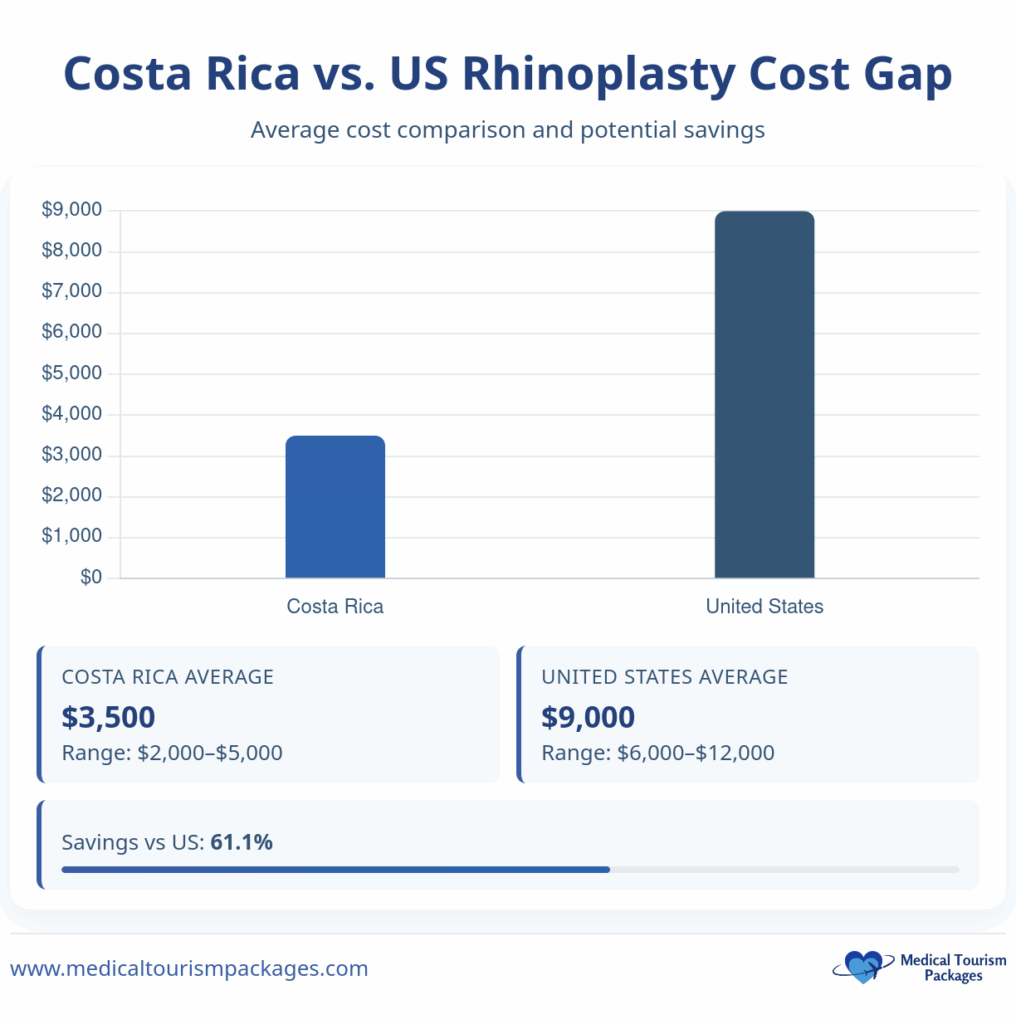
A nose job costs $2,000-$4,750 in Costa Rica compared to $7,637-$15,000 in the United States. This represents savings of 50-70% on the same procedures. Canada charges $9,000-$15,000 for rhinoplasty, making Costa Rica the most affordable option among the three countries.
What Are the Current Rhinoplasty Prices in Costa Rica?
Rhinoplasty prices in Costa Rica range from $2,000 for basic procedures to $5,300 for complex revision work. Most primary rhinoplasty procedures average between $2,900 and $3,500 at accredited facilities in San Jose and Escazu.
| Procedure Type | Costa Rica Cost | What Is Included |
|---|---|---|
| Primary Rhinoplasty | $2,000-$4,750 | Surgeon fee, anesthesia, facility, follow-up |
| Tip Rhinoplasty | $2,820-$3,500 | Surgeon fee, anesthesia, facility, follow-up |
| Open/Closed Rhinoplasty | $3,696-$5,300 | Surgeon fee, anesthesia, facility, follow-up |
| Revision Rhinoplasty | $5,000-$5,300 | Surgeon fee, anesthesia, facility, follow-up |
How Do Costa Rica Rhinoplasty Costs Compare to Other Countries?
Costa Rica rhinoplasty costs compare favorably to all major markets. Savings range from 50% against Mexico to over 70% against the United States, with the most dramatic gap in revision rhinoplasty where US prices reach $30,000-$60,000.
| Country | Price Range (USD) | Average Cost | Savings vs US |
|---|---|---|---|
| Costa Rica | $2,000-$4,750 | $2,900-$3,500 | 50-70% |
| Mexico | $2,500-$6,000 | $4,000 | 45-55% |
| United States | $7,637-$15,000+ | $8,000-$12,000 | Baseline |
| Canada | $9,000-$15,000 | $12,000-$13,000 | – |
| United Kingdom | $8,000-$10,000 | $9,000 | 0% |
The American Society of Plastic Surgeons reports an average surgeon fee of $7,637 for rhinoplasty in the US. This does not include anesthesia, facility costs, or follow-up visits. Total costs in metro areas like New York and Los Angeles often exceed $15,000-$20,000.
Can You Combine Rhinoplasty with Other Procedures to Save More?
You can combine rhinoplasty with other facial procedures to save 10-20% off individual prices. Most surgeons in Costa Rica limit combined surgery to 4-6 hours total. Plan a minimum two-week stay for combined procedures.
| Combined Procedure | Added Cost | Benefits |
|---|---|---|
| Chin Augmentation | +$1,500-$2,500 | Creates facial harmony, minimal added time |
| Facelift | +$3,500-$5,500 | Addresses lower face and neck |
| Blepharoplasty (Eyelid Surgery) | +$1,800-$3,000 | Similar recovery area, overlapping bruising |
| Lip Lift or Augmentation | +$800-$1,500 | Enhances facial balance, minimal time |
Which Types of Rhinoplasty Are Available in Costa Rica?
Costa Rica offers six main types of rhinoplasty: open, closed, ethnic, revision, tip, and ultrasonic. Board-certified surgeons at JCI-accredited facilities perform all techniques. Success rates for primary rhinoplasty range from 85-90% based on published medical literature.
What Is the Difference Between Open and Closed Rhinoplasty?
Open rhinoplasty uses a small incision across the columella (the tissue between the nostrils). This gives the surgeon direct visualization of nasal structures. Surgeons in San Jose use this approach for complex cases that require significant reshaping. Success rates reach 85-90%.
Closed rhinoplasty places all incisions inside the nostrils. This means no visible external scars. Patients experience less swelling and shorter recovery times. The closed technique works best for simpler modifications. Both approaches achieve similar success rates of 85-90%.
What Are Ethnic, Revision, and Tip Rhinoplasty?
Ethnic rhinoplasty preserves the patient’s natural facial characteristics while achieving desired changes. This specialized approach requires surgeons with experience across different nasal structures and skin types.
Revision rhinoplasty corrects problems from previous nose surgeries. These procedures start at $5,000-$5,300 in Costa Rica, compared to $30,000-$60,000 in the United States. Revision work is more complex and carries higher complication rates than primary surgery.
Tip rhinoplasty focuses exclusively on reshaping the nasal tip. This is a less invasive option for patients who only need changes to the lower portion of the nose. Tip procedures start around $2,820 at clinics in San Jose.
What Is Ultrasonic Rhinoplasty and How Does It Differ?
Ultrasonic rhinoplasty uses piezoelectric instruments to reshape nasal bone with precision. These ultrasonic tools cause approximately 30% less tissue damage than traditional methods. Patients experience reduced bruising and faster healing.
The technique allows surgeons to sculpt bone without affecting surrounding soft tissue. This precision leads to more predictable results. Several clinics in Escazu and San Jose offer ultrasonic rhinoplasty as an advanced option.
How Do You Choose a Qualified Rhinoplasty Surgeon in Costa Rica?
You choose a qualified rhinoplasty surgeon by verifying board certification through the ACCPRE (Costa Rican College of Doctors and Surgeons), checking facility accreditations, and reviewing before-and-after photo galleries. Schedule a virtual consultation before committing to any procedure.
What Qualifications Should a Costa Rican Rhinoplasty Surgeon Have?
A qualified rhinoplasty surgeon in Costa Rica should hold three essential credentials. These ensure the surgeon meets both local and international standards for plastic surgery.
- ACCPRE board certification: Mandatory license to practice medicine in Costa Rica, issued by the Costa Rican College of Doctors and Surgeons
- Specialized training: Advanced fellowship training at recognized US or European institutions
- Verifiable credentials: International certifications you can confirm through official registries
Review the surgeon’s before-and-after gallery for cases similar to yours. Ask about annual procedure volume and complication rates during your consultation.
Which Accreditations Should You Look For in a Clinic?
The most important accreditations for a rhinoplasty clinic in Costa Rica are JCI and AAAASF certification. These ensure the facility meets international safety, equipment, and staffing standards.
- Joint Commission International (JCI): Gold standard for hospital accreditation. Hospital CIMA and Clinica Biblica both hold JCI accreditation
- AAAASF certification: American Association for Accreditation of Ambulatory Surgery Facilities International ensures proper equipment, emergency protocols, and staff training
- ABPS verification: Some Costa Rican surgeons also hold American Board of Plastic Surgery certification
You can verify JCI accreditation at jointcommission.org. AAAASF accreditation is verifiable through the AAAASF website. Always confirm credentials independently before scheduling surgery.
Where Are the Best Clinics and Hospitals for Rhinoplasty in Costa Rica?
The best rhinoplasty clinics and hospitals in Costa Rica are concentrated in the San Jose metropolitan area. Two hospitals hold JCI accreditation, and multiple clinics carry AAAASF certification. All major facilities feature English-speaking staff and US dollar pricing.
What Are the JCI-Accredited Hospitals in Costa Rica?
Costa Rica has two JCI-accredited hospitals, both in the San Jose area. These facilities meet over 1,200 international standards for patient safety, quality of care, and process improvement.
| Hospital | Location | JCI Status | Key Features |
|---|---|---|---|
| Hospital CIMA San Jose | Escazu | 6th consecutive Gold Seal | Baylor University Medical Center affiliation, only Central American hospital accredited by US Department of Veterans Affairs |
| Clinica Biblica | San Jose and Santa Ana | 15+ years continuous JCI | First JCI-accredited institution in Central America, 80% of international patients from the US |
Which AAAASF-Accredited Clinics Perform Rhinoplasty?
Several AAAASF-accredited clinics in Costa Rica specialize in rhinoplasty and other cosmetic procedures. These ambulatory surgical facilities meet US-level standards for equipment, emergency protocols, and staff training.
The Rosenstock-Lieberman Center on Paseo Colon in San Jose is a pioneer in Costa Rican cosmetic surgery. Operating since 1984, the center holds AAAASF International accreditation and maintains a 4.7 out of 5 patient rating.
The European Center for Plastic Surgery also holds the AAAASF “Gold Standard” quality seal. Both facilities offer rhinoplasty performed by board-certified surgeons with international training.
Which Cities Are Best for Rhinoplasty in Costa Rica?
The best cities for rhinoplasty in Costa Rica are San Jose, Escazu, and Santa Ana. All three are within 20-30 minutes of Juan Santamaria International Airport.
| City | Top Facilities | Best For |
|---|---|---|
| San Jose | Clinica Biblica, Rosenstock-Lieberman Center | Central location, largest concentration of surgeons |
| Escazu | Hospital CIMA San Jose | Upscale area, recovery inns, strong expat community, gated communities |
| Santa Ana | Clinica Biblica (second campus), AAAASF clinics | Quieter atmosphere, lower-cost accommodations |
Ground transportation between the airport and these cities costs $40-80 each way. Most recovery inns in Escazu provide complimentary hospital transfers. Patients comparing destinations may also explore rhinoplasty options in Colombia, where costs range from $2,500 to $5,000.
What Should You Expect During Rhinoplasty Surgery and Recovery?
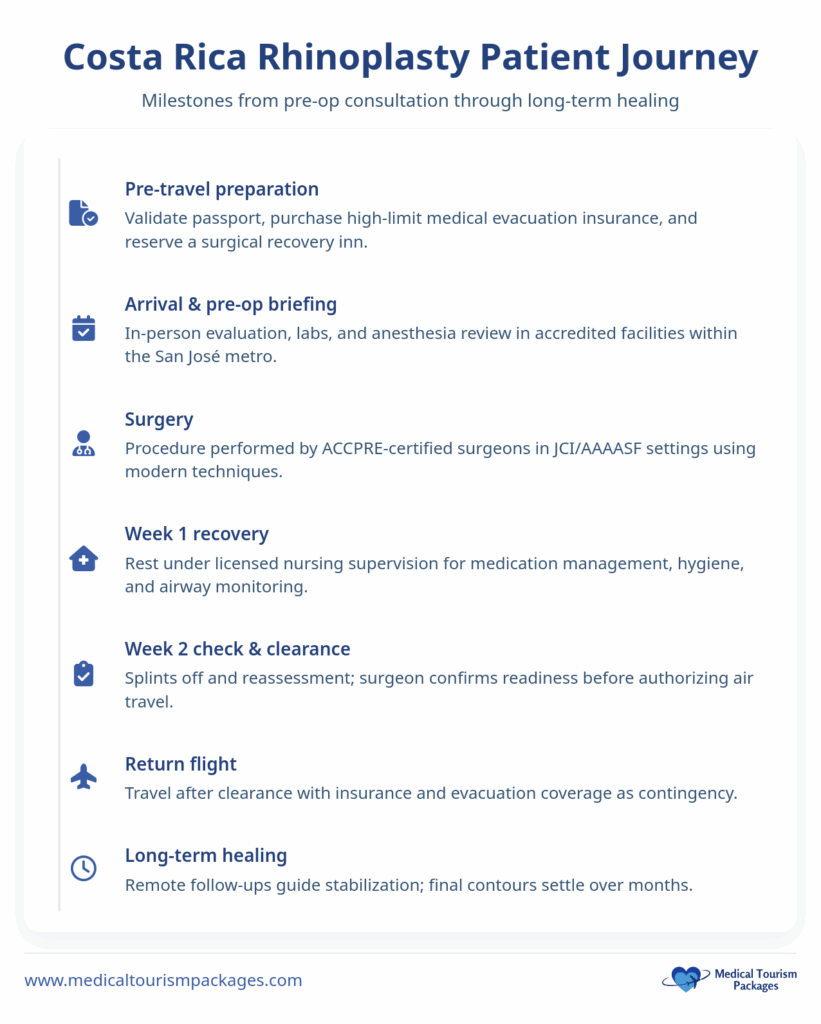
You should expect rhinoplasty surgery to last 1.5 to 3 hours under general anesthesia. Recovery requires an 11-12 day stay in Costa Rica. Most patients return to desk work within two weeks. Final results stabilize over 6-12 months.
What Happens During the Rhinoplasty Procedure?
During the rhinoplasty procedure, the surgeon makes incisions using either the open or closed technique. They reshape bone and cartilage to achieve the planned changes. Some cases require cartilage grafts from the septum or ear.
Ultrasonic instruments cause approximately 30% less tissue damage compared to traditional tools. Internal and external splints support the new nasal structure during healing. Most patients leave the hospital or surgery center the same day. They recover at a hotel or specialized recovery facility in Escazu or San Jose.
What Does the Recovery Timeline Look Like?
The recovery timeline after rhinoplasty in Costa Rica spans 6-12 months for final results. However, most patients fly home after 11-12 days and return to normal activities within two to three weeks.
| Time Period | What to Expect | Activities Allowed |
|---|---|---|
| Days 1-7 | Significant swelling and bruising. Splint removed on day 7. | Complete rest. Light walking only. |
| Week 2 | Bruising reduces significantly. Most visible swelling subsides. | Light activities. No exercise. Desk work allowed. |
| Days 11-12 | Cleared to fly home. Residual swelling remains. | Air travel approved. Most normal activities resume. |
| Months 2-3 | Most swelling resolved. Nose looks close to final shape. | Full exercise with surgeon clearance. |
| 6-12 months | Final results stabilize completely. | All activities unrestricted. |
What Are the Main Steps to Getting Rhinoplasty in Costa Rica?
The main steps to getting rhinoplasty in Costa Rica include scheduling a virtual consultation, completing medical tests, and planning your 11-12 day stay. Most patients complete the process within 4-6 weeks from first consultation to surgery date.
- Schedule a virtual consultation: Discuss goals, review photos, and learn about the recommended surgical approach
- Complete medical tests: Blood work, CBC, and sometimes EKG or chest X-rays 2-3 weeks before travel
- Plan your stay: Book an 11-12 day trip. Surgery on days 1-2, splint removal on day 7, fly home on days 11-12
- Prepare travel documents: Valid passport, return ticket, and medical correspondence
- Book recovery accommodation: Recovery houses in Escazu provide nursing support, meals, and transportation
- Prepare physically: Stop smoking 4 weeks before surgery, discontinue NSAIDs 2 weeks prior, avoid alcohol 48 hours before
What Are the Risks and How Do You Handle Follow-Up Care?
The risks of rhinoplasty in Costa Rica include standard surgical complications and medical tourism-specific concerns. Revision rates range from 5-15% for primary rhinoplasty worldwide. Proper facility selection and insurance reduce most risks significantly.
What Are the Medical Risks of Rhinoplasty Abroad?
The medical risks of rhinoplasty abroad include both standard surgical complications and travel-specific concerns. Choosing JCI or AAAASF-accredited facilities reduces these risks to levels comparable with US hospitals.
Medical tourism-specific risks:
- Nontuberculous Mycobacteria (NTM) infections, documented in rare cases
- Bloodborne infections and MRSA at clinics with poor infection control
- Limited legal recourse compared to the US legal system
- Complications during air travel if flying too soon after surgery
Standard surgical risks:
- Bleeding and hematoma formation
- Adverse reactions to anesthesia
- Breathing difficulties or numbness
- Asymmetry or unsatisfactory results
- Scarring or septal perforation
- Need for revision surgery (5-15% of cases)
How Do You Manage Follow-Up Care After Returning Home?
You manage follow-up care by scheduling virtual appointments with your Costa Rican surgeon and establishing a local surgeon relationship before traveling. Many US and Canadian plastic surgeons decline to treat complications from procedures performed abroad.
Most Costa Rican surgeons offer virtual follow-ups at 3, 6, and 12 months after surgery. These appointments are usually included in the surgical fee or cost $50-100 each. Virtual consultations work well for routine monitoring but cannot replace physical exams for serious issues.
Request detailed operative notes, surgical photos, and approach details before leaving Costa Rica. If revision surgery is needed, returning to your original surgeon costs $5,000-$5,300. Getting revision locally in the US costs $8,000-$15,000 or more.
What Legal Rights and Insurance Do You Need?
You need comprehensive travel medical insurance that explicitly covers complications from elective cosmetic procedures. Standard US health insurance does not cover elective surgeries performed abroad.
- Emergency medical coverage: Minimum $50,000. Must explicitly include elective cosmetic procedure complications
- Medical evacuation coverage: $100,000-$1,000,000. Evacuation from Central America costs $50,000-$100,000
- Trip interruption insurance: Covers extended stays due to surgical complications
Costa Rican malpractice law differs from US tort law. Damage awards typically range from $10,000-$50,000 maximum, even in severe cases. Legal proceedings require a Costa Rican attorney at $150-300 per hour and are conducted in Spanish. Purchase insurance before making any deposits.
How Do You Plan Your Rhinoplasty Trip to Costa Rica?
You plan your rhinoplasty trip by securing travel documents, booking flights to San Jose, and arranging recovery accommodation. Most patients need 11-12 days in Costa Rica. Round-trip flights average $239 from major US cities.
What Are the Visa and Entry Requirements?
US and Canadian citizens enter Costa Rica visa-free for up to 180 days (six months). No special medical visa is required. The immigration officer determines the exact number of days on your entry stamp.
You need a valid passport, proof of onward or return travel, and proof of economic means. The minimum is $100 per month of your planned stay. Bring printed copies of your medical correspondence and surgery confirmation.
How Do You Get to Costa Rica and What Does It Cost?
You fly into Juan Santamaria International Airport (SJO) in San Jose. Thirteen US cities offer direct flights. Average round-trip fares range from $180 to $450 depending on the departure city.
| US City | Flight Time | Round-Trip Cost | Airlines |
|---|---|---|---|
| Miami | 3-3.5 hours | $180-$350 | American, United, Spirit |
| Atlanta | 4 hours | $220-$400 | Delta, Spirit |
| New York | 5-5.5 hours | $250-$450 | JetBlue, United, Delta |
| Houston | 3.5-4 hours | $230-$400 | United, Spirit |
| Los Angeles | 5.5-6 hours | $230-$450 | Delta, United, Alaska |
April is the cheapest month to fly. Tuesday and Wednesday departures offer the lowest fares. Book 2 months before your surgery date for the best prices.
What Should You Know About Currency, Accommodation, and Recovery Housing?
You should know that US dollars are widely accepted throughout Costa Rica, especially at medical facilities and in tourist areas. The local currency is the Costa Rican Colon, with an exchange rate of approximately 465 colones per dollar (March 2026).
Most hospitals and clinics in San Jose and Escazu price services in US dollars. Credit cards (Visa and Mastercard) are accepted at hospitals, hotels, and restaurants. ATMs dispense both colones and US dollars. For smaller purchases at local markets, colones offer better exchange rates.
Specialized recovery inns in Escazu provide 24/7 nursing care, hospital beds, meals, and transportation. Las Cumbres Inn and Costa Rica Medical Center Inn charge $80-150 per night. Book these facilities before finalizing surgery dates, as they fill weeks in advance.
What Emergency Contacts Should You Have?
You should have emergency contact numbers saved in your phone before arriving in Costa Rica. Keep printed copies in your travel documents as well.
- Emergency services (police, fire, ambulance): 911
- US Embassy main line: +(506) 2519-2000
- US Embassy after-hours emergency: +(506) 2220-3127
- US Embassy email: acssanjose@state.gov
- US Embassy address: Calle 98, Via 104, Pavas, San Jose
Frequently Asked Questions About Rhinoplasty in Costa Rica
How much does rhinoplasty cost in Costa Rica?
Rhinoplasty costs $2,000-$4,750 in Costa Rica, with most procedures averaging $2,900-$3,500. This is 50-70% less than the $7,637-$15,000 charged in the United States. Prices include the surgeon’s fee, anesthesia, facility costs, and initial follow-up appointments at JCI-accredited hospitals.
Is rhinoplasty in Costa Rica safe?
Yes, rhinoplasty in Costa Rica is safe when performed at accredited facilities. Hospital CIMA holds its 6th consecutive JCI Gold Seal, and Clinica Biblica has maintained JCI accreditation for over 15 years. Choose JCI or AAAASF-accredited clinics to ensure US-level safety standards.
How long do you need to stay in Costa Rica for a nose job?
You need to stay 11-12 days in Costa Rica for rhinoplasty. Surgery happens on days 1-2, your splint is removed on day 7, and you are cleared to fly home on days 11-12. Combined procedures require a minimum two-week stay.
Are Costa Rican rhinoplasty surgeons board certified?
Yes, qualified Costa Rican rhinoplasty surgeons are board certified through ACCPRE, the Costa Rican College of Doctors and Surgeons. Many also hold US or European credentials. Verify any surgeon’s certification independently through official registries before scheduling your procedure.
What is the difference between open and closed rhinoplasty?
Open rhinoplasty uses a small external incision across the columella for direct visualization. Closed rhinoplasty places all incisions inside the nostrils, leaving no visible scars. Open is better for complex reshaping. Closed offers faster recovery. Both achieve 85-90% success rates.
Can you fly home after rhinoplasty in Costa Rica?
Yes, you can fly home 11-12 days after rhinoplasty in Costa Rica. Your surgeon removes the splint on day 7 and clears you for air travel around days 11-12. Residual swelling is normal during the flight. Avoid bending forward and stay hydrated.
Does health insurance cover rhinoplasty in Costa Rica?
No, standard US health insurance does not cover elective cosmetic rhinoplasty abroad. You need separate travel medical insurance with at least $50,000 in emergency coverage that explicitly includes cosmetic procedure complications. Medical evacuation coverage of $100,000 or more is also recommended.
How do you choose the best rhinoplasty clinic in Costa Rica?
You choose the best clinic by verifying JCI or AAAASF accreditation, checking surgeon ACCPRE board certification, and reviewing before-and-after photos. Hospital CIMA and Clinica Biblica in San Jose both hold JCI accreditation. Schedule virtual consultations with 3-5 surgeons before deciding.
What is the recovery time after rhinoplasty in Costa Rica?
Recovery time after rhinoplasty is 11-12 days before flying home. Most swelling resolves within 2-3 months. Final results stabilize at 6-12 months (six months to one year). You can return to desk work within two weeks. Full exercise resumes after 2-3 months with surgeon approval.
Ready to Start Your Rhinoplasty Journey in Costa Rica?
Medical Tourism Packages coordinates your entire rhinoplasty journey to Costa Rica. We connect you with board-certified surgeons at JCI-accredited hospitals in San Jose and Escazu. We arrange travel, accommodations, and recovery housing, and provide bilingual support throughout your treatment.
Contact us today for a free consultation and personalized rhinoplasty package.