Book Appointment Now




Hip Replacement Surgery in Mexico: Complete Guide, Costs, and Best Locations for Medical Tourists
 By
By
Hip replacement in Mexico costs $9,000 to $15,000, roughly 40 to 84 percent less than the United States, using the same FDA-approved implants found in US hospitals.
Mexico’s JCI-accredited hospitals, including ABC Medical Center (a Houston Methodist affiliate) and Médica Sur (a Mayo Clinic Care Network member), serve more than a million medical tourists each year. Total hip replacement runs $9,000 to $15,000 versus $25,000 to $55,000 in the US, with board-certified orthopedic surgeons in Tijuana, Cancún, and Guadalajara.
Our network connects you with vetted, JCI-accredited facilities and board-certified orthopedic surgeons who use Zimmer Biomet, DePuy Synthes, and Stryker implants. Each hospital is verified for accreditation, US affiliation, and international patient experience. Below you will find cost comparisons, the best Mexican cities and hospitals, surgeon-vetting steps, recovery timelines, risks, and answers to the most common questions about hip replacement in Mexico.
What Is Hip Replacement Surgery?
Hip replacement is surgery that removes a damaged hip joint and replaces it with a prosthetic ball-and-socket implant. Surgeons in Mexico use it to relieve chronic pain and restore mobility when other treatments stop working. The procedure takes 1.5 to 3 hours.
Also called hip arthroplasty, the operation replaces the worn parts of your joint with components made from medical-grade metal, ceramic, or durable plastic. You stay in the hospital about two days afterward. Most patients receive general, spinal, or regional anesthesia.
What Types of Hip Replacement Are Available in Mexico?
The types of hip replacement available in Mexico include total, partial, resurfacing, revision, and robotic-assisted procedures. Surgeons also choose between the anterior, posterior, and lateral approaches. The right option depends on your joint damage, age, and activity goals.
Each approach differs by incision and recovery. This table compares the main options Mexican orthopedic surgeons offer:
| Procedure Type | What It Involves | Incision | Best Fit For |
|---|---|---|---|
| Total Hip Replacement | Replaces the whole ball-and-socket joint | 3 to 4 inches (minimally invasive) or 6 to 10 inches | Severe arthritis affecting the entire joint |
| Partial Hip Replacement | Replaces only the ball (femoral head) | Standard or minimally invasive | Certain hip fractures in older patients |
| Hip Resurfacing | Caps the femoral head instead of removing it | Standard | Younger, active patients with strong bone |
| Anterior Approach (Direct Anterior) | Total replacement through the front of the hip | 3 to 4 inches | Patients wanting faster early mobility |
| Robotic-Assisted (MAKO) | Computer-guided implant placement | Minimally invasive | Patients prioritizing precision alignment |
How Much Does Hip Replacement Surgery Cost in Mexico?
Hip replacement surgery in Mexico costs $9,000 to $15,000, compared to $25,000 to $55,000 in the United States, according to AAOS pricing data compiled by orthopedic surgeon Andrew Wickline. That means savings of 40 to 84 percent for most patients.
How Do Mexico Costs Compare to the US and Canada?
Mexico costs a fraction of US and Canadian prices for the same hip replacement. Here is how the average cost ranges compare:
| Country | Average Cost Range (USD) |
|---|---|
| Mexico | $9,000–$15,000 |
| United States | $25,000–$55,000 |
| Canada (Private) | $20,000–$35,000 |
Many American patients pay less for the entire surgery in Mexico than their US deductible alone. If your plan has a $5,000 deductible and 20 percent coinsurance, a $55,000 US procedure could cost you $15,000 out of pocket. That same amount can cover your surgery and travel in Mexico. Patients comparing destinations can also review hip replacement in Panama, where costs run $10,000 to $20,000.
What Does the Package Price Include?
The package price in Mexico usually includes hospital fees, the surgeon’s fee, anesthesia, the implant, and early physical therapy. Transparent pricing lets you know your costs before you commit. A typical hip replacement package covers these items:
- Hospital and operating room fees
- Surgeon and anesthesiologist fees
- The prosthetic implant and surgical supplies
- Medications during your hospital stay
- Initial physical therapy and follow-up visits
Why Choose Mexico for Hip Replacement Surgery?
Mexico is attractive for hip replacement because of three things: low cost, short wait times, and easy travel from the US. More than a million medical tourists visit Mexico each year. You can save 40 to 84 percent versus US prices. Our guide to medical tourism in Mexico covers hospitals, travel, and entry rules in more detail.
These savings do not mean lower quality. Leading Mexican facilities use the same surgical techniques found in top American hospitals, including MAKO robotic assistance and the Direct Anterior Approach for minimally invasive surgery. Geography helps too. Tijuana sits about 20 miles from San Diego, an easy drive for patients in the western United States.
Wait times are another advantage. Mexican facilities can often schedule your surgery within weeks. By contrast, hip replacement waits in Canada are long and frequently exceed clinical benchmarks, according to the Fraser Institute and the Canadian Institute for Health Information. You could be recovering in Mexico while still waiting for a consultation at home.
What Implant Brands Do Mexican Clinics Use?
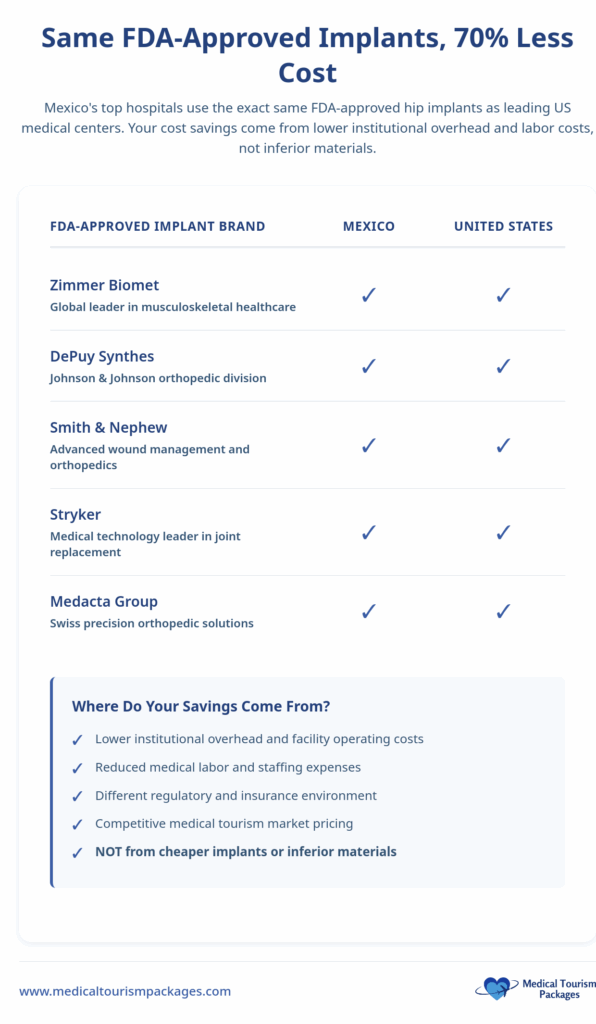
Mexican orthopedic clinics use FDA-approved implant brands, including Zimmer Biomet, DePuy Synthes, Smith & Nephew, Stryker, and Medacta Group. These are the same manufacturers that supply hospitals across North America and Europe. The hardware is identical to what you would receive at home.
The savings come from lower overhead and labor costs in Mexico, not from cheaper parts. A hip implant placed in Cancún uses the same prosthetic components as one placed in Chicago. This is why implant longevity does not depend on where you have the surgery.
Which Mexican Cities Are Best for Hip Replacement Surgery?
The best Mexican cities for hip replacement are Tijuana, Cancún, Puerto Vallarta, and Guadalajara. Each offers board-certified orthopedic surgeons and modern facilities. Your choice depends on travel distance, budget, and recovery preferences.
Cost and access vary by city. This table compares the four main destinations:
| City | Cost Range | Access | Best For |
|---|---|---|---|
| Tijuana | $9,000–$14,000 | 20 miles from San Diego | US patients wanting minimal travel and easy family visits |
| Cancún | $10,000–$15,000 | Direct flights from most major US cities | Patients wanting a calm recovery setting |
| Puerto Vallarta | $9,000–$14,000 | Direct flights from US and Canadian cities | Those preferring a quieter, less crowded location |
| Guadalajara | $9,000–$15,000 | Good airport connections to US hubs | Patients prioritizing major-hospital infrastructure |
Why Choose Tijuana for Hip Replacement Surgery?
Tijuana is the most accessible option for American patients. The city sits about 20 miles from San Diego, so you can drive to your appointments. There are no flights to book. Family members from the western United States can visit easily during recovery.
Hip replacement in Tijuana costs $9,000 to $14,000. The border location offers a key benefit. You can drive home once your surgeon clears you for travel, which avoids the four-to-six-week wait required before flying. That can save you money on extended lodging.
Why Choose Cancún for Hip Replacement Surgery?
Cancún pairs strong medical care with a calm recovery setting. The city has direct flights from most major US cities, so travel is simple despite the distance. Hospital Galenia in Cancún holds JCI accreditation and treats many international patients.
Hip replacement in Cancún costs $10,000 to $15,000. The slightly higher price reflects the resort location and its medical tourism infrastructure. Bilingual support is available throughout your stay, which eases coordination for English-speaking patients.
Why Choose Puerto Vallarta for Hip Replacement Surgery?
Puerto Vallarta offers a quieter alternative to Cancún. The atmosphere is less crowded, and direct flights run from major US and Canadian cities. The Pacific coast location gives you a relaxed place to recover away from large resort crowds.
Hip replacement in Puerto Vallarta costs $9,000 to $14,000, a moderately priced option. Medical facilities here serve a steady flow of international patients. Staff are familiar with medical tourism logistics and patient coordination.
Why Choose Guadalajara for Hip Replacement Surgery?
Guadalajara is one of Mexico’s major medical hubs. As a large metropolitan center, it hosts top-ranking hospitals and many credentialed orthopedic specialists. Choose this city if you prioritize large-hospital infrastructure over a resort setting.
Hip replacement in Guadalajara costs $9,000 to $15,000. The city has good airport connections to US hubs, so access is straightforward despite its inland location. Patients seeking high levels of institutional oversight often focus their search here.
What Are the Best Hospitals for Hip Replacement in Mexico?
The best hospitals for hip replacement in Mexico are JCI-accredited centers with orthopedic programs and US affiliations. Strong options include ABC Medical Center, Médica Sur, Hospital Galenia, and Hospital Ángeles Pedregal. Mexico has fewer than ten JCI-accredited hospitals.
JCI accreditation and US hospital ties are useful quality markers. This table compares four leading facilities:
| Hospital | City | JCI Accredited | US Affiliation |
|---|---|---|---|
| ABC Medical Center | Mexico City | Since 2008 | Houston Methodist Hospital |
| Médica Sur | Mexico City | Since 2014 | Mayo Clinic Care Network |
| Hospital Galenia | Cancún | Since 2012 | None |
| Hospital Ángeles Pedregal | Mexico City | Since 2024 | None |
Médica Sur is notable as the first hospital outside the United States, and the only one in Latin America, to join the Mayo Clinic Care Network. ABC Medical Center has partnered with Houston Methodist since 2006. Many other strong hospitals show quality through modern equipment and high international patient volumes rather than JCI alone. You can explore the full range of orthopedic surgery options in Mexico across these facilities.
How Do You Choose the Right Surgeon in Mexico?
You choose the right surgeon in Mexico by verifying credentials across several markers, not just one. Check board certification, fellowship training, professional memberships, experience, and annual procedure volume. Ask each surgeon directly about their numbers.
What Surgeon Credentials Should You Verify?
You should verify five credentials before booking. Each one signals training, oversight, or experience. Confirm the following:
- Board certification equivalent to the American Board of Orthopedic Surgery – confirms rigorous training and exams
- Fellowship training in the US or Europe – shows specialized hip and joint education
- Professional memberships – look for FEMECOT, the Mexican Society of Hip Surgery, or ISAKOS
- Years of experience – more years usually mean more procedures performed
- High international patient volume – important because Mexico’s national hip-surgery rate is low, about 8 per 100,000 people versus more than 200 per 100,000 in the US, according to the OECD
Do not hesitate to ask your surgeon about their training, annual procedure volume, and complication rates compared to international benchmarks. A confident, experienced surgeon will answer these questions clearly.
Who Is a Good Candidate for Hip Replacement Surgery?
A good candidate for hip replacement has severe hip pain that conservative care no longer controls. You may need surgery if pain continues at rest, walking and bending are hard, and medications or a cane no longer help. Your doctor confirms candidacy.
What Conditions Lead to Hip Replacement?
Several conditions commonly lead to hip replacement. Most involve joint damage from wear, disease, or injury. These are the most frequent causes:
- Osteoarthritis – age-related wear that breaks down cartilage
- Rheumatoid arthritis – autoimmune disease causing joint inflammation
- Osteonecrosis – poor blood flow to the hip bone
- Hip dysplasia – abnormal socket formation present from birth
- Traumatic arthritis – joint damage from accidents or falls
- Hip fractures – severe breaks that cannot heal properly
What Conditions May Disqualify You?
Some conditions may disqualify you from surgery or require treatment first. Your surgeon must stabilize these issues to lower your risk. Watch for the following:
- Active infections – must be resolved before elective surgery
- Smoking – slows healing and raises complication risk
- Severe osteoporosis – weak bones may not support implants
- Uncontrolled diabetes or heart disease – require stabilization first
- Extreme obesity (BMI over 40) – increases surgical risks
- Recent heart attack or stroke – surgery must wait until you recover
What Is the Hip Replacement Procedure Like in Mexico?
The hip replacement procedure in Mexico follows the same protocols used across North America and Europe. The surgery takes 1.5 to 3 hours. Understanding the steps can ease your worry on surgery day.
What Are the Steps on Surgery Day?
On surgery day, the procedure moves through a clear sequence of steps. Your care team prepares you, performs the operation, and monitors recovery. The process unfolds as follows:
- IV line and catheter placement – access for medications and monitoring
- Anesthesia – general anesthesia or regional numbing from the waist down
- Incision – 6 to 10 inches for traditional surgery or 3 to 4 inches for minimally invasive
- Removal of damaged parts – the femoral head and damaged bone are removed
- Implant placement – a new socket goes in the pelvis and a stem in the femur
- Testing and closure – range of motion is checked before the incision is closed
- Recovery room – several hours of monitoring before moving to your room
What Is the Recovery Timeline for Hip Replacement in Mexico?
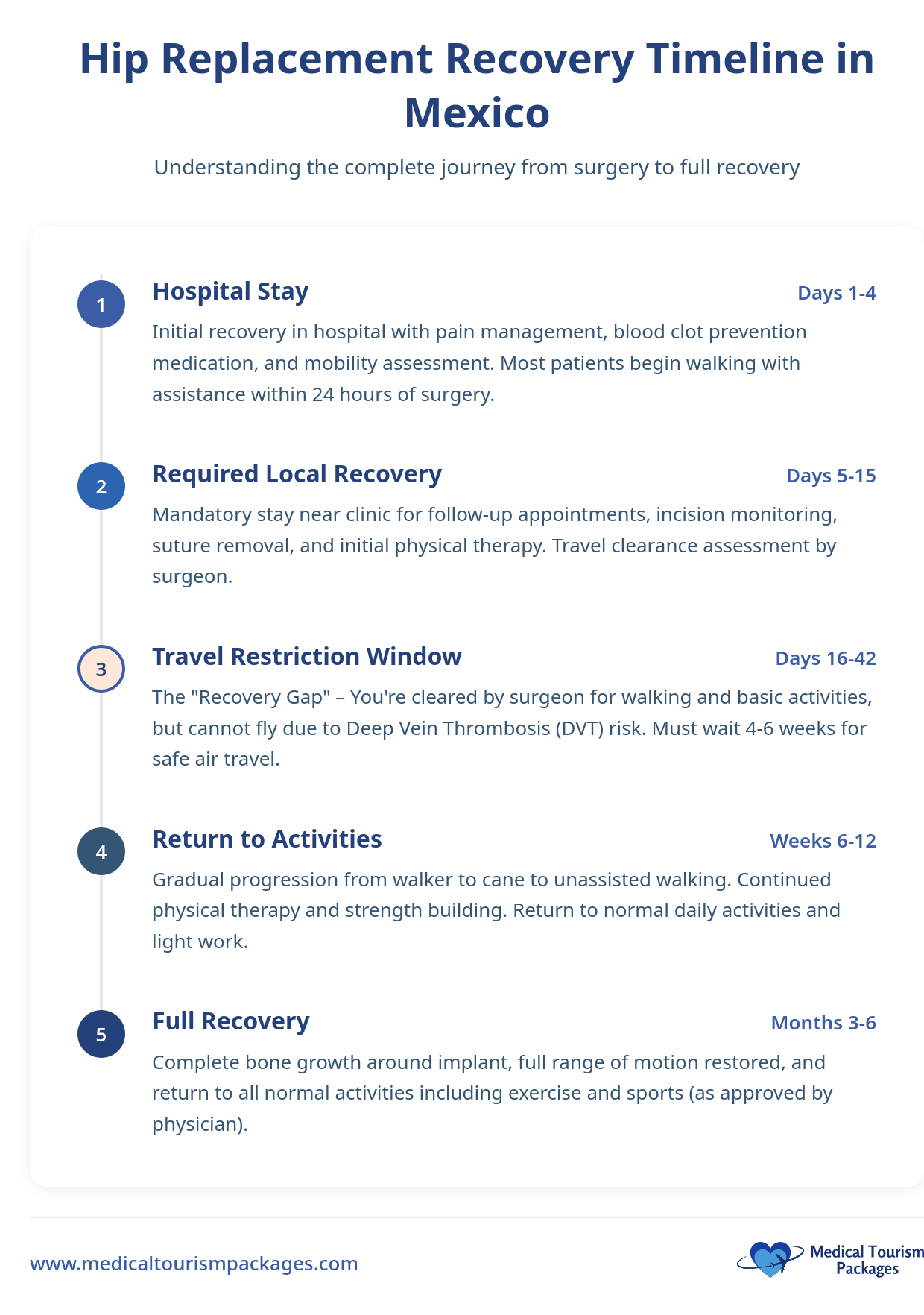
Recovery from hip replacement follows a predictable timeline that runs from your hospital stay to full function at three to six months. Planning enough time in Mexico is essential, since rushing home can slow healing. The phases below reflect AAOS OrthoInfo guidance.
What Does the Recovery Timeline Look Like?
The recovery timeline moves through four phases over about six months. Here is what to expect at each stage, based on AAOS OrthoInfo:
| Recovery Phase | Timeline | What to Expect |
|---|---|---|
| Hospital Stay | Days 1–3 | Pain control, clot prevention, walking with help |
| Local Recovery | Days 4–15 | Wound monitoring, suture removal, travel clearance |
| Strength Building | Weeks 6–12 | Progress from walker to cane to unassisted walking |
| Full Recovery | 3–6 months | Normal function, bone growth complete |
When Can You Fly Home?
You can usually fly home four to six weeks after surgery, because most surgeons advise waiting that long to lower blood clot risk. Since you only need to stay near your hospital for 10 to 15 days, this creates a recovery gap of two to three extra weeks.
You can fill that gap by staying in Mexico or, if you live near the border, driving home after the initial period. When you do fly, wear compression stockings, walk the aisle every hour, and request an aisle seat with extra legroom to protect against clots.
What Are the Risks and Complications of Hip Replacement Surgery in Mexico?
The risks of hip replacement in Mexico are the same as anywhere else, because the surgery carries inherent risks regardless of location. The most common concerns are infection, blood clots, and dislocation. The biggest difference abroad is logistical, not surgical.
What Are the Common Complications?
The common complications of hip replacement include infection, clots, and dislocation. These risks exist with the procedure everywhere. Watch for the following:
- Infection – periprosthetic joint infection affects roughly 1 to 2 percent of primary hip replacements, with about half of cases appearing within the first six months
- Blood clots – can form during periods of limited movement
- Joint dislocation – possible if you move incorrectly, especially early on
- Implant loosening – may develop after many years of use
- Leg length difference – one leg may end up slightly different in length
- Nerve damage – rare but possible
Despite these risks, modern hip implants are durable. A 2025 multi-registry meta-analysis published in The Lancet, drawing on eight national joint registries, found average implant survivorship exceeding 92 percent at 30 years and 93.6 percent at 20 years. Most patients keep their implant for decades.
What Are the Post-Operative Care Challenges?
The main challenge after surgery abroad is logistical, not medical. Some US and Canadian physicians are reluctant to manage care for surgeries they did not perform, citing liability concerns. You should secure acceptance from a home provider before you travel.
Contact your primary care physician and local orthopedic surgeons about follow-up care, document their agreement in writing, and ask your Mexican surgeon to send all records to your home care team. This planning prevents gaps in your recovery.
What Are the Advantages and Disadvantages of Hip Replacement Surgery in Mexico?
The advantages of hip replacement in Mexico are lower cost, short wait times, and easy access, while the disadvantages include limited legal recourse and post-care logistics. Weighing both sides helps you make an informed choice.
What Are the Advantages?
The advantages center on cost, speed, and quality of care. These are the main benefits:
- Cost savings of 40 to 84 percent versus US prices
- FDA-approved implants from Zimmer Biomet, DePuy Synthes, Smith & Nephew, Stryker, and Medacta
- Modern techniques, including MAKO robotic assistance
- Surgery scheduled within weeks instead of months
- Close proximity and direct flights from many US cities
What Are the Disadvantages?
The disadvantages involve legal protection, follow-up logistics, and added recovery costs. Consider these drawbacks:
- Limited legal recourse for malpractice compared to the US
- Financial exposure if complications arise after you return home
- Extended lodging costs during the recovery gap, often $2,000 to $5,000
- Fewer than ten JCI-accredited facilities nationwide
- Low national surgical volume, about 8 versus 200 per 100,000 in the US
- No standardized public outcome reporting
How Do You Prepare for Hip Replacement Surgery in Mexico?
You prepare for hip replacement in Mexico by organizing your medical records, tests, and travel four to six weeks ahead. Good preparation makes the journey and recovery smoother. Start with documents your Mexican team needs.
What Pre-Operative Requirements Are Needed?
You need complete medical documentation and standard pre-operative tests. Begin gathering these four to six weeks before surgery. The requirements include:
- Physical exam, blood and urine tests, EKG, chest x-rays, and MRI or CT scans
- Medical records, prescriptions, and referral letters with full history
- A passport valid for six months beyond your travel date
- Comfortable clothing, mobility aids, and compression stockings
What Travel Arrangements Should You Make?
You should arrange a travel companion and plan a minimum 10-to-14-day stay after surgery before heading home. Your mobility will be limited, and you will need help with basic tasks for at least the first week.
US and Canadian citizens do not need a visa for Mexico and can stay up to 180 days as tourists. Flights are short and affordable. Houston to Mexico City takes about 2.5 hours, and Miami to Cancún takes under 3 hours, with roundtrip fares often between $250 and $550.
What Are the Most Common Questions About Hip Replacement Surgery in Mexico?
How long does a hip replacement last in Mexico?
Hip implants placed in Mexico last as long as those placed in the US. A 2025 Lancet multi-registry analysis found survivorship above 92 percent at 30 years. Mexican hospitals use the same Zimmer Biomet, DePuy Synthes, and Stryker implants, so longevity depends on your activity and care, not the country.
Can I fly home immediately after hip replacement surgery?
No. You should stay in Mexico for 10 to 15 days for initial recovery and follow-up visits. Most surgeons recommend waiting four to six weeks before flying to lower the risk of blood clots. If you live near the border, driving home earlier is possible, but air travel needs more healing time.
Will my US insurance cover hip replacement in Mexico?
Most US and Canadian insurance plans do not cover elective procedures performed abroad, so expect to pay out of pocket. However, the total cost in Mexico, $9,000 to $15,000, is often less than your US deductible and coinsurance would be for the same surgery at home.
How do I find a qualified surgeon in Mexico?
Seek surgeons affiliated with JCI-accredited hospitals who hold board certification equivalent to the American Board of Orthopedic Surgery. Verify fellowship training in the US or Europe and membership in FEMECOT, ISAKOS, or the Mexican Society of Hip Surgery. Ask about annual procedure volume and complication rates.
What happens if I have complications after returning home?
Some US physicians are reluctant to manage complications from surgeries done abroad due to liability concerns. Arrange domestic follow-up care before you travel. Contact your primary care physician and local orthopedic surgeons to confirm they will provide post-operative monitoring, and document their agreement in writing.
Is the quality of hip implants in Mexico the same as in the US?
Yes. Leading Mexican facilities use identical FDA-approved implants from the same manufacturers that supply US hospitals, including Zimmer Biomet, DePuy Synthes, Smith & Nephew, Stryker, and Medacta Group. The hardware quality is the same. Savings come from lower overhead and labor costs, not cheaper parts.
How much money can I actually save by going to Mexico?
You can save 40 to 84 percent versus US prices. A total hip replacement costs about $9,000 to $15,000 in Mexico versus $25,000 to $55,000 in the US. That yields savings of roughly $16,000 to $46,000, even after travel, lodging, and extended recovery expenses.
Do I need a medical visa to get surgery in Mexico?
No medical visa is required for US and Canadian citizens. You can enter under standard tourist rules with a valid passport and stay up to 180 days. Make sure at least six months of passport validity remain, and bring documentation of your medical appointments.
Ready to Start Your Hip Replacement Journey in Mexico?
Medical Tourism Packages coordinates your full hip replacement journey to Mexico. We connect you with vetted, JCI-accredited hospitals and board-certified orthopedic surgeons, arrange travel and accommodations, and provide bilingual support through treatment and recovery. We also help transfer your records to your US physicians for follow-up care.
Save 40 to 84 percent on hip replacement in Mexico without compromising quality or safety. Contact us today for a free consultation and a personalized cost estimate.