Book Appointment Now


IVF in Mexico: Costs, Top Clinics, Success Rates, and How to Plan Your Trip
 By
By
IVF in Mexico costs $4,000 to $8,000 per cycle, up to 70% less than US prices, at accredited clinics in Tijuana and Cancún.
A standard own-egg IVF cycle in Mexico costs $4,500 to $8,000, versus $15,000 to $25,000 in the US. Clinics in Tijuana, Cancún, Guadalajara, and Mexico City hold REDLARA and COFEPRIS accreditation. They treat thousands of North American patients each year.
Our network connects you with board-certified reproductive endocrinologists at accredited Mexican fertility clinics. Each facility is verified for REDLARA membership, COFEPRIS licensing, and laboratory standards. This guide covers costs, top clinic cities, success rates, legal access for single and LGBTQ+ parents, and trip planning.
What Is IVF in Mexico?
IVF in Mexico is in vitro fertilization performed at private fertility clinics for a fraction of the US price. It is one of the most established forms of fertility treatment Mexico offers international patients.
Cross-border fertility care has grown into an organized corridor between the United States, Canada, and Mexico. Patients travel mainly because assisted reproduction costs far less south of the border. Insurance at home rarely covers it. Only 25 US states and Washington, D.C. require any fertility benefit.
Mexico now captures roughly 17% to 18% of all fertility cycles in Latin America. That makes it the second-largest market in the region, behind Brazil. The average fertility patient in Latin America is about 38 years old. To serve them, Mexican clinics have built out advanced services. These include donor egg banks, preimplantation genetic testing, and gestational carrier programs.
For a broader view of what the country offers, read our guide to medical tourism in Mexico.
How Much Does IVF Cost in Mexico?
IVF in Mexico costs $4,000 to $8,200 for a standard own-egg cycle. The same cycle costs $15,000 to $25,000 in the United States. That is a saving of up to 70%. This lower price is the main reason patients ask how much is IVF in Mexico before booking.
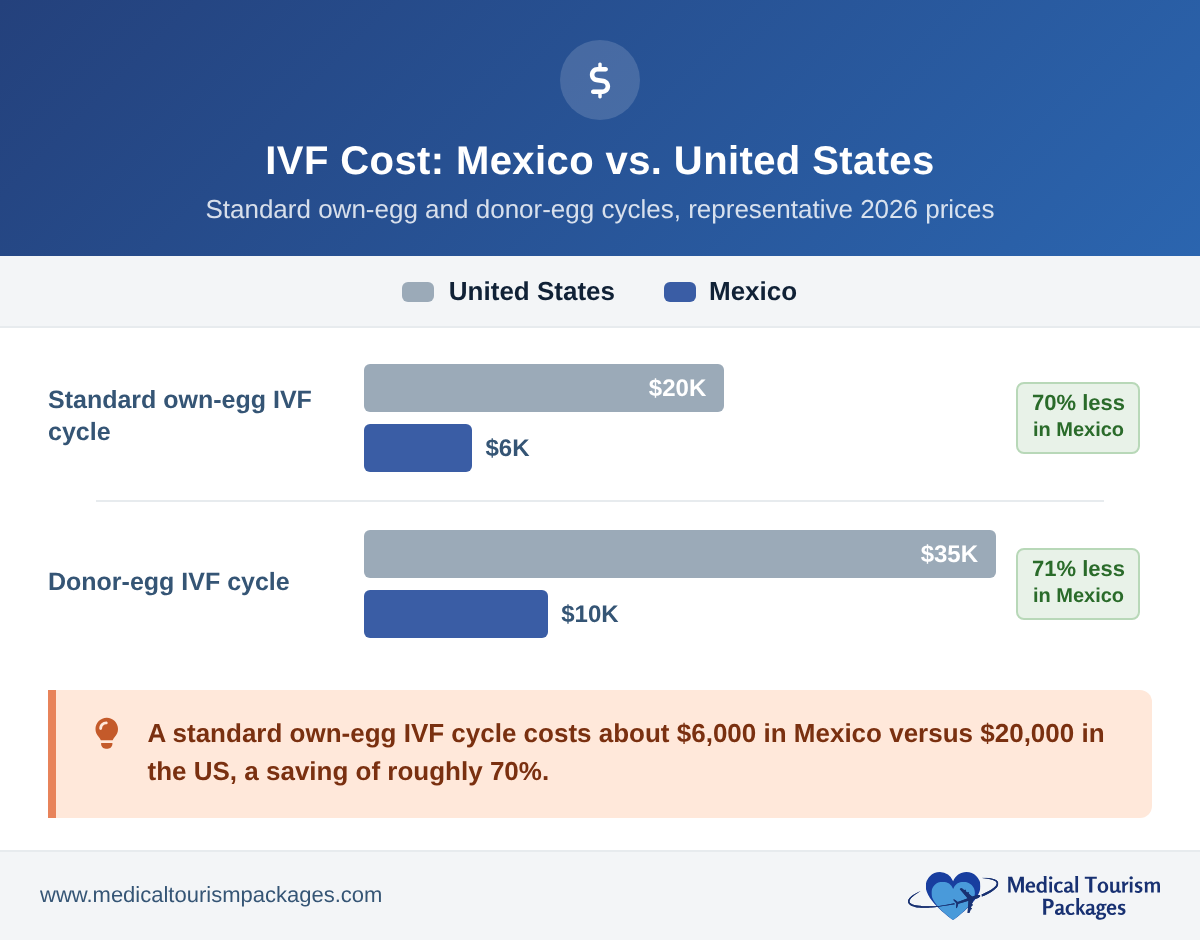
The table below compares common fertility procedures in Mexico and the US.
| Procedure or Service | Mexico (USD) | United States (USD) | Savings |
|---|---|---|---|
| Standard own-egg IVF cycle | $4,500 to $8,000 | $15,000 to $25,000+ | 65% to 70% |
| IVF with ICSI | $5,000 to $9,000 | $16,000 to $27,000+ | 66% to 68% |
| Donor egg IVF cycle | $7,300 to $12,500 | $25,000 to $50,000 | 70% to 75% |
| ROPA (reciprocal IVF) | $5,000 to $11,000 | $20,000 to $35,000 | 68% to 75% |
| Ovarian stimulation medications | $1,850 to $3,970 | $3,000 to $8,000+ | 50% to 60% |
| PGT-A genetic testing | $2,000 to $5,000 | $4,000 to $10,000 | 50% to 60% |
| Embryo freezing and storage | $500 to $1,000 | $1,000 to $2,000 | 50% |
| Egg freezing | $3,500 to $5,000 | $10,000 to $15,000 | 65% to 70% |
| Intrauterine insemination (IUI) | $500 to $1,500 | $2,500 to $4,000 | 62% to 80% |
The IVF Mexico cost you pay depends on the clinic, the city, and the add-ons you need. Many clinics bundle the core services into one package price. That reduces the risk of surprise fees.
What Does the Price of an IVF Cycle Include?
The base price of an IVF cycle covers your consultations, scans, egg retrieval, lab work, and embryo transfer. Add-ons like genetic testing and extra storage are priced separately.
The table below breaks down the main clinical and lab components of a cycle in Mexico.
| Cycle Component | Low (USD) | High (USD) | Notes |
|---|---|---|---|
| Specialist consultations and scans | $300 | $600 | Baseline diagnostics, ovarian reserve checks, hormone monitoring |
| Surgical egg retrieval | $1,200 | $2,000 | Operating room, surgeon, and nursing fees |
| Anesthesia | $400 | $800 | Conscious sedation by a board-certified anesthesiologist |
| Embryology laboratory | $1,500 | $2,500 | Fertilization, ICSI, culture to blastocyst, grading |
| Embryo transfer | $800 | $1,500 | Ultrasound-guided catheter placement |
| Urban premium | +20% | +30% | Applied in Mexico City and Guadalajara |
| Imported medication surcharge | +25% | +40% | Applied when you choose imported brands over generics |
How Much Do Donor Egg and ICSI Cycles Cost?
A donor egg IVF cycle in Mexico costs $7,300 to $12,500. IVF with ICSI costs $5,000 to $9,000. Both cost 65% to 75% less than the same treatment in the US.
ICSI injects a single sperm directly into each egg. Clinics use it for male-factor infertility or low-yield cycles. Donor egg IVF is a common form of egg donation Mexico clinics provide. The donor egg price usually includes screening, donor medication, retrieval, and the recipient transfer. Donor identity is protected by Mexican law.
Where Is the Cheapest IVF in Mexico?
The cheapest IVF in Mexico is usually found at border and smaller-city clinics, and through hybrid cycles. Prices rise in Mexico City and Guadalajara, where clinics add a 20% to 30% urban premium.
A hybrid cycle keeps your costs down. You complete hormone monitoring with a doctor in your home state. You then travel to Mexico only for the egg retrieval and embryo transfer. This cuts both travel time and total cost. To see how the wider savings compare, read our breakdown of how Mexico’s medical costs compare with US prices.
Which Cities Have the Best IVF Clinics in Mexico?
The best IVF clinics in Mexico are concentrated in Tijuana, Cancún, Mexico City, Guadalajara, and Mexicali. Each city offers a different mix of price, travel access, and lab technology.
Mexico’s fertility sector is large and competitive. The country handles roughly 17% to 18% of all fertility cycles in Latin America. For regional cost and growth figures, see our Latin America medical tourism statistics.
Why Is Tijuana a Top Choice for IVF?
Tijuana is a top choice for IVF because it sits minutes from San Diego, California. That proximity makes it easy for North American patients to run hybrid cycles. Demand for IVF Tijuana has grown more than 50% year over year.
Patients complete early monitoring at home. They then cross the border only for retrieval and transfer. Established Tijuana facilities include The Fertility Center by IMI and Centro de Fertilidad del Prado. Both run on-site labs and treat many US patients. Basic cycles at some Tijuana clinics start near $4,800. Nearby Mexicali offers another border option, with all-inclusive packages at facilities like Hospital de la Familia.
What Do Cancún, Mexico City, and Guadalajara Offer?
Cancún, Mexico City, and Guadalajara each offer strong clinical options with their own advantages. Cancún pairs treatment with a resort setting. Mexico City has the deepest bench of specialists. Guadalajara combines advanced labs with competitive pricing.
- Cancún: A major international medical tourism hub. The resort environment helps patients manage the stress of treatment. Clinics like Advanced Fertility Center Cancún and IREGA draw patients from the US, Canada, and Europe. IREGA operates inside the Galenia Hospital complex.
- Mexico City: Home to the largest concentration of reproductive specialists and academic-grade labs. REDLARA-certified networks such as Ingenes, Fertilidad Integral, and HOPE IVF operate here, several offering multi-cycle programs.
- Guadalajara: A hub for western Mexico and North America. Clinics such as Fertilidad Integral and BioFertility Center run continuous embryo monitoring. They also support same-sex female couples through the ROPA method.
All clinics you shortlist should be board-certified and REDLARA-affiliated, whether they sit in Tijuana, Cancún, or Guadalajara.
What Technology Do Mexican Fertility Clinics Use?
Mexican fertility clinics use the same laboratory technology as top clinics in the US and Europe. Leading centers use these tools to improve embryo selection and raise success per transfer.
- Mini IVF: Uses lower medication doses for a gentler cycle. It suits low ovarian reserve and lowers the risk of overstimulation.
- AI embryo selection: Software reads time-lapse images inside the incubator. It flags the embryos with the best chance of implanting, without any biopsy.
- Cryotec vitrification: An ultra-fast freezing method from Japan. Post-thaw survival rates consistently top 95%.
- Endometrial receptivity analysis (ERA): A biopsy that finds the best day to transfer an embryo. It helps patients with repeated transfer failure.
- Donor matching technology: AI tools analyze facial features to match intended parents with egg donors of similar appearance.
What Are IVF Success Rates in Mexico?
IVF success rates in Mexico look very high in clinic marketing but lower in independent registries. Many clinics advertise 60% to 90% success. Independent registry data for own-egg cycles is far lower, so you should read the numbers carefully.
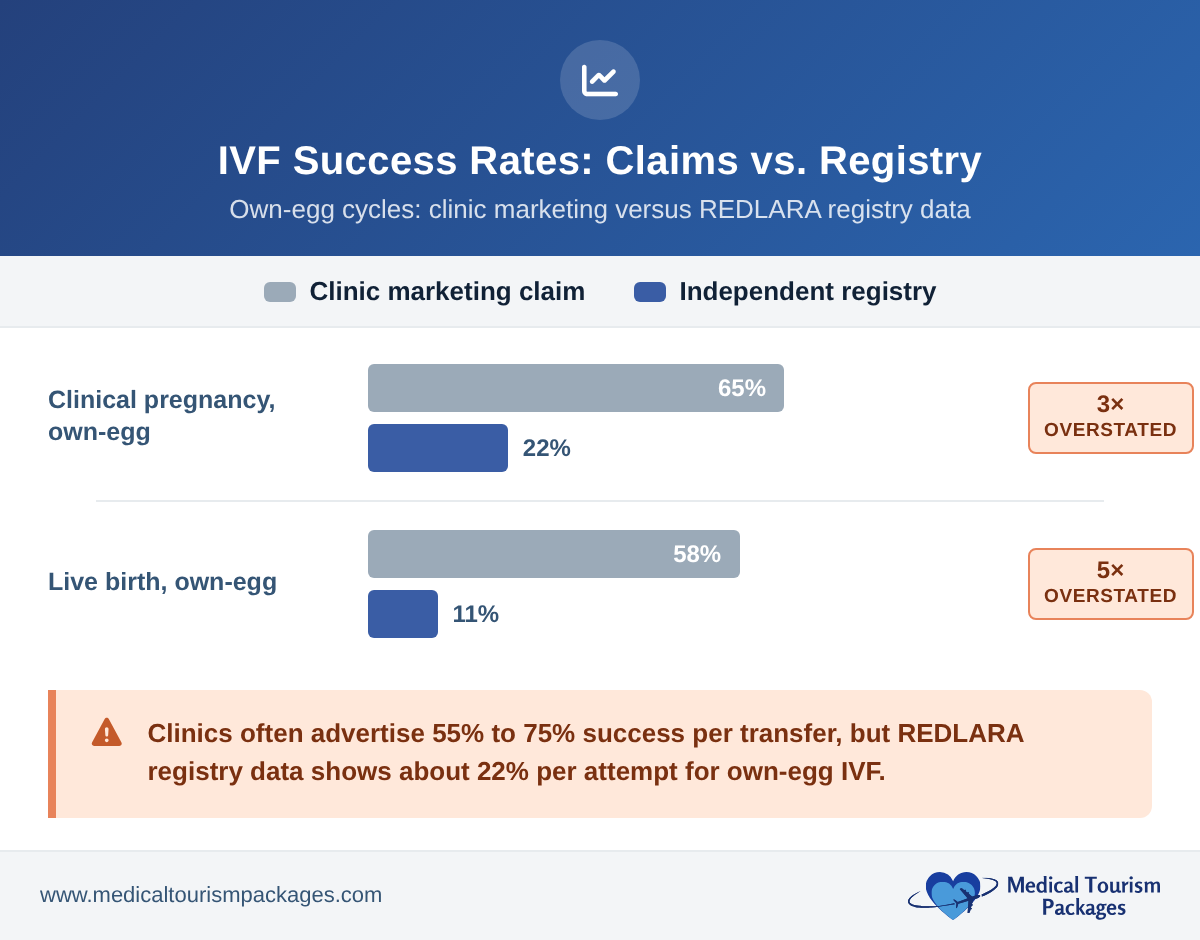
The gap comes from how the numbers are counted. Marketing often reports clinical pregnancy per embryo transfer. That excludes cancelled cycles and does not confirm a live birth. Independent registries like REDLARA count every started cycle, which is more honest.
| Success Metric | Clinic Marketing Claim | Independent Registry Data |
|---|---|---|
| Own-egg clinical pregnancy | 55% to 75% per transfer | 21.9% per attempt |
| Own-egg live birth | 50% to 65% cumulative | 10.8% per attempt |
| IUI pregnancy | 30% to 45% per cycle | 3.4% per attempt |
| REDLARA own-egg baseline | Not reported | 15.6% IVF; 14.8% ICSI per attempt |
| Donor egg pregnancy | 65% to 80% per transfer | Low-to-mid 30% per transfer |
Ask three questions before you trust any success rate. Is it clinical pregnancy or live birth? Is it counted per transfer or per retrieval? What is the rate for patients your age? Donor egg rates stay high across ages because they use young donor eggs. Those numbers do not predict your odds with your own eggs at an older age.
What Are the Legal Rules for IVF and Surrogacy in Mexico?
Mexican law gives broad access to IVF and egg donation. Surrogacy is also legal, but the rules change from state to state. Most fertility care is straightforward for international patients.
Can Single Women and LGBTQ+ Couples Get IVF in Mexico?
Yes, single women, unmarried couples, and LGBTQ+ patients can get IVF in Mexico. Access to assisted reproduction is protected as part of the right to form a family. This is true regardless of marital status or sexual orientation.
Same-sex female couples can use the ROPA method, also called reciprocal IVF. One partner provides the eggs. The other carries the pregnancy. Mexico has recognized double maternity since 2007. Both mothers are listed on the child’s birth certificate with written consent. Mexico sets no federal age limit, though clinics apply their own medical limits, often up to about 55.
Is Surrogacy Legal in Mexico?
Yes, surrogacy is legal in Mexico, but each state sets its own rules. In June 2021, the Supreme Court ruled surrogacy a protected medical procedure. It based parentage on the intent to form a family, not on genetics alone.
State practice still varies widely. Sinaloa allows both altruistic and compensated surrogacy. Jalisco, which includes Guadalajara, handles it through a pre-birth court order called an amparo. Querétaro and San Luis Potosí prohibit surrogacy agreements. Surrogacy Mexico programs typically cost $48,500 to $100,000, depending on the clinic and legal fees. Anyone considering it should hire an independent Mexican family-law attorney. The main medical cities include Mexico City, Guadalajara, Cancún, and Tijuana. They carry a Level 2 Increased Caution travel advisory and remain standard medical tourism corridors.
How Do You Plan an IVF Trip to Mexico?
You plan an IVF trip to Mexico in three stages. First, consult a clinic by video. Then travel for the retrieval and transfer. Finally, verify the clinic’s accreditation before you pay.
Can You Do IVF in Mexico as a US or Canadian Citizen?
Yes, you can do IVF in Mexico as a US or Canadian citizen. You do not need a visa for a tourist stay of up to 180 days. You only need a valid passport.
Most patients start with two or three video consultations. This lets you compare communication, response times, and English-speaking staff. You then choose a clinic and schedule your travel around your cycle dates.
How Long Do You Need to Stay in Mexico for IVF?
You need to stay in Mexico about two to three weeks for a full IVF cycle. This covers monitoring, egg retrieval, and the embryo transfer. A hybrid cycle shortens your stay.
With a hybrid cycle, you do early monitoring at home. You travel to Mexico only for the retrieval and transfer window. That can cut your in-country time to a week or less.
Can You Bring IVF Medications Back Across the Border?
Yes, you can usually bring IVF medications across the border for personal use. US Customs generally allows up to a 90-day personal supply under the FDA’s personal importation policy.
- Keep the original packaging: Carry medications in their manufacturer-labeled boxes.
- Bring your prescription: Have a valid prescription or proof the drugs continue a treatment cycle.
- Declare at customs: Tell the border or airport officer what you are carrying.
- Protect the cold chain: Move injectable hormones in an insulated cooler with ice packs.
Is IVF in Mexico Right for You?
IVF in Mexico is a strong option for many North American patients. It fits you well if you are uninsured or underinsured for fertility care. It also fits if US or Canadian prices have priced you out. Patients who want donor egg, ROPA, or LGBTQ+-friendly access find Mexico welcoming. Clinics in Tijuana, Cancún, Mexico City, and Guadalajara deliver current technology at 65% to 75% less than US cost.
Mexico is not the right fit for everyone. Read success rates carefully and match them to your age and diagnosis. If you are considering surrogacy, get legal advice before you commit. When you are ready, the first steps are simple. Digitize your medical records. Shortlist REDLARA and COFEPRIS-accredited clinics. Book video consultations and request an itemized quote.
What Questions Do Medical Tourists Ask Most Often About IVF in Mexico?
Why do people go to Mexico for IVF?
People go to Mexico for IVF mainly to save money. A cycle costs 65% to 75% less than in the US. Accredited clinics in Tijuana, Cancún, and Mexico City use the same lab technology. Mexico also offers broad legal access for single, unmarried, and LGBTQ+ patients.
Can I do IVF in Mexico as a US citizen?
Yes, you can do IVF in Mexico as a US citizen. You do not need a visa for a tourist stay of up to 180 days. You only need a valid passport. Most patients start with a video consultation before they travel. Canadian citizens follow the same simple process.
How long do I have to stay in Mexico for IVF?
You should plan to stay about two to three weeks for a full IVF cycle. This covers monitoring, egg retrieval, and the embryo transfer. A hybrid cycle can shorten your stay. You complete early monitoring at home and travel only for the retrieval and transfer window.
Is IVF in Mexico safe?
Yes, IVF in Mexico is safe when you choose an accredited clinic. Top clinics hold REDLARA membership and COFEPRIS licensing. They use the same lab technology as US and European centers. Always confirm a clinic’s accreditation and ask for age-specific success rates before you pay.
Are Mexican fertility clinics accredited to international standards?
Yes, leading Mexican fertility clinics meet international standards. Many are active members of REDLARA, the Latin American reproductive medicine network. Clinics must also hold COFEPRIS licensing, the national health authority. Ask each clinic to confirm its REDLARA membership and COFEPRIS registration in writing.
Do fertility clinics in Mexico have English-speaking staff?
Yes, most clinics that serve North American patients have English-speaking staff. Bilingual patient coordinators guide you from your first consultation through treatment. Clinics in Tijuana and Cancún handle high volumes of US and Canadian patients. This removes the language barrier that complicates care in some other countries.
Sources
- IVF cost ranges and US comparison: Treatment Abroad IVF in Mexico cost guide and Flymedi IVF Mexico 2026 prices.
- Up to 70% savings versus the US and hybrid-cycle logistics: Nomadoc IVF Mexico cost and safety guide.
- Donor egg IVF pricing and legal donor anonymity: Egg Donation Friends: Egg Donation IVF in Mexico and PlacidWay fertility treatment prices, Mexico.
- Success rate marketing versus REDLARA registry data: CureMeAbroad IVF success rate in Mexico and SciELO México study on fertility clinic success rates.
- Legal access for single, unmarried, and LGBTQ+ patients and ROPA double maternity: IMI México Fertility Laws Mexico.
- Surrogacy legality, the 2021 Supreme Court ruling, and state variation: Sensible Surrogacy: Surrogacy in Mexico and CAREM surrogacy Mexico legal process.
- Regional market share (17% to 18% of Latin American cycles): CureMeAbroad IVF success rate in Mexico.
- Bringing medications across the US border: U.S. Customs and Border Protection personal medication guidance and FDA Personal Importation.
Ready to Start Your IVF Journey in Mexico?
Medical Tourism Packages coordinates your entire IVF journey in Mexico. We connect you with REDLARA and COFEPRIS-accredited clinics in Tijuana, Cancún, Mexico City, and Guadalajara. We arrange your travel and accommodations and provide bilingual support throughout your treatment. Get a free consultation to discuss your fertility goals and receive a personalized quote.
Contact us today to start planning your affordable IVF in Mexico.