Book Appointment Now



Orthopedic Surgery in Mexico: Definition, Cost Savings, and Complete Process Guide
 By
By
Orthopedic surgery in Mexico costs 60 to 84 percent less than in the United States, with 8 JCI-accredited hospitals and surgeons holding dual CMCOT and US or Canadian board certification.
Mexico’s leading orthopedic hospitals (ABC Medical Center, Hospital Galenia, Hospital Ángeles Pedregal, Christus Muguerza) perform joint replacement, spine, sports medicine, and hand surgery for international patients. Knee replacement runs $8,000 to $15,000, hip replacement $9,000 to $15,000, and carpal tunnel surgery $1,800 to $2,530, regulated by COFEPRIS.
Our network connects you with JCI-accredited hospitals in Mexico City, Cancún, and Monterrey, plus border-accessible facilities near Tijuana for Californian patients. Every facility is verified for accreditation status, US institutional affiliations (Houston Methodist, Christus Health), and use of FDA-approved Zimmer Biomet, Stryker, and DePuy Synthes implants. Below, you will find cost comparisons against Colombia, Panama, and Costa Rica, vetted hospital profiles, procedure-specific recovery timelines from AAOS OrthoInfo, financing options, and answers to common patient questions about orthopedic surgery in Mexico.
What Is Orthopedic Surgery and Why Get It in Mexico?
Orthopedic surgery is any operation on the musculoskeletal system: bones, joints, ligaments, tendons, and the spine. In Mexico, patients from the US and Canada access the same procedures performed at home for 60 to 84 percent less, at hospitals overseen by COFEPRIS and accredited by JCI.
What does orthopedic surgery include?
Orthopedic surgery covers joint replacement (knee, hip, shoulder), spine procedures (lumbar and cervical fusion), sports medicine (ACL reconstruction, meniscus repair, rotator cuff repair), and hand surgery (carpal tunnel release). Mexican facilities perform the same operations using the same FDA-approved implants found in US hospitals.
The American Academy of Orthopaedic Surgeons (AAOS) reports that knee and hip replacement together account for the majority of elective orthopedic procedures sought by international patients, with carpal tunnel release leading hand-surgery volume. These predictable, well-protocolized operations transfer cleanly to a medical-tourism setting because outcomes depend more on surgeon volume and implant selection than on local follow-up.
Why do US and Canadian patients travel to Mexico for it?
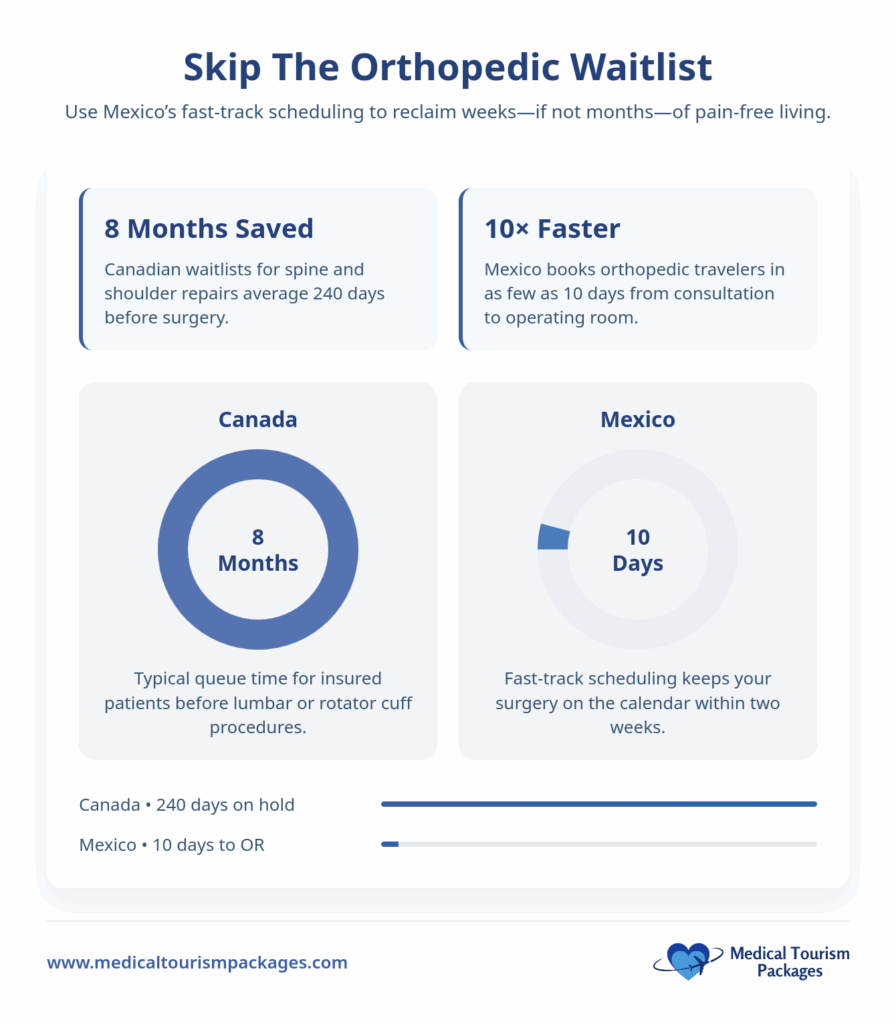
US and Canadian patients choose Mexico because joint replacement costs 60 to 84 percent less than at home, surgery is scheduled within 2 to 4 weeks instead of the 8-month Canadian public-system wait reported by the Canadian Institute for Health Information, and Tijuana sits walking distance from San Diego. Our broader medical tourism in Mexico guide covers logistics, visa rules, and recovery options across procedures.
Five factors drive the decision to travel:
- Cost savings: a total knee replacement runs $8,000 to $15,000 in Mexico versus $20,000 to $50,000 in the US per AAOS national cost data.
- Short wait times: Mexican hospitals book surgery in 2 to 4 weeks; Canadian Institute for Health Information benchmarks show provincial systems average 8-plus months for joint replacement.
- Drive-able border access: Tijuana is reachable on foot or by car from San Diego, simplifying companion travel and return visits.
- Regulatory oversight: every hospital is licensed by COFEPRIS, Mexico’s federal sanitary authority, and the country has 8 JCI-accredited hospitals per Joint Commission International’s public directory.
- US-trained surgeons: many Mexican orthopedic specialists hold dual board certification, combining the Mexican Council of Orthopedics and Traumatology (CMCOT) credential with American Board of Orthopaedic Surgery (ABOS) or Royal College of Physicians and Surgeons of Canada (RCPSC) recognition after US or Canadian fellowships.
How Much Does Orthopedic Surgery Cost in Mexico Compared to the US, Canada, Colombia, and Panama?
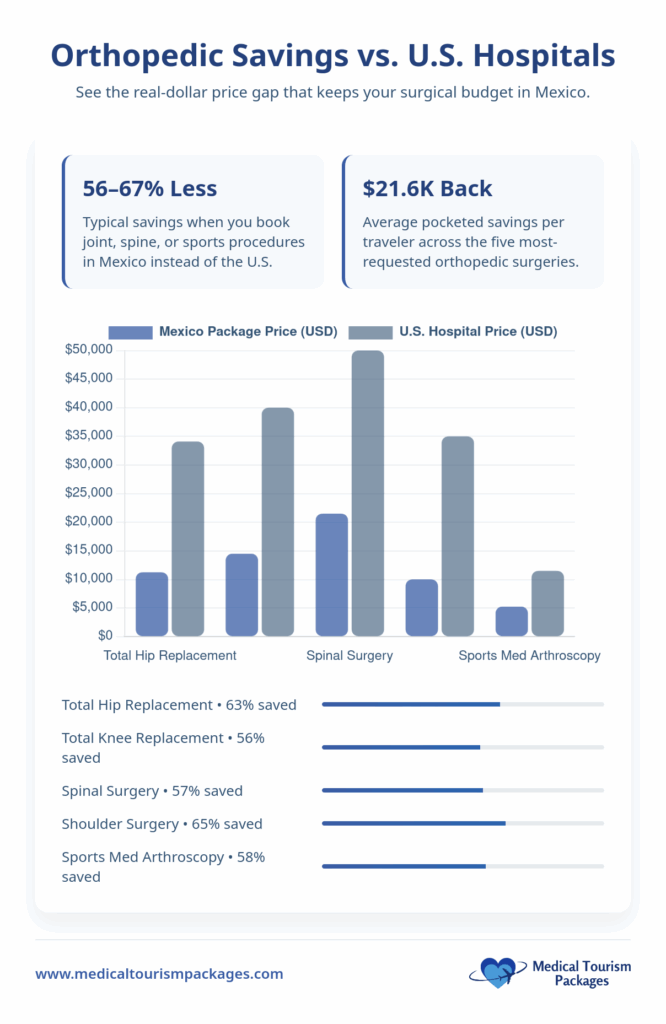
Orthopedic surgery in Mexico costs 60 to 84 percent less than in the United States. Total knee replacement runs $8,000 to $15,000 in Mexico versus $20,000 to $50,000 in the US. Total hip replacement runs $9,000 to $15,000 in Mexico versus $25,000 to $55,000 in the US.
Mexico vs the US, Canada, Colombia, and Panama: full cost comparison
Here is how the most common orthopedic procedures price out across the main medical-tourism destinations and the US, with all Mexico, Colombia, Panama, and Costa Rica ranges verified against MedicalTourismPackages.com and MedicalTourismCo cost data and US ranges sourced from AAOS national cost research:
| Procedure | Mexico | Colombia | Panama | Costa Rica | United States |
|---|---|---|---|---|---|
| Total Knee Replacement | $8,000 – $15,000 | $7,000 – $12,500 | $7,000 – $12,000 | $8,000 – $14,900 | $20,000 – $50,000 |
| Total Hip Replacement | $9,000 – $15,000 | $8,000 – $14,000 | $10,000 – $20,000 | $10,000 – $14,900 | $25,000 – $55,000 |
| Carpal Tunnel Surgery | $1,800 – $2,530 | $1,750 – $3,650 | $2,500 – $3,500 | $2,000 – $4,000 | $4,500 – $12,000 |
| Shoulder Replacement* | $10,000 – $20,000 | typically reported $9,000 – $16,000 | typically reported $10,000 – $18,000 | typically reported $11,000 – $18,000 | $25,000 – $45,000 |
| Rotator Cuff Repair* | $5,000 – $10,000 | typically reported $4,500 – $9,000 | typically reported $5,500 – $10,000 | typically reported $5,000 – $10,000 | $20,000 – $35,000 |
| Spinal Fusion* | $10,000 – $15,000 ($8,000 – $12,000 in Tijuana) | typically reported $12,000 – $25,000 | typically reported $15,000 – $28,000 | typically reported $14,000 – $24,000 | $60,000 – $100,000 |
| ACL Reconstruction* | $4,000 – $9,000 | typically reported $4,000 – $8,000 | typically reported $5,000 – $9,000 | typically reported $5,000 – $9,000 | $20,000 – $50,000 |
Across joint replacement, savings are largest for spinal fusion (around 85 percent below US prices), followed by hip and knee replacement at 60 to 84 percent. Carpal tunnel surgery shows the most consistent pricing across the four Latin American destinations.
What is included in the quoted price and what costs extra?
Mexican orthopedic packages bundle the surgical fee, anesthesia, hospital room, implants, and basic post-op care into one quoted price. Imaging, extra physical therapy, recovery-hotel stays, ground transport, and take-home medications usually come on top, adding roughly $1,000 to $3,000 for a 2 to 3-week trip.
Most all-inclusive packages include:
- Surgeon and assistant fees
- Anesthesia (regional or general, per protocol)
- Private hospital room and nursing care
- Implants from major manufacturers (Zimmer Biomet, Stryker, DePuy Synthes, Smith & Nephew)
- Initial physical therapy during hospital stay
- Post-operative consultations during your stay in Mexico
- Operative report and discharge documentation
Items that typically cost extra:
- Pre-operative imaging (X-rays $40 to $80, MRI $250 to $400 per region)
- Pre-operative lab work (CBC, metabolic panel, ECG if over 50)
- Extended outpatient physical therapy ($30 to $80 per session)
- Medications to take home
- Recovery-hotel accommodation ($60 to $150 per night)
- Ground transportation between airport, hospital, and hotel
- Meals outside the hospital and airfare
What factors affect your final cost in Mexico?
Five factors push your final price toward the high or low end of the published range:
- Accreditation level: JCI-accredited hospitals charge roughly 15 to 30 percent more than COFEPRIS-only facilities because they meet the same standards that US hospitals do.
- Implant choice: standard cobalt-chrome or titanium components cost less than premium ceramic-on-ceramic or custom-fit implants; choice can move the total by $1,500 to $4,000.
- City: Tijuana and Mexicali sit at the low end of the cost range thanks to border-driven volume; Mexico City and Monterrey charge 10 to 25 percent more for the same procedure at JCI hospitals.
- Package inclusions: bare-bones packages cover surgery only; comprehensive bundles add the recovery-hotel stay, dedicated patient coordinator, English-speaking nursing, and ground transport.
- Surgeon credentials: dual-certified surgeons (CMCOT plus ABOS or RCPSC) typically command a 10 to 20 percent premium over CMCOT-only specialists.
Which Orthopedic Procedures Should You Consider Getting in Mexico?
You should consider Mexico for elective orthopedic procedures with predictable recovery: joint replacement (knee, hip, shoulder), spine surgery, sports medicine repairs (ACL, meniscus, rotator cuff), and hand surgery (carpal tunnel). Avoid Mexico for emergencies, complex revisions, or cases needing intensive care.
Joint replacement: knee, hip, and shoulder
Joint replacement is the most common orthopedic procedure Mexican hospitals perform for international patients. Total knee replacement runs $8,000 to $15,000, total hip replacement $9,000 to $15,000, and total shoulder replacement $10,000 to $20,000. Most patients spend 3 days in the hospital and 7 to 21 days in Mexico before flying home.
Mexican hospitals use the same implant brands as US facilities: Zimmer Biomet Persona and Vanguard knee systems, Stryker Triathlon, DePuy Synthes Attune knees and Pinnacle hips, and Smith & Nephew Journey II. Surgeons commonly offer minimally invasive and computer-assisted approaches at JCI hospitals in Mexico City, Cancún, and Monterrey. For broader procedure-category context, see our overview of orthopedic surgery packages.
Spine surgery and minimally invasive options
Spinal fusion in Mexico costs $10,000 to $15,000, with Tijuana clinics quoting $8,000 to $12,000 according to a PlacidWay 2026 survey. The same single-level lumbar fusion runs $60,000 to $100,000 in the United States. Mexican spine surgeons also offer endoscopic discectomy, artificial disc replacement, and minimally invasive transforaminal lumbar interbody fusion (MIS-TLIF).
Before booking spine surgery abroad, exhaust conservative care: physical therapy, epidural steroid injections, and activity modification. The AAOS recommends 6 to 12 weeks of non-operative management for most degenerative spine conditions before considering surgery. Complex deformity correction, tumor resection, and revision spinal hardware procedures are best handled at home where revisions can be managed by the original surgical team.
Sports medicine: ACL, meniscus, and rotator cuff repair
Sports medicine procedures in Mexico include ACL reconstruction at $4,000 to $9,000, rotator cuff repair at $5,000 to $10,000, and arthroscopic meniscus repair from $3,500 to $7,000. These outpatient procedures allow most patients to fly home within 7 to 10 days after surgeon clearance, making them well suited to a shorter medical-tourism trip.
Graft choice matters for ACL reconstruction. Mexican surgeons offer autograft (your own hamstring or patellar tendon) and allograft (donor tissue) options; autograft is standard for patients under 40, while allograft suits older, lower-demand patients. Confirm the surgeon’s annual case volume for your specific procedure: AAOS data shows that surgeons performing 30 or more rotator cuff repairs per year achieve better functional outcomes than lower-volume operators.
Hand surgery: carpal tunnel and tendon repair
Carpal tunnel surgery in Mexico costs $1,800 to $2,530, compared with $4,500 to $12,000 in the US. The procedure takes 1 to 2 hours per hand, requires no hospital stay, and allows patients to fly home 7 days after surgery, with full grip and pinch strength typically restored within 3 to 6 months according to AAOS OrthoInfo.
Both open carpal tunnel release (OCTR) and endoscopic carpal tunnel release (ECTR) are available at Mexican facilities. AAOS clinical practice guidelines report 90 percent symptom resolution at 6 months for both approaches, with no clinically significant difference in long-term outcomes. Endoscopic release allows slightly faster return to desk work (about 7 days versus 10 to 14 for the open approach) but costs $300 to $600 more.
How Do You Verify a Mexican Hospital Is Safe for Orthopedic Surgery?
You verify a Mexican hospital’s safety by checking three things: Joint Commission International (JCI) accreditation, COFEPRIS licensing, and the orthopedic surgeon’s CMCOT board certification. Mexico has 8 JCI-accredited hospitals listed on the Joint Commission International public directory. Always prioritize JCI facilities for your surgery.
Which accreditations should you look for?
The three accreditations that matter for orthopedic surgery in Mexico are JCI, COFEPRIS, and CMCOT board certification for the operating surgeon:
- JCI (Joint Commission International): the same accreditor that surveys leading US hospitals. JCI re-surveys every 3 years on patient safety, infection control, medication management, surgical protocols, and quality improvement. Verify status directly on the JCI public directory before booking.
- COFEPRIS (Federal Commission for the Protection against Sanitary Risk): Mexico’s federal sanitary authority, operating under the Ministry of Health. Every legally operating hospital and clinic in Mexico must be COFEPRIS-licensed; this is the baseline, not a differentiator.
- CMCOT board certification: the Mexican Council of Orthopedics and Traumatology (Consejo Mexicano de Cirugía Ortopédica y Traumatología) certifies orthopedic specialists after completing residency and passing the board exam. The strongest candidates also hold ABOS (American Board of Orthopaedic Surgery) or RCPSC (Royal College of Physicians and Surgeons of Canada) recognition after a fellowship abroad.
Which hospitals lead Mexico for orthopedic surgery?
Four JCI or US-affiliated hospitals consistently lead Mexico for orthopedic surgery serving international patients:
| Hospital | City | Accreditation (year) | US Affiliation | Beds | Orthopedic Specialty Focus |
|---|---|---|---|---|---|
| The American British Cowdray (ABC) Medical Center | Mexico City (Observatorio + Santa Fe) | JCI (2008), COFEPRIS | Houston Methodist (since 2006) | 331 | Joint replacement, complex spine, trauma |
| Hospital Galenia | Cancún | JCI (2012), ACI | None published | 75 | Orthopedics, robotic surgery |
| Hospital Ángeles Pedregal | Mexico City (Pedregal) | JCI (2024), COFEPRIS | None published | 189 | Orthopedics, stem cell therapy, sports medicine |
| Christus Muguerza Alta Especialidad | Monterrey | COFEPRIS, Christus Health Texas network (since 2001) | Christus Health (Texas) | 200 | Orthopedics, neurosurgery, radiosurgery (CyberKnife) |
Each hospital runs a dedicated international patient department with bilingual coordinators, insurance verification, and follow-up logistics. Cross-check current JCI status on the Joint Commission International public directory before sending a deposit, since accreditation cycles run on a 3-year basis.
How do you find and vet a qualified orthopedic surgeon in Mexico?
You vet a Mexican orthopedic surgeon by verifying three credentials in writing: the Cédula Profesional (basic medical license), CMCOT board certification, and any ABOS or RCPSC fellowship recognition. Request documentation copies directly from the surgeon’s office before booking.
Use this vetting checklist before sending a deposit:
- Mexican credentials: confirm the Cédula Profesional number with Mexico’s Secretaría de Educación Pública registry and the CMCOT board certificate.
- International fellowship: ask where the surgeon completed residency and fellowship. ACGME-accredited US fellowships and RCPSC Canadian fellowships are strong indicators.
- Procedure-specific volume: ask how many of your specific procedure (not just “orthopedic surgery”) the surgeon performs per year. AAOS volume research links higher annual case counts to better outcomes for joint replacement and rotator cuff repair.
- Hospital privileges: confirm which JCI or US-affiliated hospital the surgeon operates at, and who is on the surgical team.
- Complication transparency: ask for the surgeon’s infection rate, revision rate, and 90-day readmission rate. Reluctance to share these is a red flag.
- Communication test: schedule a video consultation to assess English fluency directly, not through the facilitator. Get a second consultation with a competing surgeon to compare.
- Red flags: refusing to provide credentials, guaranteeing specific outcomes, pressuring you to schedule immediately, or quoting prices far below the published market range.
What risks should you weigh?
The main risks of orthopedic surgery in Mexico are language friction during recovery, follow-up coordination gaps with home-country physicians, distance from your surgical team if complications arise, and limited legal recourse compared with domestic malpractice systems. Each is manageable with planning.
- Language gaps: surgeons at JCI hospitals usually speak strong English, but nursing staff, physical therapists, and discharge clerks may not. Request a professional medical interpreter for consent and discharge.
- Follow-up coordination: some US primary-care physicians refuse to provide post-op care for surgeries performed abroad. Confirm follow-up willingness with your home doctor before booking.
- Distance for complications: returning to Mexico for a revision is expensive and slow. Choose hospitals offering written financial guarantees for return travel and corrective procedures within a defined window.
- Limited legal recourse: Mexican malpractice claims take 2 to 5 years through civil courts, with lower damage awards than the US system. Medical-tourism insurance (IMG Global, Trawick International, $200 to $1,000 for $25,000 to $250,000 in complication coverage) is the standard mitigation.
- Records continuity: request operative report, implant brand and lot numbers, imaging files, and physical-therapy protocols in English before leaving the hospital.
How Do You Plan Your Orthopedic Surgery Trip to Mexico?
You plan an orthopedic surgery trip to Mexico in six phases: research and remote consultation (1 to 3 weeks), medical clearance and pre-travel prep (1 to 2 weeks), arrival and pre-op assessment (2 to 3 days), surgery and hospital stay (1 to 5 days), local recovery (1 to 4 weeks), and return home with remote follow-up.
What does the journey look like from booking to recovery?
The orthopedic medical-tourism journey breaks into six sequential phases over 6 to 12 weeks total:
- Phase 1, research and remote consultation (1 to 3 weeks): shortlist 2 to 3 JCI hospitals, schedule video consultations, send medical records and recent imaging, receive preliminary surgical plans and itemized cost estimates.
- Phase 2, medical clearance and pre-travel prep (1 to 2 weeks): obtain CBC, metabolic panel, ECG (if over 50), and any specialty clearances. Stop blood thinners and NSAIDs 7 to 14 days before surgery per surgeon instructions. Book flights, recovery hotel, and travel insurance.
- Phase 3, arrival and pre-op assessment (2 to 3 days before surgery): arrive 48 hours before surgery, complete final blood work, meet the surgeon for plan review, and sign consent documents.
- Phase 4, surgery and hospital stay (1 to 5 days): joint replacement takes 1.5 to 2.5 hours; spinal fusion 3 to 6 hours; carpal tunnel 1 to 2 hours per hand. Hospital stay is 0 days for carpal tunnel, 3 days for joint replacement, and 4 to 7 days for spinal fusion.
- Phase 5, local recovery (1 to 4 weeks): stay near the hospital for suture removal at day 10 to 14 and surgeon clearance to fly. Outpatient physical therapy begins during this period.
- Phase 6, return home and remote follow-up: continue physical therapy locally for 6 to 16 weeks. Send imaging at 6 weeks, 3 months, 6 months, and 1 year to your Mexican surgeon for remote review.
How long should you plan to stay in Mexico?
Length of stay depends on the procedure. Carpal tunnel patients fly home 7 days after surgery; knee replacement patients 10 to 21 days; hip replacement patients 7 to 14 days; spinal fusion patients 14 to 28 days. Hospital stay accounts for the first 0 to 7 days; the rest is local recovery near the surgeon.
Procedure-specific in-country timelines pull from AAOS-aligned recovery protocols and Mexican hospital discharge norms:
| Procedure | Hospital Stay | Local Recovery Before Flying | Total In-Country Stay |
|---|---|---|---|
| Carpal Tunnel Surgery | Outpatient (0 days) | 7 days | 7 to 14 days |
| Total Knee Replacement | 3 days | 10 to 21 days | 14 to 28 days* |
| Total Hip Replacement | 3 days | 7 to 14 days | 14 to 28 days* |
| Spinal Fusion | 4 to 7 days | 14 to 28 days | 21 to 35 days |
What documents and pre-op tests do you need?
Bring a passport valid for the duration of your stay, recent imaging (X-ray or MRI within 3 months) on CD or DVD, prescription medications in original containers, and pre-op lab results completed within 30 days of surgery.
Required pre-op testing for orthopedic surgery in Mexico:
- Complete blood count (CBC) and comprehensive metabolic panel
- Electrocardiogram if you are over 50, plus stress testing if cardiac risk factors are present
- Hemoglobin A1c if diabetic (target below 7.0 percent before elective surgery)
- Coagulation panel if on blood thinners or with bleeding disorders
- Chest X-ray for patients over 60 or with pulmonary risk factors
- Recent X-ray or MRI of the affected joint or spine on CD or DVD
- Medical history summary with current medications, allergies, prior surgeries
How do you get to Mexico from the US?
Major US cities have direct flights to Mexico City (MEX), Cancún (CUN), and Monterrey (MTY). US and Canadian citizens enter visa-free for stays up to 180 days under the FMM tourist permit; no minimum passport-validity period applies, but bring a passport valid for your full stay.
Flight times and roundtrip price ranges from the four largest US gateways:
| Origin | Destination | Flight Time | Roundtrip Cost | Airlines |
|---|---|---|---|---|
| Miami (MIA) | Mexico City (MEX) | 3 h 45 min | $280 – $550 | American, Aeromexico, Volaris |
| New York (JFK) | Mexico City (MEX) | 5 h 30 min | $320 – $650 | Aeromexico, Delta, American, Volaris |
| Houston (IAH) | Mexico City (MEX) | 2 h 30 min | $250 – $500 | United, Aeromexico, Volaris, VivaAerobus |
| Los Angeles (LAX) | Mexico City (MEX) | 3 h 45 min | $280 – $550 | Aeromexico, Volaris, VivaAerobus, American, Delta |
| Miami (MIA) | Cancún (CUN) | 2 h 45 min | $280 – $500 | American, Aeromexico, LATAM |
| Houston (IAH) | Cancún (CUN) | 2 h 30 min | $250 – $480 | United, Spirit, Frontier |
| Los Angeles (LAX) | Cancún (CUN) | 4 h 45 min | $300 – $580 | United, Delta, American |
| Houston (IAH) | Monterrey (MTY) | 1 h 45 min | $270 – $480 | United, VivaAerobus |
| Los Angeles (LAX) | Monterrey (MTY) | 3 h 00 min | $280 – $520 | VivaAerobus, Aeromexico |
What Is Recovery Like After Orthopedic Surgery in Mexico?
Recovery after orthopedic surgery in Mexico follows the same AAOS-published phase structure used in US hospitals. Knee and hip replacement progress through hospital stay, outpatient rehab, strength building, and return to function over 6 months. Carpal tunnel recovers to full grip strength in 3 to 6 months.
Recovery timeline phases for joint replacement
AAOS OrthoInfo divides total knee replacement recovery into five phases, each with specific objectives and restrictions:
| Phase | Days | Objectives | Restrictions |
|---|---|---|---|
| 1. Hospital stay, early mobilisation | 1 – 3 | Pain management, begin physical therapy, walking with assistance | Continuous passive motion device if prescribed, no unassisted weight-bearing |
| 2. Outpatient rehabilitation | 4 – 28 | Daily physical therapy, increase range of motion | Walker or crutches as directed, wound care |
| 3. Strength building | 29 – 84 | Transition to cane then to no assistance | Avoid impact activities, continue PT |
| 4. Return to function | 85 – 180 | Resume most normal activities | No running or jumping, lifelong activity guidance |
| 5. Long-term outcome | 181 – 365 | Final strength and range of motion achieved | Annual orthopedic follow-up |
Total hip replacement follows a similar four-phase structure with one notable difference: posterior-approach hips require strict hip precautions (no bending past 90 degrees, no crossing legs) for the first 6 weeks to prevent dislocation. Anterior-approach hips usually skip these restrictions. Confirm with your surgeon which approach was used and when precautions can be lifted.
When can you fly home safely?
Hip replacement patients typically receive flight clearance 7 to 14 days after surgery, knee replacement patients 10 to 21 days, and spinal fusion patients 14 to 28 days. Carpal tunnel patients can fly home at 7 days post-op. These ranges are AAOS-aligned procedure norms; individual clearance is surgeon-dependent and pending clinician medical review for the MTP data layer.
Deep vein thrombosis (DVT) is the main flight-related risk after lower-extremity surgery. Mitigation steps include the prescribed anticoagulant regimen (typically aspirin or low-molecular-weight heparin for 4 to 6 weeks), compression stockings, an aisle seat for in-flight ankle pumps, and pre-flight clearance from your surgeon documenting that the wound has closed and there are no signs of infection.
How does follow-up work after you return home?
Follow-up combines local physical therapy with remote consultations to your Mexican surgeon. Continue PT for 6 to 12 weeks for joint replacement and 8 to 16 weeks for spinal procedures, and send imaging at 6 weeks, 3 months, 6 months, and 1 year for surgeon review.
Request these discharge documents before leaving Mexico:
- Operative report (English translation plus Spanish original)
- Implant brand, model, and lot numbers for every component placed
- Pathology reports if any tissue was removed
- Post-op imaging on CD or DVD
- Discharge summary and prescription list
- Physical therapy protocol and milestone schedule
- Direct contact information for the surgeon and international patient coordinator
- Schedule of remote follow-up consultations (6 weeks, 3 months, 6 months, 1 year)
How Do You Pay for Orthopedic Surgery in Mexico: Insurance, HSA, and Financing?
US insurance rarely covers elective orthopedic surgery in Mexico upfront, but you can use HSA or FSA funds tax-free, apply for medical financing through CareCredit or Alphaeon Credit, and submit for partial reimbursement after surgery with full documentation. Canadian provincial plans do not reimburse.
Does US or Canadian insurance cover Mexico surgery?
Most US insurance plans and all Canadian provincial plans exclude elective surgery performed abroad. Employer plans, marketplace policies, Medicare, and Medicaid restrict coverage to domestic in-network providers. Partial reimbursement is occasionally granted with itemized invoices, operative reports, proof of payment, and medical-necessity documentation, but expect to pay upfront.
A handful of self-funded employer plans and Blue Cross Blue Shield’s Global Core network include international benefits for select procedures; ask your HR department or insurance broker about international coverage riders before assuming you must pay out of pocket. The Family and Medical Leave Act (FMLA) provides up to 12 weeks of unpaid, job-protected leave, and US employers must accept medical certification from foreign healthcare providers.
Can you use HSA, FSA, or borrow money for the procedure?
Yes. HSA and FSA funds can pay for orthopedic surgery in Mexico tax-free under IRS rules for qualified medical expenses. Major medical financing companies fund procedures performed abroad with 3 to 5-year terms and 620 to 640 minimum credit scores.
- HSA / FSA: orthopedic surgery is a qualified medical expense under IRS Publication 502. Save itemized invoices and the operative report for tax records.
- CareCredit: dedicated medical-financing card; 6 to 24-month promotional 0 percent APR periods, then 17 to 27 percent standard APR. Accepted by some Mexican hospitals directly.
- Alphaeon Credit: elective-procedure financing with 6 to 60-month terms, APR typically 9 to 17 percent.
- United Medical Credit: brokers loans across multiple lenders for credit scores 620 and up; 3 to 5-year terms at 6 to 20 percent APR.
- Personal loans or HELOC: bank or credit-union financing often beats medical-specific lenders on rate if you have strong credit.
What about medical-tourism insurance for complications?
Medical-tourism insurance covers complications, evacuation, and revision surgery for procedures performed abroad. IMG Global and Trawick International offer policies priced at $200 to $1,000 for $25,000 to $250,000 in complication coverage, depending on procedure complexity, age, and pre-existing conditions.
These policies typically cover unplanned readmission, emergency medical evacuation back to the US, and revision surgery costs within a defined window (often 6 months post-op). They do not cover routine follow-up, dissatisfaction with cosmetic outcomes, or pre-existing conditions undisclosed at application. Combine medical-tourism insurance with a written financial guarantee from the surgical facility for the strongest protection.
What Are the Advantages and Disadvantages of Choosing Mexico Over Colombia, Panama, or Costa Rica for Orthopedic Surgery?
Mexico’s main advantages are the shortest US flight time, drive-able border access via Tijuana, the largest pool of JCI hospitals (8 nationwide), and competitive pricing. Colombia leads on surgeon density in Medellín, Panama on US-currency convenience, and Costa Rica on stable safety rankings.
Mexico vs Colombia, Panama, and Costa Rica side by side
The four leading Latin American medical-tourism destinations differ on cost, accreditation density, accessibility from the US, and clinical specialty strength:
| Factor | Mexico | Colombia | Panama | Costa Rica |
|---|---|---|---|---|
| Knee replacement cost | $8,000 – $15,000 | $7,000 – $12,500 | $7,000 – $12,000 | $8,000 – $14,900 |
| Hip replacement cost | $9,000 – $15,000 | $8,000 – $14,000 | $10,000 – $20,000 | $10,000 – $14,900 |
| JCI hospitals (count) | 8 | 6 | 2 | 2 |
| Flight time from LAX | 3 h 00 min – 4 h 45 min | ~7 h 30 min | ~6 h 30 min | ~6 h 00 min |
| Visa for US/CA citizens | None (180 days) | None (180 days) | None (180 days) | None (180 days) |
| Global Peace Index 2024 rank | 138 | 146 | 96 | 58 |
| Local currency | Mexican peso (USD widely accepted) | Colombian peso | US dollar (official) | Costa Rican colón |
| Orthopedic strength | Joint replacement, spine (Tijuana low-cost), broad hospital network | Joint replacement, sports medicine, surgeon density in Medellín | Joint replacement, US affiliations (Hospital Punta Pacifica – Johns Hopkins) | Joint replacement, dental, bariatric strengths |
Advantages and disadvantages of Mexico by factor
Weighing Mexico against the alternatives on a per-factor basis surfaces clear tradeoffs:
| Factor | Mexico Advantage | Mexico Disadvantage |
|---|---|---|
| Accessibility | Shortest flight times, drive-able border access at Tijuana | Border-city facilities vary in quality; verify JCI status |
| Cost | Tijuana spinal fusion at $8,000 to $12,000 is the lowest in the region | Mexico City JCI hospitals charge premiums similar to Panama |
| Hospital network | 8 JCI hospitals, the largest count in Latin America | JCI hospitals cluster in Mexico City and a handful of regional capitals |
| Surgeon training | Many surgeons hold ABOS/RCPSC fellowships from US/Canadian programs | Volume of dual-credentialed surgeons concentrated in 3 to 4 cities |
| Language | JCI hospitals provide bilingual coordinators | Nursing staff often have limited English |
| Recovery environment | Diverse climates (Mexico City highlands, Cancún tropical, Monterrey moderate) | Mexico City elevation (7,350 ft) can slow recovery for some patients |
| Legal recourse | Mexican civil courts function and accept malpractice claims | 2 to 5-year resolution, lower damages than US system |
| Insurance friction | HSA-eligible; partial reimbursement possible | No Medicare Advantage acceptance; US plans rarely pay primary |
Who is a good candidate for orthopedic surgery in Mexico, and who is not?
Good candidates have chronic orthopedic conditions needing elective surgery, ASA physical status I or II health, the flexibility to stay abroad 2 to 4 weeks, and a primary-care physician willing to provide post-op follow-up at home. Poor candidates have emergencies, complex revisions, or unstable comorbidities.
| Patient Type | Situation | Mexico Fit |
|---|---|---|
| Knee osteoarthritis, ASA I/II, financially constrained | Failed conservative care, no insurance for knee replacement | Strong fit: 60 to 84 percent savings on a high-volume Mexican procedure |
| Hip osteoarthritis, ASA I/II, 8-month Canadian wait | Provincial system delay causing chronic pain | Strong fit: scheduling in 2 to 4 weeks at a JCI hospital |
| Rotator cuff tear in active patient under 60 | Outpatient sports-medicine procedure, short recovery | Good fit: 7 to 10-day in-country stay; consider Tijuana for border access |
| Carpal tunnel, working professional | Quick outpatient procedure, fast return to desk work | Strong fit: 7 to 14-day total stay, fly home at day 7 |
| Complex revision hip replacement, prior infection | Hardware removal, two-stage revision, custom implant | Poor fit: complex revisions need home-team continuity |
| Spinal fusion candidate, severe comorbidities (unstable cardiac, BMI > 40) | High perioperative risk, intensive care contingency needed | Poor fit: select a US tertiary center with full ICU backup |
| Acute fracture or dislocation | Emergency intervention required within 24 to 48 hours | Not appropriate: seek immediate care at home |
Frequently Asked Questions About Orthopedic Surgery in Mexico
How long do I need to stay in Mexico after my orthopedic surgery?
Length of stay depends on the procedure. Carpal tunnel patients fly home 7 days after surgery. Total hip replacement patients stay 7 to 14 days, total knee replacement 10 to 21 days, and spinal fusion 14 to 28 days. Your surgeon performs a wound check and removes sutures around day 10 to 14, then clears you to fly once DVT and infection risks are low.
What happens if I have complications after returning home?
Contact your Mexican surgeon immediately for remote consultation. Most JCI hospitals offer 24-hour international patient lines. For urgent issues, seek local emergency or orthopedic care. Many Mexican facilities provide a written financial guarantee covering corrective surgery within a defined window (often 6 months), but you typically travel back to Mexico for the revision. US insurance rarely covers complications from surgeries abroad, so medical-tourism insurance ($200 to $1,000 for $25,000 to $250,000 coverage from IMG Global or Trawick International) is the standard mitigation.
Can I bring a companion or family member?
Yes, and most surgical packages encourage it. Companions provide emotional support, help with mobility and daily activities, assist with communication during recovery, manage appointments and medications, and advocate for you when language is an issue. Recovery hotels near JCI hospitals in Mexico City, Cancún, and Monterrey commonly offer companion rooms at reduced rates; some all-inclusive packages bundle companion lodging into the quoted price.
How do I get my medical records to share with my home doctor?
Request a complete discharge packet before leaving the hospital: operative report with English translation, implant brand and lot numbers for every component, pathology reports if tissue was removed, post-op imaging on CD or DVD, discharge summary, prescription list, physical-therapy protocol, and the surgeon’s direct contact information. Most JCI hospitals provide records via secure online portal as well as USB or disc, and English translations are standard at the international patient department.
Are the implants used in Mexico the same as in the US?
Yes. Reputable Mexican orthopedic hospitals use the same FDA-approved implants sold in the US and Canada, sourced from Zimmer Biomet, Stryker, DePuy Synthes, Smith & Nephew, and Medtronic. Your surgeon should document the exact brand, model, and lot number for every implant placed. Premium implant options (ceramic-on-ceramic, custom-fit, navigation-assisted placement) usually carry a $1,500 to $4,000 upgrade fee on top of the base package.
What if my surgeon does not speak English well?
Schedule a video consultation directly with the surgeon (not through the facilitator) before paying any deposit. If complex topics like graft choice, hip approach, or anticoagulant protocol cannot be explained clearly, choose a different surgeon. JCI hospital international patient departments provide professional medical interpreters for consent discussions and discharge, but day-to-day nursing communication is smoother when the surgeon speaks fluent English.
How much spending money should I bring beyond the surgery package?
Plan $1,000 to $3,000 for a 2 to 3-week trip beyond the surgical package: meals not included ($20 to $50 per person per day), take-home medications ($50 to $200), extra physical-therapy sessions ($30 to $80 each), ground transportation ($10 to $30 per trip), personal items, and a $500 to $1,000 emergency buffer. Most JCI hospital corridors accept Visa and Mastercard; bring some pesos for taxis and small vendors.
How does orthopedic surgery in Mexico compare to Colombia or Panama?
Knee and hip replacement costs are similar across Mexico ($8,000 to $15,000), Colombia ($7,000 to $14,000), and Panama ($7,000 to $20,000). Mexico’s edge is the shortest flight times and drive-able border access via Tijuana, plus the largest JCI hospital network (8 hospitals). Colombia’s strength is concentrated surgeon volume in Medellín for sports medicine. Panama uses the US dollar and offers Johns Hopkins-affiliated Hospital Punta Pacifica for joint replacement.
Can I drive home to the US after surgery in Tijuana?
Not immediately after major surgery. For joint replacement or spinal fusion, driving home within the first 7 to 14 days risks DVT, wound complications, and severe pain during border-wait time. Have a companion drive or use a medical-transport shuttle until your surgeon clears you. For outpatient procedures like carpal tunnel release, walking across the San Ysidro pedestrian crossing into San Diego and being driven home is reasonable once your bandage is dry and you have clearance from your surgeon, typically 1 to 3 days post-op.
Ready to Start Your Orthopedic Surgery Journey in Mexico?
Orthopedic surgery in Mexico delivers US-quality joint replacement, spine surgery, sports medicine, and hand surgery at 60 to 84 percent less than home, in hospitals you can verify on the JCI directory and with surgeons whose credentials you can confirm in writing.
Medical Tourism Packages connects you with JCI-accredited Mexican hospitals, board-certified orthopedic surgeons, and itemized cost estimates for knee replacement, hip replacement, shoulder surgery, spinal fusion, and carpal tunnel release. Our coordinators handle the consultation logistics, financial-guarantee paperwork, and remote follow-up scheduling so you can focus on recovery. Contact Medical Tourism Packages today for a free orthopedic-surgery consultation and a written quote within 48 hours.