Book Appointment Now

Hair Transplants in Costa Rica: Complete Guide to Affordable Hair Restoration
 By
By
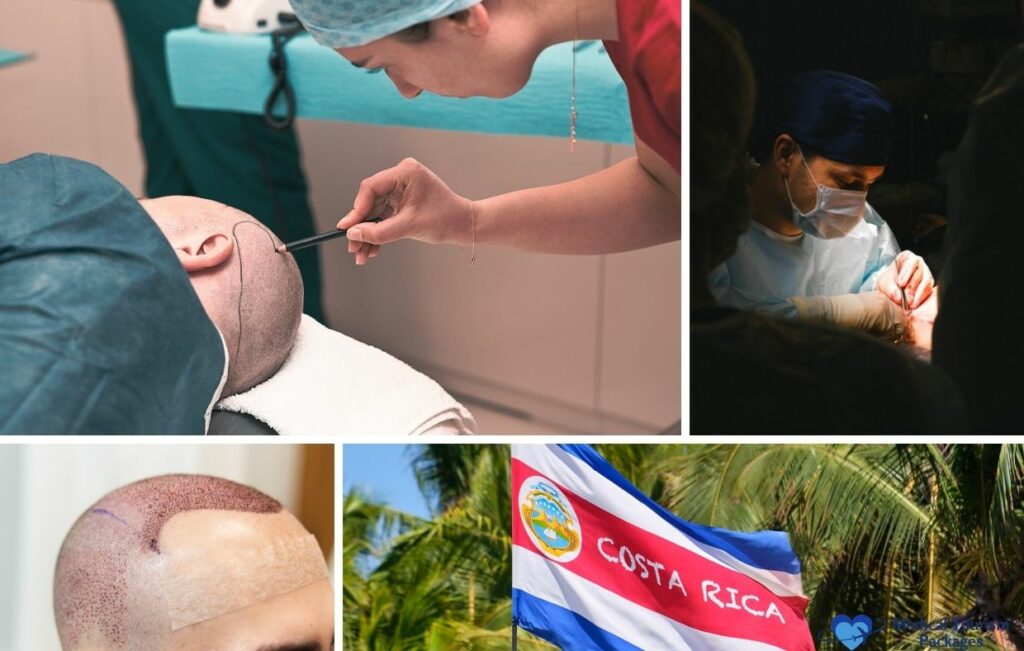
Hair transplants in Costa Rica cost $2,000 to $4,500, which is 55 to 70 percent less than US prices, with FUE and DHI performed by certified surgeons in accredited San José clinics.
A standard FUE session in Costa Rica runs $2,000 to $4,500 (about £1,600 to £3,550), versus $8,000 to $15,000 in the US. DHI starts near $2,600. ABHRS-certified Dr. Daniela Moncada at DHI Costa Rica and dermatologist Dr. Hani Farhat at Advanced Hair Clinics lead the field.
Our network connects you with hair restoration specialists in Escazú and central San José, each verified for ABHRS, JCI, or AAAASF credentials and facility accreditation. Below, you will find cost breakdowns, per-graft pricing, FUE and DHI comparisons, clinic profiles, recovery timelines, and answers to common patient questions.
Why Choose Costa Rica for a Hair Transplant?
Costa Rica is a strong choice for a hair transplant because it pairs FUE and DHI surgery at $2,000 to $4,500 with short flights from North America. San José clinics use accredited facilities and English-speaking staff.
You save roughly 55 to 70 percent against US prices while staying close to home. Direct flights from Miami take 3 hours. Houston is under 4 hours. That proximity makes follow-up visits realistic if you ever need one.
How Close Is Costa Rica for North American Patients?
Costa Rica is 3 to 6 hours by direct flight from most major US cities. Juan Santamaría International Airport (SJO) in San José receives daily nonstop service from Miami, Houston, New York, and Los Angeles on major carriers.
Unlike destinations that need 10 to 15 hour flights, Costa Rica keeps jet lag low. Short, post-surgery flights are gentler on healing grafts. If a question comes up weeks later, a quick return trip is affordable rather than a major expedition. Our guide for American medical tourists in Costa Rica covers visas, travel, and recovery logistics in more detail.
What Accreditations Protect Patients?
Accreditations that protect patients include JCI for hospitals and ABHRS certification for hair surgeons. Hospital CIMA San José holds JCI accreditation, and the Colegio de Médicos y Cirujanos de Costa Rica licenses every practicing physician.
Look for these four credentials when comparing clinics:
- ABHRS: American Board of Hair Restoration Surgery, the certification recognized by the ISHRS for hair surgery expertise
- JCI: Joint Commission International, the standard for hospital infection control and surgical safety (held by Hospital CIMA San José since 2008)
- AAAASF (QUAD A): certifies that operating rooms meet US ambulatory-surgery standards
- Colegio de Médicos y Cirujanos de Costa Rica: the national medical board that licenses all doctors
How Much Does a Hair Transplant Cost in Costa Rica?
A hair transplant costs $2,000 to $4,500 in Costa Rica, depending on technique and graft count. That is 55 to 70 percent less than the $8,000 to $15,000 typical in the United States, according to MyMediTour and GoodRx 2025 pricing data.
Here is how a typical session compares across destinations:
| Location | Typical FUE Session | Savings vs US |
|---|---|---|
| Costa Rica | $2,000-$4,500 | 55-70% |
| United States | $8,000-$15,000 | Baseline |
| Mexico | $2,500-$5,000 | 50-70% |
| Colombia | $2,000-$5,000 | 55-75% |
| Panama | $3,000-$7,000 | 40-60% |
What Do Costa Rica Clinics Charge Per Graft?
Costa Rica clinics charge roughly $1.50 to $3.50 per graft, compared to $4 to $10 per graft in the United States. A 2,000-graft case at a Costa Rican clinic runs about $2,800, while the same case costs $8,000 or more domestically.
Per-graft pricing makes side-by-side comparison clearer:
| Graft Count | Costa Rica (~$1.50-$3.50/graft) | United States (~$4-$10/graft) |
|---|---|---|
| 1,500 grafts | $2,250-$5,250 | $6,000-$15,000 |
| 2,000 grafts | $3,000-$7,000 | $8,000-$20,000 |
| 3,000 grafts | $4,500-$10,500 | $12,000-$30,000 |
Most patients land near the lower end of these ranges. The verified typical-session price for Costa Rica stays $2,000 to $4,500 because clinics quote package rates rather than strict per-graft math for standard cases.
What Is the Difference Between Per-Hair and Per-Graft Pricing?
The difference between per-hair and per-graft pricing is the unit you pay for. A graft holds an average of about two hairs, so a clinic quoting per hair can look cheaper per unit while costing more overall.
DHI Costa Rica quotes $2.00 per implanted hair rather than per graft. A large case of 2,500 grafts can contain roughly 5,500 hairs, which would total about $11,000 at that rate. Always ask clinics to convert their quote into a total price for your graft count before you compare offers.
What Are the Hidden Costs?
Hidden costs add roughly $1,500 to $2,500 on top of the surgery. Budget for recovery lodging, pre-operative blood work, optional PRP, flights, and daily expenses. These are predictable, so build them into your total before booking.
Plan for these additional expenses:
- Accommodation: $700 to $1,000 for 5 to 7 nights in a recovery-focused stay
- Pre-operative blood work: $150 to $200 if done locally in Costa Rica
- PRP therapy: $300 to $500 as an add-on to support graft survival
- Round-trip flights: $200 to $500 from most US cities
- Daily meals and transport: $50 to $80 per day
Most clinics do not offer direct financing. Third-party medical lenders such as Beautifi and United Medical Credit sometimes work with international patients. Cash and credit cards remain the standard payment methods.
How Much Does an FUE Hair Transplant Cost in Costa Rica?
An FUE hair transplant costs $2,000 to $4,500 in Costa Rica for a standard 2,000 to 3,000 graft session. FUE is the most common technique offered at San José and Escazú clinics, and it leaves no linear scar.
How Does FUE Work?
FUE, or Follicular Unit Extraction, removes individual follicles from the donor area at the back or sides of your scalp, then implants them into thinning zones, according to ISHRS practice standards. The technique leaves tiny puncture marks that heal within days.
Each session can transplant 1,500 to 4,000 grafts under local anesthesia, and it runs 4 to 8 hours as an outpatient procedure. You can usually fly home within about 5 days. Final results appear at 12 to 18 months, per ISHRS guidance.
Who Is FUE Best For?
FUE is best for patients who want shorter hairstyles and no strip scar. It suits a wide range of graft needs and donor situations. Good candidates share a few common traits.
- Stable donor density at the back or sides of the scalp
- Androgenetic alopecia or stable scarring alopecia
- A preference for very short haircuts that would expose a linear scar
- Realistic expectations about coverage from the available donor supply
How Much Does DHI Cost in Costa Rica vs FUE?
DHI costs more than standard FUE in Costa Rica, typically starting near $2,600 and rising with graft count because it is priced per implanted hair. DHI uses a Choi implanter pen for precise placement, while FUE remains the more budget-friendly option.
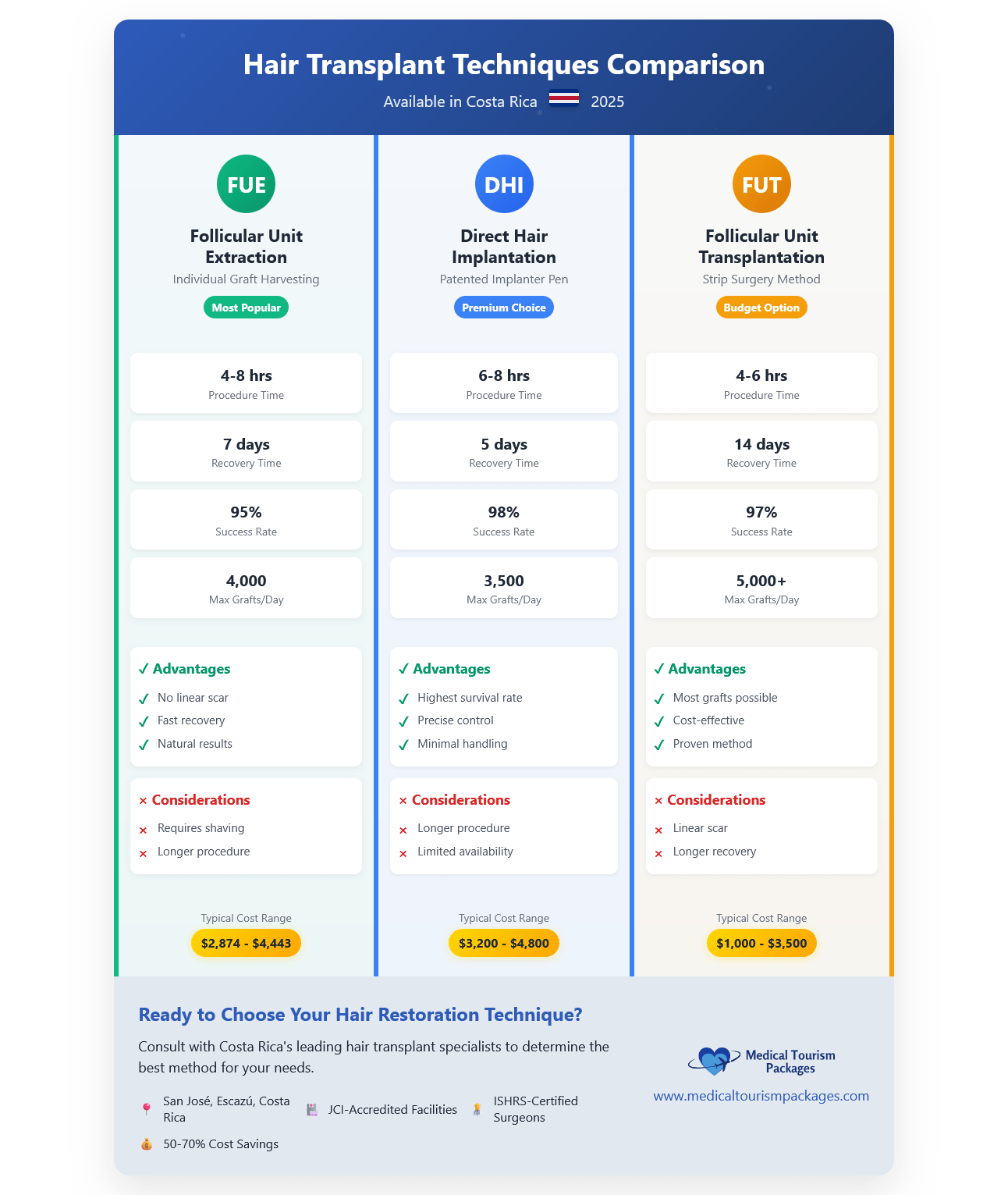
Here is how the two leading techniques compare in Costa Rica:
| Factor | FUE | DHI |
|---|---|---|
| Typical Costa Rica cost | $2,000-$4,500 per session | From $2,600, priced per hair |
| Pricing model | Per graft or package | Per implanted hair ($2.00/hair at DHI Costa Rica) |
| Tool | Manual or motorized punch plus channels | Choi implanter pen, no pre-made channels |
| Healing | 7 to 10 days | Often faster, less bleeding |
| Shaving | Usually required | Can implant between existing hairs |
How Does DHI Differ From FUE?
DHI differs from FUE in the implantation step. DHI uses a patented Choi implanter pen that extracts and places follicles in a single motion, so no pre-made channels are needed. This gives the surgeon tight control over angle, depth, and direction.
DHI procedures take longer than FUE but tend to heal faster with less bleeding. You can often implant between existing hairs without shaving. The trade-off is cost, since the per-hair model raises the total for larger cases.
What About FUT?
FUT, or Follicular Unit Transplantation, is the traditional strip method. Surgeons remove a thin strip of donor scalp and dissect it into follicular units, yielding 3,000 to 5,000 grafts in one session. It leaves a linear scar that surrounding hair usually conceals.
FUT recovery runs slightly longer than FUE. Some clinics combine FUT with FUE to maximize graft yield in severe cases. The Rosenstock-Lieberman Center offers both FUE and FUT at its San José location. For a deeper look at how each method works, see our overview of hair implant procedures and techniques.
Why Is a Hair Transplant in Costa Rica Affordable Without Lower Quality?
A hair transplant in Costa Rica is affordable because lower clinic overhead, no insurance billing layers, and a favorable cost base let surgeons charge $2,000 to $4,500 while still using accredited facilities and board-certified specialists.
How Does Costa Rica Compare to the US, Turkey, Mexico, and Colombia?
Costa Rica sits between Turkey and the US on price while offering the shortest flights for North Americans. It costs more than Turkey but far less than US clinics, and travel logistics are far easier than a long-haul trip.
This table compares cost and travel across the main destinations:
| Country | Typical Cost (USD) | UK Equivalent (approx.) | Flight From US |
|---|---|---|---|
| Costa Rica | $2,000-$4,500 | £1,600-£3,550 | 3-6 hours |
| United States | $8,000-$15,000 | £6,300-£11,800 | Domestic |
| Turkey | $2,000-$2,500 | £1,600-£2,000 | 10-15 hours |
| Mexico | $2,500-$5,000 | £2,000-£3,900 | 2-5 hours |
| Colombia | $2,000-$5,000 | £1,600-£3,900 | 4-6 hours |
Turkey wins on raw price, but a 10 to 15 hour flight strains fresh grafts and makes return visits costly. Costa Rica trades a small premium over Turkey for 3 to 6 hour flights, minimal jet lag, and easy follow-up. For a full regional breakdown, compare hair transplant costs across Latin America.
What Makes Costa Rica Cheaper Than the US?
Costa Rica is cheaper than the US because its cost structure is lower, not because corners are cut. The same accreditation bodies and surgical standards apply. Several factors drive the savings.
- Lower clinic rent, staffing, and operating costs than US metro areas
- No insurance-billing overhead, since hair restoration is paid out of pocket everywhere
- Pricing quoted directly in USD, with no hospital markup chains
- Strong competition among San José and Escazú clinics that keeps quotes honest
Which Are the Best Hair Transplant Clinics in Costa Rica?
The best hair transplant clinics in Costa Rica operate in Escazú and central San José. Three facilities stand out for credentials and international experience: DHI Costa Rica, Advanced Hair Clinics, and the Rosenstock-Lieberman Center.
What Makes DHI Costa Rica Stand Out?
DHI Costa Rica stands out for its ABHRS-certified surgeon and strict doctor-only protocol. It operates as a franchise of DHI Global Medical Group in the Edificio DUO Medical, 4th Floor, San Rafael de Escazú, and uses the DHI technique exclusively.
Dr. Daniela Moncada leads the clinic and holds certification from the American Board of Hair Restoration Surgery (ABHRS), the credential recognized by the ISHRS for hair surgery expertise. Certified physicians perform every step, with no technicians handling extraction or implantation.
This doctor-only approach lowers overharvesting risk and supports consistent graft survival. The clinic has operated since 2019 and also offers eyebrow and beard transplants. Patient reviews praise the personalized attention and natural hairline design.
What Does Advanced Hair Clinics Offer?
Advanced Hair Clinics offers FUE, Unshaven FUE, and PRP inside Hospital CIMA San José, Tower 2, 6th Floor. This JCI-accredited hospital setting provides hospital-grade sterilization and emergency protocols.
Dr. Hani Farhat serves as Medical Director. He is a dermatologist and International Fellow of the American Academy of Dermatology (AAD), with fellowship training in Athens and London. His team includes Dr. Tatiana Sánchez and Dr. Heidy Chaves.
A dermatology background helps the team diagnose scalp conditions before surgery. Dr. Farhat can identify autoimmune or scarring conditions that would make a transplant unsuccessful. Reviews highlight cleanliness, technology, and detailed pre-operative planning.
What Is the Rosenstock-Lieberman Center?
The Rosenstock-Lieberman Center is a long-established Costa Rican cosmetic surgery center operating since 1984. Located on Paseo Colón in San José, it includes a dedicated hair transplant department and holds AAAASF (now QUAD A) accreditation.
Dr. Rashi Rosenstock and Dr. Clara Lieberman lead the clinic, and both are board-certified plastic surgeons. The AAAASF credential confirms that operating rooms meet US hospital safety standards for sedation and anesthesia.
The center offers both FUE and FUT, with hair transplant prices around $3,000 to $5,500. Patients often choose it for its long track record and central San José location, which is convenient for travelers.
How Do You Plan Your Hair Transplant Trip to Costa Rica?
You can plan your hair transplant trip by booking a virtual consultation, scheduling 7 to 10 days in Costa Rica, and arranging flights and recovery lodging in Escazú or Santa Ana. US, Canadian, and UK citizens need no visa.
How Do You Prepare Before Surgery?
You prepare before surgery by completing a video consultation, basic blood work, and a hairline plan. Most clinics ask you to stop alcohol two weeks before and avoid certain medications. Plan to arrive 1 to 2 days early.
- Complete a virtual consultation so the surgeon can assess your donor area
- Get basic blood work done at home or locally in San José
- Stop alcohol roughly two weeks before and follow the clinic’s medication list
- Book 7 to 10 days total to cover consultation, surgery, and early recovery
What Are the Flight Options?
Flight options into Juan Santamaría International Airport (SJO) include nonstop service from Miami, Houston, New York, and Los Angeles. Round-trip fares typically run $280 to $650 depending on your departure city.
| From | Airlines | Flight Time | Round-Trip |
|---|---|---|---|
| Miami | American, Avianca | 3.0 hours | $280-$500 |
| Houston | United | 3.75 hours | $300-$550 |
| New York (JFK) | JetBlue | 5.5 hours | $350-$650 |
| Los Angeles | United, Delta, American | 5.75 hours | $300-$550 |
What Should You Expect on Surgery Day and Recovery?
On surgery day, you arrive around 8 AM for hairline design and photos, then receive local anesthesia. The procedure runs 4 to 8 hours while you stay awake. Recovery follows a predictable timeline over the next two weeks.
| Phase | Time Range | What Happens | Restrictions |
|---|---|---|---|
| Surgery day | Day 0 | 4-8 hour procedure under local anesthesia | Sleep semi-upright the first night |
| Early healing | Days 1-3 | Mild forehead swelling that resolves quickly | No bending or strain |
| First wash | Day 4 | Gentle washing per clinic protocol begins | Follow washing instructions exactly |
| Back in public | Days 5-7 | Most patients feel comfortable going out | Tiny scabs remain 10-14 days |
| Growth | Months 3-18 | Growth begins at month 3; full results 12-18 months | Avoid sun and strenuous exercise early on |
You have a follow-up appointment before flying home, and virtual check-ins continue at 1, 3, 6, and 12 months. Recovery-focused stays in Escazú or Santa Ana run $100 to $150 per night with nursing support.
What Qualifications and Safety Standards Should You Expect?
You should expect board-certified surgeons working in accredited facilities under verified safety protocols. Look for ABHRS certification, JCI or AAAASF accreditation, and a doctor-only model where physicians perform every surgical step themselves.
What Credentials Should Surgeons Have?
Surgeons should have, at minimum, registration with the Colegio de Médicos y Cirujanos de Costa Rica. Beyond that, hair-specific credentials matter most. Check for these markers of expertise.
- ABHRS certification: the gold standard for hair restoration; Dr. Daniela Moncada at DHI Costa Rica holds it
- AAD fellowship: signals dermatology expertise for diagnosing scalp conditions, as with Dr. Hani Farhat
- Board-certified plastic surgery: relevant for combined cosmetic centers like Rosenstock-Lieberman
- A doctor-only protocol: confirm whether physicians or technicians perform extraction and implantation
What Are the Advantages and Disadvantages?
The main advantage is strong savings near home; the main disadvantage is the need to travel and recover abroad. Weigh both sides against your priorities before booking.
| Factor | Advantage | Disadvantage |
|---|---|---|
| Cost | 55-70% less than US prices | Paid out of pocket, plus travel costs |
| Travel | 3-6 hour flights, low jet lag | Still requires 7-10 days away from home |
| Quality | JCI and AAAASF accredited facilities | Standards vary, so clinic vetting is essential |
| Follow-up | Easy return trips if needed | Most aftercare is virtual once home |
| Technique choice | FUE, DHI, and FUT all available | Premium DHI raises the total for large cases |
What Are the Medical Risks?
Medical risks are generally low when a qualified surgeon works in an accredited facility. Most side effects are minor and temporary. Serious complications are uncommon with proper sterile technique and aftercare.
According to ISHRS practice standards, the most common effects are temporary shock loss, mild swelling, redness, and minimal dot-scarring in the donor area. Shock loss is temporary shedding of native hair that typically regrows within 3 to 4 months. Infection and folliculitis are uncommon when clinics follow accredited sterilization protocols, and following your surgeon’s instructions lowers your risk further.
Frequently Asked Questions About Hair Transplants in Costa Rica
How much does a hair transplant cost in Costa Rica?
A hair transplant in Costa Rica costs $2,000 to $4,500 for a standard FUE session of 2,000 to 3,000 grafts. DHI is priced per implanted hair and starts near $2,600. This is 55 to 70 percent less than the $8,000 to $15,000 typical in the United States.
How much does DHI cost in Costa Rica?
DHI in Costa Rica starts near $2,600 and is priced per implanted hair rather than per graft. DHI Costa Rica quotes $2.00 per hair, so larger cases cost more. A small-to-moderate case stays in the low-to-mid four figures, while very large cases can reach $9,000 or higher.
Is Costa Rica safe for hair transplant surgery?
Yes, Costa Rica is safe for hair transplant surgery when you choose accredited facilities. Hospital CIMA San José holds JCI accreditation, and Rosenstock-Lieberman holds AAAASF certification. Top clinics use board-certified surgeons, sterile protocols, and doctor-only procedures that keep complication risk low.
What is the difference between FUE and DHI hair transplants?
The difference is the implantation method. FUE extracts follicles, creates recipient channels, then implants grafts in separate steps. DHI uses a Choi pen to implant directly without pre-made channels. DHI costs more and heals faster, while FUE is the more affordable choice at $2,000 to $4,500.
How many grafts do I need for a hair transplant?
Most patients need 1,500 to 3,000 grafts, depending on the size of thinning. A receding hairline may need 1,500 to 2,000 grafts, while broader crown coverage can need 3,000 or more. Your surgeon sets the exact count after assessing donor density during a consultation.
How long do I need to stay in Costa Rica for a hair transplant?
You need to stay 7 to 10 days in Costa Rica. This covers 1 to 2 days for consultation, surgery day, and 5 to 7 days for initial recovery. Your surgeon clears you to fly home after a follow-up appointment, usually around day 5.
Is Costa Rica cheaper than Turkey for hair transplants?
No, Turkey is usually cheaper, with all-inclusive packages around $2,000 to $2,500. Costa Rica costs $2,000 to $4,500 but offers 3 to 6 hour flights instead of Turkey’s 10 to 15 hours. You pay a small premium for proximity, low jet lag, and easier follow-up care.
Do hair transplant results in Costa Rica match US quality?
Yes, results in Costa Rica match US quality when you select top clinics. Dr. Daniela Moncada holds the same ABHRS certification as leading US surgeons. Hospital CIMA San José maintains JCI accreditation, the same standard held by top American medical centers.
How do I choose the best hair transplant surgeon in Costa Rica?
You choose the best surgeon by verifying credentials and facility accreditation. Look for ABHRS certification or AAD fellowship. Confirm the clinic holds JCI or AAAASF accreditation. Ask whether doctors or technicians perform the work, and request before-and-after photos from similar cases.
Can I combine a hair transplant with a vacation in Costa Rica?
Yes, but keep it gentle. After day 3 you can enjoy light sightseeing and markets in San José. Avoid swimming, strenuous activity, and direct sun for two weeks. Travel companions can explore rainforests and beaches while you recover, then plan a real vacation after grafts settle.
Are there financing options for hair transplants in Costa Rica?
Most Costa Rican clinics do not offer direct financing to international patients. Third-party medical lenders like Beautifi and United Medical Credit sometimes accept international patients. Cash and major credit cards remain the standard payment methods. Confirm your options during the consultation.
Can women get hair transplants in Costa Rica?
Yes, women can get hair transplants in Costa Rica. Clinics treat female pattern hair loss using techniques tailored to women’s hairlines, often with fewer grafts than men. Dermatologist-led clinics like Advanced Hair Clinics can diagnose underlying conditions before recommending surgery.
How soon can I see results from my Costa Rica hair transplant?
You can see initial growth around month 3, according to ISHRS guidance. Noticeable improvement appears by month 6. Full results typically develop between 12 and 18 months as the transplanted follicles complete their growth cycles. Patience through the early shedding phase is normal.
Do I need to speak Spanish for hair transplant surgery in Costa Rica?
No, you do not need to speak Spanish. Major clinics serving international patients have English-speaking surgeons, nurses, and coordinators. DHI Costa Rica and Advanced Hair Clinics both operate primarily in English for medical tourists, and Hospital CIMA reports about 90 percent English fluency among staff.
Ready to Start Your Hair Transplant Journey in Costa Rica?
Medical Tourism Packages coordinates your entire hair transplant journey in Costa Rica. We connect you with ABHRS-certified surgeons and JCI-accredited facilities in San José and Escazú, then arrange consultations, travel, and recovery lodging with bilingual support.
Contact us today for a free consultation and personalized quote.