Book Appointment Now


Bariatric Surgery in Costa Rica: Cost, Safety & Recovery
 By
By
Bariatric surgery in Costa Rica costs $6,000 to $15,000, saving patients 40% to 60% versus the United States.
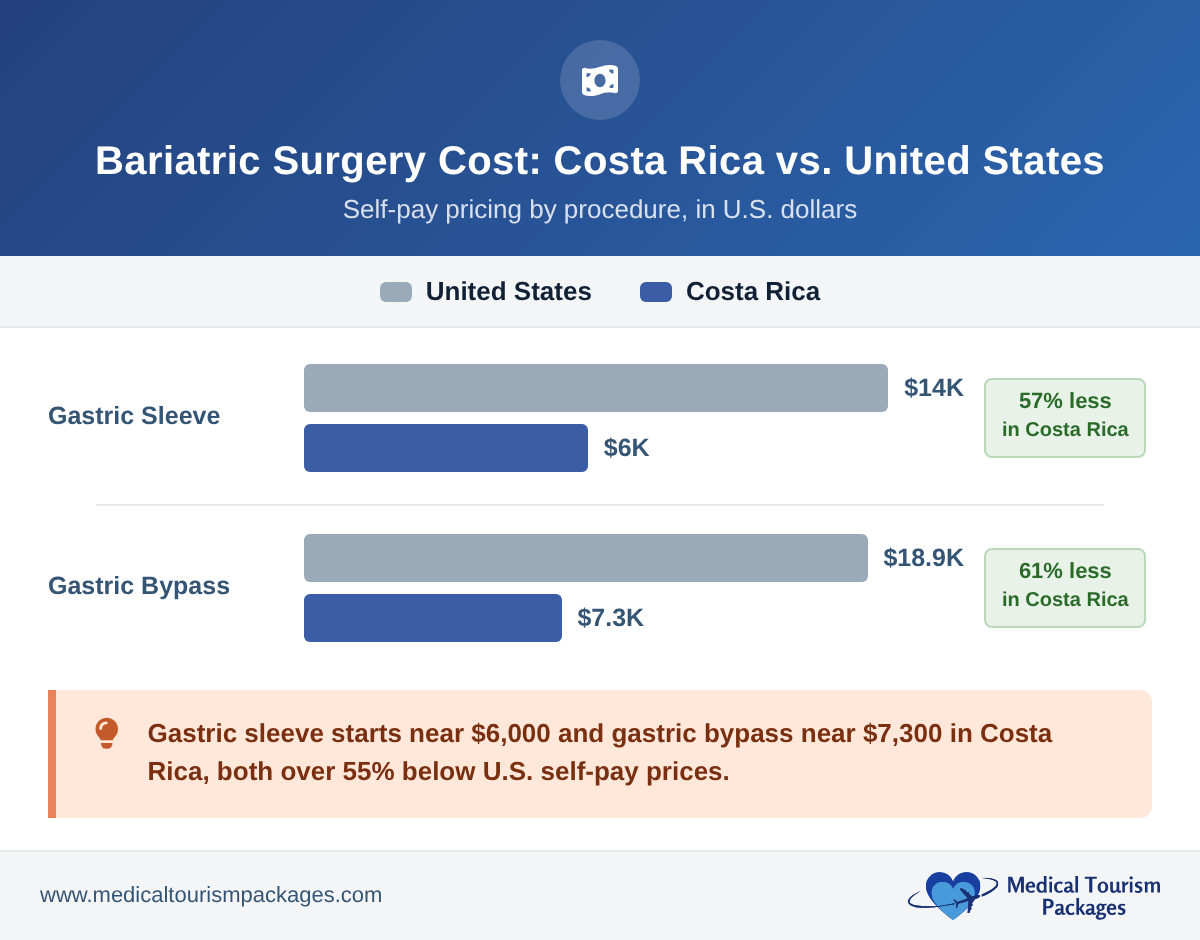
Gastric sleeve surgery in Costa Rica costs $6,000 to $14,000, compared to $14,000 to $22,000 in the United States. Gastric bypass costs $7,300 to $15,000, versus $18,900 to $35,000 in the US. Surgeons operate in San Jose at JCI-accredited hospitals.
Our facilitator network verifies board-certified bariatric surgeons and JCI-accredited hospitals in the San Jose area before recommending them to patients. Surgeons hold specialist licenses from the Colegio de Medicos y Cirujanos de Costa Rica. Below, you will find pricing for both procedures, surgeon credentials, hospital accreditation, recovery timelines, and package details.
What Is Bariatric Surgery in Costa Rica?
Bariatric surgery is surgery that reduces stomach size or reroutes the digestive tract to help patients lose weight. Costa Rica offers two main procedures for international patients: gastric sleeve and gastric bypass. Both procedures treat obesity and related health problems, including type 2 diabetes and sleep apnea.
US and Canadian patients travel to Costa Rica for two main reasons:
- Lower cost: procedures run 40% to 60% cheaper than at home.
- Insurance exclusions: many US insurance plans exclude weight-loss surgery as elective, leaving patients to pay out of pocket.
Costa Rica pairs lower prices with JCI-accredited private hospitals in the San Jose metro area. Read our full guide to bariatric surgery in Latin America for a wider view.
Surgeons in Costa Rica also perform related procedures. These include mini gastric bypass, band removal, and revision surgery for a failed first surgery. This guide focuses on gastric sleeve and gastric bypass, the two most common choices for medical travelers.
How Much Does Bariatric Surgery Cost in Costa Rica?
Bariatric surgery in Costa Rica costs $6,000 to $15,000, depending on the procedure and hospital tier. Gastric sleeve packages run $6,000 to $14,000. Gastric bypass packages run $7,300 to $15,000. Both procedures cost far less than the same surgery in the United States or Canada.
The table below compares average package prices across the three countries.
| Procedure | Costa Rica | United States | Canada |
|---|---|---|---|
| Gastric Sleeve | $6,000 – $14,000 | $14,000 – $22,000 | $11,000 – $20,000 |
| Gastric Bypass | $7,300 – $15,000 | $18,900 – $35,000 | $19,200 |
Price alone does not tell the whole story. A quote far below this range can mean a smaller clinic with fewer safety resources. The packages section below explains what a fair price should include.
What Does Each Procedure Cost Compared to the US and Canada?
Gastric sleeve surgery in Costa Rica costs $6,000 to $14,000, compared to $14,000 to $22,000 in the United States. Gastric bypass costs $7,300 to $15,000 in Costa Rica, compared to $18,900 to $35,000 in the United States. Canadian self-pay prices run close to US prices, since Canada’s public system carries long waitlists for bariatric surgery.
Package price depends heavily on hospital tier. The table below breaks down pricing by program level.
| Hospital Tier | Gastric Sleeve | Gastric Bypass |
|---|---|---|
| Standard private center | $6,000 – $8,000 | $7,300 – $12,000 |
| Premium hospital (San Jose) | $9,000 – $10,000 | $12,000 – $12,350 |
| All-inclusive boutique/tertiary | $10,000 – $14,000 | $15,000 |
Costa Rica sits at the higher end of Latin America’s bariatric pricing. Costa Rica’s private hospitals carry Joint Commission International (JCI) accreditation and run lower-volume, more selective surgical programs. Surgeons see fewer patients per day than high-volume centers elsewhere in the region, which supports more individualized care.
What Is the Difference Between Gastric Sleeve and Gastric Bypass?
Gastric sleeve surgery removes most of the stomach, while gastric bypass reroutes the digestive tract around most of the stomach. Both procedures restrict how much food you can eat at one time.
Surgeons typically recommend gastric sleeve for patients with a lower BMI and no severe reflux disease. Gastric bypass suits patients with a higher BMI, severe GERD, or poorly controlled type 2 diabetes. Bypass changes hunger and metabolism hormones more than sleeve does, which can improve diabetes control faster. Your surgeon reviews your BMI, health history, and goals to recommend the right procedure.
What Happens During Gastric Sleeve Surgery?
Gastric sleeve surgery removes about 80% of the stomach, leaving a narrow tube along its lesser curve. Surgeons also call this procedure sleeve gastrectomy or vertical sleeve gastrectomy (VSG).
The surgery uses small laparoscopic incisions under general anesthesia. Removing most of the stomach lowers ghrelin, the hormone that drives hunger. This helps patients feel full on much smaller meals. Surgeons test the staple line for leaks before closing, using an air or dye test. Most patients stay in the hospital 1 to 3 nights after surgery. Gastric sleeve is the more common choice for international patients. It is technically simpler than bypass and carries a lower risk of long-term nutrient problems.
What Happens During Gastric Bypass Surgery?
Gastric bypass surgery creates a small stomach pouch and connects it directly to the middle of the small intestine. Surgeons call the standard version Roux-en-Y gastric bypass, or RNY.
The new pouch holds about 30 milliliters, far less than a full stomach. Food bypasses the rest of the stomach and the first part of the small intestine. This limits how much you eat and how many calories your body absorbs. Gastric bypass is generally the more complex of the two procedures. Surgeons perform it laparoscopically, and patients stay in the hospital 1 to 3 nights afterward. Bypass often resolves type 2 diabetes faster than sleeve, with remission rates up to 80%.
Where Are Bariatric Surgeries Performed in Costa Rica?
Bariatric surgeries in Costa Rica take place in San Jose, inside the Gran Area Metropolitana (GAM). San Jose is home to Costa Rica’s main private hospital network.
These hospitals typically offer:
- JCI accreditation: the same patient-safety standard used by top US hospitals.
- Full intensive care units and on-site blood banks: for rapid response to complications.
- Dedicated bariatric surgery units: staffed with international patient coordinators.
- Ministerio de Salud recognition: many programs hold this national health authority status alongside JCI.
Recovery hotels in Escazu and Santa Ana sit 10 to 15 minutes from the main San Jose hospitals. Most patients spend their post-discharge recovery days at one of these hotels before flying home.
Juan Santamaria International Airport (SJO) in Alajuela serves the San Jose area. Direct flights connect from Miami, Atlanta, Houston, and Toronto, averaging 3 to 5 hours from major North American hubs.
What Credentials Do Bariatric Surgeons in Costa Rica Need?
Bariatric surgeons in Costa Rica need a medical degree, a general surgery residency, and a bariatric fellowship. This training path takes 12 to 14 years to complete.
Surgeons first earn a Licenciado en Medicina y Cirugia degree, Costa Rica’s MD equivalent, over 6 to 7 years. They then complete one year of public health service before registering as general practitioners. Next comes a 4 to 5 year general surgery residency at a teaching hospital. Surgeons then register as a Specialist in General Surgery. This registration goes through the Colegio de Medicos y Cirujanos de Costa Rica, the national licensing board. Finally, surgeons complete 1 to 2 years of fellowship training in bariatric and minimally invasive surgery. Many train abroad in the US, Europe, Mexico, or Brazil. Beyond licensing, look for surgeons who hold active membership in recognized professional bodies:
- Colegio de Medicos y Cirujanos de Costa Rica: the statutory board that licenses every doctor in the country.
- Asociacion Costarricense de Cirugia (ACC): the main national group for general and gastrointestinal surgeons.
- International Federation for the Surgery of Obesity and Metabolic Disorders (IFSO): signals global bariatric protocol adherence.
- American College of Surgeons (ACS): senior surgeons often hold Fellow status (FACS), showing alignment with US surgical standards.
Is Bariatric Surgery Safe in Costa Rica?
Bariatric surgery in Costa Rica is safe when performed at a JCI-accredited hospital by a board-certified surgeon. Safety in medical tourism comes down to verified accreditation.
Accredited Costa Rican hospitals report outcomes similar to high-volume centers in the US and Europe. At accredited, high-volume facilities, 30-day surgical mortality runs 0.1% to 0.3%. Staple-line leak rates for gastric sleeve stay under 1.0% at these hospitals. These numbers depend on choosing an accredited program with a proper intensive care unit and strict patient screening.
What Accreditations Should the Hospital Have?
The hospital should hold Joint Commission International (JCI) accreditation and maintain an on-site adult intensive care unit. National Ministerio de Salud recognition is a baseline requirement for every legal facility.
Here is what the main accreditations mean. JCI (Joint Commission International) verifies compliance with over 1,200 patient-safety standards. Ministerio de Salud recognition confirms the facility meets Costa Rica’s national health regulations. ISO certifications, where present, confirm quality-management standards for lab and imaging services. Look for a hospital with these standards, a dedicated bariatric unit, and 24/7 lab and emergency support.
What Are the Warning Signs of an Unsafe Program?
Warning signs of an unsafe program include prices far below the market range and a refusal to name the hospital. These red flags point to unaccredited or under-resourced facilities.
Watch for these signs when researching a provider:
- Package pricing under $5,000: often means an unaccredited day clinic without emergency backup.
- No on-site adult ICU: ambulatory centers without ICU access raise risk during complications.
- Surgeons not registered with the Colegio de Medicos: this board tracks every licensed specialist in the country.
- No structured follow-up program: safe programs offer 3 to 12 months of virtual nutrition follow-up after you go home.
Treat a provider that cannot answer questions about accreditation or licensing clearly as a reason to keep looking.
How Long Is Recovery After Gastric Sleeve or Gastric Bypass?
Recovery after gastric sleeve takes 7 to 10 days in Costa Rica before you can fly home. Gastric bypass needs a longer stay, 10 to 14 days, because the surgery is more complex.
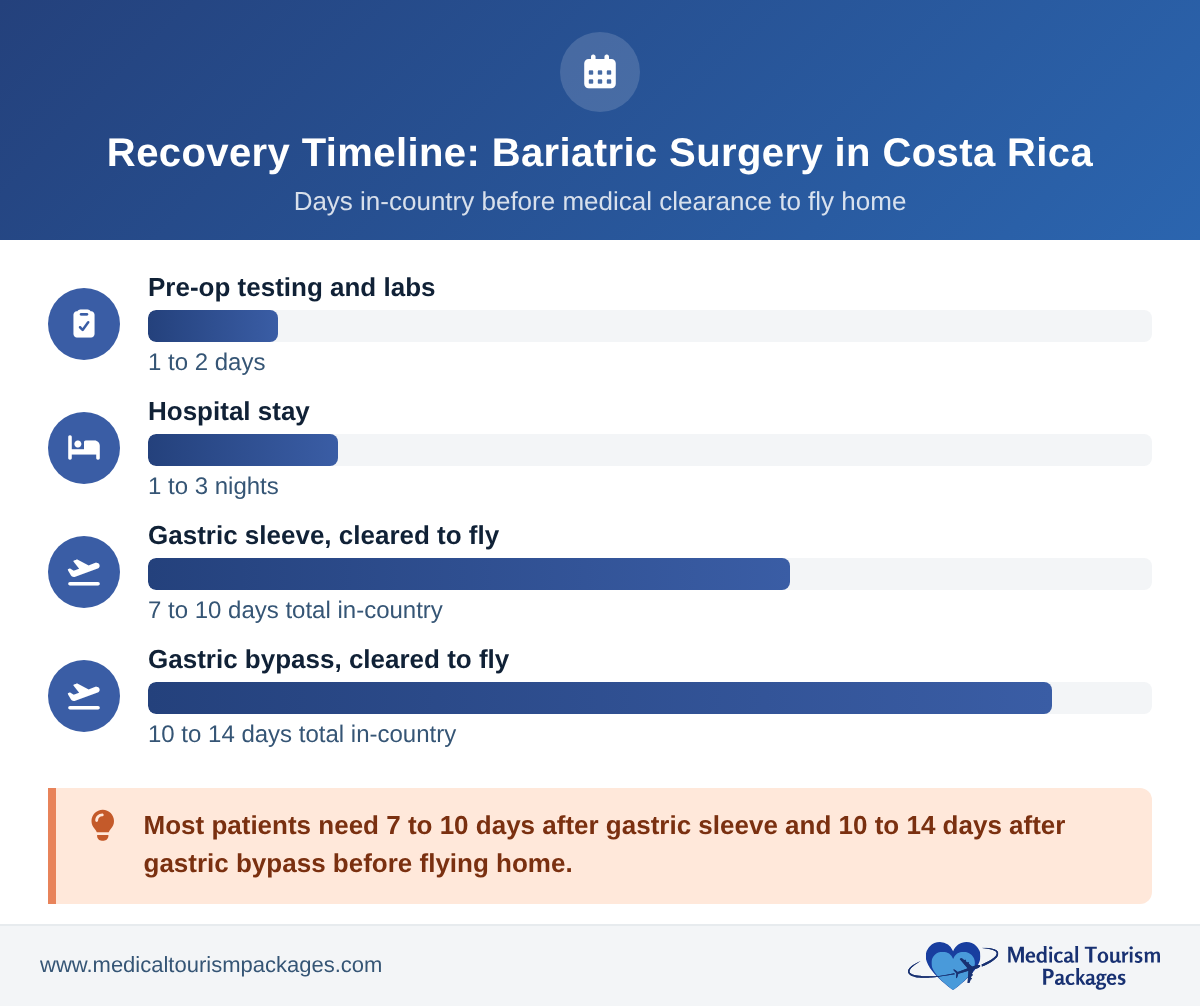
Both procedures involve 1 to 3 nights in the hospital right after surgery. From there, you move to a recovery hotel in Escazu or Santa Ana. A full trip usually runs 7 to 14 days total, including 1 to 2 days of pre-op testing. Your diet changes in stages after surgery. The table below shows the standard recovery timeline.
| Phase | Timing | What You Eat |
|---|---|---|
| Clear liquids | Days 1-7 | Water, broths, sugar-free gelatin |
| Full liquids | Days 8-14 | Protein shakes, strained soups |
| Pureed foods | Weeks 3-4 | Blended meats, eggs, cottage cheese |
| Soft solids | Weeks 5-6 | Flaky fish, cooked vegetables, soft poultry |
| Regular solids | Month 2+ | Nutrient-dense solid foods |
Flying home after bariatric surgery carries a real risk of blood clots. Cabin pressure changes and long periods sitting raise the chance of deep vein thrombosis (DVT). Your surgeon will not clear you to fly until you pass a fit-to-fly check.
Follow these steps to protect yourself on the flight home:
- Wear graduated compression stockings for the entire flight.
- Walk the cabin or move your legs every hour.
- Stay hydrated and avoid alcohol during the flight.
- Take any blood thinner your surgeon prescribes as directed.
What Is Included in a Bariatric Surgery Package in Costa Rica?
A bariatric surgery package in Costa Rica typically includes surgeon and anesthesia fees, your hospital stay, and pre-op testing. Most packages also cover transport, recovery support, and nutrition follow-up.
Standard packages generally include:
- Surgical and anesthesia fees: the lead surgeon, surgical assistants, and a board-certified anesthesiologist.
- Hospitalization: 1 to 3 nights in a private hospital room with nursing care and monitoring.
- Pre-operative testing: blood panels, a chest X-ray, an ECG, and a pre-anesthesia evaluation.
- Operating room supplies: laparoscopic equipment, single-use staplers, and leak-testing agents.
- Ground transportation: airport pickup and transfers between your hotel and the hospital.
- Aftercare medications: post-discharge painkillers, acid reducers, and anti-nausea medication.
- Nutrition follow-up: 3 to 12 months of remote virtual dietitian support after you return home.
Packages generally exclude international airfare, extra hotel nights, and care for conditions unrelated to your bariatric surgery. Most providers ask for a non-refundable deposit of $500 to $1,000 to secure your date. The balance is due on arrival. A patient coordinator manages the process from booking through your return flight home.
Do You Need to Qualify for Bariatric Surgery in Costa Rica?
Yes, you need to meet BMI and health criteria to qualify for bariatric surgery in Costa Rica. Surgeons follow the same clinical guidelines used by the NIH and the American Society for Metabolic and Bariatric Surgery.
Candidacy depends mainly on your BMI and any related health conditions:
- BMI of 40 or higher: qualifies for gastric sleeve or gastric bypass without needing a documented comorbidity.
- BMI of 35 to 39.9: qualifies with one condition, such as type 2 diabetes, severe hypertension, or sleep apnea.
- BMI of 30 to 34.9: may qualify for gastric sleeve if you have poorly controlled type 2 diabetes.
Before travel, you complete a remote medical review and send lab results, imaging, and your health history. On arrival, most programs require a full lab panel, an upper endoscopy, a chest X-ray, and an ECG. Many programs also place you on a liquid diet for 7 to 14 days before surgery. This shrinks the liver and makes surgery safer.
Why Do Patients Travel Abroad for Bariatric Surgery?
Patients travel abroad for bariatric surgery because US insurance frequently excludes weight-loss surgery as an elective procedure. Without coverage, self-pay prices in the US can reach $35,000 for gastric bypass.
The tax code and financing options ease this cost:
- IRS Section 213(d): classifies weight-loss surgery as a qualified medical expense for severe obesity or related conditions.
- HSA and FSA funds: use pre-tax Health Savings Account or Flexible Spending Account funds toward surgery in Costa Rica.
- Itemized deductions: out-of-pocket costs may qualify once unreimbursed medical expenses pass 7.5% of adjusted gross income.
- Medical travel financing: fixed-rate loans spread the $6,000 to $15,000 upfront cost over time. Costa Rica providers do not bill US insurance directly.
Costa Rica answers this coverage gap with accredited private hospitals at a fraction of the US price. JCI-accredited facilities, board-certified surgeons, and structured aftercare give patients a documented, verifiable option.
Which Country Is Best for Bariatric Surgery?
Costa Rica stands out for its JCI-accredited hospitals, lower surgical volume per surgeon, and direct flights from the US.
Direct flights from Miami, Atlanta, Houston, and Toronto keep travel time to 3 to 5 hours. Political stability and an established private healthcare sector add predictability for medical travelers. The table below compares Costa Rica to its regional neighbors.
| Country | Gastric Sleeve | Gastric Bypass |
|---|---|---|
| Costa Rica | $6,000 – $14,000 | $7,300 – $15,000 |
| Panama | $10,500 | $14,000 |
| Colombia | $4,500 – $6,500 | $6,000 – $8,000 |
| Mexico | $3,995 – $6,500 | $5,295 – $8,000 |
Mexico offers the highest surgical volume in the region and the lowest starting prices. You can compare procedures and pricing in our guide to bariatric surgery in Mexico. Panama sits closest to Costa Rica’s price range. See our guide to bariatric surgery in Panama for details. The right country depends on your budget, your BMI, and how much you value a lower-volume surgical program.
Is Bariatric Surgery in Costa Rica Right for You?
Bariatric surgery in Costa Rica can be the right choice when you meet the BMI criteria and want accredited care. It fits a budget of roughly $6,000 to $15,000 and a 7 to 14 day recovery stay abroad.
Verifying your surgeon’s board certification and your hospital’s JCI accreditation protects you before you book. A free consultation is the best next step. A patient coordinator reviews your health history and confirms your candidacy. From there, they build a plan around your BMI, budget, and travel dates.
What Questions Do Medical Tourists Ask About Bariatric Surgery in Costa Rica?
Where Does This Information Come From?
- Costa Rica and worldwide gastric sleeve and bypass price ranges: ALO Bariatrics, Best Country for Bariatric Surgery: Top 5 Compared; Mexico Bariatric Center, Gastric Bypass Surgery Costs, Worldwide Price Comparison.
- Surgeon education pathway and Colegio de Medicos y Cirujanos de Costa Rica licensing: Best Heart Surgery, The Definitive Guide to Hospitals in Costa Rica; Health Tourism, Bariatric Surgery in Costa Rica.
- JCI recognition in Costa Rica’s private hospital sector: Living Costa Rica, Private Hospitals Have Joint Commission International Accreditation.
- JCI’s 1,200-plus patient-safety standards (Hospital CIMA accreditation): International Hospital Corporation, Operations; Hospital CIMA, Accreditations.
- More on what JCI accreditation verifies: MetroBlog, Learn All About JCI Accreditation.
- 30-day surgical mortality and staple-line leak rate benchmarks: Istanbul Bariatric Center, Cheapest Country for Bariatric Surgery 2026: The Honest Comparison.
- Type 2 diabetes remission rate after gastric bypass: Global Obesity Group, Bariatric Surgery in 2026: Safer, More Effective, Accessible.
- HSA/FSA eligibility and IRS tax treatment of weight-loss surgery: TurboTax, What Is IRS Publication 502?; IRS Publication 502.
- Medical travel complications insurance guidance: Medical Tourism Packages, Medical Tourism in Colombia for Americans.
- Latin America medical tourism context: Medical Tourism Packages, Best Countries for Medical Tourism in Latin America.
This is for informational purposes only. For medical advice or diagnosis, consult a professional.
Ready to Start Your Bariatric Surgery Journey in Costa Rica?
Medical Tourism Packages coordinates your entire bariatric surgery journey in Costa Rica. We connect you with board-certified surgeons at JCI-accredited hospitals in San Jose. We arrange your travel, recovery lodging, and provide bilingual support throughout your treatment. Get a free consultation to discuss your health goals and receive a personalized quote.
Contact us today to start planning your affordable bariatric surgery in Costa Rica.