Book Appointment Now

Hair Implant Industry in Latin America: Market Analysis, Top Destinations, and Cost Guide
 By
By
Hair transplants in Latin America cost $2,000 to $7,000 across Panama, Colombia, Costa Rica, and Mexico, saving US and Canadian patients 50% to 87% versus $5,000 to $15,000 at home.
Colombia and Costa Rica anchor the low end at $2,000 to $5,000 per FUE session, while Panama’s USD-priced clinics and Mexico’s COFEPRIS-regulated Tijuana cluster bracket the high end at $3,000 to $7,000. Flight times from Miami run 3.0 to 4.0 hours across all four destinations.
This guide compares verified per-graft pricing, technique options (FUE, FUT, DHI, and robotic ARTAS), recovery timelines, and credentialing steps across four MTP destinations with current pricing data. Every clinical claim is sourced from ISHRS practice standards and the cost tables are verified against current MTP pricing data, with dedicated country pages linked for Panama, Colombia, Costa Rica, and Mexico.
How Much Does a Hair Transplant Cost in Latin America?
A hair transplant in Latin America costs $2,000 to $7,000 across the four leading medical-tourism countries, compared with $5,000 to $15,000 in the United States. Patients save 50% to 87% depending on the country, technique, and graft count.
How Do Hair Transplant Costs Compare Across the Top Four Latin American Countries?
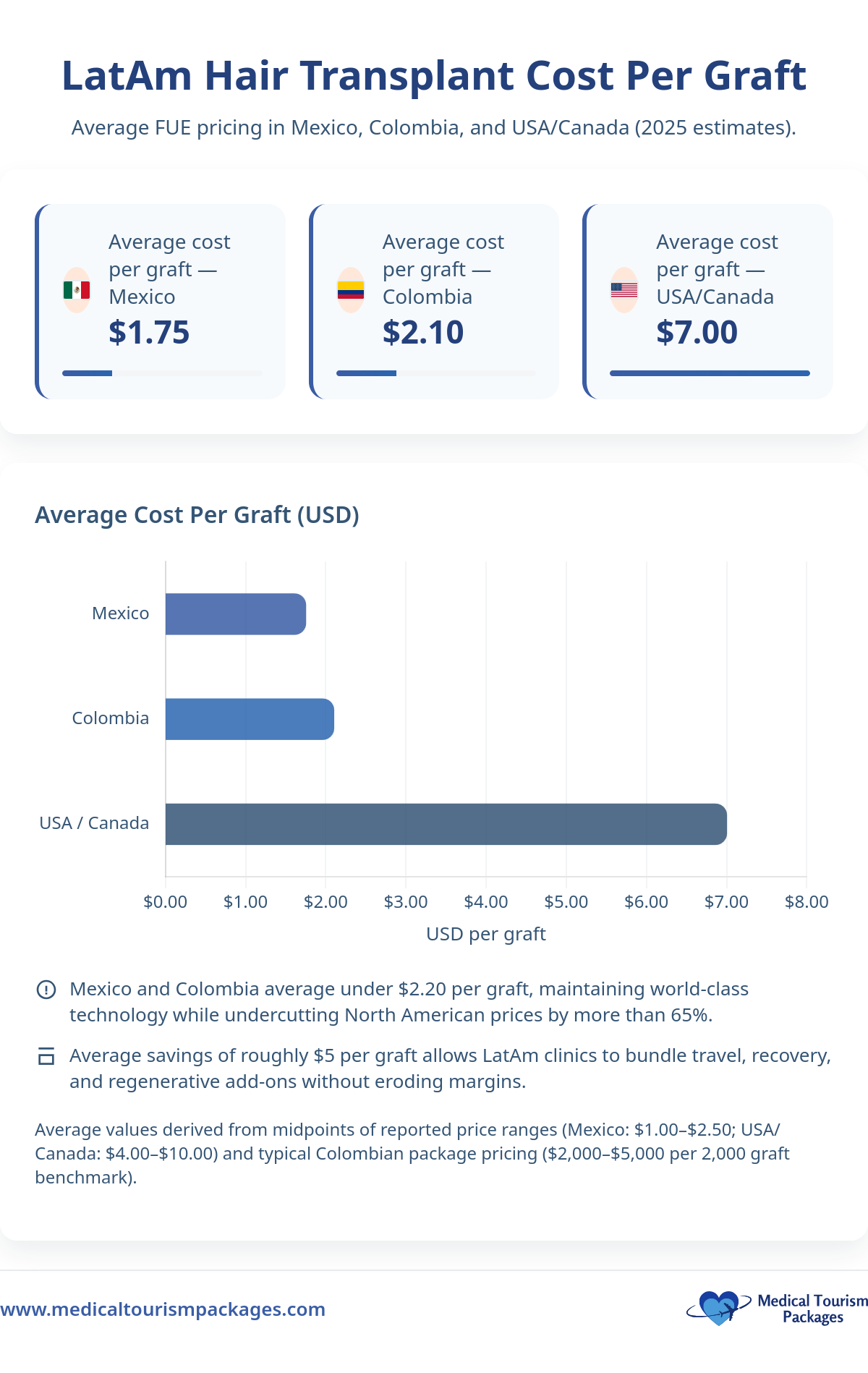
Hair transplant prices in Latin America range from $2,000 in Colombia and Costa Rica to $7,000 in Panama for a single FUE session of roughly 2,000 to 3,000 grafts. The United States baseline runs three to five times higher for the same graft count.
FUE pricing varies by country across the region:
| Country | FUE Session Cost | Per-Graft Equivalent | Savings vs US Baseline |
|---|---|---|---|
| United States (baseline) | $5,000 to $15,000 | $4.00 to $10.00+ | baseline |
| Panama | $3,000 to $7,000 | $1.50 to $3.50 | 50% to 80% |
| Colombia | $2,000 to $5,000 | $1.00 to $2.50 | 67% to 87% |
| Costa Rica | $2,000 to $4,500 | $1.00 to $2.25 | 70% to 87% |
| Mexico | $2,500 to $5,000 | $1.25 to $2.50 | 67% to 83% |
| Sources: GoodRx 2024 (US baseline), Hero Hair Institute Colombia, ClinicsOnCall Mexico, MyMediTour Costa Rica, MedicalTourismPackages Panama. All figures verified May 2026. | |||
What Drives the Price Difference Between Latin American Clinics and US Hair Restoration Centers?
The price gap comes from lower labor costs, lower facility overhead, lower medical-malpractice premiums, and favorable exchange rates in Colombia, Costa Rica, and Mexico. Surgeon training and graft-handling equipment are comparable when the clinic uses ISHRS-credentialed practitioners.
A lower price does not signal lower quality when the clinic verifiably belongs to the International Society of Hair Restoration Surgery and the surgeon holds American Board of Hair Restoration Surgery (ABHRS) certification. Both directories are public and free to search. Skip any clinic that cannot prove membership.
How Much Should You Budget Total for the Procedure, Flight, and Stay?
A realistic all-in budget for a 2,000-graft FUE session, roundtrip flight from Miami, and a five-night stay runs $3,200 to $8,500 across the four destinations. Patients flying from Los Angeles or New York add roughly $200 to $400 to the flight line.
All-in budgets from Miami break down as follows:
| Country | Procedure (FUE) | Roundtrip Flight from Miami | 5-Night Mid-Range Hotel | All-In Budget |
|---|---|---|---|---|
| Panama | $3,000 to $7,000 | $300 to $550 | $500 to $900 | $3,800 to $8,450 |
| Colombia (Bogotá) | $2,000 to $5,000 | $300 to $550 | $400 to $750 | $2,700 to $6,300 |
| Costa Rica (San José) | $2,000 to $4,500 | $280 to $500 | $450 to $850 | $2,730 to $5,850 |
| Mexico (Mexico City) | $2,500 to $5,000 | $280 to $550 | $400 to $750 | $3,180 to $6,300 |
| Flight costs from MTP flight-logistics database (verified May 2026). Hotel ranges reflect mid-tier medical-tourism neighborhoods near each hospital cluster. | ||||
Which Latin American Country Should You Choose for Your Hair Transplant?
Choose based on three factors: total cost, flight distance from your home city, and clinic credentials. Mexico wins on proximity for US patients, Colombia on lowest price, Costa Rica on safety ranking, and Panama on currency stability with US-affiliated hospitals.
Is Mexico the Right Choice for a Hair Transplant?
Mexico fits best if you live in the southern or western United States and want a short flight or drive-across border crossing. FUE sessions cost $2,500 to $5,000, the regulator COFEPRIS licenses every clinic, and Tijuana sits a 30-minute drive from San Diego.
Reasons US patients pick Mexico include the following:
- Shortest travel time: Houston-to-Mexico City takes 2.5 hours; Houston-to-Monterrey takes 1.75 hours.
- Border-city access: Tijuana clinics serve Southern California patients without a flight.
- ARTAS availability: Robotic-assisted FUE is offered in Mexico City and Guadalajara clinics.
- COFEPRIS oversight: Mexico’s federal health regulator licenses clinics and equipment, including ARTAS devices.
- Bilingual care: Tijuana, Mexico City, and Cancún clinics routinely staff English-speaking coordinators.
For full Mexico coverage, see our hair implant procedures in Mexico guide and the medical tourism in Mexico country overview.
Should You Get a Hair Transplant in Colombia?
Colombia offers the lowest hair-transplant prices in the region, with FUE sessions at $2,000 to $5,000 in Bogotá and Medellín. The regulator INVIMA oversees clinics, and Medellín’s mature medical-tourism cluster includes English-speaking coordinators across most major facilities.
Colombia stands out for these reasons:
- Lowest regional pricing: Per-graft costs of $1.00 to $2.50 are the lowest of the four MTP countries.
- Six JCI-accredited hospitals: The highest count among the four destinations, including Fundación Santa Fe de Bogotá and Hospital Pablo Tobón Uribe.
- Established cosmetic ecosystem: Medellín and Bogotá have run international cosmetic programs for two decades.
- Direct flights: Miami-to-Bogotá and Miami-to-Medellín both run under four hours.
For dedicated Colombia coverage, see our hair implants Colombia guide and the guide for American medical tourists in Colombia.
What About Costa Rica for Hair Restoration?
Costa Rica suits patients who want the safest LatAm destination paired with the second-lowest prices. FUE sessions run $2,000 to $4,500 in San José and Escazú. The Global Peace Index ranks Costa Rica 58th worldwide, the highest of the four MTP destinations.
Costa Rica’s advantages for hair-transplant tourists include:
- Safety leader: Highest peace-index ranking of the four destinations, per the 2024 Global Peace Index.
- JCI-accredited recovery infrastructure: Hospital CIMA San José (JCI since 2008) and Hospital Clínica Bíblica (JCI since 2007) anchor the medical district.
- Short Miami flight: Three hours nonstop on American or Avianca.
- Ministerio de Salud licensure: Costa Rica’s health ministry registers all surgical facilities.
For Costa Rica specifics, see our hair transplants in Costa Rica guide and the guide for American medical tourists in Costa Rica.
How Does Panama Compare for Hair Implants?
Panama prices a hair transplant at $3,000 to $7,000, the highest of the four MTP destinations but still 50% to 80% below US pricing. Patients pay in US dollars, eliminating exchange-rate risk. Pacífica Salud in Panama City carries Johns Hopkins Medicine International affiliation.
Panama’s distinctive features for hair-transplant patients include:
- USD currency: Panama is the only LatAm hair-transplant destination that uses US dollars natively.
- JCI-accredited hospitals: Pacífica Salud (JCI since 2011) and Clínica Hospital San Fernando (JCI since 2011) anchor surgical care.
- US-hospital affiliations: Pacífica Salud links to Johns Hopkins; San Fernando links to Tulane Medical Center and Baptist Health South Florida.
- Miami flight: 3.1 hours nonstop on Copa or American.
- MINSA oversight: Panama’s Ministerio de Salud licenses all clinics and surgical practitioners.
For Panama specifics, see our hair implants Panama guide and the guide for American medical tourists in Panama.
What About Brazil, Argentina, or Chile for Hair Transplants?
Medical Tourism Packages coordinates hair-transplant inquiries in Argentina. MTP does not currently coordinate care in Brazil or Chile. Brazil’s ANVISA regulator oversees a large domestic market with prices roughly comparable to Mexico. Argentina and Chile offer FUE in Buenos Aires and Santiago at prices between Colombia and Mexico, but logistics, English-language support, and credentialing transparency vary widely.
If you are weighing those destinations, focus on three questions: Does the surgeon appear in the public ISHRS member directory? Does the clinic publish before-and-after photos with consistent technique? Does the country’s regulator license the facility for surgical procedures?
What Are FUE, FUT, and DHI Hair Transplants and Which Is Right for You?
FUE removes individual follicles, FUT removes a strip of donor scalp, and DHI uses an implanter pen to place follicles directly. FUE is the most common technique in Latin American clinics, while DHI and robotic ARTAS extraction serve specific patient profiles.
How Do FUE, FUT, DHI, and Robotic ARTAS Hair Transplants Differ?
The four techniques differ in how follicles are harvested and implanted, the scar pattern they leave, and the patient profile they best serve.
Technique comparison at a glance:
| Technique | How It Works | Donor Scar Pattern | Session Length | Best-Fit Patient | Relative Cost |
|---|---|---|---|---|---|
| FUE | Individual follicles extracted one by one with a micro-punch | Tiny dot scars, hidden in short hair | 4 to 8 hours | Patients who wear hair short or shaved | Baseline (most common) |
| FUT | Strip of donor scalp removed and dissected into grafts | Single linear scar at back of head | 4 to 6 hours | Patients needing high graft yield in one session, who wear hair long | 10% to 20% less than FUE |
| DHI | Follicles loaded into a Choi pen and implanted without pre-made channels | Same dot pattern as FUE | 6 to 10 hours | Patients seeking dense packing or hairline reconstruction | 15% to 30% more than FUE |
| ARTAS (robotic FUE) | Robot extracts follicles with computer-guided punch; surgeon implants manually | FUE-style dot pattern | 5 to 9 hours | Patients wanting machine-consistent harvest | 20% to 40% more than manual FUE |
| Source: ISHRS practice standards and peer-reviewed FUE outcome literature. Technique availability varies by clinic. | |||||
Which Hair Transplant Technique Has the Best Long-Term Results?
All four techniques produce permanent, natural-looking results when the surgeon is skilled, with graft survival in the 85% to 95% range according to peer-reviewed FUE outcome literature cited by the International Society of Hair Restoration Surgery. The choice depends more on your hair length, scar tolerance, and graft count than on long-term success.
FUE remains the dominant technique in Latin American clinics because it leaves no linear scar, suits patients with short or shaved hairstyles, and gives the surgeon precise control. See our hair implants overview for a deeper explainer on each technique. DHI shines for dense packing in the hairline because the Choi pen lets the surgeon set angle and depth in one motion. Robotic ARTAS appeals to patients who want machine-consistent extraction, but the implantation step is still done by hand.
When Should You Add PRP Therapy to Your Hair Transplant?
Platelet-rich plasma therapy, or PRP, is a useful adjunct in two scenarios: as a healing accelerant injected at the end of your transplant session, and as ongoing maintenance for surrounding native hair every six to twelve months. PRP costs $150 to $700 per session across the four MTP countries.
Multiple randomized controlled trials and a systematic review have shown PRP delivers a statistically significant improvement in hair density compared with placebo, per the evidence summary cited in our procedures data. Effect is not permanent, which is why maintenance sessions matter. Discuss with your surgeon whether to add PRP at the same surgical visit or schedule separately on a follow-up trip.
How Do Latin American Hair Transplant Clinics Compare to the US, Turkey, and Spain?
Latin American clinics offer 50% to 87% savings versus US pricing, with flight times of two to six hours from the United States. Turkey is cheaper than Latin America but adds 11 to 14 hours of flying. Spain prices sit between Latin America and the United States.
Why Do US and Canadian Patients Travel to Latin America Instead of Turkey?
Distance and time-zone alignment drive the choice. A US patient can leave Miami at 8 a.m. and be in Panama City, Bogotá, or San José by lunchtime. The same patient flying to Istanbul faces overnight travel, jet lag during the surgical week, and a recovery flight home that lasts more than half a day.
Other reasons North American patients pick Latin America over Turkey include the following:
- Time-zone friendly: Eastern or Central Time alignment makes post-op telemedicine easy.
- Bilingual care: Spanish-English coordination is routine at major LatAm clinics; Turkish English fluency is more clinic-dependent.
- Familiar regulators: COFEPRIS, INVIMA, MINSA, and Costa Rica’s Ministerio de Salud all maintain transparent licensing registries.
- Short recovery flight: Three to six hours home with light pressure on the scalp is more tolerable than a 12-hour return leg.
How Does Latin American Hair Restoration Compare to Spain and Europe?
Spanish hair-transplant clinics in Madrid and Barcelona price FUE roughly 30% to 50% below US rates, putting Spain between Latin America and the United States on cost. For North American patients, the additional six to eight hours of flight time and the weaker time-zone fit make Latin America the more practical choice unless the patient already lives in Europe.
How Do You Plan Your Hair Transplant Trip to Latin America?
Plan in four steps: pick a country and clinic, complete pre-op testing remotely, book flights for at least seven days in-country, and arrange follow-up by telemedicine. Most patients spend five to seven nights on the ground, with a five-day minimum before flying home.
How Do You Choose the Right Hair Transplant Clinic and Surgeon?
Vet every prospective clinic against the same checklist before paying a deposit.
The clinic and surgeon checklist covers seven points:
- ISHRS membership: Verify the surgeon in the International Society of Hair Restoration Surgery member directory.
- ABHRS certification: Confirm American Board of Hair Restoration Surgery status if claimed.
- National license: Check the clinic’s registration with COFEPRIS, INVIMA, MINSA, or Costa Rica’s Ministerio de Salud.
- Before-and-after portfolio: Ask for 10+ patient photos showing the same technique you want.
- Live video consultation: Insist on a video call with the surgeon, not only a coordinator.
- Graft-count transparency: Demand a written graft estimate with per-graft pricing.
- English-speaking post-op contact: Confirm 24-hour reachability for the first 14 days after surgery.
What Documents and Pre-Op Testing Do You Need?
Pre-op testing for a hair transplant is light compared with other surgeries. You need scalp imaging, basic bloodwork, and a clinical photograph set. Most clinics accept digital files emailed seven to ten days before your appointment.
Standard pre-op requirements include the following:
- Trichoscopy and donor density assessment: Performed remotely from photos or at the in-person consultation.
- Complete blood count (CBC): Bloodwork can be done at any lab in your home country.
- Clinical photographs: Top, front, and side views with consistent lighting.
- Hair-pull test: Performed at the in-person consultation to confirm donor stability.
- Passport: Valid for at least three months beyond your travel date for Panama and Costa Rica entry.
- Medication list: Disclose blood thinners, isotretinoin, or recent steroid use.
How Long Should You Stay In Country for a Hair Transplant?
Plan for a five- to seven-night stay. The minimum interval before flying home is five days after surgery, per the FUE recovery guidance published by the International Society of Hair Restoration Surgery. Booking the seventh night gives buffer for any scheduling slip.
Typical in-country schedule:
| Day | What Happens | Activity Restrictions |
|---|---|---|
| Day 1 (arrival) | In-person consultation, hair-pull test, surgical plan finalized | None |
| Day 2 (surgery) | FUE or DHI session, 4 to 10 hours in clinic | No bending, no alcohol |
| Day 3 | First post-op check, donor and recipient area care instructions | No hair washing, sleep elevated |
| Day 4 | Recovery day, light walking permitted | No sun exposure, no exercise |
| Day 5 | Final post-op visit, clearance to fly | Gentle washing only, hat for sun protection |
| Day 6 or 7 | Fly home | Soft cushion or neck pillow to protect graft area |
What Visa and Travel Logistics Apply to US, Canadian, and UK Patients?
None of the four MTP destinations require a visa for US, Canadian, or UK passport holders for stays under 180 days. Panama and Costa Rica require three months of remaining passport validity at entry. Colombia and Mexico allow entry on the day of expiration.
What Does the Hair Transplant Procedure and Recovery Look Like?
The procedure runs four to ten hours under local anesthesia in an outpatient setting. Recovery spans four phases over 18 months, from immediate post-op care in week one to final density at month 12 to 18, per the ISHRS recovery guidance.
What Happens During the Hair Transplant Procedure?
A standard FUE session follows a predictable sequence inside the clinic.
The procedure steps are as follows:
- Final consultation and design: Surgeon marks the recipient area, confirms graft count, and reviews the surgical plan.
- Donor preparation: Donor area at the back and sides of the scalp is shaved and cleaned.
- Local anesthesia: Lidocaine-based anesthetic applied to donor and recipient zones.
- Follicle extraction: Surgeon harvests individual follicles using a micro-punch (FUE) or a strip (FUT).
- Graft preparation: Technicians sort and trim follicles under microscopes.
- Recipient site creation: Surgeon creates micro-channels matching natural growth angles.
- Implantation: Follicles placed into channels by hand, or via Choi pen for DHI.
- Post-op care: Donor area dressed, written aftercare instructions reviewed.
What Is the Hair Transplant Recovery Timeline Day By Day?
FUE recovery moves through four distinct phases over roughly 18 months, per the ISHRS FUE recovery guidance.
The four recovery phases:
| Phase | Days | What Happens | Activity Restrictions |
|---|---|---|---|
| 1. Acute post-op | Day 1 to 3 | Donor and recipient site care, swelling management | No hair washing, sleep elevated, no bending |
| 2. Crust formation and shedding | Day 4 to 21 | Scabs form then fall off; donor area heals | Gentle washing only, no sun exposure, no swimming |
| 3. Shock loss and dormancy | Day 22 to 90 | Transplanted hairs shed; follicles enter dormant phase | Resume normal activities, continue medications if prescribed |
| 4. New growth and density build | Day 91 to 540 | Hair regrows; density builds gradually | Continue PRP or medical therapy as recommended |
| Source: ISHRS FUE Recovery Guidance. | |||
When Will You See Final Hair Transplant Results?
The final result becomes visible at 12 to 18 months after surgery, per the long-term outcome data cited by the International Society of Hair Restoration Surgery. Transplanted hairs are permanent, but native surrounding hair may continue to thin with age, which is why some patients schedule a second session three to five years later.
What Are the Risks and Realistic Expectations for a Hair Transplant?
Hair transplants carry low surgical risk but real cosmetic risk if grafts are damaged during extraction or placed at the wrong angle. The most common complications are temporary, including shock loss, folliculitis, and minor numbness, per ISHRS-cited FUE outcome literature.
What Are the Common Complications of Hair Transplant Surgery?
The published risk profile for FUE focuses on temporary and cosmetic issues rather than systemic complications, per the FUE outcome literature cited in our procedures data.
Recognized complications include the following:
- Temporary shock loss: Existing hair around the treatment area sheds, typically regrowing in 3 to 4 months.
- Folliculitis: Scalp pimples in the recipient area, treated with topical antibacterials.
- Infection: Rare with proper sterile technique; managed with oral antibiotics.
- Dot-scar pattern in donor area: Minimal with FUE; visible only at very short hair length.
- Poor growth: Happens when grafts are damaged during extraction or transit.
- Numbness at harvest sites: Usually resolves within weeks to months.
What Graft Survival Rates Can You Realistically Expect?
Graft survival in the 85% to 95% range is reported across peer-reviewed FUE outcome literature cited by the International Society of Hair Restoration Surgery. Survival depends heavily on graft-handling skill, time outside the body, and storage solution. Ask any prospective clinic to confirm their out-of-body holding time and storage protocol.
Who Is Not a Good Candidate for a Hair Transplant?
A hair transplant works only when the donor area has stable, dense follicles to harvest. Several patient profiles do not qualify.
Hair transplants are not recommended for the following patient profiles:
- Insufficient donor density: Patients whose donor area cannot supply enough viable follicles for the recipient zone.
- Unstable hair loss: Active, fast-progressing alopecia where the surgeon cannot predict which hairs will survive.
- Diffuse pattern across the donor zone: Loss spread evenly leaves no stable harvest area.
- Unrealistic expectations: Patients expecting teenage-density coverage from limited donor supply.
- Active scalp conditions: Untreated scarring alopecia, psoriasis flares, or infected scalp.
- Uncontrolled medical conditions: Uncontrolled diabetes, bleeding disorders, or recent isotretinoin use.
Are Latin American Hair Transplant Clinics Safe and Properly Accredited?
Yes, when the clinic is licensed by the country’s federal health regulator and the surgeon belongs to the International Society of Hair Restoration Surgery. Every MTP destination has a transparent public regulator. Skip any clinic that refuses to share its license number or its surgeon’s ISHRS membership status.
What Regulatory Bodies Govern Hair Transplant Clinics in Each Country?
Each MTP country has a federal health regulator plus international surgeon-credentialing bodies that apply to hair restoration specifically.
Regulatory landscape across the four destinations:
| Country | Federal Regulator | What It Verifies |
|---|---|---|
| Mexico | COFEPRIS | Clinic licensure, surgical equipment registration, ARTAS device clearance |
| Colombia | INVIMA | Health-product and facility registration; clinic-level Habilitación for procedures |
| Costa Rica | Ministerio de Salud | Facility operating permits, practitioner registration |
| Panama | MINSA | Facility licensure, surgical practitioner registration |
| Global (all four countries) | ISHRS + ABHRS | Surgeon training, board certification, ethical standards for hair restoration |
How Do You Verify a Hair Transplant Clinic’s Credentials?
Verification takes 20 minutes per clinic and three free public directories.
The clinic-verification process:
- Search the ISHRS member directory: Confirm the surgeon’s name and clinic appear at ishrs.org.
- Search the ABHRS certification registry: Confirm board-certification status at abhrs.org.
- Check the country regulator: Look up the clinic on COFEPRIS, INVIMA, MINSA, or Costa Rica’s Ministerio de Salud website.
- Cross-reference before-and-after photos: Look for consistent lighting, angles, and graft-count claims across multiple patients.
- Request the surgeon’s specific case count: Years in practice and FUE-specific case volume.
- Speak with the surgeon by video: A coordinator-only response is a red flag.
Frequently Asked Questions About Hair Transplants in Latin America
How much does a hair transplant cost in Latin America?
A hair transplant in Latin America costs $2,000 to $7,000 across Panama, Colombia, Costa Rica, and Mexico for a typical 2,000 to 3,000 graft FUE session, versus $5,000 to $15,000 in the United States. Colombia and Costa Rica offer the lowest pricing; Panama the highest of the four MTP destinations.
Which Latin American country has the cheapest hair transplant?
Colombia and Costa Rica share the lowest pricing among the four MTP destinations, with FUE sessions at $2,000 to $5,000 in Colombia and $2,000 to $4,500 in Costa Rica. Per-graft equivalents run $1.00 to $2.50 in both countries, compared with $4.00 to $10.00 or more in the United States.
Is a hair transplant in Mexico safe?
Hair transplants in Mexico are safe when the clinic is licensed by COFEPRIS and the surgeon belongs to the International Society of Hair Restoration Surgery. Tijuana, Mexico City, and Cancún host vetted clinics serving US patients. Verify clinic license and surgeon ISHRS status before booking.
What is the difference between FUE and DHI hair transplants?
FUE extracts and implants follicles in two separate steps. DHI uses a Choi pen to extract and implant in one continuous motion, allowing denser packing in the hairline. DHI sessions run 15% to 30% more than FUE and take 6 to 10 hours, compared with 4 to 8 hours for FUE.
How many grafts will I need for a hair transplant and what will they cost?
Most patients need 1,500 to 4,000 grafts depending on bald-pattern stage and donor density. At Latin American per-graft rates of $1.00 to $3.50, a 2,500-graft session costs $2,500 to $8,750, plus the clinic’s session fee. The exact graft count is set at your in-person consultation.
How long does a hair transplant take to fully grow in?
Final results appear at 12 to 18 months after surgery, per the long-term outcome data cited by the International Society of Hair Restoration Surgery. Transplanted hairs shed during shock loss in month 1 to 3, regrow starting month 4 to 6, and reach full density by month 12 to 18.
Can I fly home the day after a hair transplant?
No. The minimum interval before flying home is five days after surgery, per the FUE recovery guidance published by the International Society of Hair Restoration Surgery. Most patients book a five- to seven-night stay to allow swelling to settle and to attend a final post-op check before boarding.
Do US or Canadian insurance plans cover hair transplants abroad?
No. US and Canadian insurance plans classify hair transplants as cosmetic procedures and do not cover them, whether performed at home or abroad. Most patients self-pay or use financing through medical-tourism lenders like CareCredit or Prosper Healthcare Lending, which work with select Latin American clinics.
Ready to Plan Your Hair Transplant in Panama, Colombia, Costa Rica, or Mexico?
Medical Tourism Packages coordinates hair-transplant journeys across all four leading Latin American destinations. We match you with ISHRS-credentialed surgeons at COFEPRIS, INVIMA, MINSA, or Ministerio de Salud licensed clinics, arrange flights and recovery accommodations, and stay with you through the 12 to 18 month growth-in period via telemedicine follow-up.
Contact us today for a free consultation and a personalized hair transplant package with verified per-graft pricing.