Book Appointment Now


Medical Tourism in Panama: A Guide for American Medical Tourists
 By
By
Medical tourism in Panama offers Americans high-quality healthcare at 40-70% lower costs, with JCI-accredited hospitals affiliated with Johns Hopkins Medicine and US-trained bilingual physicians.
Panama’s JCI-accredited hospitals, affiliated with Johns Hopkins Medicine International, perform 50,000+ procedures annually for international patients. Costs range from $1,000 dental implants to $15,000 knee replacements (60-70% less than US prices) with English-speaking surgeons trained in America.
Our network connects you with board-certified surgeons at Hospital Punta Pacifica, The Panama Clinic, and Clinica Hospital San Fernando. Each facility is verified for JCI accreditation, patient outcomes, and international standards. Below, you’ll find comprehensive cost comparisons, hospital profiles, procedure details, planning guides, and answers to common questions about medical tourism in Panama.
What Is Medical Tourism in Panama?
Medical tourism in Panama is traveling to Panama from another country to receive medical procedures at lower costs while maintaining high quality standards. American patients save 40-70% on surgeries, dental work, and cosmetic procedures compared to US prices, with access to JCI-accredited hospitals affiliated with Johns Hopkins Medicine and staffed by US-trained bilingual physicians.
Panama has become one of Latin America’s premier medical tourism destinations due to its strategic location, dollarized economy, and sophisticated healthcare infrastructure. The country welcomes approximately 50,000 international medical tourists annually, with Americans representing the largest patient demographic seeking everything from routine dental work to complex cardiovascular procedures.
Why Is Panama a Leading Medical Tourism Destination?
Panama is a leading medical tourism destination because it combines world-class healthcare facilities with significant cost savings, convenient geographic proximity to the United States, and a stable dollarized economy that eliminates currency exchange concerns for American patients.
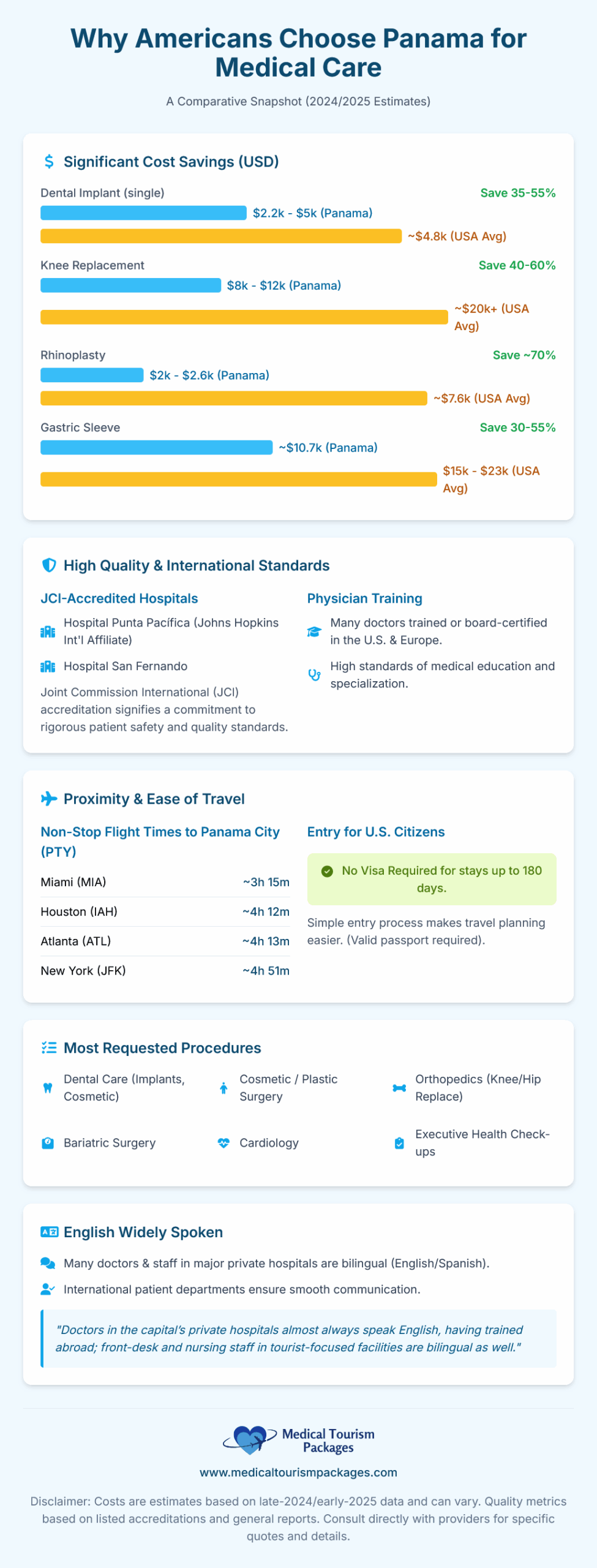
- US dollar is the official currency, eliminating exchange rate concerns for American patients
- Direct flights from major US cities take only 2-5 hours
- Johns Hopkins Medicine affiliation and TEMOS accreditation at top hospitals
- Cutting-edge technology including Da Vinci surgical robots and advanced diagnostic equipment
- English widely spoken among healthcare professionals, with many doctors trained in the United States
Who Benefits Most from Medical Tourism in Panama?
American patients aged 40-70 seeking high-complexity procedures benefit most from medical tourism in Panama, particularly those facing high out-of-pocket costs, long wait times, or lack of insurance coverage in the United States. Retirees on fixed incomes, self-employed individuals, and patients needing dental implants, joint replacements, or cosmetic surgery find the best value.
Medical tourists in the 25-39 age range typically choose Panama for cosmetic procedures like rhinoplasty and breast augmentation, while patients 55-69 represent the dominant demographic for orthopedic surgeries such as knee and hip replacements. Younger patients seeking advanced dental work including All-on-4 restorations and dental implants also benefit significantly from Panama’s 50-70% cost savings compared to US dental prices.
How Much Does Medical Tourism Cost in Panama?
Medical tourism in Panama costs 40-70% less than equivalent procedures in the United States. For example, a knee replacement in Panama runs $12,000-$15,000 compared to $35,000-$50,000 in the US. Comprehensive pricing includes surgeon fees, facility charges, anesthesia, and initial post-operative care.
| Procedure Type | Panama Cost (2026 USD) | US Cost (2026 USD) | Savings |
|---|---|---|---|
| Knee Replacement | $12,000-$15,000 | $35,000-$50,000 | 65-70% |
| Hip Replacement | $12,000-$15,000 | $35,000-$45,000 | 65-70% |
| Coronary Artery Bypass | $18,000-$22,000 | $75,000-$150,000 | 75-85% |
| Heart Valve Replacement | $20,000-$25,000 | $80,000-$200,000 | 75-87% |
| Spinal Fusion | $15,000-$18,000 | $80,000-$150,000 | 80-88% |
These prices typically include all medical costs but exclude travel, accommodation, and recovery expenses. Most private hospitals in Panama offer all-inclusive pricing that covers pre-operative consultations, surgery, hospital stay, medications, and follow-up appointments within the first week after the procedure. See our comprehensive medical tourism vs US healthcare cost comparison for more details.
What Do Cosmetic Procedures Cost in Panama?
Cosmetic procedures in Panama cost $2,500-$8,000 depending on complexity, representing 50-70% savings compared to US prices.
| Cosmetic Procedure | Panama Cost | US Cost | Savings |
|---|---|---|---|
| Breast Augmentation | $4,000-$5,500 | $8,000-$12,000 | 50-65% |
| Rhinoplasty | $3,500-$4,500 | $8,000-$15,000 | 60-70% |
| Facelift | $5,000-$7,000 | $12,000-$20,000 | 60-65% |
| Liposuction | $2,500-$4,000 | $5,000-$10,000 | 50-60% |
| Tummy Tuck | $4,500-$6,000 | $10,000-$15,000 | 55-60% |
| Brazilian Butt Lift | $3,500-$5,500 | $8,000-$15,000 | 56-63% |
Popular cosmetic surgeons in Panama City, such as those practicing at Hospital Punta Pacifica and The Panama Clinic, have completed thousands of successful procedures. Board-certified plastic surgeons often trained in the United States or Europe and maintain membership in the International Society of Aesthetic Plastic Surgery (ISAPS).
What Do Dental Procedures Cost in Panama?
Dental procedures in Panama cost 50-75% less than US prices.
| Dental Procedure | Panama Cost | US Cost | Savings |
|---|---|---|---|
| Single Dental Implant | $1,000-$1,500 | $3,000-$5,000 | 60-70% |
| All-on-4 (Full Arch) | $12,000-$15,000 | $25,000-$40,000 | 52-70% |
| Porcelain Veneers (per tooth) | $400-$600 | $1,000-$2,500 | 60-76% |
| Dental Crown | $400-$700 | $1,000-$2,000 | 60-65% |
| Root Canal | $250-$400 | $800-$1,500 | 69-73% |
| Teeth Whitening | $200-$350 | $500-$1,000 | 60-65% |
Dental clinics in Panama City use the same technology found in American practices, including CEREC same-day crowns, digital impression systems, and 3D imaging for implant placement. Learn more about dental implant procedures available in Latin America. Many dentists are American Dental Association (ADA) trained and speak fluent English.
What Do Orthopedic Procedures Cost in Panama?
Orthopedic procedures in Panama cost 60-70% less than US prices.
- Knee replacement: $12,000-$15,000 vs. $35,000-$50,000 in the US
- Hip replacement: $12,000-$15,000 vs. $35,000-$45,000 in the US
- Spinal fusion: $15,000-$18,000 vs. $80,000-$150,000 in the US
- Rotator cuff repair and arthroscopic surgery also available at comparable savings
Orthopedic surgeons at JCI-accredited hospitals in Panama perform joint replacements using the same implant brands used in the United States, including Zimmer, Stryker, and DePuy. Advanced techniques like minimally invasive hip replacement and robotic-assisted knee surgery are available at facilities equipped with the Mako Robotic Arm and ROSA robotic systems. Learn more about surgical procedures available in Panama. Recovery times are comparable to US procedures, with most patients staying in Panama for 7-14 days post-surgery for initial healing and physical therapy before returning home.
What Is Included in Medical Tourism Pricing?
Medical tourism pricing in Panama typically includes the following, costing 50-70% less than US medical expenses alone.
- Surgeon fees and facility charges
- Anesthesia and hospital stay
- Medications during treatment
- Initial post-operative consultations
- Coordination services, airport transfers, and 24-hour patient support
Premium medical tourism plans may also include additional services.
- Recovery center accommodation
- Post-surgery massage therapy
- Nutritional meal plans
- Follow-up telemedicine consultations after returning home
- Medical suite arrangements at partner hotels with nursing visits
Prices vary depending on procedure complexity and accommodation level but consistently offer significant savings compared to paying for medical care and recovery separately in the United States.
Which Are the JCI-Accredited Hospitals in Panama?
The JCI-accredited hospitals in Panama are Hospital Punta Pacifica and Clinica Hospital San Fernando, both located in Panama City. These facilities maintain Joint Commission International certification, the gold standard for international healthcare quality, ensuring they meet rigorous safety protocols, infection control standards, and patient care benchmarks equivalent to top American hospitals.
| Hospital Name | Location | JCI Status | International Affiliation | Key Specialties |
|---|---|---|---|---|
| Hospital Punta Pacifica | Panama City | JCI Accredited | Johns Hopkins Medicine International | Cardiology, Oncology, Orthopedics, Neurosurgery |
| Clinica Hospital San Fernando | Panama City | JCI Accredited (since 2011) | Tulane Medical Center, Baptist Health South Florida | Cosmetic Surgery, Bariatrics, Orthopedics, General Surgery |
| The Panama Clinic | Panama City | TEMOS Accredited | German certification for international patients | Robotic Surgery, Transplants, Oncology, Urology |
| Centro Médico Paitilla | Panama City | Working toward JCI | Cleveland Clinic affiliation (historical) | Neurology, Oncology, Cardiology, Cosmetics |
| Hospital Nacional | Panama City | Local accreditation | None | General Surgery, Gastroenterology |
JCI accreditation requires hospitals to undergo comprehensive evaluation every three years, covering over 1,300 standards related to patient safety, medication management, infection prevention, and quality improvement. Medical tourists seeking the highest safety assurance should prioritize JCI-accredited facilities or those with specialized international patient certifications like TEMOS.
What Is Hospital Punta Pacifica?
Hospital Punta Pacifica is Panama’s premier medical facility and the only hospital in Central America affiliated with Johns Hopkins Medicine International. Founded in 2006, it features 118 beds, intelligent operating rooms equipped for high-complexity procedures, and JCI accreditation ensuring compliance with global healthcare standards.
The hospital recently completed major renovations including a complete 5th floor upgrade with modern recovery suites and remodeled pediatric emergency facilities. Hospital Punta Pacifica specializes in cardiovascular surgery, advanced cancer treatment, complex orthopedic procedures, and neurosurgery. The Johns Hopkins affiliation ensures that clinical protocols, patient safety standards, and medical staff training align directly with American academic medical standards. International patients benefit from dedicated concierge services, English-speaking staff, and coordination with US-based physicians for seamless continuity of care.
What Is Clinica Hospital San Fernando?
Clinica Hospital San Fernando is Panama’s first JCI-accredited hospital, receiving certification in 2011. Founded in 1949, it maintains active affiliations with prominent US hospitals including Tulane Medical Center, Baptist Health South Florida, and three specialized children’s hospitals.
San Fernando specializes in cosmetic and plastic surgery, bariatric procedures, orthopedic surgery, and general surgical services. The hospital’s integrated clinical approach combines surgical interventions with comprehensive post-operative care in modern recovery facilities. Many international patients choose San Fernando for cosmetic procedures due to its specialized plastic surgery department and proven track record with thousands of successful aesthetic operations. The facility accepts several US insurance plans including Medicare Advantage, Aetna, Cigna, and Tricare.
What Is The Panama Clinic?
The Panama Clinic is a 27-story medical facility within the Pacific Center complex, holding TEMOS accreditation, a German certification specifically evaluating quality of care for international patients. The clinic is the only private hospital in Panama to offer this specialized accreditation and features over 460 medical offices with 1,200 accredited specialists.
The Panama Clinic pioneered several medical firsts in Central America, including becoming the first private hospital accredited to perform bone marrow transplants in 2025. The facility utilizes the Da Vinci XI surgical robot for minimally invasive procedures and the Artemis system for advanced prostate cancer diagnostics. The clinic’s vertical health ecosystem integrates medical care with on-site hotel accommodations, allowing patients to stay within the same building complex during recovery. The Panama Clinic accepts Medicare Advantage plans, making it one of the few international facilities where US seniors can use their insurance coverage.
What Medical Procedures Are Most Popular for Tourists in Panama?
The most popular medical procedures for tourists in Panama are dental work (implants, veneers, crowns), cosmetic surgery (rhinoplasty, breast augmentation, liposuction), orthopedic surgery (knee and hip replacements), and cardiovascular treatments (bypass surgery, valve replacement). These procedures account for approximately 75% of medical tourism volume in South America, with dental procedures representing the largest single category.
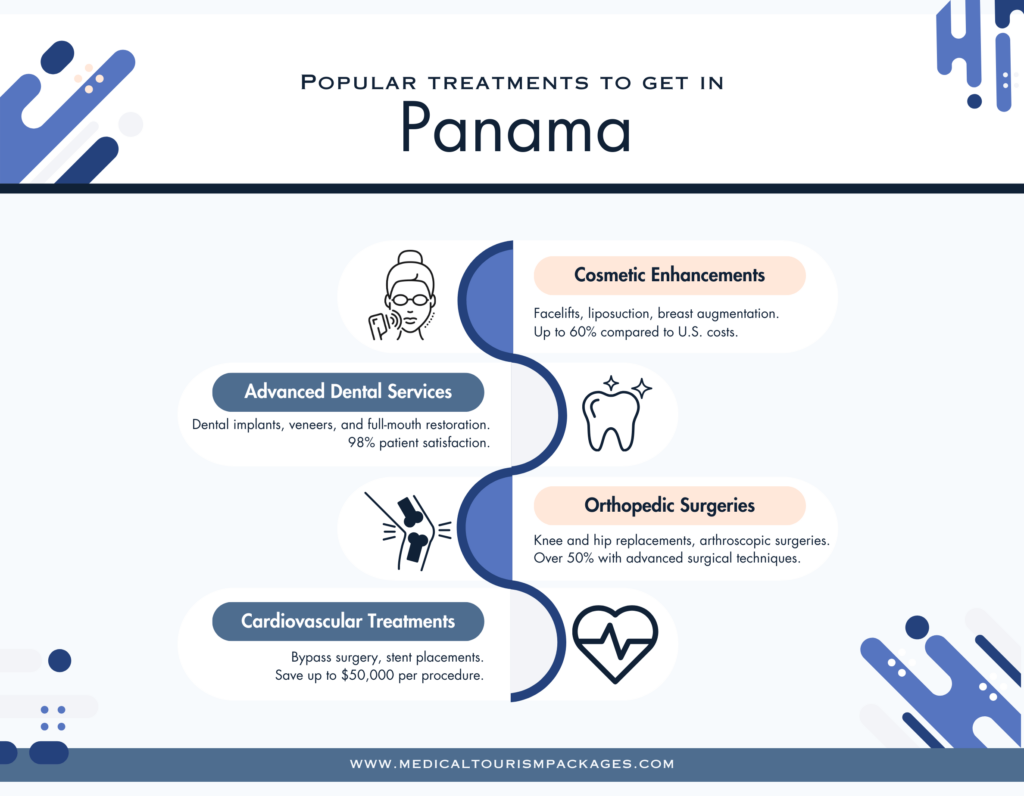
Americans primarily choose Panama for procedures that combine high cost in the United States with proven safety records abroad. The average medical tourist stays 7-14 days in Panama, depending on procedure complexity and recovery requirements. Many patients combine medical treatment with vacation activities during the recovery period, taking advantage of Panama’s tropical climate, modern amenities, and tourist attractions.
What Dental Procedures Are Available in Panama?
Dental procedures available in Panama include the following.
- Dental implants
- Porcelain veneers
- Crowns and bridges
- Root canals
- All-on-4 full arch restorations
- Cosmetic teeth whitening
Advanced dental services use CEREC technology for same-day crowns, 3D imaging for precise implant placement, and digital impressions for improved accuracy.
Dental tourism to Panama is particularly popular because procedures require shorter recovery times than major surgery, allowing patients to return home within 7-10 days. Many dental clinics are located in Panama City’s modern financial district, near hotels and restaurants, making the treatment experience convenient. Dentists typically trained in the United States or completed ADA-recognized programs speak fluent English and can coordinate with your home dentist for follow-up care.
What Cosmetic Surgeries Are Performed in Panama?
Cosmetic surgeries performed in Panama by board-certified plastic surgeons trained in the United States, Colombia, or Europe include the following.
- Rhinoplasty
- Breast augmentation
- Liposuction
- Tummy tucks
- Facelifts
- Brazilian butt lifts
- Eyelid surgery
- Minimally invasive treatments (Botox, dermal fillers)
Panama’s cosmetic surgery industry benefits from Latin America’s advanced aesthetic medicine techniques combined with rigorous safety standards. Surgeons typically require pre-operative virtual consultations to evaluate candidacy, discuss realistic expectations, and plan the procedure. Recovery accommodations range from hospital suites to dedicated recovery centers with 24-hour nursing care, massage therapy, and specialized post-operative meal plans. Most cosmetic surgery patients stay 10-14 days in Panama before returning home.
What Orthopedic Surgeries Are Available in Panama?
Orthopedic surgeries available in Panama use the same implant brands found in US hospitals (Zimmer, Stryker, DePuy). Explore all orthopedic surgery options abroad to compare procedures across countries.
- Total knee replacement
- Total hip replacement
- Spinal fusion
- Rotator cuff repair
- Arthroscopic surgery
- Joint revision procedures
Advanced options include ceramic bearings and highly cross-linked polyethylene for longer implant life.
Minimally invasive techniques and robotic-assisted surgery are available at major hospitals, reducing recovery time and improving surgical precision. Physical therapy begins immediately after surgery, with most hospitals offering on-site rehabilitation facilities. Orthopedic patients typically stay 10-14 days in Panama for initial healing and physical therapy before traveling home, with follow-up care coordinated through telemedicine and your local orthopedic surgeon.
What Are the Emerging Medical Treatments in Panama?
Emerging medical treatments in Panama include the following.
- Stem cell therapy (over 10,000 procedures performed at the Stem Cell Institute in Panama City using mesenchymal stem cells for conditions like autism, multiple sclerosis, and chronic inflammation)
- Regenerative medicine
- Medical cannabis for pain management (formalized in 2025)
- Advanced cancer treatments using immunotherapy and targeted radiation
Panama has become a global leader in stem cell therapy because regulatory frameworks allow treatments that remain restricted or unavailable in the United States. The country’s medical cannabis program, formalized in 2025, permits licensed physicians to prescribe cannabis-based treatments for pain management, making Panama the first Central American country to grant formal permits under structured state regulation. These emerging treatments attract medical tourists seeking innovative therapies unavailable or unaffordable in their home countries. Panama’s diagnostic capabilities also include full body MRI scans available across Latin America for preventive screening.
How Do You Plan a Medical Trip to Panama?
You plan a medical trip to Panama by following these steps. Working with a medical tourism facilitator simplifies this process.
- Select a JCI-accredited hospital
- Schedule virtual consultations with surgeons
- Gather medical records and diagnostic imaging
- Confirm passport validity (at least 3 months beyond departure)
- Book flights and accommodation
- Arrange travel insurance that covers medical care abroad
Most hospitals provide dedicated international patient coordinators who handle logistics, airport transfers, and accommodation arrangements.
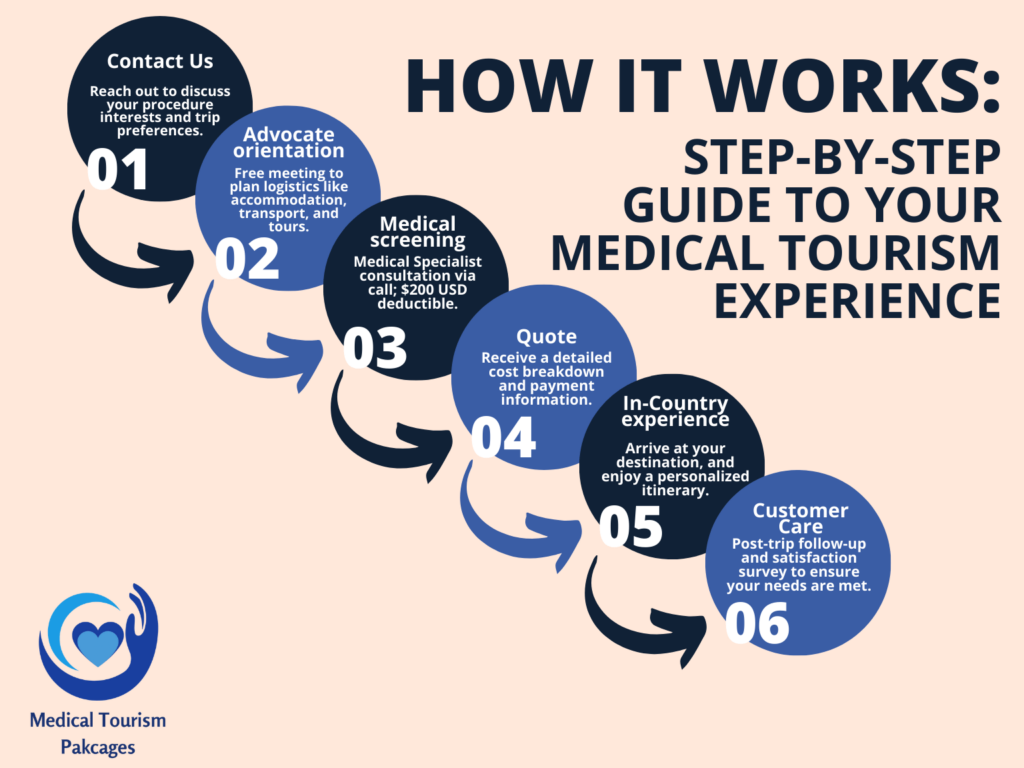
The planning process typically takes 2-4 weeks from initial consultation to travel date, depending on procedure complexity and surgeon availability. Hospitals like The Panama Clinic and Hospital Punta Pacifica offer comprehensive concierge services including pre-travel coordination, airport VIP assistance, translation services, and 24-hour patient support throughout your stay.
What Are the Visa Requirements for Americans?
Americans do not need a visa to visit Panama for medical tourism stays up to 180 days, provided they have a passport valid for at least three months beyond their planned departure date and proof of onward travel. US passport holders receive automatic tourist entry stamps at Tocumen International Airport.
You should carry documentation of your medical appointments, including hospital confirmation letters and surgeon contact information, though immigration officials rarely request these for medical tourism visits. Some medical tourists apply for Panama’s pensionado or friendly nations visa if planning extended stays for recovery, but this is not necessary for typical 1-2 week medical trips.
What Medical Records Do You Need?
You need the following medical records prepared before traveling.
- Recent blood test results
- Imaging studies (X-rays, MRIs, CT scans)
- Current medication lists
- Allergy information
- Relevant medical history documentation
- For orthopedic procedures: recent X-rays or MRI scans of the affected joint
- For dental work: recent dental X-rays and panoramic imaging if available
Your surgeon will typically request specific tests or imaging during the pre-travel virtual consultation. Medical records in English do not require translation, but ensure digital copies are available in PDF format for easy transmission. Many US physicians will provide copies of records specifically for medical tourism purposes if you explain your plans. Hospitals in Panama can perform additional diagnostic tests if needed, though this may extend your pre-operative stay by 1-2 days.
How Do You Arrange Travel and Accommodation?
You arrange travel by booking direct flights from major US cities to Tocumen International Airport in Panama City, with flight times ranging from 2-5 hours depending on departure city. Major airlines including Copa Airlines, American Airlines, Delta, and United offer daily service, with round-trip fares typically costing $300-$800.
| US City | Flight Time | Typical Round-Trip Cost | Primary Airlines |
|---|---|---|---|
| Miami | 2 hours 30 minutes | $300-$500 | Copa, American, Avianca |
| New York | 5 hours 15 minutes | $400-$700 | Delta, United, Copa |
| Houston | 3 hours 45 minutes | $350-$600 | United, Copa |
| Los Angeles | 6 hours 30 minutes | $500-$800 | Copa, United |
For accommodation, most hospitals partner with nearby hotels offering medical tourism rates. The Panama Clinic and other major facilities often have integrated hotel accommodations within the same building complex, eliminating the need for travel between lodging and medical appointments. Standard hotel rooms near hospitals cost $80-$150 per night, while private recovery suites with nursing care cost $200-$400 per night.
What Insurance Coverage Do You Need?
You need travel medical insurance covering emergency medical expenses, medical evacuation, and repatriation, even when traveling for planned procedures in Panama. Some medical tourists purchase international travel medical insurance from providers like Atlas International, Patriot International Lite, or GeoBlue Voyager, with coverage limits ranging from $50,000 to $1 million.
Several Panama hospitals now accept Medicare Advantage plans, including The Panama Clinic and Hospital Mae Lewis in David, allowing US seniors to use their insurance coverage for treatment. Major private insurance companies including Aetna, Cigna, and Tricare are accepted at some facilities. You should verify coverage with both your insurance provider and the hospital before booking procedures. For patients without international coverage, hospitals offer payment plans and accept major credit cards, with the understanding that you may seek reimbursement from your US insurance upon returning home.
What Should You Expect During Your Medical Stay in Panama?
During your medical stay in Panama, you should expect comprehensive pre-operative consultations, surgery performed using advanced technology by board-certified specialists, post-operative monitoring in modern facilities, and English-speaking staff coordinating your entire care journey. Most patients stay 7-14 days in Panama, with 1-2 days for pre-surgery evaluation, 1-3 days for the procedure and immediate recovery, and 5-10 days for initial healing and follow-up.
Panama’s medical facilities emphasize patient-centered care with dedicated international patient departments managing logistics, translation, and 24-hour support. The healthcare experience combines American-style efficiency with Latin American hospitality, creating a comfortable environment for medical tourists unfamiliar with international healthcare.
What Happens During Initial Consultations?
Initial consultations in Panama involve comprehensive medical evaluations, review of your medical history and diagnostic tests, discussion of procedure details and risks, and creation of a customized treatment plan. Surgeons typically spend 45-90 minutes in the first consultation, significantly longer than typical US appointments.
During the consultation, your surgeon will explain the procedure in detail, show before-and-after photos of similar cases, discuss realistic expectations, and answer all questions. For surgical procedures, you’ll receive information about anesthesia, recovery timeline, potential complications, and post-operative care requirements. Most hospitals require you to arrive 24-48 hours before scheduled surgery for this pre-operative consultation and any necessary additional testing.
How Are Medical Procedures Performed?
Medical procedures in Panama are performed in state-of-the-art operating rooms using the same technology and techniques found in top US hospitals. Surgeons follow international protocols for infection control, patient safety, and quality assurance, with JCI-accredited facilities maintaining standards equivalent to American hospitals.
Anesthesiologists monitor patients continuously during surgery using advanced monitoring equipment. Operating rooms feature high-efficiency air filtration, specialized surgical equipment, and backup power systems. For minimally invasive procedures, hospitals use robotic surgical systems including the Da Vinci platform and advanced laparoscopic equipment. Surgery duration varies by procedure complexity, with most operations taking 2-4 hours. After surgery, you’ll recover in a private room with nursing care, pain management, and family visitation allowed.
What Post-Procedure Care Is Available?
Post-procedure care in Panama includes the following components.
- Hospital monitoring for 1-3 days after surgery
- Pain management
- Wound care
- Physical therapy or rehabilitation services
- Follow-up consultations before returning home
- Detailed discharge instructions in English
- Medication prescriptions and coordination with your US physicians
Nurses check on patients every 2-4 hours during hospital stays, monitoring vital signs, managing pain medications, and assisting with mobility. Physical therapy begins as soon as medically appropriate, especially for orthopedic procedures where early movement prevents complications. Before discharge, surgeons conduct final examinations, remove drains or temporary devices if applicable, and provide written care instructions including activity restrictions, medication schedules, and warning signs requiring immediate medical attention.
How Do You Manage Recovery After Treatment?
You manage recovery after treatment by following these steps.
- Stay in Panama for initial healing (typically 7-14 days)
- Follow post-operative care instructions strictly
- Attend all scheduled follow-up appointments
- Arrange recovery center or hotel accommodation near your hospital
- Establish telemedicine follow-up with your surgeon after returning home
The recovery period is critical for surgical success, requiring rest, proper wound care, medication compliance, and gradual return to normal activities. Most hospitals recommend against flying for at least 5-7 days after surgery to reduce risks of blood clots and complications. Many medical tourists use this time to recover in Panama’s comfortable climate while enjoying light tourism activities as their condition permits.
What Recovery Centers Are Available?
Recovery centers available in Panama include specialized post-surgical facilities offering 24-hour nursing care, physical therapy, nutritional meal plans, and comfortable private suites designed for healing. These centers provide a bridge between hospital discharge and hotel accommodation, offering medical supervision without the clinical hospital environment.
Many recovery centers are located in Panama City’s upscale neighborhoods or the mountain town of Boquete, offering serene environments conducive to healing. Services typically include daily nurse visits, medication administration, wound care, assistance with bathing and dressing, and coordination of follow-up medical appointments. Costs range from $100-$250 per day depending on the level of care required. Some patients prefer to recover in hotel suites with in-home nursing visits, which offers more independence while maintaining medical support.
How Do You Arrange Follow-Up Care in the US?
You arrange follow-up care in the US by obtaining comprehensive medical reports from your Panama surgeon, scheduling appointments with your primary care physician or a local specialist before returning home, and establishing telemedicine consultations with your Panama surgeon for the first 30-60 days post-procedure.
Most Panama hospitals provide detailed discharge summaries in English including surgical notes, pathology reports when applicable, medication prescriptions with generic names, and recommended follow-up schedules. These documents help your US physicians understand exactly what was done and how to continue care. Many surgeons offer telemedicine follow-up appointments via video call to monitor healing, address concerns, and adjust treatment plans without requiring return travel to Panama. For complications requiring in-person evaluation, your Panama surgeon will coordinate with local physicians or recommend returning to Panama if necessary, though this is rare with proper post-operative care.
Is Medical Tourism in Panama Safe?
Yes, medical tourism in Panama is safe when you choose JCI-accredited hospitals with board-certified surgeons and follow proper planning protocols. Panama ranks as one of the most stable and safe countries in Latin America, with its capital Panama City offering modern healthcare infrastructure comparable to major US cities. Read our detailed analysis of the pros and cons of medical tourism in Panama for a balanced perspective.
The country maintains strict healthcare regulations enforced by the Ministry of Health (MINSA), requiring private hospitals to meet international standards for patient safety, infection control, and medical staff qualifications. JCI-accredited facilities undergo comprehensive evaluations every three years covering over 1,300 standards related to quality and safety. Most complications in medical tourism occur due to inadequate patient selection, failure to follow post-operative instructions, or choosing unaccredited facilities, not because of inherent risks in Panama’s healthcare system.
What Are Panama’s Safety Standards?
Panama’s safety standards for private hospitals include mandatory licensing through the Ministry of Health, adherence to international infection control protocols, professional liability insurance requirements for surgeons, and compliance with medication safety guidelines updated in 2024 and 2025 through pharmaceutical sector modernization laws.
The country’s medical malpractice system provides legal recourse through civil courts, with a two-year statute of limitations from the date of incident or injury discovery. Most private hospitals require their surgeons to carry professional liability insurance as part of international patient programs. Panama’s healthcare regulations also mandate specific staff-to-patient ratios, sterilization procedures for surgical equipment, and protocols for handling medical emergencies. The US Embassy in Panama City provides emergency contact information for Americans requiring consular assistance during medical complications.
How Do You Overcome Language Barriers?
You overcome language barriers in Panama through the following approaches.
- Choose hospitals with English-speaking healthcare providers
- Use professional medical translation services provided by most international patient departments
- Utilize technology translation aids for day-to-day communication outside medical settings
Hospital Punta Pacifica, The Panama Clinic, and Centro Médico Paitilla employ multilingual staff specifically trained to work with international patients. Many surgeons and specialists completed medical training or residencies in the United States and speak fluent English. For patients who prefer additional language support, hospitals provide professional medical interpreters for all consultations, informed consent discussions, and post-operative instructions. Outside the hospital, English is widely spoken in Panama City’s tourist areas, hotels, and restaurants, though basic Spanish phrases help with taxis and local interactions.
Frequently Asked Questions About Medical Tourism in Panama
How much do dental implants cost in Panama?
Dental implants in Panama cost $1,000-$1,500 per tooth including the implant post, abutment, and crown, compared to $3,000-$5,000 per tooth in the United States. This represents 60-70% savings while using the same implant brands (Straumann, Nobel Biocare) found in American dental practices. Full-mouth restoration with All-on-4 technique costs $12,000-$15,000 in Panama versus $25,000-$40,000 in the US.
Are Panama hospitals JCI accredited?
Yes, Panama has two JCI-accredited hospitals: Hospital Punta Pacifica (affiliated with Johns Hopkins Medicine International) and Clinica Hospital San Fernando (accredited since 2011). The Panama Clinic holds TEMOS accreditation, a German certification specifically for international patient care. JCI accreditation ensures these facilities meet over 1,300 standards for patient safety, quality care, and infection control equivalent to top American hospitals.
Do Americans need a visa for medical tourism in Panama?
No, Americans do not need a visa for medical tourism stays in Panama up to 180 days. US citizens only need a passport valid for at least three months beyond their departure date and proof of onward travel (return ticket). You’ll receive an automatic tourist entry stamp at Tocumen International Airport upon arrival.
What is the recovery time for surgery in Panama?
Recovery time for surgery in Panama varies by procedure: dental work requires 5-7 days, cosmetic surgery needs 10-14 days, orthopedic procedures require 10-14 days before flying home, and cardiovascular surgery may require 14-21 days of recovery before air travel. Most patients stay in Panama for initial healing with follow-up care continuing at home through telemedicine and local physicians.
Can I use Medicare in Panama?
Traditional Medicare does not cover medical care outside the United States, but some hospitals in Panama now accept Medicare Advantage plans. The Panama Clinic and Hospital Mae Lewis in David accept Medicare Advantage, allowing US seniors to use their insurance coverage for treatment. You should verify coverage with both your Medicare Advantage provider and the hospital before booking procedures. Private insurance from Aetna, Cigna, and Tricare is also accepted at select facilities.
How much does orthopedic surgery cost in Panama?
Orthopedic surgery in Panama costs $12,000-$18,000 for major procedures including knee replacement, hip replacement, and spinal fusion, compared to $35,000-$150,000 for the same procedures in the United States. This represents 60-85% savings while using the same implant brands (Zimmer, Stryker, DePuy) and techniques found in top US orthopedic centers.
Do doctors in Panama speak English?
Yes, most doctors at JCI-accredited hospitals in Panama speak fluent English, with many having completed medical training or residencies in the United States or Europe. Hospital Punta Pacifica, The Panama Clinic, and Centro Médico Paitilla specifically employ multilingual staff trained to work with international patients, and professional medical interpreters are available for any consultations if needed.
What medical procedures cannot be performed in Panama?
Panama hospitals can perform nearly all medical procedures available in the United States, but some highly specialized treatments requiring extensive multi-disciplinary teams (complex pediatric cardiac surgery, certain cancer immunotherapies, rare transplants) may be better suited to large US academic medical centers. Most routine to moderately complex procedures including joint replacements, cardiac surgery, cancer treatment, and organ transplants are successfully performed at Panama’s JCI-accredited facilities.
How do I choose between Panama and other medical tourism destinations?
Choose Panama over other medical tourism destinations if you prioritize Johns Hopkins affiliation, dollarized economy eliminating currency exchange, short flight times from the United States (2-5 hours), and political stability. Mexico offers lower prices but less institutional credibility, Costa Rica emphasizes holistic care but has fewer JCI hospitals, and Colombia provides deeper discounts but requires currency exchange and longer travel times. Panama occupies a premium value niche combining US-affiliated hospitals with significant cost savings. Explore our top reasons why Panama is ideal for medical tourism for more details.
Ready to Start Your Medical Tourism Journey?
Medical Tourism Packages coordinates your entire healthcare journey to Panama. We connect you with JCI-accredited hospitals, arrange travel and accommodations, and provide bilingual support throughout your treatment and recovery.
Contact us today for a free consultation and personalized medical tourism plan.