Book Appointment Now

Dental Veneers in Mexico: Complete Cost Guide and Treatment Process
 By
By
Dental veneers in Mexico cost $350 to $600 per tooth, up to roughly 70 percent less than US prices, with ISO-certified clinics using the same Emax and Zirconia materials found in American practices.
A full set of 6 to 8 porcelain veneers costs $1,800 to $4,800 in Mexico, versus $6,000 to $20,000 in the US. Border clinics in Los Algodones and Tijuana, plus resort destinations like Cancun, use CAD/CAM technology and complete most cases in 5 to 7 days.
We connect you with ISO-certified cosmetic dentists across Los Algodones, Tijuana, and Cancun, each vetted for specialist credentials, premium materials like IPS e.max, and in-house CAD/CAM technology. Below, you will find veneer costs by type, city-by-city comparisons, the complete treatment process, safety guidance, and answers to common questions about dental veneers in Mexico.
What Are Dental Veneers?
Dental veneers are thin shells, about 0.3 to 0.5mm thick, that bond to the front of your teeth. They correct discoloration, chips, gaps, and minor misalignment. Veneers are a cosmetic, not a structural, fix for your smile.
What Materials Are Veneers Made From?
Veneers are made from three main materials: porcelain, lithium disilicate (Emax), and composite resin. Each balances appearance, durability, and cost differently. Ceramic options last longest, while composite costs least and is the only reversible choice.
- Porcelain: lifelike, stain-resistant, lasts 10 to 20 years
- Emax (lithium disilicate): the premium choice, superior translucency, lasts 10 to 15+ years
- Composite resin: budget-friendly, minimal tooth prep, lasts 5 to 7 years
How Much Do Dental Veneers Cost in Mexico?
Dental veneers cost $350 to $600 per tooth in Mexico, against $900 to $2,500 per tooth in the United States. That is savings of up to roughly 70 percent. Border clinics in Los Algodones price Emax veneers from $350 per tooth.
What Do Veneers Cost by Type?
Veneer prices in Mexico depend on the material, quoted here per tooth:
| Veneer Type (per tooth) | Mexico Cost | US/Canada Cost | Savings |
|---|---|---|---|
| Porcelain Veneers | $350-$600 (avg $475) | $900-$2,500 (avg $1,400) | up to ~70% |
| Emax/Lithium Disilicate | $450-$700 (avg $575) | $950-$2,800+ (avg $1,875) | up to ~70% |
| Composite Resin | $150-$350 (avg $250) | $400-$1,500 (avg $950) | up to ~70% |
What Does a Full Smile Makeover Cost?
A full smile makeover with 6 to 8 porcelain veneers costs $1,800 to $4,800 in Mexico, versus $6,000 to $20,000 in the United States, according to the CareCredit 2025 dental veneers cost guide. Most patients save several thousand dollars per case.
A set of 6 to 8 porcelain veneers compares as follows:
| Smile Makeover (6-8 veneers) | Mexico | United States |
|---|---|---|
| Porcelain set | $1,800-$4,800 | $6,000-$20,000 |
| Composite set (10) | from ~$2,500 | $4,000-$15,000 |
| Emax set (10) | up to ~$4,500 | $9,500-$25,000 |
These savings easily cover travel costs for most patients. For other dental work, see our complete guide to dental implants in Mexico.
How Do Veneer Costs Compare to Other Countries?
Veneer costs in Mexico sit alongside other top dental tourism destinations. A set of 6 to 8 porcelain veneers costs $1,800 to $4,800 in Mexico, close to Panama, Colombia, and Costa Rica, and far below US prices.
Here is how a porcelain veneer set compares across countries:
| Country | Porcelain Set (6-8) | Savings vs US |
|---|---|---|
| Mexico | $1,800-$4,800 | up to ~90% |
| Panama | $1,800-$4,000 | up to ~90% |
| Colombia | $1,800-$4,000 | up to ~90% |
| Costa Rica | $1,500-$4,400 | up to ~90% |
| United States | $6,000-$20,000 | baseline |
Patients comparing destinations may also explore dental veneers in Panama, where prices and clinical standards are similar to Mexico.
What Types of Veneers Are Available in Mexico?
Three veneer types are available in Mexico: porcelain, Emax (lithium disilicate), and composite resin. Each offers a different mix of appearance, durability, and price. Your dentist helps you match the material to your goals and budget.
What Are Porcelain Veneers?
Porcelain veneers are ceramic shells with a lifelike, translucent finish that resists staining from coffee, tea, and wine. They are a popular choice for a natural, long-lasting smile and need two visits over 5 to 7 days.
- Appearance: lifelike, natural translucency, highly stain-resistant
- Durability: 10 to 20 years with proper care
- Tooth preparation: requires 0.3 to 0.5mm enamel removal, which is irreversible
- Repair: difficult; damage usually means full replacement
- Cost: $350 to $600 per tooth
What Are Emax Veneers?
Emax veneers are made from lithium disilicate and offer the most natural look through superior translucency. They are the premium veneer option and resist wear and staining well. Like porcelain, they take two visits over 5 to 7 days.
- Appearance: superior translucency, the most natural look
- Durability: 10 to 15+ years, high resistance to wear and staining
- Tooth preparation: 0.3 to 0.5mm enamel removal, similar to porcelain
- Repair: difficult; replacement is typically needed if damaged
- Cost: $450 to $700 per tooth
What Are Composite Resin Veneers?
Composite resin veneers cost the least and need minimal tooth preparation. A dentist sculpts them directly onto your teeth, often in one or two visits. They suit patients who want a reversible, budget-friendly option for minor changes.
- Appearance: good with modern materials, but more prone to staining over time
- Durability: 5 to 7 years on average
- Tooth preparation: minimal to none, potentially reversible
- Repair: easier than porcelain; chips can often be patched
- Cost: $150 to $350 per tooth
Are Dental Veneers in Mexico Safe?
Yes, dental veneers in Mexico are safe when you choose ISO-certified clinics with specialist dentists. Top facilities use the same premium materials and CAD/CAM technology found in US practices. The biggest safety factor is allowing enough treatment time.
What Quality Standards and Materials Do Clinics Use?
Top Mexican clinics use the same premium materials and technology as US practices. The competitive dental tourism market has pushed leading facilities to match North American equipment. This includes digital scanners, CAD/CAM milling, and brand-name ceramics.
- CAD/CAM systems such as CEREC for precise milling and 24 to 48 hour fabrication
- Digital intraoral scanners for accurate impressions without uncomfortable molds
- 3D imaging and digital radiography for treatment planning
- Premium materials: IPS e.max and Zirconia, the same brands used in the US and Europe
- Major systems from Ivoclar, Dentsply Sirona, and Amann Girrbach
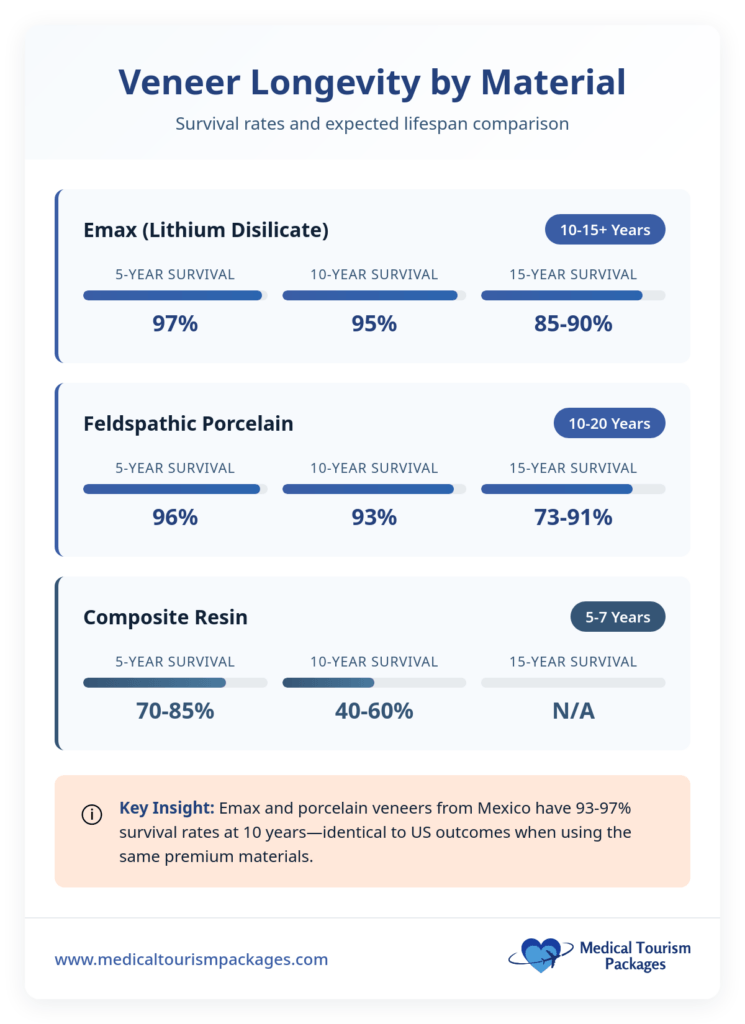
Quality materials translate to lasting results. Porcelain veneers show 93 to 94 percent survival at 10 years in peer-reviewed veneer-longevity studies, and Emax (lithium disilicate) performs similarly or better. These outcomes match US results when clinics use identical premium materials.
What Training and Credentials Should You Verify?
You should verify ISO certification, specialist training, and premium material use. Mexican dentists complete a 5-year Doctor of Dental Surgery (DDS) program, and cosmetic specialists add 2 to 3 years of advanced training. Many also complete international residencies.
- ISO certifications for quality management systems, the most important credential to confirm
- Specialization in Prosthodontics, Cosmetic Dentistry, or Oral Rehabilitation
- International training or dual certifications from US or European institutions
- Premium materials such as IPS e.max or Zirconia, not generic ceramics
- Bilingual staff for clear communication about your treatment
Note that the ADA does not directly accredit foreign clinics. Top Mexican facilities follow ADA standards voluntarily as a benchmark for best practice.
What Are the Main Risks and How Do You Reduce Them?
The main risk is a rushed treatment timeline, not material quality or dentist skill. Compressed 2 to 3 day schedules can skip critical bite adjustments. The American Dental Association also lists tooth sensitivity, chipping, and bond failure as general veneer risks.
- Allocate 4 to 5 days minimum for multi-veneer cases
- Schedule a post-procedure check-up before departing Mexico
- Ensure time for bite (occlusion) adjustments
- Confirm written warranty and at-home follow-up options before you start
Follow-up care at home matters too. The CDC notes that infection is a general risk in medical tourism, so plan for a local dentist who can handle minor adjustments after you return.
Who Is a Good Candidate for Veneers in Mexico?
Good candidates have healthy gums, sound teeth, and enough enamel for bonding. You should have realistic expectations and no untreated dental problems. Severely misaligned teeth or active gum disease must be addressed before veneer placement.
You are likely a good candidate if you meet these conditions:
- Healthy gums with no active gum disease
- Sound teeth without large untreated cavities
- Sufficient enamel for proper bonding
- Teeth that are not severely misaligned
- Good oral hygiene habits and realistic expectations
When Should You Treat Other Issues First?
You should treat certain conditions before getting veneers. Your dentist confirms candidacy through X-rays and an exam, so be honest about your dental history and grinding habits.
- Active gum disease must be resolved first
- Extensive decay needs filling before veneers
- Very thin enamel may disqualify you from traditional veneers
- Severe teeth grinding (bruxism) requires a nightguard commitment
What Is the Veneer Treatment Process in Mexico?
The veneer process takes 5 to 7 days and includes consultation, preparation, fabrication, and bonding. Most patients complete treatment in one trip. Composite veneers can sometimes finish in one or two visits.
Step 1: How Does the Consultation Work?
During the consultation, your dentist performs an oral exam with X-rays and digital scans. You discuss tooth shape, shade, and smile design. Many clinics use Digital Smile Design software to preview your results before treatment begins.
Step 2: How Are Teeth Prepared?
To prepare teeth, your dentist uses local anesthesia and removes about 0.3 to 0.5mm of enamel from the front surface. This lets veneers sit flush with surrounding teeth. Composite veneers may need little to no enamel removal.
Step 3: How Are Impressions and Temporaries Done?
Impressions use digital intraoral scanners for precise 3D measurements, though some clinics still use putty molds. Your dentist then places temporary veneers to protect prepared teeth. You wear these for 2 to 7 days while the lab works.
Step 4: How Long Is Lab Fabrication?
Lab fabrication takes 2 to 5 business days for traditional methods. Clinics with in-house CAD/CAM systems can reduce this to 24 to 48 hours. Skilled technicians craft each veneer from your chosen premium material.
Step 5: How Is Final Bonding and Follow-Up Done?
Final bonding starts with a trial fitting to check fit, color, and shape. Your dentist then etches the teeth, applies cement, and uses a curing light to bond each veneer. A follow-up checks your bite and polishes any rough edges.
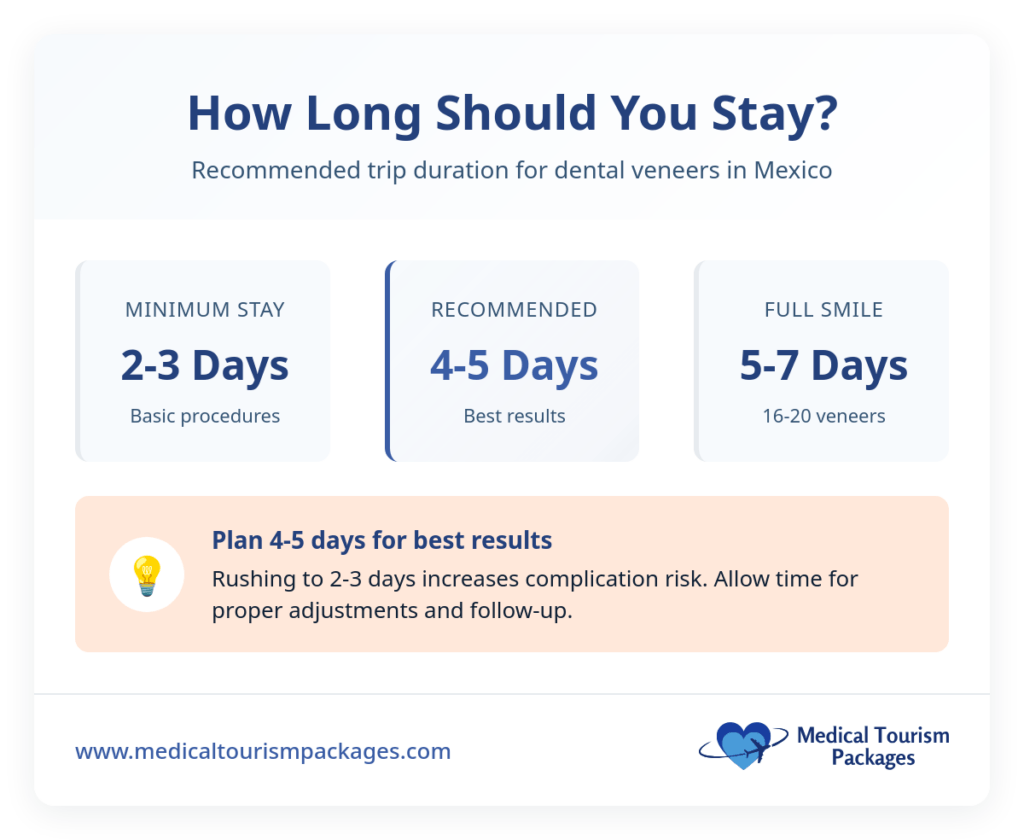
How Long Should You Plan to Stay?
You should plan for 2 to 3 days minimum, but 4 to 5 days is strongly recommended for multi-veneer cases. The extra time allows proper adjustments and reduces rushing. A relaxed schedule protects your long-term comfort and results.
How Long Do Mexico Veneers Last?
Ceramic veneers from Mexico last 10 to 20 years with proper care, while composite veneers last 5 to 7 years. Longevity depends on material quality, placement technique, and your aftercare. Premium ceramics offer better long-term value.
Survival rates by material, drawn from peer-reviewed veneer-longevity studies, are shown below:
| Material Type | 5-Year Survival | 10-Year Survival | Expected Lifespan |
|---|---|---|---|
| Feldspathic Porcelain | ~96% | ~93% | 10-20 years |
| Emax/Lithium Disilicate | ~97% | ~95% | 10-15+ years |
| Composite Resin | 70-85% | 40-60% | 5-7 years |
Where Are the Best Cities in Mexico for Dental Veneers?
The best cities for dental veneers are Los Algodones, Tijuana, and Cancun, plus Los Cabos, Puerto Vallarta, and Guadalajara. Border towns offer the lowest prices and easiest access. Resort cities let you combine treatment with a vacation.
Each city fits a different type of trip:
| City | Best For | Price Tier | Access |
|---|---|---|---|
| Los Algodones | Lowest prices, quick trips | Budget | Walk across from Yuma, Arizona |
| Tijuana | Weekend visits | Budget to mid | Short drive from San Diego |
| Cancun | Beach vacation plus treatment | Mid to premium | Direct flights from US cities |
| Los Cabos | Luxury experience | Premium | Direct flights |
| Puerto Vallarta | Pacific coast resort | Premium | Direct flights |
| Guadalajara | City exploration | Mid | Direct flights |
Los Algodones, known as Molar City, packs 350+ dental clinics and 600+ dentists into a small town near Yuma, Arizona. Emax veneers start at $350 per tooth, and partner hotels run around $60 per night. Tijuana serves Southern California patients with quick weekend trips from San Diego.
Cancun pioneered the dental vacation model, pairing treatment with Caribbean beaches, and many clinics partner with hotels for up to 50 percent off standard rates. Los Cabos and Puerto Vallarta cater to the luxury segment at 15 to 35 percent above border prices, while Guadalajara offers urban dental care without resort pricing.
For complete travel planning, read our guide for American medical tourists in Mexico.
How Do You Plan and Choose a Veneer Clinic in Mexico?
You plan a veneer trip by confirming travel documents, budgeting for travel and lodging, and vetting clinics carefully. A valid US passport is required. Border-zone visits under 72 hours are simple, while flights serve resort cities.
What Travel Documents Do You Need?
You need a valid US passport to enter Mexico and re-enter the US. US, Canadian, and UK citizens do not need a visa and may stay up to 180 days. The FMM tourist permit is waived for border visits within 25km for 72 hours or less.
This exemption supports the typical 2 to 3 day border veneer trip. If you drive, Mexican auto insurance is mandatory, since US policies are not recognized.
What Will Travel and Accommodation Cost?
Travel and accommodation cost depends on your destination. Flights to Mexico City or Cancun run $250 to $650 roundtrip from major US cities. Lodging ranges from $60 per night in border towns to $300+ in luxury resort areas.
Flight times and roundtrip costs from major US cities are shown below:
| From | To Mexico City | To Cancun | Roundtrip |
|---|---|---|---|
| Houston | 2.5 hrs | 2.5 hrs | $250-$500 |
| Miami | 3.75 hrs | 2.75 hrs | $280-$550 |
| Los Angeles | 3.75 hrs | 4.75 hrs | $280-$580 |
| New York | 5.5 hrs | 4.25 hrs | $320-$650 |
Typical lodging costs by destination type are shown below:
| Location Type | Nightly Rate | 7-Day Estimate |
|---|---|---|
| Border Hubs (Los Algodones/Tijuana) | $60 (clinic partner rates) | $420 |
| Vacation Hubs, Budget | up to $150 | $1,050 |
| Vacation Hubs, Mid-range | $150-$300 | $1,050-$2,100 |
| Vacation Hubs, Luxury | $300+ | $2,100+ |
Many clinics partner with local hotels and offer special rates for dental tourists. Cancun clinics frequently provide up to 50 percent off standard hotel rates.
How Do You Spot a Reputable Clinic vs Red Flags?
You spot a reputable clinic by confirming ISO certification, specialist credentials, and premium materials. Avoid clinics with extremely low prices or rushed timelines. Written warranties and follow-up protocols signal a quality facility.
Watch for these red flags when comparing clinics:
- No ISO certifications or verifiable accreditations
- Only general dentistry, no specialist credentials
- Extremely rushed timelines that finish in 2 to 3 days
- No in-house CAD/CAM technology
- No written warranty or post-procedure check-up
- Prices far below market, under $300 for porcelain or Emax
What Aftercare Keeps Veneers Lasting?
Aftercare keeps veneers lasting through daily hygiene, smart diet choices, and protective habits. The American Dental Association recommends gentle brushing, daily flossing, and regular cleanings. A custom nightguard protects against grinding.
- Brush twice daily with a soft-bristled toothbrush and non-abrasive toothpaste
- Floss daily; water flossers work well around veneer margins
- Avoid hard foods (ice, hard candy, nuts) and sticky foods (caramel, gum)
- Limit staining agents like coffee, tea, and red wine
- Wear a custom nightguard, especially if you grind your teeth
- Schedule professional cleanings every six months
Get written warranty documentation before treatment. Emax veneers typically carry 3-year warranties, and porcelain veneers often carry up to 5-year warranties.
Frequently Asked Questions
How much do dental veneers cost in Mexico?
Dental veneers cost $350 to $600 per tooth in Mexico, versus $900 to $2,500 in the US. A full set of 6 to 8 porcelain veneers runs $1,800 to $4,800, compared to $6,000 to $20,000 stateside. That is savings of up to roughly 70 to 90 percent.
How much are veneers in Cancun?
Veneers in Cancun cost a bit more than in border towns, with porcelain running up to about $450 per tooth. Cancun pricing is mid-range to premium because it pairs treatment with a Caribbean vacation. Many clinics offer up to 50 percent off partner hotel rates.
How long do I need to stay in Mexico for veneers?
Plan for a minimum of 2 to 3 days. For multiple veneers, 4 to 5 days is recommended to allow for lab fabrication, fitting, and any bite adjustments. The extra time reduces rushing and protects your long-term comfort and results.
Are dental veneers in Mexico safe?
Yes, when you choose ISO-certified clinics with qualified specialists. Look for dentists trained in prosthodontics or cosmetic dentistry. Top clinics use the same materials and CAD/CAM technology as US practices. Allowing enough treatment time is the most important safety step.
What happens if my veneers fail after I return home?
Most reputable clinics offer warranties of 3 to 5 years, depending on the material. Minor issues can often be handled by a US dentist, while major problems may require a return trip. Choosing a high-quality clinic upfront and arranging at-home follow-up reduces this risk.
Do I need a passport for dental work in Mexico?
Yes. A valid US passport is required for entry into Mexico and re-entry to the United States. US, Canadian, and UK citizens do not need a visa and may stay up to 180 days. For border-zone visits under 72 hours, the FMM tourist permit may be waived.
Can I get veneers in one day in Mexico?
Composite veneers can sometimes be completed in one day. Porcelain and Emax veneers usually need 2 to 7 days for lab fabrication, though clinics with in-house CAD/CAM can finish them in about 24 to 48 hours. Plan extra time for adjustments.
What’s the difference between Emax and porcelain veneers?
Emax veneers are lithium disilicate and offer superior translucency for a very natural look. Traditional porcelain also looks excellent but may be slightly less translucent. Both can last 10 to 20 years with proper care. Emax typically costs a little more per tooth.
Ready to Start Your Dental Veneer Journey in Mexico?
Medical Tourism Packages coordinates your entire dental veneer journey in Mexico. We connect you with ISO-certified cosmetic dentists, arrange your travel and accommodations, and provide bilingual support throughout treatment. Get a free consultation to discuss your smile goals and receive a personalized quote.
Contact us today to start planning your affordable dental veneers in Mexico.