Book Appointment Now

Breast Reduction in Mexico: Cost, Procedure, and Recovery Guide
 By
By
Breast reduction surgery in Mexico costs $3,500 to $7,000 USD – roughly 50% to 70% below US prices – performed by CMCPER-board-certified plastic surgeons at JCI- and QUAD A-accredited facilities in Tijuana, Guadalajara, Mexico City, and Cancún.
All-inclusive packages typically bundle the surgeon’s fee, anesthesia, operating room, one to two hospital nights, pre-op lab work, post-op medications, and a surgical bra into a single quoted price. Most US patients budget 11 to 14 days in country for consult, surgery, recovery, drain removal, and fit-to-fly clearance – the timeline is a safety requirement, not a recommendation.
Below you will find city-by-city pricing, a hospital comparison with accreditation detail, technique tradeoffs, a phased recovery plan, and the surgeon-verification steps that separate accredited care from cut-rate risk.
What Is Breast Reduction Surgery?
Breast reduction surgery (reduction mammaplasty) removes excess glandular tissue, fat, and skin from the breast, then reshapes the remaining tissue and repositions the nipple-areola complex to a higher, more proportionate position. Typical resections range from 300 to 800 grams per side; larger removals are routine for patients with macromastia.
The procedure is most often sought for functional relief from chronic upper-back, neck, and shoulder pain; bra-strap grooving; submammary skin rashes; posture compromise; sleep disturbance; and difficulty exercising. Cosmetic improvement – smaller, lifted, more symmetric breasts – is a near-universal secondary benefit. Reduction differs from a breast lift (mastopexy), which repositions tissue without significant volume removal, and from breast augmentation, which adds volume. Many patients researching reduction also evaluate breast augmentation in Latin America as a contrast.
US payers often reimburse reduction performed domestically when documentation supports medical necessity (resection weight thresholds, failed conservative care, chronic pain). Reimbursement for the same procedure performed abroad is rare; most US carriers exclude out-of-country elective care. HSA and FSA funds may apply to eligible expenses regardless of where the surgery occurs.
How Much Does Breast Reduction Cost in Mexico?
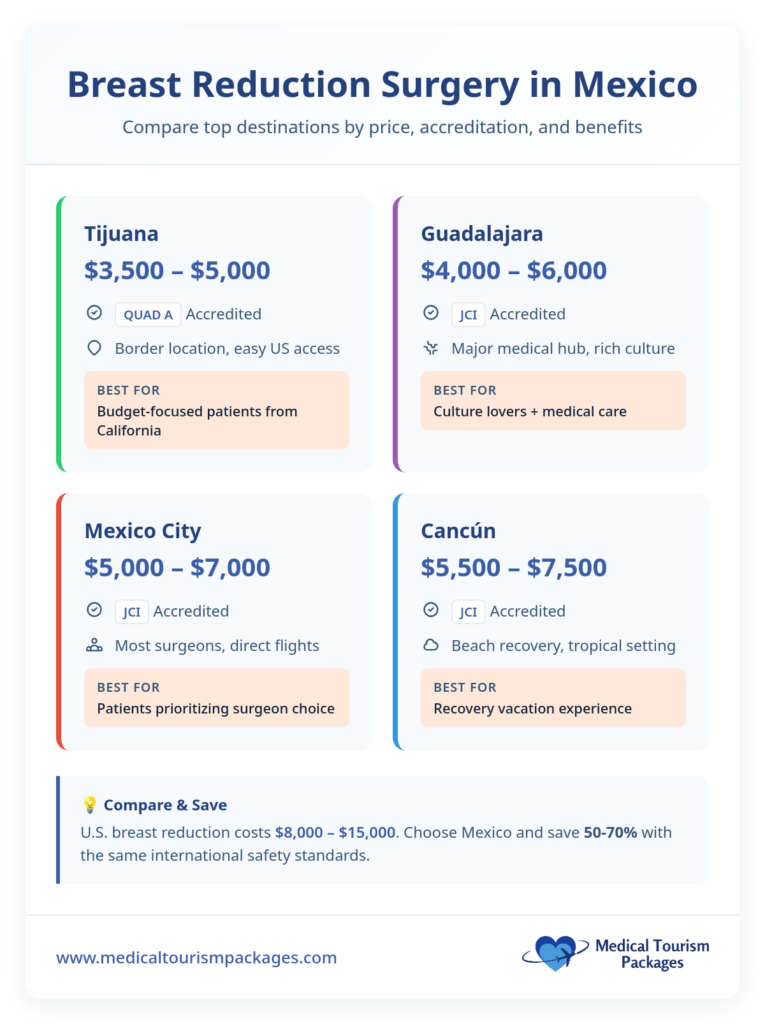
Breast reduction in Mexico costs $3,500 to $7,000 USD all-in, against a US total of $8,000 to $15,000 once surgeon, anesthesia, facility, and ancillary fees are combined. According to the American Society of Plastic Surgeons’ 2024 statistics, the US surgeon’s fee alone averages roughly $6,800 – before any facility or anesthesia charges – and Bookimed’s 2025 verified Mexico pricing puts the all-inclusive Mexican package about 54% below the US total. The headline savings come from lower hospital and labor costs, not from cutting clinical inputs.
Cost by Mexican city (all-inclusive USD)
| City | Package range (USD) | What drives the variance |
|---|---|---|
| Tijuana | $3,500 – $5,000 | Highest cosmetic-surgery volume in Mexico; competitive border-market pricing; mostly QUAD A or AAAASF facility accreditation |
| Guadalajara | $4,000 – $6,000 | Major medical hub; JCI hospital access; mid-range surgeon fees |
| Mexico City | $5,000 – $7,000 | Highest concentration of CMCPER-certified plastic surgeons; premium JCI hospitals; higher real-estate and labor costs |
| Cancún | $5,500 – $7,500 | Resort-recovery pricing premium; JCI hospitals; bundled hotel options |
Multi-country comparison
| Country | All-inclusive cost (USD) | Savings vs US high |
|---|---|---|
| United States | $8,000 – $15,000 | Baseline |
| Mexico | $3,500 – $7,000 | 53% – 77% |
| Colombia | $2,800 – $5,500 | 63% – 81% |
| Costa Rica | $4,000 – $6,500 | 57% – 73% |
| Panama | $3,800 – $6,500 | 57% – 75% |
What is – and isn’t – in an all-inclusive package
- Typically included: board-certified plastic surgeon’s fee, certified anesthesiologist, sterile operating room, one to two hospital nights in a private room, pre-op labs (CBC, BMP, coagulation panel, ECG if indicated), post-op pain and antibiotic medications, surgical bra and compression garments, and two to three follow-up consultations.
- Often not included: international airfare, extended hotel stay beyond the recovery window, ground transfers, companion-traveler costs, mammogram or pre-op imaging your surgeon may require, revision surgery, and any complication treatment after fit-to-fly clearance. Confirm each line item in writing before paying a deposit.
What Are the Best Hospitals for Breast Reduction in Mexico?
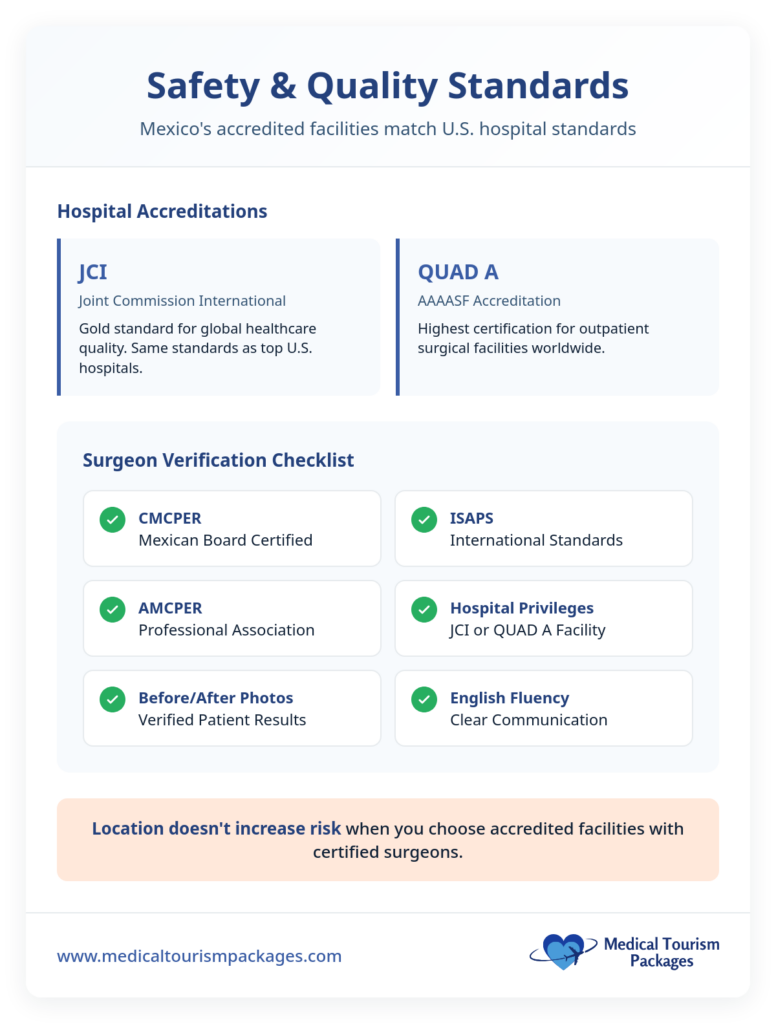
JCI-accredited tertiary hospitals concentrate in Mexico City and Cancún; Tijuana’s cosmetic-surgery economy is built mostly around freestanding outpatient surgical centers carrying QUAD A or AAAASF facility accreditation. The four hospitals below all hold verified international or US-affiliated credentials and accept international patients through dedicated coordinator desks.
| Hospital | City | Accreditation | US affiliation | Notable for breast reduction |
|---|---|---|---|---|
| American British Cowdray (ABC) Medical Center | Mexico City | JCI since 2008 | Houston Methodist (since 2006) | 331-bed general tertiary; English fluency ~90%; surgeon hospital privileges available to CMCPER plastic surgeons |
| Hospital Ángeles Pedregal | Mexico City | JCI since 2024 | None | 189 beds; cosmetic surgery a listed specialty; accepts Bupa and AXA international plans |
| Hospital Galenia | Cancún | JCI and ACI since 2012 | None | Cosmetic surgery and bariatrics among headline specialties; English fluency ~75%; international patient department on site |
| VIDA Wellness & Beauty (representative Tijuana cosmetic center) | Tijuana | QUAD A facility accreditation (confirm at booking) | None | High-volume cosmetic-only surgical center; freestanding outpatient model; verify CMCPER credentials of the assigned surgeon before deposit |
Verify accreditation in three places before you commit: the Joint Commission International public directory for JCI claims, the QUAD A or AAAASF directories for outpatient surgical centers, and the CMCPER public directory for the surgeon’s individual board certification. A facility that cannot produce active accreditation on request is a hard stop.
Is Breast Reduction in Mexico Safe?
Reduction mammaplasty is one of the most predictable major plastic surgery procedures, and accredited Mexican facilities meet the same peri-operative standards as US accredited centers. According to the American Society of Plastic Surgeons’ clinical practice guidance, major complications requiring revision – principally hematomas that need surgical drainage – occur in roughly 1% of breast reductions; minor wound complications such as superficial dehiscence, superficial site infection, and seroma occur in 3% to 20% of patients depending on body mass index, age, and amount of tissue removed.
One ASPS-referenced cohort of 338 reductions reported 0.8% revision-requiring hematomas, 3.5% superficial site infections, 3.2% seromas, and 1.2% fat necrosis – figures consistent with US-accredited national benchmarks. ASPS press guidance also documents that patients over age 50 and patients with elevated BMI carry meaningfully higher infection and wound-healing risk regardless of where surgery is performed.
Risks every patient should understand
- Hematoma – blood collection under the skin; small ones resolve, large ones need drainage
- Surgical site infection – superficial infections respond to oral antibiotics; deeper infections rarely require admission
- Wound dehiscence – partial separation of the incision, more common in smokers and patients with diabetes
- Fat necrosis – firm nodules that usually soften with time
- Altered nipple sensation – temporary in most patients, permanent in a minority
- Reduced breastfeeding capacity – depends on the pedicle technique your surgeon chooses
- Scarring and mild asymmetry – expected; scars mature over 12 to 18 months
- Anesthesia reactions – rare; always reviewed in the anesthesia consult
Where Mexico-specific risk actually concentrates is unaccredited cut-rate clinics, surgeons without active CMCPER certification, and patients persuaded to stack multiple major procedures (breast reduction plus tummy tuck plus liposuction or a Brazilian butt lift) into a single anesthesia session. Combination surgeries that exceed roughly six hours of operative time materially raise venous thromboembolism, fluid-shift, and wound-healing risk – ask any surgeon offering this what their cumulative time limit is and how they monitor for these specific complications.
How Do You Choose the Right Plastic Surgeon in Mexico?
Surgeon selection is the single decision that most affects outcome. Use the verification checklist below in the order shown; do not skip steps for a price advantage.
- CMCPER certification, active. The Consejo Mexicano de Cirugía Plástica, Estética y Reconstructiva is the sole certifying body for plastic surgery in Mexico. Search the surgeon’s full name in the CMCPER public directory; confirm recertification is current (renewal required every five years).
- AMCPER membership. Membership in the Asociación Mexicana de Cirugía Plástica, Estética y Reconstructiva signals good professional standing and continuing education compliance.
- ISAPS membership (preferred). The International Society of Aesthetic Plastic Surgery vets international training exposure.
- Hospital privileges at an accredited facility. Confirm the surgeon operates at a JCI hospital or a QUAD A / AAAASF-accredited outpatient surgical center for your procedure – not just consults there.
- Annual reduction volume. Ask directly how many breast reductions the surgeon performs per year. Thirty or more is meaningful; less than ten is a yellow flag for a major reduction.
- Pedicle technique disclosure. Ask which pedicle (inferior, superomedial, or central) the surgeon plans to use for your case – the choice influences nipple sensation and future breastfeeding likelihood.
- Before-and-after portfolio matching your body type. Request photos of patients with body habitus, breast size, and resection target similar to yours. Cross-check on RealSelf.
- Bilingual coordinator in writing. Confirm an English-speaking surgical coordinator before paying a deposit. Hospital international patient departments at ABC, Galenia, and Ángeles Pedregal maintain dedicated English-speaking staff; many freestanding clinics rely on the surgeon’s personal English ability.
Working through an established medical tourism facilitator can shortcut the credential-verification work and consolidate hospital, surgeon, recovery hotel, and transfer logistics into one quote. Read what a medical tourism facilitator does before deciding whether to coordinate independently.
What Techniques Are Used for Breast Reduction?
Mexican plastic surgeons use the same three core techniques in routine practice as their US and European counterparts. The right approach depends on resection weight, degree of breast ptosis (sagging), and skin elasticity.
| Technique | Incision pattern | Best for | Scarring | Recovery to light use | Relative cost |
|---|---|---|---|---|---|
| Anchor (Wise-pattern, inverted T) | Around the areola, vertical down, horizontal along the breast fold | Resections of 500 g or more per side; significant ptosis | Most visible (anchor shape) | 2 to 3 weeks | Highest within the city band |
| Vertical (lollipop, short-scar) | Around the areola plus single vertical incision | Moderate resections; mild to moderate ptosis | Less visible (lollipop shape) | 2 weeks | Mid-range |
| Liposuction-only | 2 to 3 small suction port incisions | Fat-dominant breasts; excellent skin elasticity; minor reductions | Minimal (millimeter-scale) | 1 to 2 weeks | Lowest within the city band |
Equally important and less discussed is the pedicle choice – the blood-supply pattern the surgeon preserves to keep the nipple-areola complex viable. Inferior pedicle is the most common in high-volume reductions; superomedial pedicle preserves the upper-pole fullness many patients prefer aesthetically and tends to maintain nipple sensation better. Ask your surgeon to name the pedicle they plan to use for you and to explain the tradeoff.
What Does the Breast Reduction Journey Look Like in Mexico?
The end-to-end journey for a US patient runs roughly 8 to 12 weeks from first virtual consult to scar-care month one, with the in-country window concentrated in 11 to 14 days.
Pre-trip (4 to 8 weeks out)
- Virtual consultation via WhatsApp or video; submit standing front, oblique, and lateral photos with measurements
- Receive written quote (USD), confirmation of CMCPER credentials, deposit instructions, and itemized package inclusions
- Get a primary-care medical clearance letter; complete any required bloodwork or ECG
- Quit smoking and all nicotine four weeks pre-op (non-negotiable for wound healing)
- Hold aspirin, ibuprofen, naproxen, and other anticoagulants two weeks pre-op per surgeon instruction
- Book flights, hotel within 15 minutes of the hospital, and a companion if possible
Days 1 to 3 in country
- In-person consult with the surgeon – confirm the surgical plan, pedicle choice, anticipated resection weight, and incision pattern
- Pre-op labs at the hospital: CBC, BMP, coagulation panel; ECG and chest X-ray if age 45+ or clinically indicated
- Anesthesia consult and surgical markings
Day 4: Surgery
General anesthesia. Operative time runs 2 to 4 hours depending on technique and resection volume. Drains are placed at the surgeon’s discretion. Admission for one to two hospital nights is standard for anchor and vertical techniques; liposuction-only reductions may discharge same-day.
Days 5 to 10: Early recovery
Discharge to recovery hotel; daily or every-other-day wound checks; drain removal typically day 5 to 7; gradual reintroduction of walking; compression garment worn 24/7.
Days 11 to 14: Final review and fit-to-fly
Final in-person follow-up; suture removal if non-absorbable; scar-care instructions; written fit-to-fly clearance letter for cabin-pressure exposure.
Travel logistics from major US cities
| US origin | Mexican destination | Direct flight time | Typical roundtrip (USD) | Airlines |
|---|---|---|---|---|
| Miami | Mexico City (MEX) | 3 hr 45 min | $280 – $550 | American, Aeromexico, Volaris |
| Houston | Mexico City (MEX) | 2 hr 30 min | $250 – $500 | United, Aeromexico, Volaris, VivaAerobus |
| Los Angeles | Mexico City (MEX) | 3 hr 45 min | $280 – $550 | Aeromexico, Volaris, American, Delta |
| New York | Mexico City (MEX) | 5 hr 30 min | $320 – $650 | Aeromexico, Delta, American, Volaris |
| Miami | Cancún (CUN) | 2 hr 45 min | $280 – $500 | American, Aeromexico, LATAM |
| Houston | Cancún (CUN) | 2 hr 30 min | $250 – $480 | United, Spirit, Frontier |
| San Diego | Tijuana (TIJ) | Ground crossing (San Ysidro / Otay Mesa) plus CBX pedestrian bridge | n/a (drive or shuttle) | Direct walk-across |
Visa and entry
US, Canadian, and UK citizens do not need a tourist visa to enter Mexico for stays up to 180 days, per the Mexican Secretariat of Foreign Affairs’ 2025 guidance. A valid passport for the duration of stay and a completed Multiple Migratory Form (FMM, issued by your airline or at the port of entry) are the only documents required. A 2025 tourism tax of approximately 860 Mexican pesos applies to most arrivals. The local currency is the Mexican peso; medical tourism packages are almost always quoted and paid in USD by wire or international card.
Where to stay during recovery
| City | Recommended neighborhood | Proximity to surgical hub | Accommodation tier |
|---|---|---|---|
| Mexico City | Polanco or Santa Fe | Within 15 minutes of ABC Medical Center and Ángeles Pedregal | 4- to 5-star international chains; recovery-friendly |
| Tijuana | Zona Río | Walking distance to most cosmetic surgical centers | 3- to 4-star international; many partner with clinics |
| Guadalajara | Providencia or Zona Real | Within 15 minutes of major hospitals | 3- to 4-star international and boutique |
| Cancún | Hotel Zone (north end) | Within 10 minutes of Galenia | 4- to 5-star resort; quiet-room requests for recovery |
What Is Recovery Like After Breast Reduction in Mexico?
Recovery follows a predictable arc. Most patients describe day 1 to 2 discomfort as moderate but well-controlled with prescribed medication; by day 4 to 5 most are off opioids and on over-the-counter analgesics.
| Phase | Timeframe | Objectives | Restrictions |
|---|---|---|---|
| Immediate post-op | Days 0 to 2 | Hospital monitoring; pain control; first wound check; mobilize for clot prevention | Bed-to-chair only; surgical bra on at all times; no arms-above-shoulder; no heavy meals first 24 hours |
| Early home recovery | Days 3 to 7 | Drain removal; walking every hour while awake; daily wound inspection | No lifting over 5 lb; no driving while on opioids; no immersion baths or pools |
| Mid recovery | Weeks 2 to 6 | Return to desk work week 2 to 3; light walking and stairs; gradual nipple-sensation return for most patients | No lifting over 10 lb; no strenuous exercise; no upper-body workouts; no smoking or alcohol; no direct sun on incisions |
| Late recovery and scar maturation | Months 2 to 18 | Light cardio week 3 to 4; full upper-body activity week 6 to 8; scar massage and silicone sheet protocol; telehealth follow-ups at 6 weeks and 6 months | Sun protection on scars 12 months; weight stable to preserve result |
Fit-to-fly clearance is the controlling milestone for return travel. Plan on 5 to 7 days post-op for short flights under 3 hours and 10 to 14 days for longer flights; flying earlier raises swelling and venous thromboembolism risk. Final breast shape settles over 2 to 3 months as swelling resolves; scars mature and fade over 12 to 18 months with sun protection and consistent silicone-sheet use.
What Are the Advantages and Disadvantages of Breast Reduction in Mexico?
| Factor | Advantage of Mexico | Disadvantage to weigh |
|---|---|---|
| Cost | 50% to 70% below US all-in pricing | Insurance reimbursement is rare; cash-pay assumption |
| Surgeon volume | Mexico City and Tijuana host very high-volume CMCPER plastic surgeons | Volume varies dramatically; verify individual surgeon, not city |
| Accreditation | JCI hospitals in Mexico City and Cancún; QUAD A and AAAASF accreditation common in Tijuana | Some clinics market accreditation they do not hold – always verify directly |
| Travel time | Direct flights under 3 hours from Houston, Miami, LA, San Diego | 11 to 14-day in-country commitment is non-negotiable |
| Language | JCI hospitals and major facilitators maintain English-speaking coordinators | Freestanding cosmetic clinics vary; confirm bilingual support in writing |
| Continuity of follow-up | Most surgeons offer telehealth follow-up at 6 weeks and 6 months | Complications after fit-to-fly clearance must be managed at home, usually out-of-pocket |
| Regulatory recourse | CMCPER-certified surgeons subject to formal board oversight | Cross-border malpractice recovery is materially harder than domestic recovery |
Is Mexico the Right Choice for Your Breast Reduction?
The patient-fit matrix below maps the most common situations to a recommendation. Use it as a starting point, then validate with your primary-care physician and any surgeon you consult.
| Patient situation | Best-fit Mexican city | Country fit |
|---|---|---|
| Cash-pay cosmetic patient near US border; budget-driven | Tijuana | High |
| Patient prioritizing JCI hospital plus cultural travel | Mexico City or Guadalajara | High |
| Patient wanting resort-recovery setting | Cancún | High |
| Patient with significant comorbidities (uncontrolled diabetes, BMI > 35, cardiac history) | n/a – treat domestically | Low |
| Patient counting on US insurance reimbursement | n/a – reimbursement is unlikely abroad | Low |
| Patient with full-time caregiver responsibilities at home | n/a – 11- to 14-day window is firm | Low |
Patients who do best are those with stable BMI, no major medical comorbidities, realistic resection expectations, a willing companion or recovery-hotel arrangement, and the flexibility to commit 11 to 14 days plus 6 to 8 weeks of US-side recovery. Patients who do worst are those compressing the timeline, stacking multiple major procedures, or selecting on price alone.
What Questions Do Medical Tourists Ask Most Often About Breast Reduction in Mexico?
How much does breast reduction cost in Mexico compared to the US?
An all-inclusive breast reduction package in Mexico costs $3,500 to $7,000 USD, against $8,000 to $15,000 in the US once surgeon, anesthesia, facility, and ancillary fees are combined. Bookimed’s 2025 verified Mexico pricing puts the savings at roughly 54% vs the US median, and the American Society of Plastic Surgeons’ 2024 statistics show the US surgeon’s fee alone averages about $6,800 before any facility charges.
Is breast reduction surgery in Mexico safe?
Yes, when performed by a CMCPER-certified plastic surgeon at a JCI- or QUAD A-accredited facility. According to ASPS clinical practice guidance, major complications requiring revision occur in about 1% of breast reductions; minor wound complications fall in the 3% to 20% range and are heavily influenced by BMI, age, and resection weight – the same risk profile as US-accredited centers. The risk concentrates in unaccredited clinics and multi-procedure marathon sessions, not in the country itself.
How long should I plan to stay in Mexico after breast reduction?
Plan 11 to 14 days minimum. The timeline covers days 1 to 3 for in-person consult and pre-op labs, day 4 for surgery, days 5 to 10 for recovery and drain removal, and days 11 to 14 for the final follow-up and a written fit-to-fly letter. This is a safety window driven by drain timing, suture review, and venous thromboembolism risk – not an upsell.
Will my US insurance cover breast reduction in Mexico?
Almost certainly not. Most US private and Medicare Advantage plans exclude elective care performed outside the US, including medically necessary reductions. Even when domestic reduction would be covered as medically necessary (documented chronic pain, sufficient resection weight, failed conservative care), the abroad version typically is not. HSA and FSA funds may be used for eligible medical expenses regardless of country – verify with your plan administrator first. Many patients note that the Mexican all-in price ($3,500 to $7,000) is similar to or below a typical US deductible plus coinsurance maximum.
How do I verify my surgeon’s credentials in Mexico?
Search the surgeon by full name in the CMCPER public directory to confirm active certification (recertification renews every 5 years). Cross-reference AMCPER membership and, ideally, ISAPS membership for international training exposure. Confirm hospital privileges at the JCI or QUAD A facility where you would be operated on, and review a before-and-after portfolio matching your body type. A surgeon who cannot produce these on request is a hard no.
When can I fly home after breast reduction surgery?
Only after your surgeon issues a written fit-to-fly clearance, typically 5 to 7 days post-op for short flights under 3 hours and 10 to 14 days for longer flights. Cabin pressure increases tissue swelling and prolonged sitting raises venous thromboembolism risk – flying too early is one of the few avoidable causes of medical-tourism complications.
Will I have scars after breast reduction?
Yes – every technique leaves scars. Anchor (Wise-pattern) reductions leave the most visible scars (around the areola, vertical, and along the breast fold); vertical or lollipop reductions leave less; liposuction-only leaves only port-sized marks. With sun protection and consistent silicone-sheet use, most scars fade substantially over 12 to 18 months. Patients with darker skin tones should ask their surgeon about hypertrophic-scar risk and preventive scar-care protocols.
Can I breastfeed after breast reduction surgery?
Many women can, but outcomes depend heavily on the pedicle technique used (the blood-supply pattern preserving the nipple-areola complex). Superomedial and central pedicle techniques tend to preserve more milk ducts than inferior pedicle in some studies. If breastfeeding matters to you, tell your surgeon during consultation and ask which pedicle they plan to use and why.
Do Mexican plastic surgeons speak English?
Most CMCPER-certified surgeons who treat international patients are functionally English-fluent; the major JCI hospitals (ABC Medical Center, Hospital Galenia, Hospital Ángeles Pedregal) maintain dedicated international patient departments with English-speaking coordinators. At freestanding cosmetic clinics, language support varies – confirm bilingual coordinator availability and the surgeon’s own English ability in writing before paying a deposit. JCI accreditation requires demonstrated language access policies; QUAD A and AAAASF accreditations do not.
Can I combine breast reduction with a tummy tuck or breast lift?
Sometimes, and with careful limits. Combining a reduction with a modest tummy tuck or limited liposuction is feasible for healthy patients when total operative time stays under roughly six hours and total blood loss is closely monitored. Stacking three or more major procedures – or adding a Brazilian butt lift – meaningfully raises venous thromboembolism, fluid-shift, and wound-healing risk. Any surgeon offering a multi-procedure marathon should explain their cumulative operative-time limit and the monitoring plan for these specific complications. If they don’t, walk away.
Ready to Start Your Breast Reduction Journey in Mexico?
Medical Tourism Packages coordinates breast reduction trips end to end across Tijuana, Guadalajara, Mexico City, and Cancún. We pre-verify CMCPER surgeon certification and facility accreditation, build the all-inclusive USD quote (surgeon, hospital, anesthesia, recovery hotel, transfers), and stay with you from virtual consult through telehealth follow-up six months out. Patients evaluating their options often compare the full Mexico medical tourism landscape first, then narrow to a procedure-specific plan with us.
Contact us to receive a personalized breast reduction quote in Mexico, with verified surgeon, facility, and recovery details.