Book Appointment Now

Your Complete Guide to Plastic Surgery in Panama
 By
By
Plastic surgery in Panama costs 50 to 70 percent less than in the US, performed at two JCI-accredited hospitals in Panama City, one of them a Johns Hopkins Medicine International affiliate.
A breast augmentation costs $3,000 to $5,500 in Panama versus $6,000 to $12,000 in the US, and a Brazilian Butt Lift costs $2,500 to $5,000 versus $8,000 to $15,000. Pacífica Salud and Clínica Hospital San Fernando hold JCI accreditation, and Panama’s dollar economy keeps quotes fixed.
Our network connects you with board-certified surgeons at JCI-accredited hospitals in Panama City, each verified for accreditation, US institutional affiliation, and APCPER credentials. Below, you will find procedure-by-procedure costs, hospital profiles, surgeon-vetting steps, BBL safety guidance, recovery timelines, and answers to the questions patients ask most about plastic surgery in Panama.
Why Do Patients Choose Panama for Plastic Surgery?
Patients choose Panama for plastic surgery because it pairs 50 to 70 percent savings with two JCI-accredited hospitals, a Johns Hopkins Medicine International affiliation, and a dollarized economy. Around 50,000 medical tourists visit Panama each year, per countries-level industry data.
Panama positions itself as a premium regional choice rather than the cheapest one. The country competes on safety validation, not volume. Its price floor sits a few hundred dollars above Colombia’s, and that gap reflects investment in JCI accreditation and Johns Hopkins clinical standards. For travel logistics and visa details, see our guide for American medical tourists in Panama.
How Much Can You Save Compared to the US?
You can save 50 to 70 percent compared to US prices, and the savings are predictable because Panama uses the US dollar. A $5,000 quote stays exactly $5,000 at payment. There is no exchange-rate risk and no foreign transaction fees on dollar payments.
Who Chooses Panama Over Other Destinations?
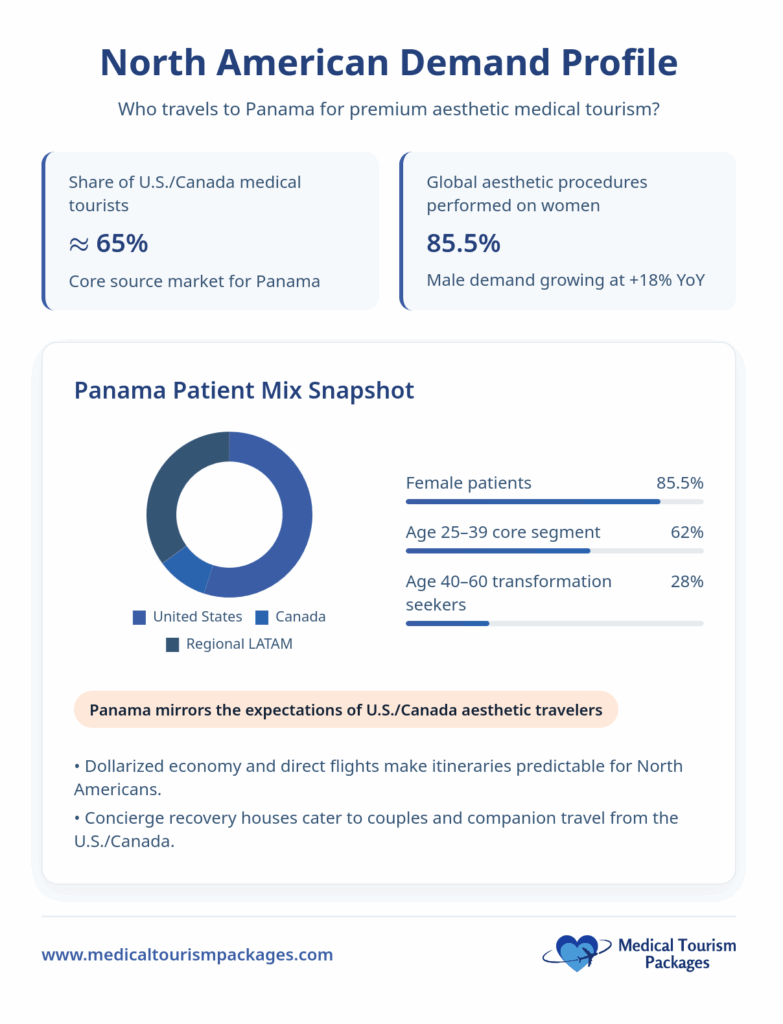
Panama suits safety-focused patients who value accreditation over the lowest possible price. Most patients come from the United States and Canada. The typical patient prioritizes JCI hospitals, wants currency stability for budgeting, and can stay 2 to 3 weeks for proper recovery.
Patients combining several procedures, such as a mommy makeover or full body contouring, also favor Panama because bundled package pricing improves value. Those who feel comfortable verifying surgeon credentials independently get the most out of the destination.
How Much Does Plastic Surgery Cost in Panama?
Plastic surgery in Panama costs 50 to 70 percent less than in the United States. A breast augmentation runs $3,000 to $5,500 in Panama versus $6,000 to $12,000 in the US, according to American Society of Plastic Surgeons 2024 average fees. Prices below are in US dollars.
Here is how common procedures compare between Panama and the United States:
| Procedure | Panama Range | USA Range | Savings |
|---|---|---|---|
| Breast Augmentation | $3,000–$5,500 | $6,000–$12,000 | 50–55% |
| Tummy Tuck | $4,000–$7,000 | $8,000–$15,000 | 50–55% |
| Brazilian Butt Lift (fat grafting) | $2,500–$5,000 | $8,000–$15,000 | 60–70% |
| Butt Implants | $3,000–$6,000 | $10,000–$18,000 | 60–70% |
| Liposuction | $2,000–$5,000 | $6,000–$8,500 | 40–50% |
| Mommy Makeover | $6,000–$10,000 | $12,000–$18,000 | 45–50% |
| Facelift | $5,000–$10,000 | $12,000–$25,000 | 55–60% |
| Rhinoplasty | $2,500–$5,000 | $7,000–$12,000 | 55–60% |
Liposuction and mommy makeover ranges are approximate combined-procedure estimates and vary by the number of areas treated. Always request an itemized quote that lists the surgeon fee, anesthesia, facility, and implants separately.
How Much Does a BBL Cost in Panama?
A Brazilian Butt Lift using your own fat costs $2,500 to $5,000 in Panama, compared to $8,000 to $15,000 in the United States, per American Society of Plastic Surgeons 2024 fee data. Butt implants are a separate procedure and cost $3,000 to $6,000 in Panama.
Here is how a BBL and butt implants differ in Panama:
| Option | Method | Panama Cost | US Cost |
|---|---|---|---|
| Brazilian Butt Lift | Fat transfer from liposuction | $2,500–$5,000 | $8,000–$15,000 |
| Butt Implants | Silicone gluteal implants | $3,000–$6,000 | $10,000–$18,000 |
A higher BBL price usually reflects more surgeon experience and a stronger safety record, not a different result. Because the BBL carries real risk, choose a surgeon and facility on safety credentials first and price second. You can read more about how a butt lift and gluteoplasty work before your consultation.
How Do Panama’s Prices Compare to Colombia, Mexico, and Costa Rica?
Panama’s prices sit at the high end of the region, typically $500 to $1,500 above Colombia’s minimums. Mexico and Colombia compete on lower prices and higher volume, while Panama and Costa Rica position as premium destinations with stronger accreditation signals.
Here is how three core procedures compare across the region:
| Procedure | Panama | Colombia | Mexico | Costa Rica |
|---|---|---|---|---|
| Breast Augmentation | $3,000–$5,500 | $2,500–$4,500 | $2,500–$5,000 | $3,000–$5,000 |
| Tummy Tuck | $4,000–$7,000 | $3,000–$5,000 | $3,000–$7,000 | $3,500–$6,500 |
| Brazilian Butt Lift | $2,500–$5,000 | $3,000–$6,000 | $3,500–$7,000 | $3,500–$7,000 |
The Panama premium buys regulatory alignment with US standards and dollar pricing. If you want the absolute lowest price and can accept peso swings, Colombia or Mexico may cost less. If you want accreditation plus currency stability, Panama justifies the gap. Patients weighing nearby options can compare plastic surgery in Costa Rica and plastic surgery in Colombia for cost and quality.
What Is Included in All-Inclusive Surgery Packages?
All-inclusive packages bundle the surgical fees with recovery support so you book one price. They typically cover the surgeon, anesthesiologist, operating room, facility fees, and FDA or EMA-approved implants. Several items are excluded, so always confirm in writing.
Most Panama packages include the following:
- Surgical fees: Surgeon, anesthesiologist, operating room, and facility
- Implants and materials: FDA or EMA-approved devices
- Recovery lodging: 7 to 14 nights with nursing support
- Post-op care: Lymphatic drainage, massage, follow-ups, compression garments, wound care, initial medications
- Local transport: Airport pickup and rides to medical appointments
Packages usually exclude international flights, medical complication insurance, standard travel insurance, most meals, personal expenses, revision surgery, and treatment of complications. US and Canadian citizens enter visa-free for up to 180 days, so visa fees rarely apply.
Which Hospitals in Panama Are JCI Accredited?
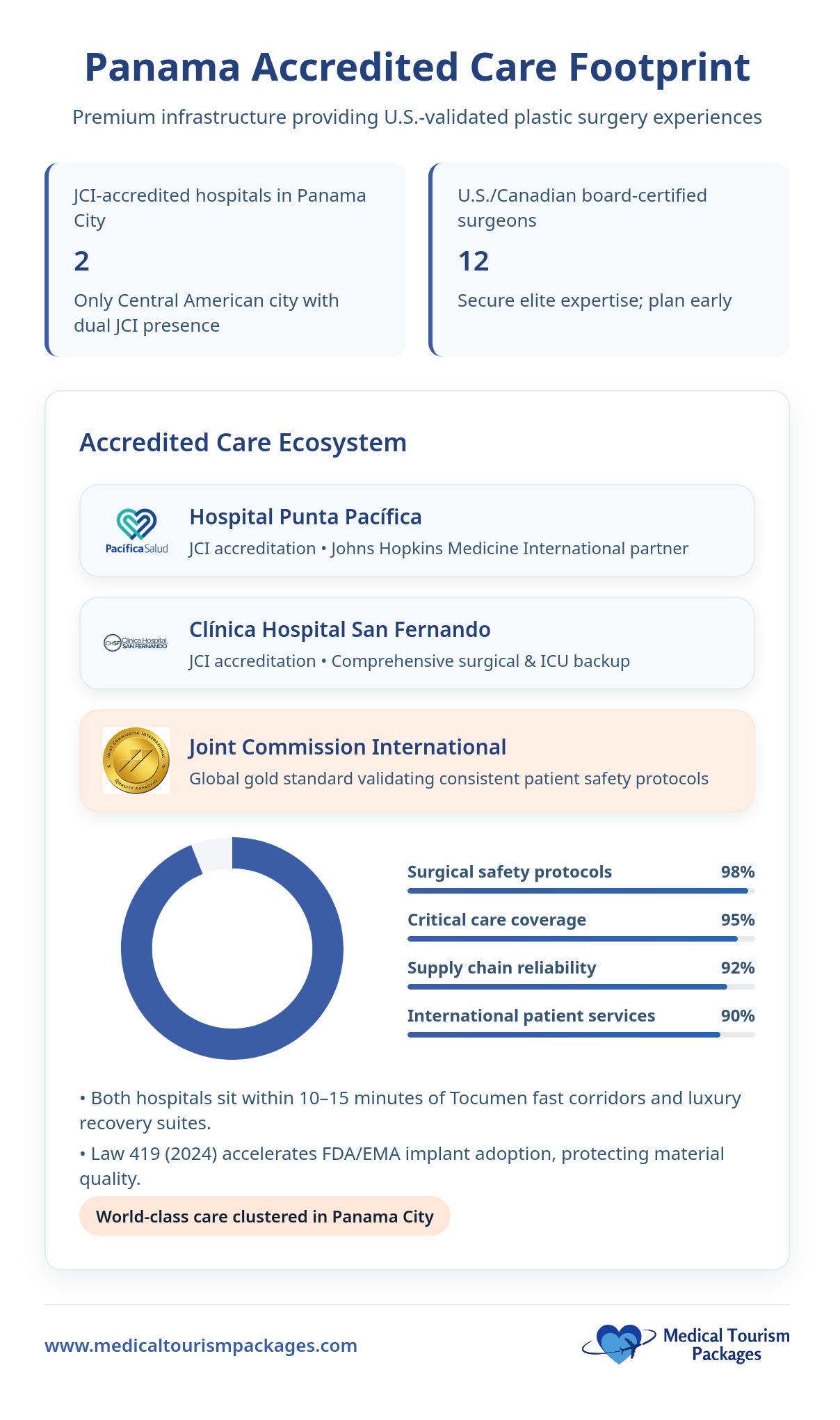
Two hospitals in Panama City hold JCI accreditation for plastic surgery: Pacífica Salud (formerly Hospital Punta Pacífica) and Clínica Hospital San Fernando. Both earned Joint Commission International accreditation in 2011 and maintain US institutional affiliations.
Here is how the two JCI-accredited facilities compare:
| Hospital | JCI Accredited | US Affiliation | Notable Feature |
|---|---|---|---|
| Pacífica Salud (Hospital Punta Pacífica) | Yes, since 2011 | Johns Hopkins Medicine International | Only Johns Hopkins affiliate in Central America |
| Clínica Hospital San Fernando | Yes, since 2011 | Tulane Medical Center, Baptist Health South Florida | Full ICU and emergency capability |
Is Hospital Punta Pacifica JCI Accredited?
Yes, Pacífica Salud (Hospital Punta Pacífica) has held JCI accreditation since 2011 and is the only Johns Hopkins Medicine International affiliate in Central America. A second branch opened in Costa del Este in February 2022, expanding its Johns Hopkins-aligned capacity.
The Johns Hopkins relationship means clinical governance, patient-safety practices, and quality monitoring follow US academic-medical standards. The hospital offers advanced aesthetic technology including VASER ultrasound-assisted liposuction, BodyTite radiofrequency, and Renuvion J-Plasma skin tightening. Confirm consultation fees directly when you request a quote.
Is Clinica Hospital San Fernando JCI Accredited?
Yes, Clínica Hospital San Fernando holds JCI accreditation, first earned in 2011 and renewed in the years since. It affiliates with Tulane Medical Center and Baptist Health South Florida, and provides full ICU and emergency support for managing complications.
San Fernando is a multi-specialty hospital with a long operating history and a large physician staff across specialties. Its ICU and emergency departments matter for plastic surgery because they provide the critical-care infrastructure that non-accredited clinics lack.
Why Does JCI Accreditation Matter for Plastic Surgery?
JCI accreditation matters because it enforces the international safety systems that prevent and manage surgical complications. Joint Commission International audits hospitals against standardized protocols and re-inspects them regularly, which is why facility choice is as important as surgeon choice.
JCI-accredited hospitals provide these safeguards:
- Surgical safety checklists and medication-verification procedures
- Infection-prevention protocols and sterilization standards
- Outcome monitoring and systematic complication tracking
- ICU and emergency access with 24/7 specialist coverage
- External auditing by independent inspectors
How Do You Verify a Surgeon’s Credentials in Panama?
You verify a surgeon’s credentials by confirming APCPER membership directly through its registry, checking for international certification, and confirming privileges at a JCI hospital. Do not rely on clinic websites or marketing for this step.
What Is APCPER and Why Does It Matter?
APCPER is the Asociación Panameña de Cirugía Plástica Estética y Reconstructiva, Panama’s official body for board-certified plastic surgeons. It matters because membership confirms a surgeon is properly trained in aesthetic, plastic, and reconstructive surgery. Only a small number of Panama surgeons also hold US or Canadian fellowship credentials.
The strongest candidates add American FACS (Fellow of the American College of Surgeons) or Canadian FRCSC (Fellow of the Royal College of Surgeons of Canada) certification, and many trained at US or European institutions. For example, Dr. Jacqueline Richa trained at the Mayo Clinic and works at JCI-accredited hospitals. Verify any such claim through the surgeon’s training program directly.
What Questions Should You Ask During a Consultation?
You should ask questions that confirm credentials, experience, and complication planning. Ask for specifics, not general reassurance, and request written answers where possible. A qualified surgeon answers all of these transparently.
Ask each surgeon the following:
- What is your APCPER status, and do you hold FACS or FRCSC certification?
- Where did you complete medical school, residency, and fellowship?
- Which JCI-accredited hospital grants your current operating privileges?
- How many times have you performed my specific procedure?
- What are your complication and revision rates for this procedure?
- What follow-up care do you provide after I return home?
- Which implant brands and materials do you use, and are they FDA or EMA approved?
What Warning Signs Should Make You Walk Away?
You should walk away from any surgeon who cannot verify board certification or operating privileges at a JCI hospital. Prices far below market, pressure tactics, and vague answers about complications are reliable red flags.
Refuse a provider who shows any of these signs:
- No verifiable APCPER membership or refusal to share credentials
- Operating only in non-accredited clinics without ICU access
- Prices $1,000 or more below market, which signals cut corners
- Promises of guaranteed or unrealistic results
- High-pressure sales or limited-time offers
- No clear plan for complications or post-operative follow-up
What Plastic Surgery Procedures Can You Get in Panama?
You can get the full range of body, breast, facial, and male procedures in Panama, performed with modern aesthetic technology at JCI hospitals. Available procedures span body contouring, breast surgery, facial surgery, and male-specific treatments.
Panama hospitals offer these procedure categories:
- Body contouring: Liposuction, tummy tuck, Brazilian butt lift, mommy makeover, body lifts
- Breast surgery: Augmentation, lift (mastopexy), reduction, reconstruction
- Facial surgery: Facelift (rhytidectomy), rhinoplasty, eyelid surgery (blepharoplasty), brow lift, neck lift
- Male-specific: Gynecomastia correction, male liposuction, hair restoration
What Advanced Technologies Do Panama’s JCI Hospitals Offer?
Panama’s JCI hospitals offer VASER liposuction, BodyTite radiofrequency, and Renuvion J-Plasma, the same aesthetic platforms used in leading US clinics. These technologies reduce trauma, tighten skin, and improve precision during body contouring.
Renuvion J-Plasma, also marketed as J-Plasma, is a minimally invasive skin-tightening device that draws strong search interest from patients in Panama City. It pairs helium plasma with radiofrequency energy to firm loose skin, often combined with liposuction. VASER uses ultrasound to loosen fat before removal, and BodyTite tightens skin with radiofrequency during the same procedure. Real-time ultrasound guidance is also used to place fat safely during a BBL.
How Safe Is the Brazilian Butt Lift in Panama?
The Brazilian Butt Lift is the highest-risk cosmetic procedure, but safety has improved sharply when surgeons inject fat above the muscle only. The American Society of Plastic Surgeons reports that older estimates placed mortality near 1 in 3,000, a figure that has fallen with updated technique.
What Safety Protocols Do JCI Hospitals Follow for BBL?
JCI hospitals follow the gluteal fat grafting safety protocols defined by the American Society of Plastic Surgeons task force. The core rule is subcutaneous injection only, meaning fat is placed above the gluteal muscle to avoid the large veins that cause fatal embolism.
Accredited Panama facilities apply these BBL safeguards:
- Subcutaneous injection only, never into or below the muscle
- Real-time ultrasound guidance to confirm injection depth
- Controlled injection volume per side to limit embolism risk
- ICU monitoring after surgery for the high-risk window
- Strict patient selection based on cardiovascular health and BMI
- Board-certified anesthesiologists for general anesthesia
What Are the Latest BBL Safety Statistics?
The latest BBL safety data show a large drop in mortality once surgeons adopted subcutaneous-only fat placement. The Aesthetic Surgery Education and Research Foundation reported that mortality, once estimated near 1 in 3,000, fell closer to 1 in 15,000 among board-certified surgeons using safer technique.
According to the American Society of Plastic Surgeons gluteal fat grafting task force, the great majority of surgeons now inject fat above the muscle only, the practice most associated with avoiding fatal fat embolism. Panama’s JCI hospitals adopted enhanced BBL protocols in 2018 and report no BBL-related deaths since, a facility-level claim you should confirm with the hospital and your surgeon. The takeaway for patients is direct: a BBL should be performed only at a JCI-accredited facility with ICU capability and ultrasound guidance.
What Is the Step-by-Step Process from Booking to Recovery?
The process spans about four months: three months of preparation and vetting, then a 2 to 3 week stay in Panama for surgery and recovery. Understanding each phase helps you plan time off, insurance, and follow-up before you travel.
What Happens During the Research and Booking Phase?
During the research and booking phase you vet surgeons, verify credentials, and lock in insurance before paying any deposit. This phase runs roughly three months before surgery and protects you from rushed, high-risk decisions.
The preparation phase follows these steps:
- Three months out: Hold video consultations, verify APCPER credentials, request before-and-after photos, and get medical clearance from your home doctor
- One to two months out: Choose a JCI hospital, pay the deposit, book flexible flights, and buy medical complication insurance before any deposit
- Four weeks out: Stop smoking, adjust medications per surgeon instructions, and confirm at least three weeks off work
What Should You Expect During Your Stay in Panama?
During your stay you arrive 2 to 3 days early for in-person evaluation and pre-operative testing, then have surgery and begin monitored recovery. Most patients stay 7 to 14 days depending on the procedure.
A typical in-country timeline looks like this:
- Arrival: In-person consultation, blood work and EKG, surgical markings, and consent forms in English
- Surgery day: Procedure under general anesthesia, then 24 to 48 hours of hospital monitoring (24-hour ICU for a BBL)
- Days 3 to 5: Move to recovery lodging, daily nursing wound care, first surgeon follow-up, and lymphatic drainage
- Days 6 to 10: Suture or staple removal, post-operative massage, and gradual return to light mobility
- Days 11 to 13: Final evaluation and written flight clearance once healing allows safe air travel
After you return home, expect weekly telemedicine check-ins with your surgeon for the first month and photo submissions at 2, 4, 8, and 12 weeks. Identify a local doctor willing to handle any complications before you travel.
How Long Is Recovery for Each Procedure?
Recovery time depends on the procedure, ranging from about 7 days of in-country stay for breast augmentation to a full 14 days for a tummy tuck or BBL. Return to desk work usually takes 1 to 4 weeks, with full results appearing over months.
Here is how recovery compares across common procedures:
| Procedure | Hospital Stay | Stay in Panama | Return to Desk Work | Full Recovery |
|---|---|---|---|---|
| Breast Augmentation | 24–48 hours | 7–14 days | 1–2 weeks | 4–6 weeks |
| Tummy Tuck | 24–48 hours | 12–14 days | 3–4 weeks | 6–12 months |
| Brazilian Butt Lift | 24-hour ICU | 14 days | 3–6 weeks | 6 months |
| Mommy Makeover | 24–48 hours | 14–21 days | 4–6 weeks | 12 months |
BBL patients cannot sit directly on the buttocks for 2 to 3 weeks and must use a special pillow. Surgeons clear air travel only after a final in-person evaluation, which reduces the risk of blood clots and wound problems.
What Should You Know Before Booking Surgery in Panama?
Before booking, you should understand the real risks of surgery abroad, why complication insurance is mandatory, and how the dollar economy protects your budget. These factors decide whether Panama is the right fit for you.
What Are the Real Risks of Getting Surgery Abroad?
The real risks include standard surgical complications plus travel-specific concerns such as blood clots after long flights and harder follow-up at home. Quality also varies sharply between JCI hospitals and non-accredited clinics, which is why facility choice is critical.
Key risks to weigh before booking include the following:
- Deep vein thrombosis from long flights soon after surgery
- Follow-up gaps if a local doctor declines to treat overseas complications
- Higher revision costs, since US revision can exceed the original price
- Limited legal recourse under Panamanian jurisdiction
- Quality variation between accredited and non-accredited facilities
Why Is Medical Complication Insurance Non-Negotiable?
Medical complication insurance is non-negotiable because standard travel insurance excludes elective surgery complications. Without it, a complication can cost tens of thousands of dollars and erase any savings from traveling for surgery.
Buy specialized medical tourism insurance with at least $25,000 in coverage that lasts 180 or more days after surgery. Good policies also cover emergency evacuation and an extended stay if complications delay your flight home. Comprehensive coverage typically costs $150 to $300, and you should purchase it before paying any deposit.
Why Does Panama’s Use of the US Dollar Matter?
Panama’s use of the US dollar matters because it removes exchange-rate risk from your budget. A $5,000 quote stays $5,000 at payment, with no conversion fees and no surprises between booking and surgery.
This stability is a real advantage over peso-based destinations. Colombia’s and Mexico’s currencies can swing 15 to 30 percent over a year, which can raise a quoted price by hundreds or thousands of dollars before you pay. Because Panama recommends a three-month booking timeline, dollar pricing keeps your financial plan valid through the entire process.
How Does Panama Compare to Colombia, Mexico, and Costa Rica?
Panama compares as the premium, currency-stable option, while Colombia and Mexico compete on lower prices and volume and Costa Rica matches Panama’s quality positioning. Your priorities, price versus predictability and accreditation, decide the best fit.
Here is how the four destinations compare on the factors that matter most:
| Factor | Panama | Colombia | Mexico | Costa Rica |
|---|---|---|---|---|
| Currency | US dollar (stable) | Peso (volatile) | Peso (volatile) | Colón (moderate) |
| JCI Hospitals | 2 | Several | Several | 2 |
| Key Advantage | Johns Hopkins affiliation, dollar stability | Lower cost, high surgeon volume | US proximity, volume | Premium quality positioning |
| Price Positioning | High-end regional | Mid-range | Low to mid | High-end regional |
Choose Panama for accreditation and dollar stability, especially if combining procedures. Choose Colombia or Mexico if the lowest price matters most and you can accept currency swings. Costa Rica is a close alternative to Panama for patients who want similar quality signals.
Frequently Asked Questions
How much does a BBL cost in Panama?
A Brazilian Butt Lift using fat transfer costs $2,500 to $5,000 in Panama, versus $8,000 to $15,000 in the US per American Society of Plastic Surgeons 2024 fees. Butt implants are a separate procedure costing $3,000 to $6,000 in Panama. Choose a JCI-accredited facility with ICU capability.
Is Hospital Punta Pacifica JCI accredited?
Yes. Pacífica Salud, formerly Hospital Punta Pacífica, has held JCI accreditation since 2011 and is the only Johns Hopkins Medicine International affiliate in Central America. A second branch opened in Costa del Este in February 2022. It offers VASER, BodyTite, and Renuvion technologies for body contouring.
Why is Panama more expensive than Colombia for plastic surgery?
Panama sits at the high end of regional pricing, typically $500 to $1,500 above Colombia’s minimums. The premium reflects JCI-accredited facilities, the Johns Hopkins affiliation, regulation favoring FDA and EMA-approved products, and full dollarization. You trade the lowest price for stronger quality assurance and currency stability.
What makes Panama’s use of the US dollar so important?
The US dollar removes exchange-rate risk. A $5,000 quote stays $5,000 with no conversion fees. By contrast, peso volatility in Colombia or Mexico can move final costs 15 to 30 percent if rates shift before you pay. Panama removes that uncertainty during the recommended three-month booking window.
What is included in all-inclusive Panama packages?
Packages include surgical fees (surgeon, anesthesiologist, operating room, facility), FDA or EMA-approved implants, 7 to 14 nights of recovery lodging with nursing, post-op care, and local transport. They exclude international flights, complication insurance, most meals, personal expenses, and revision surgery. Always request an itemized quote.
Do I really need special insurance for surgery abroad?
Yes, it is non-negotiable. Standard travel insurance excludes elective surgery complications. Buy dedicated medical tourism insurance with at least $25,000 in coverage that lasts 180 or more days after surgery. Comprehensive coverage costs about $150 to $300 and can prevent bills that erase your savings.
How long must I stay in Panama after surgery?
Plan on 7 to 14 days depending on the procedure. Breast augmentation often allows 7 to 10 days, while a tummy tuck or BBL typically requires the full 14 days. Surgeons clear travel based on healing, and most major-procedure patients fly home between days 11 and 13.
What happens if complications arise after I return home?
Complications at home can be difficult, since some local providers decline overseas cases and US revisions can cost more than the original surgery. Reduce risk with weekly telemedicine for the first month, a local doctor lined up for emergencies, and English-language operative reports and post-op instructions with warning signs.
Is getting plastic surgery in Panama actually worth it?
It is a strong choice for safety-focused patients who value accreditation, dollar stability, and bundled care, especially when combining procedures and able to stay 2 to 3 weeks. It is less ideal for the most budget-sensitive patients, since Colombia may cost $500 to $1,500 less, or for anyone needing immediate US access.
Ready to Start Your Plastic Surgery Journey in Panama?
Medical Tourism Packages coordinates your entire plastic surgery journey in Panama. We connect you with surgeons at JCI-accredited hospitals in Panama City, verify credentials, and arrange travel, recovery lodging, and bilingual support from consultation through follow-up.
Contact us today for a free consultation and a personalized Panama plastic surgery quote.