Book Appointment Now


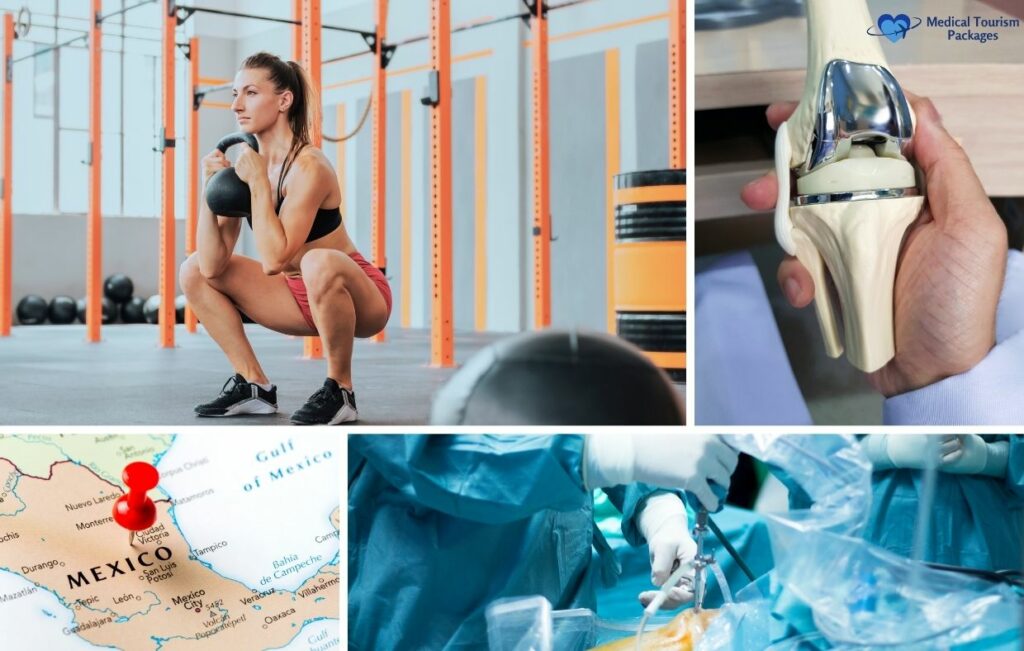
Knee Replacement Surgery in Mexico: Complete Guide, Costs, and Recovery
 By
By
Knee replacement surgery in Mexico costs $8,000 to $15,000 USD, roughly 70% less than the $20,000 to $50,000 typically charged in the United States, with 8 Joint Commission International (JCI) accredited hospitals serving North American patients.
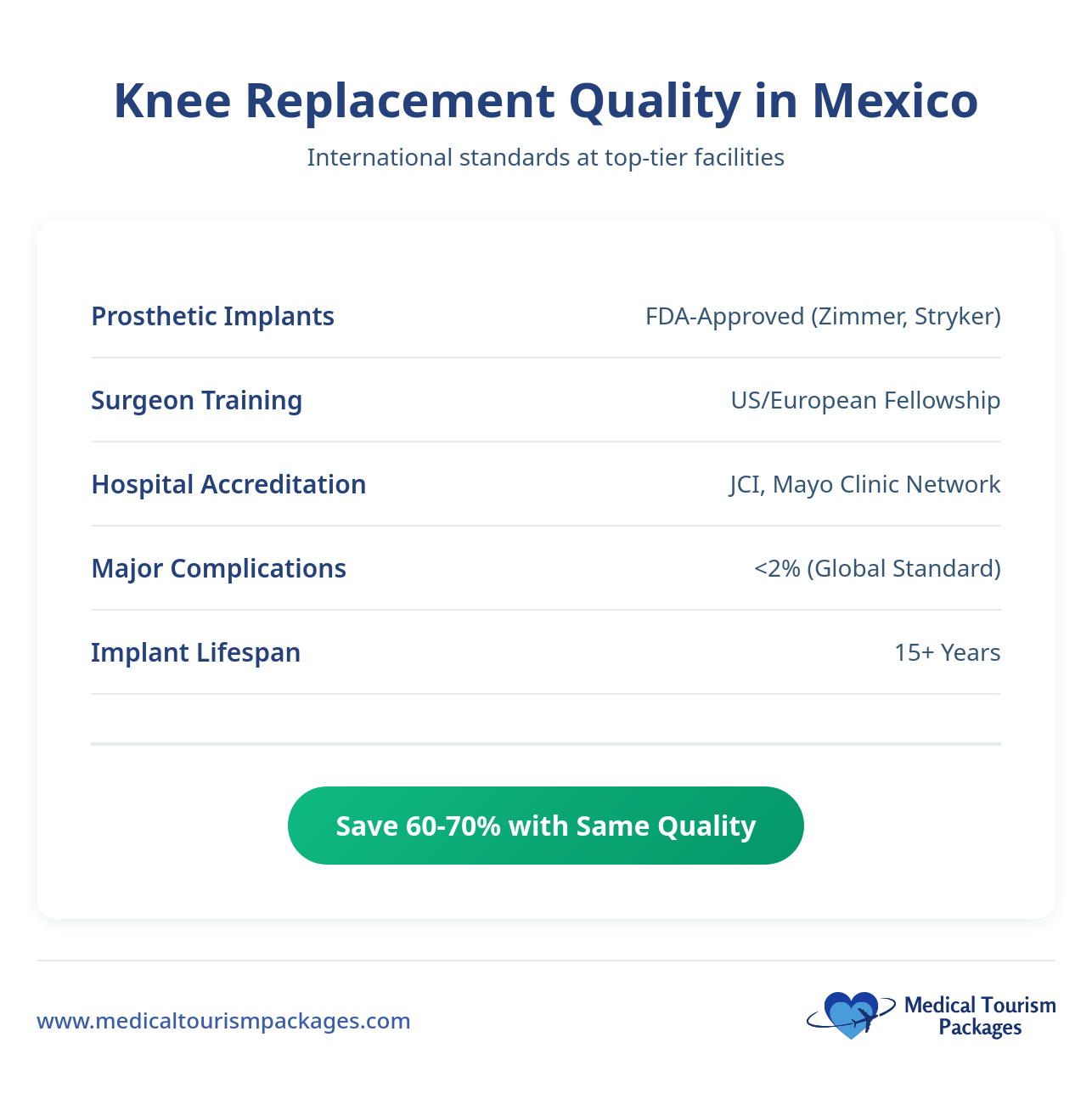
Mexican CMOT-certified orthopedic surgeons, many holding US or European joint-reconstruction fellowships, use the same FDA-approved Zimmer Biomet, Stryker, and DePuy Synthes implants found in US operating rooms. The National Joint Registry 20th Annual Report records 96.7% implant survival at 10 years on these implants.
This guide covers Mexico’s verified knee replacement cost ranges, the JCI-accredited hospitals in Mexico City, Cancún, Monterrey, and Tijuana that handle international patients, the procedure-variant choices (total, partial, robotic, revision), the mandatory 10 to 14 day in-country recovery, and how Mexico compares with our knee replacement in Panama and knee replacement in Colombia guides.
What Is Knee Replacement Surgery?
Knee replacement surgery, medically called total knee arthroplasty, is an orthopedic procedure that resurfaces the worn ends of the thighbone (femur), shinbone (tibia), and kneecap (patella) with metal and high-grade plastic components. According to the National Joint Registry 20th Annual Report, the procedure delivers 96.7% implant survival at 10 years and 95.4% at 15 years, with most patients reporting substantial pain relief and restored mobility.
You may be a candidate if you have severe osteoarthritis, rheumatoid arthritis, or post-traumatic arthritis that limits walking, stairs, or rising from a chair. Most orthopedic specialists recommend surgery only after at least six months of conservative care has failed.
- Conservative care tried first: physical therapy, NSAIDs and anti-inflammatories, corticosteroid injections, hyaluronic acid injections, and weight management if applicable.
- Eligibility checklist: significant pain and functional impairment, failed conservative treatment for 6+ months, and cardiovascular fitness for major surgery.
- Pre-operative testing: bilateral knee X-rays, MRI if soft tissue is a concern, complete blood count, comprehensive metabolic panel, ECG if cardiac history, and type-and-screen blood work.
How Much Does Knee Replacement Surgery Cost in Mexico?
Total knee replacement in Mexico costs $8,000 to $15,000 USD, roughly 70% less than the $20,000 to $50,000 typically charged in the United States. The MedicalTourismPackages 2025 orthopedic cost data and Healthline / American Academy of Orthopaedic Surgeons benchmarks support both ranges. The price normally bundles surgeon fees, anesthesia, operating room, implant, a 3-to-5 day hospital stay, basic in-hospital physical therapy, and post-operative follow-up during the in-country recovery period.
Knee Replacement Cost: Mexico vs the United States and Latin American Alternatives
| Country | Total Knee Cost (USD) | Savings vs US | Typical English Fluency at Top Hospitals |
|---|---|---|---|
| United States | $20,000 – $50,000 | baseline | n/a |
| Mexico | $8,000 – $15,000 | ~70% | ~84% |
| Panama | $7,000 – $12,000 | ~75% | ~86% |
| Colombia | $7,000 – $12,500 | ~72% | ~86% |
| Costa Rica | $8,000 – $14,900 | ~70% | ~84% |
What the Mexico Knee Replacement Package Typically Includes
- Surgeon, anesthesiologist, and operating room fees
- FDA-approved knee implant (typically Zimmer Biomet, Stryker, or DePuy Synthes)
- 3 to 5 nights in the hospital with nursing care and meals
- Standard post-operative medications during the hospital stay
- Initial physical therapy, often the first 5 supervised sessions
- Follow-up consultations during the 10 to 14 day in-country recovery window
Items usually billed separately include extended outpatient physical therapy ($2,500 to $7,000 depending on duration), recovery-hotel accommodation ($500 to $1,500 for the mandatory in-country stay), companion travel, and any complication-driven extended hospital care. Always ask for an itemized written quote before committing.
Cost Variation by Mexican City
| City | Typical Package Position | Best For |
|---|---|---|
| Tijuana | Lower end of the $8K–$15K range | California, Arizona, and Texas patients who can drive or take a short flight to San Diego and cross the border |
| Monterrey | Lower-to-mid range | Texas patients (1.75 hours from Houston) who want a major industrial-city hospital with US affiliations |
| Guadalajara | Mid range | Patients seeking a major medical hub with broad orthopedic capacity |
| Cancún | Mid range | Patients combining recovery with a Caribbean resort setting; direct flights from most US East Coast cities |
| Mexico City | Mid-to-upper range | Patients who want the largest academic medical centers and the broadest specialist depth |
Insurance and Financing
Most US and Canadian insurance plans do not cover elective surgery performed abroad. A growing number of self-funded employer plans now reimburse medical travel, and Medicare Advantage carriers like Aetna and Cigna list select Mexican hospitals in their international networks. Even without coverage, the savings often beat the cost of meeting a high US deductible. Medical financing for credit scores of 640 or higher is available from specialty lenders, typically with 2-to-5 year repayment terms.
What Are the Best Hospitals for Knee Replacement in Mexico?
Mexico hosts 8 Joint Commission International (JCI) accredited hospitals across its major cities. JCI is the US-based standard that evaluates patient safety, infection control, and clinical outcomes against the same criteria applied to American hospitals. The following four hospitals appear in our verified hospital data set, with their accreditation year, US affiliation, and specialty depth confirmed against the Joint Commission International directory.
| Hospital | City | JCI Year | US Affiliation | Orthopedic Specialty Notes |
|---|---|---|---|---|
| Hospital ABC (Centro Médico ABC) | Mexico City | 2008 | Houston Methodist Hospital (since 2006) | 331-bed multispecialty with dedicated orthopedic and trauma services; in-network with Aetna, Cigna, and Blue Cross Blue Shield |
| Hospital Galenia | Cancún | 2012 (also ACI Qmentum International) | None listed | Holds dual international accreditation; orthopedics is a core specialty alongside bariatrics and cosmetic surgery |
| Hospital Ángeles Pedregal | Mexico City | 2024 | None listed | 189 beds; orthopedics, bariatrics, and stem cell therapy; in-network with Bupa and AXA international plans |
| Christus Muguerza Alta Especialidad | Monterrey | Local accreditation (JCI verification pending) | Christus Health, Texas (since 2001) | 200-bed specialty hospital with US-network parent; in-network with MetLife, New York Life, ING, and Generali |
How to Verify a Hospital’s JCI Status
- Look the facility up on the public Joint Commission International “Who Is JCI Accredited” directory. Accreditation is awarded for 3 years and must be renewed.
- Confirm the accreditation date is current and the hospital’s full legal name matches what you see on its quote and surgical consent forms.
- For Tijuana-area hospitals popular with US patients, verify accreditation directly through the JCI directory rather than relying on hospital marketing pages alone.
What Types of Knee Replacement Are Available in Mexico?
Mexican orthopedic surgeons perform every major knee replacement variant available in US hospitals. Choosing the right approach depends on which compartments of your knee are damaged, your activity level, and your bone quality. The National Joint Registry 20th Annual Report and your surgeon’s pre-operative imaging together guide which variant suits your case.
| Variant | Incision | Recovery to Light Use | Best Fit Patient | Relative Cost in Mexico |
|---|---|---|---|---|
| Total knee replacement (cemented) | 6–10 in | 6–12 weeks | Advanced arthritis affecting all three knee compartments; the most common choice for patients over 65 | Baseline $8,000 – $15,000 |
| Total knee replacement (cementless) | 6–10 in | 6–12 weeks | Younger, more active patients with good bone density | Baseline $8,000 – $15,000 |
| Partial (unicompartmental) knee replacement | 3–5 in | 3–6 weeks | Arthritis limited to one compartment, intact ligaments, and good motion | Typically $6,500 – $11,000 per Bookimed and MedicalTourismCo facility quotes |
| Robotic-assisted knee replacement | 6–10 in | 6–12 weeks | Patients who want computer-guided implant placement for precision | Typically $1,000 – $3,000 above baseline at hospitals offering Stryker Mako or Zimmer ROSA systems |
| Revision knee replacement | 8–12 in | 12–24 weeks | Patients with a failed prior knee implant | Quoted case by case; usually 1.3x to 1.8x the primary total knee price |
Is Knee Replacement Surgery in Mexico Safe?
Yes, knee replacement at a JCI-accredited Mexican hospital meets the same patient-safety standards applied to US facilities. The Joint Commission International audits infection control, medication management, surgical-site protocols, and outcome tracking on the same rubric used in the United States. According to the National Joint Registry 20th Annual Report, total knee replacements show 96.7% implant survival at 10 years and 95.4% at 15 years across the modern implant manufacturers (Zimmer Biomet, Stryker, DePuy Synthes) that Mexican hospitals use.
What JCI Accreditation Means in Practice
- Triennial on-site audits of infection control, medication safety, surgical protocols, and patient-experience metrics
- Standardized surgical timeout, antibiotic prophylaxis, and DVT-prophylaxis checklists matching US joint-commission practice
- Mandatory outcome reporting that lets hospitals benchmark their infection and revision rates against international peers
Implant Quality and Surgical Protocols
JCI-accredited Mexican hospitals use FDA-approved implants from the same manufacturers found in US operating rooms, including Zimmer Biomet, Stryker, and DePuy Synthes. Surgical technique, anesthesia options (general, spinal, or regional), and post-operative protocols follow the same evidence-based guidelines published by the American Academy of Orthopaedic Surgeons.
Mexico’s Country Safety Profile
The Institute for Economics and Peace ranks Mexico 138 of 163 countries in the Global Peace Index 2024. Medical tourism cities cluster around well-policed hospital districts, gated recovery hotels, and direct hospital-to-airport transfers. Hospital coordinators arrange door-to-door transport so patients rarely use public transit during the recovery window. As with any international travel, patients should follow their hospital’s recommended recovery-hotel and transport partners rather than independent options.
The Mandatory 10 to 14 Day In-Country Recovery
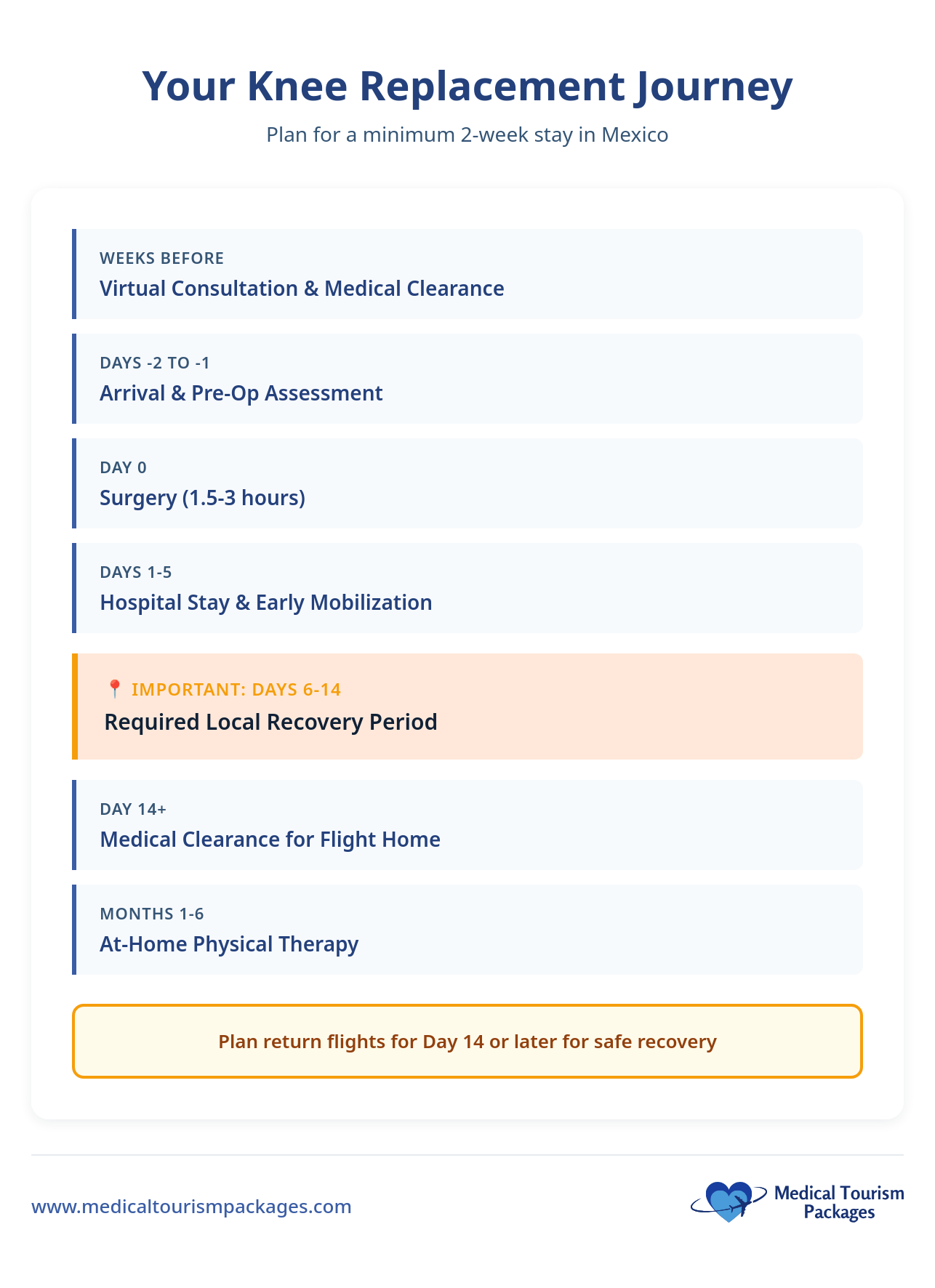
The 10-to-14 day stay in Mexico before flying home is non-negotiable and potentially life-saving. After knee replacement, you face elevated risk for deep vein thrombosis (DVT) and pulmonary embolism (PE), and prolonged air travel further raises clot risk through immobility, cabin pressure changes, and dehydration. Your surgeon must personally clear you for flight after confirming anticoagulation is therapeutic, mobility has improved, and the surgical site is healing without complication.
How Do You Choose the Right Knee Surgeon in Mexico?
The surgeon you choose has more bearing on your outcome than which city you fly into. Mexican orthopedic surgeons certified by the Mexican Council of Orthopedics and Traumatology (Consejo Mexicano de Ortopedia y Traumatología, or CMOT) have completed a 4-year orthopedic residency and passed national board exams. The strongest joint-reconstruction specialists also hold US or European fellowships.
Credentials Checklist
- CMOT board certification: ask for the surgeon’s Mexican Council of Orthopedics and Traumatology certificate number; the council publishes a searchable directory.
- Joint-reconstruction fellowship: US, Canadian, or European fellowship training in adult joint reconstruction signals depth on knee and hip work.
- Annual case volume: 50 to 100+ knee replacements per year is associated with stronger outcomes in registry data.
- Hospital privileges at a JCI-accredited facility: a useful proxy for credentialing rigor.
- Telemedicine consultation before booking: reputable surgeons offer free pre-travel video consults so you can assess communication, ask about case volume, and walk through the surgical plan.
Questions to Ask Before Booking
- How many total knee replacements did you perform last year, and how many were revisions versus primary cases?
- What is your 90-day infection rate, and how do you handle a deep joint infection if one occurs?
- What implant manufacturers and models do you use, and why?
- What is your DVT-prophylaxis protocol, and what anticoagulant will I take during the in-country recovery and the flight home?
- What telemedicine follow-up do you offer after I return home, and for how long?
What Does the Knee Replacement Journey Look Like in Mexico?
Pre-Travel Phase (4 to 8 Weeks Out)
- Submit recent knee X-rays, MRI (if available), and a brief medical history to your selected hospital’s international patient department.
- Complete a video consult with the surgeon and a separate review with the international patient coordinator.
- Receive a written, itemized package quote covering surgery, hospital stay, and follow-up.
- Arrange flights, recovery-hotel reservations, companion travel, and home-country physical therapist for post-return rehab.
Pre-Operative Assessments in Mexico (2 to 3 Days Before Surgery)
| Assessment | Purpose |
|---|---|
| Blood tests (CBC, comprehensive metabolic panel, type and screen) | Confirm fitness for surgery, screen for anemia and infection |
| Bilateral knee X-rays (and MRI if soft-tissue concern) | Finalize implant size and surgical plan |
| ECG if cardiac history | Anesthesia clearance |
| In-person surgeon and anesthesiologist consultation | Review plan, choose anesthesia (general, spinal, or regional) |
Surgery Day
The procedure typically runs 1.5 to 3 hours. You will receive spinal anesthesia (numb from the waist down, awake) or general anesthesia based on your surgeon and anesthesiologist’s joint recommendation. The implant is inserted, the incision is closed, and you are transferred to recovery for monitoring.
Hospital Stay (3 to 5 Days)
- Day 1: pain control, first supervised walk with a walker
- Days 2-3: graduated walking, in-room physical therapy twice daily, anticoagulant prophylaxis
- Days 3-5: stair training, wound check, discharge planning
In-Country Recovery (Days 5 to 14)
You will recover at a hospital-affiliated recovery hotel or service apartment, with continued outpatient physical therapy and daily wound checks. Your surgeon issues written flight clearance once anticoagulation, mobility, and wound status are confirmed.
Flight Logistics from the US and Canada
| From | To Mexico City (MEX) | To Cancún (CUN) | To Monterrey (MTY) |
|---|---|---|---|
| Miami (MIA) | 3.75 hrs / $280–$550 | 2.75 hrs / $280–$500 | 3.75 hrs / $300–$550 |
| New York (JFK) | 5.5 hrs / $320–$650 | 4.25 hrs / $320–$600 | 4.75 hrs / $380–$680 |
| Houston (IAH) | 2.5 hrs / $250–$500 | 2.5 hrs / $250–$480 | 1.75 hrs / $270–$480 |
| Los Angeles (LAX) | 3.75 hrs / $280–$550 | 4.75 hrs / $300–$580 | 3.0 hrs / $280–$520 |
US, Canadian, and UK citizens do not need a visa to enter Mexico for medical care. A valid passport is required. The Mexican peso (MXN) is the local currency, but US dollars are widely accepted at international hospitals and most tourist-area businesses.
What Is Recovery Like After Knee Replacement in Mexico?
Recovery follows a phased timeline that balances early mobilization with protection of the implant. Most patients walk with assistance within 24 hours, transition to a cane around 3 weeks, and return to low-impact activities like golf or cycling by 12 weeks. Full recovery extends 6 months to a year. Per the National Joint Registry 20th Annual Report, modern implants are designed to last well beyond 15 years, with 95.4% surviving past that mark.
| Recovery Phase | Time Range | Objectives | Restrictions |
|---|---|---|---|
| Immediate post-op | 24–48 hours | Pain control, first walk with assistance, start anticoagulation | Bed and chair only without supervision |
| Hospital stay | Days 3–5 | In-hospital physical therapy, wound care, stair training | Walker or crutches required |
| In-country recovery | Days 5–14 | Outpatient PT, DVT prevention, flight clearance evaluation | No flights until written surgeon clearance |
| Early home rehab | Weeks 2–6 | Independent walking, range of motion goal 0 to 110 degrees | Low-impact activity only |
| Intermediate rehab | Weeks 6–12 | Return to driving, light daily activities | Avoid high-impact loads |
| Long-term recovery | Months 3–12 | Return to golf, cycling, swimming; restore strength | High-impact sports limited indefinitely |
Extended Physical Therapy After You Return Home
The Mexican package typically covers your initial 5 supervised physical therapy sessions during the hospital stay and the in-country recovery window. Plan for 4 to 8 weeks of continued PT at home (some patients benefit from 3 to 4 months), at $75 to $200 per session in the United States. Total extended PT typically runs $2,500 to $7,000 depending on duration and intensity. Arrange your home-country physical therapist before you leave for Mexico so therapy starts within the first week back.
Follow-Up Care with Your Mexican Surgeon
| Timeframe | Type | Focus |
|---|---|---|
| Days 5–14 (in country) | In-person daily checks | Wound, mobility, DVT prevention, flight clearance |
| Week 6 post-op | Telemedicine | Range of motion, PT progress check |
| Months 3, 6, 12 post-op | Telemedicine | Long-term progress; imaging review if requested |
Warning Signs Requiring Immediate Local Medical Attention
- Fever above 101°F (38.3°C), spreading redness around the incision, warmth, or drainage (possible infection)
- Severe uncontrolled pain that does not respond to prescribed pain medication
- Sudden calf swelling or tenderness, chest pain, or shortness of breath (possible DVT or pulmonary embolism; call emergency services immediately)
What Are the Advantages and Disadvantages of Knee Replacement in Mexico?
| Factor | Advantage | Disadvantage |
|---|---|---|
| Cost | $8,000–$15,000 in Mexico vs $20,000–$50,000 in the US (~70% savings) | Out of pocket; rarely covered by US insurance plans |
| Travel time | 1.75 to 5.5 hours by air from major US cities; ground access at Tijuana | Mandatory 10 to 14 day in-country stay before flight clearance |
| Hospital quality | 8 JCI-accredited hospitals; same FDA-approved implants as US | Some Tijuana facilities lack JCI verification; always recheck the JCI directory |
| Surgeon access | Many CMOT-certified surgeons hold US or European joint-reconstruction fellowships; English-speaking patient coordinators are standard | Continuity with your usual US or Canadian orthopedist requires deliberate coordination |
| Wait times | Surgery typically scheduled within weeks of inquiry | You build the trip around two phases (consult plus surgery, often combined) |
| Recovery setting | Beach and resort options in Cancún or Puerto Vallarta; major-city options in Mexico City and Monterrey | Home-country PT must be arranged in advance for the post-return weeks |
Is Mexico the Right Choice for Your Knee Replacement?
| Patient Type | Decisive Factor | Mexico Fit |
|---|---|---|
| US patient with no insurance or a high deductible | Cost | Strong: $8K–$15K vs $40K–$80K total US out of pocket |
| Canadian patient on a public waitlist | Wait time | Strong: surgery within weeks rather than 6 to 18 months |
| Patient with complex cardiac, immunocompromised, or anticoagulation history | Risk profile | Possible at high-volume Mexico City or Monterrey centers; coordinate carefully with home physician |
| Patient needing revision of a failed prior implant | Surgical complexity | Possible at high-volume centers; expect a 1.3x to 1.8x price premium |
| Patient near the US-Mexico border (California, Arizona, Texas) | Geographic convenience | Strong: Tijuana and Monterrey accessible by ground or short flight |
| Patient who values continuity with home orthopedist | Continuity | Weaker fit unless you arrange shared-care follow-up with your usual surgeon |
If you want to weigh Mexico against other Latin American destinations, compare these two well-documented alternatives: knee replacement in Panama at $7,000-$12,000 with Johns Hopkins and Tulane-affiliated hospitals, and knee replacement in Colombia at $7,000-$12,500 with several JCI-accredited centers in Bogotá and Medellín. For background on the full Mexico medical-tourism landscape, see our complete guide to medical tourism in Mexico and our hub of advanced orthopedic procedures.
Ready to Start Your Knee Replacement Journey in Mexico?
Knee replacement surgery in Mexico costs $8,000 to $15,000 at JCI-accredited hospitals with surgeons trained on the same implants and protocols used in US operating rooms. The 10-to-14 day in-country recovery is non-negotiable, but the trip pays for itself many times over for most North American patients. Talk to a medical tourism coordinator to request a free written quote, schedule a video consultation with a CMOT-certified knee surgeon, and compare two or three Mexican hospitals (or weigh Mexico against our Panama and Colombia knee replacement guides) before you commit. Your path to a pain-free knee starts with one conversation.
What Questions Do Patients Ask Most Often About Knee Replacement in Mexico?
Is knee replacement surgery in Mexico as safe as in the US or Canada?
Yes, when you choose a JCI-accredited hospital with a CMOT board-certified surgeon. JCI audits Mexican facilities against the same patient-safety, infection-control, and outcome standards applied to US hospitals. The implants are FDA-approved Zimmer Biomet, Stryker, or DePuy Synthes components, identical to those used in US operating rooms. The National Joint Registry 20th Annual Report records 96.7% implant survival at 10 years on these implants.
How much does knee replacement cost in Mexico compared with the US?
Total knee replacement in Mexico runs $8,000 to $15,000 USD all-in for the typical package. The same procedure averages $20,000 to $50,000 in the US per Healthline and American Academy of Orthopaedic Surgeons benchmarks, with many patients paying $40,000 to $80,000 once hospital fees, anesthesia billing, and physical therapy are added. Mexico’s savings of roughly 70% reflect lower labor costs, government-regulated implant pricing, and integrated all-inclusive packages rather than the US fee-for-service model.
Will my insurance cover knee replacement surgery in Mexico?
Most US and Canadian plans do not cover elective surgery performed outside your home country. A growing number of self-funded employer plans now reimburse medical travel, and Medicare Advantage carriers like Aetna and Cigna list select Mexican hospitals (including Hospital ABC in Mexico City) in their international networks. Contact your insurer directly to confirm coverage. Even without reimbursement, Mexico’s pricing often beats meeting a US plan’s high deductible plus copays.
How do I verify my surgeon’s credentials and experience?
Request documentation of CMOT (Consejo Mexicano de Ortopedia y Traumatología) board certification, fellowship training in joint reconstruction (US, Canadian, or European), and the surgeon’s annual volume of knee replacement cases. Look for 50 to 100 or more knee replacements per year. Reputable surgeons welcome a video consultation where you can ask about complication rates, infection protocols, and revision experience. Confirm the surgeon holds privileges at a JCI-accredited hospital.
Can I bring a family member or friend with me?
Yes, and most patients do. A companion handles luggage, transport between the hospital and the recovery hotel, and the practical demands of the 10-to-14 day in-country window. Hospital international patient departments typically reserve a companion bed in your room and arrange recovery-hotel rooms that accommodate two. Plan for your companion’s flight, lodging, and meals when budgeting.
What happens if I have complications after returning home?
Before leaving Mexico you receive a complete surgical record, operative report, anticoagulant prescription, and your surgeon’s direct contact details. Most Mexican joint-reconstruction surgeons offer telemedicine follow-up for 6 to 12 months. Arrange a home-country primary care physician and physical therapist before traveling so they can manage routine follow-up, wound checks, and any complication that requires in-person care. For emergencies, contact local services first, then notify your Mexican surgical team.
Do doctors and hospital staff speak English?
At medical tourism hospitals, yes. International patient departments at Hospital ABC, Hospital Galenia, Hospital Ángeles Pedregal, and Christus Muguerza employ English-speaking patient coordinators and English-fluent surgeons. Hospital-level English fluency at the top Mexican medical tourism hospitals averages around 84% per industry surveys. You will typically be assigned a dedicated coordinator who acts as your single point of contact for scheduling, billing, and post-operative communication.
How soon after surgery can I fly home?
You must wait a minimum of 10 to 14 days after surgery, and only after your surgeon issues written flight clearance. Air travel sooner significantly raises the risk of deep vein thrombosis and pulmonary embolism, which can be fatal. Your surgeon evaluates healing, anticoagulation status, and mobility before approving flight. During the flight, wear medical-grade compression stockings, continue prescribed anticoagulant, drink water, and do ankle pumps every 30 to 60 minutes.
What’s included in the surgery package price?
Standard packages cover surgeon and anesthesiologist fees, operating room, FDA-approved implant, 3 to 5 night hospital stay, in-hospital medications, the first 5 supervised physical therapy sessions, and follow-up consults during the in-country recovery window. Not included: extended outpatient PT ($2,500 to $7,000), recovery-hotel accommodation beyond the hospital ($500 to $1,500), companion travel and lodging, and any extended hospital care driven by complications. Always request a written, itemized quote.
How does Mexico compare with Costa Rica, Colombia, or Panama for knee replacement?
Costa Rica ($8,000 to $14,900) and Mexico ($8,000 to $15,000) are nearly identical on price, with Costa Rica offering JCI-accredited hospitals in San José and Mexico offering border access and the broadest hospital network. Panama ($7,000 to $12,000) typically prices lower and offers Johns Hopkins and Tulane affiliations at Pacífica Salud and Clínica San Fernando. Colombia ($7,000 to $12,500) also prices lower and brings several JCI-accredited centers in Bogotá, Medellín, and Cali. See our knee replacement in Panama and knee replacement in Colombia guides for a side-by-side comparison.