Book Appointment Now

Breast Augmentation in Latin America: Costs, Safety, and Recovery Guide
 By
By
Breast augmentation in Latin America costs $3,000 to $7,500, 50 to 70 percent below US prices, with board-certified surgeons and JCI-accredited hospitals.
Colombia, Mexico, Costa Rica, and Panama offer breast augmentation from $3,000 to $7,500 versus $6,000 to $12,000 in the United States, per ASPS 2024 fees. Patients use the same FDA-approved implants from Allergan, Mentor, and Motiva at JCI-accredited hospitals like Pacífica Salud.
Medical Tourism Packages connects you with board-certified surgeons across Medellín, Mexico City, San José, and Panama City, each verified for JCI accreditation, board certification through bodies like the SCCP and CMCPER, and international affiliations such as Johns Hopkins Medicine. Below you will find cost comparisons by country, implant options, surgeon-vetting steps, recovery timelines, safety data, and answers to common breast augmentation questions.
What Is Breast Augmentation in Latin America?
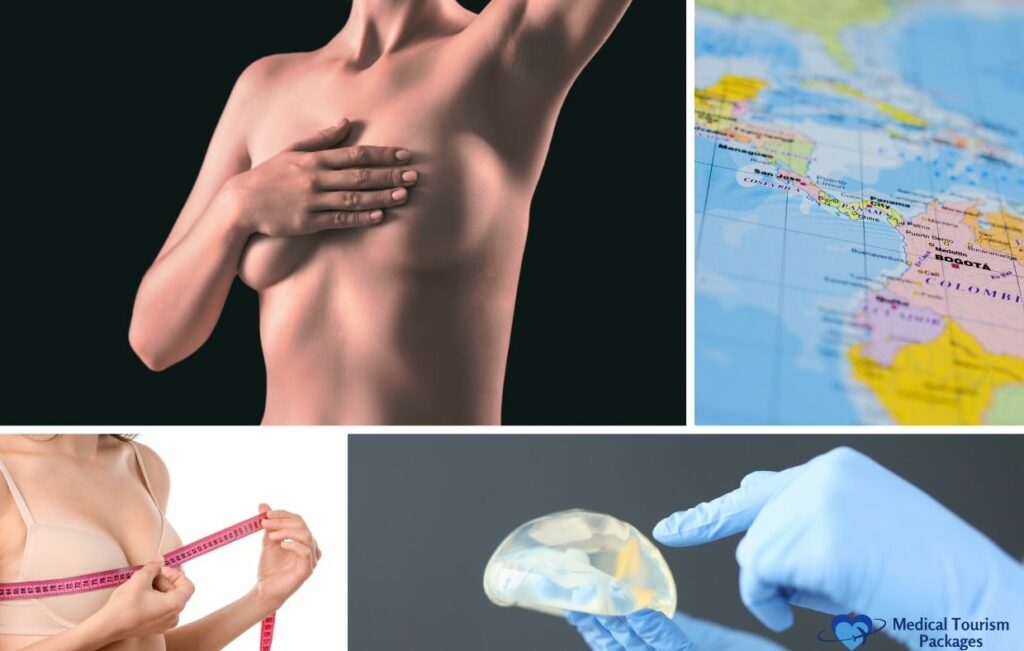
Breast augmentation in Latin America is implant or fat-transfer surgery that increases breast size and shape, performed in Colombia, Mexico, Costa Rica, and Panama at prices 50 to 70 percent below US costs.
The surgery places silicone or saline implants behind the breast tissue or chest muscle. It takes one to three hours and is done as outpatient surgery, so you return to your recovery accommodation the same day. Women choose it for cosmetic enhancement, reconstruction after mastectomy, or to correct natural asymmetry. A median patient-satisfaction rate near 86 percent is reported in ASPS 2023 procedural statistics covering more than 300,000 procedures and a peer-reviewed patient-satisfaction review.
The region pairs lower cost with strong credentials. Many surgeons hold board certification from recognized bodies like ASPS or ISAPS, several hospitals carry Joint Commission International (JCI) accreditation, and patients use the same FDA-approved implants sold in North America, including Allergan, Mentor, Motiva, and Sientra.
Why Choose Latin America for Breast Augmentation?
You choose Latin America for breast augmentation because it cuts cost by 50 to 70 percent while keeping board-certified surgeons, FDA-approved implants, and JCI-accredited hospitals. A procedure that costs $6,000 to $12,000 in the United States runs roughly $3,000 to $7,500 across the region.
The savings hold up because the region has built a mature cosmetic-surgery sector, not because corners are cut. Colombia, Mexico, Costa Rica, and Panama each treat international patients every year through dedicated patient departments at accredited hospitals. The four advantages that matter most to patients are cost, surgeon credentials, implant access, and English-speaking coordination.
- Cost savings: $3,000 to $7,500 in the region versus $6,000 to $12,000 in the United States, a 50 to 70 percent reduction
- Qualified surgeons: board certification through national bodies plus ASPS or ISAPS membership at leading clinics
- FDA-approved implants: access to Allergan, Mentor, Motiva, and Sientra devices
- English-speaking care: bilingual coordinators and surgeons at international-patient departments
What Types of Breast Implants Are Available in Latin America?
Surgeons in Latin America offer four options: saline implants, silicone gel implants, form-stable gummy bear implants, and fat-transfer augmentation. Each suits a different body type, budget, and feel preference, and all use the same FDA-approved devices sold in the United States.
Here is how the four options compare on feel, cost, and best fit:
| Implant Type | Feel | Cost Impact | Best Fit For |
|---|---|---|---|
| Saline | Firmer; more rippling | Most affordable | Budget-conscious patients; smaller incisions |
| Silicone gel | Natural; least rippling | Mid-range | Most patients seeking a natural look |
| Gummy bear (form-stable) | Firmest; best shape retention | Adds $500 to $1,500 | Patients wanting the longest-lasting results |
| Fat transfer | Most natural; your own tissue | Varies; no implant | Modest, 1 to 2 cup-size increase, no foreign material |
Saline implants hold sterile saltwater in a silicone shell and are safe if they rupture, since the body absorbs the saline. Silicone gel is the most popular choice and mimics natural tissue, but it needs MRI monitoring every two to three years to detect silent ruptures. Gummy bear implants hold their shape even if the shell breaks; Motiva reports a capsular-contracture rate of 0.54 percent in a published review of nearly 5,000 implant patients, and its FDA three-year primary-augmentation trial showed about 0.5 percent.
Fat Transfer: Breast Augmentation Without Implants
Fat-transfer augmentation uses your own fat, harvested by liposuction, then purified and injected into the breasts. It is the option for patients who want no foreign material, offering the most natural feel and contouring a donor area at the same time.
The tradeoff is size. Results are modest, with a one to two cup-size increase, and only 50 to 70 percent of transferred fat survives long-term because the body reabsorbs the rest. Fat transfer works best for patients who want a small change without implants and have enough donor fat to harvest. Some surgeons combine fat transfer with a small implant for added volume.
How Much Does Breast Augmentation Cost in Latin America?
Breast augmentation costs $3,000 to $7,500 across Latin America, versus $6,000 to $12,000 in the United States according to ASPS 2024 average fees. Prices below cover the surgeon fee, facility fee, anesthesia, and standard implants. Premium implants add $500 to $1,500.
Here is how breast augmentation cost compares by country against the US baseline:
| Country | Price Range (USD) | Savings vs US | Source |
|---|---|---|---|
| Colombia | $4,000-$7,500 | up to ~67% | TuColombiaOnline 2025 pricing |
| Mexico | $3,000-$5,500 | up to ~75% | MedicalTourismCo Mexico |
| Costa Rica | $3,500-$5,000 | ~17-71% | UniversalMedicalTravel Costa Rica |
| Panama | $3,000-$5,500 | ~8-75% | Medical Tourism Packages Panama |
| United States | $6,000-$12,000 | Baseline | ASPS 2024 average fees |
Mexico and Panama hold the lowest verified ranges at $3,000 to $5,500, while Colombia runs roughly $4,000 to $7,500 per 2025 TuColombiaOnline pricing. In Mexico, cost varies by city: Tijuana sits at the low end due to its border location and high volume, while resort cities like Cancún command more. For full details on each destination, see the country guides below.
- Breast Augmentation in Colombia
- Breast Augmentation in Mexico
- Breast Augmentation in Costa Rica
- Breast Augmentation in Panama
What Is Included in the Quoted Price?
The quoted price usually covers the surgeon fee, implants, anesthesia, operating-room and facility fees, standard pre-op labs, a surgical garment, and initial follow-up visits. International flights, hotels, and complication costs are typically separate.
- Included: surgeon fee, implants, anesthesia, facility fee, standard labs, surgical garment, initial follow-ups
- Usually extra: flights, hotel and recovery stay, premium implants ($500 to $1,500), revision beyond warranty, companion costs
How Do You Select a Qualified Surgeon in Latin America?
You select a qualified surgeon by confirming board certification, checking the national plastic-surgery registry, and verifying hospital privileges at an accredited facility. Each country sets its own requirements, and certification is legally required to operate in Mexico.
- Colombia: Sociedad Colombiana de Cirugía Plástica (SCCP) certification
- Mexico: CMCPER certification is legally required; it demands six years of medical school, three to four years of general surgery, two to three years of plastic surgery, and re-certification every five years
- Costa Rica: ACCPRE board certification and CRCPS registration
- Panama: board certification in plastic surgery plus ISAPS or ASPS membership
Verification Steps
Never trust credentials without independent checks. Follow these four steps before you book:
- Request the certification number and specialty license number
- Verify it through the official board registry for that country
- Confirm hospital privileges at an accredited facility
- Ask how many procedures the surgeon performs each year (100 or more signals high volume)
Red Flags
Avoid surgeons who refuse to share certification numbers, carry unverifiable credentials, claim certification is pending, operate outside established facilities, or use pressure tactics and pricing that looks too low to be real.
What Should You Know About Latin American Hospitals and Clinics?
You should confirm the facility holds JCI accreditation or operates within a JCI-accredited hospital, since facility quality matters as much as surgeon credentials. Each country also enforces its own licensing rules to protect patient safety.
Accredited hospitals and licensed surgical clinics across the four countries include the following facilities:
| Country | Facilities | Notable Credential |
|---|---|---|
| Mexico | Hospital San José TecSalud (Monterrey), Hospital Ángeles Pedregal and Médica Sur (Mexico City), Hospital Galenia (Cancún) | Galenia holds JCI accreditation |
| Panama | Pacífica Salud (Panama City) | JCI-accredited since 2011; Johns Hopkins Medicine International affiliation |
| Costa Rica | Hospital CIMA San José, Hospital Clínica Bíblica | Private accredited hospitals in San José |
| Colombia | Fundación Santa Fe de Bogotá, Hospital Pablo Tobón Uribe (Medellín) | Internationally certified hospitals |
Regulatory Requirements
Each country runs a regulator that licenses facilities and devices. These bodies enforce safety rules you can check before you travel:
- Mexico: COFEPRIS authorization is mandatory; it closed 78 facilities in 2023 for violations
- Colombia: INVIMA device registration and Ministry of Health oversight
- Costa Rica: Ministry of Health regulation with strict safety rules
- Panama: Ministry of Health licensing and compliance
What Is the Recovery Timeline After Breast Augmentation in Latin America?
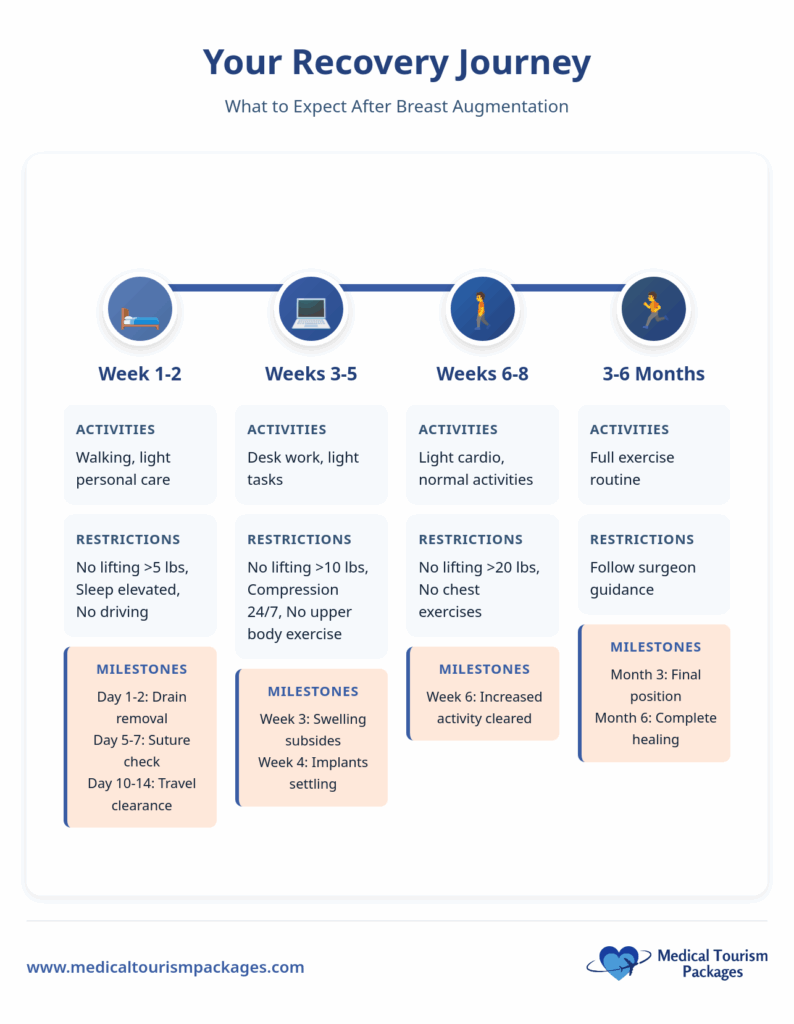
Recovery follows predictable phases over three to six months. You walk the same day, return to desk work in three to five weeks, and resume full exercise by three months. Plan to stay in-country 10 to 14 days for follow-ups before flying home.
This week-by-week timeline shows activities, restrictions, and milestones:
| Timeframe | Activities | Restrictions | Milestones |
|---|---|---|---|
| Week 1-2 | Walking, light personal care | No lifting over 5 lbs; sleep elevated; no driving on pain meds | Days 1-2: first follow-up, drain removal; Days 5-7: suture check; Days 10-14: travel clearance |
| Weeks 3-5 | Desk work, light tasks | No lifting over 10 lbs; compression garment 24/7; no upper-body exercise | Week 3: swelling subsides; Week 4: implants settling |
| Weeks 6-8 | Light cardio, normal activities | No lifting over 20 lbs; no chest exercises | Week 6: increased activity cleared |
| 3-6 Months | Full exercise | Follow surgeon guidance | Month 3: final position; Month 6: complete healing |
Pain management includes prescribed medication for three to seven days, regional nerve blocks giving 24 to 48 hours of relief, ice packs for the first 48 hours, an elevated sleeping position for two weeks, and compression garments for four to six weeks.
Follow-Up Care and Flying Home
Plan to stay in-country 10 to 14 days to complete two to three in-person appointments before you fly. After returning home, you submit weekly photos for three weeks, give monthly updates, and keep 24/7 emergency contact. Arrange a local follow-up surgeon before you travel, because many will not manage another surgeon’s complications.
What Are the Risks and Safety Considerations?
Breast augmentation is generally safe at accredited facilities, but every surgery carries risk. The most common complications are capsular contracture, infection, hematoma, implant rupture, and asymmetry. Choosing a board-certified surgeon and an accredited hospital lowers these risks.
This table shows typical complication rates and how each is treated:
| Complication | Reported Rate | Treatment | Notes |
|---|---|---|---|
| Infection | 1-2% | Antibiotics; possible implant removal | Most appear within two weeks |
| Capsular contracture | 4.1% to 37% (varies by implant; 0.54% with Motiva) | Surgery for severe cases | Smooth implants and prepectoral placement raise the rate |
| Hematoma/seroma | 3-5% | Drainage procedure | Usually develops in the first week |
| Implant rupture | under 1% per year | Replacement surgery | Silicone requires MRI monitoring |
| Asymmetry | 8-12% | Revision surgery if significant | Some asymmetry is normal |
Capsular-contracture estimates vary widely by implant and technique. A 2025 Aesthetic Surgery Journal systematic review reports a 10 to 37 percent range, the FDA postmarket study documents 4.1 percent grade III or IV at 10 years, and a published Motiva review of nearly 5,000 patients reports 0.54 percent. For implant rupture, FDA data shows under 1 percent per year with modern devices.
Distance from your surgeon is the biggest medical-tourism risk if a complication develops. Published medical-tourism complication data indicates that among patients who need treatment after returning home, about 36.8 percent require hospitalization and 51.8 percent need surgery, with treatment often taking two months or more. Home physicians are frequently unfamiliar with techniques used abroad, and the cost falls on you, which can erase the initial savings.
Who Should Avoid Traveling for Surgery?
Some medical conditions make travel for surgery dangerous no matter the savings. You should stay local if you have any of these absolute contraindications, and proceed with extra caution if you have the risk factors that follow.
- Avoid travel entirely: active infection or cancer, uncontrolled diabetes, severe heart or lung disease, pregnancy or breastfeeding, blood-clotting disorders
- Extra caution: BMI over 35, active smoking, previous chest radiation, keloid scarring tendency, mental-health conditions affecting expectations
Can You Combine Procedures with Breast Augmentation in Latin America?
Yes, many patients combine breast augmentation with other surgery in one operation. The mommy makeover, which pairs augmentation with a tummy tuck and sometimes a breast lift, is the most popular combination and costs far less than separate US procedures.
In Mexico, mommy-makeover packages run about $9,700 to $9,900 versus $15,000 to $25,000 in the United States, a 50 to 60 percent saving. Combining surgery means one recovery period, one international trip, and consolidated time off work. The tradeoff is a longer four to six hour operation, a more complex recovery across multiple surgical sites, a two to three week minimum stay, higher risk than a single procedure, and more home support afterward.
What Are the Long-Term Considerations After Getting Implants?
Breast implants are not lifetime devices and need ongoing monitoring wherever you have surgery. They typically last 10 to 20 years, require periodic imaging, and most come with a manufacturer warranty you must register to keep active.
Replacement timing and monitoring depend on the implant type:
- Saline: 10 to 15 years typical
- Silicone: 15 to 20 years average; MRI screening at 5 to 6 years, then every 2 to 3 years to catch silent ruptures
- Gummy bear: 15 to 25 years expected
- Individual variation: some last 30 years or more, others fail within 5
Beyond replacement, you need mammograms with a modified technique for implants, monthly self-exams, and annual clinical breast exams. FDA-approved implants include free replacement for rupture, ranging from 10 years to lifetime by brand, plus $1,200 to $2,500 toward surgery fees. You must register the implants within 45 days to activate that warranty.
How Does Each Latin American Country Compare?
Each destination fits a different priority. Mexico and Panama offer the lowest verified prices, Colombia has the deepest cosmetic-surgery sector, and Costa Rica is known for transparent pricing and quick airport access. The table below compares cost and strengths.
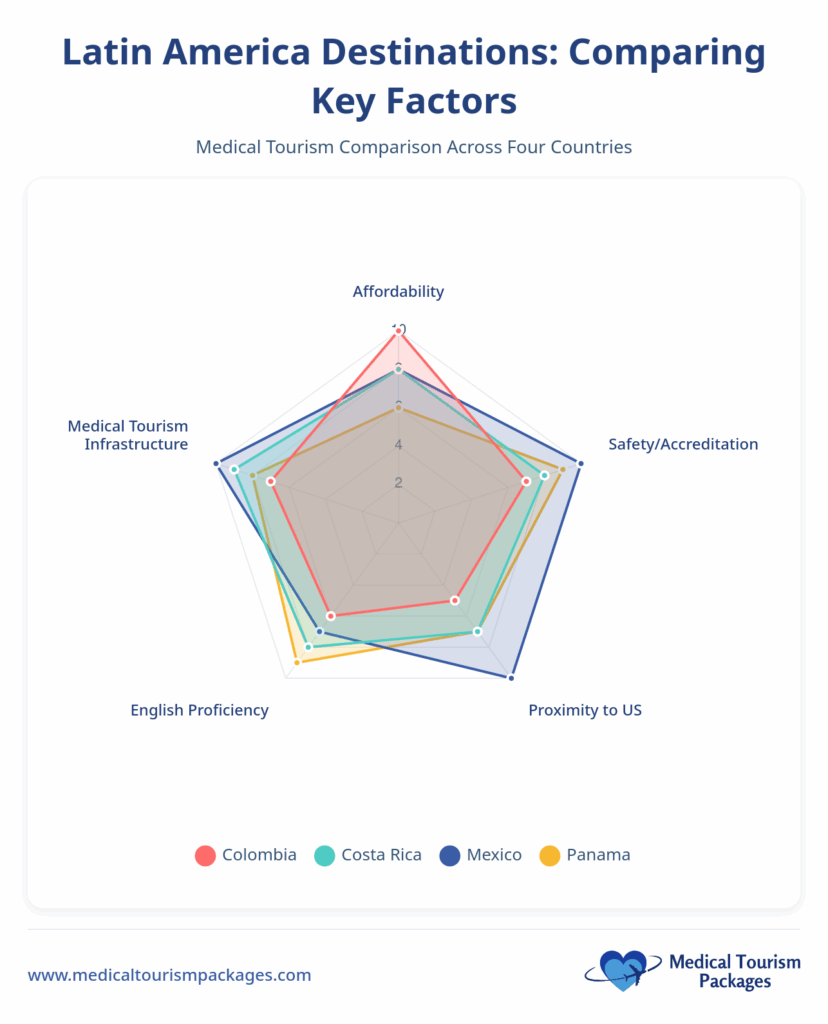
| Country | Cost Range (USD) | Key Advantages | Notable Features |
|---|---|---|---|
| Colombia | $4,000-$7,500 | Deepest cosmetic-surgery sector; up to ~67% savings | Bilingual patient coordination; recovery in Medellín and Bogotá |
| Mexico | $3,000-$5,500 | Lowest verified prices; geographic proximity | JCI-accredited hospitals; Tijuana and Monterrey medical hubs |
| Costa Rica | $3,500-$5,000 | Transparent pricing; airport 20 minutes from clinics | Private accredited hospitals in San José; strong public-health base |
| Panama | $3,000-$5,500 | Johns Hopkins affiliation; English-speaking staff common | JCI-accredited Pacífica Salud; uses the US dollar; close to North America |
For surgeon options, facility details, and planning guidance for each destination, use the country guides linked in the cost section above.
Frequently Asked Questions About Breast Augmentation in Latin America
How long do I need to stay in Latin America after breast augmentation?
Plan for at least 10–14 days to complete follow-ups: days 1–2 for initial assessment and possible drain removal, days 5–7 for suture checks, and days 10–14 for final clearance to travel. Leaving earlier raises complication risks during travel and may void certain warranties or support agreements with your surgical team.
What happens if I develop complications after returning home?
This is a critical consideration for medical tourists. About 36.8% of patients with complications require hospitalization and 51.8% need surgery. Many home physicians are unfamiliar with techniques used abroad and may hesitate to treat another surgeon’s patient. Arrange a local surgeon for follow-up before you travel. All costs for treating complications are your responsibility and can erase any initial savings.
Do I need to speak Spanish to get breast augmentation in Latin America?
Not necessarily. Most established medical tourism facilities employ bilingual staff and coordinators who speak fluent English. Surgeons at internationally certified centers often trained in English-speaking countries and communicate effectively with foreign patients, and many hospitals offer translation services. Basic Spanish phrases or a translation app still help for restaurants, pharmacies, and transportation outside the clinic.
How do I pay for breast augmentation in Latin America, and what payment methods are accepted?
Most facilities require a 30–50% deposit to secure your date, with the balance due before surgery. Commonly accepted methods include international wire transfers, credit cards (often with a 3–5% processing fee), and sometimes cash in U.S. dollars. Avoid clinics that demand full payment far in advance or only accept untraceable methods. Always request itemized written quotes that specify exactly what’s included.
Can I bring a companion with me, and should I?
Yes, bringing a companion is strongly recommended. They can help with practical tasks during the first 48 to 72 hours, attend post-op visits to hear instructions, assist with communication if issues arise, and provide emotional support. Most packages can accommodate companions for an added cost, and some facilities offer companion discounts or include one companion in the price.
What’s actually included in the quoted price for breast augmentation?
Standard packages usually include surgeon fees, facility and anesthesia fees, standard implants, compression garments, prescribed medications, and 2–3 follow-up appointments during your stay. Common exclusions: premium implants (add roughly $500–$1,500), lodging beyond a recovery house, flights, pre-op testing if done separately, treatment of complications requiring additional surgery, and extended stays. Request an itemized quote that specifies inclusions and exclusions.
When is it safe to fly home after breast augmentation?
Most surgeons clear patients for air travel 10 to 14 days after surgery, depending on healing and any complications. Flying too early increases risks such as blood clots and potential implant displacement from cabin pressure changes, and you may lack access to urgent care mid-flight. Book flexible or refundable tickets, since your true clearance date is confirmed at your final appointment.
How do I verify a surgeon’s credentials before booking my procedure?
Request the surgeon’s certification and specialty license numbers and verify them through official registries (e.g., Mexico: CMCPER; Colombia: SCCP; Costa Rica: ACCPRE; Panama: ISAPS or ASPS membership). Cross-check international directories like ASPS.org or ISAPS.org, confirm hospital privileges (ideally at JCI-accredited facilities), and search for any disciplinary actions. Legitimate surgeons welcome verification; refusal to provide verifiable credentials is a red flag.
Ready to Start Your Breast Augmentation Journey in Latin America?
Medical Tourism Packages coordinates breast-augmentation medical travel in Colombia, Mexico, Costa Rica, Panama, and Argentina.
Contact us today for a free consultation, transparent breast augmentation pricing, and a personalized Latin America medical tourism package.