Book Appointment Now

Blepharoplasty in Mexico: Costs, Surgeons & Travel Guide
 By
By
Blepharoplasty in Mexico costs $1,200 to $3,500, compared to $3,200 to $14,000 in the US, delivering 50 to 75 percent savings with CMCPER-certified surgeons and JCI-accredited hospitals.
Mexico’s CMCPER-certified plastic surgeons perform eyelid surgery at JCI-accredited hospitals in Tijuana, Mexico City, and Cancún. Combined blepharoplasty costs $1,750 to $3,500 (60 to 75 percent less than US prices of $7,000 to $14,000), with Hospital Médica Sur in Mexico City holding a Mayo Clinic Care Network affiliation.
Our verified surgeons work at AAAASF-certified clinics like VIDA Wellness and Beauty in Tijuana and JCI-accredited facilities including Hospital Médica Sur in Mexico City and Hospital San José TecSalud in Monterrey. Below, you will find cost tables, city comparisons, surgeon credentials, recovery timelines, and answers to the most common questions about eyelid surgery in Mexico.
What Is Blepharoplasty, and Who Is It For?
Blepharoplasty is eyelid surgery that removes excess skin, muscle, and fat to refresh tired-looking eyes and, in some cases, improve vision. It treats drooping upper lids, puffy under-eye bags, and loose skin. Good candidates are healthy adults with realistic goals.
You can learn more about the procedure on our eye lift and blepharoplasty overview page. Blepharoplasty ranked as the world’s most performed cosmetic surgical procedure in 2024, according to the International Society of Aesthetic Plastic Surgery (ISAPS), with more than 2.1 million procedures performed globally. Upper blepharoplasty corrects hooded lids through incisions hidden in the natural crease. Lower blepharoplasty targets bags and loose skin using external or transconjunctival incisions.
What Is the Difference Between Upper and Lower Blepharoplasty?
Upper blepharoplasty removes excess skin from the upper lids to open the eye, while lower blepharoplasty reduces under-eye bags and loose skin. A combined procedure treats both areas in one session. Each technique uses different incisions, recovery times, and target concerns.
Here is how the three approaches compare:
| Feature | Upper Eyelid | Lower Eyelid | Combined |
|---|---|---|---|
| Main Goal | Open hooded or droopy upper lids | Reduce bags, puffiness, loose skin | Refresh upper and lower lids together |
| Incision Location | Hidden in the natural upper crease | Below the lash line or inside the lid | Both upper crease and lower lid |
| Anesthesia | Local with sedation | Local with sedation or general | Local with sedation or general |
| Duration | 45 to 60 minutes | 1 to 2 hours | 2 to 3 hours |
| Downtime | 7 to 10 days | 10 to 14 days | 10 to 14 days |
What Non-Surgical Alternatives Should You Try Before Surgery?
You can try several non-surgical treatments before choosing surgery, especially for mild eyelid aging. Botox, hyaluronic fillers, and laser resurfacing soften lines and add volume, but they cannot remove excess skin or fat. Discuss these options with your surgeon during your consultation.
These treatments address mild signs but do not replace surgery:
- Botox brow lift: Relaxes muscles for a subtle lift and softens crow’s feet, lasting 3 to 4 months
- Hyaluronic acid fillers: Fill tear-trough hollows under the eyes, lasting 6 to 18 months
- Laser resurfacing: Tightens skin and reduces fine lines around the eyes, lasting 12 to 18 months
- Radiofrequency or Ultherapy: Non-surgical skin tightening best suited for mild laxity
Who Makes an Ideal Candidate for Eyelid Surgery?
Ideal candidates are healthy adults with drooping upper lids or puffy lower lids who want a refreshed look and hold realistic expectations. The best results go to non-smokers, or those willing to quit at least four weeks before surgery, with stable vision and no active eye disease.
You should be in good general health and emotionally ready for surgery. Blepharoplasty improves eyelid appearance, but it does not stop aging or change your basic eye shape. Patients with thyroid eye disease, severe dry eye, or bleeding disorders need clearance from an eye specialist before proceeding.
How Much Does Blepharoplasty Cost in Mexico?
Blepharoplasty costs $1,200 to $3,500 in Mexico, compared to $3,200 to $14,000 in the United States, representing 50 to 70 percent savings. Prices are quoted in US dollars and vary by surgeon, facility, and procedure scope. Most Mexican clinics offer all-inclusive package pricing.
What Do Upper, Lower, and Combined Procedures Cost?
Costs in Mexico depend on which eyelids are treated and the complexity involved. These ranges come from published facility pricing in 2026:
| Procedure Type | Mexico Cost (USD) | Savings vs US |
|---|---|---|
| Upper Eyelid Surgery | $1,350 to $2,500 | 50 to 70% |
| Lower Eyelid Surgery | $1,200 to $2,800 | 55 to 70% |
| Combined Upper & Lower | $1,750 to $3,500 | 60 to 75% |
Prices in Mexico City or Guadalajara may run 15 to 20 percent higher than in border cities like Tijuana. Treat these figures as estimates that vary by surgeon and facility.
How Do Mexican Prices Compare to the US, Colombia, and Costa Rica?
Mexico offers some of the lowest blepharoplasty prices among popular medical tourism destinations. The table below compares Mexico with the United States and two peer countries:
| Procedure | Mexico | United States | Colombia | Costa Rica |
|---|---|---|---|---|
| Upper Eyelid | $1,350 to $2,500 | $3,200 to $6,000 | $1,750 to $2,500 | $2,000 to $4,500 |
| Lower Eyelid | $1,200 to $2,800 | $4,000 to $8,000 | $2,000 to $3,000 | $2,000 to $4,500 |
| Combined | $1,750 to $3,500 | $7,000 to $14,000 | $3,000 to $4,000 | $3,000 to $5,000 |
US figures reflect all-in totals including surgeon, anesthesia, and facility fees, according to American Society of Plastic Surgeons fee data and multiple 2026 pricing guides. Mexico’s proximity to the US border adds a travel-cost advantage over Colombia and Costa Rica.
What Does the All-In Price Typically Include?
Mexican clinics usually bundle most surgical costs into one all-inclusive price, unlike US facilities that bill each component separately. Knowing what is and is not included helps you budget the full trip accurately.
A typical Mexican package includes:
- Surgeon’s fee: The board-certified plastic surgeon’s professional charge
- Facility and operating-room fee: Use of the accredited surgical suite
- Anesthesia: Local sedation or general anesthesia and the anesthesiologist
- Initial follow-up: Suture removal and early post-operative checks
Packages usually exclude flights, hotel accommodation, and take-home medications, so budget an extra $500 to $1,500 for these. The Mexican Peso (MXN) trades at roughly 17 to 18 per US dollar in mid-2026, but international clinics quote and accept payment in USD.
Is Blepharoplasty in Mexico Safe?
Yes, blepharoplasty in Mexico is safe when you choose a CMCPER-certified surgeon working in a JCI or AAAASF-accredited facility. These centers follow international infection-control and safety protocols. The procedure carries the same low complication risk reported at accredited clinics worldwide.
Mexico ranks 138th out of 163 countries on the Global Peace Index 2024, published by the Institute for Economics and Peace. This is a national average. Major medical-tourism corridors, including Mexico City’s Polanco district, Cancún’s Hotel Zone, and Tijuana’s Zona Río, maintain security conditions oriented toward international visitors.
What Are the Risks and Complication Rates of Blepharoplasty?
Blepharoplasty is generally safe, but it carries risks like any surgery. According to Mayo Clinic, the most common issue is temporary dry eye, while serious problems such as vision loss are rare. The table below summarizes complications and their typical management. The frequency ranges shown reflect figures commonly reported across oculoplastic surgery practice references rather than a single peer-reviewed study, so treat them as general guidance and confirm specifics with your surgeon.
| Complication | Frequency | Management Strategy | Long-Term Impact |
|---|---|---|---|
| Infection | 1 to 2% | Antibiotics, wound care, possible drainage | Minimal if treated promptly |
| Bleeding/Hematoma | 1 to 3% | Pressure, possible surgical drainage | Usually resolves completely |
| Asymmetry | 5 to 10% | Observation, possible revision surgery | Correctable with a follow-up procedure |
| Dry Eyes | 10 to 15% | Artificial tears, temporary punctal plugs | Usually resolves in 3 to 6 months |
| Vision Problems | Under 1% | Immediate evaluation, specialist referral | Most resolve; rarely permanent |
According to Mayo Clinic, dry eye is the most frequent complication after upper blepharoplasty and is usually mild and temporary. Contact your surgeon right away if you notice severe pain, sudden vision loss, heavy bleeding, or signs of infection like fever or pus.
What Medical Conditions Could Disqualify You from Surgery?
Several medical conditions make blepharoplasty unsafe until they are treated or stabilized. Your surgeon will review your full history to confirm you are a safe candidate. These conditions require clearance from a specialist first.
The main contraindications include:
- Thyroid eye disease: Can worsen eyelid position and healing
- Severe dry eye syndrome: Surgery can intensify symptoms
- Bleeding disorders: Raise the risk of hematoma during and after surgery
- Uncontrolled glaucoma or high blood pressure: Need management before any eyelid procedure
How Do You Verify That a Clinic Meets International Safety Standards?
You verify a clinic by checking its accreditation and confirming the surgeon’s board certification. JCI accreditation from Joint Commission International is the global benchmark for hospital safety, infection control, and patient rights. AAAASF certification applies the same US surgical-facility standards to ambulatory centers.
For surgeon credentials, confirm certification with the Consejo Mexicano de Cirugía Plástica, Estética y Reconstructiva (CMCPER), Mexico’s sole plastic surgery certification authority. CMCPER maintains a searchable directory of active certifications. Ask your surgeon for their certification number and verify it independently before you book or pay any deposit.
Why Do Patients Choose Mexico for Eyelid Surgery?
Patients choose Mexico for eyelid surgery because it combines 50 to 70 percent cost savings with US-affiliated hospitals, short flights, and no visa requirement. Mexico City’s Hospital Médica Sur belongs to the Mayo Clinic Care Network, and major facilities employ English-speaking, internationally trained surgeons. Our complete guide to medical tourism in Mexico covers logistics, accreditation, and travel planning for US patients.
What Are the Advantages and Disadvantages of Having Surgery in Mexico?
Mexico offers strong advantages for eyelid surgery, but it has trade-offs worth weighing honestly. This table lays out both sides across the factors that matter most to patients:
| Factor | Advantage | Disadvantage |
|---|---|---|
| Cost | 50 to 70% savings versus US prices | Not covered by US insurance if cosmetic |
| Proximity | Short flights; Tijuana is 30 minutes from San Diego | Still requires travel and time off |
| Surgeon quality | CMCPER-certified, often ASPS or ISAPS members | Quality varies between accredited and non-accredited clinics |
| Language | English-speaking staff at major facilities | Less common at smaller regional clinics |
| Accreditation | JCI and AAAASF facilities available | Not every clinic holds international accreditation |
| Follow-up | Telemedicine follow-up available after you return home | In-person revisions require returning to Mexico |
How Qualified Are Plastic Surgeons in Mexico?
Plastic surgeons in Mexico are highly qualified when certified by CMCPER, which requires at least five years of formal residency and specialty training after medical school. CMCPER is the sole authority that certifies plastic surgeons in Mexico, and certification must be renewed periodically to maintain competency standards.
Many top Mexican specialists also hold memberships in the American Society of Plastic Surgeons (ASPS) and the International Society of Aesthetic Plastic Surgery (ISAPS). English-speaking surgeons are standard at major accredited facilities. Always confirm certification through the official CMCPER directory rather than relying on a clinic’s marketing claims.
Do US or Canadian Patients Need a Visa to Travel to Mexico for Surgery?
No, US, Canadian, and UK patients do not need a visa to travel to Mexico for surgery. A valid passport allows medical stays of up to 180 days, since Mexican immigration law lists medical treatment as a qualifying purpose for visa-exempt entry, according to the Mexican consulate.
All visitors complete a Multiple Immigration Form (FMM), which costs about $57 USD and is handled at the port of entry or online in advance. Standard travel advice is to keep at least six months of passport validity. All published prices for international patients are quoted in US dollars.
Which Mexican Cities Offer Blepharoplasty Surgery?
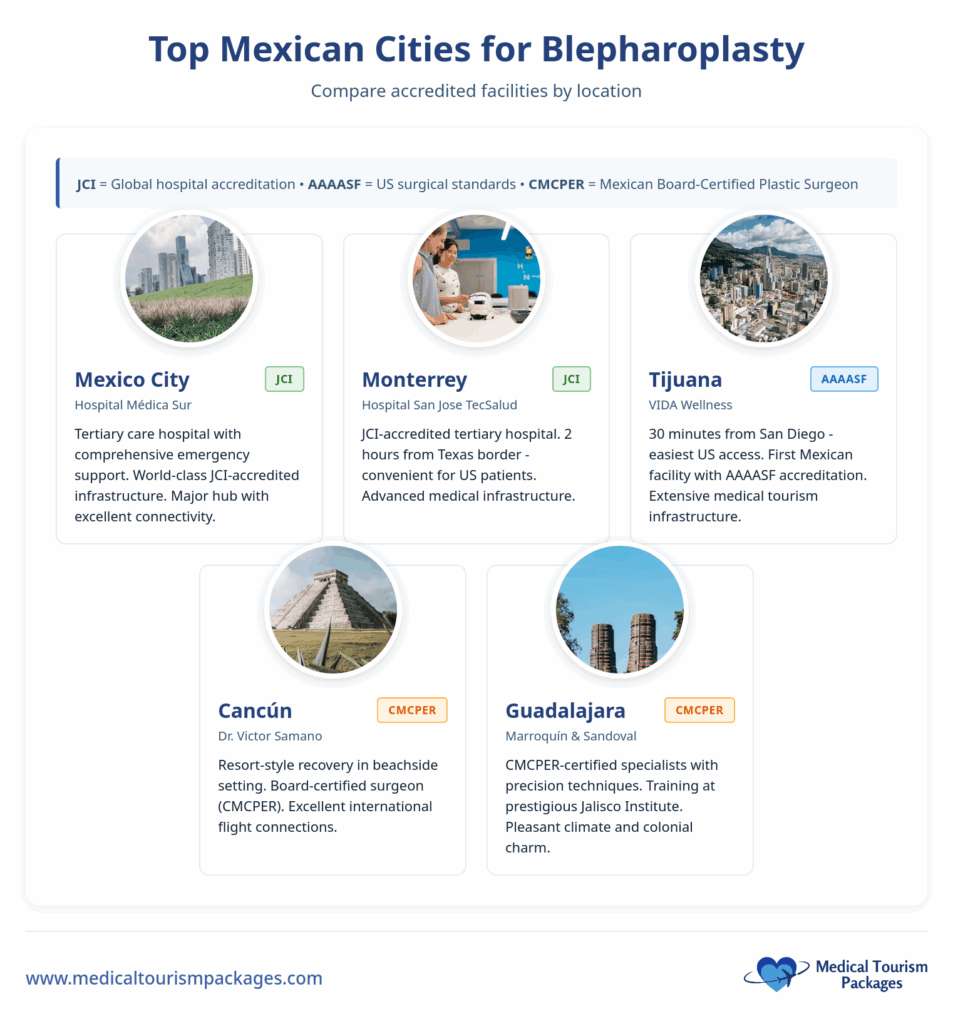
Five Mexican cities offer established blepharoplasty care: Tijuana for border access, Mexico City for JCI hospitals, Cancún for resort recovery, plus Guadalajara and Monterrey. Each city offers different advantages based on your proximity to the US, accreditation needs, and recovery preferences.
How Do Tijuana, Cancún, Mexico City, Guadalajara, and Monterrey Compare?
Each city pairs different accreditation levels with distinct patient advantages. The table below compares facilities, US affiliations, and key benefits:
| City | Accreditation | Notable Facility | US Affiliation | Key Advantage |
|---|---|---|---|---|
| Tijuana | AAAASF (clinic level) | VIDA Wellness & Beauty | None confirmed | 30 minutes from San Diego |
| Mexico City | JCI (2014) | Hospital Médica Sur | Mayo Clinic Care Network | Tertiary hospital backup |
| Monterrey | JCI (2007) | Hospital San José TecSalud | None confirmed | Earliest JCI hospital in Mexico |
| Cancún | CMCPER surgeons | Private plastic surgery clinics | None confirmed | Resort-style recovery |
| Guadalajara | CMCPER surgeons | Private plastic surgery clinics | None confirmed | Lower prices, medical hub |
VIDA Wellness & Beauty in Tijuana holds AAAASF clinic-level accreditation. For Cancún and Guadalajara, confirm any individual clinic’s CMCPER certification directly, since these cities offer many private practices rather than a single flagship hospital.
Which Neighborhoods Are Best for Recovery Near Each City’s Clinics?
Recovery is easiest in safe, walkable neighborhoods close to your clinic. The table below matches each city with its recommended recovery district:
| City | Neighborhood | Proximity to Clinic | Accommodation Tier | Notes |
|---|---|---|---|---|
| Mexico City | Polanco | 15 min from Médica Sur | Luxury hotels | Embassies, constant security presence |
| Mexico City | Condesa / Roma Norte | 20 to 30 min | Mid-range | Walkable, expat-friendly cafes |
| Tijuana | Zona Río | Same district as clinic | Mid-range to upscale | Main medical corridor; private transport advised |
| Cancún | Zona Hotelera | Near private clinics | Resort hotels | 24-hour security, gated environment |
| Guadalajara | Zapopan | Near medical district | Mid-range to upscale | Quiet, modern residential zone |
| Monterrey | San Pedro Garza García | Near TecSalud | Upscale | Safest district in the metro area |
How Long Is the Flight from Major US Cities to Mexico?
Flights from major US cities to Mexico’s medical hubs take roughly 1.5 to 5.5 hours. Tijuana is reachable in a 30-minute drive from San Diego. The table below shows approximate flight times to the three main hubs:
| Origin City | Mexico City | Cancún | Monterrey |
|---|---|---|---|
| Houston | 2h 30m | 2h 30m | 1h 45m |
| Miami | 3h 45m | 2h 45m | 3h 45m |
| Los Angeles | 3h 45m | 4h 45m | 3h 00m |
| New York | 5h 30m | 4h 15m | 4h 45m |
Southern California patients often choose Tijuana, reached via a 15-minute drive or the Cross Border Xpress pedestrian bridge from San Diego. Round-trip flights to the main hubs typically run $250 to $680 depending on city and season.
Which Hospitals and Clinics Perform Blepharoplasty in Mexico?
Top facilities include Hospital Médica Sur in Mexico City (JCI since 2014, Mayo Clinic Care Network), Hospital San José TecSalud in Monterrey (JCI since 2007), and VIDA Wellness & Beauty in Tijuana (AAAASF). The right facility depends on your location, budget, and accreditation needs.
What Accreditations Should a Blepharoplasty Facility Hold?
A safe facility should hold internationally recognized accreditation plus a CMCPER-certified surgeon. Each accreditation signals a different layer of safety, from full hospital standards to surgical-room standards.
Look for these credentials:
- JCI (Joint Commission International): The global gold standard for full-hospital safety and infection control
- AAAASF: Applies US ambulatory surgery-facility standards to outpatient clinics
- Consejo de Salubridad General: Mexico’s national hospital accreditation
- CMCPER surgeon certification: Confirms the surgeon completed plastic surgery board training
What Is the Full Hospital Comparison for Blepharoplasty in Mexico?
The verified facilities differ in accreditation, US affiliation, and ideal patient profile. This comparison covers the confirmed options:
| Facility | City | Accreditation | JCI Year | US Affiliation | Patient Note |
|---|---|---|---|---|---|
| Hospital Médica Sur | Mexico City | JCI | 2014 | Mayo Clinic Care Network | 204-bed tertiary hospital with full emergency backup |
| Hospital San José TecSalud | Monterrey | JCI | 2007 | None confirmed | Earliest JCI hospital in Mexico; university health network |
| VIDA Wellness & Beauty | Tijuana | AAAASF | N/A | None confirmed | Outpatient plastic surgery with recovery boutique near San Diego |
Hospital Médica Sur is the first non-US member of the Mayo Clinic Care Network, making it a strong choice for patients who want hospital-grade backup. For Cancún and Guadalajara clinics, verify CMCPER certification individually, since those facilities are not listed in our verified hospital database.
How Is Blepharoplasty Performed in Mexico?
Blepharoplasty in Mexico is a 45-minute to 3-hour outpatient procedure performed under local sedation or general anesthesia. You return to your accommodation the same day with no hospital stay required. The technique depends on whether you treat the upper lids, lower lids, or both.
What Pre-Operative Assessments Are Required Before Surgery?
Your surgeon orders several tests before surgery to confirm you are healthy enough for the procedure. These assessments protect your safety and help plan the surgery.
Standard pre-operative testing includes:
- Blood work: Complete blood count and coagulation studies
- Cardiac evaluation (ECG): Recommended for patients over 40 or with heart history
- Ophthalmology exam: Checks eye health, vision, and tear function
- Medication review: Identifies blood thinners and supplements to stop before surgery
What Surgical Techniques Do Surgeons Use for Upper vs. Lower Eyelids?
Surgeons use a crease incision for upper eyelids and either an external or transconjunctival incision for lower eyelids. Upper blepharoplasty removes excess skin and fat through a cut hidden in the natural crease, leaving no visible scar once healed.
Lower blepharoplasty uses one of two routes. The transcutaneous approach makes a fine incision just below the lash line, which suits patients with loose skin. The transconjunctival approach places the incision inside the lower lid, leaving no external scar, and works best for younger patients who only need fat removed or repositioned. Combined procedures address both lids in a single session.
How Long Does the Procedure Take, and Will You Stay Overnight?
The procedure takes 45 minutes to 3 hours and requires no overnight stay. Upper lids take about 45 to 60 minutes, lower lids 1 to 2 hours, and combined surgery 2 to 3 hours. Blepharoplasty is an outpatient procedure, so you go home the same day.
After surgery, you spend one to two hours in a supervised recovery area while nurses monitor your condition. Once cleared, you return to your hotel rather than staying in the hospital. Plan to have a companion or arranged transport bring you back to your accommodation.
What Is the Recovery Timeline After Blepharoplasty in Mexico?
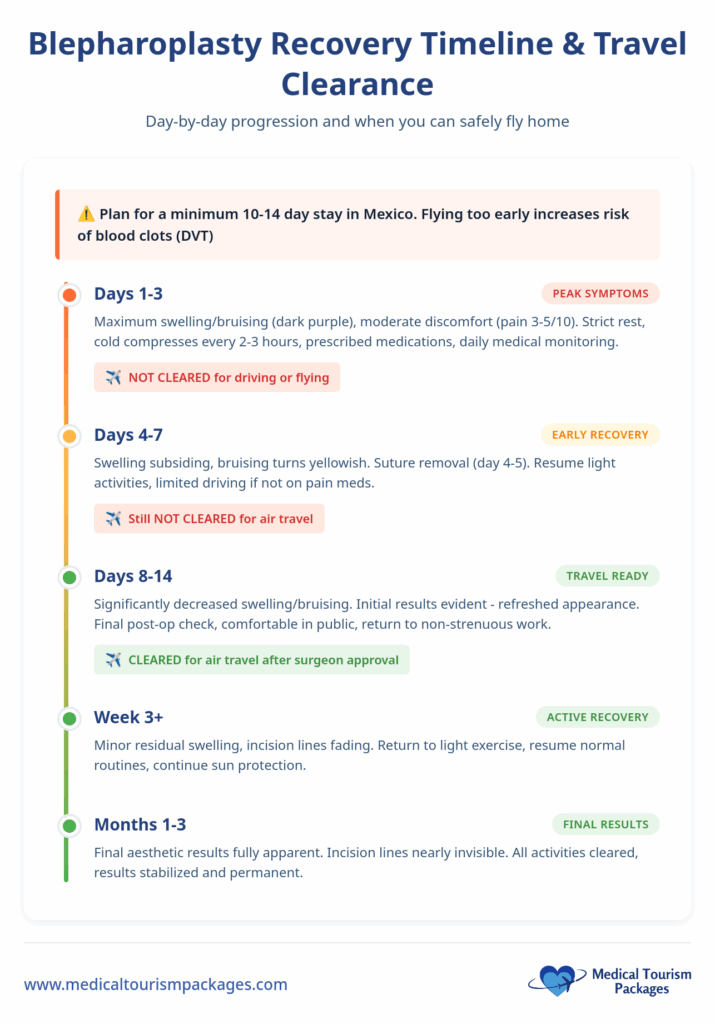
Recovery follows predictable stages: swelling and bruising peak within 48 hours, sutures come out at 5 to 7 days, and most swelling subsides by week two. Final results appear over 3 to 6 months. Plan to stay in Mexico 7 to 10 days before flying home.
What Happens in the First Two Weeks After Surgery?
The first two weeks bring the most visible changes, from peak swelling to suture removal and a return to light activity. This timeline shows what to expect day by day:
| Timeline | What to Expect | Care Instructions |
|---|---|---|
| Day 1 to 3 | Swelling and bruising peak | Apply cold compresses every 2 to 3 hours |
| Day 5 to 7 | Suture removal, swelling starts to drop | Keep the surgical area clean and dry |
| Week 2 | Comfortable in public, most swelling gone | Return to light activity; avoid strain |
| Week 3 to 4 | Makeup allowed, steady improvement | Residual swelling continues fading |
| 3 to 6 months | Final results, scars fade to thin lines | Continue UV protection |
How Do You Manage Swelling, Discomfort, and Eye Care After Surgery?
You manage recovery with cold compresses, head elevation, prescribed eye drops, and sun protection. Consistent care in the first days reduces swelling and speeds healing.
Follow this post-operative care checklist:
- Cold compresses: Apply 10 to 15 minutes each waking hour for the first 48 hours
- Head elevation: Sleep on two or three pillows for at least one week
- Prescribed eye drops: Use lubricating drops to prevent dryness during healing
- UV protection: Wear wraparound sunglasses outdoors to shield from sun, wind, and dust
- Avoid screens: Limit screen time for the first 48 hours to reduce eye strain
When Is It Safe to Fly Home After Blepharoplasty?
It is safe to fly home 8 to 10 days after blepharoplasty at the earliest, and only once your surgeon clears you in writing. The ideal window is 10 to 14 days, after sutures are removed and swelling has settled. Plan a total in-country stay of 7 to 10 days.
Cabin pressure changes can increase swelling, so flying too early may compromise your results and raise complication risk. Wait for suture removal, which happens around five to seven days, before booking your return. Buy travel insurance that covers trip extensions in case you need to stay longer.
What Results Can You Expect, and Is Mexico the Right Choice for You?
Blepharoplasty opens and brightens the eye area by removing droopy upper lids and under-eye bags, with results lasting many years. Mexico is the right choice for budget-conscious patients near the US border who want accredited care, but less ideal for those needing in-person US follow-up. Patients who want to compare options may also review blepharoplasty in Colombia, where JCI-accredited hospitals in Bogotá and Medellín offer similar savings.
How Long Do Blepharoplasty Results Last?
Blepharoplasty results typically last 7 to 10 years or longer, with upper-lid results tending to outlast lower-lid results. Because upper-lid surgery removes excess skin that does not grow back, those results tend to be long-lasting, while lower lids may need touch-ups sooner due to ongoing changes in fat and skin.
Longevity depends on age, skin quality, genetics, sun exposure, and smoking. Blepharoplasty consistently ranks among the highest patient-satisfaction cosmetic procedures, according to the International Society of Aesthetic Plastic Surgery. Surgery improves your eyelids but does not stop the natural aging process, so gravity will eventually affect the area again.
Is Mexico the Right Country for Your Blepharoplasty?
Mexico fits some patients better than others. This matrix matches common patient situations with how well Mexico suits them:
| Patient Situation | Mexico Fit | Notes |
|---|---|---|
| Budget-conscious US or Canadian patient | High fit | 50 to 70% savings versus home prices |
| Patient near the US-Mexico border | High fit | Tijuana is 30 minutes from San Diego |
| Patient who wants a JCI hospital | High fit | Médica Sur and TecSalud are JCI-accredited |
| Patient needing in-person US follow-up | Moderate fit | Arrange follow-up plan before departing |
| Patient with severe dry eye or thyroid eye disease | Low fit | Consult an ophthalmologist before any surgery |
Frequently Asked Questions About Blepharoplasty in Mexico
Is blepharoplasty in Mexico safe?
Yes, when you choose CMCPER-certified surgeons in JCI or AAAASF-accredited facilities. Mexico ranks 138th of 163 on the Global Peace Index 2024, but medical hubs like Polanco and Zona Río maintain higher local security. Verify the surgeon’s certification in the official CMCPER directory and confirm facility accreditation before booking.
Is blepharoplasty painful?
Most patients feel pressure rather than pain. With local sedation or general anesthesia, you feel nothing during surgery. Post-op discomfort, usually tightness or burning, peaks in the first 48 hours and responds to prescribed medication or acetaminophen. Most patients switch to over-the-counter relief by day 3 or 4.
Can I combine blepharoplasty with other procedures?
Yes. Common pairings include brow lift, facelift, and laser resurfacing around the eyes. Combining procedures can reduce anesthesia and facility costs and consolidate recovery into one period. Total surgery time increases, and recovery may run slightly longer than a standalone eyelid procedure. Discuss your options at your consultation.
When can I wear makeup after blepharoplasty?
Eye makeup typically resumes at 3 to 4 weeks once your surgeon confirms the incisions have healed. Avoid makeup during week one. After suture removal at 7 to 10 days, you may use makeup away from incision lines if cleared. Start with new, hygienic products and remove gently with oil-free cleansers.
Is blepharoplasty covered by insurance?
Cosmetic blepharoplasty is not covered. Upper eyelid surgery may qualify when it treats functional vision obstruction (ptosis), usually requiring ophthalmologic documentation of significant field loss. Insurers may ask you to try non-surgical measures first and may cover only the functional portion. Lower blepharoplasty is cosmetic and not covered.
How long do blepharoplasty results last?
Results typically last 7 to 10 years or longer, and because upper-lid surgery removes excess skin that does not grow back, those results tend to be long-lasting. Longevity depends on age, skin quality, genetics, sun exposure, and smoking. Upper-lid results last longest; lower lids may need touch-ups sooner. Patients treated in their 40s or 50s often go a decade without revision.
How long does blepharoplasty surgery take?
Surgery takes 45 minutes to 2 hours per pair of lids: upper lids about 45 to 60 minutes, lower lids 1 to 2 hours, and combined upper and lower about 2 to 3 hours. Complex cases with fat repositioning may approach 3 hours. Expect an extra 1 to 2 hours for prep and recovery monitoring.
How soon can I return to work?
Most people return to desk work in 7 to 10 days once swelling and bruising improve. Physically demanding jobs typically require about 2 weeks. If your appearance is critical, such as in sales, hospitality, or media, consider 10 to 14 days so bruising resolves and makeup can conceal any residual discoloration.
When can I exercise after blepharoplasty?
Walk lightly right away to promote circulation, but keep your heart rate low during week one. Avoid strenuous exercise, bending, and lifting over 10 pounds for the first 2 weeks. At 2 weeks, add light cardio if cleared. Resume full workouts, including weights and swimming, around 4 to 6 weeks after complete healing.
What’s the difference between upper and lower blepharoplasty?
Upper blepharoplasty removes excess skin and fat that cause hooding or block vision, with incisions hidden in the eyelid crease. Lower blepharoplasty treats under-eye bags and loose skin via a sub-lash or internal (transconjunctival) incision. Upper lids recover faster; lower lids swell and bruise more. See the techniques section above for full detail.
What is transconjunctival blepharoplasty?
Transconjunctival blepharoplasty is a scarless lower-lid technique using an incision inside the eyelid to remove or reposition fat, leaving no external scar. It suits patients with puffy fat pads, good skin elasticity, and minimal excess skin. Recovery is often faster with less bruising. Significant loose skin still requires an external approach.
Ready to Plan Your Blepharoplasty in Mexico?
Medical Tourism Packages coordinates your entire eyelid surgery journey to Mexico. We connect you with CMCPER-certified surgeons at JCI-accredited hospitals in Mexico City, Tijuana, and Monterrey, arrange travel and accommodations, and provide bilingual support throughout your blepharoplasty treatment and recovery.
Contact us today for a free consultation and personalized blepharoplasty package for Mexico.