Book Appointment Now

Abdominoplasty in Mexico: Complete Guide, Costs, and Certified Surgeons
 By
By
Abdominoplasty in Mexico costs $3,000 to $6,000 for a standard tummy tuck, 40-70% less than US prices, performed by CMCPER-certified surgeons at JCI-accredited hospitals.
Mexico’s CMCPER-certified plastic surgeons perform tummy tucks at JCI-accredited hospitals including Hospital ABC, Médica Sur, and Hospital Galenia. Standard procedures cost $3,000-$6,000 (40-70% below the US average of $8,000-$15,000) in Tijuana, Cancun, Mexico City, and Monterrey.
Our network connects patients with CMCPER-certified surgeons at JCI-accredited facilities across Tijuana, Cancun, Mexico City, and Monterrey, each verified for surgical credentials, hospital accreditation, and international patient programs. Below, you will find a full cost breakdown by city, abdominoplasty procedure types, hospital profiles, planning guides for your trip, and answers to the most common questions about tummy tuck surgery in Mexico.
What Is Abdominoplasty in Mexico?
Abdominoplasty in Mexico is a tummy tuck that removes excess abdominal skin and fat and tightens loose muscles. It costs $3,000 to $6,000 for a standard procedure, performed by CMCPER-certified surgeons at JCI-accredited hospitals across Tijuana, Cancun, and Mexico City.
The surgeon makes a horizontal incision low across the abdomen, from hip to hip. Through this incision, they remove unwanted tissue and repair the underlying muscle wall. The remaining skin is pulled down and the navel is repositioned for a natural look. This procedure is body contouring, not weight loss. You can read our guide for American medical tourists in Mexico for broader planning context.
Who Is an Ideal Candidate for Abdominoplasty?
An ideal candidate is at or near a stable target weight, in good general health, and a non-smoker. Surgeons in Mexico look for weight that has held steady for at least six months and a body mass index under 30, which lowers complication risk.
This procedure helps people whose concerns cannot be fixed by diet and exercise alone. Post-pregnancy patients often have stretched skin and separated abdominal muscles that remain even after they reach their pre-pregnancy weight. Patients who lost a large amount of weight may carry loose skin that no workout can tighten. Women are usually advised to finish childbearing first, since a later pregnancy can reverse the muscle repair. Smokers are asked to quit at least four to six weeks before surgery to protect healing.
What Conservative Alternatives Should You Try First?
You should try non-surgical options before committing to surgery, since a tummy tuck is permanent and requires real recovery. Most surgeons in Mexico ask you to rule out these conservative measures first, especially if your skin laxity and muscle separation are mild.
- Diet and structured exercise: Reduce abdominal fat and strengthen core muscles, which can resolve mild cases without surgery.
- Targeted physical therapy: Specific core and pelvic-floor work can partially improve mild post-pregnancy muscle separation.
- Non-surgical body contouring: Treatments like CoolSculpting reduce small fat pockets but do not remove loose skin or repair muscle.
- Liposuction alone: Removes fat but does not tighten skin, so it suits patients with good skin elasticity and no muscle separation.
Why Do Patients Choose Mexico for Abdominoplasty?
Patients choose Mexico for 40 to 70 percent cost savings, close proximity to the United States, and JCI-accredited hospitals with English-speaking staff. A standard tummy tuck runs $3,000 to $6,000 in Mexico versus $8,000 to $15,000 in the United States, a difference of several thousand dollars.
Proximity matters more for this procedure than for almost any other. Tijuana sits minutes from the California border, so many patients drive across rather than fly, which avoids cabin-pressure risk in the early recovery window. Cancun, Mexico City, and Monterrey offer direct flights under five hours from most North American cities. Mexico also pioneered post-operative recovery houses staffed by licensed nurses, an option that does not exist in the standard US outpatient model. Together these factors make Mexico a practical choice, not just a cheaper one.
What Types of Abdominoplasty Are Available in Mexico?
Four abdominoplasty techniques are available in Mexico: mini, full (standard), extended, and circumferential. Each targets a different degree of skin laxity and muscle separation. The full tummy tuck is the most common choice for medical tourists, costing $3,000 to $6,000.
What Is a Mini Tummy Tuck?
A mini tummy tuck corrects loose skin below the navel only, using a shorter incision and little or no muscle work. It suits patients with minor lower-belly redundancy and minimal muscle separation. Indicative pricing runs roughly $2,500 to $4,500, and surgery takes one to two hours.
Because the mini procedure leaves the navel in place and limits the incision, recovery is faster than a full tummy tuck. The mini price above is indicative only, since it falls outside the verified Mexico-wide cost ranges; ask each clinic for a written quote.
What Is a Full Abdominoplasty?
A full abdominoplasty is the standard tummy tuck, using a hip-to-hip incision to remove excess skin, repair separated muscles, and reposition the navel. It costs $3,000 to $6,000 in Mexico and takes two to four hours. This procedure is the most common choice for post-pregnancy patients.
The full procedure corrects diastasis recti, the muscle separation that is common after pregnancy or large weight changes. It addresses both the upper and lower abdomen, which the mini version cannot reach. This makes it the right fit for most patients with skin laxity across the whole midsection.
What Is an Extended Tummy Tuck?
An extended tummy tuck uses a longer incision that reaches the flanks and lower back to remove skin from the sides as well as the front. It costs $4,500 to $8,000 in Mexico and takes three to five hours. This procedure suits patients after significant weight loss.
For patients with skin excess that wraps the entire torso, surgeons may recommend a circumferential or 360-degree procedure, which addresses the abdomen, flanks, back, and buttocks in one operation. Pricing for the circumferential approach varies by city and the amount of tissue removed, so request a custom quote. Many full-torso cases also combine liposuction; see our guide to liposuction in Mexico for context.
How Do Recovery Times Compare Across Procedure Types?
Recovery length scales with the size of the procedure, from the mini through the extended tummy tuck.
| Procedure Type | Surgery Time | Recommended Stay in Mexico | Return to Light Activity |
|---|---|---|---|
| Mini tummy tuck | 1-2 hours | 10 days | 2 weeks |
| Full abdominoplasty | 2-4 hours | 14 days | 3-4 weeks |
| Extended tummy tuck | 3-5 hours | 14-21 days | 4-6 weeks |
These timeframes reflect general guidance and require your surgeon’s confirmation. Drains, when used, are typically removed at the follow-up visit before you fly home.
How Much Does Abdominoplasty Cost in Mexico?
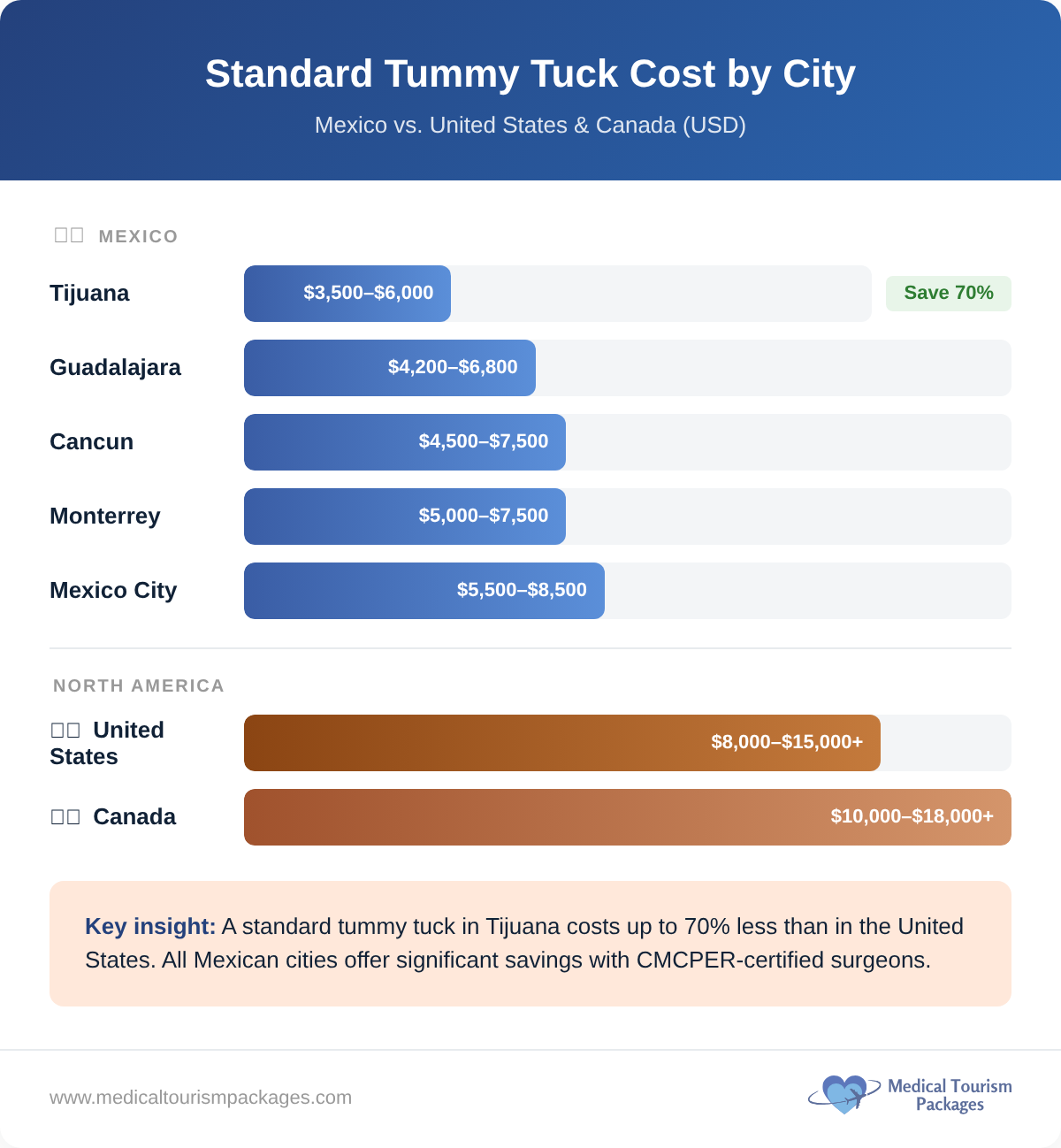
Abdominoplasty costs $3,000 to $6,000 for a standard tummy tuck in Mexico and $4,500 to $8,000 for an extended procedure. That is 40 to 70 percent less than the United States, where a standard tummy tuck costs $8,000 to $15,000. All prices are quoted in US dollars.
What Are the Cost Ranges by City?
City pricing stays within the verified Mexico range, with premium hubs trending toward the higher end.
| City | Standard Tummy Tuck (USD) | Extended Tummy Tuck (USD) | Price Tier |
|---|---|---|---|
| Tijuana | $3,000-$6,000 | $4,500-$8,000 | Budget border hub |
| Guadalajara | $3,000-$6,000 | $4,500-$8,000 | Mid-range |
| Cancun | $3,000-$6,000 | $4,500-$8,000 | Upper end of range |
| Monterrey | $3,000-$6,000 | $4,500-$8,000 | Upper end of range |
| Mexico City | $3,000-$6,000 | $4,500-$8,000 | Upper end of range |
Premium-tier hospitals in Cancun, Monterrey, and Mexico City often price near the top of these ranges, while Tijuana clinics tend toward the lower end. Always request a written, itemized quote, since the final figure depends on procedure type, surgeon experience, and whether liposuction is added.
What Is Included in the Tummy Tuck Package Price?
The quoted package price usually bundles every major cost into one figure, unlike US billing that fragments each charge. Most all-inclusive Mexican packages cover the following items.
- Surgeon and anesthesiologist fees for the procedure
- Hospital or operating-room charges at the accredited facility
- Pre-operative lab tests such as blood work and a coagulation panel
- Compression garment worn during early healing
- Initial post-operative visits and drain removal
- Airport transfers and recovery-house nights in many packages
What is usually not included: your flights, extra hotel nights beyond the recovery stay, revision surgery, and any treatment for complications after you return home. Confirm these exclusions in writing before you book.
How Does Mexico Compare to the US and Canada on Cost?
Mexico costs 40 to 70 percent less than the United States and Canada for the same tummy tuck.
| Country | Standard Tummy Tuck | Extended Tummy Tuck | Savings vs US |
|---|---|---|---|
| Mexico | $3,000-$6,000 | $4,500-$8,000 | 40-70% |
| United States | $8,000-$15,000 | $12,000-$18,000 | Baseline |
| Canada | $8,500-$17,000 CAD | $14,000-$24,000 CAD | Higher than US |
The savings hold even after you add flights and accommodation. A standard tummy tuck that costs $12,000 in the United States is available for $5,000 to $6,000 at a Mexican accredited hospital, leaving room for travel and a supervised recovery stay. Canadian patients see the largest gap, since home prices reach $17,000 CAD. For a full breakdown of procedure types and package inclusions, see our tummy tuck abdominoplasty service page.
Which Hospitals Perform Abdominoplasty in Mexico?
Several JCI-accredited hospitals perform abdominoplasty in Mexico, including Hospital ABC in Mexico City, Hospital Galenia in Cancun, and Hospital Ángeles Pedregal in Mexico City. Each holds Joint Commission International accreditation, the same standard used by leading US hospitals, and runs an international patient program.
Which Hospitals Are JCI-Accredited for Plastic Surgery?
Five verified hospitals combine JCI accreditation with plastic surgery programs across three Mexican cities.
| Hospital | City | JCI Since | US Affiliation | Notable Feature |
|---|---|---|---|---|
| Hospital ABC | Mexico City | 2008 | Houston Methodist | Dedicated aesthetic and reconstructive surgery center |
| Hospital Galenia | Cancun | 2012 | None on record | Also holds Accreditation Canada International (ACI) |
| Hospital Ángeles Pedregal | Mexico City | 2024 | Ángeles Health Intl | 22 operating rooms; lipoabdominoplasty program |
| Médica Sur | Mexico City | 2014 | Mayo Clinic Care Network | Dedicated plastic surgery center |
| Hospital San José TecSalud | Monterrey | 2007 | Tec de Monterrey system | Academic teaching hospital |
For US patients, the Houston Methodist tie at Hospital ABC and the Mayo Clinic Care Network link at Médica Sur are strong trust signals. Canadian patients should note that Hospital Galenia in Cancun also carries Accreditation Canada International. Verify any hospital’s current status directly in the JCI directory before you book.
How Do You Verify a Surgeon’s CMCPER Credentials?
You verify a surgeon’s credentials through CMCPER, the only official body that certifies plastic surgeons in Mexico. Check the surgeon’s name in the CMCPER directory at cmcper.org, and confirm their professional license through the SEP Cédula Profesional system. Use both, not a clinic’s marketing page.
A certified surgeon completes an accredited medical school, then at least five years of residency that includes general surgery and dedicated plastic surgery training, before passing written and practical exams. CMCPER certification must be renewed every five years. (The exact length of residency required for certification is pending medical-reviewer confirmation.) Many surgeons also belong to AMCPER, the Mexican plastic surgery association, and pursue extra fellowship training at US or Latin American centers. Confirming both the CMCPER listing and the cédula gives you two independent checks on any surgeon you are considering.
How Do You Plan an Abdominoplasty Trip to Mexico?
You plan an abdominoplasty trip to Mexico by booking a stay of 10 to 14 days, completing pre-operative labs, and arranging flights or a border crossing. US and Canadian citizens need no visa for stays up to 180 days, only a valid passport.
How Long Should You Plan to Stay?
Your stay length depends on the size of your procedure, since larger operations need more healing before air travel.
- Mini tummy tuck: Plan about 10 days in Mexico before flying home.
- Full abdominoplasty: Plan 14 days to allow drain removal and suture care.
- Extended tummy tuck: Plan 14 to 21 days, as recovery takes longer.
These windows let your surgeon remove drains and sutures, check your healing, and clear you for the flight. The 10 to 14 day guidance for full procedures is a conservative standard that still requires your surgeon’s sign-off before you travel.
How Long Is the Flight from the US to Mexican Surgery Centers?
Flights from major US cities to Mexican surgery hubs run under six hours, and several are under three.
| From | To Mexico City | To Cancun | To Monterrey |
|---|---|---|---|
| Houston | 2.5 hrs | 2.5 hrs | 1.75 hrs |
| Los Angeles | 3.75 hrs | 4.75 hrs | 3.0 hrs |
| Miami | 3.75 hrs | 2.75 hrs | 3.75 hrs |
| New York | 5.5 hrs | 4.25 hrs | 4.75 hrs |
Tijuana has no major international flight hub for most patients. Instead, fly into San Diego and drive across the San Ysidro border crossing, about 20 minutes from the Zona Río medical district. This border route is why many California patients pick Tijuana.
What Pre-Operative Tests and Documents Do You Need?
You need standard pre-operative lab work and travel documents before surgery. Many clinics can run the labs on arrival, but completing them at home first saves time and catches problems early.
- Complete blood count (CBC): Checks for anemia and infection risk.
- Comprehensive metabolic panel: Confirms kidney, liver, and electrolyte health.
- Coagulation panel: Verifies normal blood clotting before surgery.
- Pregnancy test: Required for women of childbearing age.
- Valid passport and medical records: Bring your history, medication list, and any prior imaging.
US and Canadian citizens enter on a tourist card and need no visa for stays up to 180 days. Enroll in the free Smart Traveler Enrollment Program (STEP) at the US State Department before you go, so the embassy can reach you in an emergency.
What Are Your Payment and Currency Options?
You pay in US dollars at most Mexican medical tourism clinics, which quote all package prices in USD. The local currency is the Mexican peso (MXN), but you do not need to convert money to book or pay for your procedure.
JCI-accredited hospitals widely accept Visa and Mastercard, and some take American Express. Most facilities ask for a deposit to reserve your surgery date and full payment, or a card hold, before discharge. Confirm the exact deposit amount, accepted cards, and any wire-transfer option with your coordinator in writing before you travel.
What Happens During and After Abdominoplasty in Mexico?
During abdominoplasty in Mexico, the surgeon removes excess skin, repairs the muscle wall, and repositions the navel under general anesthesia. Afterward, you recover over several months, with most swelling resolving by three months and final results appearing by 6 to 12 months.
How Is the Abdominoplasty Procedure Performed?
The procedure follows a clear sequence under general anesthesia, monitored by a board-certified anesthesiologist throughout.
- Anesthesia: General anesthesia is administered and your vital signs are monitored.
- Incision: A horizontal cut is made low across the abdomen, hidden beneath underwear lines.
- Tissue removal: Excess skin and fat are removed; tumescent liposuction may refine contours.
- Muscle plication: Separated muscles are sutured back together along the midline to flatten the wall.
- Drain placement: Drains or progressive tension sutures reduce fluid buildup and seroma risk.
- Closure: The skin is pulled down, the navel is repositioned, and the incision is closed.
Surgery lasts two to five hours depending on the procedure type. Many surgeons in Mexico use progressive tension sutures, which attach the skin flap to the muscle wall and can remove the need for external drains entirely.
What Milestones Mark Your Recovery?
Your recovery follows a predictable timeline, from the first day of walking to final results within a year, according to ASPS tummy tuck recovery guidance.
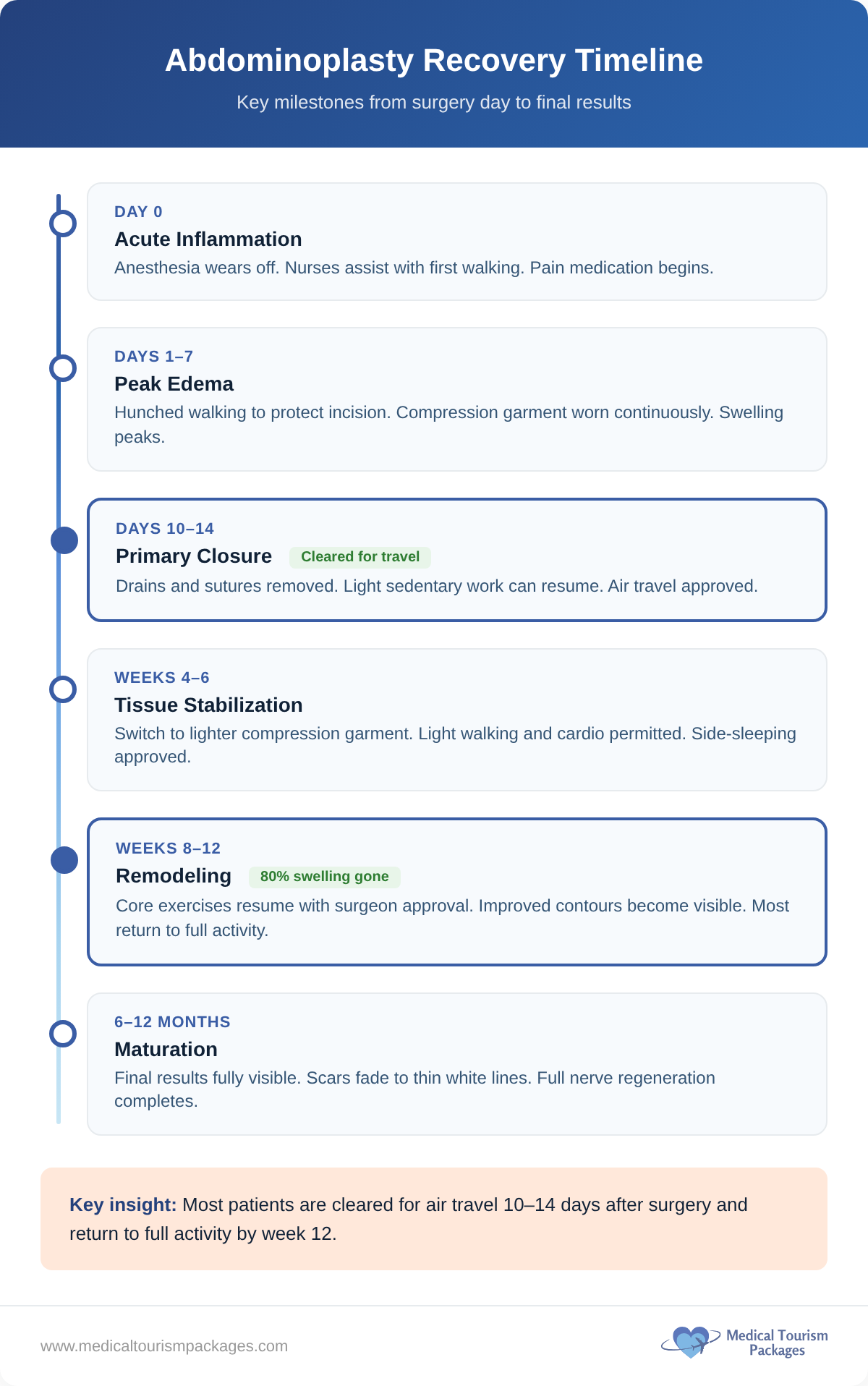
- Day 1 to 3: Nurses help you walk to prevent clots; you wear a compression garment and manage pain with medication.
- Week 1 to 2: Swelling peaks, drains and sutures are removed, and your surgeon clears you for travel.
- Week 4 to 6: Light walking and cardiovascular activity become permissible with surgeon approval, per ASPS guidance.
- Week 8 to 12: Core-strengthening exercise can resume gradually, again with surgeon approval, per ASPS guidance.
- Month 6 to 12: Final results appear as swelling fully resolves and scars fade to thin white lines, per ASPS guidance.
These milestones reflect ASPS recovery guidance and require your surgeon’s confirmation for your specific case. Apply scar care and sun protection to the lower-abdominal scar for the first year, as ASPS recommends.
When Can You Fly Home After Surgery?
You can fly home 10 to 14 days after surgery, once your surgeon clears you. This minimum stay lowers the risk of deep vein thrombosis and pulmonary embolism, which rise when reduced post-surgery mobility meets the pressurized cabin environment. Mini procedures may clear sooner.
On the flight home, wear medical-grade compression stockings, drink water steadily, and do calf exercises every 30 to 60 minutes. Book an aisle seat so you can stand and walk roughly once an hour. These simple steps protect against blood clots during travel. The 10 to 14 day window is conservative guidance that your surgeon must confirm before you book your return flight.
How Safe Is Abdominoplasty in Mexico?
Abdominoplasty at accredited Mexican hospitals is safe when performed by CMCPER-certified surgeons. According to a 2024 analysis of 55,956 patients in the Aesthetic Surgery Journal, the overall complication rate was 2.1 percent. A separate ASPS CosmetAssure study reported a 4 percent major complication rate.
Those figures come from large, accredited-setting datasets and are the most reliable numbers available. The Aesthetic Surgery Journal analysis of 55,956 abdominoplasty patients found a 2.1 percent overall complication rate, while the ASPS-published CosmetAssure study put major complications at about 4 percent for abdominoplasty. The same ASPS study noted that certain factors raise risk: male sex, age 55 and older, a body mass index of 30 or higher, and combining the tummy tuck with other procedures each increase the complication rate modestly. Your safety depends on choosing a CMCPER-certified surgeon working in a JCI-accredited hospital, not on the destination alone.
What Accreditation Standards Apply at Mexican Hospitals?
Joint Commission International (JCI) is the leading standard that applies at top Mexican hospitals. It is the same accreditation used by elite US hospitals and covers sterilization, emergency response, and patient-safety monitoring. Mexico also has a national health authority, COFEPRIS, that regulates medical facilities.
JCI accreditation is voluntary and renewed on a fixed cycle, so a hospital that holds it has chosen to meet an international benchmark and submit to outside review. This is the standard to look for, because it protects you with documented protocols for infection control and surgical safety. When a facility claims accreditation, confirm it yourself in the JCI directory rather than relying on the clinic’s own description.
What Are the Realistic Risks of Abdominoplasty?
Abdominoplasty carries the general risks of major surgery, which are uncommon at accredited facilities but real. Knowing them helps you choose carefully and recognize warning signs early.
- Seroma: Fluid collecting under the skin, which drains and progressive tension sutures help prevent.
- Hematoma: A pocket of blood that may need to be drained.
- Infection: Reduced by sterile technique and antibiotics at accredited hospitals.
- Blood clots (DVT or pulmonary embolism): Lowered by early walking and compression garments.
- Visible scarring: Expected along the incision; some patients later choose scar revision.
The single biggest factor in your risk is where and by whom the surgery is done. Choosing a JCI-accredited hospital and a CMCPER-certified surgeon keeps your odds close to the 2.1 to 4 percent complication rates reported in the Aesthetic Surgery Journal and ASPS studies. Unregulated clinics carry far higher risk.
What Are the Advantages and Disadvantages of Abdominoplasty in Mexico?
The main advantage of abdominoplasty in Mexico is 40 to 70 percent cost savings at JCI-accredited hospitals close to the United States. The main disadvantage is distance from home support during recovery and limited legal recourse if something goes wrong.
How Do Advantages and Disadvantages Compare?
Each factor carries both an upside and a trade-off worth weighing side by side.
| Factor | Advantage | Disadvantage |
|---|---|---|
| Cost | 40-70% savings versus US and Canada | Flights and lodging add to the total |
| Accreditation | JCI hospitals match top US standards | Unregulated clinics also exist; vetting is on you |
| Travel distance | Under 5 hours; Tijuana by car from California | Coordinating time off and logistics is complex |
| Language | Surgeons and coordinators speak English | Some overnight nursing staff may speak less English |
| Continuity of care | Telemedicine follow-up with your surgeon | Home doctor must coordinate any complications |
| Recovery environment | Nurse-staffed recovery houses available | Family cannot easily provide hands-on support |
| Legal recourse | Consumer protections exist in Mexico | Cross-border malpractice claims are very difficult |
Is Mexico the Right Destination for Your Abdominoplasty?
The matrix below maps common patient types to how well Mexico suits them for abdominoplasty.
| Patient Type | Situation | Mexico Fit |
|---|---|---|
| California border patient | Wants to drive, avoid flying early | Excellent: Tijuana by car |
| Post-pregnancy patient | Stable weight, finished childbearing | Strong: standard tummy tuck |
| Post-weight-loss patient | Loose skin around the torso | Strong: extended procedure |
| Budget-conscious patient | Priced out of US surgery | Strong: 40-70% savings |
| High-BMI patient | BMI above 35, not weight-stable | Poor: optimize health first |
| High-risk patient | Heart or clotting conditions | Poor: treat closer to home |
If you fall in a strong-fit row, the savings and accredited care make Mexico a sound choice. If you fall in a poor-fit row, address the underlying health issue first, since stable weight and controlled medical conditions lower your surgical risk wherever you have the procedure.
What Questions Do Medical Tourists Ask Most Often About Abdominoplasty in Mexico?
How long should I stay in Mexico after abdominoplasty?
You should stay 10 to 14 days after abdominoplasty before flying home. Mini tummy tucks need about 10 days, while full and extended procedures need 14 days or more. This window lets your surgeon remove drains and sutures and clear you for travel. US and Canadian citizens need no visa for stays up to 180 days.
Are Mexican hospitals accredited to international standards?
Yes, Mexico has multiple JCI-accredited hospitals, the same standard used by top US hospitals. Hospital ABC in Mexico City holds JCI accreditation since 2008 with a Houston Methodist affiliation. Hospital Galenia in Cancun has held JCI since 2012. Hospital Ángeles Pedregal earned JCI in 2024. All meet international patient-safety standards.
Do Mexican plastic surgeons speak English?
Yes, most specialized plastic surgeons in Mexico are fluent in English. Board-certified surgeons at JCI-accredited facilities in Tijuana, Cancun, and Mexico City speak English, and international patient coordinators communicate clearly throughout your treatment. At Hospital Galenia in Cancun, around 75 percent of staff speak English, which removes the language barriers common in many other destinations.
What happens if I have complications after returning home?
Mexican plastic surgeons coordinate with your home primary care physician for follow-up after you return. Many surgical packages include telemedicine appointments so you can reach your surgeon directly with concerns. Obtain a full copy of your operative report before leaving Mexico, and share it with your home doctor so any local treatment is informed by your surgical details.
Is it safe to fly after abdominoplasty?
Yes, it is safe to fly after the recommended 10 to 14 day waiting period, once your surgeon clears you. Waiting reduces the risk of blood clots that cabin pressure and reduced mobility can trigger. On the flight, wear compression stockings, stay hydrated, and walk roughly once an hour to keep your circulation moving and protect your healing incision.
What training do Mexican plastic surgeons have?
Mexican plastic surgeons complete medical school followed by at least five years of residency in general and plastic surgery, then pass written and practical exams. They are certified by CMCPER, the only official certifying body, and renew it every five years. Many also belong to AMCPER and pursue extra fellowship training at US or Latin American centers.
How much does a tummy tuck cost in Mexico compared to the US?
A standard tummy tuck costs $3,000 to $6,000 in Mexico versus $8,000 to $15,000 in the United States, a saving of 40 to 70 percent. An extended tummy tuck costs $4,500 to $8,000 in Mexico. All prices are quoted in US dollars, and most Mexican packages bundle the surgeon, anesthesia, hospital, and follow-up into one figure.
What is the BMI requirement for abdominoplasty in Mexico?
Most surgeons in Mexico prefer a body mass index under 30 for abdominoplasty, and many decline patients above 35 until they reach a more stable weight. A lower BMI reduces complication risk. Surgeons also want your weight to hold steady for at least six months and prefer non-smokers, since smoking slows healing of the incision.
How do I verify that a Mexican plastic surgeon is board-certified?
You verify board certification through two independent sources. Search the surgeon’s name in the CMCPER directory at cmcper.org, the only official body that certifies plastic surgeons in Mexico. Then confirm their license in the SEP Cédula Profesional system. Using both checks, rather than a clinic’s own website, protects you from uncertified providers.
Can I combine a tummy tuck with other procedures in Mexico?
Yes, surgeons in Mexico often combine a tummy tuck with liposuction for full-torso contouring, or with other body procedures in a single operation. Combining procedures saves on facility and anesthesia costs but modestly raises complication risk, according to ASPS data. Discuss whether a staged or combined plan fits your health and recovery goals with your surgeon.
Ready to Start Your Abdominoplasty Journey in Mexico?
Medical Tourism Packages coordinates your entire abdominoplasty journey in Mexico. We connect you with JCI-accredited hospitals, arrange your travel and accommodations, and provide bilingual support throughout your treatment. Get a free consultation to discuss your body contouring goals and receive a personalized quote.
Contact us today to start planning your affordable abdominoplasty in Mexico.