Reservar cita



Hand Surgery in Costa Rica: Complete Guide, Costs, Top Surgeons, and Medical Tourism Planning
 Por
Por
Hand surgery in Costa Rica costs 50-80% less than US prices at JCI-accredited hospitals with fellowship-trained hand surgeons.
Carpal tunnel release costs $1,200-$2,800 in Costa Rica versus $6,000-$12,000 in the US. Board-certified surgeons at Hospital CIMA San José and Hospital Clínica Bíblica hold subspecialty fellowship training in hand and microsurgery.
This guide covers costs, top hospitals in San José, surgeon qualifications, and procedure types. You will find cost comparisons, hospital profiles, recovery timelines, and safety information for planning your hand surgery in Costa Rica.
What Is Hand Surgery in Costa Rica?
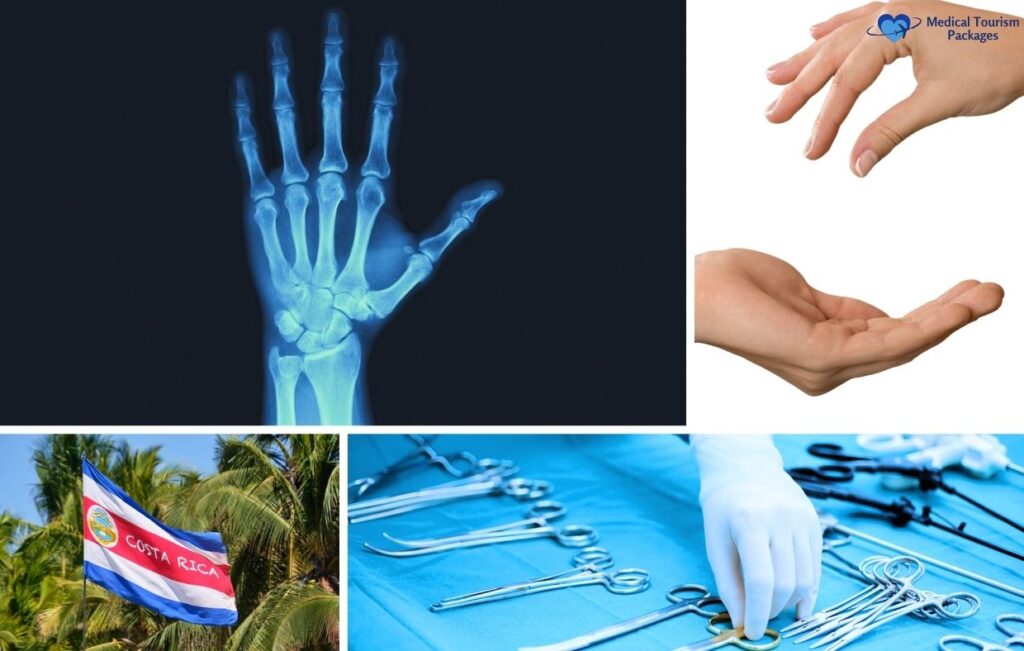
Hand surgery in Costa Rica treats problems affecting the hand, wrist, fingers, and forearm. These procedures range from minimally invasive repairs to complex microsurgical reconstructions.
The hand contains 27 bones and an intricate network of tendons, ligaments, nerves, and blood vessels. Surgeons at San José facilities treat congenital, traumatic, and degenerative conditions. This requires both macroscopic orthopedic and microscopic neural expertise.
Common conditions treated include carpal tunnel syndrome, trigger finger, hand fractures, and tendon injuries. Surgeons also treat Dupuytren’s contracture and arthritis. Costa Rica’s medical tourism market is projected to grow from $289 million to $1.66 billion. North American patients seeking affordable orthopedic care are driving this growth.
Read our complete guide to hand surgery in Latin America for broader regional comparisons.
Why Choose Costa Rica for Hand Surgery?
You should choose Costa Rica for hand surgery because of 50-80% cost savings and English-speaking medical teams. The country is also close to North America. Procedures costing $6,000-$25,000 in the US are available for $1,500-$12,000 in Costa Rica.
The savings come from lower administrative overhead, reduced malpractice insurance costs, and efficient healthcare delivery. Costa Rica spends $1,935 per capita on healthcare versus the OECD average of $5,967, yet achieves equivalent clinical outcomes.
Costa Rica offers these key advantages for medical tourists:
- Major cost savings — Pay 50-80% less than US prices using identical techniques and FDA-approved implants.
- JCI-accredited facilities — Multiple hospitals in the San José area hold Joint Commission International certification.
- English-speaking staff — Medical professionals in Escazú and downtown San José speak fluent English.
- Geographic convenience — Direct flights from major North American cities take just 3-4 hours.
- Recovery infrastructure — Specialized recovery lodges near hospitals provide post-operative nursing support.
- Medical technology ecosystem — The country exports $7.6 billion in medical devices annually.
What Types of Hand Surgery Procedures Are Available in Costa Rica?
Hospitals in San José and Escazú perform seven main types of hand surgery. These range from outpatient nerve releases to complex joint replacements.
¿Qué es la liberación del túnel carpiano?
Carpal tunnel release is the most commonly performed hand surgery for international patients in Costa Rica. It addresses compression of the median nerve, which causes pain, numbness, and weakness in the hand.
Costa Rican surgeons offer both open and endoscopic carpal tunnel release (ECTR). ECTR uses a smaller incision, causes less pain, and allows faster recovery. Clinical data shows 87.5% of ECTR patients would choose the surgery again. Most procedures are performed as outpatient surgery at facilities in San José.
What Is Trigger Finger Release?
Trigger finger release treats stenosing tenosynovitis, a condition that causes a finger to lock in a bent position. The tendon sheath becomes too narrow for the tendon to glide freely.
Surgeons at San José facilities perform A1 pulley release under local anesthesia. The procedure takes under 20 minutes and provides immediate relief from the locking sensation. Patients are often discharged the same day.
What Is Tendon Repair and Reconstruction?
Tendon repair addresses severed flexor or extensor tendons from trauma or lacerations. Surgeons use advanced suturing techniques to reconnect the tendon ends.
For cases with significant tissue loss, tendon grafts replace the damaged segment. Early controlled movement begins within days to prevent adhesion formation. Complex cases benefit from the microsurgical expertise available at Escazú and downtown San José hospitals.
What Is Hand and Wrist Fracture Fixation?
Fracture fixation treats displaced metacarpal and phalange fractures. Surgeons use low-profile plates and screws for stable anatomical alignment.
Internal fixation allows early mobilization and reduces stiffness risk. Patients can begin gentle movement within one to two weeks. This approach is standard at JCI-accredited facilities in the San José metropolitan area.
What Is Dupuytren’s Contracture Surgery?
Dupuytren’s contracture surgery treats thickening of the palmar fascia that bends fingers toward the palm. Surgical techniques range from fasciotomy to radical fasciectomy.
Surgeons in Costa Rica focus on longitudinal strain relief and careful skin handling. This reduces the risk of recurrence and skin-related complications. Most patients regain full finger extension after recovery.
What Is Hand Joint Replacement?
Hand joint replacement treats advanced arthritis of the finger or thumb joints. Surgeons insert high-grade prosthetic implants to restore function and reduce chronic pain.
Facilities in San José stock implants from Zimmer Biomet, Stryker, and DePuy Synthes. These are the same manufacturers used in top US hospitals. Patients with osteoarthritis or rheumatoid arthritis are common candidates for this procedure.
What Is Wrist Arthroscopy?
Wrist arthroscopy is a minimally invasive technique that diagnoses and treats internal wrist problems. A small camera guides the procedure without the need for open surgery.
Surgeons use this approach to repair ligament tears, treat cartilage damage, and remove ganglion cysts. Recovery is faster than with open procedures. Most patients return to light activities within two to four weeks.
How Much Does Hand Surgery Cost in Costa Rica?
Hand surgery in Costa Rica costs $800-$12,000 depending on the procedure. This represents 50-80% savings compared to US self-pay prices.
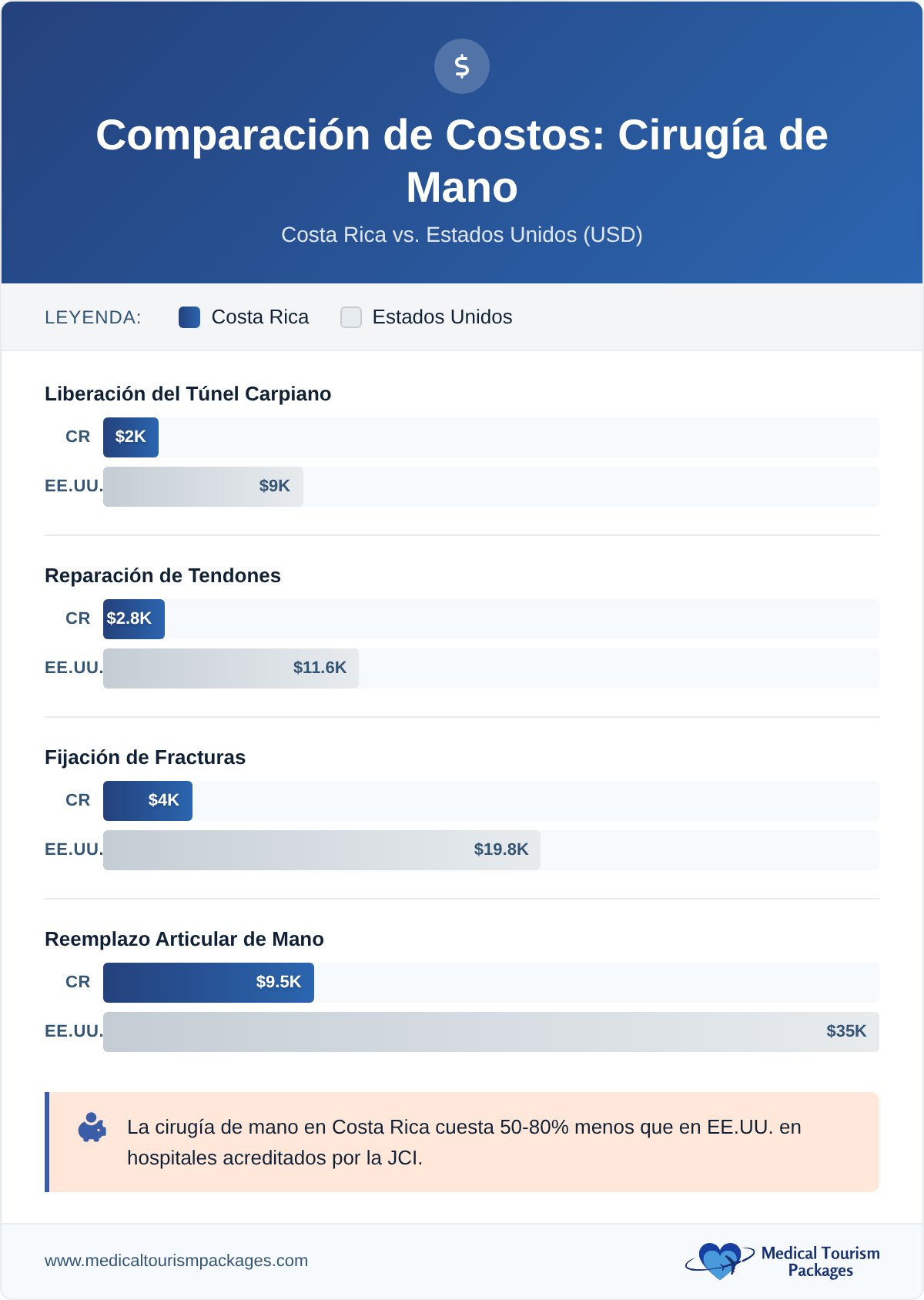
The savings come from lower labor costs, reduced overhead, and bundled pricing that prevents fragmented billing. Costa Rican hospitals use the same FDA-approved implants and techniques found in top North American surgical centers.
Cost Comparison by Procedure (USD)
| Procedimiento | Costa Rica | EE.UU. | Canadá | REINO UNIDO | Turquía | México |
|---|---|---|---|---|---|---|
| Liberación del túnel carpiano | $1,200-$2,800 | $6,000-$12,000 | $4,000-$7,000 | $2,060-$4,240 | $1,300-$3,000 | $1,000-$2,500 |
| Liberación del dedo gatillo | $800-$1,300 | $1,500-$4,000 | $1,000-$2,500 | $1,800-$3,500 | $600-$1,500 | $300-$800 |
| Wrist Arthroscopy | $3,000-$6,500 | $10,200-$11,800 | $3,500-$18,000 | $5,000-$8,500 | $2,500-$6,000 | $2,000-$5,000 |
| Reparación de tendones | $1,500-$4,000 | $10,300-$12,800 | $5,000-$9,000 | $4,500-$7,000 | $2,000-$5,000 | $1,800-$4,500 |
| Fracture Fixation | $2,500-$5,500 | $15,000-$24,500 | $6,000-$12,000 | $8,000-$15,000 | $3,500-$7,500 | $2,000-$5,000 |
| Hand Joint Replacement | $7,000-$12,000 | $25,000-$45,000 | $15,000-$22,000 | $12,000-$18,000 | $6,000-$10,000 | $6,000-$11,000 |
| Dupuytren’s Surgery | $1,300-$3,500 | $8,000-$15,000 | $5,000-$10,000 | $6,000-$9,000 | $2,000-$4,500 | $1,500-$4,000 |
These prices include surgeon fees, anesthesia, facility charges, and basic post-operative care. Additional costs for pre-operative testing or extended stays may apply.
What Are the Top Hospitals for Hand Surgery in Costa Rica?
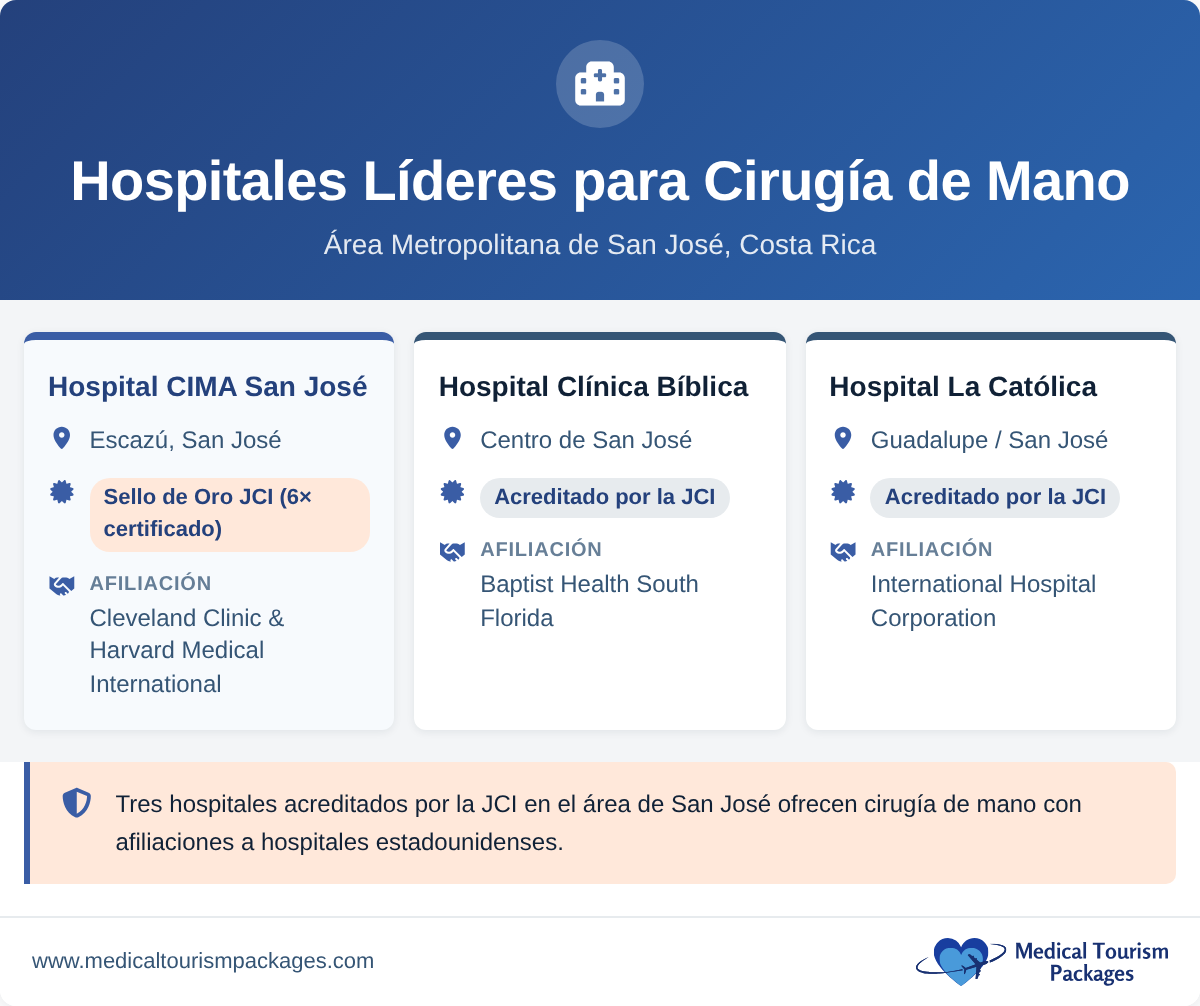
The top hospitals for hand surgery are JCI-accredited facilities in the San José metropolitan area. These hospitals have modern equipment, dedicated orthopedic services, and bilingual patient coordination teams.
Instalaciones médicas líderes
| Hospital | Ubicación | Acreditación | Key Affiliations |
|---|---|---|---|
| Hospital CIMA San José | Escazú | JCI Gold Seal (6th time) | Cleveland Clinic, Harvard Medical International |
| Hospital Clínica Bíblica | Downtown San José | Acreditado por la JCI | Baptist Health South Florida |
| Hospital La Católica | Guadalupe, San José | Acreditado por la JCI | International Hospital Corporation |
| Clínica UNIBE | Heredia | ISO 9001 Certified | University of Iberoamerica medical training |
What Technology Do These Hospitals Use?
Hospital CIMA San José in Escazú was founded through a partnership with Baylor University Medical Center. It now maintains relationships with the Cleveland Clinic and Harvard Medical International.
Key technology and equipment at San José facilities includes:
- 64-slice CT scanners and high-resolution MRI — These provide precise preoperative mapping of nerves and vessels in the hand.
- Laminar airflow surgical theaters — These maintain positive air pressure and HEPA filtration to reduce infection risk.
- FDA-approved implants — Hospitals stock hardware from Zimmer Biomet, Stryker, and DePuy Synthes.
- JCI-mandated safety protocols — Accreditation requires compliance with over 300 standards covering patient safety and surgical precision.
Who Are the Leading Hand Surgeons in Costa Rica?
The leading hand surgeons in Costa Rica are board-certified specialists with fellowship training in hand and microsurgery. Many completed advanced training at institutions in the United States, Canada, or Europe.
Hand surgeons in Costa Rica follow a rigorous training pathway. It begins with a five-year residency in orthopedic or plastic surgery. This is followed by a one to two-year fellowship specifically in hand and upper extremity surgery. This training is comparable to North American standards.
Surgeon Qualification Standards
| Credential | Costa Rican Standard | US Equivalent |
|---|---|---|
| Basic Residency | 5 Years (Orthopedics or Plastic Surgery) | 5-6 Years |
| Fellowship | 1-2 Years (Hand and Microsurgery) | 1 Year (ACGME Accredited) |
| Certificación de la Junta | Physicians and Surgeons College of Costa Rica | ABOS or ABPS Certification |
| Formación continua | Mandatory credential renewal | Maintenance of Certification (MOC) |
| Afiliaciones internacionales | AAOS, ASSH, AO Trauma | Standard Professional Memberships |
How Do You Verify Surgeon Credentials in Costa Rica?
You verify surgeon credentials by checking their Costa Rican board certification and subspecialty training. All orthopedic surgeons must hold certification from the Physicians and Surgeons College of Costa Rica.
Key verification steps include:
- Confirm subspecialty fellowship training — Look for a one to two-year hand and microsurgery fellowship at a national or international institution.
- Verify international affiliations — Check for active memberships in AAOS, ASSH, or AO Foundation.
- Check hospital privileges — Confirm the surgeon operates at JCI-accredited facilities in Escazú or San José.
For more guidance on selecting a qualified surgeon, see our orthopedic surgery guide for Costa Rica.
What to Expect During Recovery After Hand Surgery in Costa Rica?
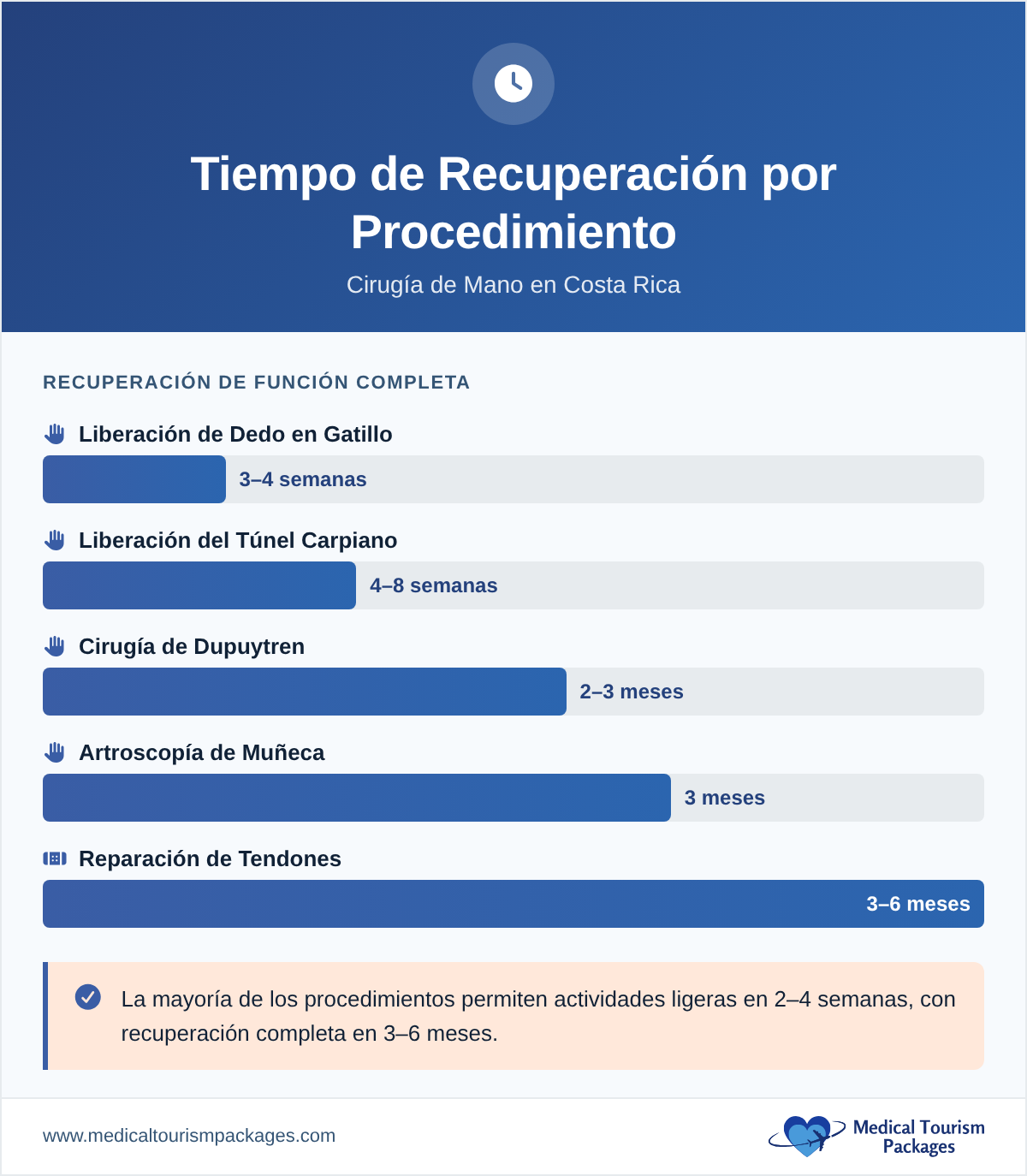
Recovery time depends on the procedure type and your adherence to rehabilitation. Simple procedures like carpal tunnel release require 2-3 weeks for initial healing. Complex procedures like tendon repair can take 3-6 months for full function.
US and Canadian citizens receive automatic visa-free entry for 90 days. This provides enough time for surgery and initial follow-up appointments. Most patients return home within 1-2 weeks after the surgeon clears them for travel.
Recovery Timeline by Procedure
| Procedimiento | Initial Immobilization | PT Start | Light Activities | Full Function |
|---|---|---|---|---|
| Liberación del túnel carpiano | 1-3 días | Day 2-5 | 2 semanas | 4-8 semanas |
| Liberación del dedo gatillo | None to 48 hours | Día 2 | 1 semana | 3-4 semanas |
| Reparación de tendones | 3-14 days (splinted) | Day 4-7 | 6-8 semanas | 3-6 meses |
| Fracture Fixation | 2-4 semanas | Day 7-14 | 8 semanas | 4-6 meses |
| Wrist Arthroscopy | 1-3 días | Día 3 | 2-4 semanas | 3 meses |
| Dupuytren’s Surgery | 2 days (elevated) | Día 2 | 4 weeks | 2-3 meses |
What Physical Therapy Is Available in Costa Rica?
Costa Rica has a network of specialized upper extremity therapists trained in hand rehabilitation. NeuroFT San José is a certified hand therapy provider near major hospitals in the San José area.
Post-operative care at Costa Rican facilities typically includes:
- Early controlled mobilization — Gentle movement starts within 48 hours to promote tendon excursion and prevent scarring.
- Edema control — Elevation and compression garments reduce swelling in the first week.
- Custom splinting — Thermoplastic splints protect repairs while allowing specific movements.
- Manual therapy — Myofascial release and scar mobilization improve tissue flexibility.
What Telemedicine Support Is Available After You Return Home?
Costa Rican surgeons use telemedicine platforms for remote care after you leave. Virtual consultations allow surgeons to check wound healing and manage minor issues remotely.
Your surgeon can coordinate directly with your local physical therapist. This keeps your recovery on track between in-person appointments. Most international patients in San José hospitals have access to telemedicine follow-up as part of their care.
Where Should You Stay During Hand Surgery Recovery in Costa Rica?
The best recovery accommodations are in Escazú and the Santa Ana district, near Hospital CIMA San José. These areas offer specialized recovery lodges and standard hotels with medical tourism amenities.
Costa Rica leads the world in “recovery retreat” facilities. These bridge the gap between hospital care and a regular hotel.
Recovery lodge options include:
- Las Cumbres Inn — Located in Escazú, this lodge provides 24/7 nursing, transport to follow-up appointments, and post-surgical meal plans.
- Recovery Center Chetica — A mountain retreat offering 24/7 medical support, orthopedic beds, and organic cuisine.
- Costa Rica Medical Center Inn — A 50-room facility near Hospital CIMA San José with full nursing recovery services.
- Residence Inn by Marriott and Hyatt Centric — Standard hotels near CIMA in Escazú with ADA-compliant rooms and kitchens.
What Are the Travel and Visa Requirements for Costa Rica?
US, Canadian, UK, and most European citizens do not need a visa to enter Costa Rica. These citizens receive visa-free entry for 90 to 180 days upon arrival.
You must carry a passport valid for the duration of your stay. You also need proof of onward travel. Juan Santamaría International Airport (SJO) in San José offers direct flights from dozens of North American hubs.
For medical stays that exceed the standard entry period, patients can request an extension. A formal physician’s letter certifying medical necessity is required. Patients present this letter to the Costa Rican immigration office.
How Safe Is Hand Surgery in Costa Rica?
Hand surgery in Costa Rica is safe when you choose JCI-accredited facilities and verified surgeons. Complication rates match international standards.
JCI hospitals in San José report 97% success rates for knee replacement and 98% for hip replacement. These figures reflect the quality of orthopedic care across all specialties at these facilities. Carpal tunnel release patients report 87.5% satisfaction rates high enough to repeat the surgery.
Common complications and how they are managed:
- Joint stiffness — Mitigated by early hand therapy and custom splinting within 48 hours.
- Surgical site infection — Managed through laminar airflow operating rooms and antibiotic protocols.
- Recurrence — Reduced through meticulous technique by fellowship-trained specialists.
- Complex Regional Pain Syndrome (CRPS) — A rare condition; surgeons in San José are trained in early identification and management.
What Are the Advantages and Disadvantages of Hand Surgery in Costa Rica?
The main advantages are 50-80% cost savings, JCI-accredited quality care, and convenient access for North American patients. Consider both benefits and limitations before planning your surgery.
Ventajas:
- Major cost savings — Pay $800-$12,000 for procedures costing $1,500-$45,000 in the US.
- English-speaking care teams — Communicate directly with surgeons and staff in Escazú and San José.
- Short travel time — Direct flights of 3-4 hours from most US cities.
- Recovery infrastructure — Specialized lodges in Escazú provide nursing support and therapy access.
- International standards — JCI accreditation ensures safety protocols match top US hospitals.
Desventajas:
- Travel required — International travel adds logistical complexity compared to local treatment.
- Limited insurance coverage — Most US insurance does not cover international procedures.
- Complication coordination — Managing issues while overseas requires planning and a “shared care” model.
Is Hand Surgery in Costa Rica Right for You?
Hand surgery in Costa Rica is right for you if you face high US costs or insurance limitations. The 50-80% savings make procedures accessible when US prices are too high.
Choose JCI-accredited facilities in the San José metropolitan area with proven records treating international patients. Confirm your surgeon’s fellowship training in hand and microsurgery. Look for memberships in AAOS or ASSH. Costa Rica works well for carpal tunnel release, trigger finger repair, and fracture fixation.
Before traveling, identify a hand specialist at home who will provide follow-up care. Most patients stay 1-2 weeks in Costa Rica for surgery and initial follow-up. They then continue rehabilitation at home with telemedicine support from their Costa Rican surgeon.
What Questions Do Medical Tourists Ask Most Often About Hand Surgery in Costa Rica?
How Long Should I Stay in Costa Rica After Hand Surgery?
You should plan to stay 7-14 days after hand surgery before flying home. Simple procedures like carpal tunnel release or trigger finger release require 5-7 days. Complex procedures like tendon repair or fracture fixation need 10-14 days. Your surgeon will clear you for travel after verifying wound healing. US and Canadian citizens can stay visa-free for up to 90 days, which covers even extended recovery periods.
Are Costa Rica Hospitals Accredited to International Standards?
Yes, Costa Rica has multiple JCI-accredited hospitals in the San José metropolitan area. Joint Commission International (JCI) is the same standard used by top US hospitals. Hospital CIMA San José has earned the JCI Gold Seal for the sixth consecutive time. Hospital Clínica Bíblica and Hospital La Católica are also JCI-accredited. These hospitals must meet over 300 standards covering patient safety, infection control, and surgical precision.
Do Hand Surgeons in Costa Rica Speak English?
Yes, most specialized hand surgeons at private hospitals in San José and Escazú are fluent in English. English fluency is nearly universal among specialists and senior nursing staff at JCI-accredited facilities. International patient coordinators assist with communication throughout your stay. Many facilities also offer translation services for French, German, and Mandarin speakers.
¿Qué sucede si tengo complicaciones después de regresar a casa?
Costa Rica’s leading hand surgeons use a “shared care” model for patients who return home. Your Costa Rican surgeon coordinates directly with your primary care physician or local hand specialist. This makes sure post-operative follow-up continues without gaps after you leave. Many surgical packages include telemedicine consultations for remote wound checks and rehabilitation guidance. Hospital CIMA San José’s affiliations with Cleveland Clinic and Harvard Medical International also create pathways for complex consultations when needed.
Is It Safe to Fly After Hand Surgery in Costa Rica?
Yes, it is safe to fly after the recommended waiting period. Most hand surgeons recommend a 5-14 day stay before flying, depending on procedure complexity. Cabin pressure changes and blood clot risk require adequate healing time before flight. Your surgeon will clear you for travel after checking your wound and swelling. Keep your hand elevated during the flight to reduce swelling. Direct flights from San José to major North American cities take only 3-4 hours.
What Training Do Hand Surgeons in Costa Rica Have?
Costa Rican hand surgeons are board-certified specialists with extensive fellowship training. They complete a six-year medical degree from an accredited university. This is followed by a five-year residency in orthopedic or plastic surgery. After residency, they pursue a one to two-year fellowship in hand and microsurgery. Fellowship training often occurs at premier centers in the United States or top Latin American institutions. Many are active members of the American Academy of Orthopaedic Surgeons (AAOS) or the American Society for Surgery of the Hand (ASSH).
Ready to Start Your Hand Surgery Journey in Costa Rica?
Medical Tourism Packages coordinates your entire hand surgery journey in Costa Rica. We connect you with JCI-accredited hospitals, arrange your travel and accommodations, and provide bilingual support throughout your treatment. Get a free consultation to discuss your hand health goals and receive a personalized quote.
Contact us today to start planning your affordable hand surgery in Costa Rica.