Book Appointment Now

All-on-4 Dental Implants in Colombia: Costs, Clinics, and What Every Medical Tourist Needs to Know
 By
By
All-on-4 dental implants in Colombia cost $8,500–$12,000 per arch — 60–70% less than US prices, with board-certified oral surgeons trained to international standards.
Full-mouth All-on-4 in Bogotá, Medellín, Cartagena, and Cali costs $12,000–$22,000. This compares to $48,000–$70,000 in the United States. Colombian clinics use Straumann and Nobel Biocare implants. These are the same brands used in US and UK practices.
Medical Tourism Packages connects patients with Habilitación-certified dental clinics in Bogotá and Medellín. Each clinic is verified for RETHUS-licensed surgeons, INVIMA-registered implant brands, and English-speaking patient coordination. Below, you will find cost comparisons, procedure details, the two-trip timeline, and what to expect during recovery.
What Are All-on-4 Dental Implants?
All-on-4 is a full-arch restoration system. It replaces every tooth in your upper jaw, lower jaw, or both. It uses just four dental implants as the foundation. Two implants are placed straight at the front of the jaw. The other two are tilted at up to 45 degrees toward the back. That angled placement finds denser, more stable bone. In most cases it removes the need for bone grafting entirely.
On surgery day, a fixed temporary bridge is attached directly to the four implants. You leave the clinic with a complete set of teeth. This is what “Teeth in a Day” means. Those teeth are not your final teeth. The temporary bridge is a functional placeholder. The implants fuse with your jawbone over the following three to six months. This biological process is called osseointegration. Once that is complete, the temporary bridge is replaced with your permanent prosthesis.
How Does All-on-4 Differ from Traditional Full-Arch Implants?
Traditional full-arch restoration places one implant per missing tooth. That is typically six to eight implants per arch. All-on-4 achieves the same result with four. The angled rear implants spread chewing forces across a wider area of bone. This makes the reduced implant count structurally sound. For a medical tourist, the difference is significant. Fewer implants means shorter surgery, lower cost, and a faster healing period.
Who Is a Good Candidate for All-on-4?
Most patients with full tooth loss or failing teeth qualify. Bone loss alone is rarely disqualifying. The angled implant design is built for compromised bone. Smokers, diabetics, and patients with autoimmune conditions can still be candidates. Outcomes depend on how well those conditions are managed. Patients who are not suitable include those with active oral infections or uncontrolled systemic disease. A 3D CBCT scan gives the surgeon a clear picture of your anatomy. This scan is taken before or on arrival in Bogotá or Medellín.
How Much Does All-on-4 Cost in Colombia vs. the US, UK, and Canada?
All-on-4 per arch in Colombia costs $6,900–$12,000 depending on the city. In the United States, the same procedure costs $24,000–$35,000 per arch. Colombian clinics save patients 60–78% on the procedure alone.
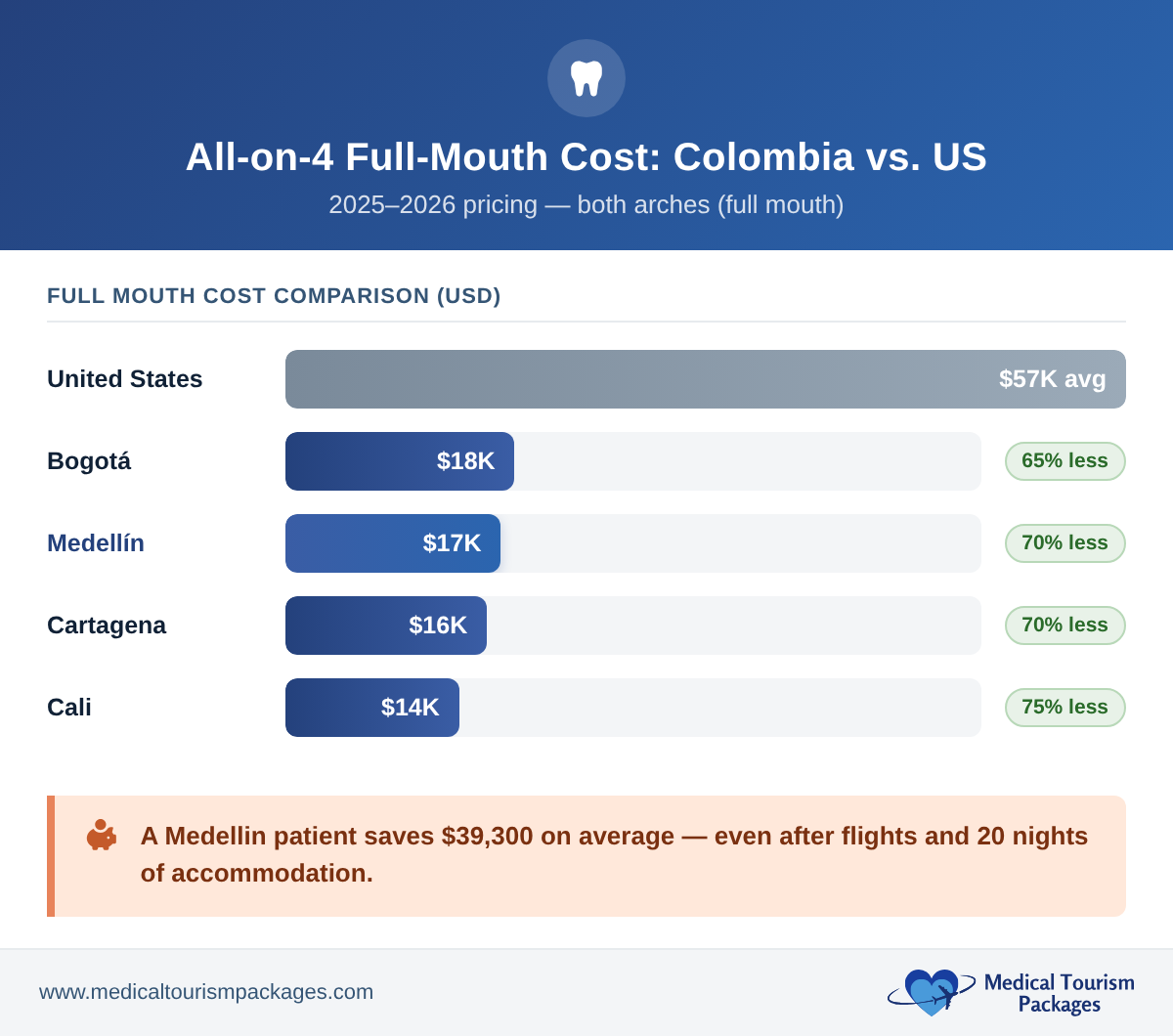
The price gap is structural, not superficial. Lower operational overhead, in-house digital laboratories, and a more competitive professional environment all contribute. The quality of components and clinical care does not change. The cost of delivering them does.
What Does All-on-4 Cost by City in Colombia?
Prices vary across Colombia’s major cities and differ significantly from North America and the UK.
| Location | Per Arch (USD) | Full Mouth (USD) | Savings vs. US |
|---|---|---|---|
| Bogotá | $9,000 – $12,000 | $15,000 – $22,000 | 60–65% |
| Medellín | $8,500 – $12,000 | $14,000 – $20,000 | 65–70% |
| Cartagena | $8,500 – $11,000 | $13,500 – $18,000 | 65–72% |
| Cali | $6,900 – $10,300 | $12,000 – $16,000 | 70–78% |
| United States | $24,000 – $35,000 | $48,000 – $70,000 | — |
| United Kingdom | $15,000 – $22,000 | $30,000 – $50,000 | 40–50% |
| Canada | $14,500 – $22,000 | $29,000 – $45,000 | 45–55% |
Cali consistently offers the most competitive pricing in Colombia. Bogotá commands slightly higher rates but provides the densest concentration of maxillofacial specialists. This matters for complex cases with severe bone loss. Medellín sits in between. It combines strong specialist availability with pricing well below North American rates.
What Does the True All-In Cost Look Like?
The procedure price is only part of the equation. A realistic full-mouth budget for a Medellín patient, across both trips, looks like this:
- Procedure cost: $15,000
- Round-trip flights (x2 trips): $1,200
- Accommodation (20 nights total): $2,000
- Total investment: $18,200
The equivalent treatment in the United States averages $57,500. That is a net saving of $39,300, approximately 68%, after every travel expense is accounted for. Flights from North American hubs run $400–$800 round trip. Miami to Bogotá is approximately 3.5 hours direct. As a general rule, budget an additional 15–20% above your quoted procedure cost for out-of-pocket variables.
What Costs Do Patients Commonly Overlook?
Several costs are often missing from clinic quotes. Know these before you start comparing prices:
- Travel insurance: $150–$300 — essential because standard travel policies do not cover elective surgical complications
- Consultation fees: $50–$100 where not bundled into the procedure quote
- CT scans: $100–$200 where not included — most Colombian clinics include these
- Extended accommodation: variable cost if recovery requires additional observation days
For more information on planning your dental trip, read our complete guide to dental tourism in Colombia.
What Implant Brands and Prosthetic Materials Do Colombian Clinics Use?
Leading Colombian clinics use Straumann Group (including Neodent), Nobel Biocare, BioHorizons, and Zimmer Biomet. These are identical to the systems used in the US and UK. Every implant must carry valid INVIMA registration. INVIMA is Colombia’s national medical device regulatory authority — the equivalent of the FDA. Before your procedure, confirm the implant brand and request the INVIMA documentation. At placement, ask for your implant serial numbers and manufacturer paperwork. Global warranty support is only valid with authentic, registered components.
What Is the Difference Between Acrylic and Zirconia Prosthetics?
Your permanent bridge will be made from one of two materials. The choice has real clinical implications depending on your age, bite strength, and budget.
| Acrylic with Titanium Bar | Monolithic Zirconia | |
|---|---|---|
| Durability | Good | Virtually unbreakable |
| Staining | Susceptible over 7–10 years | Immune to staining |
| Weight | Lighter, easier on opposing jaw | Heavier |
| Aesthetics | Natural-looking | Highest realism |
| Warranty | Typically 2 years | Typically 4 years |
| Best for | Budget-conscious patients; lighter bite forces | Younger patients; bruxism cases |
For most patients, zirconia is the better long-term investment. For those on a tighter budget or with specific clinical needs, the hybrid bridge is a proven and durable solution.
How Are Colombian Oral Surgeons Trained and Verified?
Choosing a surgeon is the single most important decision in this process. Cost and location come second. Colombia’s dental training pathway is rigorous. The credentials are publicly verifiable before you book a flight.
What Training Do Colombian Oral Surgeons Have?
The path to practicing as an oral surgeon in Colombia takes a minimum of nine to ten years. Board-certified specialists complete a structured training pathway:
- 5-year undergraduate dental degree at one of 21 nationally accredited dental schools
- 1-year mandatory Social Service (SSO) in public hospitals or rural clinics, required before any private license is granted
- 3 to 4-year specialist residency in Oral and Maxillofacial Surgery or Prosthodontics
That mandatory public service year is worth noting. It gives Colombian surgeons hands-on clinical volume that many Western graduates do not accumulate until years into private practice.
For guidance on choosing a qualified dental surgeon abroad, review our complete dentist selection criteria.
How Do You Verify a Surgeon Before You Travel?
Colombia provides the tools to verify credentials independently. These three steps take less than an hour:
- Search RETHUS. The Registro Único Nacional del Talento Humano en Salud is Colombia’s publicly searchable national health professional registry. Ask your clinic for the surgeon’s RETHUS registration number. Confirm it yourself before committing.
- Check international society membership. Surgeons who hold membership in bodies such as the American Association of Oral and Maxillofacial Surgeons have met credentials that go beyond Colombian national requirements.
- Confirm Habilitación certification. Your surgeon must operate within a facility certified under Ministry of Health Resolution 3100. This verifies that the clinic meets national standards for sterilization, clinical infrastructure, and safety. No reputable clinic will refuse to provide this documentation on request.
What Is the Two-Trip Treatment Timeline for All-on-4 in Colombia?
All-on-4 in Colombia requires two separate trips. There is no shortcut. The biology of osseointegration takes three to six months. Any clinic promising a permanent result in a single visit is not being truthful. Here is exactly what each phase involves.
What Happens Before You Travel?
The process starts before you leave home. Send your existing dental X-rays or a CBCT scan to your chosen clinic in Bogotá or Medellín. The clinical team uses that imaging to map your bone density and nerve positions digitally. They then build your treatment plan and issue a firm quote. You should have both in hand before you book anything. Schedule your virtual consultation at least four weeks before your departure date.
What Happens During Trip 1 (Surgery and Temporary Bridge)?
Your first trip to Colombia runs seven to ten days. It covers the surgical phase of treatment:
- Day 1: In-person physical exam and final 3D scans. The surgical team confirms the treatment plan.
- Day 2: Surgery under local anesthesia or IV sedation. Failing teeth are extracted. Four implants are placed. A fixed temporary bridge is attached in one session. You leave with a complete, functional smile.
- Days 3 to 10: Healing check-ups and bite adjustments. Swelling peaks around day three and subsides steadily. Most patients are comfortable enough for light activity within 48 hours. Medical clearance to fly is given between day seven and ten.
What Happens During the Healing Period at Home?
This phase happens in your home country. It cannot be rushed. Osseointegration takes three to six months. This depends on your bone density and overall health. During this time a soft and semi-solid diet is required. The temporary bridge is functional but not built for full chewing forces. Your Colombian clinical team stays involved through scheduled video calls. Telemedicine support is available for up to 12 months post-procedure.
What Happens During Trip 2 (Permanent Bridge Delivery)?
The second trip runs seven to twelve days and involves no surgery. The surgeon confirms osseointegration is complete. The temporary bridge is unscrewed and removed — a simple and painless process. Final digital impressions are taken. Your permanent bridge is fabricated, fitted, and adjusted until your bite is exactly right. The permanent prosthesis restores approximately 90% of full natural tooth function. With proper care, it is designed to last a lifetime.
What Does Recovery Look Like After All-on-4 in Colombia?
What Should You Expect in the First Week?
The first 72 hours are the most uncomfortable. Swelling peaks around day three and then steadily improves. Most patients manage with prescribed anti-inflammatories and ice packs. Pain levels are consistently reported as lower than patients anticipate. By day one or two, light activity is realistic. A gentle walk or quiet sightseeing in Medellín’s El Poblado or Bogotá’s Zona Rosa is fine. Anything that raises your heart rate significantly is off limits for four to six weeks. Elevated blood pressure increases bleeding risk at the implant sites. Medical clearance to fly is typically given between day seven and ten.
How Do You Manage Follow-Up Care Once You Are Home?
Once you are home, your Colombian surgical team is no longer physically accessible. This phase requires planning before you travel:
- Ask your clinic about affiliate dentists in your home country before you travel. Some leading Colombian clinics maintain working relationships with US and UK dental practices for minor post-operative needs such as screw tightening and bite adjustments.
- Identify a local maxillofacial surgeon before you leave home as a backup emergency provider. Most will not take on another surgeon’s implant case as a primary patient, but having a professional aware of your situation is essential.
- Get your warranty terms in writing before treatment begins. Reputable Colombian clinics provide a three to five year warranty on the prosthesis and a lifetime warranty on the implant posts.
What Are the Long-Term Success Rates for All-on-4?
All-on-4 is one of the most well-documented procedures in modern implantology. Reported success rates in Colombia consistently exceed 95%. A clinical cohort study in Pereira, Colombia recorded a 97.1% success rate. This is in line with results at leading centers in the US and Europe. The variables that most influence your long-term outcome are largely within your control:
- Oral hygiene is non-negotiable. Implants cannot decay, but the tissue surrounding them can develop peri-implantitis — a form of gum disease and the leading cause of implant failure.
- Smoking reduces osseointegration success rates and impairs gum healing throughout the recovery period.
- Systemic health, particularly blood sugar control in diabetic patients, directly affects how well bone integrates with the implants.
Gum health is the single most important factor over the long term. Daily cleaning, regular professional maintenance, and annual check-ups separate a lifetime result from a premature failure.
Is Colombia the Right Choice for Your All-on-4?
Colombia is not the only country offering All-on-4 at competitive prices. But for most patients traveling from the US, Canada, or the UK, it offers the strongest combination of clinical depth, regulatory rigor, and logistical infrastructure.
How Does Colombia Compare to Mexico and Costa Rica?
Mexico is the most common alternative. It offers comparable per-arch pricing of $7,000–$12,000 and similar proximity to the US. Where Colombia leads is in specialist concentration, the prevalence of in-house digital laboratories, and the formal Habilitación regulatory framework. Costa Rica has a strong reputation for quality but more limited direct flight options from the US East Coast and the UK. Colombia’s recovery infrastructure is more developed than most competing destinations in Latin America. This includes dedicated medical tourism neighborhoods such as El Poblado in Medellín and Zona Rosa in Bogotá, nursing recovery houses, and remote monitoring hubs.
What Questions Should You Ask Every Clinic Before You Book?
Never commit to a clinic based on a website or a price alone. Before you pay a deposit, get clear written answers to these questions:
- Request the surgeon’s RETHUS registration number and verify it yourself. A surgeon unwilling to provide this is a red flag.
- Confirm the implant brand and request INVIMA registration documentation for the specific components being used.
- Ask for a fully itemized price breakdown confirming exactly what is and is not included. This covers scans, extractions, sedation, the temporary bridge, and post-operative visits.
- Confirm warranty terms: three to five years on the prosthesis and a lifetime warranty on the implant posts.
- Confirm English-speaking staff and a named patient coordinator who will be your single point of contact from remote consultation through to final bridge delivery.
What Questions Do Medical Tourists Ask Most Often About All-on-4 in Colombia?
How long should I stay in Colombia after All-on-4 surgery?
You should stay 7 to 10 days in Colombia after your first trip surgery. Medical clearance to fly is given between day seven and ten. Your second trip for the permanent bridge requires 7 to 12 days. US, Canadian, and UK citizens can stay up to 90 days in Colombia without a visa.
Are Colombian dental clinics accredited to international standards?
Yes, Colombian dental clinics must meet Habilitación certification under Ministry of Health Resolution 3100. This standard mandates requirements for sterilization, clinical infrastructure, and professional licensing. Leading clinics also maintain ISO 9001 quality management systems. Some clinics are located within JCI-accredited medical districts. These facilities meet the same patient safety standards used in the United States.
Do Colombian oral surgeons speak English?
Yes, most specialized oral surgeons at leading Colombian clinics are fluent in English. English-speaking patient coordinators provide support throughout your entire treatment journey. Leading clinics in Bogotá and Medellín specifically employ bilingual staff for international patients. This removes the language barriers common in many other dental tourism destinations.
What happens if I have complications after returning home?
Colombian dental clinics provide telemedicine follow-up for up to 12 months after your procedure. Some clinics maintain affiliate relationships with US and UK dentists for minor adjustments. These include screw tightening and bite corrections. Reputable clinics offer a three to five year warranty on the prosthesis. Serious complications require an in-person evaluation with your Colombian team or a local specialist.
Is it safe to fly after All-on-4 surgery in Colombia?
Yes, it is safe to fly after the recommended waiting period. Surgeons provide medical clearance to fly between day seven and ten after surgery. Cabin pressure changes and blood clot risk require adequate healing time before flight. Do not book a return flight earlier than day seven. Keep your head elevated during the flight to reduce swelling.
What training do Colombian oral surgeons have?
Colombian oral surgeons are board-certified specialists with extensive training. They complete a five-year dental degree from one of 21 accredited institutions. This is followed by a mandatory one-year Social Service in public hospitals. After that, they complete a three to four year residency in Oral and Maxillofacial Surgery or Prosthodontics. Surgeons can be verified through the RETHUS national health professional registry before you travel.
Ready to Start Your All-on-4 Journey in Colombia?
Medical Tourism Packages coordinates your entire All-on-4 journey in Colombia. We connect you with Habilitación-certified dental clinics, arrange your travel and accommodations, and provide bilingual support throughout your treatment. Get a free consultation to discuss your restoration goals and receive a personalized quote.
Contact us today to start planning your affordable All-on-4 dental implants in Colombia.