Reservar cita



Joint Revision Surgery in Panama: Costs, Top Hospitals, Safety, and Recovery
 Por
Por
Joint revision surgery in Panama costs 40–70% less than US prices at JCI-accredited hospitals with Johns Hopkins and Mayo Clinic ties.
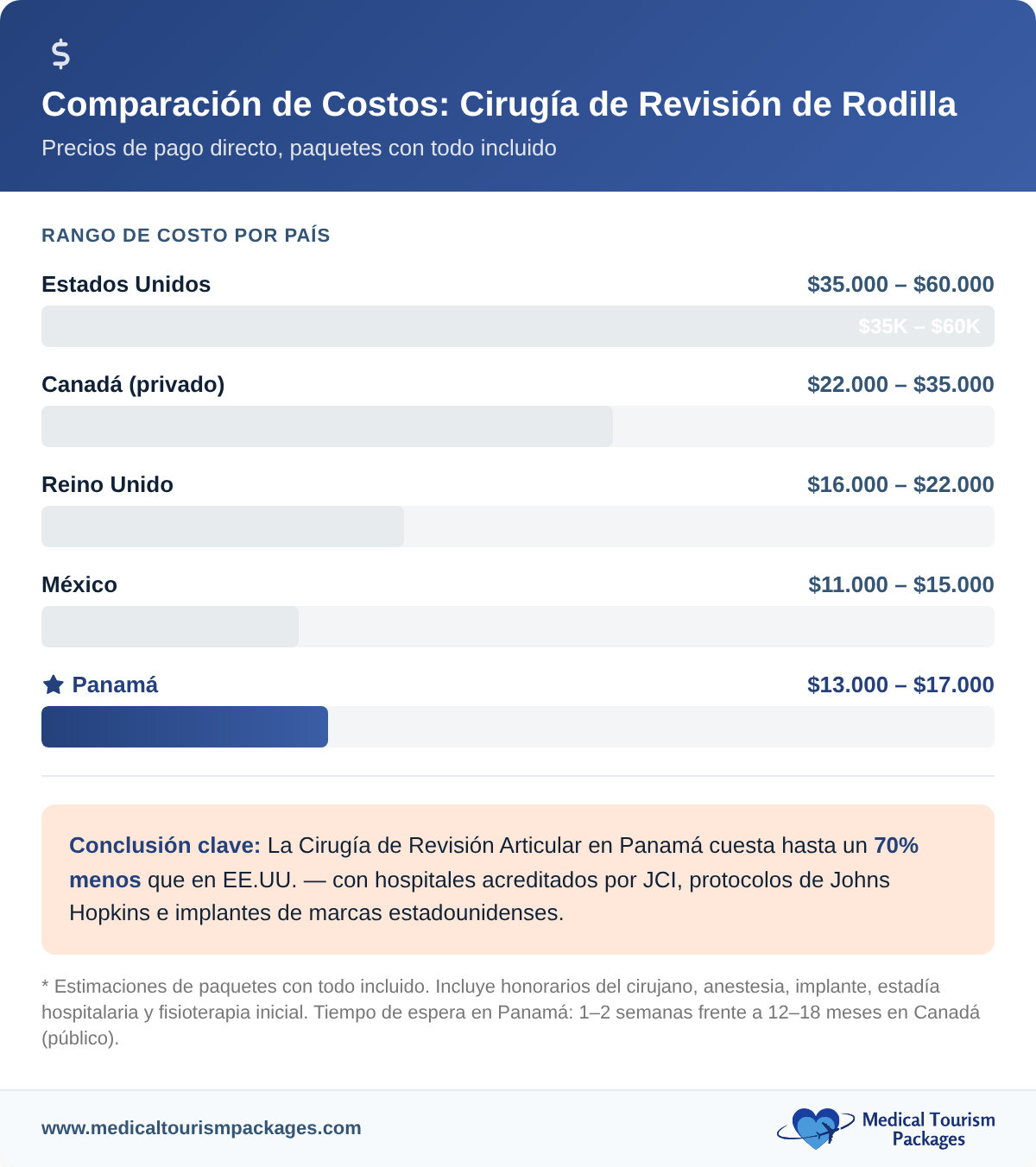
Revision hip surgery costs $12,000–$18,000 in Panama versus $30,000–$50,000 in the US. Revision knee surgery costs $13,000–$17,000 versus $35,000–$60,000. These all-inclusive bundles cover the surgeon, implant, anesthesia, and hospital stay.
Our network connects you with fellowship-trained orthopedic surgeons in Panama City. These surgeons work at JCI-accredited hospitals with direct ties to Johns Hopkins and the Mayo Clinic. Below, you’ll find cost comparisons, top hospital profiles, safety data, surgeon credentials, and recovery timelines.
What Is Joint Revision Surgery?
Joint revision surgery—formally called revision total joint arthroplasty—replaces a failing joint implant. It is performed when a primary joint replacement has worn out, become infected, or stopped working correctly. The three joints most commonly revised are the knee, hip, and shoulder. Approximately 22,000 revision knee surgeries are performed every year in the United States. That number is rising as more patients with aging implants reach the revision threshold. Shoulder revision is the fastest-growing category. It is driven by the rapid adoption of reverse shoulder arthroplasty, which now accounts for nearly 75% of all shoulder replacements performed today.
How Does Joint Revision Surgery Differ from a Primary Joint Replacement?
Revision surgery is more complex than the original procedure. The surgeon works around existing hardware, scar tissue, and bone that may already be compromised. The table below shows how that complexity translates into practical differences for the patient.
| Primary Arthroplasty | Revision Arthroplasty | |
|---|---|---|
| Bone Condition | Natural, intact bone | Often compromised by wear or previous surgery |
| Tejido blando | Virgin tissue planes | Significant scar tissue from prior procedure |
| Surgical Duration | 1–2 horas | 3–6+ hours |
| Estancia en el hospital | 1–2 nights | 3–5+ nights |
| Implant Type | Standardized components | Specialized, long-stemmed, or custom components |
| Weight-Bearing | Often immediate | Frequently delayed; bracing may be required |
Why Do Joint Replacements Fail in the First Place?
Understanding your implant failure is the starting point for any revision consultation. There are five common failure modes, and each requires a different surgical response.
- Aseptic Loosening and Osteolysis: Wear debris triggers an immune response. The body begins resorbing bone around the implant. The components become unstable over time. This is the leading cause of late-term revision in hip and knee replacements.
- Periprosthetic Infection: Bacteria colonize the implant surfaces. Those surfaces have no blood supply. The immune system cannot clear the infection on its own. Surgical removal of the hardware is unavoidable. This typically requires a two-stage procedure.
- Mechanical Wear and Fatigue: Implants have a finite lifespan. In younger or more active patients, the polyethylene liner wears down faster than expected. It requires replacement before the underlying metal housing sustains damage.
- Instability and Dislocation: Incorrectly positioned components or insufficient soft tissue causes repeated dislocation. Revision corrects the alignment and tension of the implant to restore stability.
- Periprosthetic Fractures: A fall or trauma fractures the bone supporting the implant. The surgeon must stabilize the fracture and replace the implant. A long-stem version is used that anchors into healthy bone below the fracture site.
How Much Does Joint Revision Surgery Cost in Panama?
Panama is not the cheapest destination in Latin America for joint revision surgery. But it offers something Colombia and Mexico do not: US-dollar pricing, US-affiliated hospitals, and bundled billing. In the US, a revision procedure generates separate invoices from the hospital, surgeon, anesthesiologist, and specialists. In Panama, one package price covers all of it.
For more on how Panama compares to other medical tourism destinations, see our complete guide for American medical tourists in Panama.
What Does a Full Cost Breakdown Look Like for Joint Revision in Panama vs. Other Countries?
Panama revision surgery costs 40–70% less than US self-pay prices, with all-inclusive bundled packages that eliminate surprise billing.
| País | Revision Hip | Revision Knee | Revision Shoulder | Est. Wait Time |
|---|---|---|---|---|
| EE.UU. | $30,000–$50,000 | $35,000–$60,000 | $50,000–$90,000 | 2–4 weeks |
| Canadá | $20,000–$34,000 | $22,000–$35,000 | $25,000–$45,000 | 12–18 months (public) |
| REINO UNIDO | $15,000–$25,000 | $16,000–$22,000 | $18,000–$28,000 | Más de 6 meses |
| México | $10,000–$12,000 | $11,000–$15,000 | $15,000–$22,000 | 1–2 weeks |
| Colombia | $8,400–$13,000 | $9,000–$14,000 | $12,000–$18,000 | 1–2 weeks |
| Panamá | $12,000–$18,000 | $13,000–$17,000 | $15,000–$22,000 | 1–2 weeks |
What Drives the Cost Difference Between Panama and the US?
Three structural factors explain Panama’s lower prices. None of them involve a reduction in clinical quality.
- Lower malpractice insurance: Malpractice premiums are much lower than in the US. This directly reduces what surgeons charge per procedure.
- Lean administration: Private hospitals in Panama do not maintain large billing departments. They do not need to navigate complex US insurance networks. This lowers overhead across the board.
- US dollar pricing: Panama uses the US dollar. There is no exchange rate exposure. The price you are quoted is the price you pay. This is unlike Colombia or Mexico, where currency changes can reduce your projected savings.
What Are the Best Hospitals for Joint Revision Surgery in Panama?
Medical tourists in Panama use the private sector exclusively. Private hospitals in Panama City offer shorter wait times, advanced surgical technology, and dedicated international patient coordinators. The four leading institutions for joint revision each hold JCI or TEMOS accreditation. All carry direct affiliations with major US medical institutions. This is what separates Panama from most other medical tourism destinations.
How Do Panama’s Top Hospitals Compare for Joint Revision Surgery?
Each of Panama City’s four leading hospitals brings different strengths to complex revision cases.
| Hospital | Acreditación | US Afiliación | Orthopedic Focus | Patient Rating |
|---|---|---|---|---|
| Hospital Punta Pacífica | Acreditado por la JCI | Medicina Johns Hopkins Internacional | Robotic-assisted revisions | 5/5 (Clinical) |
| Hospital San Fernando | Acreditado por la JCI | Tulane University / Baptist Health | Complex trauma and multi-specialty | 4.0/5 |
| Clínica de Panamá | TEMOS / Mayo Clinic | Mayo Clinic Care Network | Minimally invasive arthroplasty | 4.5/5 |
| Hospital Paitilla | JCI Candidate | Cleveland Clinic / Hospiten Group | Advanced diagnostic imaging | 3.5/5 |
Hospital Punta Pacífica is the only hospital in Central America affiliated with Johns Hopkins Medicine International. This partnership governs clinical protocols, physician training, and patient safety standards. For complex revision cases, the hospital uses real-time videoconferencing to consult with Johns Hopkins specialists in Baltimore. Hospital San Fernando has held JCI accreditation since 2011, making it the first hospital in Panama to earn that credential. The Panama Clinic is purpose-built for medical tourists. Its recovery suites are designed for extended post-operative stays. Hospital Paitilla completed a major modernization following its 2019 merger with the Hospiten Group. It is currently working toward full JCI accreditation.
Is Joint Revision Surgery in Panama Safe?
At JCI-accredited facilities in Panama City, the clinical safety standards are directly comparable to top US hospitals. Panama’s leading hospitals report complication rates at or below the global benchmark of 4.7% for joint arthroplasty procedures. Operating theaters use laminar flow ventilation systems that filter airborne contaminants continuously. Mandatory pre-operative antibiotic protocols are standard. Robotic-assisted surgery reduces soft-tissue trauma through improved implant placement precision. For rare or complex revision cases, Hospital Punta Pacífica’s real-time consultation capability with Johns Hopkins specialists in Baltimore provides a level of clinical oversight that few hospitals anywhere in the world can match.
What Implants and Technology Are Used for Joint Revision Surgery in Panama?
Panama’s top hospitals source implants from the same global manufacturers as US surgical centers. There is no risk of receiving unapproved or inferior components at an accredited facility. Panama City surgeons use four main implant systems:
- Zimmer Biomet: The Persona Revision Knee and NexGen Legacy systems are widely available. These modular systems allow surgeons to match the specific bone loss of the patient.
- Stryker: Known for the Triathlon Knee and Accolade Hip systems. Stryker hardware is often paired with the Mako robotic arm, which is active at Hospital Punta Pacífica.
- DePuy Synthes (Johnson & Johnson): The Attune Knee and Pinnacle Hip systems are standard in Panamanian surgical suites.
- Advanced Materials: Highly cross-linked polyethylene liners and titanium-foam augments are used for cases involving significant bone loss.
How Do Panama’s Revision Surgery Outcomes Compare to Global Benchmarks?
Outcomes at Panama’s JCI-accredited hospitals match international standards. Shoulder revision success rates run at 90–95%. Leading surgeons report 10-year implant survival rates of 94–96%. One important reality applies regardless of where the surgery is performed: revision implants last 10–15 years, compared to 15–25 years for a primary replacement. Patients should factor that into their long-term planning. Surgeon selection is also critical. Revision patients are five times more likely to need a further re-revision than patients having a primary implant.
How Do You Choose the Right Joint Revision Surgeon in Panama?
Surgeon selection is the most important decision a revision patient makes. Surgeons who perform more revision procedures consistently produce fewer complications. This volume-outcome relationship is well established in orthopedic research. When evaluating a surgeon in Panama City, ask how many revision arthroplasties they perform annually—not how many joint replacements overall. The best revision surgeons combine international fellowship training with high-volume practices at accredited institutions.
For guidance on finding a qualified specialist, see our complete guide to orthopedic surgery in Panama.
How Can a Patient Verify a Surgeon’s Credentials in Panama?
You can verify any surgeon’s credentials using three independent sources. Do this before committing to any procedure.
- Consejo Técnico de Salud app: Confirm the surgeon’s active license and registered specialty. This is Panama’s official medical licensing authority.
- certificationmatters.org: Verify any claimed US board certification through this official resource.
- Surgeon CV with fellowship documentation: Request their CV with documentation showing fellowship training specifically in revision arthroplasty—not just general orthopedic surgery. A surgeon trained in primary replacement is not automatically qualified for complex revision work.
What Does the Joint Revision Surgery Journey Look Like in Panama?
The process begins before you travel. Panama’s leading hospitals accept digital imaging in DICOM format through secure patient portals. Your surgical team reviews the files and returns a formal opinion within 48–72 hours. A video consultation with your surgeon is then scheduled. By the time you board your flight, your surgeon already knows your case in full.
What Visa and Entry Requirements Apply to Medical Tourists?
US and Canadian citizens do not require a visa for stays up to 180 days. This comfortably covers the full surgical and recovery window. You need to meet five entry requirements:
- Passport validity: Your passport must be valid for at least 3 months beyond your entry date.
- Return flight proof: Bring proof of a return or onward flight.
- Economic solvency: Show $500 in cash or a major credit card at the border.
- Biometrics at arrival: Facial scans and fingerprints are collected at Tocumen International Airport.
- Hospital confirmation letter: Carry your hospital letter in case border agents question your length of stay.
What Is the In-Country Timeline from Arrival to Departure?
Most revision patients spend 21 days in Panama from surgery to departure clearance. Here is what each phase looks like.
| Milestone | Marco temporal | Actividades principales |
|---|---|---|
| Pre-Op Arrival | Days −3 to −1 | Physical exam, blood work, anesthesia consultation, imaging review |
| Surgery and Hospitalization | Days 0–5 | Revision procedure (3–6 hours), pain management, early mobilization |
| Outpatient Recovery | Weeks 1–3 | Daily physiotherapy, nursing visits for wound care and mobility |
| Return Flight Clearance | Day 21 | Surgeon confirms wound stability and DVT risk is within safe limits |
What Is Recovery Like After Joint Revision Surgery in Panama?
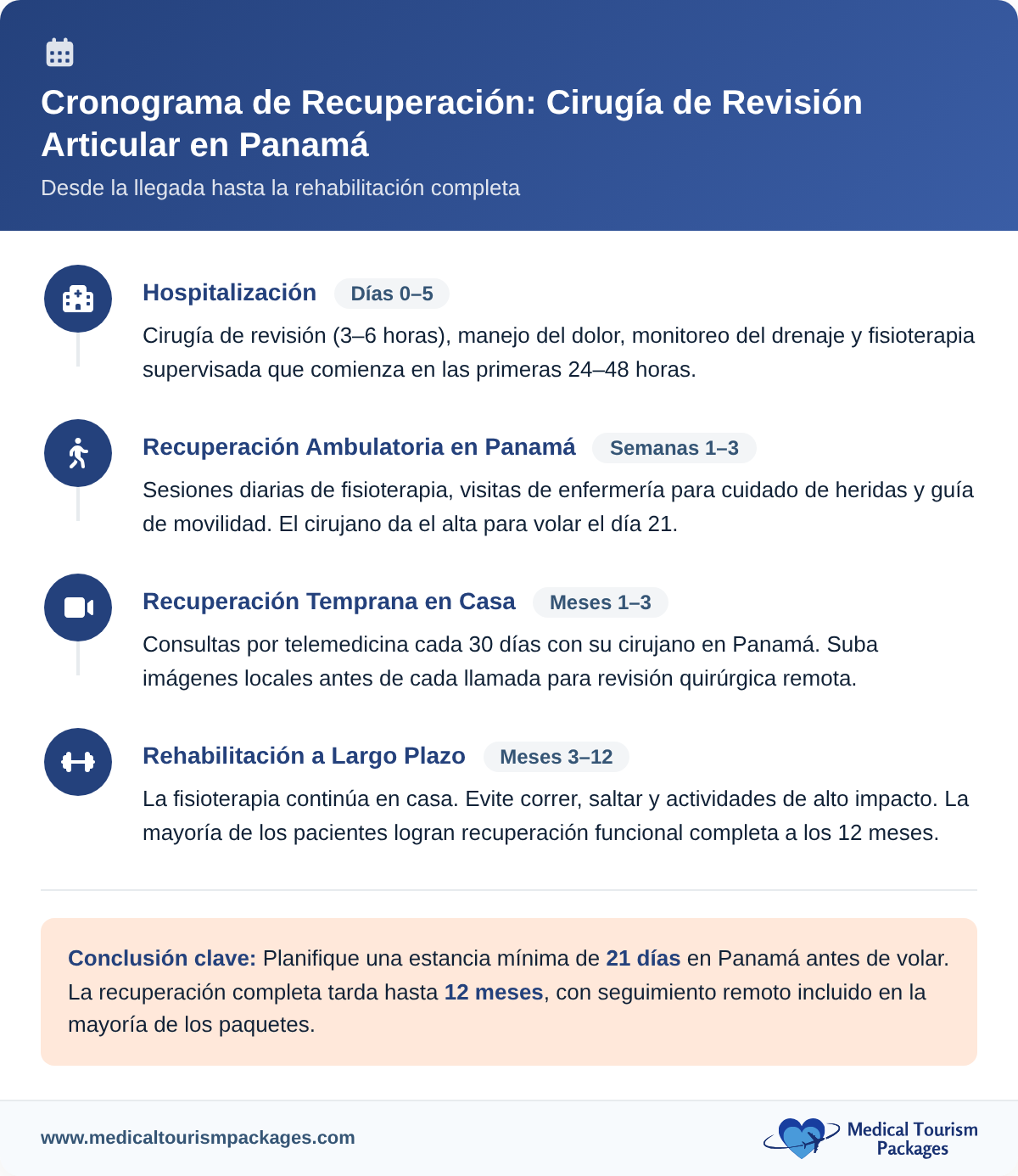
Recovery from revision surgery is longer and more demanding than recovery from a primary replacement. Panama City’s post-operative infrastructure is built around that reality. Physical therapy begins within the first 24–48 hours of surgery and continues daily throughout the in-country window. A nurse or therapist visits your hotel or apartment once or twice daily during the first two weeks. They cover wound care, medication management, and mobility guidance. After you return home, your Panamanian surgical team schedules a telemedicine check-in every 30 days during the first three months. Local imaging is uploaded before each call for remote surgical review.
What Does a Realistic Recovery Timeline Look Like After Joint Revision Surgery?
Full recovery takes up to 12 months. The process has four clear phases.
| Fase | Marco temporal | Actividades principales |
|---|---|---|
| Hospitalización | Days 0–5 | Pain management, drainage monitoring, supervised physiotherapy begins |
| Outpatient Recovery in Panama | Weeks 1–3 | Daily physiotherapy, nursing visits, wound check before departure |
| Early Home Recovery | Months 1–3 | Telemedicine check-ins every 30 days, local imaging for remote review |
| Long-Term Rehabilitation | Months 3–12 | Ongoing physiotherapy; avoid running, jumping, and high-impact activity |
What Recovery Accommodations Are Available Near Panama City Hospitals?
Patients in Panama City have access to several recovery accommodation options near the top hospitals.
- Punta Pacífica and Costa del Este: The JW Marriott and Marriott Residence Inn are ADA-compliant and within minutes of the top hospitals. Both offer medical tourism rates for extended stays.
- Casco Viejo (Old Town): The Sofitel Legend and Hotel La Compañía offer boutique recovery options. The neighborhood’s walkable waterfront is well suited to early rehabilitation walks.
- Specialized Rehab Facilities: The Centro de Rehabilitación Especializada and the Instituto Panameño de Rehabilitación both offer intensive outpatient programs for medical tourists.
What Are the Advantages and Disadvantages of Joint Revision Surgery in Panama?
Every medical tourism decision involves trade-offs. Panama’s case is strong, but it has practical limitations. Here is an honest assessment of both sides.
What Are the Advantages of Choosing Panama for Joint Revision Surgery?
Panama offers seven clear advantages for revision arthroplasty patients.
- Cost savings: A revision procedure that costs $35,000–$60,000 in the US runs $13,000–$18,000 in Panama. The price is bundled and all-inclusive.
- US clinical partnerships: Panama’s top hospitals in Panama City operate under active partnerships with Johns Hopkins and the Mayo Clinic—not just accreditation certificates.
- Same implant brands: Implants are sourced from the same Zimmer Biomet, Stryker, and DePuy Synthes supply chains as US hospitals.
- No currency risk: Panama uses the US dollar. The price quoted is the price you pay.
- Visa-free entry: US and Canadian citizens can enter without a visa for up to 180 days.
- English-speaking staff: English-speaking staff are standard at all JCI-accredited facilities in Panama City.
- Longer surgeon consultations: Surgeons in Panama spend 45–60 minutes with revision patients pre-operatively. The US norm is around 10 minutes.
What Are the Disadvantages of Choosing Panama for Joint Revision Surgery?
Panama also has four practical limitations to factor into your planning.
- 21-day mandatory stay: The in-country recovery window is non-negotiable. Factor it into your time-off planning from the start.
- Home physician may decline: Some US and Canadian doctors will not manage complications from surgery performed abroad. Arrange a willing local doctor before you travel.
- Administrative friction: Some patients report slow or disorganized billing processes at the hospital level. Complaints are concentrated in administrative—not clinical—departments.
- Shorter implant lifespan: Revision implants last 10–15 years, regardless of where the surgery is performed. Primary implants typically last 15–25 years. Plan accordingly.
Is Panama the Right Choice for Your Joint Revision Surgery?
Panama is not the cheapest destination in Latin America for joint revision surgery. But it offers something Colombia and Mexico cannot match: US-standard clinical infrastructure, dollar-denominated pricing, and direct affiliations with Johns Hopkins, Mayo Clinic, and Cleveland Clinic. If you are facing a self-pay revision in the US, Panama deserves serious consideration.
Three things determine whether the experience goes well. First, verify your surgeon’s fellowship training is specifically in revision arthroplasty through the Consejo Técnico de Salud. Second, choose a hospital with an active US institutional affiliation—not just an accreditation certificate. Third, commit to the full 21-day recovery window before booking your return flight. Panama’s investment in robotic technology and advanced biological materials is ongoing. Its position as the most clinically advanced medical tourism destination in Central America is strengthening.
For a complete overview of surgical options in the region, read our guide to surgical procedures in Panama.
What Questions Do Medical Tourists Ask Most Often About Joint Revision Surgery in Panama?
How long should I stay in Panama after joint revision surgery?
You should stay at least 21 days after joint revision surgery before flying home. The first 3–5 days are spent in the hospital for pain management. The following two weeks include daily physical therapy and wound care. Your surgeon confirms your wound is stable and your DVT risk is safe before clearing you for the flight. US and Canadian citizens can stay visa-free for up to 180 days.
¿Los hospitales de Panamá están acreditados según las normas internacionales?
Yes, Panama has multiple JCI-accredited hospitals. Joint Commission International (JCI) is the same standard used by top US hospitals. Hospital Punta Pacífica is affiliated with Johns Hopkins Medicine International. Hospital San Fernando was the first JCI-accredited hospital in Panama, earning that credential in 2011. The Panama Clinic is TEMOS accredited and part of the Mayo Clinic Care Network. These hospitals meet the same patient safety standards as US medical centers.
Do joint revision surgeons in Panama speak English?
Yes, most specialized orthopedic surgeons at JCI-accredited facilities in Panama City speak English fluently. Many trained at institutions in the United States or Europe. International patient coordinators are available at all major hospitals. They communicate clearly throughout your consultation, surgery, and recovery. This removes the language barrier that complicates medical tourism in many other countries.
¿Qué ocurre si tengo complicaciones al volver a casa?
Panama’s leading orthopedic surgeons provide telemedicine follow-up every 30 days during your first three months home. Your surgeon will review local imaging uploaded before each call. Many hospitals issue a surgical passport—a digital record of the surgery, implant serial numbers, and operative notes. This allows a local US or Canadian surgeon to step in with full knowledge of your procedure. Arrange a willing local physician before you travel for added peace of mind.
Is it safe to fly home after joint revision surgery in Panama?
Yes, it is safe to fly after the required 21-day waiting period. Surgeons enforce this rule to manage DVT risk and allow the wound to stabilize. Cabin pressure changes and immobility during long flights increase blood clot risk if you fly too soon. Your surgeon will clear you for flight after a final wound check on day 21. Keep your operated joint elevated during the flight to reduce swelling.
What training do joint revision surgeons in Panama have?
Panama’s revision surgeons are board-certified orthopedic specialists with fellowship training. They complete a medical degree followed by a multi-year orthopedic residency. After residency, they pursue a fellowship specifically in revision arthroplasty. Fellowship training often takes place at premier centers in the United States or Europe. Many hold memberships in international orthopedic associations. Verify any surgeon’s credentials through the Consejo Técnico de Salud app and certificationmatters.org before committing.
Ready to Start Your Joint Revision Surgery Journey in Panama?
Medical Tourism Packages coordinates your entire joint revision journey in Panama. We connect you with JCI-accredited hospitals, arrange your travel and accommodations, and provide bilingual support throughout your treatment. Get a free consultation to discuss your mobility goals and receive a personalized quote.
Contact us today to start planning your affordable joint revision surgery in Panama.