Reservar cita



Carpal Tunnel Surgery in Panama: Costs, Top Hospitals, and What Medical Tourists Need to Know
 Por
Por
Carpal tunnel surgery in Panama costs $2,500–$3,500, up to 70% less than US prices, at JCI-accredited hospitals with fellowship-trained surgeons.
Carpal tunnel release in Panama costs $2,500–$3,500 versus $4,500–$12,000 in the US—55–70% less. Pacífica Salud holds JCI Gold Seal accreditation with Johns Hopkins Medicine International protocol alignment since 2006.
This guide covers procedure types, cost comparisons, top hospitals in Panama City, surgeon credentials, recovery timelines, and practical planning tips. You will find everything you need to plan your carpal tunnel surgery at Pacífica Salud, Clínica Hospital San Fernando, or The Panama Clinic.
What Is Carpal Tunnel Surgery?
Carpal tunnel syndrome occurs when the median nerve gets compressed at the wrist. That compression produces numbness, tingling, and weakness in the hand and fingers. Carpal tunnel release surgery corrects this by cutting the transverse carpal ligament. This widens the tunnel and relieves pressure on the nerve. It is one of the most common hand surgeries in the world, with a success rate above 90%.
What Is the Difference Between Open and Endoscopic Release?
Panama’s top hospitals offer two surgical techniques. Your surgeon will recommend one based on your anatomy, symptom severity, and how quickly you need to return to normal activity.
| Lanzamiento abierto (OCTR) | Liberación endoscópica (ECTR) | |
|---|---|---|
| Tamaño de la incisión | 3–5 cm palm incision | 1–2 portal incisions under 1 cm each |
| Visualisation | Direct view of nerve and ligament | Camera-guided from inside the tunnel |
| Postoperative Pain | Moderate; higher pillar pain risk | Más bajo |
| Cicatrización | More visible scar | Mínimo |
| Recuperación para uso ligero | 4-6 semanas | 2-4 semanas |
| Paciente más adecuado | Complex anatomy or concurrent pathologies | La mayoría de los turistas médicos |
| Costo relativo | Más bajo | Higher due to specialised equipment |
When Is Surgery Recommended?
Most surgeons require three to six months of conservative treatment first. That includes night splinting, corticosteroid injections, and activity modification. When those fail, or when nerve conduction studies show severe compression, surgery is the right next step. Left untreated, severe compression causes permanent nerve damage. It also causes wasting of the thenar muscles at the base of the thumb. Recovery after surgery then takes much longer and may be incomplete.
How Much Does Carpal Tunnel Surgery Cost in Panama?
Carpal tunnel surgery in Panama costs $2,500–$3,500. The same procedure costs up to $12,000 in the United States. That price gap comes from three factors: lower malpractice insurance premiums, leaner hospital administration, and USD pricing. Panama uses the US dollar, so there is no currency risk.
What Does the All-In Price Include?
Panama’s top hospitals quote bundled prices. There are no separate invoices from the surgeon, anesthesiologist, and facility. One price covers:
- Surgeon fee
- Hospital or clinic facility fee
- Anestesia
- Pre-operative labs
- Initial follow-up visits
- Post-operative medications and basic medical supplies
How Do Panama’s Prices Compare to the US, Canada, and the UK?
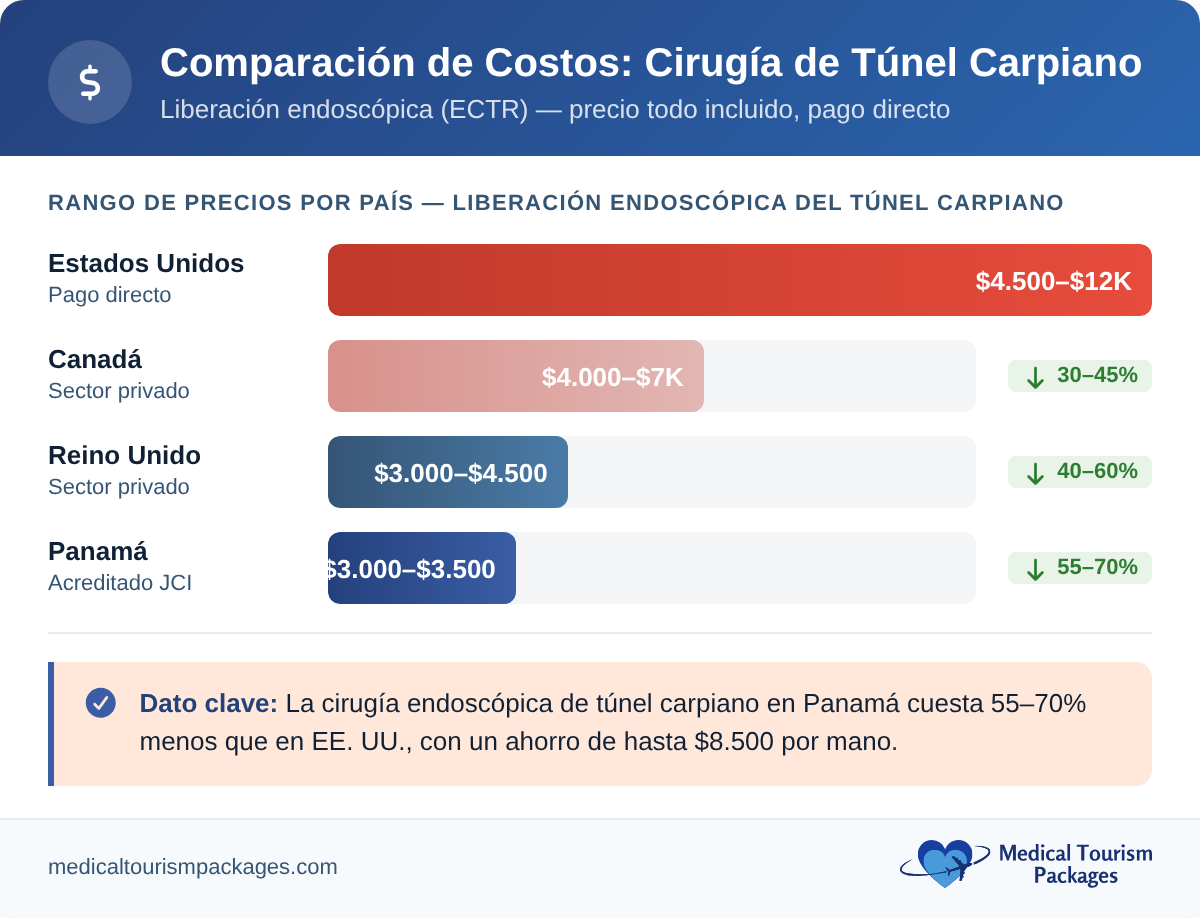
Panama saves patients 55–70% compared to US self-pay rates. It also offers better value than private care in Canada and the UK.
For a broader look at hand procedures available in Panama, see our complete guide to hand surgery in Panama.
| Open Release | Endoscopic Release | Ahorro frente a EE.UU. | |
|---|---|---|---|
| Estados Unidos | $3,000–$8,000 | $4,500–$12,000 | - |
| Canada (private) | $2,500–$5,000 | $4,000–$7,000 | 30–45% |
| Reino Unido | $1,900–$3,500 | $3,000–$4,500 | 40–60% |
| Panamá | $2,500–$3,000 | $3,000–$3,500 | 55–70% |
What Are the Best Hospitals for Carpal Tunnel Surgery in Panama?
Medical tourists in Panama use the private sector exclusively. Panama City’s leading private hospitals offer shorter wait times, advanced surgical technology, and dedicated international patient coordinators. All four leading facilities hold international accreditation. Each maintains direct affiliations with major US medical institutions.
How Do Panama City’s Top Hospitals Compare?
Four hospitals stand out for medical tourists in Panama City. All hold international accreditation and have formal ties to major US medical institutions.
| Acreditación | US Afiliación | Característica destacada | |
|---|---|---|---|
| Pacífica Salud | Sello de Oro de la JCI | Medicina Johns Hopkins Internacional | Most technologically advanced facility in Latin America |
| Clínica Hospital San Fernando | Acreditado por la JCI | Baptist Health South Florida, Tulane Medical Center | Dedicated International Patient Department |
| Clínica de Panamá | Acreditado por TEMOS | Red de atención médica de Mayo Clinic | COPAC Orthopedic Center with mini C-arm fluoroscopy |
| Hospital Paitilla | Grupo Hospiten | Cleveland Clinic (historical) | Central location; high English proficiency among staff |
What Makes Pacífica Salud the Leading Choice?
Pacífica Salud is widely regarded as the most advanced hospital in Panama and Latin America. Its affiliation with Johns Hopkins Medicine International dates to 2006. That partnership governs clinical protocols, nursing standards, and patient safety goals. They are aligned directly with American academic benchmarks. The hospital earned its first JCI accreditation in 2011 and has maintained it since. For carpal tunnel patients, Pacífica Salud provides a dedicated orthopedic unit. Specialists here complete much of their training in the United States. Advanced diagnostic imaging is available on-site. A second campus operates in Costa del Este.
Why Is Clínica Hospital San Fernando Worth Considering?
San Fernando has been operating since 1949. It was the first private hospital in Panama and the first to achieve JCI accreditation in the country. That track record reflects decades of experience with international patients. The hospital runs a well-established International Patient Department. It handles language support, appointment coordination, and administrative paperwork for overseas patients. One practical caveat: San Fernando is on Vía España, a busy central artery. Wait times for pre-operative lab work can run long at peak hours. Book your pre-op appointments for early morning to avoid delays.
Is Carpal Tunnel Surgery in Panama Safe?
At JCI-accredited facilities in Panama City, safety standards match top US hospitals. The risks are the same as for this procedure anywhere in the world. What changes is the institution you choose, not the country.
How Do Safety Standards Compare to the US?
Panama ranked as the safest country in Latin America in the 2024 Global Peace Index. Its top private hospitals consistently place in the regional top 10 for quality and patient outcomes. JCI protocols keep carpal tunnel release infection rates at or below the 1% international benchmark. Panama City tap water is potable.
What Are the Risks of Carpal Tunnel Release?
Carpal tunnel release is a low-risk outpatient procedure. Serious complications are rare. That said, every surgical procedure carries inherent risks. Known risks include:
- Sangrado
- Infection at the surgical site
- Accidental injury to the median nerve
- Scar sensitivity
- Pillar pain in the muscles flanking the incision
- Symptom recurrence if the underlying cause is not addressed
Choosing a fellowship-trained surgeon at a JCI-accredited facility is the most effective way to reduce all of these risks.
¿Cómo elegir al cirujano adecuado en Panamá?
Surgeon selection is the most important decision you will make. The hospital accreditation sets the floor, but the surgeon determines your outcome.
What Training Standards Do Panama’s Hand Surgeons Meet?
Board-certified hand surgeons in Panama City complete a multi-stage training pathway:
- Six years of medical school at an accredited university
- Four to five year orthopaedic surgery residency
- One to two year fellowship in hand and upper extremity surgery
Fellowship training often occurs at premier centres in the United States or top-tier Latin American institutions. These centres are known for high surgical volume and technical innovation. Approximately 90% of top private hospital staff in Panama City completed training in the US or Europe. Many surgeons are members of the Asociación Panameña de Ortopedia y Traumatología.
Most specialised hand surgeons at JCI-accredited facilities in Panama City are fluent in English. They provide care specifically designed for international patients.
¿Cómo se verifican las credenciales de un cirujano?
Do not rely on a hospital’s website alone to verify credentials. Use these two official sources:
- Asociación Panameña de Ortopedia y Traumatología — Panama’s official orthopaedic association. Confirms active membership and registered specialty.
- American Society for Surgery of the Hand (ASSH) — The international benchmark for hand surgery credentials. Use it to verify any claimed fellowship training.
Read our complete guide for American medical tourists in Panama for more planning tips, including hospital selection and logistics.
What Does the Carpal Tunnel Surgery Journey Look Like in Panama?
The process starts before you board your flight. Panama’s leading hospitals accept digital records and imaging through secure patient portals. Your surgical team can review your case and confirm a procedure date before you travel. Surgery is schedulable within 48 hours of arrival in Panama City.
What Do You Need to Arrange Before You Travel?
Before you travel, send your EMG and nerve conduction study results digitally to your surgeon. Pre-operative requirements include blood tests, an ECG, and a chest X-ray if requested. Sign record-release forms before leaving the hospital. This ensures your home-country physician can access your surgical records after you return.
¿Cuáles son los requisitos de visa y entrada al país?
US, Canadian, and UK citizens do not need a visa. You can stay up to 180 days on arrival. Your passport must be valid for at least three months beyond your planned departure date. Proof of financial solvency between $500 and $1,000 may be requested at the border. A confirmed return flight is mandatory and checked by airlines before departure.
¿Dónde debe hospedarse durante la recuperación?
Panama City has several districts well suited to post-surgical recovery. Your choice should be guided by how close you want to be to your hospital and what level of comfort you need during the first week.
| Cerca de hospitales | Nivel de seguridad | Accommodation Tier | |
|---|---|---|---|
| Punta Pacífica | Adjacent to Pacífica Salud and The Panama Clinic | Más alto | Lujo |
| Costa del Este | Near Pacífica Salud’s second campus | Muy alto | Upper mid-range to luxury |
| San Francisco / Paitilla | Near Hospital Paitilla and outpatient clinics | Alta | Mid-range to upper mid-range |
| El Cangrejo | 10–20 minutes from major hospitals | Alta | Budget to mid-range |
How Do You Get Around Panama City After Surgery?
Your hand will have limited dexterity after surgery. Transport planning is important. Use these options:
- Uber — Recommended for most trips. Offers transparent pricing, GPS tracking, and credit card payment. You never need to handle cash or negotiate with a sore hand.
- Private car services — Coordinated through your hospital. Best choice for airport transfers and surgical appointments.
- Avoid street-hailed taxis — Pricing is inconsistent.
- Ambulance fleets — Both Pacífica Salud and The Panama Clinic maintain private ambulance fleets. They are faster and better equipped than the public system.
What Is Recovery Like After Carpal Tunnel Surgery in Panama?
Recovery from carpal tunnel release is phased. Most patients notice immediate relief from nighttime numbness and tingling. Full grip strength and nerve regeneration take longer. What you do in the first few weeks directly affects your long-term outcome.
What Happens Week by Week?
| Fase | Objectives | Restricciones | |
|---|---|---|---|
| Días 1-3 | Acute postoperative | Wound elevation, ice therapy, edema management | No hand use; keep wrist elevated |
| Días 4-7 | Initial mobilisation | Light finger movement to prevent tendon adhesion | No heavy lifting or water immersion |
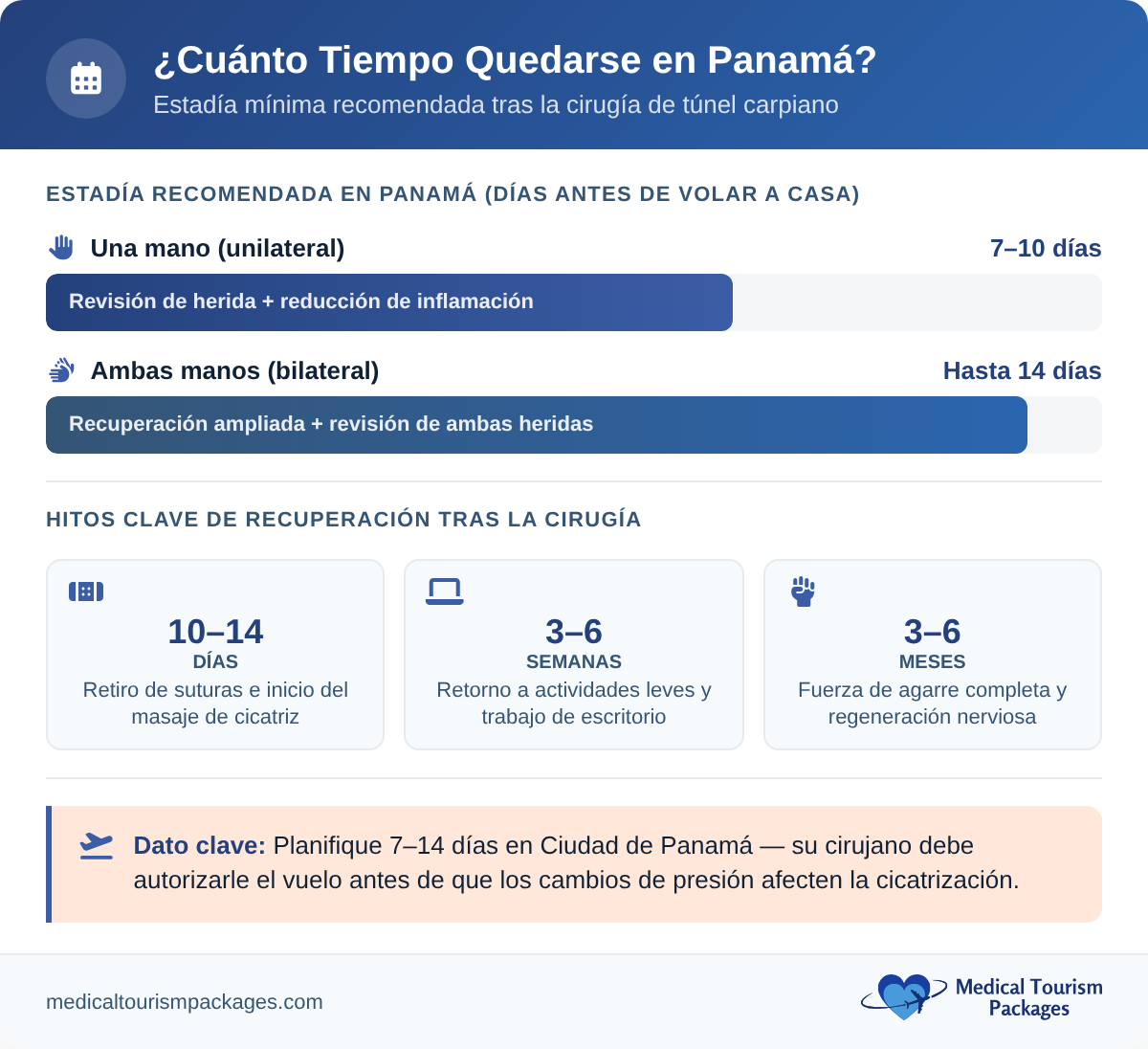
| Días 10-14 | Retirada de suturas | Sutures removed; scar massage begins | Avoid strenuous wrist activity |
| Weeks 3–6 | Functional restoration | Return to light activities and desk work; wrist stretching introduced | No manual labour or repetitive gripping |
| Months 3–6 | Full recovery | Full grip and pinch strength restored; maximum nerve regeneration | Graduated return to all activities |
When Can You Fly Home?
Plan to stay in Panama for 7 to 10 days after a single-hand procedure. Plan up to 14 days for bilateral surgery. Your surgeon needs to see you for a wound check before you fly. Initial inflammation needs time to subside. Cabin pressure changes during a long-haul flight can affect healing tissue. Build the full stay into your budget from the start.
What Post-Operative Support Do Panama Hospitals Provide?
Panama’s top hospitals provide post-operative support that is rare in North America. Doctors or nurses visit you in your hotel room once or twice daily. This continues for up to 30 days after surgery. They cover wound care, medication management, and mobility guidance. The same surgical team manages your recovery throughout.
Before you leave Panama, identify a hand therapist in your home country. Physical therapy is not optional. It is the difference between a good outcome and a full recovery. Begin rehabilitation within three to four weeks of your surgery date. If you wait longer, scar tissue stiffens and progress slows.
What Are the Advantages and Disadvantages of Carpal Tunnel Surgery in Panama?
Panama offers clear benefits for international patients. There are also limitations to consider. Review both sides before making your decision.
| Factor | Advantage | Disadvantage |
|---|---|---|
| Ahorro de costes | 55–70% less than US self-pay prices | Travel and accommodation add $1,600–$3,400 to total cost |
| Wait time | Surgery within 48 hours of arrival in Panama City | Requires advance planning and digital record submission |
| Surgeon quality | ~90% of staff trained in the US or Europe | No US-style malpractice recourse if issues arise |
| English language access | Specialist fluency above 90% at top hospitals | Some administrative and nursing staff may need interpreters |
| Post-op support | In-hotel nursing visits for up to 30 days | Physical therapy must be arranged at home before departure |
| Legal framework | JCI accreditation ensures strong clinical oversight | Panamanian malpractice laws are less developed than US or UK |
Is Panama the Right Choice for Your Carpal Tunnel Surgery?
Panama works well for specific types of patients. The table below helps you identify whether you are one of them.
| Patient Type | Situation | Panama a Good Fit? |
|---|---|---|
| Uninsured or high-deductible US patient | Surgery costs $10,000+ at home; Panama all-in runs ~$5,000 | Sí |
| Canadian or UK patient on a public waitlist | Facing 6–12 months wait with progressing symptoms | Yes, access within 48 hours |
| Any patient | Considering unaccredited or lower-tier facilities to reduce cost further | No |
Panama offers clinical quality, surgical access, and cost savings for the right patient. Pacífica Salud, Clínica Hospital San Fernando, and The Panama Clinic all operate to JCI-accredited standards. That accreditation is the non-negotiable baseline. If cost pressure is pushing you toward an unaccredited clinic, Panama is not the right destination.
For a complete overview of orthopedic procedures available in Panama, see our orthopedic surgery guide for international patients.
What Questions Do Medical Tourists Ask Most Often About Carpal Tunnel Surgery in Panama?
How long should I stay in Panama after carpal tunnel surgery?
You should stay 7 to 10 days after a single-hand procedure before flying home. Bilateral surgery requires up to 14 days. This allows initial inflammation to subside. Your surgeon needs to see you for a wound check before you fly. Cabin pressure changes can affect healing tissue during a long-haul flight. US, Canadian, and UK citizens do not need a visa for stays up to 180 days.
¿Los hospitales de Panamá están acreditados según las normas internacionales?
Yes, Panama has multiple JCI-accredited hospitals. Joint Commission International (JCI) is the same standard used by top US hospitals. Pacífica Salud holds the JCI Gold Seal and has maintained it since 2011. Clínica Hospital San Fernando was the first JCI-accredited facility in Panama. These hospitals meet the same patient safety standards as leading US medical centers.
¿Los cirujanos de mano de Panamá hablan inglés?
Yes, most specialised hand surgeons at Panama City’s top private hospitals are fluent in English. Specialist English fluency at JCI-accredited facilities is above 90%. International patient coordinators communicate clearly throughout your treatment journey. This removes the language barrier that complicates medical tourism in many other countries. Some administrative and nursing staff may require interpreters.
¿Qué ocurre si tengo complicaciones al volver a casa?
Panama’s leading hand surgeons work directly with your home-country physician. They provide seamless postoperative follow-up after you return home. Many surgical packages include telemedicine follow-up appointments. You can contact your surgeon directly for any postoperative concerns. Pacífica Salud’s Johns Hopkins Medicine International affiliation creates pathways for high-level consultation in rare cases. Your primary protection is choosing a JCI-accredited facility and a fellowship-trained surgeon.
Is it safe to fly after carpal tunnel surgery?
Yes, it is safe to fly after the recommended waiting period. Surgeons recommend a 7 to 10 day stay before flying home after a single-hand procedure. Cabin pressure changes and blood clot risk require adequate healing time before flight. Your surgeon will clear you for flight after verifying your healing progress. Keep your hand elevated during the flight to reduce swelling.
What training do Panama’s hand surgeons have?
Panama’s hand surgeons are board-certified specialists with extensive fellowship training. They complete six years of medical school followed by a four to five year orthopaedic surgery residency. After residency, they pursue a one to two year fellowship in hand and upper extremity surgery. Fellowship training often occurs at premier centres in the United States or top-tier Latin American institutions. Approximately 90% of top private hospital staff in Panama City completed training in the US or Europe. Many surgeons are members of the Asociación Panameña de Ortopedia y Traumatología.
Ready to Start Your Carpal Tunnel Surgery Journey in Panama?
Medical Tourism Packages coordinates your entire carpal tunnel surgery journey in Panama. We connect you with JCI-accredited hospitals in Panama City, arrange your travel and accommodations, and provide bilingual support throughout your treatment. Get a free consultation to discuss your hand condition and receive a personalized quote.
Contact us today to start planning your affordable carpal tunnel surgery in Panama.