Book Appointment Now

All-On-4 Dental Implants in Mexico: Costs, Procedure, and Medical Tourism Guide
 By
By
All-On-4 implants in Mexico cost $7,100-$15,000 per arch. This is 60-80% less than U.S. prices. Board-certified oral surgeons perform procedures at JCI-accredited clinics.
Mexico’s top dental clinics in Tijuana, Cancun, and Los Algodones perform All-On-4 procedures with 95-98% success rates. Costs range from $7,100-$15,000 per arch versus $40,000-$50,000 in the US. Patients save $50,000-$70,000 on full-mouth restoration.
We connect you with JCI-accredited clinics and board-certified specialists across Mexico’s leading dental tourism hubs. Below, you’ll find cost comparisons by city, procedure timelines, candidate requirements, and recovery guidance.
All-On-4 is a full-arch restoration that replaces all your upper or lower teeth. It uses only four dental implants instead of the traditional six to eight. The technique places titanium posts in areas with the strongest bone. This creates permanent, fixed teeth that work like natural ones.
How Does the All-On-4 Technique Work?
The All-On-4 technique uses four strategically angled implants to support a full arch of teeth. Two implants go vertically in the front of your jaw. Two more angle at 30-45 degrees in the back. This design uses your existing bone and avoids areas with bone loss.
The process starts with CT scans of your jaw. Your dentist then removes any problem teeth and places four titanium implants. Within days, you receive a temporary fixed bridge. This bridge lets you eat and speak while your implants heal. After 3-6 months, you return for your permanent bridge.
How Do All-On-4 Implants Compare to Traditional Dentures?
All-On-4 implants are permanently fixed to your jawbone. Traditional dentures are removable and rely on suction or adhesive. With All-On-4, you can eat without restrictions and speak clearly. You clean them by brushing like natural teeth. Fixed implants also prevent bone loss that denture wearers often experience.
What Materials and Implant Brands Are Used in All-On-4?
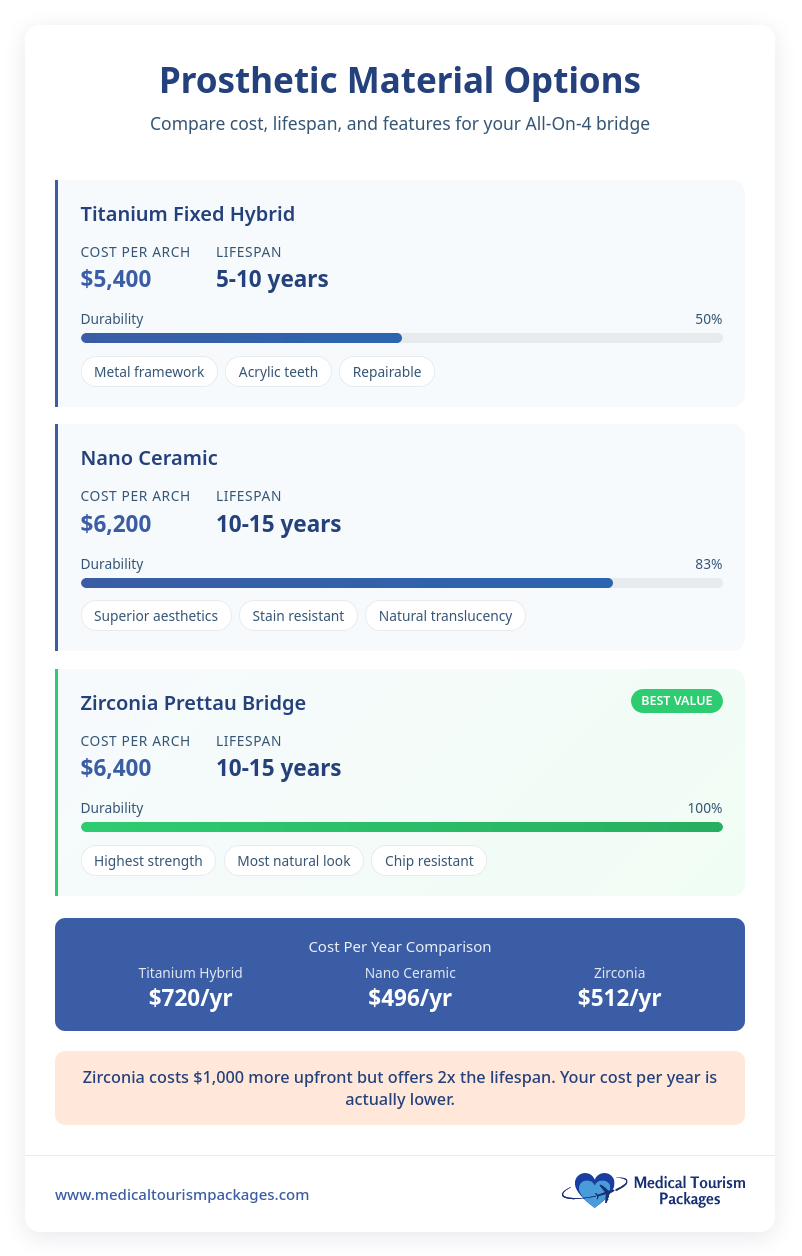
Three main prosthetic materials are available for your final bridge. Each offers different lifespans and price points. The implant brand matters equally for long-term maintenance.
Prosthetic Material Options
| Material Type | Cost (USD) | Longevity | Key Features |
|---|---|---|---|
| Titanium Fixed Hybrid | $5,400 per arch | 5-10 years | Durable metal framework with acrylic teeth |
| Nano Ceramic | $6,200 per arch | 10-15 years | Superior aesthetics and stain resistance |
| Zirconia Prettau Bridge | $6,400 per arch | 10-15 years | Highest strength and most natural appearance |
Premium implant brands like Nobel Biocare and Straumann are globally recognized. Any dentist worldwide can order parts for these systems. Generic brands may cost $1,000-$2,000 less per arch. However, your home dentist may not be able to source parts for repairs.
For more information on dental procedures in Mexico, see our complete guide to dental implants in Mexico.
Why Choose Mexico for All-On-4 Implants?
Mexico offers 60-80% savings on All-On-4 treatment compared to the U.S. and Canada. A single arch costs $40,000-$50,000 in North America. In Mexico, the same treatment costs $7,100-$15,000 per arch. Full-mouth restoration savings typically reach $50,000-$70,000 even after travel costs.
Mexico’s dental tourism industry treats over 800,000 international patients each year. Clinics in Tijuana, Cancun, and Los Algodones have board-certified specialists. Many completed training at U.S. dental schools. These facilities match North American standards at a fraction of the cost.
How Much Do All-On-4 Dental Implants Cost in Mexico?
All-On-4 costs $7,100-$15,000 per arch in Mexico. Border cities offer the most competitive prices due to high patient volume. Tourist destinations include premium amenities in their pricing.
All-On-4 Cost Comparison by Region
| Region/City | Low-End Cost | High-End Cost | US/Canada Benchmark | Savings |
|---|---|---|---|---|
| US/Canada | N/A | N/A | $40,000-$50,000 | N/A |
| Mexico Average | $7,100 | $15,000 | $40,000-$50,000 | 60-82% |
| Tijuana | $7,500 | $13,500 | $40,000-$50,000 | 73-81% |
| Cancun | $7,100 | $11,800 | $40,000-$50,000 | 76-82% |
| Los Algodones | $8,100 | $9,710 | $40,000-$50,000 | 76-80% |
Price differences usually reflect implant brand quality. Premium brands like Nobel Biocare cost more but ensure global part availability. Upgrading from acrylic to zirconia adds $1,000-$2,000 but can double your bridge lifespan.
What Are the Success Rates for All-On-4 Implants?
All-On-4 implants show 95-98% survival rates at both five and ten years. Patient satisfaction reaches 98-99%. Quality of life improves significantly after treatment.
Complication rates stay under 5%. Most issues are minor, like temporary discomfort or infections that respond to antibiotics. Serious problems like implant failure or nerve damage are rare with board-certified specialists. Mexican clinic outcomes match U.S. results.
Who Is a Good Candidate for All-On-4 Dental Implants?
You are a good candidate if you are missing most or all teeth in one or both arches. People with failing teeth from decay or gum disease qualify. Current denture wearers unhappy with fit or stability are excellent candidates.
All-On-4 works for many patients with moderate bone loss. The angled implant design uses denser bone in the front of your jaw. Many patients who would need bone grafting with traditional implants can proceed directly. Your CT scan will confirm your candidacy.
What Medical Conditions Disqualify Patients from All-On-4 Treatment?
Certain conditions may affect your eligibility. Your consultation and CT scan will determine if you need treatment modifications.
| Condition | Impact on Treatment | Possible Alternative |
|---|---|---|
| Uncontrolled diabetes | Impairs healing and bone fusion | Stabilize condition first |
| Extreme bone deficiency | Cannot achieve adequate stability | Zygomatic implants or bone grafting |
| Chronic periodontitis | Increases infection risk | Treat infection first |
| Active cancer treatment | Compromises healing ability | Postpone until complete |
| Uncontrolled bruxism | Causes excessive wear | Must wear protective nightguard |
What Is the Patient Journey Timeline for All-On-4 Treatment in Mexico?
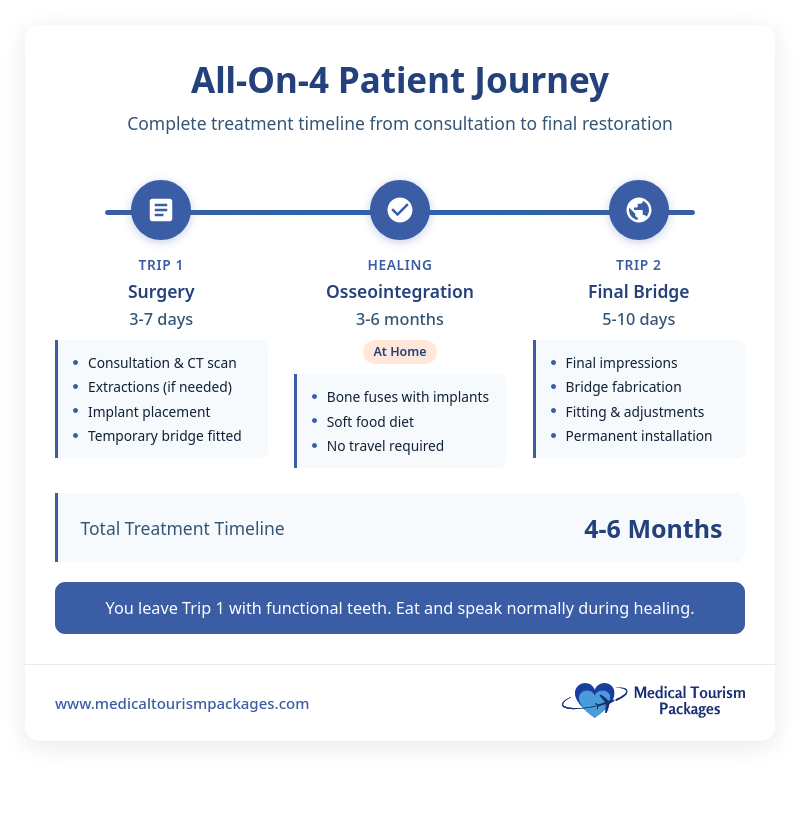
All-On-4 requires two trips to Mexico separated by 3-6 months of healing. The total timeline spans 4-6 months. Individual healing rates may vary.
All-On-4 Patient Journey Timeline
| Phase | Trip | Duration | Key Procedures |
|---|---|---|---|
| Phase 1: Planning & Surgery | Trip 1 | 3-7 days | Consultation, CT scan, extractions, implant placement, temporary bridge |
| Phase 2: Healing | At home | 3-6 months | Implants fuse with jawbone; no travel needed |
| Phase 3: Final Restoration | Trip 2 | 5-10 days | Impressions, fabrication, permanent bridge installation |
Most patients return to light activities within 3-5 days after surgery. Your temporary bridge allows eating soft foods and speaking normally during healing.
What Happens During the All-On-4 Procedure?
Your surgeon places four titanium implants and attaches a temporary bridge, often on the same day. This is called immediate loading. After sedation, remaining problem teeth are extracted. Four implants go into your jawbone based on CT scan planning.
Not all patients qualify for immediate loading. If your bone density is low, your surgeon may recommend delayed loading. This means waiting 3-6 months before attaching any bridge. While this extends treatment time, it reduces implant failure risk. Bone cells grow around the implants to create a permanent bond. After successful healing, you return for your final bridge.
What Is the Recovery Process After All-On-4 Surgery?
You should stay in Mexico 3-7 days after surgery for initial healing. Most patients experience swelling and discomfort for 48-72 hours. Prescribed medication manages pain effectively. Avoid flying immediately due to cabin pressure changes.
Post-procedure care is critical for successful outcomes:
- Brush your prosthetic teeth twice daily with soft-bristle toothbrush
- Use a water flosser to clean around implants and under the bridge
- Schedule professional cleanings every six months
- Eat only soft foods for the first 6-8 weeks
- Avoid smoking and excessive alcohol during healing
- Wear a custom nightguard if you grind your teeth
- Contact your dentist immediately if you notice persistent pain or loosening
Your clinic warranty requires proof of proper care. Neglecting hygiene can void your warranty.
What Is Long-Term Maintenance for All-On-4 Implants?
Your titanium implants can last a lifetime with proper care. The prosthetic bridge will need replacement every 10-15 years due to normal wear. This replacement is simpler than the original surgery since implants stay in place.
Warranties typically cover implants for 5+ years. The clinic will fix dental work at no charge. However, you pay for travel costs to return for warranty repairs. Warranty coverage requires following all aftercare instructions.
Before traveling to Mexico, find a local prosthodontist willing to provide routine care. Confirm they can work with your implant brand, preferably Nobel Biocare or Straumann. Many U.S. and Canadian dentists refuse to treat work done abroad due to liability concerns. Having this relationship ready ensures local support for cleanings and adjustments.
Read our guide to medical tourism in Mexico for more planning tips.
How Do You Choose a Qualified Clinic in Mexico?
The most important factor is Joint Commission International (JCI) accreditation. JCI is the gold standard for global healthcare quality. It evaluates patient safety, infection control, and staff qualifications. JCI accreditation is voluntary and requires significant investment.
All Mexican dental clinics must comply with COFEPRIS (Federal Commission for Protection against Sanitary Risks). This is the mandatory governmental regulatory body. However, COFEPRIS compliance alone is the baseline, not the benchmark. JCI accreditation provides your primary defense against quality risks.
What Dentist Qualifications Should You Look For?
Your All-On-4 treatment should only be performed by qualified specialists. Look for these credentials:
- Doctor of Dental Surgery degree (5 years of training)
- Board certification in Oral Surgery or Prosthodontics (2-3 additional years)
- International training at U.S. dental schools (70% of specialists in tourism hubs have this)
- All-On-4 certification through Nobel Biocare or equivalent programs
- English fluency for clear communication
- Experience with digital implantology and 3D treatment planning
What Are Red Flags That Indicate a Low-Quality Clinic?
Be cautious of clinics showing these warning signs:
- Refuses to specify the implant brand they use
- Offers prices significantly below regional averages
- Lacks international accreditation like JCI
- Provides no explicit warranty policies
- Uses high-pressure sales tactics
- Has no verifiable patient reviews on multiple platforms
- Cannot provide before-after documentation
If you see multiple red flags, continue your search.
What Are the Best Locations in Mexico for All-On-4?
Three main regions serve dental tourists. Cancun offers direct flights from major North American and European cities. Many clinics partner with nearby hotels for discounts up to 50%.
Tijuana and Los Algodones sit on the U.S.-Mexico border. Patients from Western states can drive across for treatment. Los Algodones has over 350 dental practices serving a town of 5,000 residents. This is the highest concentration of dental clinics per capita worldwide. Competition drives prices down and quality up.
What Are the Advantages of Getting All-On-4 Implants in Mexico?
All-On-4 in Mexico offers significant benefits:
- 60-82% cost savings compared to North American prices
- Clinical outcomes equivalent to global standards (95-98% success rates)
- 98-99% patient satisfaction rates
- Access to internationally trained specialists
- English-speaking staff at leading clinics
- Same advanced technology found in U.S. practices
What Are the Disadvantages of Getting All-On-4 Implants in Mexico?
Treatment abroad has important limitations:
- Minimum two trips required over 4-6 months
- Many U.S. dentists refuse to provide maintenance for work done abroad
- You pay for travel costs to return for warranty repairs
- Local dentists may not source parts for non-standard implant brands
- Limited legal recourse for complications
- 20% contingency budget recommended for unexpected costs
- Air travel restrictions require 5-7 day minimum stays after surgery
Is Mexico Right for Your All-On-4 Dental Implants?
Mexico offers compelling value with 60-82% savings and outcomes matching global standards. Success depends on choosing quality over the lowest price.
Key Recommendations:
- Select JCI-accredited clinics with premium implants. Verify the clinic holds JCI accreditation. Confirm they use Nobel Biocare or Straumann implants.
- Maintain a 20% contingency budget. Set aside $1,500-$3,000 per arch beyond the quoted price.
- Secure a local prosthodontist before traveling. Confirm they will provide maintenance for your implant brand.
- Accept the 4-6 month timeline. Do not pressure your surgeon to rush treatment. Proper healing is the most important factor in long-term success.
Patients who research thoroughly and prepare properly report excellent experiences.
Frequently Asked Questions About All-On-4 in Mexico
How Long Do All-On-4 Implants Last?
The titanium implants can last a lifetime with proper care. The prosthetic bridge typically lasts 10-15 years before needing replacement.
Is the All-On-4 Procedure Painful?
You receive sedation during surgery, so you feel no pain. Most patients experience mild discomfort for 2-3 days after. Prescribed medication manages pain effectively.
Can I Eat Normally with All-On-4 Implants?
Yes. After full healing, you can eat most foods normally. Avoid very hard foods like ice or hard candy to protect your bridge.
Do I Need to Speak Spanish for Treatment in Mexico?
No. Top clinics in Tijuana, Cancun, and Los Algodones have English-speaking staff. All consultations and instructions are provided in English.
How Soon Can I Fly After All-On-4 Surgery?
Wait at least 3-5 days before flying. Cabin pressure changes can affect healing. Your surgeon will confirm when air travel is safe.
What Happens If I Have Problems After Returning Home?
Contact your Mexican clinic immediately. Most issues can be addressed remotely. For warranty repairs, you must return to Mexico at your own travel expense.
Are Materials in Mexico the Same Quality as the US?
Yes. Top clinics use the same implant brands as US practices. Nobel Biocare and Straumann implants are identical worldwide.
Can I Get All-On-4 If I Have Bone Loss?
Often yes. The angled implant design works for many patients with moderate bone loss. Severe cases may need bone grafting or zygomatic implants.
Ready to Start Your All-On-4 Journey?
Medical Tourism Packages coordinates your entire All-On-4 journey in Mexico. We connect you with JCI-accredited clinics in Tijuana, Cancun, and Los Algodones. Our team arranges travel, accommodations, and provides bilingual support throughout treatment. Get a free consultation to discuss your dental goals and receive a personalized quote.
Contact us today to start planning your affordable All-On-4 dental implants in Mexico.