Book Appointment Now

Essential Travel Safety Tips for Latin America
 By
By
Latin America welcomes over 100 million tourists annually, with safety varying widely by country and region in 2026.
Costa Rica, Chile, and Uruguay rank as the safest destinations, all holding Level 1-2 travel advisories. Popular spots like Cabo San Lucas, Cancun, and Cartagena maintain strong tourist infrastructure and security. This guide covers current advisory levels, destination rankings, and practical safety tips for your trip.
Below you will find 2026 safety data, country-by-country breakdowns, and expert tips for transportation, health, and money management across Latin America.
Is Latin America Safe to Travel in 2026?
Yes, Latin America is safe to travel with proper preparation and awareness. Most tourist destinations maintain strong security infrastructure, and millions of visitors travel safely each year. The key is understanding which areas are safe and which require caution.
Safety in Latin America varies significantly by country and even by neighborhood. Popular tourist zones in Mexico, Costa Rica, Colombia, and Peru have dedicated tourist police and security measures. Rural areas and border regions carry higher risks in some countries.
The U.S. State Department classifies most Latin American countries at Level 2 (Exercise Increased Caution), similar to many European destinations. Only a few areas receive Level 4 (Do Not Travel) designations, typically border regions or conflict zones.
Petty crime like pickpocketing is the most common concern for tourists. Violent crime against visitors remains rare in tourist areas when travelers follow basic precautions.
Which Are the Safest Countries in Latin America?
The safest countries in Latin America are Costa Rica, Chile, Uruguay, Panama, and Argentina. These nations combine political stability, developed tourism infrastructure, and relatively low crime rates in tourist areas.
| Country | Safety Rating | Travel Advisory | Best For |
|---|---|---|---|
| Costa Rica | 4.2/5 | Level 2 | Eco-tourism, beaches, adventure |
| Chile | 4.1/5 | Level 2 | Wine regions, Patagonia, cities |
| Uruguay | 4.0/5 | Level 2 | Beaches, culture, food |
| Panama | 3.9/5 | Level 2 | Canal, city life, islands |
| Argentina | 3.8/5 | Level 1 | Buenos Aires, wine, nature |
| Paraguay | 3.7/5 | Level 1 | Culture, nature reserves |
| Peru | 3.6/5 | Level 2 | Machu Picchu, cuisine, history |
| Ecuador | 3.4/5 | Level 2 | Galapagos, Andes, Amazon |
| Colombia | 3.3/5 | Level 3 | Cities, coffee region, coast |
| Brazil | 3.2/5 | Level 2 | Beaches, cities, nature |
What Makes Costa Rica the Safest Destination?
Costa Rica leads safety rankings because it has no military, stable democracy, and strong eco-tourism focus. The country invests heavily in national parks and sustainable tourism infrastructure. Tourist police patrol popular areas like Manuel Antonio and Arenal.
Crime exists mainly as petty theft in busy areas. Violent crime rates are significantly lower than neighboring countries. The primary travel advisory concerns are non-violent theft and rip tides at beaches. For travelers considering healthcare procedures, see our complete guide to medical tourism in Costa Rica.
Why Do Chile and Uruguay Rank High for Safety?
Chile and Uruguay benefit from strong economies, stable governments, and well-developed infrastructure. Both countries have lower corruption levels and more effective police forces than regional averages. Santiago and Montevideo are among the safest major cities in South America.
Chile’s main concerns are occasional protests in Santiago and petty theft in tourist areas. Uruguay’s recent challenge involves a water salinity crisis in Montevideo, requiring bottled water use, but security remains excellent.
Which Countries Require Extra Caution?
Colombia, Venezuela, and parts of Mexico require extra caution due to organized crime activity. Colombia holds a Level 3 advisory, though major cities like Bogota and Medellin have transformed significantly. Venezuela currently has Level 4 (Do Not Travel) status.
Ecuador added “terrorism” to its advisory risk factors in 2025 due to gang activity in coastal areas. El Salvador maintains Level 3 despite reduced gang violence under its State of Exception. Honduras and Guatemala also carry Level 3 advisories.
What Are the 2026 Travel Advisory Levels?
The U.S. State Department travel advisory levels for Latin America in 2026 range from Level 1 (Exercise Normal Precautions) to Level 4 (Do Not Travel). Most tourist destinations fall within Levels 1-2, making them comparable to European destinations.
| Advisory Level | Countries | Main Concerns |
|---|---|---|
| Level 1 | Argentina, Paraguay | Standard precautions |
| Level 2 | Costa Rica, Chile, Uruguay, Panama, Peru, Ecuador, Brazil, Mexico (varies) | Increased caution, petty crime |
| Level 3 | Colombia, El Salvador, Honduras, Guatemala, Nicaragua | Reconsider travel, crime/civil unrest |
| Level 4 | Venezuela, Haiti | Do not travel |
Important: Within Level 2 and Level 3 countries, specific regions may have higher restrictions. Mexico has state-by-state advisories where tourist areas are Level 2 but some states are Level 4. Always check advisories for your specific destination.
Which Caribbean Islands Are Safest for Tourists?
The safest Caribbean islands are Aruba, Curacao, and Bonaire, known as the ABC islands. These Dutch territories sit outside the hurricane belt and maintain low crime rates with strong tourism infrastructure.
| Island | Safety Rating | Hurricane Risk | Crime Level | Best For |
|---|---|---|---|---|
| Aruba | 4.5/5 | Very Low | Low | Beaches, resorts, nightlife |
| Curacao | 4.4/5 | Very Low | Low | Diving, culture, beaches |
| Bonaire | 4.3/5 | Very Low | Very Low | Diving, eco-tourism |
| Cayman Islands | 4.2/5 | Moderate | Low | Diving, banking, beaches |
| Bahamas | 3.8/5 | Moderate | Moderate | Beaches, cruises, resorts |
| Puerto Rico | 3.7/5 | High | Moderate | Culture, beaches, rainforest |
| Jamaica | 3.4/5 | Moderate | Higher | Culture, beaches, music |
| Dominican Republic | 3.3/5 | Moderate | Moderate | Resorts, beaches, golf |
Why Is Aruba Considered the Safest Caribbean Island?
Aruba ranks as the safest Caribbean island because it sits outside the hurricane belt and has extremely low crime rates. The island’s economy depends almost entirely on tourism, creating strong incentives for security. Police response is quick and effective throughout the island.
Aruba has not experienced a direct hurricane hit in over 100 years due to its southern location. Petty theft exists but remains rare. The island has no “no-go zones” for tourists.
What Makes Curacao and Bonaire Safe Alternatives?
Curacao and Bonaire share Aruba’s geographic advantages, sitting outside the hurricane belt. Both islands maintain Dutch governance standards for policing and infrastructure. Bonaire especially caters to divers and eco-tourists seeking quiet, safe environments.
Curacao offers more urban experiences in Willemstad while maintaining safety. Both islands have minimal violent crime and strong emergency services.
How Does Jamaica Compare for Tourist Safety?
Jamaica requires more caution than the ABC islands due to higher crime rates in certain areas. Tourist zones like Montego Bay, Ocho Rios, and Negril maintain dedicated security, but travelers should stay within resort areas at night.
The State Department recommends avoiding certain neighborhoods in Kingston and Montego Bay. Resort areas and organized tours remain generally safe with standard precautions. Caribbean residents seeking affordable healthcare abroad can explore our Caribbean medical tourism guide.
Is It Safe to Travel to Mexico Right Now?
Yes, Mexico is safe for tourists in most popular destinations in 2026. Cabo San Lucas, Puerto Vallarta, Cancun, and Mexico City maintain strong tourist infrastructure and security. However, safety varies dramatically by state, requiring destination-specific research.
Mexico uses a state-by-state advisory system. Popular beach destinations and major cities are Level 2, while some northern and western states carry Level 4 (Do Not Travel) advisories due to cartel activity.
| Region | Key Destinations | Advisory Level | Safety Notes |
|---|---|---|---|
| Baja California Sur | Cabo San Lucas, La Paz | Level 2 | Tourist zones secure |
| Jalisco | Puerto Vallarta, Guadalajara | Level 2 | Avoid rural areas |
| Quintana Roo | Cancun, Tulum, Playa del Carmen | Level 2 | Hotel zone safe |
| Mexico City | CDMX | Level 2 | Use official transport |
| Oaxaca | Oaxaca City, Puerto Escondido | Level 2 | Generally safe |
| Sinaloa | Mazatlan | Level 4 | Do not travel |
| Guerrero | Acapulco | Level 4 | Do not travel |
| Tamaulipas | Border region | Level 4 | Do not travel |
Is Cabo San Lucas Safe for Tourists in 2026?
Cabo San Lucas is safe for tourists in 2026. The destination maintains dedicated tourist police, secure resort zones, and low crime rates in areas visitors frequent. Baja California Sur has the lowest crime rate of any Mexican state.
Standard precautions apply: use official transportation, stay in well-lit areas at night, and secure valuables. The tourist corridor between Cabo San Lucas and San Jose del Cabo is heavily patrolled.
What About Puerto Vallarta and the Pacific Coast?
Puerto Vallarta remains safe for tourists with the same Level 2 advisory as Cabo. The Romantic Zone and Hotel Zone have strong security presence. Jalisco state has some cartel activity inland, but Puerto Vallarta’s tourist areas are well-protected.
Avoid travel between cities after dark. Use Uber or official taxis rather than hailing cabs on the street. The malecon and beach areas are safe for walking during the day.
How Safe Is Cancun and the Caribbean Coast?
Cancun’s Hotel Zone is safe with extensive security infrastructure. Quintana Roo state holds Level 2 advisory status. The Hotel Zone, downtown, and nearby Playa del Carmen have dedicated tourist police.
Tulum and the Riviera Maya also maintain strong safety records. Avoid venturing into unfamiliar areas at night and use registered transportation services.
Which Mexican States Should You Avoid?
You should avoid states with Level 4 (Do Not Travel) advisories: Colima, Guerrero, Michoacan, Sinaloa, Tamaulipas, and Zacatecas. These states have active cartel violence that can affect travelers.
Sinaloa’s advisory level increased in 2025-2026 following cartel leadership changes that sparked internal violence. Acapulco in Guerrero, once a premier destination, now carries Do Not Travel status. Choose alternative beach destinations like Cancun, Cabo, or Puerto Vallarta. Mexico’s tourist zones also host excellent healthcare facilities. Learn more in our medical tourism in Mexico guide.
Is South America Safe for Traveling?
South America is safe for traveling with proper preparation. The continent offers diverse experiences from the safest countries (Chile, Uruguay, Argentina) to destinations requiring more caution (Colombia, Brazil border regions). Most tourists travel without incident by following local advice.
What Is the Safety Situation in Colombia?
Colombia maintains Level 3 (Reconsider Travel) advisory status, but major cities have transformed significantly. Bogota, Medellin, and Cartagena receive millions of tourists annually. These cities have invested heavily in security and tourism infrastructure. For travel planning, see our Medellin travel and safety guide.
Avoid border regions with Venezuela, rural areas in Arauca and Norte de Santander, and parts of Cauca. The ELN guerrilla group remains active in these zones. Urban tourist areas are generally safe with standard precautions.
For those considering medical tourism in Colombia, Bogota and Medellin host internationally accredited hospitals with strong safety records.
How Safe Is Peru for Tourists?
Peru holds Level 2 advisory status with specific Level 4 zones. Tourist destinations like Lima, Cusco, and Machu Picchu maintain good security. The Sacred Valley and coastal areas are popular and safe for organized tourism.
Avoid the VRAEM region (Valley of the Apurimac, Ene, and Mantaro Rivers) and areas within 20 kilometers of the Colombian border. These remote zones have drug trafficking activity. Roadblocks from protests can occasionally disrupt travel between cities.
What Should You Know About Brazil’s Safety?
Brazil carries Level 2 advisory status with specific restrictions. The main concerns are favela areas in Rio de Janeiro and Sao Paulo, and border regions with Venezuela, Colombia, and Peru (within 100 miles).
Tourist areas in Rio (Copacabana, Ipanema, Santa Teresa), Sao Paulo’s central districts, and destinations like Salvador and Florianopolis are safe with standard precautions. Use 99 app or Uber for transportation. Avoid displaying expensive items and stay aware of surroundings.
How Do You Research Your Destination Before Traveling?
You research your destination by checking official travel advisories, reading recent traveler reports, and understanding seasonal conditions. This preparation takes a few hours but significantly improves your safety and experience.
Start with the U.S. State Department travel advisories for official risk assessments. These advisories classify destinations from Level 1 to Level 4 and highlight specific concerns like crime, civil unrest, or health risks.
Check local news sources using Google Translate for recent developments. Expat forums and travel communities provide real-time insights from people living in your destination. Reddit’s country-specific travel subreddits offer current traveler experiences.
Research seasonal factors including hurricane season (June to November for Caribbean and Gulf coasts), rainy seasons, and local holidays that might affect travel. Understand which areas are safe and which to avoid within your destination city.
How Do You Stay Safe with Transportation in Latin America?
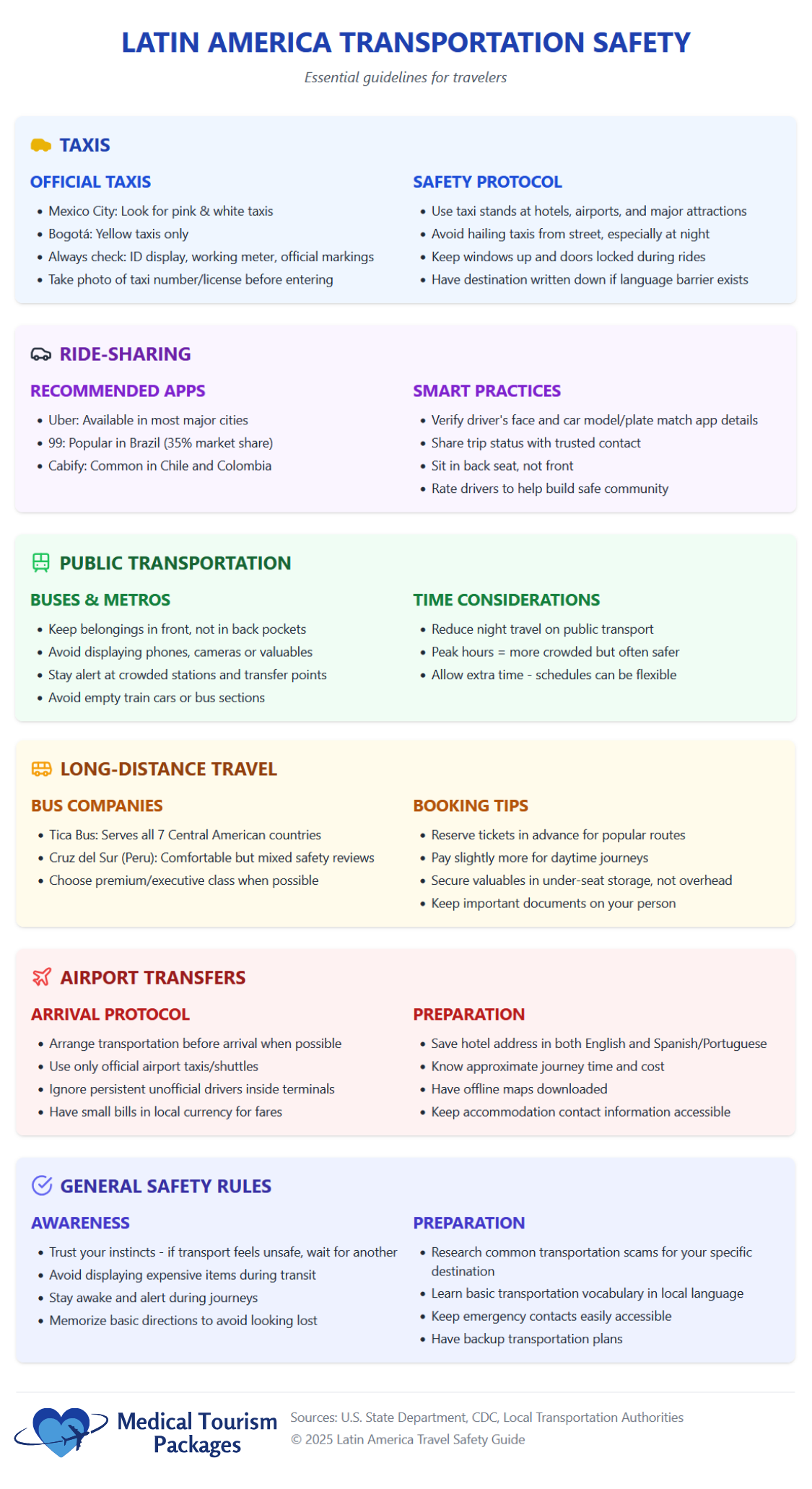
You stay safe with transportation by using ride-sharing apps, official taxis, and reputable bus companies. These options offer tracking, accountability, and vetted drivers that street hailing cannot provide.
Which Ride-Sharing Apps Work in Latin America?
Uber works in most major Latin American countries including Mexico, Colombia, Brazil, Peru, Chile, Argentina, Ecuador, Bolivia, Paraguay, Uruguay, Costa Rica, El Salvador, Guatemala, and Panama. The app provides GPS tracking, driver identification, and trip sharing features.
| Country | Uber | Cabify | Other Options |
|---|---|---|---|
| Mexico | Yes | Yes | DiDi |
| Colombia | Yes | Yes | DiDi, Beat |
| Brazil | Yes | No | 99 (primary competitor) |
| Peru | Yes | Yes | DiDi |
| Chile | Yes | Yes | DiDi |
| Argentina | Yes | Yes | – |
| Ecuador | Yes | Yes | – |
| Costa Rica | Yes | No | – |
| French Guiana | No | No | Heetch |
| Guyana | No | No | Book A Ride, 592 Rides |
| Suriname | No | No | Local taxis only |
In Brazil, the 99 app (owned by DiDi) competes directly with Uber and has strong coverage in suburban areas where Uber availability can be limited. Cabify positions itself as a premium, safety-focused alternative in Spanish-speaking markets.
How Do You Identify Official Taxis?
You identify official taxis by their regulated colors, markings, and registration numbers. Each major city has specific requirements that help distinguish legitimate taxis from unmarked vehicles.
In Mexico City, official taxis are pink and white (Rosa Mexicano on top, white on bottom) with CDMX logos and plate numbers starting with “A” or “B”. In Bogota, official taxis are yellow with visible registration numbers. A small pilot program has introduced green electric taxis, but yellow remains the standard.
In La Paz, Bolivia, look for registered radio taxis with company logos. In Lima, use taxis called through apps or hotel concierges rather than street hailing.
What Are the Safest Bus Companies for Long Distance?
The safest bus companies vary by region. Tica Bus connects Panama, Costa Rica, Nicaragua, Honduras, El Salvador, Guatemala, and southern Mexico (Tapachula). Note that Tica Bus does not serve Belize directly, requiring a transfer in Guatemala City.
In Peru, Cruz del Sur has historically been the premium option, though recent reviews show mixed feedback about service quality. Tourist-focused operators like Peru Hop maintain higher satisfaction ratings for the Cusco-Lima corridor.
For any long-distance bus travel, book tickets in advance, choose daytime departures when possible, and select first-class or “executive” service for better security and comfort.
How Do You Manage Money Safely While Traveling?
You manage money safely by dividing cash across multiple locations, using bank ATMs during daylight, and carrying a decoy wallet. These strategies minimize losses if theft occurs while ensuring you have access to funds.
Keep some cash in your day bag, some in your hotel safe, and some in a money belt worn under clothing. Never carry all your money in one location. This “divide and conquer” approach limits exposure.
Use ATMs inside banks or shopping centers rather than street-side machines. Withdraw money during daylight hours. Cover your PIN and inspect machines for skimming devices. Contact your bank before travel to avoid card blocks.
Consider a dummy wallet with expired cards and a small amount of cash. If confronted, you can hand over something without losing your actual valuables.
Three countries use the U.S. dollar as official currency: Ecuador, El Salvador, and Panama. In these destinations, you can use dollars directly. Many other countries accept dollars for larger purchases, though exchange rates may vary.
What Health and Safety Precautions Should You Take?
You should take health precautions including water safety awareness, required vaccinations, and natural disaster preparation. These steps protect against the most common health issues travelers face in Latin America.
Can You Drink Tap Water in Latin America?
Tap water safety varies significantly across Latin America. Several major cities have safe municipal water, while others require bottled water. When in doubt, especially in rural areas, stick to bottled water.
| City/Country | Tap Water Status | Notes |
|---|---|---|
| Santiago, Chile | Safe | High mineral content (hard water) |
| Buenos Aires, Argentina | Safe | Safe in city center |
| Bogota, Colombia | Safe | Old buildings may have pipe issues |
| Medellin, Colombia | Safe | Municipal water is safe |
| Cuenca, Ecuador | Safe | Best tap water in Latin America |
| Sao Paulo, Brazil | Safe (filter recommended) | Strong chlorine taste, locals use filters |
| Panama City, Panama | Safe | Quality varies in provinces |
| Montevideo, Uruguay | Caution | Salinity crisis 2023-2026 |
| Costa Rica (urban) | Safe | Rural areas may vary |
| Mexico (most areas) | Not Safe | Use bottled water |
| Central America (most) | Not Safe | Except Costa Rica urban areas |
Cuenca, Ecuador has the best tap water in Latin America, sourced from the protected Cajas National Park watershed. Montevideo, Uruguay, historically safe, now requires caution due to a prolonged drought that caused salinity issues in the municipal supply.
What Vaccinations Do You Need Before Traveling?
You need to check yellow fever requirements and consider Hepatitis A/B and typhoid vaccinations. Requirements vary by country and your travel itinerary. Consult the CDC Travelers’ Health for country-specific recommendations.
Yellow fever vaccination is mandatory for all travelers to French Guiana. It is conditionally required (if arriving from risk areas) in Colombia, Bolivia, Guyana, Panama, Paraguay, and Peru. Your vaccination certificate must be at least 10 days old to be valid.
Peru does not require yellow fever vaccination for entry, but the CDC strongly recommends it for travel to Amazon basin regions. Some airlines may check certificates if your itinerary includes stops in countries with strict requirements.
How Do You Protect Against Natural Disasters?
You protect against natural disasters by understanding seasonal patterns and monitoring weather alerts. Hurricane season runs June through November for the Caribbean and Gulf of Mexico coasts. The 2026 season is predicted to be near-normal due to El Nino transition.
Earthquakes affect Pacific coast countries including Chile, Peru, Ecuador, and western Mexico. Hotels in these regions are built to seismic codes. Know evacuation routes and keep emergency supplies accessible.
Volcanic activity occurs in Guatemala, Costa Rica, Ecuador, and parts of Chile. Check current activity levels before visiting areas near active volcanoes. National park authorities typically restrict access during elevated activity.
What Basic Spanish Phrases Help You Stay Safe?
Basic Spanish phrases that help you stay safe include emergency words, numbers for money transactions, and polite expressions. You do not need fluency, but a few key phrases build rapport and help in difficult situations.
Learn emergency phrases: “Ayuda” (Help), “Policia” (Police), “Hospital”, “Medico” (Doctor). In Portuguese-speaking Brazil, use “Socorro” for help. Memorize the emergency number for your destination.
Know numbers for transactions: Learn 1-100 to understand prices. Being able to verify costs prevents overcharging. Practice “Cuanto cuesta?” (How much does it cost?).
Understand regional variations. “Ahorita” technically means “right now” but in Mexico and Peru often means “in a little while.” Do not expect immediate action when you hear this word.
“No entiendo” (I don’t understand) is useful when conversations become confusing. A smile and attempt at Spanish generally receives positive responses from locals.
How Do You Respect Local Culture and Stay Safe?
You respect local culture by dressing modestly in religious sites, learning greeting customs, and accepting hospitality graciously. Cultural awareness builds goodwill and often improves your safety through positive local relationships.
Dress codes matter in churches and rural areas. Cover shoulders and knees when visiting religious sites. Beach attire belongs at the beach, not in town centers.
Greeting customs vary by country. In Argentina, Mexico, Colombia, and Venezuela, a single cheek kiss is standard for social greetings. In Brazil, Rio de Janeiro uses two kisses while Sao Paulo uses one. Men typically shake hands except among close friends.
If offered food, accept graciously even if unfamiliar. Refusing hospitality can be considered rude. This includes local specialties like cuy (guinea pig) in Peru or unusual mezcal varieties in Mexico.
Always ask permission before photographing people, especially in rural and indigenous areas. Respect a “no” without argument.
How Do You Keep in Touch While Traveling?
You keep in touch by using WhatsApp for free calls and messages over WiFi, sharing your location with trusted contacts, and maintaining regular check-in schedules. These practices ensure someone knows your whereabouts.
WhatsApp is the dominant communication app throughout Latin America. It works on WiFi without incurring international charges. Use it for calls, texts, and sharing photos with family at home.
Set up location sharing with 1-2 trusted contacts using Google Maps or Apple’s Find My. This creates a digital safety net without constant check-ins. Set an end date for sharing to maintain privacy after your trip.
Share your itinerary with someone at home, including hotel addresses and contact information. Establish a check-in schedule that works for both time zones.
Keep copies of important documents in cloud storage accessible from any device. Email copies to yourself and a trusted contact. Store embassy phone numbers in your phone contacts.
Ready to Plan Your Latin America Trip?
With proper preparation and awareness, Latin America offers incredible travel experiences. Research your specific destinations, follow local advice, and use the safety strategies in this guide. Millions of travelers visit Latin America safely each year.
Medical Tourism Packages coordinates travel throughout Latin America, connecting you with certified healthcare providers and trusted travel services. Contact us for assistance planning your trip.
Frequently Asked Questions About Latin American Travel Safety
Is South America Safe to Travel?
Yes, South America is safe to travel with proper preparation. Chile, Uruguay, and Argentina are the safest destinations with Level 1-2 advisories. Colombia requires more caution (Level 3) but Bogota, Medellin, and Cartagena welcome millions of tourists safely each year. Avoid border regions and research specific destinations before travel.
What Should I Research Before Traveling to Latin America?
You should research U.S. State Department travel advisories, safe neighborhoods in your destination cities, transportation options (Uber availability, official taxi colors), weather and natural disaster seasons, vaccination requirements, and local customs. Check expat forums and recent traveler reviews for current conditions. Research takes a few hours but significantly improves safety.
How Can I Keep My Important Documents Safe While Traveling?
You can keep documents safe by making both digital and physical copies. Store digital copies in password-protected cloud storage and email them to yourself. Keep physical copies separate from originals: one set in your suitcase, another in your day bag. Leave originals in your hotel safe when possible. Carry a list of emergency contacts including embassy numbers and bank hotlines.
What Are the Safest Transportation Options in Latin America?
The safest transportation options are ride-sharing apps (Uber, Cabify, 99) and official registered taxis. Uber operates in most Latin American countries except the Guianas. In Mexico City, official taxis are pink and white. In Bogota, they are yellow. For long distances, use reputable bus companies like Tica Bus (Central America) or first-class services. Avoid street hailing taxis at night.
How Should I Manage My Money Safely While Traveling?
You should manage money by dividing cash across multiple locations (day bag, hotel safe, money belt). Use ATMs inside banks during daylight hours. Cover your PIN and check for skimming devices. Carry a decoy wallet with expired cards. Notify your bank before travel. Ecuador, El Salvador, and Panama use U.S. dollars as official currency.
Can I Drink Tap Water in Latin America?
Tap water safety varies by city. Safe to drink: Santiago (Chile), Buenos Aires (Argentina), Bogota and Medellin (Colombia), Cuenca (Ecuador), Panama City. Use bottled water in: most of Mexico, Central America (except Costa Rica urban areas), rural areas throughout the region. Montevideo (Uruguay) currently has salinity issues requiring bottled water.
What Vaccinations Do I Need Before Traveling to Latin America?
Yellow fever vaccination is mandatory for French Guiana (all travelers). It is conditionally required if arriving from risk areas in Colombia, Bolivia, Guyana, Panama, Paraguay, and Peru. The CDC recommends Hepatitis A/B and typhoid for most Latin American travel. Certificates must be 10 days old to be valid. Check CDC Travelers’ Health for country-specific requirements.
Should I Learn Spanish or Portuguese Before My Trip?
You do not need fluency, but basic phrases significantly improve your experience. Learn greetings (Hola, Buenos dias), emergency words (Ayuda, Policia, Hospital), and numbers for transactions. In Brazil, learn “Socorro” for help and basic Portuguese phrases. Regional variations exist: “ahorita” in Mexico often means “later” rather than “right now.”
How Can I Stay in Touch with People Back Home While Traveling?
You can stay in touch using WhatsApp for free calls and messages over WiFi. Set up location sharing with trusted contacts through Google Maps or Find My. Share your itinerary including hotel addresses before departure. Establish a check-in schedule. Store embassy contact numbers and copies of important documents in accessible cloud storage.