Book Appointment Now

Shoulder Surgery in Mexico: Expert Care at Affordable Costs
 By
By
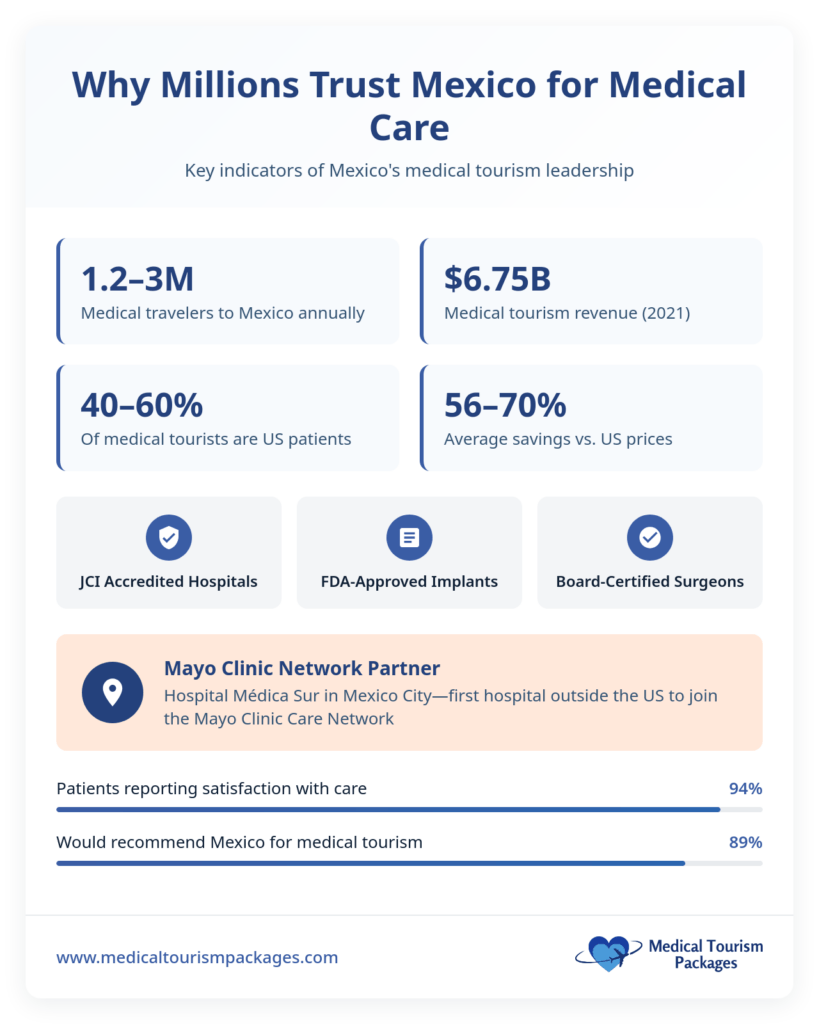
Shoulder surgery in Mexico costs 56-70% less than US prices, with JCI-accredited hospitals using FDA-approved implants and board-certified surgeons performing thousands of procedures annually.
Rotator cuff repair costs $5,000-$15,000 in Mexico versus $20,000-$50,000 in the US. Shoulder replacement runs $11,000-$16,000. Board-certified surgeons in Mexico City, Guadalajara, Monterrey, Cancun, and Tijuana hold CMOT/CONACEM credentials and often have US or European fellowship training.
This guide covers costs, top hospitals, surgeon credentials, recovery timelines, and safety considerations. You’ll find everything you need to plan your shoulder surgery in Mexico with confidence.
What Is Shoulder Surgery in Mexico?
Shoulder surgery in Mexico treats problems in the shoulder joint, rotator cuff, tendons, ligaments, and muscles. These procedures range from minimally invasive arthroscopic repairs to total joint replacements.
Common conditions treated include torn rotator cuffs, arthritis, labral tears, and chronic shoulder instability. Mexico receives 1.2-3 million medical travelers each year. Orthopedic procedures make up a large portion of this volume. The country leads North America as a medical tourism destination for US and Canadian patients.
For more information about orthopedic procedures available in Mexico, see our complete guide to orthopedic surgeries.
Why Should You Choose Mexico for Shoulder Surgery?
You should choose Mexico for shoulder surgery because of the 56-70% cost savings and fast scheduling. Procedures costing $20,000-$50,000 in the US are available for $5,000-$15,000 in Mexico.
Key benefits include:
- Major cost savings: Pay $3,500-$16,000 instead of $10,000-$55,000 in the US
- No wait times: Schedule surgery within 2-4 weeks versus 8+ months in Canada
- Same quality materials: FDA-approved implants and modern surgical techniques
- JCI accreditation: International safety and quality standards
- Short travel time: Direct flights of just a few hours from most US cities
- Personalized care: English-speaking staff and dedicated patient coordinators
How Much Does Shoulder Surgery Cost in Mexico?
Shoulder surgery in Mexico costs $3,500-$16,000 depending on the procedure. This is 56-72% less than US prices. Packages typically include surgeon fees, hospital stay, anesthesia, and initial post-operative care.
Cost Comparison by Procedure
| Procedure | Mexico Cost | US Cost | Savings |
|---|---|---|---|
| Rotator Cuff Repair | $5,000 – $15,000 | $20,000 – $50,000 | 56% – 63% |
| Shoulder Arthroscopy | $3,500 – $7,000 | $10,000 – $25,000 | 65% – 72% |
| Total/Reverse Shoulder Replacement | $11,000 – $16,000 | $30,000 – $55,000 | 60% – 70% |
The cost difference comes from lower overhead and liability costs in Mexico. Leading hospitals use the same FDA-approved implants found in US facilities. You get the same quality at a fraction of the price.
What Are the Top Hospitals for Shoulder Surgery in Mexico?
The top hospitals for shoulder surgery are JCI-accredited facilities in Mexico City, Guadalajara, Monterrey, Cancun, and Tijuana. These hospitals have modern equipment, multilingual staff, and patient coordination services.
Leading Medical Facilities by City:
- Mexico City – Hospital Médica Sur: JCI accredited since 2014. First hospital outside the US to join the Mayo Clinic Care Network. The Orthopedic Center has four decades of experience and 24/7 care teams.
- Guadalajara – Hospital de Especialidades del IMSS: ISO 9001 accredited with strong orthopedic capabilities and quality management systems.
- Monterrey – Hospital Star Médica: JCI accredited hospital with experienced orthopedic surgeons and high care standards.
- Monterrey – Border Hospitals: Multiple JCI-certified facilities near the US border offering full tertiary care services.
- Cancun – Galenia Hospital: Specialized orthopedic department with doctors experienced in treating international patients.
- Tijuana – Oasis Orthopedic Center: Qualified surgical teams near the US border. Note: This region requires careful vetting due to past infection control issues at some facilities.
What Accreditations Should You Look For?
You should look for Joint Commission International (JCI) accreditation as the primary quality indicator. JCI certification means the hospital meets rigorous global standards for safety, quality, and infection control.
ISO 9001 certification provides additional assurance of quality management systems. These accreditations confirm that facilities meet or exceed US and Canadian safety standards.
Who Are the Leading Shoulder Surgeons in Mexico?
The leading shoulder surgeons in Mexico are board-certified specialists with extensive experience and often US or European training. Here are three top surgeons:
- Dr. Rene De La Rosa (Guadalajara): Over 20 years specializing in shoulder arthroscopy and joint reconstruction. Member of orthopedic associations in Mexico, Europe, and the US.
- Dr. Gino Perretta (Tijuana): Board-certified lead orthopedic surgeon. Uses the latest minimally invasive techniques for shoulder procedures.
- Dr. Jose Antonio Santana de Dios (Cancun): Over 15 years of experience in minimally invasive surgery. Specializes in rotator cuff repair and shoulder arthroscopy.
How Do You Verify Surgeon Credentials?
You verify surgeon credentials by checking their Mexican board certification and professional license. All orthopedic surgeons must hold certification from CMOT (Mexican Council of Orthopedics and Traumatology).
You can verify their cédula profesional (professional license) through the official Mexican government registry. Additional US board certification (ABOS) or fellowship training from US/European institutions indicates advanced expertise.
What Types of Shoulder Surgeries Are Available in Mexico?
Five main shoulder surgery types are available in Mexico: arthroscopic surgery, rotator cuff repair, total shoulder replacement, reverse shoulder replacement, and labrum repair. Surgeons use both traditional open techniques and minimally invasive methods.
Shoulder Surgery Types and Details
| Surgery Type | Conditions Treated | Technique | Mexico Cost |
|---|---|---|---|
| Arthroscopic Surgery | Minor tears, impingement, loose cartilage | Minimally invasive with camera-guided instruments | $3,500 – $7,000 |
| Rotator Cuff Repair | Torn tendons, chronic pain | Open or arthroscopic with anchor reattachment | $5,000 – $15,000 |
| Total Shoulder Replacement | Severe arthritis, complex joint damage | Metal and plastic prosthetic components | $11,000 – $16,000 |
| Reverse Shoulder Replacement | Rotator cuff tear arthropathy, failed surgery | Reversed ball-and-socket configuration | $11,000 – $16,000 |
| Labrum Repair | Torn cartilage, shoulder instability | Arthroscopic cartilage reattachment | $4,000 – $9,000 |
How Long Is Recovery After Shoulder Surgery?
Recovery takes 3-6 months for most shoulder surgeries. Full recovery from shoulder replacement can take 6-12 months. Most patients follow a three-phase rehabilitation protocol.
Recovery Timeline by Phase
| Phase | Timeframe | Goal | Activities | Return to Work |
|---|---|---|---|---|
| Phase 1 | Weeks 0-6 | Protect healing tissue | Sling for 4-8 weeks; passive exercises; pendulum movements | Office work: 1-2 weeks |
| Phase 2 | Weeks 6-12 | Regain range of motion | Gentle stretching; light isometric exercises; gradual active movements | Light manual labor: 6-8 weeks |
| Phase 3 | Weeks 12-24+ | Restore strength | Progressive resistance training; functional activities; sport drills | Heavy labor: 3-4 months |
How Long Is the Hospital Stay?
The hospital stay is typically 1-2 days for pain management and initial stabilization. After discharge, patients stay at a recovery facility for 3-5 more days. This includes nursing support, vitals checks, dressing changes, and medication management.
How Long Should You Stay in Mexico?
You should stay 3-4 days for minimally invasive arthroscopic procedures. Major reconstruction like shoulder replacement requires 1-2 weeks. This allows time for wound monitoring, follow-up appointments, and initial physical therapy before traveling home.
What Physical Therapy Options Are Available?
Physical therapy is available at leading Mexican hospitals like Hospital Médica Sur and Centro Medico Puerta de Hierro. Therapists specialize in post-surgical shoulder rehabilitation.
The rehabilitation follows a three-phase protocol. Phase 1 focuses on passive range of motion during the first six weeks. Phase 2 adds active strengthening from weeks 6-12. Phase 3 progresses to functional training from weeks 12-24.
Medical coordinators share recovery plans with physical therapists in your home country. This ensures seamless continuation of your rehabilitation after you return home.
How Safe Is Shoulder Surgery in Mexico?
Shoulder surgery in Mexico is safe when you choose JCI-accredited facilities and verified surgeons. Safety varies significantly between accredited and non-accredited hospitals.
For comprehensive information about traveling to Mexico for medical care, read our guide to medical tourism in Mexico.
What Are the Complication Rates?
Shoulder replacement in Mexico shows a 4.9% revision rate and 4.3% infection rate based on academic reviews. These rates are higher than top US centers, where infection rates stay below 1-2%.
This difference highlights why you must choose JCI-accredited facilities. Accredited hospitals have better infection control, standardized protocols, and resources to handle complications.
What Are the Infection Control Standards?
Infection control standards at JCI-accredited hospitals match US and Canadian levels. These facilities follow rigorous international protocols for sterilization and patient safety.
In 2018, the CDC issued warnings about a Tijuana hospital with antibiotic-resistant infections. This shows the risk of choosing non-accredited facilities based on cost alone. Always verify JCI accreditation before booking surgery.
What Are the Advantages of Shoulder Surgery in Mexico?
The main advantages are 56-70% cost savings, no wait times, and access to quality care. Here are the key benefits:
- 56-70% cost savings: Pay $3,500-$16,000 versus $10,000-$55,000 in the US
- 2-4 week scheduling: Skip the 8+ month wait times common in Canada
- FDA-approved implants: Same prosthetic components used in US hospitals
- JCI accreditation: International safety and quality standards
- Easy travel: Direct flights from most US cities take just a few hours
- Personalized attention: Dedicated coordinators, English-speaking staff, and customized recovery plans
What Are the Disadvantages and Risks?
The main risks involve quality variation between facilities and limited legal recourse. Consider these factors:
- Variable quality: Safety differs greatly between accredited and non-accredited hospitals
- Higher infection rates at some facilities: Non-accredited hospitals may have poor sterilization
- Moderate infection risk: Even quality facilities show 4.3% infection rates versus 1-2% in top US centers
- Required due diligence: You must verify hospital accreditations and surgeon credentials yourself
- Travel after surgery: Flying home soon after surgery carries blood clot and wound risks
Is Shoulder Surgery in Mexico Right for You?
Shoulder surgery in Mexico is right for you if you need quality orthopedic care but face cost barriers or long wait times. The 56-70% savings make procedures accessible when US prices are prohibitive.
Success requires three things: choosing JCI-accredited hospitals, verifying surgeon credentials (CMOT plus US/international training), and allowing adequate recovery time. Avoid non-accredited facilities that may compromise safety.
Mexico offers strategic advantages: close proximity, fast scheduling, FDA-approved implants, and high clinical quality at certified facilities. For cost-conscious patients willing to do proper research, it’s an excellent choice.
Frequently Asked Questions
Is shoulder surgery in Mexico safe?
Yes, shoulder surgery is safe at JCI-accredited hospitals in Mexico City, Guadalajara, Monterrey, and Cancun. These facilities meet international safety standards. Avoid non-accredited hospitals, which carry higher infection risks.
How much can I save on shoulder surgery in Mexico?
You can save 56–70% on shoulder surgery in Mexico. Rotator cuff repair costs $5,000–$15,000 versus $20,000–$50,000 in the U.S. Shoulder replacement costs $11,000–$16,000 versus $30,000–$55,000.
How long should I stay in Mexico for shoulder surgery?
Stay 3–4 days for arthroscopic procedures and 1–2 weeks for shoulder replacement. This allows time for surgery, initial recovery, follow-up appointments, and starting physical therapy.
Do Mexican surgeons speak English?
Yes, most surgeons at major medical tourism hospitals speak English. Facilities in Mexico City, Guadalajara, Monterrey, Cancun, and Tijuana have bilingual staff and patient coordinators.
What if I have complications after returning home?
Your Mexican surgeon will provide detailed recovery instructions for your home doctor. Medical coordinators help ensure continuity of care, and some providers include medical tourism insurance for complication coverage.
Can I use my U.S. health insurance in Mexico?
Most U.S. health insurance does not cover procedures in Mexico. However, you can use HSA or FSA funds for qualified medical expenses abroad, and some clinics offer financing options.
How do I verify a Mexican surgeon’s credentials?
Check the surgeon’s cédula profesional through the official Mexican government registry, verify CMOT board certification, and look for additional U.S. board certification (ABOS) or fellowship training as quality indicators.
Ready to Start Your Shoulder Surgery Journey?
Medical Tourism Packages coordinates your entire shoulder surgery journey in Mexico. We connect you with board-certified orthopedic surgeons, arrange your travel and accommodations, and provide bilingual support throughout your treatment. Get a free consultation to discuss your shoulder condition and receive a personalized quote.
Contact us today to start planning your affordable shoulder surgery in Mexico.