Book Appointment Now

Rhinoplasty (Nose Job) in Mexico: Costs, Top Surgeons, Results
 By
By
Mexico has emerged as a top choice for patients seeking rhinoplasty surgery. The combination of experienced surgeons and substantial cost savings draws thousands of medical tourists across the border each year.
The financial advantage is significant. While a rhinoplasty in the United States typically runs between $8,000 and $15,000, Mexican clinics offer the same procedure for $3,000 to $5,000. This 50% to 70% discount covers everything from the surgeon’s fee to anesthesia and facility costs. You get quality care without compromising on standards.
Mexican plastic surgeons bring impressive credentials to the table. Most have trained at prestigious medical schools and completed specialized fellowships in the US or Europe. They’re certified through the Mexican Board of Plastic Surgery and work with the same advanced techniques and technology you’d find in North American operating rooms.
Cities like Tijuana, Cancun, and Guadalajara have become medical tourism hubs for good reason. Their modern facilities cater specifically to international patients, with English-speaking staff and surgeons who handle both cosmetic refinements and complex reconstructive cases.
This guide walks you through the complete process of getting a nose job in Mexico. From understanding the true costs to selecting a qualified surgeon and planning your recovery, you’ll find the practical information you need to make an informed decision about your medical journey.
Why Medical Tourists Choose Mexico for Nose Surgery
The decision to travel abroad for surgery often comes down to economics, but medical tourism in Mexico offers advantages that go well beyond price. Cost savings remain the primary draw, with patients routinely saving 50% to 85% compared to what they’d pay in the US or Canada. These savings become even more meaningful when you consider that most insurance plans don’t cover cosmetic rhinoplasty.
The quality of care matches what you’d find at home. Mexican plastic surgeons often hold dual certifications, having completed their training through both Mexican and international boards. Many studied or practiced in the United States before returning to Mexico, bringing that expertise with them. Because they trained internationally, they’re current on the latest surgical techniques and aesthetic standards.
Mexico’s medical facilities now meet international standards. Facilities accredited by Joint Commission International (JCI) follow the same rigorous protocols required in American hospitals. These clinics invest in modern equipment and maintain sterile environments that meet or exceed US safety requirements.
Geography works in your favor too. Most major medical tourism destinations in Mexico sit within a few hours of the US border or offer direct flights from major American cities. You won’t lose days to travel, and the short distance makes follow-up visits feasible if needed.
When you factor in the complete package, the value becomes clear. Total costs typically start from $3,400 for a full rhinoplasty experience. This covers your accommodation, ground transportation, post-operative care, and sometimes even meals—expenses that would quickly add up if you had surgery at home.
What Does Rhinoplasty Cost in Mexico?
The price difference between Mexico and North America is substantial across all types of nose surgery. Here’s how the costs compare:
| Procedure | Mexico | United States | Canada | Savings |
|---|---|---|---|---|
| Primary Rhinoplasty | $3,000-$7,000 | $8,000-$15,000 | $7,500-$14,000 | 50-70% |
| Revision Rhinoplasty | $4,500-$8,500 | $18,000-$24,000 | $16,000-$22,000 | 65-75% |
| Open Rhinoplasty | $3,000-$4,200 | $10,000-$16,000 | $9,000-$15,000 | 60-75% |
These figures represent the total surgical costs, though your final bill depends on several factors. Understanding what drives the price helps you budget accurately and compare quotes from different clinics.
What Affects Your Final Cost?
Several factors influence your final rhinoplasty cost in Mexico:
- Surgeon’s fee – Compensates for expertise, years of training, and surgical time
- Anesthesia costs – Board-certified anesthesiologists included in most Mexican packages
- Operating room and facility fees – Surgical equipment, nursing staff, sterile environment
- Pre-operative tests – Bloodwork, imaging studies, physical examination for surgical clearance
- Post-operative follow-ups – 7-10 days of appointments for monitoring, splint removal, and care
- Recovery accommodation – Medical monitoring in recovery houses with nursing staff
- Procedure complexity – Primary rhinoplasty costs less than revision cases requiring scar tissue work
- Surgeon experience – 20+ years experience and international training command premium pricing
- Location and accreditation – Accredited facilities in major hubs (Tijuana, Cancun) cost more than smaller cities
How Safe is Rhinoplasty in Mexico?
Safety concerns top the list of questions medical tourists ask before committing to surgery abroad. The numbers show reassurance. Rhinoplasty in Mexico carries a complication rate of 6.3%, which aligns with international standards you’d find in the United States or Europe.
Most complications that do occur fall into the minor category. About 93% involve local issues like temporary swelling, small hematomas, or minor asymmetries that resolve during the healing process. These complications rarely require additional surgery and typically respond well to conservative management. Serious complications remain rare when you choose qualified surgeons working in accredited facilities.
Patient satisfaction rates tell an encouraging story. Between 85% and 90% of medical tourists report being satisfied with their rhinoplasty results in Mexico. This satisfaction reflects not just the aesthetic outcome but also the overall experience, from initial consultation through final recovery.
Your safety depends largely on the choices you make before booking your procedure. Selecting a properly accredited facility with a certified surgeon dramatically reduces your risk profile. The difference between a safe experience and a problematic one often comes down to doing thorough research upfront.
What Safety Certifications Are Required?
When evaluating clinics and surgeons, verify these essential credentials:
| Certification | What It Means | Why It’s Critical |
|---|---|---|
| JCI Accreditation (Joint Commission International) | Clinic meets same safety and quality standards as American hospitals | Ensures infection control, emergency protocols, and patient safety systems |
| CMCPER Certification (Mexican Board of Plastic Surgery) | Surgeon completed approved residency training and passed comprehensive exams | Mexico’s equivalent to American Board certification—mandatory minimum standard |
| ISAPS Membership (International Society of Aesthetic Plastic Surgery) | Surgeon holds board certification and maintains ethical standards | Signals commitment to ongoing education and professional accountability |
Top Mexican Cities for Rhinoplasty: Where to Have Your Surgery
Location matters when planning your medical trip. Each major destination in Mexico offers distinct advantages that appeal to different types of patients. Your choice should align with your priorities, whether that’s minimizing travel time, maximizing cost savings, or combining surgery with recovery in a resort setting.
| City | Advantages | Best For |
|---|---|---|
| Tijuana | JCI-accredited facilities, proximity to California, cross-border transfers | US West Coast patients |
| Cancun | Resort recovery, English-speaking surgeons, 40+ direct US flights | Vacation combination |
| Guadalajara | Cost-effective, advanced technology, sophisticated medical resources | Budget-conscious patients |
| Mexico City | Top-tier surgeons, deepest institutional resources | Complex procedures |

Tijuana sits right on the US border. This makes it the most accessible option for West Coast patients. You can literally walk across from San Diego, which eliminates concerns about flying immediately after surgery. The city has invested heavily in medical tourism infrastructure, with multiple JCI-accredited clinics competing for international patients. Many facilities offer pickup services directly from the San Diego airport or border crossing.
Cancun attracts patients who want to blend their recovery with a vacation atmosphere. The city’s established tourism industry means you’ll find excellent hotels, English-speaking staff throughout, and amenities designed for comfort. More than 40 direct flights connect Cancun to major US cities daily, giving you flexible scheduling options. The warm climate and beach access can make your recovery period feel less clinical, though you’ll need to avoid sun exposure on your face during initial healing.
Guadalajara offers the best value without sacrificing quality. This city has become Mexico’s medical education hub, home to several top medical schools and teaching hospitals. Surgeons here have access to advanced technology and can charge less due to lower overhead costs compared to tourist-heavy cities. The local economy doesn’t depend on tourism, which translates to more competitive pricing for medical services.
Mexico City stands as the country’s medical capital. The deepest pool of highly specialized surgeons practices here, including those who handle the most complex revision cases. University hospitals and private clinics in the capital have medical equipment and specialists that smaller cities can’t match. If you’re facing a challenging procedure that requires advanced imaging, specialized anesthesia techniques, or immediate access to comprehensive medical support, Mexico City provides that infrastructure. The downside is urban congestion and slightly higher costs than other destinations.
What Credentials Should Your Mexican Rhinoplasty Surgeon Have?
Choosing the right surgeon determines whether your medical journey ends in satisfaction or regret. The good news is that Mexico has a transparent credentialing system that makes vetting surgeons straightforward if you know what to look for.
How Do You Vet a Rhinoplasty Surgeon?
Follow this five-step vetting process to ensure you choose a qualified surgeon:
1. Verify CMCPER certification (mandatory) – Check the Mexican Board of Plastic Surgery website to confirm your surgeon completed rigorous training and passed comprehensive examinations. Any legitimate surgeon will readily provide their certification number.
2. Review experience level (15-30 years ideal) – Medical tourism specialists typically have 15 to 30 years in practice, meaning they’ve handled thousands of cases and encountered virtually every complication. Experience translates directly to better outcomes in rhinoplasty.
3. Check patient ratings (4.4-5.0 out of 5.0) – Look for consistently high ratings across multiple review platforms. Pay attention to patterns in complaints—issues with communication, unexpected costs, or poor follow-up care are red flags.
4. Request before-and-after portfolios – Ask to see cases similar to yours (tip refinement, deviated septum correction, breathing issues). The portfolio should show consistent results across different nose types and ethnicities. Avoid surgeons who only show their best cases.
5. Confirm English fluency – Your surgeon should discuss anatomy, risks, and expected results in clear English without heavy reliance on translators. This communication ability often indicates international training and reduces risk of misunderstandings about surgical goals or post-operative care.
What Should Surgeon Credentials Look Like?
Here’s what credentialing looks like for established medical tourism surgeons:
| Surgeon | Location | Experience | Rating | Certifications |
|---|---|---|---|---|
| Dr. Juan Carlos Fuentes | Tijuana | 29 years | 4.7/5.0 | CMCPER, ISAPS, FACS |
| Dr. Rodolfo Castillo | Tijuana | 21 years | 4.6/5.0 | CMCPER, AMCPER |
| Dr. Karla Sandoval | Guadalajara | 13 years | 5.0/5.0 | CMCPER, ISAPS |
These examples represent the type of credentials you should expect from reputable surgeons. Multiple certifications beyond the basic CMCPER demonstrate commitment to continuing education and international standards. The combination of substantial experience and consistently high ratings indicates both technical skill and patient satisfaction.
How to Plan Your Trip for Rhinoplasty in Mexico
Proper planning transforms your medical journey from stressful to straightforward. Breaking the process into clear steps helps you anticipate what’s needed at each stage and avoid last-minute complications.
What Is the Step-by-Step Planning Process?
1. Schedule virtual consultation (often includes 3D imaging) – Most Mexican clinics offer video consultations where you’ll discuss your goals, medical history, and expected results. Advanced practices use 3D imaging software that lets you preview potential outcomes. This consultation also gives you a chance to assess the surgeon’s communication style and English fluency before committing.
2. Book 7-10 day trip (non-negotiable minimum stay) – This timeline isn’t flexible. You need at least seven days for initial healing before you’re cleared to fly home. The surgery typically happens on Day 1 or 2, with the external splint removed around Day 7. Booking return flights before Day 10 risks complications if your healing doesn’t progress as expected.
3. Arrange pre-operative tests in Mexico (complete blood count, anesthesia clearance) – Your surgeon will require basic lab work and a physical examination before operating. Most clinics handle these tests on-site during your first day in Mexico. The complete blood count checks for anemia and infection risk, while anesthesia clearance ensures your heart and lungs can handle the procedure safely.
4. Plan recovery accommodation with 24/7 medical access – Standard hotels work for some patients, but recovery houses offer distinct advantages. These facilities provide nursing staff who check on you regularly, prepare appropriate meals, and can address concerns without requiring a trip back to the clinic. Many are located within minutes of your surgeon’s office for easy follow-up visits.
5. Prepare for travel clearance on Day 10 – Your final appointment includes removing any remaining sutures and examining your healing progress. The surgeon will formally clear you for air travel and provide instructions for continued care at home. Schedule this appointment early on Day 10 if you have an afternoon flight, or plan to fly out on Day 11 to avoid rushing.
How Do You Plan Your Budget?
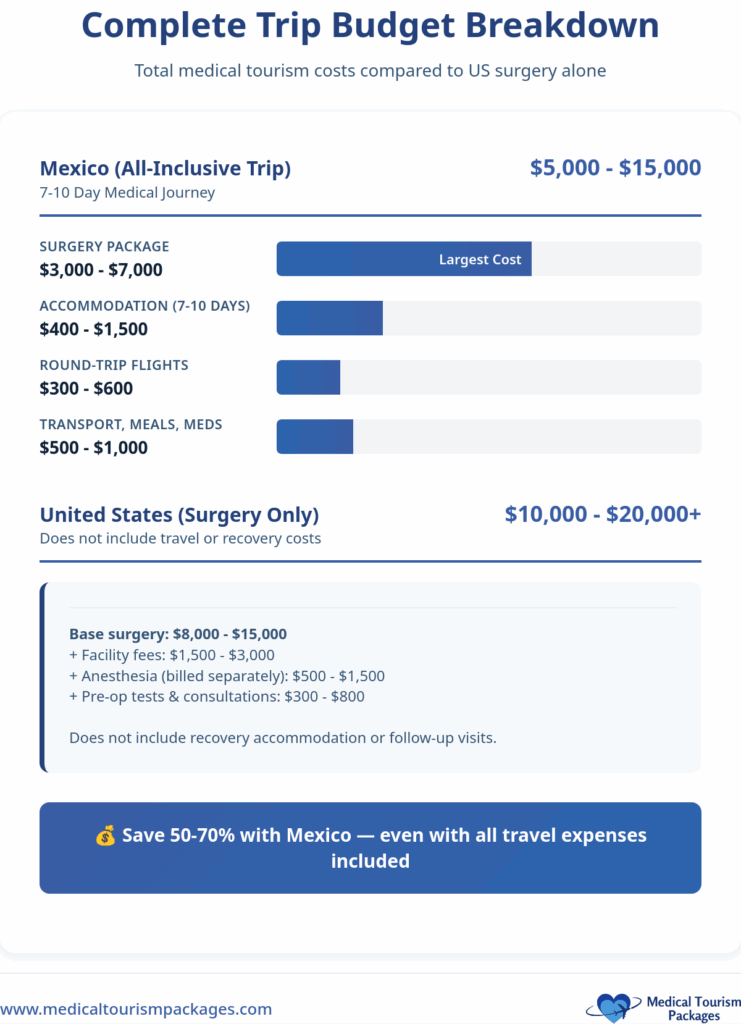
Understanding the complete financial picture helps you plan appropriately. Break down your budget into these categories:
Surgery Costs: $3,000 – $7,000
- Covers procedure, anesthesia, operating room time, and immediate post-operative care
- Varies based on case complexity and surgeon experience level
- Most surgeons require deposit at booking, balance due before surgery
Additional Costs: $2,000 – $8,000
- Round-trip flights (US to Tijuana/Cancun/Guadalajara): $300 – $600
- Accommodation: $400 (budget hotels) to $1,500 (recovery houses with medical monitoring)
- Ground transportation, meals, prescription medications: $500 – $1,000
- Companion travel (optional): Doubles accommodation and travel costs
Total Budget: $5,000 – $15,000
- Accommodation costs for the required 7-10 day stay represent your largest non-surgical expense
What Is the Rhinoplasty Recovery Timeline in Mexico?
Understanding the recovery timeline helps you set realistic expectations and plan your trip effectively. While everyone heals at slightly different rates, the basic progression follows a predictable pattern during your stay in Mexico.
What Is the 10-Day Recovery Schedule?
| Day | Activity | Medical Care |
|---|---|---|
| Day 1 | Arrival, consultation, pre-op tests | In-person evaluation, blood work, consent forms |
| Day 2 | Surgery (1-3 hours), post-anesthesia monitoring | Procedure performed, 2-4 hour recovery room observation |
| Days 3-7 | Peak swelling, rest, daily check-ups | Wound assessment, medication adjustment, ice therapy |
| Day 8 | Splint removal, nasal taping instruction | External cast removed, internal examination, taping demonstration |
| Days 9-10 | Final review, departure preparation | Travel clearance issued, home care instructions provided |
Day 1 focuses entirely on preparation. You’ll meet your surgeon in person to confirm the surgical plan discussed during your virtual consultation. The staff will photograph your nose from multiple angles for the medical record and comparison during follow-up. Pre-operative testing includes blood work and possibly a brief cardiac evaluation if you’re over 50 or have health concerns. You’ll sign consent forms after reviewing the risks and expected outcomes one final time.
Day 2 brings the surgery itself. The procedure typically takes one to three hours depending on complexity. Revision cases require more time than primary rhinoplasty. You’ll spend another two to four hours in the recovery room as the anesthesia wears off. Most patients feel groggy and experience mild nausea, which medications can control. Your nose will be packed with internal supports and covered with an external splint. You’ll return to your accommodation the same day with a companion or recovery house staff member.
Days 3 through 7 represent the most uncomfortable phase of recovery. Swelling peaks around Day 3, making your face feel tight and puffy. Bruising typically appears under the eyes and spreads across the cheeks, looking worse before it improves. You’ll breathe through your mouth since nasal packing blocks airflow. Daily check-ups allow your surgeon to monitor healing, change dressings if needed, and adjust pain medications. Most patients describe the discomfort as manageable rather than severe, similar to a bad sinus infection.
Day 8 marks a major milestone with splint removal. This process takes only minutes and feels more strange than painful. Your surgeon will examine the healing incisions and check for proper alignment. You’ll learn how to apply nasal tape. This tape helps reduce swelling and support the new shape during continued healing. Many patients feel presentable enough at this point to venture out for short periods, though bruising usually remains visible.
Days 9 and 10 focus on preparing you for the journey home. Your final review includes detailed instructions for continued care, signs of complications to watch for, and when to seek medical attention. The surgeon formally clears you for air travel after confirming that bleeding has stopped and swelling is progressing normally. You’ll receive copies of your surgical records and prescriptions for any medications you should continue taking.
What Is the Long-Term Healing Timeline?
Your recovery in Mexico is just the first step of your healing journey. Significant changes continue for months after you return home.
Most patients return to work within one to two weeks of their surgery. Office work and light activities are generally safe at this point, though residual swelling and bruising may still be visible. Makeup can conceal most discoloration, and many people choose to schedule their surgery before a vacation or long weekend to minimize time away from work.
Exercise requires more patience. Light walking is encouraged immediately, but you’ll need to wait four to six weeks before resuming vigorous workouts. Activities that risk facial impact, including contact sports, should be avoided for at least three months. Elevated heart rate and blood pressure from intense exercise can trigger bleeding or increased swelling during early healing.
Final results emerge gradually over six to twelve months. Initial swelling resolves within weeks, but subtle refinement continues much longer. The nasal tip typically takes the longest to settle into its permanent shape, sometimes requiring the full year. This extended timeline can be frustrating, but it’s normal for rhinoplasty regardless of where you have the surgery.
Compliance with nasal taping proves critical for optimal outcomes. Your surgeon will instruct you to tape your nose at night for several weeks after returning home. This external support helps control swelling and maintains the new shape as tissues heal. Patients who diligently follow taping instructions typically see better definition and faster resolution of swelling compared to those who skip this step.
What Are the Risks of Getting Rhinoplasty in Mexico?
Every surgical decision involves weighing benefits against potential downsides. While rhinoplasty in Mexico offers substantial advantages, you need to understand the specific risks that come with traveling abroad for surgery.
What Are the Medical Risks?
The overall complication rate sits at approximately 6%, which matches international standards for rhinoplasty performed anywhere. This statistic provides reassurance that Mexican surgeons achieve comparable safety outcomes to their counterparts in the United States or Canada. However, the types of complications and how they’re managed can differ based on your location.
Mexican surgeons prescribe antibiotics more often than US surgeons. They give preventive antibiotics more freely for two reasons: different medical practice standards in Mexico, and extra caution for international patients who will be healing far from their surgical team. This approach may lower your infection risk. However, it also means you’ll be taking medications that might not be necessary if you had surgery at home.
About 15% of patients may need minor adjustments after their initial healing completes. These revisions typically address small asymmetries or contour irregularities that become apparent once swelling fully resolves. The challenge comes in coordinating these touch-ups when your surgeon practices in another country. Some surgeons include one revision in their package price, but you’ll still need to arrange travel back to Mexico.
The most critical risk involves limited immediate post-operative infrastructure at home. If you develop a complication after returning to the United States, your local emergency room physicians may be unfamiliar with the specific techniques your Mexican surgeon used. They also can’t easily consult with your surgeon about treatment decisions. This communication gap can delay appropriate care and potentially worsen outcomes if problems arise during the weeks immediately following your return.
When May Mexico Not Be Right for You?
Certain circumstances make medical tourism not recommended even with the potential savings. Consider having your surgery domestically if any of these situations apply:
Cannot commit to 7-10 day stay – Cutting your recovery time short to return home earlier creates serious health risks. Flying before receiving medical clearance can cause complications from cabin pressure changes. If work, family, or other obligations prevent you from staying the full recommended period, postpone your surgery until you can dedicate the necessary time.
Need extensive long-term local follow-up – Some patients require more monitoring than others due to healing complications, complex revision work, or underlying health conditions. If your surgeon anticipates you’ll need frequent in-person evaluations during the months after surgery, having your procedure close to home makes more sense than repeatedly traveling to Mexico.
Unwilling to accept limited legal recourse (CONAMED system) – Some patients need the security of knowing they can pursue full legal action if something goes seriously wrong. The US malpractice system, despite its flaws, provides more robust patient protections than what’s available in Mexico. If this protection is important to you, the cost savings may not justify the reduced legal safeguards.
Complications history suggests need for immediate local medical access – Patients with a track record of healing problems, immune system issues, or previous surgical complications face higher risks when traveling for surgery. Having immediate access to your surgical team and local emergency services becomes more critical when your baseline risk is elevated.
What Should You Know About Rhinoplasty Procedure Options?
Understanding the different rhinoplasty techniques helps you have informed discussions with your surgeon about which approach best suits your needs. Mexican surgeons perform the full spectrum of methods, from minimally invasive closed techniques to complex open revisions. The right procedure depends on your specific goals, nasal anatomy, and whether this is a primary or revision surgery.
What Types of Rhinoplasty Procedures Are Offered in Mexico?
Mexican surgeons perform the full spectrum of rhinoplasty techniques, from straightforward cosmetic refinements to complex reconstructive work. Understanding the differences between approaches helps you have informed discussions with your surgeon about which method suits your goals.
| Technique | Approach | Best For | Scarring | Cost Range |
|---|---|---|---|---|
| Open Rhinoplasty | External incision across columella | Complex revisions, significant structural changes | Small visible scar on underside of nose | $3,000-$4,200 |
| Closed Rhinoplasty | All incisions inside nostrils | Minor adjustments, tip refinement | No visible scarring | $3,000-$7,000 |
| Ethnic Rhinoplasty | Open or closed, preserves cultural features | Maintaining ethnic identity while refining shape | Depends on technique used | $3,200-$7,000 |
| Revision Rhinoplasty | Corrects previous surgery failures | Breathing problems, aesthetic dissatisfaction | Depends on technique and previous scars | $4,500-$8,500+ |
Open rhinoplasty gives surgeons maximum visibility and control during the procedure. The surgeon makes a small incision across the columella, the strip of tissue separating your nostrils, then lifts the skin to expose the underlying cartilage and bone. This gives surgeons a clear view to make precise changes to the nasal structure, making it the preferred approach for complex cases. The external scar typically heals well and becomes barely noticeable within months, though it technically remains visible under close inspection. This technique works best when you need significant structural changes, tip work requiring cartilage grafts, or correction of severe asymmetry.
Closed rhinoplasty keeps all incisions hidden inside the nostrils. Without lifting the skin away from the framework, surgeons work through limited openings using specialized instruments. This approach results in no visible scarring and often slightly less swelling during recovery. The tradeoff comes in reduced visibility, which can make precise changes more challenging. Closed rhinoplasty suits patients who need minor refinements like smoothing a small hump, narrowing the bridge slightly, or making modest tip adjustments. Most surgeons reserve this technique for primary rhinoplasty on noses with straightforward anatomy.
Ethnic rhinoplasty addresses the unique concerns of patients who want refinement without losing their cultural identity. Different ethnic backgrounds have distinct nasal characteristics. African or Caribbean patients often have wider nostrils. Asian patients typically have lower bridges. Hispanic patients frequently have thicker skin. Surgeons experienced in ethnic rhinoplasty understand how to enhance features while maintaining harmony with your other facial characteristics. The approach can be either open or closed depending on the specific changes needed. This specialization matters because techniques that work well on European noses often produce unnatural results on other ethnicities.
Revision rhinoplasty corrects problems from previous surgeries, whether those were performed in Mexico, the United States, or elsewhere. This represents the most technically demanding type of nose surgery. Scar tissue from your first surgery makes the work harder, and the remaining cartilage may be weakened or depleted. Surgeons often need to harvest cartilage from the ear or rib to rebuild structural support. Revision cases take longer in the operating room and require more surgical skill, which explains the higher cost. If you’re considering revision work, choosing a surgeon with extensive revision experience becomes even more critical than for primary rhinoplasty.
Frequently Asked Questions About Rhinoplasty in Mexico
Can I fly home immediately after surgery?
No. After rhinoplasty you must remain in Mexico for 7–10 days. Flying before medical clearance can worsen bleeding and swelling due to cabin pressure changes. Most surgeons clear air travel around Day 10 after confirming safe healing.
Will my US insurance cover rhinoplasty in Mexico?
No. US and Canadian health insurance generally does not cover elective cosmetic surgery performed abroad, nor complications that arise later at home. Consider purchasing medical tourism complication insurance ($25,000–$100,000 coverage) to protect against unexpected costs.
What happens if I have complications after returning home?
Your local ER team may be unfamiliar with your surgeon’s specific techniques, which can slow appropriate care. Medical tourism complication insurance helps cover emergency costs. Most Mexican surgeons provide virtual follow-ups via video calls and photo updates to guide your recovery.
Can I combine my surgery with a vacation?
Yes—plan carefully. Cancun allows resort-style recovery, but avoid sun on your face early on. Expect rest and daily check-ups for the first 7 days; active activities should wait until after splint removal on Day 8. Light sightseeing is reasonable around Days 9–10 before departure.
How do I verify a surgeon’s credentials?
Check the CMCPER (Mexican Board of Plastic Surgery) for certification and confirm the surgeon’s certification number. Look for JCI-accredited facilities, review multi-platform patient ratings (ideally 4.4–5.0/5.0), and request before-and-after photos for cases similar to yours. Reputable surgeons readily provide documentation.
Can someone travel with me?
Yes. A companion is recommended to assist after anesthesia, help with transportation, and support recovery. Budget for their travel and lodging; some recovery houses offer shared rooms at reduced rates.
What’s included in the package price?
All-inclusive packages (about $3,400–$7,000) typically cover the surgeon’s fee, anesthesia, OR time, pre-op tests, and 7–10 days of follow-ups; some include ground transportation. Budget separately for flights ($300–$600), accommodations ($400–$1,500), meals, and prescriptions. Always confirm inclusions before booking.
Do I need a passport to travel to Mexico?
Yes. US citizens must have a valid passport for air, land, or sea travel to Mexico. Ensure it’s valid for at least six months beyond your planned return date. Apply or renew well before your surgery.
Will I need revision surgery?
Most patients (about 85–90%) are satisfied and do not need revisions. Roughly 15% may require minor adjustments for small asymmetries once swelling subsides. Some packages include one revision, but travel back to Mexico is your responsibility.
Is Rhinoplasty in Mexico the Right Choice for You?
The decision to have rhinoplasty abroad shouldn’t be made lightly or based solely on price. Take time to think honestly about your situation against specific criteria. This helps you determine whether medical tourism matches your needs and comfort with risk.
What Should Be on Your Pre-Decision Checklist?
Work through these five questions before committing to surgery in Mexico. If you answer no to any of them, reconsider whether medical tourism is appropriate for your situation.
1. Can you verify surgeon’s credentials and facility accreditation? – Confirm CMCPER certification and facility accreditation through official websites. These credentials represent the baseline safety standards that separate legitimate surgeons from unqualified practitioners. If you can’t independently verify certifications, don’t proceed with that surgeon regardless of price.
2. Can you commit to mandatory 7-10 day stay in Mexico? – This timeline is medically necessary, not a suggestion. Work obligations, childcare responsibilities, or travel anxiety don’t change the healing process. Leaving early puts your health at risk and can compromise your results. If you can’t realistically block out this full period, postpone your surgery until your schedule allows proper recovery time.
3. Are you comfortable with virtual follow-up care after returning home? – Most routine check-ins after you return home will happen via video calls and photo exchanges rather than in-person examinations. Some patients find this arrangement perfectly acceptable, while others feel anxious without face-to-face access to their surgeon. Your comfort level with telemedicine should factor into your decision, especially if you tend to be a worrier about health matters.
4. Have you reviewed multiple surgeon portfolios and patient ratings? – Shopping for surgery shouldn’t mirror booking a hotel. You need to invest time examining before-and-after photos from at least three to five different surgeons, reading reviews across multiple platforms, and comparing credentials side by side. Rushing this research phase to save a few hundred dollars increases your risk of poor outcomes exponentially.
How Can Medical Tourism Packages Help You?
Navigating rhinoplasty in Mexico doesn’t have to be overwhelming. Medical Tourism Packages connects you with JCI-accredited facilities and CMCPER-certified surgeons who have been thoroughly vetted for safety and quality. We take care of everything—from initial consultations and surgeon matching to travel logistics and recovery planning—ensuring you avoid common pitfalls that lead to complications.
We eliminate the guesswork by providing transparent pricing, verified credentials, and direct access to experienced medical tourism coordinators who answer your questions throughout the journey. Unlike booking independently, our partnerships with top-tier Mexican facilities mean you receive all-inclusive packages with guaranteed quality standards, comprehensive support, and clear accountability at every step.
Ready to explore your options? Contact Medical Tourism Packages today for a free consultation. Our team will match you with board-certified surgeons, provide detailed cost breakdowns, and create a customized medical tourism plan that prioritizes your safety, budget, and aesthetic goals.