Book Appointment Now


Rheumatology Surgery in Mexico: Costs, Top Hospitals, and Complete Guide for Medical Tourists
 By
By
Rheumatology surgery in Mexico delivers 50-80% savings over US prices, with JCI-accredited hospitals and board-certified orthopedic surgeons using FDA-approved implants from Stryker and Zimmer Biomet.
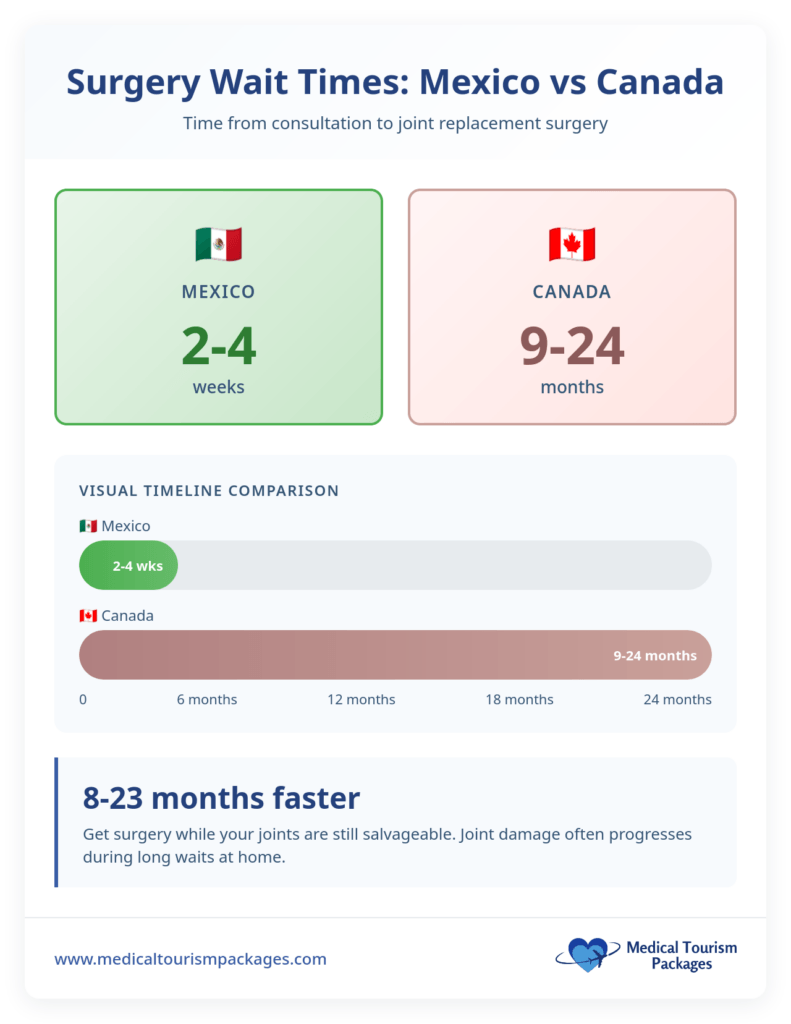
Joint replacements cost $8,000-$20,000 in Tijuana, Cancun, Guadalajara, and Mexico City—versus $30,000-$50,000+ in the US. Surgeons schedule procedures within 2-4 weeks, bypassing Canadian wait times that exceed 9 months to 2 years.
Our network connects you with internationally trained surgeons across Mexico’s top medical centers—each verified for credentials and JCI hospital accreditation. Below, you’ll find cost comparisons, top hospitals by city, surgeon selection criteria, and step-by-step planning guides.
What Is Rheumatology Surgery in Mexico?
Rheumatology surgery fixes joint and spine damage caused by autoimmune diseases. Conditions like Rheumatoid Arthritis (RA) and Ankylosing Spondylitis (AS) destroy joints over time. Surgery becomes necessary when medications and physical therapy no longer help.
Mexican orthopedic centers perform three main types of rheumatology surgery. Joint replacement is most common. Soft tissue procedures repair tendons and remove inflamed tissue. Spinal fusion corrects severe spine deformity.
What Conditions Require Rheumatology Surgery?
Three main conditions lead to rheumatology surgery. Each causes progressive damage that may need surgical repair.
- Rheumatoid Arthritis – End-stage joint damage where cartilage and bone have worn away
- Ankylosing Spondylitis – Severe spinal deformity or instability requiring correction
- Inflammatory Spondyloarthropathies – Joint and connective tissue damage throughout the body
What Types of Procedures Are Available?
Three main procedure categories treat rheumatology conditions. Your surgeon will recommend the best option based on your specific damage.
- Joint Reconstruction (Arthroplasty) – Highest volume procedures for medical tourists
- Total Knee Replacement (TKR) – Replaces damaged knee with prosthetic lasting 15-20 years
- Total Hip Replacement (THR) – Replaces damaged hip joint with prosthetic implant
- Soft Tissue Management – Repairs damaged tissue around joints
- Synovectomy – Removes inflamed joint lining to reduce pain and slow erosion
- Tendon repair – Restores function in rotator cuff, hands, and wrists
- Spinal Stabilization – Treats advanced Ankylosing Spondylitis
- Spinal fusion – Corrects severe deformity and manages instability
- Implants and Technology
- FDA-approved implants from Stryker, Zimmer Biomet, DePuy Synthes, and Medtronic
- Robotic-assisted surgery available at select centers
- Minimally invasive techniques for faster recovery
Why Should You Choose Mexico for Rheumatology Surgery?
Mexico offers 50% to 80% savings compared to US prices without sacrificing quality. You get the same implants, technology, and surgical expertise at a fraction of the cost. Canadian patients avoid wait times that often exceed 9 months to 2 years.
For comprehensive planning information, read our complete guide to medical tourism in Mexico.
How Much Does Rheumatology Surgery Cost in Mexico?
Rheumatology surgery in Mexico costs $8,000 to $28,000 depending on the procedure. This is 50% to 80% less than US prices. The table below shows exact cost comparisons.
| Procedure | Mexico Cost | USA Cost | Canada Cost | Savings vs USA |
|---|---|---|---|---|
| Total Knee/Hip Replacement | $8,000 – $20,000 | $30,000 – $50,000+ | $16,000 – $28,000 | 50% – 75% |
| Spinal Fusion Surgery | $10,000 – $28,000 | $60,000 – $100,000 | $50,000 – $75,000 | 60% – 80% |
| Synovectomy/Arthroscopy | $3,500 – $7,000 | $8,000 – $15,000 | $8,000 – $15,000 | 40% – 65% |
| Post-Surgery Rehabilitation | $1,500 – $3,000 | $5,000 – $8,000 | $4,000 – $6,000 | 60% – 70% |
The savings come from lower facility overhead, not inferior care. Spine surgery facility fees in Mexico stay below $5,000. The same US facilities charge over $20,000 before adding surgeon fees.
Which Mexican Cities Have the Best Rheumatology Surgery Hospitals?
Five cities offer excellent rheumatology surgery facilities for international patients. Each provides English-speaking staff, modern equipment, and organized support services.
What Are the Best Hospitals in Tijuana?
Tijuana and Los Algodones serve patients who want easy border access from the United States.
- Hospital Ángeles de Tijuana – High volume of international patients
- Los Algodones medical tourism center – Accessible from Yuma, Arizona
- Mediplaza surgical center – Just 4 blocks from US border crossing
- Family members can visit easily during your recovery
What Are the Best Hospitals in Cancun?
Cancun combines medical excellence with resort-style recovery options.
- Hospital Galenia – Serves international patients with bilingual staff
- Strong tourism infrastructure supports medical travelers
- Specialized recovery hotels with medical staff on site
- Resort-style recovery environment
What Are the Best Hospitals in Monterrey?
Monterrey has two major specialty care centers with advanced orthopedic services.
- Hospital Angeles Valle Oriente – Advanced joint replacement surgery
- Hospital San José TecSalud – Latest techniques for spine surgery
What Are the Best Hospitals in Guadalajara?
Guadalajara offers high-level orthopedic care with advanced surgical options.
- Centro Médico Puerta de Hierro Centro – Full orthopedic services
- Unidad de Rodilla y Cadera – Specialized joint surgery center
- Minimally invasive hip replacement available
- Robotic-assisted total knee arthroplasty
What Are the Best Hospitals in Mexico City?
Mexico City hosts the country’s most prestigious medical facilities.
- Médica Sur – JCI accredited since 2014, Mayo Clinic Care Network member
- Centro Médico ABC – Full-service international patient care
- Hospital Ángeles Pedregal – Advanced orthopedic department
How Do You Find a Qualified Rheumatology Surgeon in Mexico?
Finding a qualified surgeon requires checking credentials and experience. Mexico does not publish outcome data publicly. You must verify certifications yourself. Learn more about rheumatology surgery options to understand what to look for.
What Certifications Should Your Surgeon Have?
Your surgeon needs both Mexican board certification and international training. These credentials confirm proper education and skill level.
- Mexican Council of Orthopedics and Traumatology – Required domestic certification
- AMCICO membership – Mexican Association of Spine Surgeons for spinal procedures
- International fellowship – Advanced training at recognized institutions abroad
- FACS membership – Fellow of American College of Surgeons indicates international standards
What Questions Should You Ask Your Surgeon?
Ask direct questions during your consultation. A confident surgeon will answer transparently.
- Where did you complete your international fellowship training?
- How many years have you treated rheumatoid arthritis or ankylosing spondylitis patients?
- How do you manage patients on biologics or DMARDs?
- How many times have you performed my specific procedure?
- What are your complication rates?
What Is the Step-by-Step Process for Surgery in Mexico?
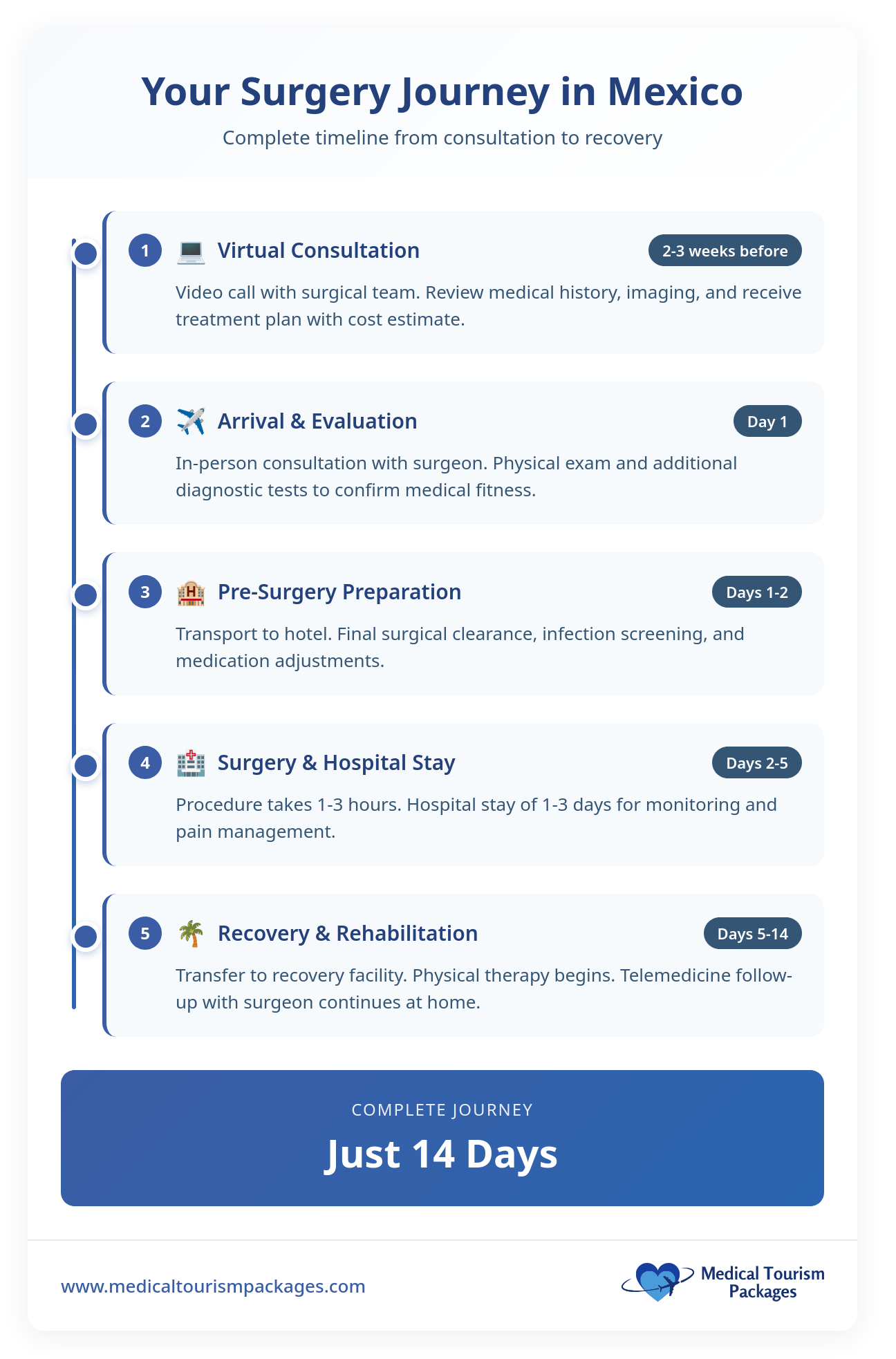
The process follows five structured steps from consultation to recovery. Medical tourism coordinators handle logistics so you can focus on your health.
| Step | Phase | What Happens | Timeline |
|---|---|---|---|
| 1 | Virtual Consultation | Video call with surgical team. Review medical history and imaging. Receive treatment plan and cost estimate. | 2-3 weeks before travel |
| 2 | Arrival Evaluation | In-person exam. Additional tests if needed. Confirm medical fitness. | Day 1 in Mexico |
| 3 | Pre-Surgery Prep | Transport to hotel. Final clearance. Infection screening. Medication adjustments. | Days 1-2 in Mexico |
| 4 | Surgery | Procedure takes 1-3 hours. Hospital stay 1-3 days for monitoring. | Days 2-5 in Mexico |
| 5 | Recovery | Transfer to recovery facility. Physical therapy begins. Telemedicine follow-up. | Days 5-14 in Mexico |
Coordinators manage airport pickup, ground transportation, and accommodation booking. They also handle communication with your surgical team.
How Long Does Recovery Take After Rheumatology Surgery?
Recovery takes 2 to 8 weeks depending on your procedure. You can return to work in 2 to 6 weeks. Desk jobs allow earlier return than physical labor.
| Recovery Phase | Timeframe | What to Expect |
|---|---|---|
| In-Country Stay | 5-14 days | Wound stabilizes. Mobility improves. Pain controlled. |
| Early Recovery | Weeks 1-2 | Pain reduces significantly. Physical therapy progresses. |
| Active Recovery | Weeks 3-6 | Range of motion improves. Daily activities resume. Work return possible. |
| Full Recovery | Weeks 6-8+ | Exercises continue. Follow-up imaging scheduled. |
Do not fly home too early. Early travel risks wound complications and blood clots. Mexican facilities structure recovery programs to keep you safe.
What Technology Do Mexican Hospitals Use?
Top Mexican hospitals use state-of-the-art equipment that matches US standards. Here is what you can expect at leading facilities.
- FDA-approved implants – Same brands as US hospitals: Stryker, Zimmer Biomet, DePuy Synthes, Medtronic
- Component quality – Identical specifications to North American implants
- Robotic-assisted arthroplasty – Improves implant positioning beyond manual techniques
- Minimally invasive techniques – Reduces tissue trauma and speeds recovery
- JCI accreditation – Confirms facilities meet global safety standards through external audits
What Are the Advantages of Rheumatology Surgery in Mexico?
Mexico offers three main advantages for rheumatology surgery patients. Cost savings lead the list, followed by quality care and fast scheduling.
What Are the Financial Benefits?
You save 50-80% compared to US prices. Joint replacements and spinal fusions cost a fraction of American prices. Spine surgery facility fees stay below $5,000 in Mexico versus $20,000+ in the US.
What Quality Standards Can You Expect?
Leading Mexican hospitals invest in modern surgical technology. You receive identical implants from top manufacturers. JCI-accredited hospitals employ surgeons with international fellowship training. Many patients report better surgeon engagement than in North America.
How Quickly Can You Get Surgery?
You can schedule surgery within 2-4 weeks. Canadian patients especially benefit by avoiding waits exceeding 9 months. Joint damage often progresses during long waits at home.
What Are the Risks of Rheumatology Surgery in Mexico?
Infection is the biggest risk for rheumatology patients in Mexico. Your immune system is likely weakened by medications like methotrexate or biologics. This makes you more vulnerable to serious infections.
What Infection Risks Should You Know About?
The Pan American Health Organization has warned about infection outbreaks at some Mexican facilities. Fungal meningitis and bacterial infections have affected US medical tourists. Prosthetic joint infections are especially dangerous and expensive to treat.
How Can You Reduce Your Risk?
Choose only JCI-accredited hospitals. JCI certification requires strict infection control protocols. Accredited facilities undergo regular external audits. Verify your hospital’s accreditation before booking.
Is Rheumatology Surgery in Mexico Right for You?
Mexico works well for patients who choose carefully. Limit your care to JCI-accredited hospitals with internationally trained surgeons. The 50-80% cost savings and 2-4 week scheduling make Mexico attractive.
However, immunosuppressed patients face higher infection risks. Prioritize safety over cost savings. Research your chosen facility thoroughly. Verify surgeon credentials independently. Have a plan for managing complications after you return home.
Frequently Asked Questions
How much does a knee replacement cost in Mexico?
A total knee replacement typically costs $8,000–$20,000 in Mexico, including surgeon fees, hospital stay, implants, and anesthesia. The same procedure often runs $30,000–$50,000+ in the United States.
Are Mexican surgeons qualified to perform joint replacement?
Yes. Leading Mexican surgeons hold board certification from the Mexican Council of Orthopedics and Traumatology. Many complete international fellowships and hold FACS membership. Always verify credentials before choosing your surgeon.
How long should I stay in Mexico after surgery?
Plan to stay 5–14 days after joint replacement. This allows your wound to stabilize before flying. Your surgeon will clear you for travel when mobility and pain levels are acceptable.
Do Mexican hospitals use the same implants as US hospitals?
Yes. Top facilities use FDA-approved implants from Stryker, Zimmer Biomet, DePuy Synthes, and Medtronic—the same brands and models used in the U.S. and Canada.
Can I get surgery if I take immunosuppressive medications?
Yes, but your medications must be managed carefully. You may need to pause biologics or DMARDs before surgery. Choose a surgeon experienced with immunosuppressed rheumatology patients, and consider JCI-accredited hospitals to reduce infection risk.
Which Mexican city is best for rheumatology or joint replacement surgery?
Mexico City offers the most prestigious facilities, including JCI-accredited Médica Sur. Tijuana provides convenient border access, Cancun offers resort-style recovery, and Guadalajara and Monterrey also have excellent hospitals. Choose based on your travel preferences.
What is included in the quoted knee replacement price in Mexico?
Packages commonly include surgeon fees, hospital stay, the knee implant, and anesthesia. Always request a written breakdown to confirm what’s covered.
How can I verify a Mexican surgeon’s credentials?
Confirm board certification with the Mexican Council of Orthopedics and Traumatology, look for international fellowship training and FACS membership, and verify details directly with the hospital before booking.
Does hospital accreditation matter for surgery in Mexico?
Yes. JCI-accredited hospitals follow international safety standards and can help reduce infection risks—especially important for immunosuppressed patients.
When will I be cleared to fly home after knee replacement?
Most patients are cleared between days 5–14, once the incision is stable and pain and mobility are well controlled. Your surgeon makes the final decision based on your recovery.
Ready to Start Your Rheumatology Surgery Journey?
Medical Tourism Packages coordinates your entire rheumatology surgery journey in Mexico. We connect you with certified orthopedic surgeons, arrange your travel and accommodations, and provide bilingual support throughout your treatment. Get a free consultation to discuss your surgical needs and receive a personalized quote.
Contact us today to start planning your affordable rheumatology surgery in Mexico.