Book Appointment Now


Hand Surgery in Latin America: Costs, Procedures, and Medical Tourism Guide
 By
By
Every year, thousands of patients travel to Latin America for hand surgery. They find skilled surgeons, modern facilities, and big cost savings. Countries like Mexico, Colombia, and Brazil lead the region for orthopedic medical tourism.
Hand surgery treats both chronic conditions and acute injuries. Patients seek these procedures for carpal tunnel syndrome, trigger finger, tendon damage, or fractures. A carpal tunnel release costs $6,000-$12,000 in the US but runs $1,500-$3,550 in Latin America. That’s savings of 50-80%.
Lower prices don’t tell the complete story, though. Quality varies between facilities and surgeons. Board certifications differ from US standards. You’ll need to stay abroad 10-14 days before flying home. This guide covers costs, credentials, and destination details for medical tourists.
What Is Hand Surgery?
Hand surgery treats problems in your hands, wrists, and forearms. Surgeons handle chronic conditions like carpal tunnel syndrome. They also treat acute trauma such as fractures and tendon injuries.
This specialty requires training in multiple areas. Hand surgeons learn orthopedic surgery, plastic surgery, and sometimes general surgery. This training lets them treat nerve compression to tissue reconstruction.
Treatment depends on your condition. Surgeons use both surgical and non-surgical methods. Conservative treatments like splinting or physical therapy may come first. Surgery follows if these don’t work.
Why Is Latin America Popular for Hand Surgery?
Cost savings drive most patients to Latin America. You’ll save more than 50% on most hand procedures. Quality matches what you’d find at home.
Many facilities hold JCI accreditation. This is the same international standard used by top US hospitals. These centers follow strict protocols for patient safety and infection control.
Wait times are much shorter. Patients from Canada and Europe face months-long delays at home. Latin American facilities often schedule appointments within days.
Mexico offers the best proximity for US patients. Facilities in Tijuana, Guadalajara, and Monterrey sit just hours from the border. You’ll save 40-60% while staying close for follow-up care. No visa is needed for US citizens. Most surgeons speak fluent English.
Which Latin American Countries Lead in Hand Surgery?
Five countries dominate the region’s hand surgery market. Each offers distinct advantages in pricing, expertise, and infrastructure.
| Country | Annual Medical Travelers | Key Strength | Specialization |
|---|---|---|---|
| Mexico | 1.2–3 million | Proximity to US, 70% diaspora-driven | Routine procedures, trauma care |
| Costa Rica | 70,000 ($437M revenue) | #1 ranked destination 2021 | High-value procedures |
| Brazil | 180,000–250,000 | 2.1M cosmetic procedures, 2nd global market | Complex reconstruction, microsurgery |
| Colombia | High foreign patient percentage | 98.2% referral rate, 3rd global aesthetic destination | Reconstructive procedures |
| Argentina | 14,000 | IWC-affiliated centers | Wrist and hand specialty |
Mexico leads in volume with 1.2-3 million medical travelers yearly. The Mexican-American diaspora drives 70% of this traffic. Facilities excel in routine procedures and trauma care.
Costa Rica attracts 70,000 patients who generate $437 million in revenue. This high revenue-per-patient ratio shows the country focuses on complex procedures. The country ranked #1 globally as a medical tourism destination in 2021.
Brazil receives 180,000-250,000 medical tourists yearly. The country performs 2.1 million cosmetic procedures annually. This volume builds expertise in complex reconstruction and microsurgery.
Colombia maintains a 98.2% patient referral rate—the highest in the region. Colombian surgeons specialize in reconstructive procedures. These require advanced plastic surgery skills.
Argentina serves 14,000 medical tourists through IWC-affiliated centers. These facilities focus on wrist and hand specialty procedures. They offer concentrated expertise in this niche.
How Much Does Hand Surgery Cost in Latin America?
You’ll save 50-80% on most hand procedures. This holds true even after accounting for travel expenses.
| Procedure | Mexico | US | Canada | Savings % |
|---|---|---|---|---|
| Carpal Tunnel Release | $1,500–$3,550 | $6,000–$12,000+ | $4,000–$7,000 | 50–80% |
| Trigger Finger Release | $300–$800 | $1,500–$4,000+ | $1,000–$2,500+ | 60–80% |
Carpal Tunnel Release shows clear savings. A procedure costing $6,000-$12,000 in the US runs $1,500-$3,550 in Mexico. Canadian patients pay $4,000-$7,000 at private facilities.
Trigger Finger Release delivers even better value. Mexico charges $300-$800 per finger. US facilities charge $1,500-$4,000+. The maximum price in Mexico often sits below the minimum US price.
Rehabilitation costs add to your savings. Post-surgical physiotherapy costs up to 70% less than North American rates. This matters because hand surgery recovery depends on proper rehabilitation. Many facilities bundle these services into surgical packages.
For more information on orthopedic procedure costs, see our complete guide to orthopedic surgery abroad.
These prices typically include surgeon’s fee, facility costs, anesthesia, and immediate post-op care. Pre-op consultations, medications, and extended recovery may cost extra.
What Hand Surgery Procedures Are Available?
Latin American facilities offer a full range of hand procedures. They handle both simple releases and complex microsurgery.
| Procedure | Best For | Recovery Time | Cost (Mexico) |
|---|---|---|---|
| Carpal Tunnel Release | Median nerve compression, endoscopic techniques available | 4–6 weeks | $1,500–$3,550 |
| Trigger Finger Repair | Stenosing tenosynovitis | 2–3 weeks | $300–$800 |
| Tendon Repair | Traumatic injuries, sports-related damage | 4–8 weeks | Variable |
| Hand Fracture Fixation | Complex fractures requiring surgical stabilization | 6–12 weeks | Variable |
| Hand Microsurgery | Free tissue transfers, nerve repair, vascular grafting | 8–12 weeks | Variable |
| Dupuytren’s Contracture | Chronic degenerative finger conditions | 4–8 weeks | Variable |
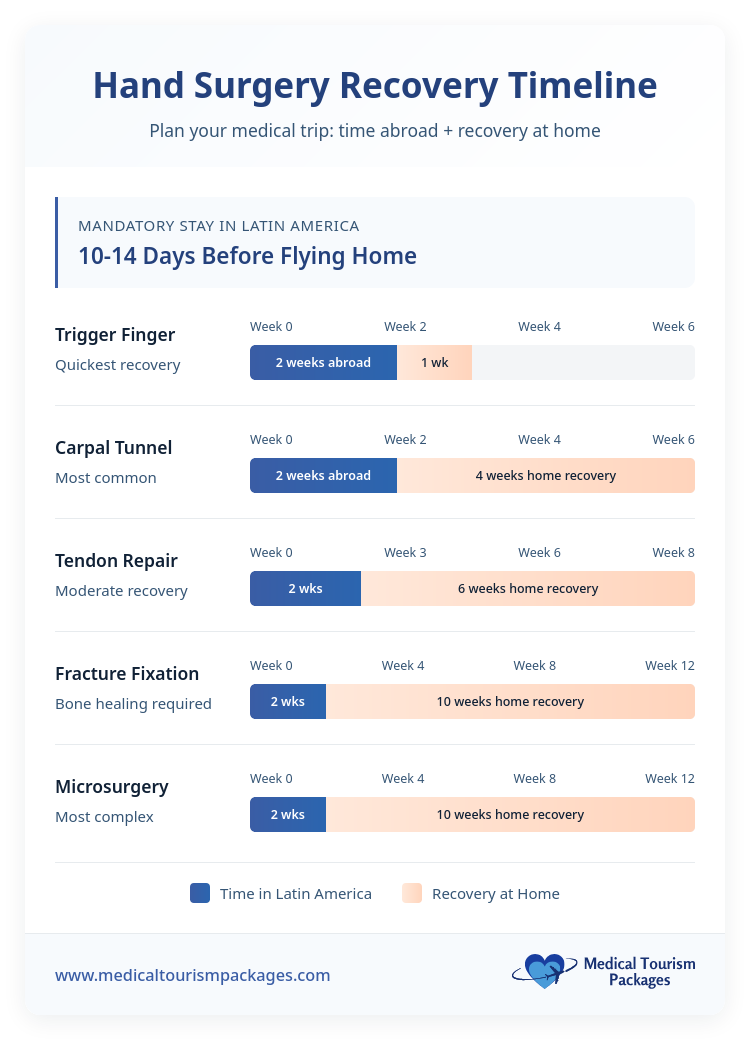
Carpal Tunnel Release is the most common procedure for medical tourists. Surgeons decompress the median nerve to relieve numbness and pain. Many facilities offer endoscopic techniques with smaller incisions. Full recovery takes 4-6 weeks.
Trigger Finger Repair treats stenosing tenosynovitis. This is when fingers lock or catch. The straightforward procedure costs just $300-$800 in Mexico. Recovery is quick at 2-3 weeks.
Tendon Repair addresses injuries from accidents or sports. Surgeons reconnect or reconstruct damaged tendons. Recovery takes 4-8 weeks depending on the damage.
Hand Fracture Fixation uses pins, plates, or screws to stabilize fractures. These injuries often involve multiple bones or joint surfaces. Recovery extends 6-12 weeks for bone healing.
Hand Microsurgery represents the most advanced procedures. Surgeons perform tissue transfers, nerve repairs, and vascular grafting under microscopes. Centers in Brazil and Colombia specialize in these cases. Recovery takes 8-12 weeks.
Dupuytren’s Contracture surgery removes tissue that pulls fingers into a bent position. This condition typically affects the ring and little fingers. Recovery ranges from 4-8 weeks.
Pricing for tendon repairs, fracture fixation, and microsurgery varies by complexity. Request detailed quotes that specify what’s included.
How Do You Find Qualified Hand Surgeons in Latin America?
Verifying credentials requires different steps than vetting US doctors. Board certifications don’t transfer between countries. You’ll need to understand each nation’s training standards.
| Region | Certification Body | Training Requirements |
|---|---|---|
| United States | ABOS/ABPS | One-year ACGME fellowship + Joint Committee examination |
| Mexico | Consejo Mexicano de Cirugía Plástica | 6-year medical degree + 4-year general surgery + 3-year plastic surgery residency |
Training standards differ but remain strict. US hand surgeons complete a one-year fellowship after residency. They then pass the Joint Committee exam. Mexican surgeons must complete 6 years of medical school. They then do 4 years of general surgery and 3 years of plastic surgery. That’s 13 years total before independent practice.
Key verification steps:
- The American Board of Surgery doesn’t offer reciprocity. You cannot assume a Latin American surgeon meets US standards. Verify credentials yourself.
- Look for fellowship training with university or international endorsements. Check for IWC (International Wrist Center) or IBRA (International Bone Research Association) affiliations. These show the surgeon pursues advanced training.
- Medyarthros in Guadalajara has a University of Guadalajara-endorsed fellowship since 2007. This facility trains surgeons in hand surgery and maintains academic standards.
- São Paulo Hand Center offers IBRA-recognized fellowships. These demonstrate advanced specialized training.
- JCI accreditation confirms safety standards. It means the hospital meets the same quality benchmarks as top US medical centers. This validates the facility, not the individual surgeon.
Ask these questions during consultations:
- What is your specific training in hand surgery?
- Are you certified by your country’s national board?
- Do you hold any international affiliations (ISAPS, IWC, IBRA)?
- How many of these procedures do you perform annually?
- Can I see before-and-after photos of similar cases?
Request documentation and verify credentials through official registries online.
What Is the Hand Surgery Procedure Process?
The timeline follows a structured path from consultation through full recovery. Understanding each phase helps you plan time away from work.
- Pre-surgery consultation: Your surgeon reviews your medical history and examines you. They screen for diabetes, hypertension, or heart issues that could affect outcomes. This consultation determines the best technique for your case.
- Procedure day: Routine procedures like carpal tunnel take 2-3 hours total. Complex cases involving microsurgery can extend 4-6 hours. You’ll receive regional anesthesia (numbing just your arm) or general anesthesia.
- Immediate post-op: You’ll transfer to a recovery house rather than the hospital. These facilities provide 24/7 bilingual nursing care. Nurses monitor your vitals, manage pain, and watch for complications.
- Days 1-2: Expect minimal activity during this phase. You’ll need help for bathroom trips and basic tasks. Compression garments stay on to reduce swelling. Pain peaks during the first 48 hours but stays manageable.
- Days 3-14: Your surgeon will see you on days 3, 7, 10, and 14. These appointments check wound healing and remove sutures if needed. Drains are removed once output drops—typically between days 7-10.
- Weeks 2-6: You can return home after day 14 and begin light tasks by week 3. Avoid lifting more than 10 pounds. Physical therapy usually starts now for range of motion.
- Months 6-12: Full activities resume after surgeon clearance—typically around weeks 8-12. Final results emerge through the first year. Most patients regain 90-95% of normal hand function by month 6.
You cannot skip the 10-14 day recovery period in Latin America. Airlines prohibit flying right after surgery due to cabin pressure and limited medical support.
What Are the Pros and Cons of Hand Surgery in Latin America?
Medical tourism for hand surgery offers real benefits but comes with challenges. Understanding both helps you decide.
Advantages:
- Cost savings remain large even after travel expenses. A carpal tunnel release costing $8,000 in the US runs $2,000 in Mexico. Add $1,500 for flights and hotels. You still save $4,500. The math works even better for multiple procedures.
- You’ll avoid long waiting lists. Canadian patients often wait 84 days for hand surgery. Americans with high deductibles delay procedures for years. Latin American facilities schedule within days. You can address painful conditions right away.
- Accredited facilities maintain international safety standards. These hospitals follow the same protocols as top US centers. Equipment comes from the same manufacturers—GE, Siemens, Philips. Many surgeons trained at US institutions.
Disadvantages:
- Credential verification takes effort. You cannot assume a Latin American surgeon meets US standards. Each surgeon requires individual verification through national boards and training records. This takes time.
- Long-distance follow-up can be challenging. Your surgeon sits thousands of miles away if problems arise. Telemedicine helps, but some issues need in-person evaluation. Establish care with a local hand surgeon before traveling.
- You must stay abroad 10-14 days. Airlines restrict post-surgical flights. This adds accommodation costs and time away from family and work. Budget for the financial and personal impact.
Which Facilities in Latin America Offer Hand Surgery?
Five facilities stand out for their hand surgery expertise and credentials. Each offers different advantages based on your procedure type and location.
| Country/City | Facility | Accreditation | Specialization |
|---|---|---|---|
| Mexico/Monterrey | Hospital San Jose TecSalud | JCI | Full tertiary care, 150 miles from Texas border |
| Mexico/Guadalajara | Medyarthros Surgery Center | University-endorsed fellowship | 7-floor trauma/orthopedics hospital, fellowship program since 2007 |
| Brazil/São Paulo | São Paulo Hand Center | IWC/IBRA | Reconstructive and robotic microsurgery |
| Panama/Panama City | Clinica Hospital San Fernando | JCI (first in Panama) | Dollarized economy |
| Argentina/Buenos Aires | Clínica de la Mano de Buenos Aires | IWC | Wrist and hand specialty procedures |
Hospital San Jose TecSalud in Monterrey holds JCI accreditation and operates as a full tertiary care center. Located 150 miles from Texas, it offers easy access for US patients. The facility handles routine releases to complex reconstructions.
Medyarthros Surgery Center in Guadalajara runs a University-endorsed fellowship program since 2007. This 7-floor hospital focuses only on trauma and orthopedics. The fellowship ensures exposure to current techniques.
São Paulo Hand Center has affiliations with IWC and IBRA. These connections show participation in global research. The center specializes in reconstructive procedures and robotic microsurgery.
Clinica Hospital San Fernando in Panama City earned the first JCI accreditation in Panama. The dollarized economy eliminates currency issues. Prices in US dollars remain stable.
Clínica de la Mano de Buenos Aires focuses only on wrist and hand procedures. Its IWC affiliation means surgeons follow international protocols. The narrow focus builds concentrated expertise.
All five facilities have English-speaking staff and patient coordinators. Request documentation of accreditations directly from facilities.
For more destination details, see our guide for American medical tourists.
How Do You Choose the Right Country for Your Procedure?
Country selection depends on your procedure, budget, and travel needs. Each destination offers different advantages.
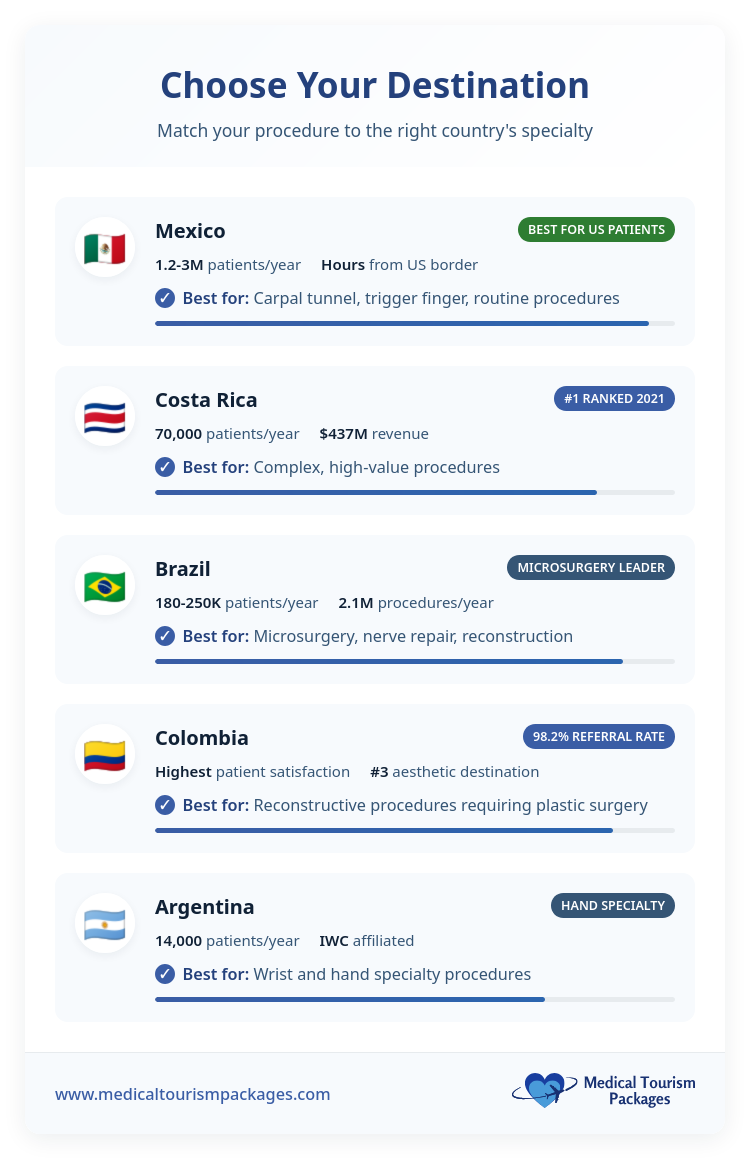
Mexico works best for proximity and routine procedures. US citizens need no visa for stays under 180 days. Tijuana, Guadalajara, and Monterrey sit hours from the border. Choose Mexico for carpal tunnel, trigger finger, and standard tendon work. Most surgeons speak fluent English.
Costa Rica attracts patients seeking top quality. The country generated $437 million from 70,000 patients. This high revenue-per-patient shows complex, high-value procedures. English is widespread due to tourism.
Brazil excels at complex reconstruction and microsurgery. With 2.1 million cosmetic procedures yearly, Brazilian surgeons have unmatched volume. Choose Brazil for tissue transfers and nerve repairs. The São Paulo Hand Center specializes in these.
Colombia delivers excellent service with a 98.2% referral rate. This reflects consistent quality and satisfaction. Colombian surgeons train extensively in plastic and reconstructive techniques.
Prioritize accreditation and fellowship training regardless of country. JCI accreditation validates safety standards. Fellowship training shows surgeons pursue specialization.
Consider proximity for follow-up. Complications are rare but possible. Mexico allows quick return if needed. Brazil or Argentina make emergency visits harder. Factor travel time if you have risk factors like diabetes.
Match procedure complexity to country strength. Simple releases work anywhere with JCI accreditation. Complex microsurgery demands Brazil or Argentina’s specialized centers.
Is Hand Surgery in Latin America Right for You?
Medical tourism works best for specific patient profiles. Assess whether your situation fits these requirements.
You’re an ideal candidate if you:
- Seek big cost savings without compromising on quality
- Feel comfortable with international travel
- Can remain abroad for the mandatory recovery period
- Have realistic expectations about outcomes and scarring
- Can budget an extra 20-30% for potential issues
Critical preparation steps:
- Verify surgeon credentials through national board registries and ISAPS membership
- Confirm facility accreditation through the official JCI website
- Arrange local follow-up care with a hand surgeon before traveling
- Set aside emergency funds representing 25-35% beyond surgical costs
You’re NOT a good candidate if you:
- Have uncontrolled diabetes, heart disease, or clotting disorders
- Cannot afford extended stays if complications arise
- Cannot take two weeks away from work or family
- Feel uncomfortable advocating for yourself in unfamiliar settings
Success depends on thorough preparation. Patients who research, verify credentials, and plan for contingencies get the best outcomes.
Frequently Asked Questions
How Long Is the Recovery Time for Hand Surgery Abroad?
Recovery time varies by procedure. Trigger finger repair takes 2-3 weeks. Carpal tunnel release takes 4-6 weeks. Complex microsurgery takes 8-12 weeks. You must stay in Latin America for 10-14 days after surgery before flying home.
Do I Need a Visa for Medical Tourism in Latin America?
US citizens don’t need visas for most Latin American countries. Mexico allows stays up to 180 days. Costa Rica, Colombia, Panama, and Brazil offer 90-day visa-free entry. Check current requirements before booking.
How Can I Verify a Surgeon’s Credentials?
Request board certification documents from the surgeon. Check with their national medical board online. Look for ISAPS membership or IWC/IBRA affiliations. Ask about fellowship training and annual procedure volume. Verify facility JCI accreditation on the official website.
What Happens If I Have Complications at Home?
Establish care with a local hand surgeon before your trip. Get written agreement they’ll see you post-op. Most facilities offer telemedicine follow-up. Keep all surgical records, imaging, and discharge instructions. Budget emergency funds for potential return trips.
Is Anesthesia Safe at Latin American Hospitals?
JCI-accredited hospitals follow the same anesthesia protocols as US facilities. They use the same monitoring equipment and medications. Anesthesiologists at accredited centers have comparable training. Ask about anesthesia team credentials during your consultation.
Do Surgeons Speak English?
Most surgeons at major medical tourism facilities speak fluent English. Many trained at US or European institutions. Facilities provide bilingual patient coordinators. Request English-speaking staff when booking your consultation.
What Is Included in the Surgical Price?
Most quoted prices include surgeon’s fee, facility costs, anesthesia, and immediate post-op care. Additional costs may include pre-op consultations, medications, extended recovery stays, and physical therapy. Always request itemized quotes specifying what’s included.
Ready to Start Your Hand Surgery Journey?
Medical Tourism Packages coordinates your entire hand surgery journey in Latin America. We connect you with certified surgeons, arrange your travel and accommodations, and provide bilingual support throughout your treatment. Get a free consultation to discuss your hand health goals and receive a personalized quote.
Contact us today to start planning your affordable hand surgery in Latin America.