Book Appointment Now

Abdominoplasty in Mexico: Complete Guide, Costs, and Certified Surgeons
 By
By
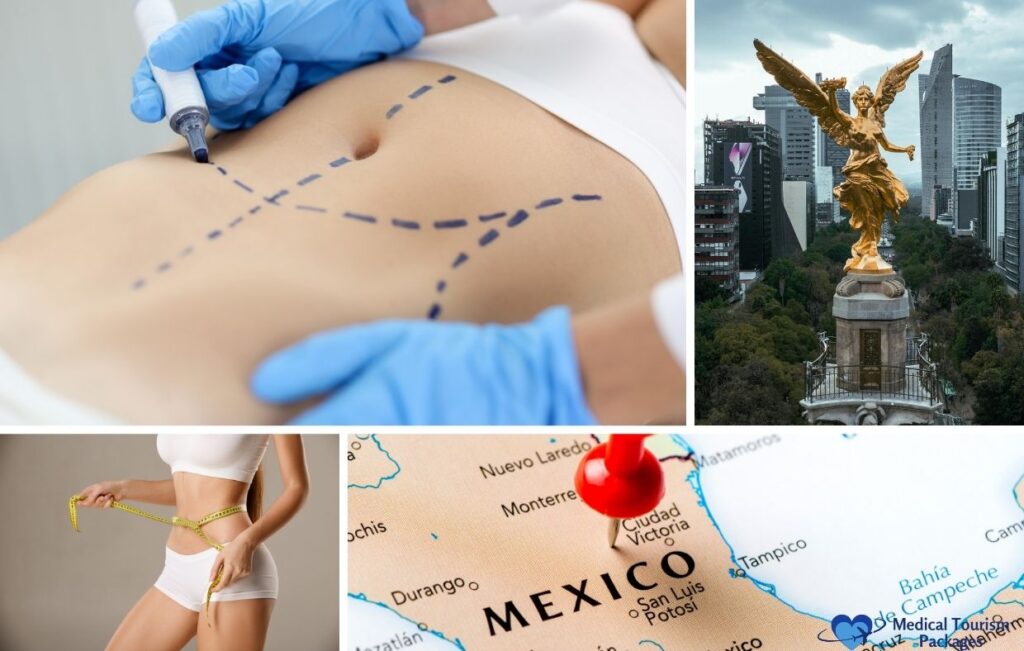
Abdominoplasty in Mexico costs $3,500-$6,000, 50-70% less than US prices, at JCI-accredited facilities with board-certified surgeons.
A standard tummy tuck in Mexico costs $3,500-$6,000 versus $8,000-$15,000 in the United States. Surgeons certified by CMCPER (Consejo Mexicano de Cirugía Plástica) complete 6-7 years of surgical residency and maintain credentials through continuing education every five years.
Our network connects you with board-certified plastic surgeons across major Mexican cities. Each surgeon operates at JCI-accredited or equivalent facilities. Below you’ll find cost comparisons, procedure types, recovery timelines, and safety data.
What Is Abdominoplasty?
Abdominoplasty is a surgical procedure that removes excess skin and fat from the abdomen. The surgeon makes a horizontal incision across the lower abdomen from hip to hip. Through this incision, they remove unwanted tissue and tighten underlying abdominal muscles. The remaining skin is pulled down and repositioned to create a flatter, firmer profile. The belly button is repositioned to maintain a natural appearance.
This procedure benefits people whose concerns cannot be resolved through diet and exercise alone. Post-pregnancy patients often struggle with stretched skin and separated abdominal muscles. These remain even after returning to pre-pregnancy weight. Weight loss patients may have significant loose skin after losing many pounds. Aging can cause skin laxity and muscle weakness in the abdominal area. Abdominoplasty is body contouring, not weight loss. Ideal candidates should be at or near their target weight. They should maintain stable body mass for at least six months before surgery.
Why Should You Choose Mexico for Abdominoplasty?
You should choose Mexico for 40-70% cost savings compared to the United States and Canada. A standard tummy tuck costs $8,000-$15,000 in the US. The same procedure runs $3,500-$6,000 in Mexico. These lower prices reflect Mexico’s lower operational costs. This advantage gets passed directly to patients through bundled all-inclusive pricing.
Mexico offers several key advantages for medical tourists:
- Geographic proximity — Tijuana sits just minutes from the California border. Patients can drive across for their procedure. Major hubs like Cancun, Mexico City, and Monterrey offer direct flights under five hours from most North American cities.
- CMCPER-certified surgeons — CMCPER is the only legal certifying body for plastic surgery in Mexico. Certification requires 6-7 years of surgical residency. Surgeons must pass complete examinations and renew credentials every five years.
- JCI-accredited facilities — Many facilities in Tijuana, Cancun, and Mexico City carry JCI accreditation. These meet the same safety and quality standards as top American hospitals.
- Recovery boutique infrastructure — Mexico pioneered recovery boutiques with 24-hour nursing care. These include hospital-grade beds and post-operative nutrition programs.
Read our guide for American medical tourists in Mexico for more planning tips.
What Types of Abdominoplasty Procedures Are Performed in Mexico?
Four main abdominoplasty techniques are available in Mexico. Each is tailored to different patient needs and body concerns. Understanding the differences helps you choose the right procedure for your goals.
| Procedure Type | Description | Price Range | Surgery Time | Best For |
|---|---|---|---|---|
| Full Abdominoplasty | Hip-to-hip incision with complete muscle repair and navel repositioning | $3,500–$6,000 | 2-4 hours | Post-pregnancy patients, significant skin laxity across entire abdomen |
| Mini Abdominoplasty | Shorter incision targeting lower abdomen only, limited muscle work, navel stays in place | $2,500–$4,500 | 1-2 hours | Minor skin redundancy below the navel, minimal muscle separation |
| Extended Abdominoplasty | Hip-to-hip incision extending to flanks and love handles, full contouring | $5,000–$8,500 | 3-5 hours | Significant weight loss patients with excess skin on sides |
| Circumferential (360°) | Incision wraps around entire torso, addresses abdomen, flanks, back, and buttocks | Varies by city | 4-6 hours | Post-massive weight loss, extreme skin laxity all around torso |
Full abdominoplasty remains the most common procedure for medical tourists. It provides full correction of muscle separation. It removes excess skin from both upper and lower abdomen. Mini abdominoplasty works well for patients with isolated lower belly concerns. It offers faster recovery needs. Extended and circumferential procedures deliver major results. These work for patients with extensive skin excess following major weight loss.
How Much Does Abdominoplasty Cost in Mexico?
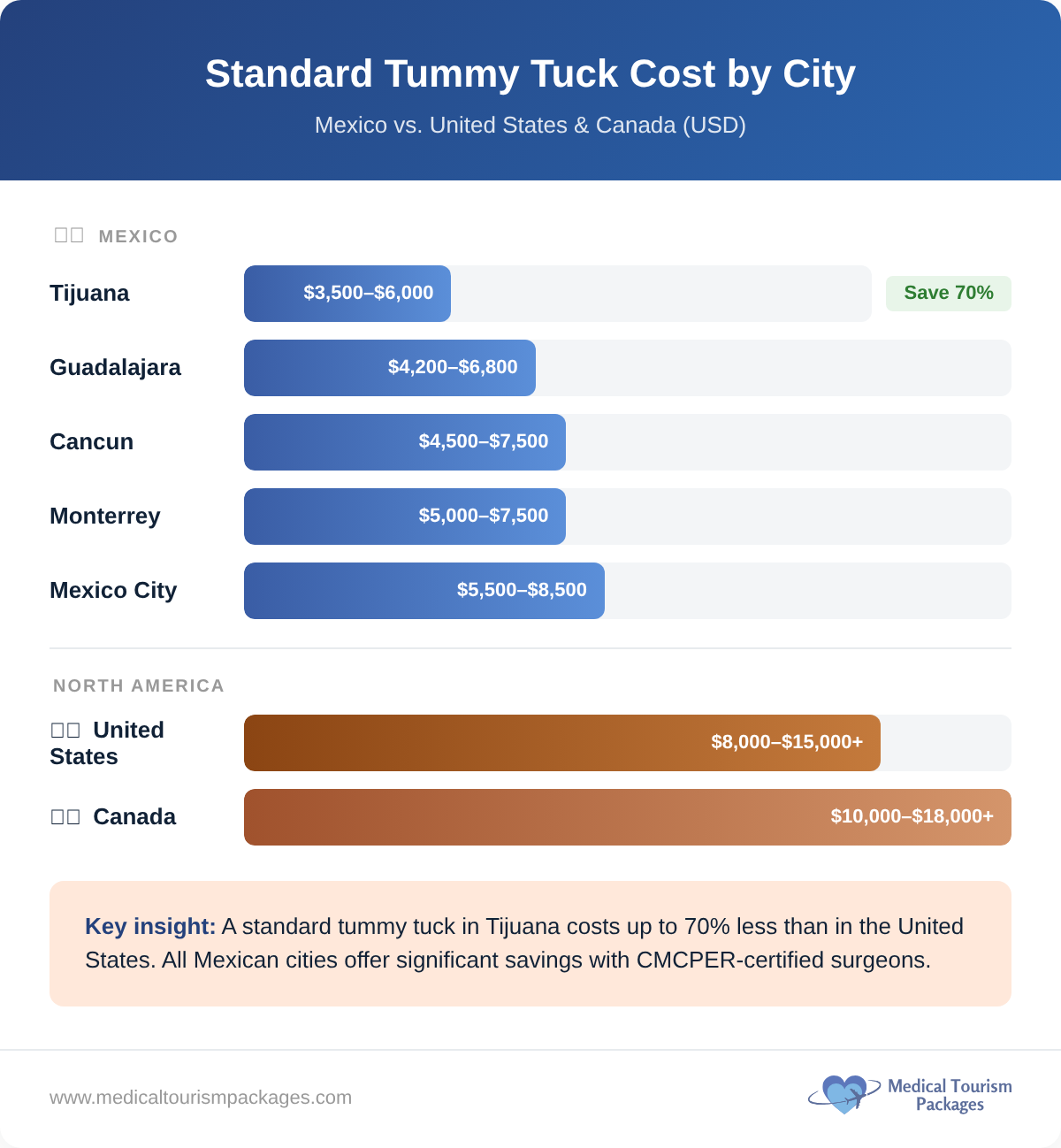
Abdominoplasty costs vary by city and procedure type. You save 40-70% compared to North American prices. The table below shows current pricing across major medical tourism destinations.
| City/Country | Mini Abdominoplasty | Standard Abdominoplasty | Extended Abdominoplasty |
|---|---|---|---|
| Tijuana | $2,500–$4,500 | $3,500–$6,000 | $5,000–$8,500 |
| Cancun | $3,500–$5,500 | $4,500–$7,500 | $6,500–$10,000 |
| Guadalajara | $3,200–$5,200 | $4,200–$6,800 | $6,000–$9,500 |
| Mexico City | $4,000–$6,000 | $5,500–$8,500 | $7,500–$11,000 |
| Monterrey | $3,800–$5,800 | $5,000–$7,500 | $7,000–$10,500 |
| United States | $5,000–$10,000 | $8,000–$15,000+ | $12,000–$25,000+ |
| Canada | $7,000–$12,000 | $10,000–$18,000+ | $15,000–$25,000+ |
You save 40-70% by choosing Mexico over the United States or Canada. A standard tummy tuck costing $12,000 in the US runs approximately $5,000 in Tijuana. This represents a savings of $7,000. Canadian patients see even greater advantages. Procedures costing $10,000-$18,000 at home are available for under $6,000 in most Mexican cities. Most facilities include surgeon fees, anesthesia, hospital charges, and initial follow-up visits in quoted prices. US pricing often fragments these costs into separate bills.
How Do You Choose a Qualified Surgeon in Mexico?
Qualified plastic surgeons must hold CMCPER certification. CMCPER is the only legal certifying body for plastic surgery specialists in Mexico. This certification requires 6-7 years of surgical residency after medical school. Surgeons must pass complete written and practical examinations. They renew credentials every five years through continuing education and clinical volume. Verify your surgeon’s certification directly through the CMCPER database. Do not rely on clinic websites or marketing materials.
Also look for surgeons who operate in JCI-accredited facilities. These meet international safety and quality standards equal to top American hospitals:
- Hospital Galenia in Cancun — Full JCI accreditation with full post-operative care for international patients
- Hospital de la Familia in Mexicali — Consejo de Salubridad General accreditation, Mexico’s equivalent to JCI
These facilities maintain rigorous protocols for sterilization, emergency response, and patient safety monitoring.
Who Are the Leading Abdominoplasty Surgeons in Mexico?
The leading abdominoplasty surgeons in Mexico are board-certified specialists with extensive fellowship training. These surgeons complete a rigorous multi-stage training pathway. It begins with a six-year medical degree from an accredited university. This is followed by a four-year residency in general surgery. After residency, they pursue additional training specifically in plastic surgery.
Fellowship training often occurs at premier centers in the United States or top-tier Latin American institutions. Many surgeons are members of AMCPER (Asociación Mexicana de Cirugía Plástica). They also hold CMCPER certifications. Most surgeons at JCI-accredited facilities in Tijuana, Cancun, and Mexico City are fluent in English.
Major cities offer different strengths for abdominoplasty patients:
- Tijuana — Near the US border with convenient access for American patients
- Mexico City — Academic-level expertise and tertiary care capabilities
- Cancun — Surgical excellence with resort-style recovery environments
How Is Abdominoplasty Performed in Mexico?
Abdominoplasty in Mexico uses general anesthesia. Board-certified anesthesiologists administer it and monitor vital signs throughout the procedure. The surgeon begins by making a horizontal incision across the lower abdomen. It is positioned between the hip bones. It is placed low enough to remain hidden beneath underwear or swimwear. The length of this incision varies based on procedure type. Mini tummy tucks require shorter incisions limited to the area below the navel. Full and extended procedures extend from hip to hip or beyond.
Once the incision is made, the surgeon separates skin from the underlying abdominal wall. This exposes the rectus abdominis muscles. Muscle plication follows. The surgeon sutures separated or weakened muscles back together along the midline. This creates a tighter, more stable abdominal wall. This step corrects diastasis recti (muscle separation). This is common after pregnancy or significant weight changes.
Surgeons in Mexico have adopted advanced techniques that reduce complications and improve comfort:
- Progressive tension sutures — These adhere the skin flap directly to the muscle wall. This removes dead space where fluid could form seromas. This technique often removes the need for surgical drains.
- Exparel pain management — A long-acting local anesthetic delivered through liposome injection. It provides targeted pain relief for up to 72 hours. This helps patients walk sooner and reduces narcotic use.
Surgery duration ranges from 2-5 hours depending on complexity.
What Is the Recovery Timeline After Abdominoplasty?
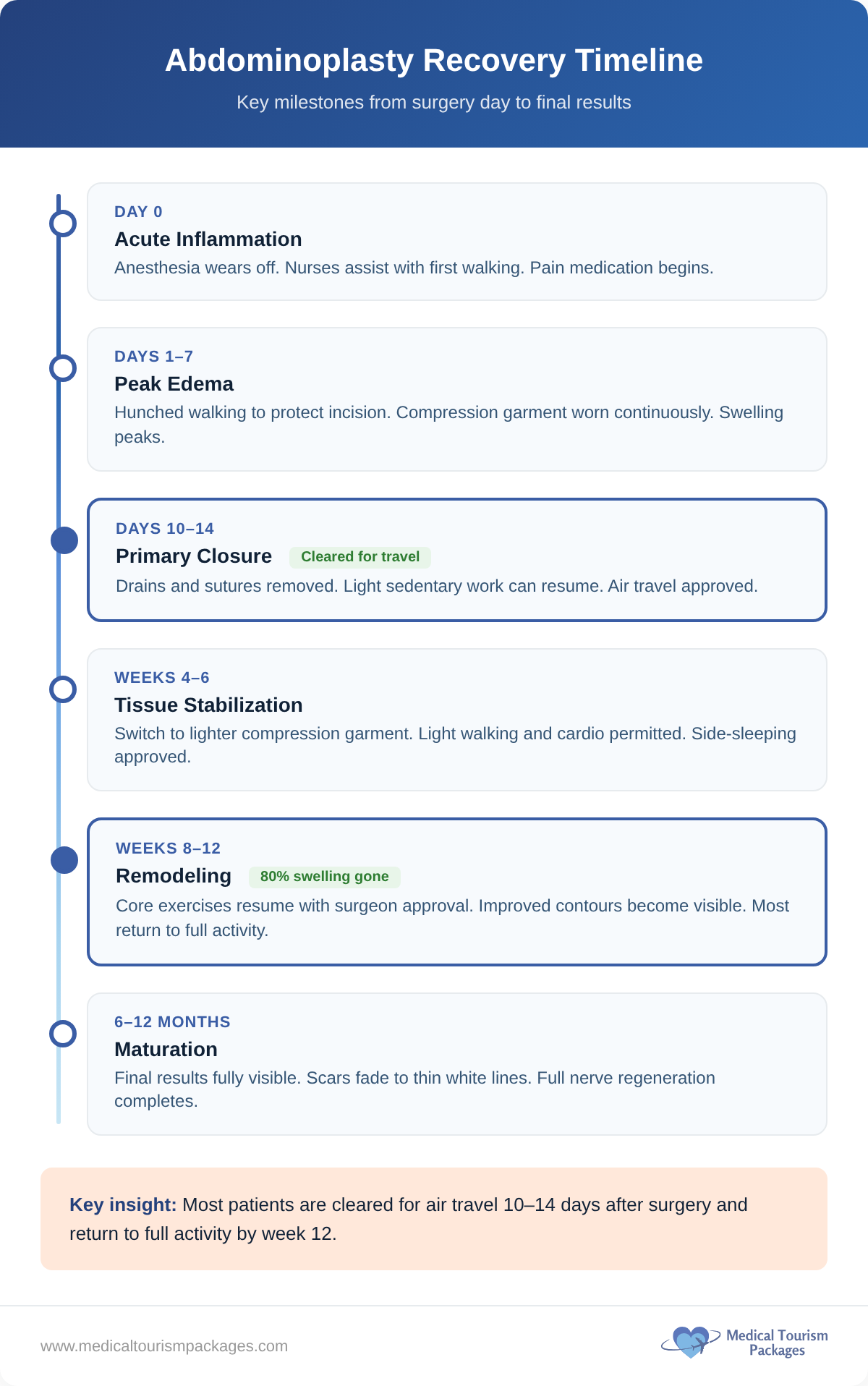
Recovery from abdominoplasty follows a predictable timeline. Specific milestones mark your return to normal activities. The table below outlines what to expect during each phase of healing.
| Recovery Phase | What to Expect |
|---|---|
| Day 0 (Acute Inflammation) | Grogginess from anesthesia wears off over several hours. Nurses assist with first attempts at walking to promote circulation. This prevents blood clots. Pain medication begins immediately. |
| Days 1-7 (Peak Edema) | Walking in a hunched position protects the incision. It reduces tension on healing tissues. Surgical drains (if placed) require emptying and monitoring. Compression garment must be worn continuously except during showers. Swelling peaks during this period. |
| Days 10-14 (Primary Closure) | Drains and non-dissolvable sutures are removed during follow-up appointments. Surgeons typically clear patients for air travel at this stage. Light sedentary work can resume. Physical limitations continue. |
| Weeks 4-6 (Tissue Stabilization) | Transition to a lighter compression garment with reduced support. Light cardiovascular exercise like walking becomes permissible. Side-sleeping receives approval. Most patients still prefer back-sleeping for comfort. |
| Weeks 8-12 (Remodeling) | Core-strengthening exercises and abdominal workouts can gradually resume with surgeon approval. Approximately 80% of swelling has resolved. This reveals improved contours. Most patients return to unrestricted physical activity. |
| 6-12 Months (Maturation) | Final surgical results become fully apparent as residual swelling completely subsides. Scars fade from pink or red to thin white lines. Full nerve regeneration occurs in areas that experienced temporary numbness. |
When Can You Fly Home After Abdominoplasty?
You can fly home 10-14 days after surgery. Surgeons mandate this minimum stay before clearing patients for air travel. This waiting period reduces the risk of deep vein thrombosis and pulmonary embolism. These are serious complications. They can occur when reduced mobility from surgery combines with the pressurized cabin environment. When you fly home, wear medical-grade compression stockings on your legs. Maintain aggressive hydration throughout the flight. Perform in-seat calf exercises every 30-60 minutes. Request an aisle seat so you can walk every hour.
How Safe Is Abdominoplasty in Mexico?
Abdominoplasty at accredited Mexican facilities is safe. Complication rates equal or beat US national benchmarks. This safety profile reflects rigorous screening medical tourists undergo before traveling. The “Healthy Traveler Effect” means international patients are typically pre-screened more carefully. They are checked for cardiovascular fitness, smoking cessation, and stable weight. This is more thorough than domestic patients who schedule procedures locally. However, safety depends entirely on choosing CMCPER-certified surgeons. They must operate in JCI-accredited or equivalent facilities.
| Facility Type | Overall Complication | Major Infection | DVT/Pulmonary Embolism | Surgical Re-intervention | Abdominoplasty-Specific |
|---|---|---|---|---|---|
| Mexican Accredited Clinics | 6.0–6.5% | 2.0–4.0% | <1.0% | 5.0% | 6.0% |
| US National Benchmarks | 10.0–10.5% | 2.5–5.0% | <1.0% | 6.2% | 10.0% |
Mexican accredited facilities report lower overall complication rates compared to US national averages. Infection rates fall within comparable ranges. DVT and pulmonary embolism risks remain below 1% in both countries when proper protocols are followed. Surgical re-intervention needs occur slightly less frequently in Mexican accredited centers. These statistics apply only to board-certified surgeons working in properly accredited facilities. They do not apply to the broader medical tourism market. This includes unregulated providers.
What Are the Advantages of Getting Abdominoplasty in Mexico?
Mexico offers medical tourists several distinct advantages. These combine cost savings with high-quality surgical care. Key benefits make Mexico an attractive destination for abdominoplasty:
- Significant cost savings of 40-70% compared to the United States and Canada. Standard tummy tucks cost $3,500-$6,000 versus $8,000-$15,000 or more domestically.
- CMCPER board-certified surgeons who complete 6-7 years of surgical residency. They maintain credentials through mandatory continuing education every five years. Many have additional training from US and European institutions.
- JCI-accredited hospitals like Hospital Galenia in Cancun and Hospital de la Familia in Mexicali. These meet international safety and quality standards. They equal top American medical centers.
- Recovery boutique infrastructure unique to Mexico. These provide around-the-clock licensed nursing care. They offer hospital-grade beds and specialized nutrition. Professional monitoring of vital signs and drain output occurs during the critical healing period.
- Advanced surgical techniques including Lipo 360 for full torso contouring. Progressive muscle plication methods create athletic definition rather than simply flat results.
- Geographic proximity to the US border, particularly in Tijuana. This allows patients to drive across for surgery. They avoid international flight complications during the immediate post-operative period.
- Lower complication rates at accredited Mexican facilities (6.0% overall) compared to US national benchmarks (10.0%). This reflects rigorous patient screening and experienced surgical teams.
- All-inclusive packages that bundle surgeon fees, anesthesia, hospital charges, compression garments, medications, airport transfers, and recovery facility stays. These create transparent single-price quotes.
What Are the Disadvantages of Getting Abdominoplasty in Mexico?
Medical tourism for abdominoplasty in Mexico presents several challenges. You must consider these before committing to surgery. Understanding these limitations helps you make an informed decision:
- Extended stay requirements of 10-14 days minimum before surgeons clear patients for air travel. This prevents deep vein thrombosis and pulmonary embolism risks. These are associated with flying after major surgery.
- Distance from home support during the critical early recovery period. Family and friends cannot provide hands-on assistance with daily activities. They cannot provide emotional support.
- Potential language barriers with nursing staff at recovery facilities. Most surgeons and coordinators speak English. Communication gaps can occur during overnight care shifts.
- Limited legal recourse compared to US malpractice options. Mexican consumer protection laws differ significantly from American medical liability standards. Cross-border litigation proves extremely difficult.
- Risk of choosing unaccredited facilities if credentials are not properly vetted. Unregulated clinics operating in residential areas carry significantly higher complication rates. These include infection and inadequate emergency response.
- Virtual follow-up care coordination requirements with your home doctor. This is needed for the 8-12 weeks following surgery. It necessitates proactive communication between your Mexican surgeon and domestic physician. This matters if complications arise.
- Complex travel logistics including coordinating time off work. You must arrange accommodations. You must book flights around recovery timelines. You must manage all aspects of international medical travel independently.
Is Abdominoplasty in Mexico Right for You?
Mexico’s value proposition for abdominoplasty extends beyond simple cost savings. It offers access to a higher standard of care than many patients could afford domestically. JCI-accredited hospitals offer dedicated recovery boutiques. These have around-the-clock nursing supervision. Surgeons employ advanced techniques. This represents better-tailored care rather than merely cheaper surgery. Patients who use Mexico’s 40-70% cost advantage can invest in complete packages. These include professional post-operative support and surgical innovations.
Success depends entirely on patient due diligence. Verify your surgeon’s CMCPER certification directly through the official database. Choose facilities with JCI accreditation. Research your surgeon’s experience with your specific procedure type. Avoid clinics offering prices below $2,500. Avoid those refusing to disclose staff credentials. Avoid those employing high-pressure sales tactics. Following the prescribed recovery timeline respects the biological reality of major surgery. Adherence to activity restrictions directly impacts your final results. Patients who approach abdominoplasty in Mexico with thorough research achieve excellent outcomes. Appropriate planning and dedication to proper healing consistently justify the investment.
How long should I stay in Mexico after abdominoplasty?
You should stay 10-14 days after abdominoplasty before flying home. Simple procedures like mini tummy tucks need 10 days. Full and extended procedures need 14 days. This allows suture removal and initial healing before flight. American and Canadian citizens do not need a visa for stays up to 180 days.
Are Mexican hospitals accredited to international standards?
Yes, Mexico has multiple JCI-accredited hospitals. Joint Commission International (JCI) is the same standard used by top US hospitals. Hospital Galenia in Cancun maintains JCI accreditation. Hospital de la Familia in Mexicali holds Consejo de Salubridad General accreditation. This is Mexico’s equivalent to JCI. These hospitals meet the same patient safety standards as US medical centers.
Do Mexican plastic surgeons speak English?
Yes, most specialized plastic surgeons in Mexico are fluent in English. Board-certified surgeons at JCI-accredited facilities in Tijuana, Cancun, and Mexico City speak English fluently. International patient coordinators communicate clearly throughout your treatment journey. This removes the language barriers that complicate medical tourism in many other countries.
What happens if I have complications after returning home?
Leading Mexican plastic surgeons work with your domestic primary care physician. They ensure seamless postoperative follow-up after you return home. Many surgical packages include telemedicine follow-up appointments. You can contact your surgeon directly for postoperative concerns. Obtain a full copy of your operative report before leaving Mexico.
Is it safe to fly after abdominoplasty?
Yes, it is safe to fly after the recommended waiting period. Surgeons recommend a 10-14 day stay before flying home. Cabin pressure changes and blood clot risks require adequate healing before flight. Your surgeon will clear you for flight after verifying healing progress. Wear compression stockings during the flight to reduce swelling.
What training do Mexican plastic surgeons have?
Mexican plastic surgeons are board-certified specialists with extensive fellowship training. They complete a six-year medical degree followed by a four-year general surgery residency. After residency, they pursue additional training specifically in plastic surgery. Fellowship training often occurs at premier US or top Latin American institutions. They are members of AMCPER and hold CMCPER certification.
Ready to Start Your Abdominoplasty Journey in Mexico?
Medical Tourism Packages coordinates your entire abdominoplasty journey in Mexico. We connect you with JCI-accredited hospitals, arrange your travel and accommodations, and provide bilingual support throughout your treatment. Get a free consultation to discuss your body contouring goals and receive a personalized quote.
Contact us today to start planning your affordable abdominoplasty in Mexico.