Book Appointment Now



Spine Surgery in Panama: Costs, Top Hospitals, Safety, and Recovery
 By
By
Spine surgery in Panama costs 70–85% less than in the US at JCI-accredited hospitals in Panama City.
Spinal fusion in Panama costs $15,000 versus $115,000 in the US. Hospital Punta Pacifica, Hospital San Fernando, and The Panama Clinic are Panama City’s top three spine centers. All three sit in the Punta Pacifica and San Fernando medical corridors. Procedures include minimally invasive discectomy, robotic-assisted fusion, and artificial disc replacement.
Our network connects you with fellowship-trained spine surgeons at facilities verified for JCI or TEMOS accreditation. This guide covers procedure types, cost comparisons, top hospitals, surgeon qualifications, and your step-by-step journey from remote consultation to recovery.
What Is Spine Surgery in Panama?
Spine surgery in Panama covers the full range of spinal procedures at JCI-accredited hospitals in Panama City. Procedures include minimally invasive decompression, spinal fusion, and artificial disc replacement. Over the past two decades, Panama has become a serious destination for complex spinal care. This growth comes from deliberate investment in advanced surgical infrastructure and internationally trained specialists.
Many of Panama’s leading spine surgeons completed fellowship training in the United States and Europe. They returned with Western clinical protocols they apply directly in Panama City’s top hospitals. For international patients, dedicated international patient offices manage scheduling and records. They coordinate everything from the first remote consultation through discharge. Bilingual staff are available throughout your stay.
Panama uses the US dollar. This means no foreign exchange and no currency risk for US patients. Read our comprehensive guide for American medical tourists in Panama for more planning tips.
What Types of Spine Surgery Are Available in Panama?
Panama’s top hospitals treat the full range of spinal conditions. These include disc herniation, spinal stenosis, degenerative disc disease, spondylolisthesis, and vertebral compression fractures. Minimally invasive spine surgery (MISS) is the dominant approach in Panama City. It uses small incisions and specialized retractors to access the spine. This causes minimal disruption to surrounding muscle and tissue. Compared to traditional open surgery, MISS results in less post-operative pain, shorter hospital stays, and faster recovery.
What Minimally Invasive Spine Procedures Are Offered in Panama?
Panama City’s leading hospitals offer five core spinal procedures. Each is performed using minimally invasive techniques where clinically appropriate.
Procedure Technique Highlights Inpatient Stay Full Recovery Spinal Fusion TLIF/ALIF; pedicle screw-and-rod fixation; bone graft or interbody cage 2–4 nights 6–12 months Microdiscectomy Incision under 3cm; microscope or endoscope; fragment removal only Same day or 1 night 4–8 weeks Laminectomy Unilateral laminotomy for bilateral decompression; midline structures preserved 1–2 nights 6–12 weeks Artificial Disc Replacement Motion-preserving prosthetic; FDA and MINSA approved; cervical and lumbar 1–2 nights 6–12 weeks Kyphoplasty Balloon tamp restores vertebral height; PMMA cement injection; percutaneous Same day 2–4 weeks
Is Robotic-Assisted Spine Surgery Available in Panama?
Yes, robotic-assisted and navigated spine surgery is available in Panama. Hospital Punta Pacifica uses StealthStation navigation for real-time pedicle screw guidance. The Panama Clinic is equipped with the HUGO RAS robotic platform. Intraoperative neuromonitoring (IONM) tracks spinal cord and nerve root integrity in real time. It is standard practice at all JCI-accredited hospitals in Panama. These are the same platforms and protocols used at top US spine centers.
How Much Does Spine Surgery Cost in Panama?
Panama hospitals offer all-in bundled pricing that covers the surgeon fee, anesthesiologist, OR time, implants, hospital stay, and initial physiotherapy. This differs from the fragmented billing common in the US. In the US, facility fees, surgeon fees, and implant charges arrive as separate invoices. Law 419 of February 2024 created the National Medicines Observatory. This monitors hardware pricing to protect international patients from overcharges. Savings range from 70–85% depending on the procedure.
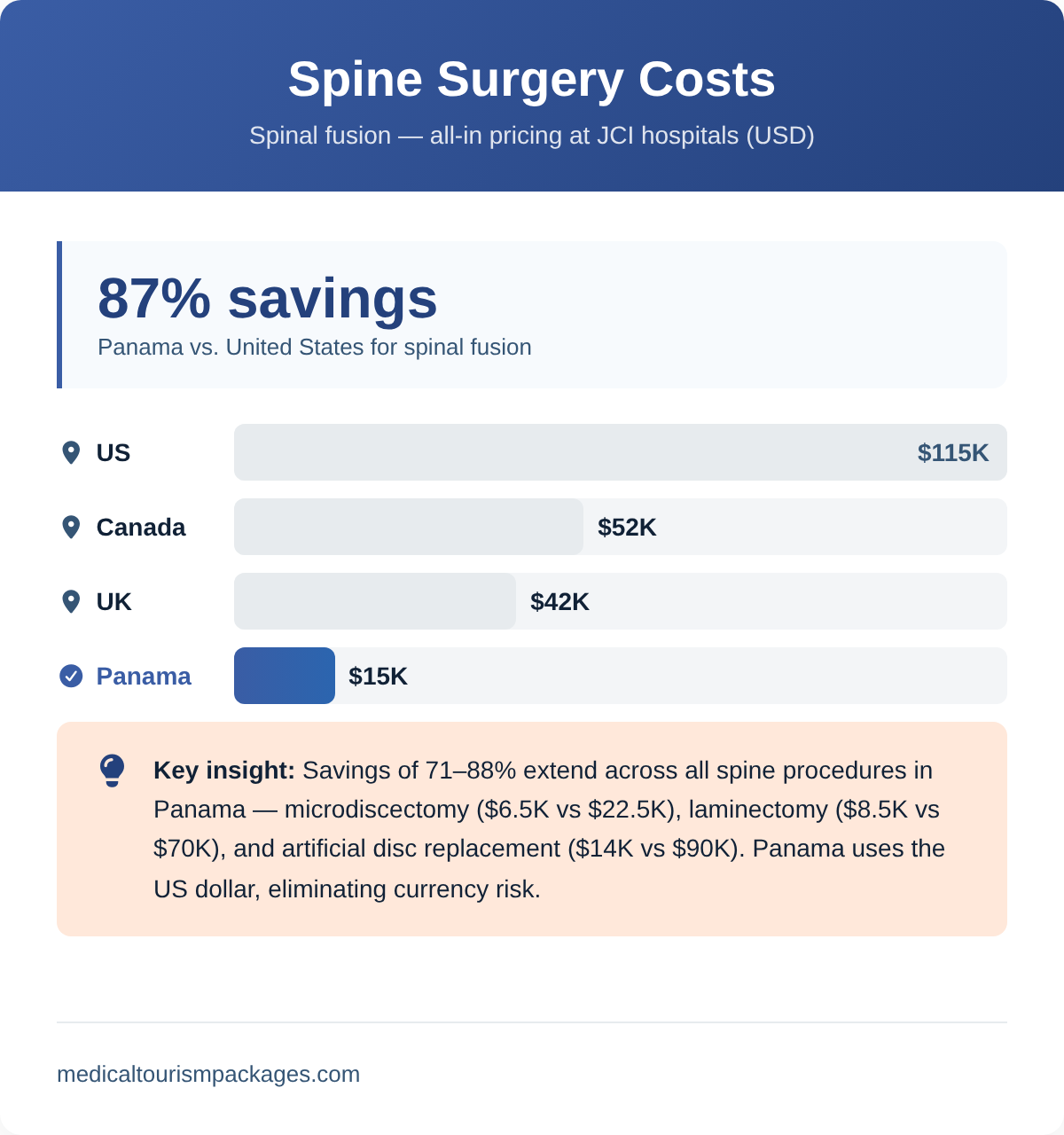
Procedure Panama United States Canada (Private) United Kingdom (Private) Spinal Fusion $15,000 $115,000 $52,000 $42,000 Microdiscectomy $6,500 $22,500 $18,250 $12,000 Laminectomy $8,500 $70,000 $27,000 $14,500 Artificial Disc Replacement $14,000 $90,000 $36,500 $31,000 Kyphoplasty $6,500 $27,500 $25,000 $17,500
What Should Medical Tourists Budget for Beyond the Surgery?
Beyond the surgical bundle, plan for these additional costs in Panama City and surrounding districts:
- Round-trip flights: $200–$600 from Miami; $400–$900 from other major US cities
- Recovery accommodation: Punta Pacifica $150–$300/night; San Francisco district $80–$150/night; El Cangrejo $60–$120/night — budget a minimum of 14 nights for fusion or ADR
- Outpatient physiotherapy: $25–$60 per session in Panama vs. $150–$300 in the US; expect 3–5 sessions per week during in-country recovery
What Are the Best Hospitals for Spine Surgery in Panama?
Panama City’s spine surgery market is concentrated in three private hospitals. Each has distinct clinical strengths and international credentials. Hospital Punta Pacifica is the only hospital in Central America affiliated with Johns Hopkins Medicine International. It has been JCI-accredited since 2011, with its fifth reaccreditation completed in 2023. It houses a dedicated neuro-spine unit with StealthStation navigation. Hospital San Fernando was the first JCI-accredited hospital in Panama, also since 2011. It offers remodeled long-stay recovery suites and affiliations with Tulane Medical Center and Baptist Health South Florida. The Panama Clinic is a TEMOS-accredited member of the Mayo Clinic Care Network. It houses the COPAC dedicated spine center and the HUGO RAS robotic surgical platform.
Hospital Accreditation Spine Unit Robotic/Nav International Patient Office Hospital Punta Pacifica JCI + JHM Affiliate Dedicated StealthStation Yes Hospital San Fernando JCI Integrated None Yes The Panama Clinic TEMOS + Mayo Network Dedicated (COPAC) HUGO RAS Yes
What Accreditations Should Patients Look For?
When evaluating any Panama hospital, these accreditations are the most reliable indicators of safety and quality.
- JCI: Global benchmark for hospital safety — held by Hospital Punta Pacifica and Hospital San Fernando since 2011
- TEMOS: International patient safety accreditation — held by The Panama Clinic
- Johns Hopkins Medicine International affiliation: The only such affiliation in Central America, at Hospital Punta Pacifica in Panama City
- Mayo Clinic Care Network membership: Held by The Panama Clinic
- MINSA registration: Panama’s Ministry of Health operating license — verify via Panama’s public health registry
See our guide to surgical procedures in Panama for more details on facility standards across all specialties.
Is Spine Surgery in Panama Safe?
Yes, spine surgery in Panama is safe at JCI-accredited hospitals, and the outcomes data supports this. Operating theaters use HEPA filtration. Surgical instruments are digitally tracked through sterilization cycles. Perioperative antibiotic protocols are strictly observed. These are standard practice, not exceptional measures.
Panama’s lower infection rates compared to the US come from three factors. First, minimally invasive techniques are the dominant approach. Second, surgeries take place in specialized orthopedic hospitals rather than general hospitals. This reduces infection risk from 2.03% to 1.31%. Third, preoperative skin decolonization protocols are standard across all top Panama City centers.
Outcome Metric Panama Top Centers US National Average Overall SSI Rate 1.1%–1.6% 2.1% Deep SSI Rate 0.7%–0.9% 1.3% 10-Year Implant Survival 94%–96% 95% 1-Year Revision Rate 2.5%–4.0% 4.7%
What Training Do Panama’s Spine Surgeons Have?
Panama’s spine surgeons train to a directly comparable standard as their US and EU counterparts.
Qualification Parameter Panama Standard US/EU Equivalent Primary Specialty Training Orthopedic or neurosurgery residency; registered with ANMEP Board certified or board eligible Subspecialty Fellowship 1–2 year spine fellowship, frequently completed in the US or Europe Fellowship trained Professional Body Sociedad Panameña de Ortopedia y Traumatología Fellow of ACS / AANS / AAOS Senior Designation FACS or FRCSC — requires peer-reviewed clinical excellence Fellow of ACS or FRCS Language Proficiency Bilingual English/Spanish at international patient units Varies
JCI-accredited facilities in Panama City employ fellowship-trained spine surgeons. Most completed their fellowship training in the United States or Europe. All spine surgeons practicing at international patient units are bilingual. Surgeons are members of the Sociedad Panameña de Ortopedia y Traumatología and international professional societies.
What Does the Spine Surgery Journey Look Like in Panama?
The spine surgery journey in Panama follows a structured pathway. It runs from remote consultation through to post-operative clearance before flying home.
Can You Consult and Share Imaging Before Traveling?
Yes, you can consult and share imaging before you travel to Panama. Panama’s leading hospitals accept DICOM files via secure patient portals. DICOM is the standard format for MRI and CT scan data. The surgical team reviews your imaging and returns a formal opinion within 48–72 hours. A 30–60 minute video consultation follows. It covers your diagnosis, surgical plan, expected outcomes, and an all-inclusive quote. For complex revision cases, Hospital Punta Pacifica’s Johns Hopkins Medicine International affiliation enables real-time consultation with specialists in Baltimore. By the time you travel, your surgeon already knows your case fully.
What Is the In-Country Timeline from Arrival to Departure?
A typical spinal fusion trip runs 18–21 days from arrival to departure in Panama City.
Stage Duration Primary Activity Arrival and Pre-Op 1–2 days Final labs, physical exam, pre-anesthesia assessment Surgery 1 day OR and PACU recovery; mobilization begins within 24 hours Acute Hospitalization 2–4 nights Pain management, wound monitoring, early PT Outpatient Recovery 10–14 days Recovery hotel, wound checks, PT 3–5x per week Final Follow-Up 1 day Suture removal, fit-to-fly clearance from surgeon
What Visa Requirements Apply to Medical Tourists Visiting Panama?
Most medical tourists do not need a visa to enter Panama. US and Canadian citizens can enter without a visa for stays up to 180 days. UK citizens can stay up to 90 days without a visa. All nationalities need a passport valid for at least 6 months. You also need a return ticket and proof of $500 in economic solvency at entry. A credit card satisfies the solvency requirement.
What Is Recovery Like After Spine Surgery in Panama?
Recovery after spine surgery in Panama follows a structured in-country phase. Plan for 10–14 days in-country after microdiscectomy or kyphoplasty. Plan for 14–21 days after fusion or ADR. Physiotherapy begins within 24–48 hours of surgery. Early mobilization reduces the risk of deep vein thrombosis (DVT) and speeds up recovery of functional movement. The rehabilitation protocol aligns with American Physical Therapy Association (APTA) guidelines. Outpatient PT in Panama City costs $25–$60 per session, compared to $150–$300 in the US.
Fit-to-fly clearance depends on your destination. Short-haul clearance to Miami or Houston is typically issued at 2–4 weeks. Long-haul clearance to London or Vancouver requires 6–8 weeks. This minimizes DVT and pulmonary embolism risk on long flights. Once home, telehealth follow-up continues monthly through Week 12. Direct surgeon contact via WhatsApp or email is standard practice. Ninety-five percent of international patients report high satisfaction with virtual follow-up protocols.
How Do You Choose the Right Spine Surgeon in Panama?
Choosing the right surgeon requires concrete verification steps, not just reviews. Before committing to a procedure, work through this checklist to confirm the key credentials that matter most for your safety.
- Verify ANMEP registration. ANMEP is Panama’s national registry of licensed healthcare professionals. Confirm your surgeon holds a valid license in their declared specialty. If they are not listed, do not proceed.
- Confirm JCI or TEMOS accreditation at the facility. These are the two internationally recognized standards for hospital safety. All three of Panama’s top spine hospitals hold one or both.
- Confirm MINSA-approved implants. Under Law 419 of February 2024, MINSA-approved implants meet the same manufacturing standards as FDA-cleared devices. Approved brands include Medtronic, DePuy Synthes, Stryker, and NuVasive.
- Ask the right questions during your virtual consultation. Ask about fellowship training location, annual surgical volume, and implant systems used. An experienced surgeon will answer without hesitation.
International patients consistently find Panama’s surgical teams more accessible than those at home. Direct surgeon communication via WhatsApp or email is standard rather than the exception. Arrange ground transport through your hospital’s international patient office in Panama City before arrival.
For more guidance on orthopedic care in Panama, see our complete guide to orthopedic surgery in Panama.
What Are the Advantages and Disadvantages of Spine Surgery in Panama?
Panama offers a strong case for medical tourists seeking spine surgery abroad, but it also has practical trade-offs. Understanding both sides clearly will help you make the right decision.
What Are the Advantages of Spine Surgery in Panama?
The main advantages are significant cost savings, top accreditation standards, and easy access from North America.
- 70–85% cost savings vs. the US — driven by lower operational costs, not lower clinical standards
- JCI-accredited facilities — meeting the same patient safety benchmarks as top US and European hospitals
- Johns Hopkins Medicine International affiliation — the only such affiliation in Central America, at Hospital Punta Pacifica in Panama City
- Fellowship-trained, English-speaking surgeons — trained in the US or Europe; bilingual staff at all JCI hospitals
- Sea-level altitude — no acclimatization required; eliminates post-operative inflammation risk associated with high-altitude destinations like Bogotá or Mexico City
- US dollar economy — no foreign exchange required; full price transparency for US patients
- Short travel time — 2.5–5 hour flights from major US cities
What Are the Disadvantages of Spine Surgery in Panama?
The main disadvantages are the required minimum stay and cross-border follow-up logistics.
- Minimum 14–21 day stay required — fusion and ADR patients cannot safely fly home sooner; this is a firm clinical requirement
- Cross-border follow-up logistics — requires active coordination between your Panamanian surgical team and your home physician
- Slightly higher absolute cost than Colombia or Thailand — Panama’s advantages in proximity, language, and currency come at a modest premium
Is Panama the Right Choice for Your Spine Surgery?
Panama is the strongest single option for North American patients seeking spine surgery abroad. JCI accreditation, a Johns Hopkins Medicine International affiliation, sea-level altitude, US dollar pricing, and 70–85% cost savings combine in a way no other regional destination matches. The same generation of Medtronic, DePuy Synthes, Stryker, and NuVasive hardware used in US operating rooms is available in Panama. Law 419’s regulatory guarantee means patients are not trading quality for cost.
Panama is not the right choice for everyone. Patients who cannot commit to 14–21 days abroad should explore domestic options first. The same applies to those with complex conditions requiring continuity with a local specialist team. For appropriate candidates, the path forward is clear. Digitize your imaging in DICOM format. Identify a JCI-accredited hospital in Panama City with a dedicated international patient office. Initiate a remote consultation. Most Panama hospitals return a surgical opinion within 48–72 hours at no cost.
What Questions Do Medical Tourists Ask Most Often About Spine Surgery in Panama?
You should stay 10–14 days after microdiscectomy or kyphoplasty before flying home. After spinal fusion or artificial disc replacement, plan for 14–21 days in-country. This allows for suture removal, wound checks, and fit-to-fly clearance from your surgeon. US and Canadian citizens do not need a visa for stays up to 180 days in Panama.
Yes, Panama has multiple internationally accredited hospitals. Hospital Punta Pacifica and Hospital San Fernando both hold JCI accreditation since 2011. JCI is the same standard used by top US hospitals. The Panama Clinic holds TEMOS accreditation, which focuses specifically on international patient safety. Hospital Punta Pacifica also maintains the only Johns Hopkins Medicine International affiliation in Central America.
Yes, most specialized spine surgeons at Panama City’s JCI-accredited hospitals are fluent in English. Many completed their fellowship training in the United States or Europe. International patient coordinators also communicate in English throughout your treatment journey. This removes the language barriers common in medical tourism in many other countries.
Panama’s leading spine surgeons work directly with your home primary care physician. They coordinate seamless postoperative follow-up after you return. Hospital Punta Pacifica’s Johns Hopkins Medicine International affiliation creates pathways for high-level consultation in rare cases of complications. Many surgical packages include monthly telehealth follow-up through Week 12. You can contact your surgeon directly via WhatsApp or email for any postoperative concerns.
Yes, it is safe to fly after the recommended waiting period. For short-haul flights to Miami or Houston, surgeons issue clearance at 2–4 weeks. For long-haul flights to London or Vancouver, clearance requires 6–8 weeks. This waiting period minimizes the risk of deep vein thrombosis and pulmonary embolism. Your surgeon will clear you for flight after verifying your healing progress.
Panama spine surgeons are board-certified specialists with extensive fellowship training. They complete a medical degree followed by an orthopedic or neurosurgery residency. They then register with ANMEP, Panama’s national licensing body. After residency, they pursue a 1–2 year spine fellowship. This is frequently completed at premier centers in the United States or Europe. Many hold FACS or FRCSC designations and are members of the Sociedad Panameña de Ortopedia y Traumatología.
Medical Tourism Packages coordinates your entire spine surgery journey in Panama. We connect you with fellowship-trained spine surgeons at JCI-accredited facilities in Panama City, arrange your travel and accommodations, and provide bilingual support throughout your treatment. Get a free consultation to discuss your spine health goals and receive a personalized quote. Contact us today to start planning your affordable spine surgery in Panama.
How long should I stay in Panama after spine surgery?
Are Panama hospitals accredited to international standards?
Do Panama spine surgeons speak English?
What happens if I have complications after returning home?
Is it safe to fly after spine surgery in Panama?
What training do Panama spine surgeons have?
Ready to Start Your Spine Surgery Journey?