Book Appointment Now

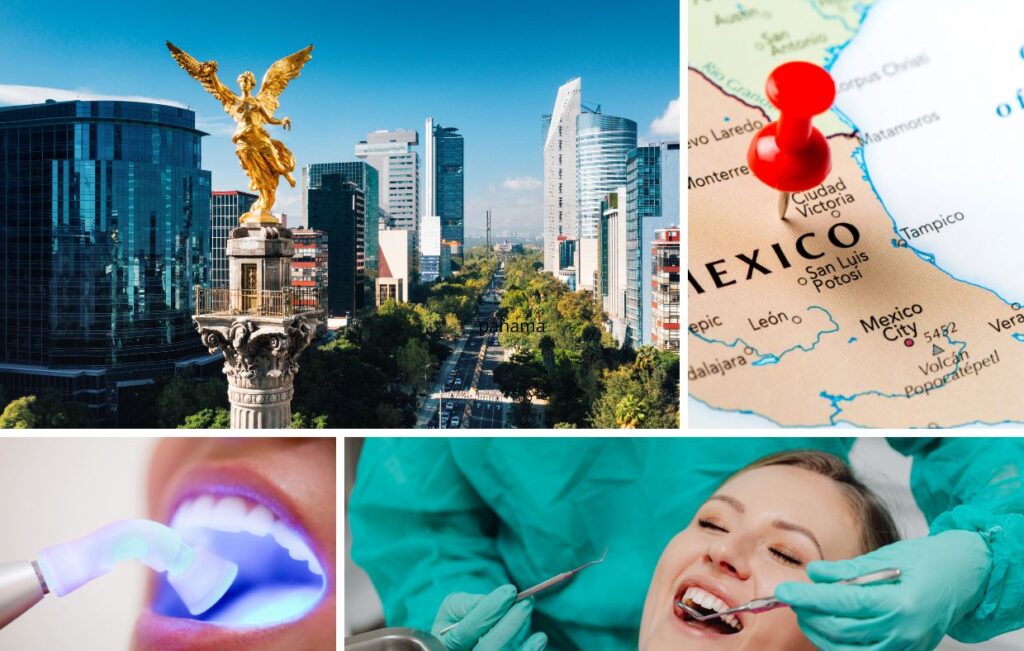
Smile Correction in Mexico: Costs, Procedures, and Complete Medical Tourism Guide
 By
By
Smile correction in Mexico saves patients 50% to 80% compared to US prices.
Mexico handles 25% of the global dental tourism market as of 2025. Patients save $5,000 to $20,000 on veneers, implants, and full smile makeovers using FDA-approved materials available in Tijuana, Cancun, and Los Algodones.
This guide covers procedure types, costs, clinic selection, and safety standards. It also covers trip planning logistics for cities including Guadalajara and Los Cabos. Use it to make informed decisions about smile correction in Mexico.
What Is Smile Correction?
Smile correction is a complete dental treatment that improves both the look and function of your teeth. Unlike traditional single-procedure dentistry, this method fixes multiple issues at once. It addresses tooth alignment, discoloration, damaged teeth, missing teeth, and your gum line. The result is a smile that fits your facial features naturally.
The process involves three types of specialists. Prosthodontists design dental restorations. Periodontists manage gum health. Maxillofacial surgeons handle complex jaw or bone cases. Mexican dental clinics have refined the “Smile Makeover” model for medical tourists. Dentists study your facial structure to design a smile that looks natural when you speak and rest.
Considering dental implants as part of your makeover? Our guide to dental implants covers costs, brands, and what to expect. For trip planning help, visit our medical tourism in Mexico guide. You can also explore our smile correction and orthodontics service page for package options.
What Types of Smile Correction Procedures Are Available in Mexico?
Mexican dental clinics offer everything from minor cosmetic work to full mouth rehabilitation. Costs run 50% to 80% less than in North American facilities. The table below compares typical pricing for the most common smile correction procedures.
| Procedure Type | Mexico Cost | USA Cost | Canada Cost | Savings % |
|---|---|---|---|---|
| Porcelain Veneers (per tooth) | $350–$600 | $900–$2,500 | $800–$2,000 | 60%–76% |
| Zirconia Crowns | $300–$680 | $1,000–$2,500 | $900–$2,200 | 70%–78% |
| Single Dental Implant | $750–$1,500 | $3,000–$6,000 | $2,500–$5,000 | 70%–75% |
| All-on-4 (per arch) | $6,998–$12,000 | $15,000–$32,000 | $15,000–$28,000 | 41%–61% |
| Traditional Metal Braces | $1,000–$2,500 | $3,000–$7,000 | $3,000–$7,000 | 64%–67% |
| Clear Aligners (Invisalign) | $2,500–$4,800 | $5,000–$8,500 | $5,000–$8,500 | 38%–50% |
| Full Smile Makeover (10 units) | $3,500–$6,000 | $10,000–$25,000 | $9,000–$22,000 | 65%–75% |
Veneers and crowns use premium ceramics including IPS e.max and Zirconia grades like Prettau Zirconia and Ivoclar Vivadent. These materials mimic the light-reflecting properties of natural tooth enamel. Mexican clinics use CAD/CAM technology to mill crowns and veneers with sub-millimeter precision. This ensures a perfect fit that prevents secondary decay. Many clinics in Tijuana and Cancun complete veneer and crown cases in 5 to 10 days. That makes them ideal for medical tourists on tight schedules.
Dental implants are the most requested procedure among medical tourists. Mexican clinics use FDA-approved brands including Nobel Biocare, Straumann, and Neodent. These titanium posts join with your jawbone through osseointegration. This process requires 4 to 6 months of healing between implant placement and final crown attachment. Success rates at accredited Mexican facilities range from 95% to 98%. Clinics use 3D Cone Beam CT scanning to map your bone density and nerve pathways before surgery. The All-on-4 technique replaces a full arch of teeth using just four implants. This reduces both cost and recovery time.
For orthodontic treatment, your options break down like this:
- Traditional metal braces — Cost $1,000 to $2,500 in Mexico vs. $3,000 to $7,000 in the US. Require adjustments every 4 to 8 weeks. Best for patients near the border, such as those in Arizona, California, or Texas.
- Clear aligners (Invisalign) — Cost $2,500 to $4,800. Require fewer in-person visits. Best option for medical tourists who cannot travel frequently.
Why Choose Mexico for Smile Correction?
Mexico is the leading dental tourism destination in the Western Hemisphere. The main draw is large cost savings without any drop in clinical quality. These savings come from lower operating costs, reduced labor costs, and lower real estate prices. Professional liability insurance premiums are also much lower in Mexico. These factors allow clinics to offer competitive pricing while keeping top facilities.
Mexican dental clinics have invested heavily in advanced technology. Many surpass what North American practices offer. Top facilities feature 3D CBCT scanners, laser dentistry equipment, and in-house CAD/CAM milling centers that produce same-day restorations. Tijuana, Los Algodones, and Cancun are all easy to reach by direct flight or short border crossing. Many medical tourists report more personal attention than they received at high-volume practices back home. Dentists spend more time on consultations and explaining treatment options.
Which Mexican Cities Are Best for Dental Tourism?
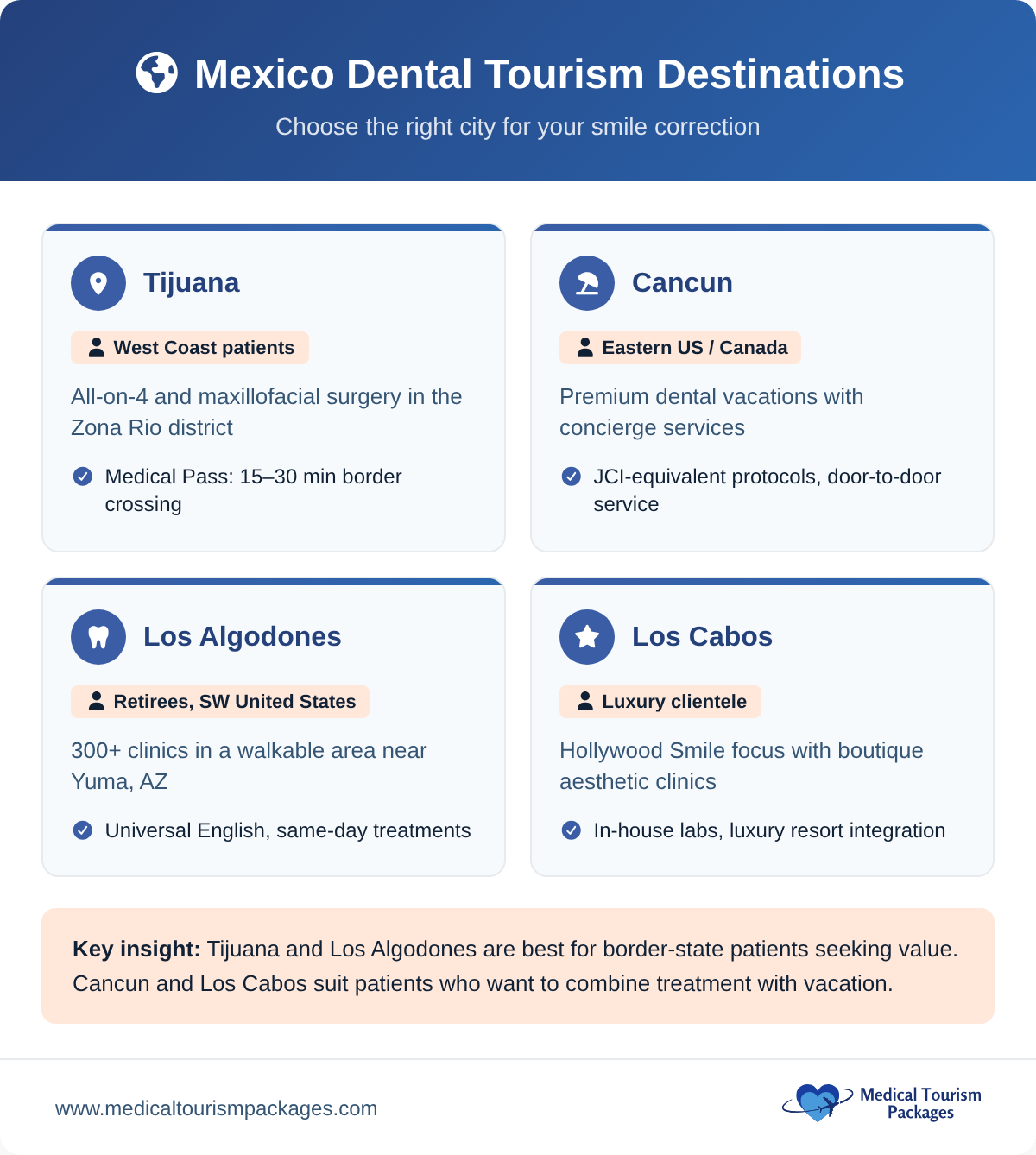
The top cities for dental tourism in Mexico are Tijuana, Cancun, Los Algodones, Los Cabos, Mexico City, and Guadalajara. Each offers different strengths based on your needs, travel preferences, and budget. The table below shows the key traits of each major destination.
| City | Specialization | Top Clinics | Best For | Key Features |
|---|---|---|---|---|
| Tijuana | All-on-4, maxillofacial surgery | Multiple accredited clinics in Zona Río district | West Coast patients | Medical Pass for 15–30 minute border crossing |
| Cancun | Premium dental vacations | Internationally accredited vacation-dental clinics | Eastern US/Canada patients | JCI-equivalent protocols with door-to-door services |
| Los Algodones | High-volume, cost-efficient care | 300+ clinics, many ADA-recognized | Retirees, Southwestern US | Walkable area with universal English proficiency |
| Los Cabos | High-end aesthetic dentistry | Boutique aesthetic clinics with in-house labs | Wealthy clientele | Hollywood Smile focus with luxury resort integration |
| Mexico City / Guadalajara | Academic excellence | University-affiliated and top-rated urban clinics | Patients seeking top credentials | University-trained practitioners with robotic surgery |
Tijuana has evolved into a sophisticated medical hub. Modern dental clinics in the Zona Río district resemble high-end San Diego practices. The city’s proximity to the US border makes it ideal for patients who can drive across for treatment. Many clinics provide patients with a Medical Pass. This grants access to dedicated border lanes. Wait times drop from several hours to about 15 to 30 minutes when returning to the United States.
Cancun represents the premium end of the market. It attracts patients who seek to combine dental work with a vacation experience. The city’s infrastructure caters to medical tourists. Concierge services include airport pickup, resort transportation, and coordination of local tours during recovery days. Recovery-oriented hotels offer air-conditioned rooms, quiet atmospheres, and staff trained to prepare soft meals.
Los Algodones highlights:
- Located just across the border from Yuma, Arizona
- Houses over 300 dental clinics in a small walkable area
- Functional and clinical atmosphere — most patients return to the US the same day or within 48 hours
- Near-universal English proficiency among dentists and support staff
How Do You Choose a Qualified Dental Clinic in Mexico?
Selecting a reputable dental clinic requires checking credentials, technology, and patient outcomes. Here is what to look for:
- Cédula Profesional — Request the dentist’s license number from the Mexican Ministry of Education. Legitimate practitioners provide this readily.
- Cirujano Dentista degree — Confirm the dentist completed this program, which equals a Doctor of Dental Surgery degree in the US.
- Postgraduate training — Check whether specialists trained at institutions like Universidad Nacional Autónoma de México or international universities.
- International accreditation — Look for American Dental Association recognition, JCI-equivalent protocols, Medical Tourism Association membership, or Better Business Bureau recognition.
- Patient ratings — Check platforms like WhatClinic and Bookimed. Look for consistent 4.5+ star ratings.
- FDA-approved materials — Confirm the clinic uses brands like Nobel Biocare, Straumann, Prettau Zirconia, and Ivoclar Vivadent ceramics.
- Sterilization center — Tour photos should show industrial autoclaves, in-house CAD/CAM equipment, and proper instrument packaging.
- Before and after photos — Look for Golden Proportion symmetry and natural translucency in restorations, not a solid white appearance.
Patient reviews reveal that medical tourists frequently report more personal attention than at domestic practices. Dentists spend extended consultation time explaining treatment options. One patient said that dentistry stopped feeling transactional and started feeling human again. Anxiety management receives particular praise. Patients describe staff who held their hands during procedures and used cooling air to help manage dental phobia.
Watch for these red flags before booking:
- Prices too low — A $300 implant quote likely means non-certified materials or improper sterilization. Legitimate implants in Mexico cost $750 to $1,500.
- Credential refusal — Any hesitation to provide the dentist’s Cédula Profesional number is a major warning sign.
- Pressure to proceed without diagnostics — Reputable clinics require X-rays or CBCT scans before recommending treatment. Pressure to start complex work without imaging suggests poor clinical protocols.
What Should You Expect During Your Dental Tourism Trip?
Your stay length depends on the complexity of your procedure and how long healing takes. The table below shows typical trip durations by procedure type.
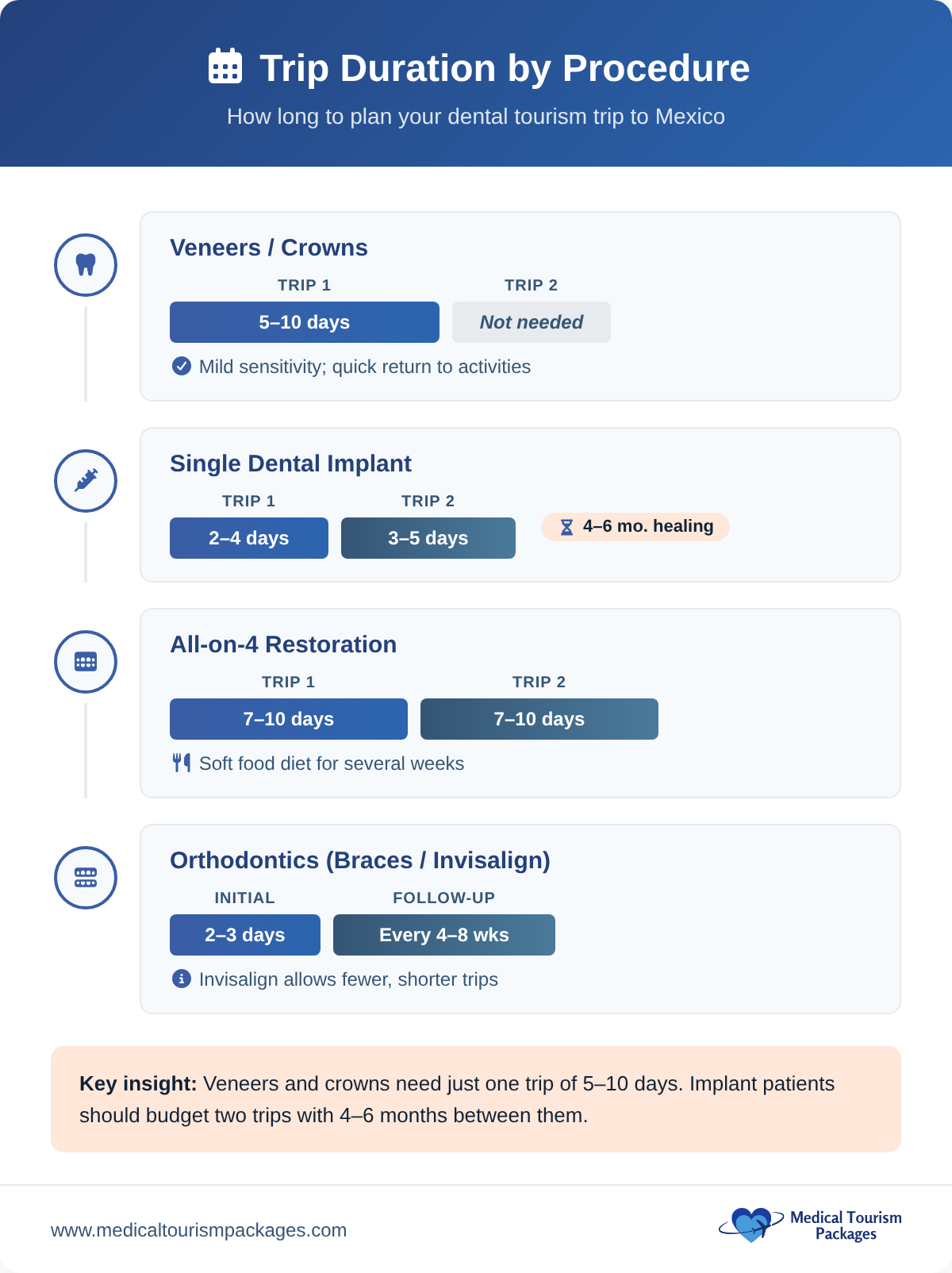
| Procedure | Trip 1 Duration | Trip 2 Duration | Recovery Notes |
|---|---|---|---|
| Veneers / Crowns | 5–10 days | Not needed | Mild sensitivity; return to activities quickly |
| Single Dental Implant | 2–4 days | 3–5 days | 4–6 months healing between trips |
| All-on-4 Restoration | 7–10 days | 7–10 days | Soft food diet for several weeks |
| Orthodontics | 2–3 days | Every 4–8 weeks | Invisalign allows fewer, shorter trips |
You need specific documents to enter Mexico and return home. A valid passport book is required for air travel. If crossing by land, a US passport card or enhanced driver’s license works for US re-entry. All international visitors must obtain an FMM entry permit. Stays under seven days in the border zone are usually free. Longer stays or travel into Mexico’s interior cost about $35. That permit is valid for up to 180 days.
Your clinical experience starts with full diagnostics. Clinics use 3D Cone Beam CT scanning for implant surgical planning. This maps your bone density, sinus cavities, and nerve pathways for precise implant placement. Before you leave Mexico, your dentist will schedule at least one post-operative visit. This checks your bite and confirms your restorations are stable. For long-term care, coordinate with your local dentist for routine cleanings. Most Mexican clinics provide detailed treatment records using standard ADA procedure codes. This makes it easy for your home dentist to continue your care.
Is Smile Correction in Mexico Safe?
Safety in Mexican dental tourism depends on choosing clinics under proper regulatory oversight. The Federal Commission for Protection against Sanitary Risks (COFEPRIS) is the main regulatory authority for healthcare in Mexico. It operates under the Ministry of Health. COFEPRIS has the power to conduct random inspections of dental clinics. It checks for valid practitioner licenses, proper disposal of hazardous waste, and working sterilization equipment.
Infection control standards have strengthened significantly since 1999. That year, biological monitoring of dental sterilizers became required. Clinics must verify sterilization effectiveness through scientific testing. They cannot rely on temperature indicators alone. Accredited facilities follow sterilization protocols that meet or exceed American Dental Association standards. They use industrial autoclaves that eliminate all microorganisms from surgical instruments. You can verify a clinic’s safety commitment by requesting a tour of their sterilization center.
Reputable Mexican clinics use FDA-approved materials. Here is what the material safety framework looks like:
- Sanitary registration — All medical devices and pharmaceuticals must be registered with COFEPRIS before use.
- Streamlined approvals — COFEPRIS relies on US FDA and Health Canada decisions to speed up clearances. North American-approved materials typically clear quickly.
- Established brands — Top clinics use brands with strong quality control and warranty support, including Nobel Biocare, Straumann, Prettau Zirconia, and Ivoclar Vivadent.
What Are the Benefits and Drawbacks of Smile Correction in Mexico?
Knowing both the benefits and drawbacks helps you set realistic expectations. Here are the key factors to weigh before booking.
Key benefits:
- Cost savings — 50% to 80% less than US or Canadian prices
- Advanced technology — 3D imaging, laser dentistry, and CAD/CAM milling centers that often exceed domestic practices
- More personal attention — Dentists spend more time per patient than high-volume North American offices
- Fast turnaround — Clinics with in-house labs produce crowns and veneers within days
- Dental vacation — Destinations like Cancun and Los Cabos let you combine treatment with leisure during recovery
Key drawbacks:
- Multiple trips for implants — 4 to 6 months of healing between placement and final crown requires two Mexico visits
- More planning required — Scheduling flights, hotels, and appointments takes more effort than visiting a local dentist
- Follow-up distance — Complications after returning home may require another trip to Mexico. You may also need to find a local dentist willing to work on foreign restorations
- Orthodontic logistics — Traditional braces need adjustments every 4 to 8 weeks, which is hard unless you live near the border
How Much Can You Save with Smile Correction in Mexico?
You can save $17,000 or more on major procedures even after paying for travel. Take an All-on-4 restoration as an example.
| Cost Item | United States | Mexico |
|---|---|---|
| Procedure cost | $30,000 | $10,500 |
| Travel (flights, hotel, meals) | $0 | $2,500 |
| Total | $30,000 | $13,000 |
| Net savings | — | $17,000 (56.6%) |
For procedures costing $10,000 or more in the US, adding $2,000 to $3,000 for travel still leaves you saving over 50%. Even two-trip implant patients save a large amount overall. The savings grow further if you combine dental work with a planned vacation.
Mexican dental clinics accept several payment methods. Cash is common and sometimes qualifies for a small discount. Verify exchange rates and withdrawal fees with your bank first. Major credit cards like Visa and Mastercard are widely accepted. They provide transaction records and fraud protection. Larger clinics now offer financing plans designed for dental tourists. These let you pay for complex restorations over several months rather than all at once.
Is Smile Correction in Mexico Right for You?
Mexico is the leading dental tourism destination in the Western Hemisphere. It handles 25% of the global market for cross-border dental care. For patients who vet clinics carefully and plan logistics well, accredited Mexican facilities are increasingly safe compared to domestic care. COFEPRIS regulations and voluntary international accreditations create a strong safety framework.
Mexico is right for you if you are willing to coordinate travel and verify credentials. It is also a good fit if you can accept the planning that comes with receiving care abroad. If so, Mexico offers a world-class path to smile correction at a fraction of domestic costs.
What Questions Do Medical Tourists Ask Most Often About Smile Correction in Mexico?
What Questions Do Medical Tourists Ask Most Often About Smile Correction in Mexico?
How long should you stay in Mexico after smile correction?
The length of your stay depends on your procedure. Veneers and crowns typically require 5 to 10 days in a single trip. Single dental implants require two trips of 2 to 4 days each, separated by 4 to 6 months of healing. All-on-4 restorations need two trips of 7 to 10 days each. Your dentist will schedule a post-operative visit before you leave. This visit confirms your bite and checks the stability of your restorations.
Are Mexican dental clinics accredited to international standards?
Many top Mexican dental clinics hold international accreditations. These include American Dental Association recognition, JCI-equivalent protocols, and Medical Tourism Association membership. COFEPRIS, Mexico’s federal health authority, conducts random inspections of clinics. It checks for valid licenses, proper sterilization equipment, and safe disposal of hazardous waste. Look for clinics with Better Business Bureau recognition and consistent 4.5+ star ratings on platforms like WhatClinic and Bookimed.
Do Mexican dentists speak English?
Yes. English proficiency is near-universal at clinics in major dental tourism hubs. In Los Algodones, almost all dentists and support staff speak English. This is because the vast majority of patients are American. Clinics in Tijuana, Cancun, and Los Cabos also hire bilingual staff specifically to serve North American patients. Many clinics offer bilingual consultation calls before your visit so you can discuss your treatment plan in English.
What happens if you have complications after returning home?
Reputable clinics provide warranties on their work. Implants typically carry a 5 to 10 year warranty on the titanium post. Crowns and veneers are usually covered for 1 to 5 years against chipping or debonding. If complications arise after you return home, contact your clinic first. Many handle minor issues remotely. For in-person care, you may need to return to Mexico. You could also find a local dentist willing to work on foreign restorations. Specialized medical tourism insurance can cover complication costs up to $250,000. Coverage typically lasts six months after your procedure.
Is it safe to fly after dental procedures in Mexico?
Flying is generally safe after most dental procedures, but timing matters. For veneers and crowns, most patients can fly within a day or two after their final appointment. For implant surgery, dentists typically recommend waiting 24 to 48 hours before flying. This allows initial healing and reduces swelling. For All-on-4 restorations, your dentist will advise you based on your specific healing progress before you leave Mexico. Always attend your post-operative visit before departing. Your dentist will confirm whether you are ready to fly.
What training do Mexican dental specialists have?
Mexican dental specialists complete a multi-year Cirujano Dentista program. This is equivalent to a Doctor of Dental Surgery degree in the United States. Specialists working in dental tourism hubs often pursue additional postgraduate training. Many train at top institutions like Universidad Nacional Autónoma de México or international universities in the US and Europe. You can verify a dentist’s credentials by requesting their Cédula Profesional. This is a license number issued by the Mexican Ministry of Education that confirms their qualifications.
Ready to Start Your Smile Correction Journey in Mexico?
Medical Tourism Packages coordinates your entire smile correction journey in Mexico. We connect you with accredited dental clinics, arrange your travel and accommodations, and provide bilingual support throughout your treatment. Get a free consultation to discuss your dental goals and receive a personalized quote.
Contact us today to start planning your affordable smile correction in Mexico.