Book Appointment Now


Rotator Cuff Surgery in Panama: Cost, Hospitals, Surgeons, and Recovery
 By
By
Rotator cuff surgery in Panama costs $7,000–$8,200—70% less than US prices—at JCI-accredited hospitals with Johns Hopkins affiliation.
A full-thickness repair costs $18,000–$35,000 in the United States. In Panama, the same procedure runs $7,000–$8,200 as an all-inclusive bundle. That bundle covers the surgeon fee, anesthesia, facility, implants, imaging, and medications—in a single price, billed in US dollars.
This guide covers procedure types, costs, and surgeon credentials. It also covers top hospitals in Panama City’s Punta Pacífica and Costa del Este districts. You will find cost comparisons, hospital profiles, and a complete patient journey from virtual consultation to flight clearance.
What Types of Rotator Cuff Procedures Can You Get in Panama?
Panama City orthopedic centers offer five main shoulder procedures, ranging from partial tendon repair ($5,000–$6,500) to reverse shoulder replacement ($15,000–$22,000). The right procedure depends on your tear size, age, activity level, and tissue quality.
The rotator cuff is a group of four tendons. These tendons connect muscle to bone in your shoulder. They allow you to rotate and lift your arm. When one or more tendons tear, surgery is often needed. Surgeons reattach the tendon and restore shoulder function.
| Procedure | Cost in Panama (USD) | Best For |
|---|---|---|
| Partial Rotator Cuff Repair | $5,000 – $6,500 | Tears involving less than 50% of tendon depth |
| Full-Thickness Repair | $7,000 – $8,200 | Complete tendon detachment from the bone |
| SLAP / Labrum Repair | $6,000 – $7,500 | Tears to the cartilage ring surrounding the socket |
| Total Shoulder Replacement | $10,000 – $15,000 | Severe arthritis with intact surrounding muscles |
| Reverse Shoulder Replacement | $15,000 – $22,000 | Massive tears with poor remaining muscle function |
Most repairs are performed arthroscopically through small portal incisions under one centimeter. This reduces post-operative pain and speeds up early recovery. For larger tears that need better visualization, surgeons use a mini-open approach with a three to five centimeter incision. Open repair is reserved for the most complex cases. These include massive tears or revision surgeries requiring tissue transfers or extensive reconstruction.
Why Do Medical Tourists Choose Panama for Rotator Cuff Surgery?
Panama offers several advantages that other medical tourism destinations cannot match. Here are the main reasons North American patients choose Panama City for rotator cuff surgery:
- US dollar pricing — Panama uses the US dollar. There is no exchange rate risk. The price you are quoted is the price you pay. This is simpler than Mexico or Colombia, where currency fluctuations add uncertainty.
- 50% to 70% cost savings — Panama typically costs 50% to 70% less than US self-pay rates. Quality is not the trade-off.
- JCI-accredited hospitals — Panama’s top hospitals are accredited by the Joint Commission International. This is the same body that accredits US hospitals. It evaluates facilities against more than 1,000 measurable standards covering patient safety, infection control, and clinical outcomes.
- Fellowship-trained surgeons — Surgeons at these facilities completed fellowship training in the United States, Europe, or Brazil. They bring subspecialty expertise in shoulder repair and arthroscopy.
- FDA-approved implants — The implants used come from Zimmer Biomet, Stryker, and DePuy Synthes. These are FDA-approved and identical to those used in American operating rooms.
Patient experience reflects this standard. Among those who had rotator cuff surgery in Panama, 88% report satisfaction with cost. 82% rate clinical competence positively. 84% say they would recommend it to others.
How Much Does Rotator Cuff Surgery in Panama Cost Compared to the US?
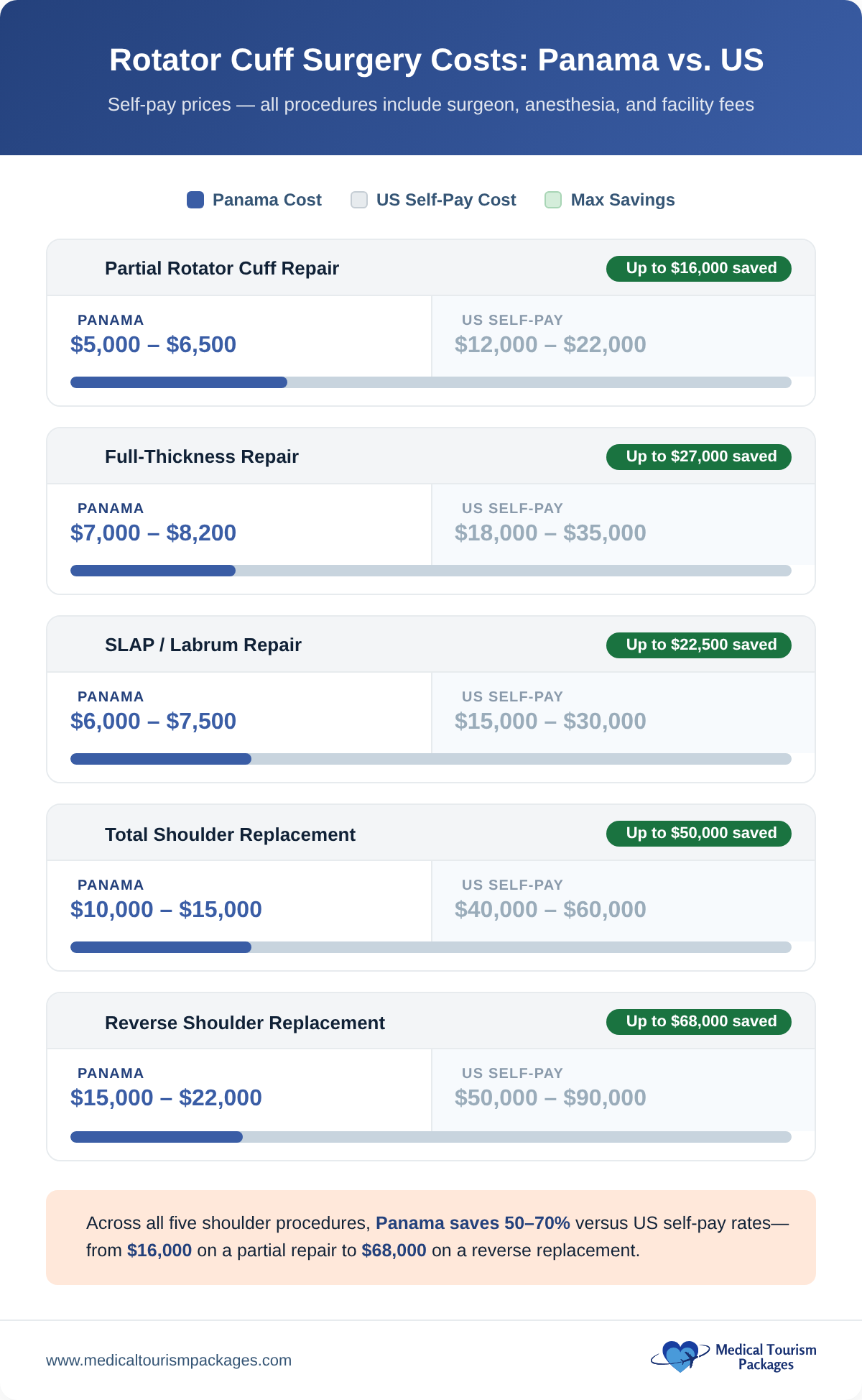
Rotator cuff surgery in Panama costs 50%–70% less than US self-pay rates across every procedure type. Panama uses an all-inclusive bundle model. Your quoted figure covers the surgeon’s fee, anesthesia, facility costs, implants, pre-operative imaging, and medications in a single amount. In the United States, each component arrives as a separate bill from separate providers. This makes it hard to know your true out-of-pocket cost before surgery.
| Procedure | Panama | United States (Self-Pay) | Estimated Savings |
|---|---|---|---|
| Partial Rotator Cuff Repair | $5,000 – $6,500 | $12,000 – $22,000 | Up to $16,000 |
| Full-Thickness Repair | $7,000 – $8,200 | $18,000 – $35,000 | Up to $27,000 |
| SLAP / Labrum Repair | $6,000 – $7,500 | $15,000 – $30,000 | Up to $22,500 |
| Total Shoulder Replacement | $10,000 – $15,000 | $40,000 – $60,000 | Up to $50,000 |
Overall, patients save between 50% and 70% compared to US self-pay rates. Even after adding flights, hotel, and two weeks of recovery costs in Panama City, total spending is far lower than the US alternative.
For a broader look at shoulder procedures available in Panama, see our complete guide to shoulder surgery in Panama.
Which Hospitals in Panama Specialize in Rotator Cuff Surgery?
Three hospitals in Panama City specialize in rotator cuff surgery: Hospital Punta Pacifica, Clínica Hospital San Fernando, and Hospital Nacional. All three are JCI-accredited. They are located in Panama City’s Punta Pacífica and Costa del Este districts—modern medical corridors built to international standards. They mirror US private hospital care, from surgical equipment and nursing protocols to international patient services.
| Hospital | Accreditation | Key Affiliation | Orthopedic Offering |
|---|---|---|---|
| Hospital Punta Pacifica | JCI / ISO | Johns Hopkins Medicine International | Robotic surgery suites; 118 beds; US-level infection control |
| Clínica Hospital San Fernando | JCI | Baptist Health International; Tulane University | 400+ physicians; dedicated orthopedic unit; international patient center |
| Hospital Nacional | International | Independent | Joint reconstruction; complex orthopedic procedures |
What Makes Hospital Punta Pacifica Stand Out?
Hospital Punta Pacifica is the only hospital in Central America affiliated with Johns Hopkins Medicine International. This affiliation means its clinical protocols and patient safety standards match one of the world’s most recognized medical institutions. Surgeons there average 45 to 60 minutes per initial consultation. This compares to roughly 10 minutes at a busy US clinic. Patients get genuine time to understand their diagnosis and ask questions before committing to a procedure.
What Does Clínica Hospital San Fernando Offer?
Clínica Hospital San Fernando has been operating since 1949. It brings decades of orthopedic experience. It holds JCI accreditation and academic partnerships with Baptist Health International and Tulane University. Its international patient center is designed for North American travelers. It handles coordination, translation, and logistical support throughout the stay.
Hospital Nacional is a third option in Panama City. It focuses on joint reconstruction and serves patients who prefer a smaller private facility.
Who Are the Leading Rotator Cuff Surgeons in Panama?
The leading rotator cuff surgeons in Panama City are board-certified orthopedic specialists with extensive fellowship training. Their training follows a rigorous pathway. It begins with a medical degree from an accredited university. This is followed by a residency in orthopedic surgery. After residency, surgeons pursue a one to two-year fellowship in shoulder repair or arthroscopy.
Fellowship training often takes place at premier centers in the United States, Europe, or Brazil. These institutions are known for high surgical volume and technical excellence. Many surgeons in Panama hold active membership in the American Academy of Orthopaedic Surgeons (AAOS). This membership signals adherence to internationally recognized standards in orthopedic care.
Most specialized shoulder surgeons at JCI-accredited facilities in Panama City are fluent in English. They provide care specifically designed for international patients.
When evaluating a surgeon, look for three things. First, fellowship training at a named international institution. Second, active AAOS membership. Third, a high volume of arthroscopic shoulder cases. Top surgeons practice at leading accredited facilities in Panama City. These include Hospital Punta Pacífica, Clínica Hospital San Fernando, and the COPAC orthopedic center.
For guidance on choosing a qualified orthopedic surgeon abroad, review our complete surgeon selection criteria.
How Does the Rotator Cuff Surgery Process Work in Panama?
The process follows a clear step-by-step timeline from home to Panama City and back:
- Before travel (Weeks -4 to 0) — Submit your existing MRI or CT scans through the hospital’s patient portal. The surgical team reviews them remotely. Within 24 to 72 hours, your surgeon confirms if you are a candidate. You then schedule a virtual consultation covering your procedure, outcomes, and recovery. Stop anti-inflammatory medications and blood thinners 7 to 10 days before surgery.
- Arrival and testing (Days 1–2) — The first two days in Panama City are for in-person evaluation. You will meet your surgeon, complete lab work, and undergo any final imaging.
- Surgery (Day 3) — Most arthroscopic procedures are performed as outpatient surgery or with a single night of observation.
- Early recovery (Days 4–10) — Focus on protecting the repair. Wear a sling with an abduction pillow to maintain correct arm positioning. Daily cryotherapy is essential to control swelling and manage pain.
- Clearance for travel (Days 11–14) — Your surgeon removes sutures and assesses healing. You are cleared for air travel once post-operative risk has decreased enough.
Plan to stay in Panama City for a minimum of 11 to 14 days. Beyond your surgical bundle, budget for non-medical travel costs. International airfare from the US typically runs $500 to $800. A recovery-friendly hotel costs $100 to $200 per night. Local ground transportation adds $20 to $50 per day.
Read our complete guide for American medical tourists in Panama for detailed planning tips on travel, accommodation, and logistics.
What Is the Recovery Timeline After Rotator Cuff Surgery?
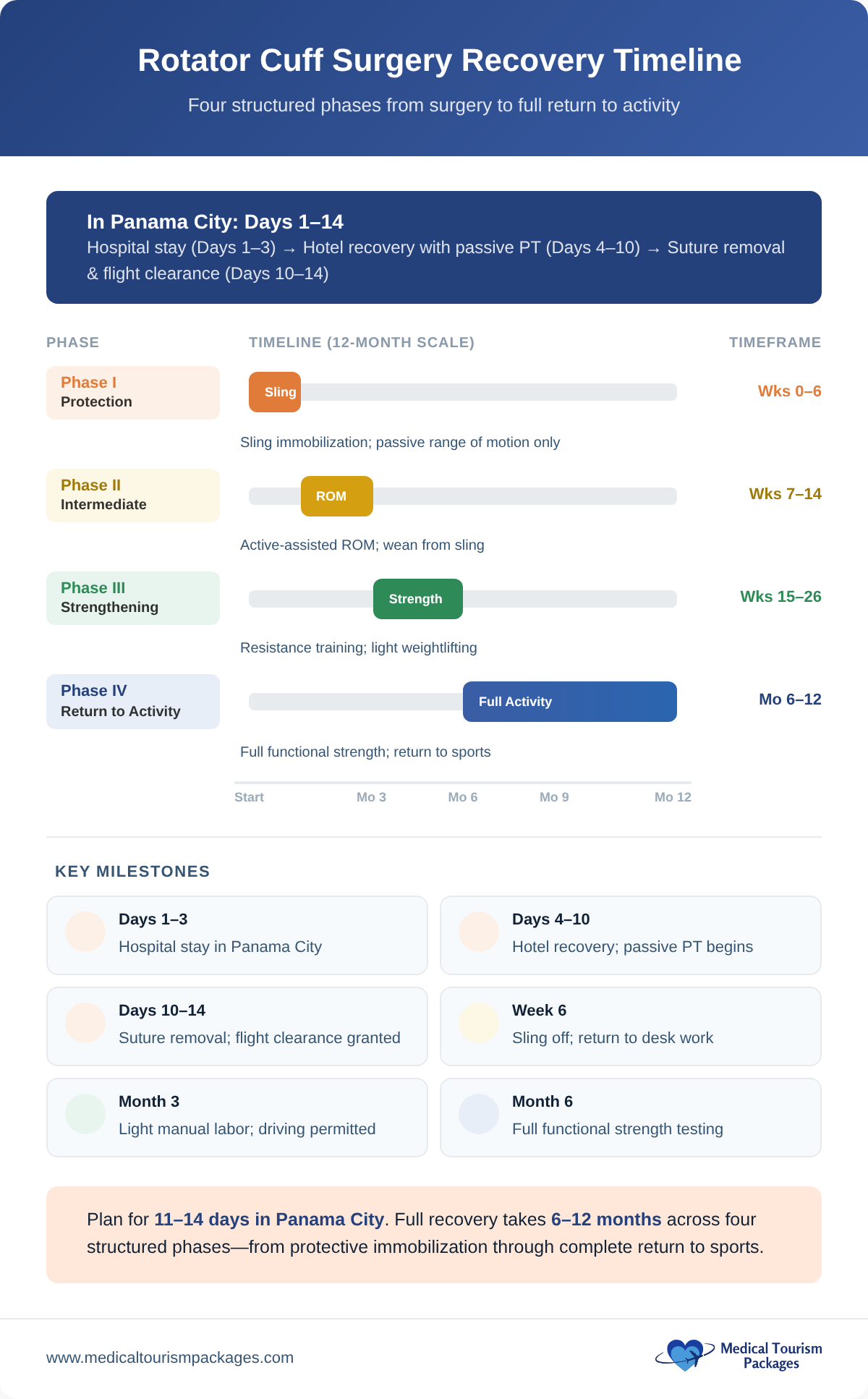
Full recovery after rotator cuff surgery takes 6 to 12 months. The process follows four structured phases—from initial protection through return to sports. Understanding each phase before you travel helps you plan your time in Panama City. It also helps you coordinate physical therapy at home and set realistic expectations.
| Phase | Timeframe | Primary Goals |
|---|---|---|
| Phase I – Protection | Weeks 0–6 | Sling immobilization; passive range of motion only |
| Phase II – Intermediate | Weeks 7–14 | Active-assisted ROM; wean from sling; zero-weight exercises |
| Phase III – Strengthening | Weeks 15–26 | Resistance training; light weightlifting; functional movements |
| Phase IV – Return to Activity | Months 6–12 | Full functional strength; return to sports |
Tendon-to-bone healing takes 6 to 8 weeks. Full recovery takes 6 to 12 months. These timelines are biological and cannot be shortened by effort alone. Pushing too hard too early is the most common cause of repair failure. Following each phase matters as much as the surgery itself.
Recovery is consistently the hardest part of this journey. Half of all rotator cuff patients rate recovery difficulty negatively. The primary driver is not the surgical outcome but the pain and length of rehabilitation. The first 72 hours after surgery are particularly intense. Patients who go in without realistic expectations are often caught off guard by the discomfort. This is especially true if certain pain medications are not suitable for them.
What Are the Advantages and Risks of Rotator Cuff Surgery in Panama?
Panama’s top hospitals use the same robotic surgical platforms and suture anchor systems as premier American orthopedic centers. The technology is not a compromise. Here are the main advantages and risks to weigh.
Advantages:
- Same technology — The equipment is identical to what US orthopedic centers use. It is operated by surgeons trained at the same caliber of institutions.
- 50%–70% cost savings — Panama City facilities offer significant savings compared to US self-pay rates.
- English-speaking staff — All leading facilities in Panama City have English-speaking clinical staff for international patients.
Risks to understand:
- No public complication rate databases — Panama does not have hospital-specific complication rate registries. In the United States, the AAOS maintains transparent outcome registries. That level of visibility does not yet exist in Panama.
- Negative clinical competence ratings — In patient forum data, 6% of patients rated clinical competence negatively. That is a minority, but not a figure to dismiss.
- DVT risk during flight — The most common patient concern is re-tearing the repair during the flight home. Clinically, this is rare when the 14-day protocol is followed. The more real risk is deep vein thrombosis. Your surgeon will not clear you for air travel until Days 11 to 14. Following the protocol is not optional.
Is Rotator Cuff Surgery in Panama Right for You?
Panama is a strong fit for two groups. The first is uninsured or high-deductible US patients paying out of pocket. The second is Canadian patients facing public system wait times that exceed what their condition allows. Both groups benefit from accredited care, experienced surgeons, and a transparent pricing model. The total cost is predictable from the start.
The surgery carries the same risk profile as an equivalent procedure in the United States. What determines your outcome is not where you have the operation. It is whether you respect the recovery protocol afterward. Patients who complete the 11 to 14 day in-country stay and follow a 6-month physical therapy program at home achieve US-level results. Those who cut corners on either end are the ones who face complications.
For a full-thickness rotator cuff repair, potential savings versus US self-pay range from $10,000 to $27,000. For many patients, that figure is the difference between accessing surgery this year or continuing to delay care they need.
What Questions Do Medical Tourists Ask Most Often About Rotator Cuff Surgery in Panama?
How long should I stay in Panama after rotator cuff surgery?
You should stay in Panama City for a minimum of 11 to 14 days after surgery. Simple arthroscopic repairs require the lower end of this range. Complex full-thickness repairs or shoulder replacements require the full 14 days. This window allows suture removal and your surgeon’s clearance for air travel. US citizens do not need a visa for stays up to 180 days.
Are Panama hospitals accredited to international standards?
Yes, Panama has multiple JCI-accredited hospitals. Joint Commission International (JCI) is the same standard used by top US hospitals. Hospital Punta Pacifica is the only hospital in Central America affiliated with Johns Hopkins Medicine International. Clínica Hospital San Fernando holds JCI accreditation with partnerships with Baptist Health International. These hospitals meet the same patient safety standards as US medical centers.
Do rotator cuff surgeons in Panama speak English?
Yes, most specialized orthopedic surgeons at JCI-accredited facilities in Panama City are fluent in English. International patient coordinators also communicate clearly throughout your treatment journey. Hospital Punta Pacifica’s entire international patient department operates in English. This removes language barriers that complicate medical tourism in many other countries.
What happens if I have complications after returning home?
Panama’s leading orthopedic surgeons work directly with your domestic primary care physician. They support seamless postoperative follow-up after you return home. The affiliation between Hospital Punta Pacifica and Johns Hopkins Medicine International creates pathways for high-level consultation in rare complex cases. Many surgical packages include telemedicine follow-up appointments. You can contact your surgeon directly for any postoperative concerns.
Is it safe to fly home after rotator cuff surgery in Panama?
Yes, it is safe to fly after the recommended waiting period. Surgeons require a minimum 11 to 14 day stay before clearing you for air travel. The primary flight-related risk is deep vein thrombosis, not re-tearing the repair. Your surgeon will clear you for flight only after verifying your healing progress. Keep your arm in a sling during the flight to reduce swelling and protect the repair.
What training do rotator cuff surgeons in Panama have?
Panama’s rotator cuff surgeons are board-certified orthopedic specialists with extensive fellowship training. They complete a medical degree from an accredited university followed by a four-year orthopedic surgery residency. After residency, they pursue a one to two-year fellowship in shoulder repair or arthroscopy. Fellowship training often takes place at premier centers in the United States, Europe, or Brazil. Many surgeons hold active membership in the American Academy of Orthopaedic Surgeons (AAOS).
Ready to Start Your Rotator Cuff Surgery Journey in Panama?
Medical Tourism Packages coordinates your entire rotator cuff surgery journey in Panama. We connect you with JCI-accredited hospitals in Panama City. We arrange your travel and accommodations. We provide bilingual support throughout your treatment. Get a free consultation to discuss your shoulder condition and receive a personalized quote.
Contact us today to start planning your affordable rotator cuff surgery in Panama.