Book Appointment Now

Trinidad & Tobago Medical Tourism Guide: Affordable Healthcare Solutions Abroad for Trinidad & Tobago Residents
 By
By
Trinidad & Tobago residents save 40-80% on medical procedures in Panama and Colombia. A hip replacement costs $9,500 in Bogotá versus $18,000+ in Port of Spain. Cardiac bypass surgery runs $18,000-$24,000 in Panama City versus unaffordable rates locally.
The public healthcare system has months-long wait times and outdated equipment. Private facilities charge prices most families cannot afford. Medical tourism bridges this gap with JCI-accredited hospitals in Panama City, Bogotá, and Medellín.
Copa Airlines flies direct from Piarco International to Panama City in just over three hours. From there, you can connect to Bogotá or Medellín. Trinidad & Tobago citizens need no visa for stays up to 90-180 days.
Total trip costs, including flights and two weeks of recovery, often run lower than private facility prices in Trinidad. This guide covers costs, travel logistics, and procedures for Trinidad & Tobago medical tourists.
What is the Current State of Healthcare in Trinidad & Tobago?
Trinidad & Tobago’s healthcare system has two tiers. A free public sector runs alongside an expensive private industry. The relationship between them creates problems for patients. The government has increased health budgets and hired more staff. Yet health outcomes have remained unchanged.
The system’s failures create specific consequences that medical tourism addresses directly:
| Healthcare Constraint | Primary Outcome for Patients | Strategic Alternative in Medical Tourism |
|---|---|---|
| Extended Wait Times | Disease progression while waiting; decreased quality of life | Immediate access to JCI-accredited facilities in Panama and Colombia |
| High Private Out-of-Pocket Costs | Financial instability or deferred treatment | 40-80% savings at Latin American medical centers |
| Lack of Specialized Technology | Inaccurate or delayed diagnostic results | Access to Da Vinci robotics and PET-CT scanners |
| Throughput Inefficiencies | Overcrowded ERs; indefinite delays | High-efficiency clinical models with hospital-integrated recovery |
Private hospitals offer modern facilities and shorter wait times. But they charge prices most residents cannot afford. A hip replacement at a Port of Spain private facility costs $18,000 or more. Advanced treatments like robotic surgery and specialized cardiac care are not available locally. When they are available, the costs make them inaccessible.
This creates a middle-income trap. You may be too wealthy for public system priority lists. But you cannot afford private care costs. Medical tourism solves this problem. Total trip cost to Colombia or Panama is often lower than private care in Port of Spain.
For more information on medical tourism options for Caribbean residents, see our Caribbean medical tourism guide.
Where Do Medical Tourists Find Better Care?
Medical tourism hospitals in Panama and Colombia hold JCI accreditation. They specialize in specific procedures and have expertise that local hospitals cannot match.
| Destination City | Specialty Focus | Notable JCI Hospital | International Affiliation |
|---|---|---|---|
| Panama City, Panama | Cardiac, Oncology, Stem Cell | Hospital Punta Pacifica | Johns Hopkins Medicine International |
| Bogotá, Colombia | Cardiology, Neurosciences | Fundación Santa Fe de Bogotá | Universidad de los Andes |
| Medellín, Colombia | Cosmetics, Dentistry, Orthopedics | Hospital Pablo Tobón Uribe | Research-focused non-profit |
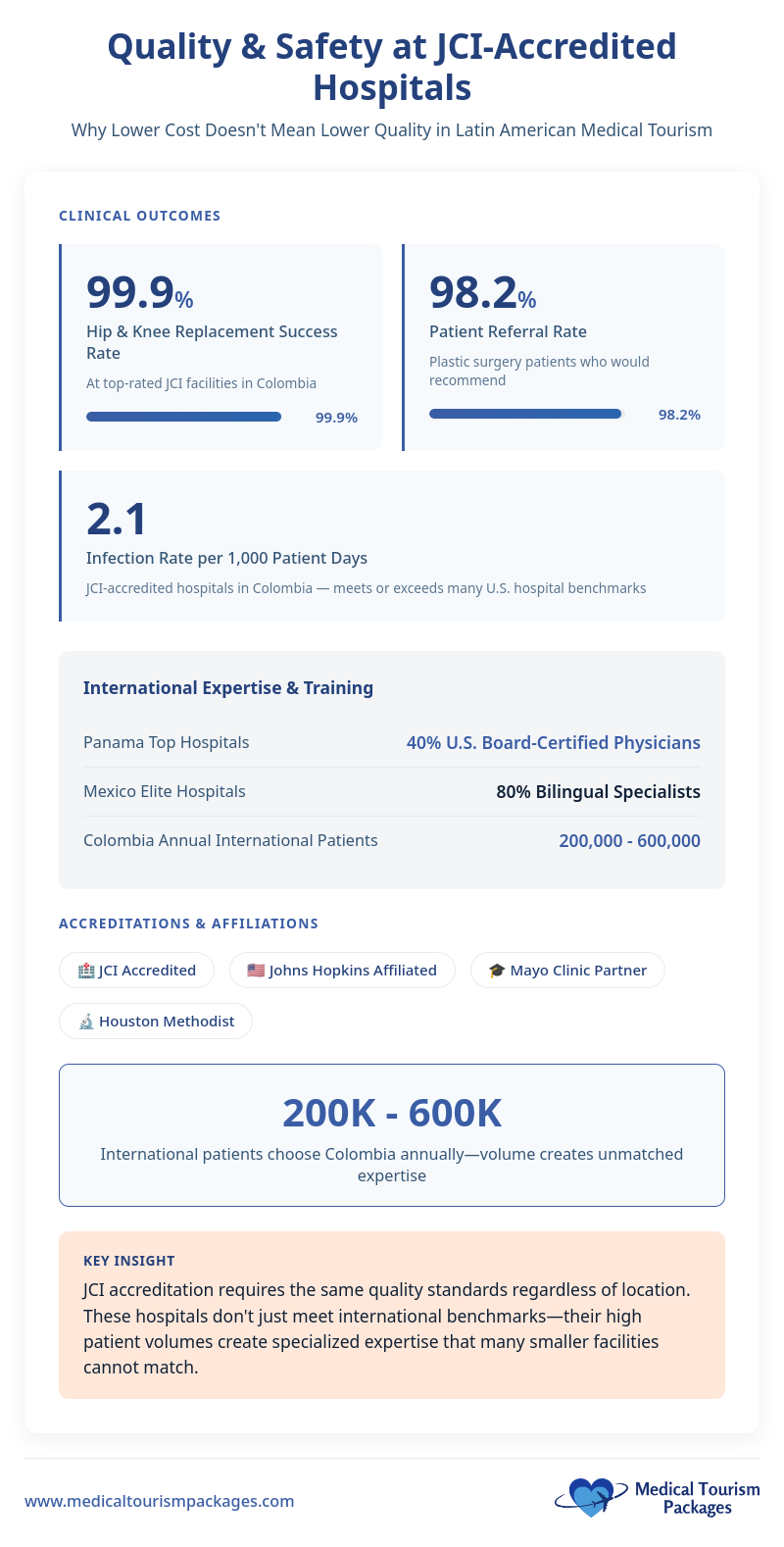
Hospital Punta Pacifica in Panama City has the only Johns Hopkins affiliation in Central America. The facility uses Johns Hopkins protocols and quality standards. Many physicians trained in the United States. Colombia’s hospitals built their reputation through high patient volume. Fundación Santa Fe de Bogotá handles complex neurology and cardiology cases.
How Much Can Trinidad & Tobago Residents Save with Medical Tourism?
Trinidad & Tobago residents save 40-80% compared to USA or Canada pricing. Total trip cost including flights, accommodation, and recovery often costs less than private care in Port of Spain.
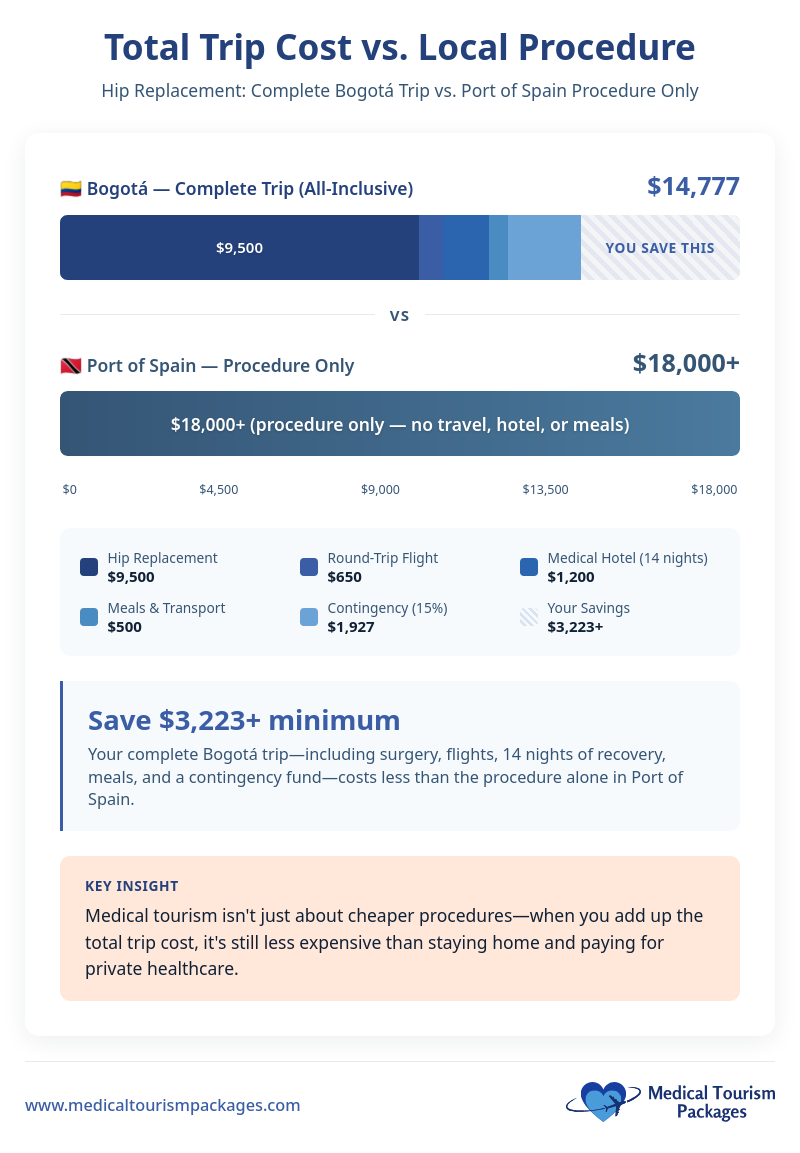
flights, hotels, and meals.
What Does Medical Care Cost in Panama?
Panama is the premium medical destination in Central America. The country uses the U.S. dollar, which eliminates currency exchange risks.
| Procedure | T\&T Private (Est.) | Panama Cost | USA Cost | Savings vs USA |
|---|---|---|---|---|
| Cardiac Bypass | $45,000+ | $18,000-$24,000 | $123,000-$150,000 | $99,000-$132,000 |
| Hip Replacement | $18,000+ | $11,000-$13,000 | $40,000-$60,000 | $27,000-$49,000 |
| Knee Replacement | $18,000+ | $12,000-$14,000 | $35,000-$50,000 | $21,000-$38,000 |
| Single Dental Implant | $2,500+ | $900-$1,500 | $3,000-$5,000 | $1,500-$3,500 |
| Gastric Sleeve | $12,000+ | $5,500-$8,000 | $15,000-$20,000 | $7,000-$14,500 |
| Rhinoplasty | $6,000+ | $1,500-$2,500 | $8,000-$15,000 | $3,500-$13,500 |
Hospital Punta Pacifica operates under the same protocols used in Baltimore. About 40% of physicians in Panama’s top hospitals are U.S. board-certified. Panama excels at complex procedures that need specialized nursing. The facilities offer 24/7 monitoring and Johns Hopkins expertise.
What Does Medical Care Cost in Colombia?
Colombia is Latin America’s top medical tourism destination. It treats 200,000-600,000 international patients each year. This high volume creates expertise that other providers cannot match.
| Procedure | T\&T Private (Est.) | Colombia Cost | USA Cost | Savings vs USA |
|---|---|---|---|---|
| Cardiac Bypass | $45,000+ | $18,000-$22,000 | $123,000-$150,000 | $101,000-$132,000 |
| Hip Replacement | $18,000+ | $8,000-$11,500 | $40,000-$60,000 | $28,500-$52,000 |
| Knee Replacement | $18,000+ | $8,000-$12,000 | $35,000-$50,000 | $23,000-$42,000 |
| Single Dental Implant | $2,500+ | $700-$1,200 | $3,000-$5,000 | $1,800-$4,300 |
| All-on-4 Dental | High local pricing | $8,000-$12,000 | N/A | Major savings vs local |
| Gastric Sleeve | $12,000+ | $4,500-$7,000 | $15,000-$20,000 | $8,000-$15,500 |
| Rhinoplasty | $6,000+ | $2,500-$4,500 | $8,000-$15,000 | $3,500-$12,500 |
Colombian healthcare emphasizes “humanized medicine.” This approach balances clinical excellence with patient empathy. JCI hospitals in Colombia report infection rates of 2.1 per 1,000 patient days. This matches or exceeds many U.S. hospital benchmarks. Plastic surgery patients report a 98.2% referral rate. Hip and knee replacement success rates reach 99.9%. Colombia leads the region in robotic-assisted orthopedic surgery.
Learn more in our complete guide to medical tourism in Colombia.
What Does Medical Care Cost in Mexico?
Mexico specializes in bariatric surgery and ophthalmology. Mexico City has more Da Vinci robotic surgery platforms than any other Mexican city.
| Procedure | T\&T Private (Est.) | Mexico Cost | USA Cost | Savings vs USA |
|---|---|---|---|---|
| Hip Replacement | $18,000+ | $13,000-$17,000 | $40,000-$60,000 | $23,000-$47,000 |
| Knee Replacement | $18,000+ | $12,000-$16,000 | $35,000-$50,000 | $19,000-$38,000 |
| Single Dental Implant | $2,500+ | $800-$1,500 | $3,000-$5,000 | $1,500-$4,200 |
| Gastric Sleeve | $12,000+ | $4,000-$7,000 | $15,000-$20,000 | $8,000-$16,000 |
| Rhinoplasty | $6,000+ | $3,000-$5,000 | $8,000-$15,000 | $3,000-$12,000 |
Hospital Médica Sur and Centro Médico ABC hold JCI accreditation. They have partnerships with the Mayo Clinic and Houston Methodist Hospital. About 80% of specialists in elite hospitals speak English and Spanish.
How Do You Travel from Trinidad & Tobago for Medical Care?
Copa Airlines operates daily direct flights from Port of Spain to Panama City. Panama is the natural hub for connecting to other medical centers in Latin America. Tocumen International Airport offers connections to Bogotá, Medellín, and Mexico City.
| Destination | Primary Airline | Travel Time | Typical Fare (Round Trip) |
|---|---|---|---|
| Panama City | Copa Airlines | 3h 15m (Direct) | $400-$600 |
| Bogotá | Copa Airlines / Avianca | 5h-7h (via Panama) | $450-$750 |
| Medellín | Copa Airlines | 6h-8h (via Panama) | $500-$800 |
| Mexico City | Copa Airlines / Aeromexico | 8h-10h (via Panama) | $480-$900 |
Trinidad & Tobago passport holders have visa-exempt status in all major medical tourism destinations. This simplifies travel planning.
| Country | Visa Status | Maximum Stay | Requirements |
|---|---|---|---|
| Panama | Visa Exempt | 90 Days | Valid passport, return ticket, proof of $500 minimum funds |
| Colombia | Visa Exempt | 90-180 Days | Valid passport with 6 months validity |
| Mexico | Visa Exempt | 180 Days | Valid passport, tourist card provided on flight |
What Medical Procedures Can Trinidad & Tobago Residents Access Through Medical Tourism?
Medical tourism opens access to procedures that Trinidad & Tobago cannot provide affordably. Each destination has developed specific expertise based on their medical infrastructure.
What Cardiac Surgery Options Are Available?
Cardiac disease drives more Caribbean medical travel than any other condition. Cardiac bypass costs $18,000-$24,000 in Panama and Colombia. This compares to $144,000 in the United States.
Hospital Punta Pacifica in Panama City uses Johns Hopkins protocols for cardiac care. They perform bypass grafting, valve replacements, and angioplasty with stents. Colombia’s Fundación Cardioinfantil in Bogotá specializes in complex heart valve and pediatric cardiac surgery.
How Much Does Joint Replacement Cost Abroad?
Long wait lists in Trinidad & Tobago make joint replacements highly sought after. Colombia leads the region in robotic-assisted orthopedic surgery:
- Colombia knee replacement: $8,000-$12,000 compared to $35,000-$50,000 in the U.S.
- Colombia hip replacement: $8,000-$11,500 with robotic precision
- Panama hip/knee replacement: $11,000-$14,000 at Johns Hopkins-affiliated facilities
- Mexico hip replacement: $13,000-$17,000 with Da Vinci robotic systems
- Mexico knee replacement: $12,000-$16,000 in Mexico City
Robotic surgery uses 3D imaging to plan exact joint placement before any incisions. Sub-millimeter precision ensures optimal alignment. The savings cover your entire trip with $5,000-$10,000 left over.
What Dental Procedures Can You Access?
Dental tourism is the most accessible form of medical travel for Caribbean residents. Procedures typically require just 3-7 days. The “All-on-4” technique replaces an entire arch of teeth with just four implants:
- Colombia full-arch zirconia restoration: $8,000-$12,000 for permanent, natural-looking teeth
- Single dental implant: Colombia $700-$1,200; Panama $900-$1,500; Mexico $800-$1,500
- Trinidad & Tobago private pricing: $2,500+ per single implant
Six implants cost $15,000 in Trinidad & Tobago versus $4,200-$7,200 in Colombia. That $8,000-$11,000 savings covers flights, accommodation, and meals with money remaining.
What Are Your Options for Bariatric and Cosmetic Surgery?
Mexico is the specialist destination for bariatric surgery. Gastric sleeve costs $4,000-$7,000 in Mexico, $4,500-$7,000 in Colombia, and $5,500-$8,000 in Panama. Trinidad & Tobago private sector charges $12,000 or more. For detailed information, see our bariatric surgery guide.
Medellín is Latin America’s cosmetic surgery capital. Rhinoplasty costs $2,500-$4,500 in Colombia, $1,500-$2,500 in Panama, and $3,000-$5,000 in Mexico. Local pricing runs $6,000 or more. The 98.2% referral rate in Colombia shows consistent patient satisfaction.
How Long Should You Stay for Different Medical Procedures?
Your stay length depends on medical safety requirements. Deep Vein Thrombosis (DVT) is a risk when flying after surgery. Blood clots can form during immobility and travel to your lungs.
| Procedure Category | Recommended Days | Rationale |
|---|---|---|
| Dental Procedures | 3-7 days | Infection monitoring, final crown fitting, bite alignment |
| Cosmetic Surgery | 7-14 days | Drain removal, wound monitoring, swelling reduction |
| Joint Replacement | 10-14 days | Physical therapy, mobility assessment, DVT prevention |
| Bariatric Surgery | 10-14 days | Diet stabilization, leak monitoring, nutritional counseling |
| Cardiac Surgery | 14-21 days | Cardiovascular monitoring, medication adjustment, stress testing |
Panama and Colombia use a hospital-integrated recovery model. Recovery happens in the hospital complex or at nearby medical hotels. Nursing staff communicate directly with your surgical team. These are purpose-built recovery centers, not regular hotels.
The advantages show when complications arise. Nurses notice problems during routine checks. Your surgeon can be at your bedside within minutes. Physical therapy begins in a controlled clinical environment. For joint replacement patients, early intervention improves outcomes. The integrated model adds minimal cost while reducing complication rates.
Why Should Trinidad & Tobago Residents Consider Medical Tourism?
Medical tourism solves problems that Trinidad & Tobago’s healthcare system cannot address. The public sector has months-long waits. The private sector charges prices most families cannot afford. Medical tourism gives you immediate access to superior facilities at lower costs.
What Are Panama’s Key Advantages?
Panama offers Johns Hopkins-standard care with financial stability. Here are the main benefits:
- Johns Hopkins Medicine International affiliation (only in Central America)
- 40% of physicians are U.S. board-certified
- Dollarized economy eliminates currency risk
- High English proficiency among medical staff
- Leaders in interventional cardiology
- Ideal for complex procedures requiring specialized nursing
What Are Colombia’s Key Advantages?
Colombia combines high-tech innovation with patient-centered care. Here are the main benefits:
- 200,000-600,000 international patients annually
- JCI-accredited hospitals ranking among world’s best
- “Humanized medicine” approach balances clinical excellence with empathy
- Regional leader in robotic-assisted orthopedic surgery
- Bogotá specializes in high-complexity neurology and cardiology
- Medellín serves as cosmetic surgery and dentistry hub
- 2.1 infection rate per 1,000 patient days
- 98.2% plastic surgery referral rate
- 99.9% hip/knee replacement success rate
- Bilingual patient coordinators available
What Are Mexico’s Key Advantages?
Mexico excels in specialized procedures with advanced technology. Here are the main benefits:
- Specialist in bariatric surgery and ophthalmology
- Most Da Vinci robotic platforms in Mexico City
- Elite specialists and PET-CT scanners
- JCI-accredited facilities with Mayo Clinic connections
- 80% of top-tier specialists are bilingual
- Minimally invasive procedures for faster recovery
What Is the Total Cost of a Medical Tourism Trip?
Understanding complete trip costs helps you plan realistically. Here is the full cost of a hip replacement in Bogotá:
| Expense Category | Cost (USD) | Notes |
|---|---|---|
| Hip Replacement Procedure | $9,500 | JCI facility fee, titanium implant, surgeon fee, anesthesia |
| Round-Trip Flight POS-BOG | $650 | Copa Airlines via Panama City, economy class |
| Accommodation (14 Days) | $1,200 | Medical hotel with nursing staff at $85-100 per night |
| Meals and Transport | $500 | Daily meals and transportation to appointments |
| Contingency Fund (15%) | $1,927 | Buffer for unexpected medications or extended stay |
| Total Trip Cost | $14,777 | Complete all-inclusive expense |
This $14,777 total compares to $18,000+ for just the procedure in Port of Spain. You save money while getting superior care. The contingency fund covers unexpected situations.
How Much Can You Save on Different Procedures?
The savings transform treatment from impossible to accessible:
- Cardiac bypass: Save $95,000-$132,000 versus USA, making life-saving surgery affordable
- Hip replacement: Save $23,000-$52,000 versus USA, including all trip costs
- Knee replacement: Save $19,000-$42,000 versus USA at fraction of costs
- All-on-4 dental: $8,000-$12,000 total with major savings versus local pricing
- Gastric sleeve: Save $8,000-$16,000 versus USA, making surgery accessible
- Total trip cost often lower than Port of Spain private facility out-of-pocket expenses
These are transformative savings, not marginal ones. They make medical treatment possible. A family that cannot afford $18,000 in Port of Spain can get superior care in Bogotá for $14,777.
Is Medical Tourism the Right Choice for Trinidad & Tobago Residents?
Trinidad & Tobago’s healthcare system cannot meet the population’s needs. System delays bottleneck every procedure. High private costs exclude most residents. Extended wait times turn treatable conditions chronic. The middle-income trap forces families to defer treatment or face financial hardship.
Medical tourism provides immediate access to quality care at sustainable costs. Panama delivers Johns Hopkins-standard care in a dollarized economy. Colombia combines high-tech innovation with humanized medicine at competitive prices. Mexico City specializes in bariatric surgery and ophthalmology. All three destinations offer JCI-accredited hospitals.
For cardiac surgery, joint replacements, dental work, bariatric procedures, and cosmetic surgery, medical tourism delivers what the domestic system cannot. You get quality care when you need it, at prices you can afford.
Frequently Asked Questions
Is medical tourism safe for Trinidad & Tobago residents?
Yes, medical tourism is safe when you choose JCI-accredited hospitals. JCI is the gold standard for international healthcare quality. Hospitals in Panama, Colombia, and Mexico meet the same safety standards as top U.S. facilities. Many surgeons are U.S. board-certified or trained in American medical schools.
How do I choose a hospital for medical tourism?
Look for JCI accreditation first. Then check for international affiliations like Johns Hopkins or Mayo Clinic partnerships. Review the hospital’s specialization in your specific procedure. Ask about surgeon credentials, success rates, and patient testimonials. A medical tourism facilitator can help you compare options.
How long after surgery can I fly back to Trinidad & Tobago?
Flying time depends on your procedure. Dental work requires 3-7 days. Cosmetic surgery needs 7-14 days. Joint replacements require 10-14 days. Cardiac surgery needs 14-21 days. Your surgeon will clear you for travel based on your recovery progress and DVT risk.
Can I get follow-up care in Trinidad & Tobago after surgery abroad?
Yes, you can arrange follow-up care locally. Your medical tourism hospital provides detailed records and recovery instructions. Local doctors can monitor your progress and handle routine follow-ups. For complications, many hospitals offer virtual consultations with your original surgical team.
How do I pay for medical procedures abroad?
Most hospitals accept credit cards, wire transfers, and cash. Panama uses U.S. dollars, eliminating currency conversion. Colombia and Mexico accept USD or local currency. Many facilities require a deposit before surgery and final payment before discharge. Medical tourism facilitators can help arrange payment plans.
Do I need a visa to travel from Trinidad & Tobago for medical care?
No, Trinidad & Tobago citizens have visa-exempt status in Panama, Colombia, and Mexico. Panama allows 90 days. Colombia allows 90-180 days. Mexico allows 180 days. You only need a valid passport with at least 6 months validity and proof of return travel.
Ready to Start Your Medical Tourism Journey?
Medical Tourism Packages coordinates your entire healthcare journey in Panama, Colombia, or Mexico. We connect you with JCI-accredited hospitals and certified surgeons. We arrange your travel, accommodations, and provide bilingual support throughout your treatment.
Get a free consultation to discuss your healthcare needs and receive a personalized quote. Contact us today to start planning your affordable medical care abroad.