Book Appointment Now

Medical Tourism for Guyana Residents: Complete Guide to Affordable Healthcare in Colombia and Panama
 By
By
Guyanese residents save 40-70% on medical procedures in Panama and Colombia. A hip replacement costs $8,000-$11,500 in Bogotá versus $12,000-$16,000 locally. Cardiac bypass surgery runs $18,000-$24,000 in JCI-accredited hospitals abroad.
Guyana’s healthcare system faces serious constraints. Public hospitals have long wait times and limited equipment. Private facilities charge prices most families cannot afford. No hospital in Guyana holds JCI accreditation. Complex procedures like cardiac surgery and joint replacements are often unavailable.
Medical tourism solves these problems. Panama and Colombia operate JCI-accredited hospitals with Johns Hopkins partnerships. Travel is straightforward from Georgetown. Flights to Panama City take under four hours. Guyanese passport holders need no visa for stays up to 90-180 days.
What Is the Current State of Healthcare in Guyana?
Guyana’s healthcare system cannot meet the demand for specialized care. The country has no JCI-accredited hospitals. Local hospitals hold ISO certifications instead. ISO shows basic quality management but does not equal JCI’s comprehensive safety requirements.
What Accreditation Do Guyanese Hospitals Have?
Guyanese hospitals have ISO certification but lack JCI accreditation. JCI accreditation is the global standard for hospital quality and patient safety. ISO certification shows basic quality management only. This gap matters when you need complex surgery or specialized care.
What Infrastructure Challenges Exist in Guyana?
Infrastructure modernization is ongoing but incomplete. The government allocated GYD 161 billion in the 2026 budget for improvements. Six regional hospitals opened in 2025 with GYD 38 billion investment. Digital health record systems are still in development. Full implementation is not expected until after 2026.
Why Do Patients Face Long Wait Times?
Service efficiency creates major problems for Guyanese patients. Long wait times delay treatment for months. Cost transparency is poor. Patients often don’t know procedure prices until after consultations. Satisfaction surveys show 88.5% approval for clinical care. Service efficiency remains the primary improvement area.
Why Is Specialized Care Limited in Guyana?
Guyana struggles to attract and retain surgeons for complex procedures. Cardiac surgery, advanced orthopedics, and cancer care require experienced teams. Limited surgeon availability means fewer procedures. Wait lists extend for months. Cardiac bypass capacity is minimal. Cancer care often requires referrals abroad. Joint replacements happen at only a few facilities.
These limitations push Guyanese patients toward medical tourism. Panama and Colombia offer what Guyana cannot: JCI-accredited hospitals, no wait times, and transparent pricing.
How Much Can Guyanese Residents Save with Medical Tourism?
Guyanese residents save 40-80% on medical procedures through medical tourism. Colombia and Panama offer JCI-accredited care at prices comparable to Guyana’s private facilities. The crucial difference is internationally certified hospitals with proven safety records.
| Procedure | USA Cost | Guyana Cost | Colombia Cost | Panama Cost | Savings vs USA |
|---|---|---|---|---|---|
| Coronary Bypass | $75,000-$150,000 | $15,000-$25,000 | $18,000-$22,000 | $24,000 | $53,000-$132,000 |
| Valve Replacement | $50,000-$100,000 | $12,000-$18,000 | $15,000-$20,000 | $18,000-$22,000 | $30,000-$85,000 |
| Hip Replacement | $39,000-$45,000 | $12,000-$16,000 | $8,000-$11,500 | $11,000-$13,000 | $26,000-$37,000 |
| Knee Replacement | $35,000-$50,000 | $12,000-$16,000 | $8,000-$12,000 | $12,000-$14,000 | $21,000-$42,000 |
| Single Dental Implant | $3,000-$6,000 | $800-$1,500 | $700-$1,200 | $900-$1,500 | $1,800-$5,300 |
| All-on-4 Dental | $25,000-$35,000 | $9,000-$15,000 | $8,000-$12,000 | $12,000 | $13,000-$27,000 |
| Mommy Makeover | $15,000-$30,000 | $6,000-$10,000 | $6,000-$9,000 | $7,000-$10,000 | $6,000-$24,000 |
| Tummy Tuck | $8,000-$15,000 | $3,500-$6,000 | $4,000-$6,000 | $2,500-$5,000 | $3,000-$13,000 |
How Much Do Joint Replacement Procedures Cost?
Colombia delivers the lowest prices for joint replacements. Hip replacement costs $8,000-$11,500 in Bogotá. This compares to $12,000-$16,000 in Georgetown. You save $500-$4,500 while accessing JCI-accredited facilities. Colombian hospitals offer robotic-assisted surgery for precise joint placement.
How Much Do Cardiac Procedures Cost?
Panama specializes in cardiac care through its Johns Hopkins partnership. Hospital Punta Pacifica performs cardiac bypass for $24,000. This is comparable to Guyana’s estimated range. The difference is Johns Hopkins protocols and 24/7 cardiac monitoring. U.S.-trained surgeons perform all cardiac procedures.
What Does a Complete Medical Trip Cost?
Total trip costs often run lower than Guyana private facility prices. Consider a hip replacement in Bogotá: procedure ($9,500), round-trip flights ($650-$750), medical hotel for 14 days ($1,200), and meals and transport ($500). The total is $11,850-$11,950. Compare this to $12,000-$16,000 for just the procedure in Georgetown. You save $50-$4,150 while getting JCI-certified care.
How Do You Travel from Guyana for Medical Care?
Guyanese residents travel from Cheddi Jagan International Airport (GEO) in Georgetown. Most routes require one connection. Travel is visa-free for all major destinations.
What Are the Flight Routes and Travel Times?
Panama City is the most direct destination. Copa Airlines operates regular flights through Miami or direct service. Travel time totals 4-6 hours including connections. Round-trip fares start at $400-$600.
| Destination | Primary Airlines | Travel Time | Typical Round-Trip Fare |
|---|---|---|---|
| Panama City | Copa Airlines, Copa via Miami | 4-6 hours | $400-$600 |
| Bogotá | Copa Airlines, Avianca (via Panama/Miami) | 6-8 hours | $500-$750 |
| Medellín | Copa Airlines (via Panama/Bogotá) | 7-9 hours | $550-$850 |
Bogotá requires one connection, typically through Panama City or Miami. Total travel time runs 6-8 hours. Fares range $500-$750. Medellín follows similar routing. Travel time extends to 7-9 hours with fares of $550-$850.
Book connecting flights with 2-3 hours between segments. This protects you if your first flight delays. Consider flexible tickets if your procedure schedule might change.
Do Guyanese Citizens Need a Visa for Medical Tourism?
No, Guyanese passport holders need no visa for medical tourism destinations. This simplifies travel planning significantly.
Panama offers visa-free entry for up to 180 days. You need only a valid passport with six months remaining validity. Bring proof of return travel and sufficient funds ($500 minimum).
Colombia provides visa-free entry for 90 days. You can extend to 180 days if needed. Only passport validity is required.
Mexico allows visa-free entry for 180 days. Airlines provide a tourist card during your flight.
All three countries provide sufficient time for procedures and recovery. Most treatments require 3-21 days depending on complexity.
What Medical Procedures Should Guyanese Access Abroad?
Medical tourism opens access to procedures Guyana either lacks or provides with severe limitations. Each destination has developed specific expertise. Colombia leads in joint replacements and dental work. Panama excels in cardiac care. Both offer what Guyana cannot provide locally.
How Much Do Cardiac and Joint Procedures Cost Abroad?
Cardiac procedures are barely available in Guyana. Long wait times and limited teams restrict access. Joint replacements face similar constraints. Wait times extend for months. Panama and Colombia offer immediate treatment with proven outcomes.
| Procedure | Country | Hospital/Facility | Cost | Key Features |
|---|---|---|---|---|
| Cardiac Bypass | Panama | Hospital Punta Pacifica | $24,000 | Johns Hopkins protocols, U.S.-trained surgeons |
| Cardiac Bypass | Colombia | Fundación Cardioinfantil | $18,000-$22,000 | High volume, weekly procedures |
| Valve Replacement | Panama | Hospital Punta Pacifica | $18,000-$22,000 | Full ICU, American standards |
| Valve Replacement | Colombia | Fundación Cardioinfantil | $15,000-$20,000 | Cardiac specialization |
| Hip Replacement | Colombia | JCI-accredited facilities | $8,000-$11,500 | Robotic-assisted, 99.9% success rate |
| Hip Replacement | Panama | Hospital Punta Pacifica | $11,000-$14,000 | Johns Hopkins affiliation |
| Knee Replacement | Colombia | JCI-accredited facilities | $8,000-$12,000 | Robotic precision |
| Knee Replacement | Panama | Hospital Punta Pacifica | $12,000-$14,000 | Immediate PT access |
Colombia leads Latin America in robotic-assisted joint replacement. Surgeons use 3D imaging to plan exact joint placement before incisions. High surgical volume builds expertise. Teams perform joint replacements multiple times weekly.
How Much Do Dental and Cosmetic Procedures Cost Abroad?
Dental work offers the fastest medical tourism option. Most treatments require just 3-7 days. Medellín is Latin America’s cosmetic surgery capital. Surgeons perform hundreds of body contouring procedures monthly.
| Procedure | Colombia | Panama | Guyana | Key Advantages Abroad |
|---|---|---|---|---|
| Single Dental Implant | $700-$1,200 | $900-$1,500 | $800-$1,500 | High volume, JCI standards |
| All-on-4 Dental | $8,000-$12,000 | $12,000 | $9,000-$15,000 | Experienced specialists |
| Tummy Tuck | $4,000-$6,000 | $2,500-$5,000 | $3,500-$6,000 | 98.2% referral rate |
| Rhinoplasty | $2,500-$4,500 | $1,500-$2,500 | Higher pricing | U.S./Europe training |
| Gastric Sleeve | $4,500-$7,000 | $5,500-$8,000 | Minimal capacity | JCI facilities |
Six dental implants cost $4,200-$7,200 in Colombia. Compare this to $15,000 in Guyana. Savings cover your entire trip plus spending money. Colombian cosmetic surgeons trained in the United States and Europe. They specialize in specific procedures rather than general practice.
How Do Colombia and Panama Compare for Guyanese Patients?
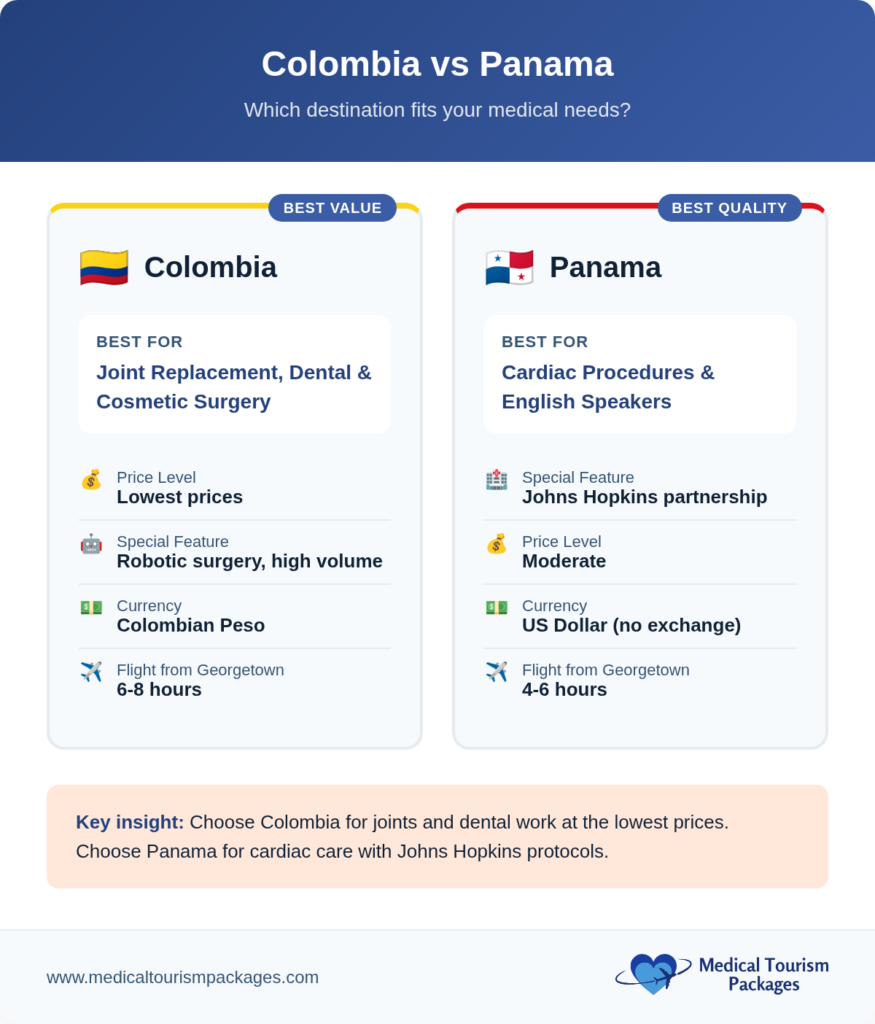
Colombia offers lower prices and higher surgical volumes. Panama provides Johns Hopkins affiliation and U.S. dollar transactions. Your choice depends on your procedure type and priorities.
Choose Colombia for:
- Joint replacements (lowest prices, robotic technology)
- Dental procedures (40-50% lower costs)
- Cosmetic surgery (Medellín specialization)
- Budget-conscious patients
Choose Panama for:
- Cardiac procedures (Johns Hopkins partnership)
- Patients who prefer English communication
- U.S. dollar transactions (no currency exchange)
- Proximity to Georgetown (shortest flights)
How Long Should You Stay for Different Medical Procedures?
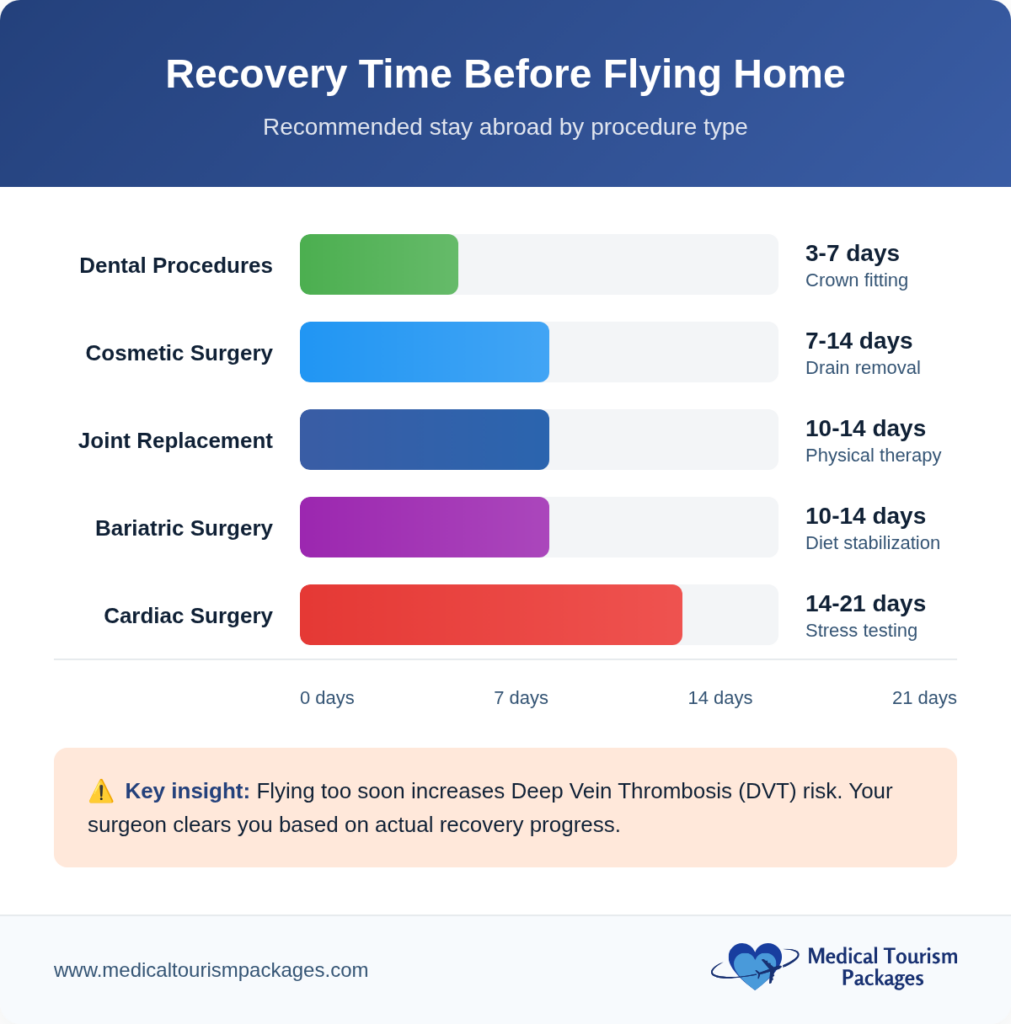
Your stay length depends on medical safety, not convenience. Flying too soon after surgery increases DVT risk. Deep Vein Thrombosis occurs when blood clots form during immobility. Clots can travel to your lungs during flight. This condition can be fatal. Proper recovery time is essential before air travel.
| Procedure Type | Recommended Stay | Key Recovery Needs |
|---|---|---|
| Dental Procedures | 3-7 days | Infection monitoring, crown fitting |
| Cosmetic Surgery | 7-14 days | Drain removal, wound monitoring |
| Joint Replacement | 10-14 days | Physical therapy, DVT prevention |
| Bariatric Surgery | 10-14 days | Diet stabilization, leak monitoring |
| Cardiac Surgery | 14-21 days | Cardiovascular monitoring, stress testing |
Why Is Recovery Time Important Before Flying?
DVT risk increases with both surgery and air travel. Anesthesia and immobility during surgery promote clot formation. Cabin pressure changes during flight further increase risk. Joint replacement carries the highest DVT risk. Hip and knee surgery disrupts blood flow in major leg vessels.
You receive blood thinners and compression stockings as standard prevention. You still need 10-14 days before flying. This lets your mobility improve and blood flow normalize.
What Are Hospital-Integrated Recovery Facilities?
Panama and Colombia use a hospital-integrated recovery model. You recover in medical hotels within the hospital complex. Nursing staff have direct access to you. These recovery centers provide immediate access to your surgical team.
Nurses check vital signs daily. They monitor wounds and identify complications early. Physical therapy starts in a controlled clinical environment. Therapists work with you daily. Medical hotel rooms cost $85-$120 per night. This is comparable to regular hotels but includes medical oversight.
When Can You Fly Home After Surgery?
Book return flights as flexible tickets when possible. Your surgeon gives final clearance based on your actual recovery. This may differ from estimated timelines. Confirm clearance at your final post-operative appointment. Your surgeon checks wounds, reviews mobility, and assesses DVT risk before authorizing air travel.
What Are the Disadvantages of Medical Tourism for Guyanese?
Medical tourism has limitations Guyanese patients should understand. Distance from home creates challenges. Language barriers may exist. Follow-up care requires planning. Not every patient is a good candidate for medical travel.
What Complications Can Occur After Returning Home?
Complications after returning to Guyana can be difficult to manage. Your surgeon is in another country. Local doctors may not be familiar with your procedure. Infection, blood clots, or wound issues require immediate attention. You may need emergency care that Guyanese hospitals cannot provide.
Plan for this possibility before traveling. Identify a local doctor willing to manage post-operative issues. Keep detailed records of your procedure. Know the warning signs that require immediate medical attention.
Is Medical Tourism Right for Every Patient?
Medical tourism is not suitable for all patients. Patients with unstable conditions should not travel. Those who cannot tolerate long flights should reconsider. Patients without a travel companion face additional challenges. People who cannot take 2-3 weeks away from work may struggle.
Consider your overall health before committing. Discuss medical travel with your local doctor first. Some conditions require local monitoring that distance makes impossible.
What Are the Risks of Distance from Your Surgeon?
Your relationship with your surgeon ends when you leave the country. Most communication happens through email or phone. Physical examinations are not possible. Your surgeon cannot assess complications in person. Emergency interventions require finding local care.
Choose hospitals with established international patient programs. These facilities have protocols for managing distant patients. They coordinate with local providers when needed.
Why Should Guyanese Residents Consider Medical Tourism?
Medical tourism solves problems Guyana’s healthcare system cannot address. You get immediate access to JCI-accredited hospitals unavailable at home. Hospital Punta Pacifica partners with Johns Hopkins Medicine. Colombia operates five JCI-accredited hospitals. These facilities have dedicated international patient departments.
What Access Do You Gain Through Medical Tourism?
Wait times disappear. You schedule procedures within 2-4 weeks instead of waiting months. Advanced medical technology provides superior precision. Robotic-assisted surgery and hybrid operating rooms are standard. Higher surgical volumes build expertise. Colombian cardiac surgeons perform bypass procedures weekly. Orthopedic teams complete 15-20 joint replacements per week.
Is Medical Tourism Safe for Guyanese Patients?
Yes, medical tourism is safe when you choose JCI-accredited facilities. Success rates reach 99.9% for joint replacements. Infection rates match U.S. benchmarks. Emergency response is immediate. Hospital-integrated recovery facilities mean nurses check on you daily. Your surgeon is minutes away if problems arise.
Are Total Costs Lower Than Guyana Private Facilities?
Yes, total trip costs often run lower than Guyana private facility prices. A hip replacement in Bogotá costs $11,850 all-inclusive. Compare this to $12,000-$16,000 for just the surgery in Georgetown. You get JCI-certified care, robotic precision, and hospital-integrated recovery.
Guyanese residents share these challenges with patients across the region. Like other Caribbean medical tourists, they find better options abroad. Medical tourism delivers immediate access to quality care. You avoid months of waiting. You access better equipment. You pay comparable or lower prices.
What Questions Do Guyanese Medical Tourists Ask Most Often?
How Long Should I Stay for My Medical Procedure?
Stay length depends on your procedure type. Dental work requires 3-7 days. Cosmetic surgery needs 7-14 days for drain removal and wound monitoring. Joint replacements require 10-14 days for physical therapy. Cardiac surgery needs 14-21 days for cardiovascular monitoring. Never fly before your surgeon clears you.
Do Guyanese Citizens Need a Visa for Medical Tourism?
No, Guyanese passport holders need no visa for Panama, Colombia, or Mexico. Panama allows 180 days visa-free. Colombia allows 90 days, extendable to 180 days. Mexico allows 180 days. You need only a valid passport with six months remaining validity and proof of return travel.
Are Hospitals in Colombia and Panama Accredited?
Yes, top hospitals hold JCI accreditation. JCI is the global gold standard for hospital quality and patient safety. Panama’s Hospital Punta Pacifica has a Johns Hopkins Medicine affiliation. Colombia operates five JCI-accredited hospitals. Guyana has no JCI-accredited hospitals, only ISO certifications.
What Happens If I Have Complications After Returning Home?
Plan for complications before traveling. Identify a local doctor willing to manage post-operative issues. Keep detailed records of your procedure and medications. Most international patient departments provide follow-up support via phone and email. Serious complications may require local emergency care in Georgetown.
Is It Safe to Fly After Surgery?
Flying too soon increases Deep Vein Thrombosis risk. DVT occurs when blood clots form during immobility. Clots can travel to your lungs during flight. Wait times vary by procedure: 3-5 days for dental, 14 days for cosmetic and orthopedic surgery. Your surgeon gives final clearance based on your actual recovery.
How Much Can I Save Compared to Guyana Private Hospitals?
Total trip costs often equal or beat Guyana private facility prices. A hip replacement in Bogotá costs $11,850 all-inclusive. This compares to $12,000-$16,000 for just the surgery in Georgetown. You get JCI-accredited care, robotic precision, and hospital-integrated recovery for the same price or less.
Should I Choose Colombia or Panama for My Procedure?
Choose Colombia for joint replacements, dental work, and cosmetic surgery. Colombia offers the lowest prices and highest surgical volumes. Choose Panama for cardiac procedures. Hospital Punta Pacifica has a Johns Hopkins partnership. Panama also offers shorter flights and U.S. dollar transactions.
Ready to Start Your Medical Journey from Guyana?
Medical Tourism Packages coordinates your entire healthcare journey from Guyana to Colombia or Panama. We connect you with JCI-accredited hospitals and certified surgeons. We arrange your travel and accommodations with bilingual support throughout your treatment. Get a free consultation to discuss your health goals and receive a personalized quote.
Contact us today to start planning your affordable medical care abroad.