Book Appointment Now

Medical Tourism for Cayman Islands Residents: Complete Guide to Affordable Healthcare in Colombia and Panama
 By
By
The Cayman Islands offers quality healthcare through JCI-accredited hospitals. Health City and Doctors Hospital deliver excellent care. Yet premium pricing puts many procedures out of reach. A cardiac bypass costs $25,000-$32,000 locally. Hip replacements run $12,000-$15,000. These prices create barriers even for insured families.
Medical tourism solves this problem. Colombia and Panama offer the same procedures at 30-50% lower costs. You access JCI-certified hospitals with U.S.-trained surgeons. A cardiac bypass costs $18,000-$24,000 in Panama City. Hip replacement runs $8,000-$11,500 in Bogotá. Total savings cover your flights, accommodation, and recovery stay.
Direct flights connect Grand Cayman to Panama City in 5-6 hours through Miami. Copa Airlines operates daily service. Colombia requires 6-8 hours with one connection. Most nationalities need no visa for stays up to 90-180 days.
This guide shows you exactly what medical tourism costs. You’ll learn which procedures deliver the best value. We cover travel logistics, hospital selection, and recovery planning.
What Is the Current State of Healthcare in the Cayman Islands?
The Cayman Islands operates three primary hospitals on Grand Cayman. Each serves a distinct market niche. Health City Cayman Islands is a 110-bed facility with JCI Gold Seal accreditation. Dr. Devi Shetty founded it to bring high-volume cardiac care to the Caribbean.
Health City Camana Bay represents a $100 million investment. It houses a specialized Cancer Care Center and NICU. Doctors Hospital is an 18-bed boutique facility. It holds JCI 8th Edition accreditation—the most rigorous standard available. The hospital operates a 500-slice CT scanner and AI-integrated MRI machines.
The Health Services Authority runs the 127-bed Cayman Islands Hospital. Its Accident & Emergency department is the best-equipped trauma center in the islands.
For detailed information on Colombian facilities, see our comprehensive guide to medical tourism in Colombia.
Read our complete guide to medical tourism in Panama for more planning tips.
What Capacity Limitations Exist in Cayman Islands Hospitals?
Despite quality facilities, the Cayman Islands operates a premium pricing model. Cardiac bypass surgery costs $25,000-$32,000. Joint replacements run $12,000-$16,000. Advanced imaging and specialized procedures carry premium rates.
The hospitals deliver excellent care. But financial barriers prevent many residents from accessing it. Limited capacity also creates wait times for certain procedures. You may need to schedule weeks or months in advance.
What Procedures Do Cayman Residents Struggle to Access Affordably?
Cayman residents face high costs for major procedures. Cardiac bypass costs $25,000-$32,000. Joint replacements run $12,000-$16,000. These prices exceed what many families can pay out of pocket.
| Medical Service | Reality in Cayman Islands | What It Costs |
|---|---|---|
| Cardiac Bypass Surgery | Available at Health City | $25,000-$32,000 |
| Hip Replacement | Available but expensive | $12,000-$15,000 |
| Knee Replacement | Available but expensive | $12,000-$16,000 |
| Gastric Bypass | Available at select facilities | $5,200-$8,000 |
| All-on-4 Dental | Private dentists, premium pricing | $12,000+ estimated |
| IVF Cycle | Cayman Fertility Centre available | $6,750 |
| Advanced Imaging | 500-slice CT, AI-MRI available | Premium pricing |
How Much Can Cayman Residents Save with Medical Tourism?
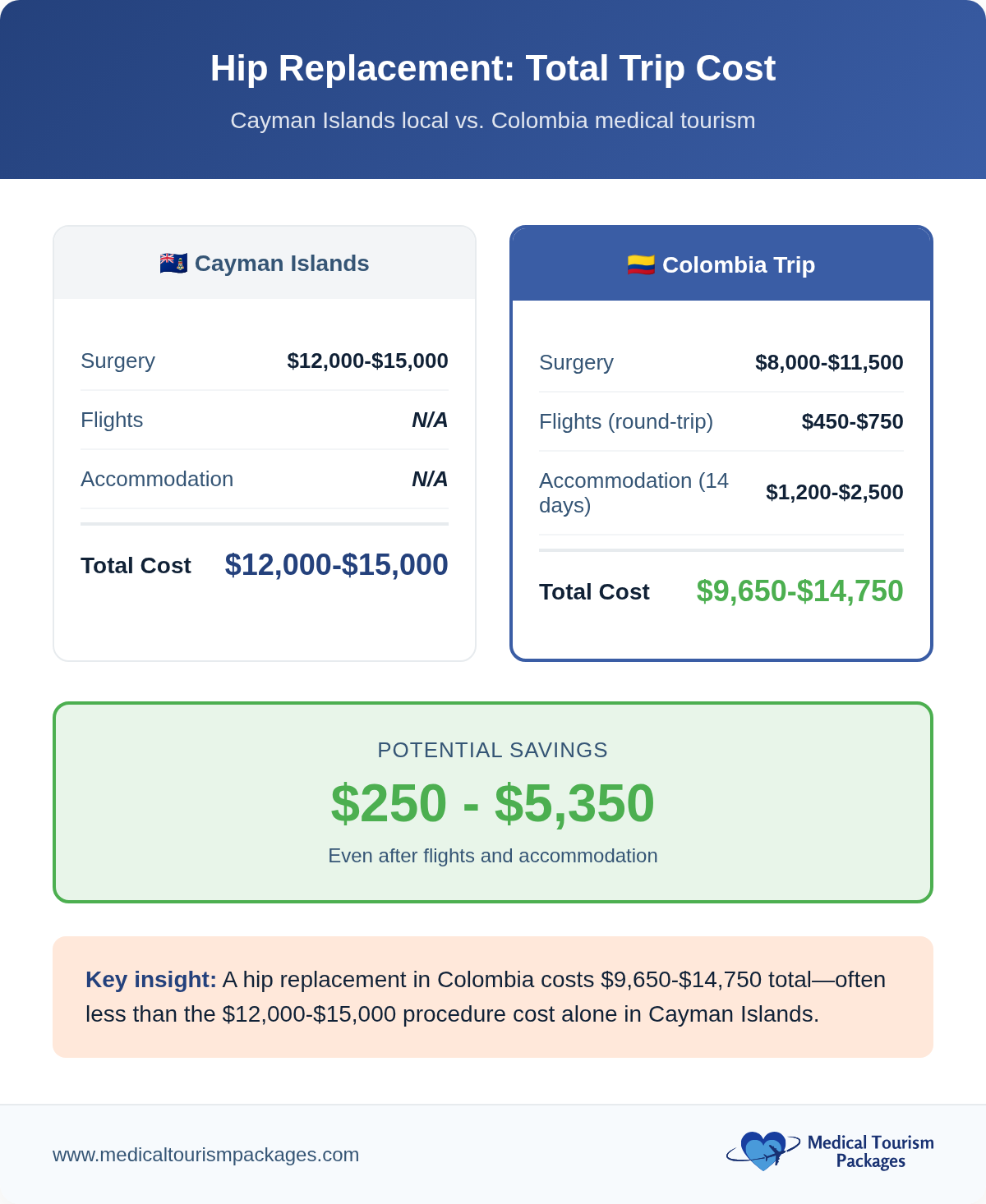
Cayman residents save 40-70% on medical procedures abroad versus U.S. pricing. Against local premium pricing, savings range from modest to substantial. Hip replacement in Colombia costs $8,000-$11,500 versus $12,000-$15,000 locally. That’s a $3,500-$7,000 savings.
Cardiac bypass in Panama runs $18,000-$24,000 versus $25,000-$32,000 at home. Even after adding flights and accommodation, total trip cost often beats local prices.
How Do Panama’s Medical Costs Compare to Cayman Islands?
Panama offers significant savings on major procedures. Cardiac bypass costs $18,000-$24,000 versus $25,000-$32,000 in Cayman. Hip replacement runs $11,000-$13,000. You save $1,000-$5,000 on orthopedic procedures.
| Procedure | Cayman Islands | Panama | USA Cost | Savings vs USA |
|---|---|---|---|---|
| Heart Bypass (CABG) | $25,000-$32,000 | $18,000-$24,000 | $144,000 | $120,000-$126,000 |
| Angioplasty | $13,000-$15,000 | Similar range | $57,000 | $42,000-$44,000 |
| Hip Replacement | $12,000-$15,000 | $11,000-$13,000 | $39,299 | $26,000-$28,000 |
| Knee Replacement | $12,000-$16,000 | $12,000-$14,000 | $50,000 | $34,000-$38,000 |
| Gastric Sleeve | $5,200-$8,000 | $5,500-$8,000 | $23,000 | $15,000-$17,500 |
| Single Dental Implant | $800-$1,500 | $900-$1,500 | $3,000-$6,000 | $1,500-$5,100 |
| Rhinoplasty | Not detailed | $1,500-$2,500 | $8,000-$15,000 | $5,500-$13,500 |
Hospital Punta Pacifica holds the only Johns Hopkins Medicine International affiliation in Central America. The facility follows Johns Hopkins protocols and quality standards. About 40% of physicians are U.S. board-certified.
Panama uses the U.S. dollar. This eliminates currency exchange risk. You pay exactly what’s quoted with no conversion surprises. English proficiency is high among medical staff. Doctor consultations cost $50-$60. A teeth cleaning runs just $25.
How Do Colombia’s Medical Costs Compare to Cayman Islands?
Colombia offers the largest savings for Cayman residents. Hip replacement costs $8,000-$11,500 versus $12,000-$15,000 locally. You save $3,500-$7,000. Cardiac bypass runs $18,000-$22,000 versus $25,000-$32,000 at home.
| Procedure | Cayman Islands | Colombia | USA Cost | Savings vs USA |
|---|---|---|---|---|
| Heart Bypass (CABG) | $25,000-$32,000 | $18,000-$22,000 | $144,000 | $122,000-$126,000 |
| Hip Replacement | $12,000-$15,000 | $8,000-$11,500 | $39,299 | $27,800-$31,000 |
| Knee Replacement | $12,000-$16,000 | $8,000-$12,000 | $50,000 | $38,000-$42,000 |
| All-on-4 Dental | $12,000+ estimated | $8,000-$12,000 | N/A | Up to $4,000 vs Cayman |
| Gastric Sleeve | $5,200-$8,000 | $4,500-$7,000 | $23,000 | $16,000-$18,500 |
| Single Dental Implant | $800-$1,500 | $700-$1,200 | $3,000-$6,000 | $1,800-$5,300 |
| Rhinoplasty | Not detailed | $2,500-$4,500 | $8,000-$15,000 | $3,500-$12,500 |
| MRI Scan | Very limited availability | $250-$500 | Higher | Substantial savings |
Colombia treats 200,000-600,000 international patients annually. The country operates five JCI-accredited hospitals. These facilities contain 40% of Latin America’s best clinics.
Hip and knee replacement success rates reach 99.9%. Plastic surgery patients report a 98.2% referral rate. Infection rates run 2.1 per 1,000 patient days. This matches or beats U.S. hospital benchmarks.
Colombia leads the region in robotic-assisted orthopedic surgery. Bogotá specializes in cardiology and complex procedures. Medellín serves as the cosmetic surgery and dentistry hub.
How Do Colombia and Panama Compare for Cayman Patients?
Colombia and Panama each offer distinct advantages. Your choice depends on procedure type and priorities. Colombia delivers the lowest prices for orthopedics and cosmetics. Panama offers Johns Hopkins oversight and U.S. dollar transactions.
| Factor | Colombia | Panama |
|---|---|---|
| Best Procedures | Orthopedics, cosmetics, dental | Cardiac, complex surgery |
| Price Advantage | 40-50% lower than Cayman | 25-35% lower than Cayman |
| Hospital Affiliation | JCI-accredited facilities | Johns Hopkins partnership |
| Currency | Colombian peso | U.S. dollar (no exchange risk) |
| Travel Time | 6-8 hours via Miami | 5-6 hours via Miami |
| English Proficiency | Bilingual coordinators available | High among medical staff |
How Do Mexico’s Medical Costs Compare to Cayman Islands?
Mexico offers competitive pricing for dental work and bariatric surgery. Single implants cost $800-$1,200—the lowest prices among all destinations. Gastric sleeve runs $4,000-$7,000.
| Procedure | Cayman Islands | Mexico | Savings vs USA |
|---|---|---|---|
| Hip Replacement | $12,000-$15,000 | $13,000-$17,000 | $23,000-$43,000 |
| Knee Replacement | $12,000-$16,000 | $12,000-$16,000 | $19,000-$38,000 |
| Single Dental Implant | $800-$1,500 | $800-$1,200 | $1,800-$4,800 |
| All-on-4 Dental | $12,000+ estimated | $8,000-$12,000 | Up to $4,000 |
| Gastric Sleeve | $5,200-$8,000 | $4,000-$7,000 | $8,000-$16,000 |
| Rhinoplasty | Not detailed | $3,000-$5,000 | $3,000-$12,000 |
Mexico attracts 1.2 to 3 million medical tourists each year. This is more than any other Latin American country. The country specializes in dental work. Mexico City operates more Da Vinci robotic surgery platforms than any other Mexican city.
JCI-accredited facilities include Hospital Médica Sur and Centro Médico ABC. These hospitals partner with Mayo Clinic and Houston Methodist Hospital. About 80% of specialists in elite hospitals speak both English and Spanish.
How Do You Travel from Cayman Islands for Medical Care?
Owen Roberts International Airport serves as a major Caribbean aviation hub. Direct flights connect Grand Cayman to Miami in just 1 hour 15 minutes. Additional direct routes reach Atlanta, Charlotte, New York, and Toronto.
This connectivity makes medical tourism straightforward. You connect through Miami to reach Panama, Colombia, or Mexico. If complications arise during your trip, medical evacuation to Miami takes just two hours. This proximity provides a critical safety net.
What Flight Connections Are Available from Grand Cayman?
Multiple airlines connect Grand Cayman to medical tourism destinations. Panama City is the fastest option at 5-6 hours total. Colombia requires 6-8 hours with one connection through Miami or Panama.
| Destination | Primary Airline | Travel Time | Typical Fare (Round Trip) |
|---|---|---|---|
| Panama City | Copa/American/Spirit via Miami | 5-6 hours total | $400-$600 |
| Bogotá | Via Miami or Panama | 6-8 hours total | $450-$750 |
| Medellín | Via Miami or Panama | 6-8 hours total | $500-$800 |
| Mexico City | Via Miami or Atlanta | 5-8 hours total | $480-$900 |
Book connections with at least 2-3 hours between flights. This buffer protects you if your first flight delays. Caribbean weather can cause departure delays during summer months.
Consider purchasing flexible tickets. Your procedure schedule may shift by a day or two. Flexible tickets let you modify travel dates without paying change fees.
What Are the Visa Requirements for Cayman Residents?
Most nationalities enter Panama, Colombia, and Mexico visa-free. You need only a valid passport and return ticket. All three countries allow stays that exceed typical medical tourism timelines.
| Country | Visa Status for Most Nationalities | Maximum Stay | Requirements |
|---|---|---|---|
| Panama | Visa-Free | 90-180 days | Valid passport, return ticket |
| Colombia | Visa-Free | 90-180 days | Valid passport with 6 months validity |
| Mexico | Visa-Free | 180 days | Valid passport, tourist card on flight |
Cayman residents should verify specific requirements based on passport nationality. British Overseas Territory passport holders typically face no restrictions. Other passport holders may need to check with the destination embassy.
When Is the Best Time to Travel for Medical Care?
The best months for medical tourism are November through mid-December. Late April through May also offers ideal conditions. Weather is pleasant during these periods. Accommodation prices remain reasonable.
Avoid traveling from August through October. Hurricane season peaks during these months. Storms can disrupt flights and delay your return home. High humidity complicates wound healing. The heat increases infection risk for surgical sites.
July brings extreme humidity even without hurricanes. This makes recovery uncomfortable. December through April is high season across Latin America. Accommodation costs spike 30-50% during these months. May and October are shoulder seasons. You get lower costs with manageable climate risks.
What Medical Procedures Should Cayman Residents Access Abroad?
Medical tourism makes the most sense for high-cost procedures. Cardiac surgery, joint replacements, dental work, and cosmetic procedures offer the strongest value. These procedures cost thousands less abroad even after adding travel expenses.
You access JCI-accredited hospitals with surgeons trained at top institutions. The quality matches or exceeds what’s available locally. The difference is price.
How Much Do Cardiac Procedures Cost Abroad?
Cardiac procedures deliver the largest savings for Cayman patients. Bypass surgery costs $18,000-$24,000 in Panama versus $25,000-$32,000 locally. You save $7,000-$14,000 on this single procedure.
Health City Cayman Islands performs cardiac bypass surgery for $25,000-$32,000. This represents quality care from the Narayana Health network. However, you can access the same quality abroad for less.
Hospital Punta Pacifica in Panama City operates under Johns Hopkins protocols. Cardiac bypass costs $18,000-$24,000. The facility provides 24/7 cardiac monitoring and full ICU capabilities.
Bogotá’s cardiac programs charge $18,000-$22,000 for bypass surgery. Multiple surgeon options give you flexibility. Fundación Cardioinfantil specializes in complex valve replacements.
The clinical outcomes justify traveling for cardiac care. The Narayana/HCCI network reports 30-day CABG mortality of 1.4%. The U.S. benchmark sits at 1.9%. These aren’t budget hospitals. They’re world-class cardiac centers that charge less.
How Much Do Orthopedic Procedures Cost Abroad?
Orthopedic procedures offer substantial savings in Colombia. Hip replacement costs $8,000-$11,500 versus $12,000-$15,000 locally. You save $3,500-$7,000 per procedure. Knee replacement runs $8,000-$12,000 versus $12,000-$16,000 at home.
Colombia leads the region in robotic-assisted orthopedic surgery. These systems use 3D imaging to plan exact joint placement. Sub-millimeter precision ensures optimal alignment. This reduces complications and improves outcomes.
Colombian facilities report 99.9% success rates for hip and knee replacements. Multiple hospital options give you choices. Limited capacity in Cayman may force you to wait weeks or months.
Panama charges $11,000-$14,000 for joint replacement. You save $1,000-$5,000 versus Cayman pricing. Mexico offers hip replacement with Da Vinci robotics for $13,000-$17,000.
Recovery timelines favor medical tourism. You spend 7-10 days in Colombia or Panama. Physical therapy begins the day after surgery. Your surgical team monitors progress daily.
How Much Does Dental Care Cost Abroad?
Dental procedures offer quick treatment with minimal recovery time. All-on-4 restoration costs $8,000-$12,000 in Medellín versus $12,000+ in Cayman. You save up to $4,000 while accessing high-volume specialists.
Single implants cost $700-$1,200 in Colombia. Panama charges $900-$1,500. Mexico offers the lowest prices at $800-$1,200. These prices include the implant, abutment, and crown.
Panama makes routine care affordable too. Teeth cleaning costs $25. Whitening runs $100. Crowns cost $500. You can maintain dental health at a fraction of local costs.
Dental tourism requires just 3-7 days total. You fly in, complete treatment, and return home. High-volume dental centers handle international patients daily. The dentists speak English. The facilities meet international standards.
How Much Do Bariatric and Cosmetic Procedures Cost Abroad?
Bariatric surgery offers 60% savings versus U.S. pricing. Gastric sleeve costs $4,500-$7,000 in Colombia versus $5,200-$8,000 locally. Panama charges $5,500-$8,000. Mexico delivers the best value at $4,000-$7,000.
Medellín is Latin America’s cosmetic surgery capital. The city reports a 98.2% referral rate for plastic surgery patients. Surgeons perform hundreds of procedures monthly. This volume builds expertise.
Tummy tucks cost $4,000-$6,000 in Colombia and Mexico. Panama charges $2,500-$5,000. Rhinoplasty runs $2,500-$4,500 in Colombia. Panama offers rhinoplasty for $1,500-$2,500. Mexico charges $3,000-$5,000.
Hospital Punta Pacifica provides 24/7 emergency coverage during cosmetic surgery recovery. This safety net matters when you’re far from home. Complications are rare but possible.
How Long Should You Stay for Different Medical Procedures?
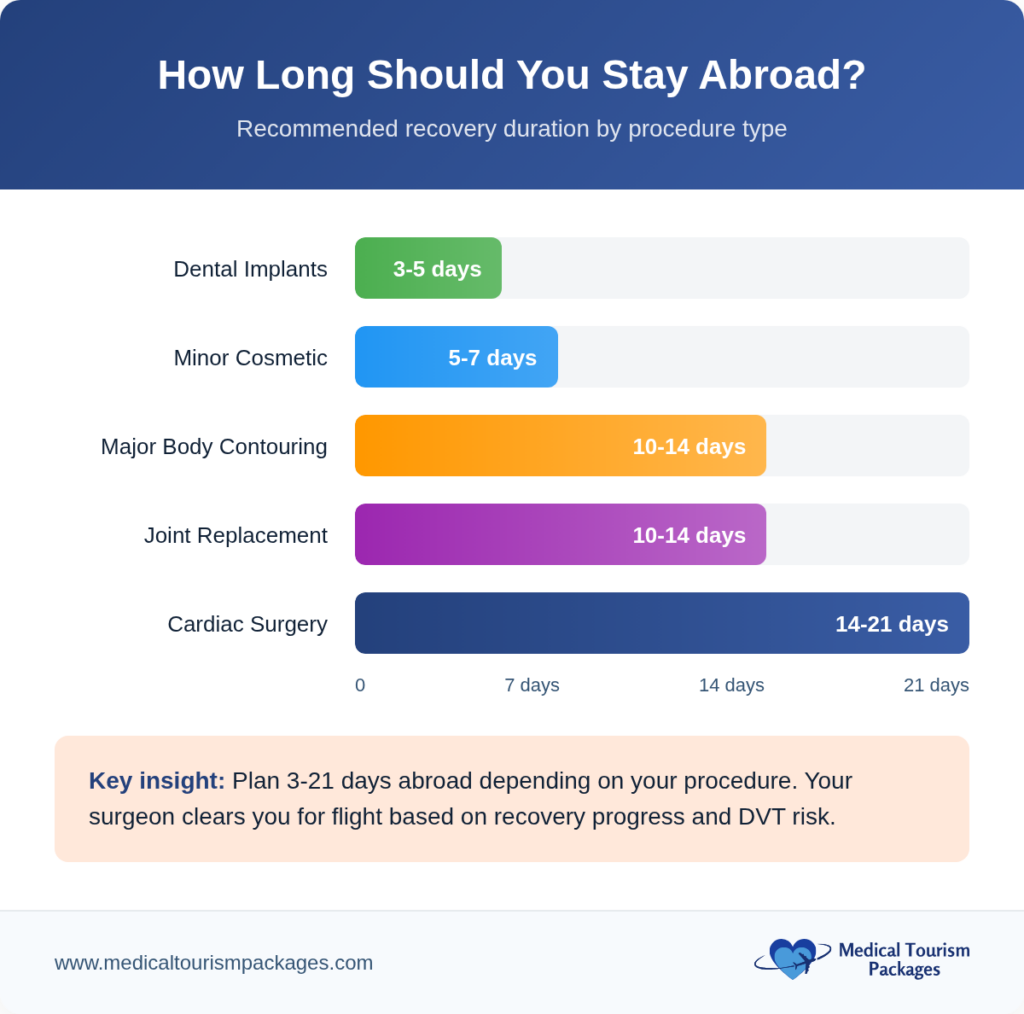
Stay duration depends on your procedure type. Dental work requires just 3-5 days. Cardiac surgery needs 14-21 days for safe recovery before flying.
| Procedure | Recommended Stay | Key Recovery Needs |
|---|---|---|
| Dental Implants | 3-5 days | Monitor tissue integration |
| Minor Cosmetic (lipo, injectables) | 5-7 days | Manage swelling, pressure garment checks |
| Major Body Contouring (tummy tuck, BBL) | 10-14 days | Drain removal, wound care |
| Joint Replacement | 10-14 days | Physical therapy, DVT prevention |
| Cardiac Surgery | 14-21 days | Cardiac monitoring, medication adjustment |
Your surgeon clears you for flight based on recovery progress. Don’t rush this timeline. Flying too soon increases your risk of Deep Vein Thrombosis (DVT). Blood clots can form during immobility. Your medical team monitors specific markers before approving travel.
Most international hospitals use a hospital-integrated recovery model. You stay in purpose-built medical hotels near the hospital campus. Nursing staff communicate directly with your surgical team. This isn’t a regular hotel. It’s a recovery center designed for post-surgical care.
Physical therapy begins in a controlled clinical environment. Joint replacement patients start mobility exercises the day after surgery. Early intervention improves long-term outcomes.
Why Should Cayman Residents Consider Medical Tourism?
Medical tourism lets you access the same or superior quality care at lower costs. You bypass capacity limitations in the Cayman system. JCI-accredited hospitals in Panama, Colombia, and Mexico meet rigorous international standards.
The surgeons trained at institutions in the United States, Canada, or Europe. They bring that expertise to Latin America. Lower operating costs allow lower pricing. You’re not choosing between quality and affordability. You’re accessing both.
What Are Panama’s Key Advantages?
Panama offers Johns Hopkins oversight and U.S. dollar transactions. Hospital Punta Pacifica is the only Johns Hopkins Medicine International affiliation in Central America. This partnership ensures consistent quality standards.
- Hospital Punta Pacifica: Only Johns Hopkins affiliation in Central America
- Johns Hopkins protocols: Same quality standards used in Baltimore
- U.S. board-certified physicians: 40% of doctors hold U.S. certification
- U.S. dollar economy: No currency risk—you pay exactly what’s quoted
- High English proficiency: Medical staff speak English fluently
- Interventional cardiology leaders: Specialized expertise in cardiac procedures
- Specialized nursing: Ideal for complex post-operative monitoring
- Direct Copa Airlines flights: Grand Cayman to Panama City in 5-6 hours
What Are Colombia’s Key Advantages?
Colombia offers the highest patient volumes and lowest orthopedic prices. The country treats 200,000-600,000 international patients annually. Five JCI-accredited hospitals rank among the world’s best medical centers.
- High patient volume: 200,000-600,000 international patients annually
- Five JCI-accredited hospitals: Facilities ranking among world’s best
- Regional concentration: Contains 40% of Latin America’s top clinics
- Humanized medicine approach: Balances clinical excellence with patient comfort
- Robotic surgery leader: Regional leader in robotic-assisted orthopedics
- Low infection rates: 2.1 per 1,000 patient days—matches U.S. benchmarks
- Joint replacement success: 99.9% success rate for hip and knee procedures
- Cosmetic surgery satisfaction: 98.2% referral rate from plastic surgery patients
- Bogotá specialization: Cardiology and complex medical procedures
- Medellín expertise: Cosmetic surgery and dental care hub
- Bilingual coordinators: Patient coordinators available throughout your journey
What Are Mexico’s Key Advantages?
Mexico attracts more medical tourists than any other Latin American country. The country specializes in dental work and bariatric surgery. Single implants cost less than anywhere else in the region.
- Highest medical tourism volume: 1.2 to 3 million patients annually
- Bariatric and ophthalmology specialist: Centers of excellence for weight loss
- Da Vinci robotics: Most robotic platforms in Mexico City
- Lowest dental prices: Most affordable implant costs among all destinations
- JCI-accredited facilities: Hospital Médica Sur and Centro Médico ABC
- U.S. hospital partnerships: Collaborations with Mayo Clinic and Houston Methodist
- Bilingual specialists: 80% of elite hospital specialists speak English
- Advanced imaging: PET-CT scanners and elite diagnostic specialists
- Minimally invasive focus: Procedures designed for faster recovery
What Are the Disadvantages of Medical Tourism from Cayman Islands?
Medical tourism has real limitations. Extended travel adds 5-8 hours versus local treatment. You recover away from your family support network. These factors matter for your decision.
What Travel and Logistics Challenges Exist?
Travel requirements create practical challenges. Flights run $400-$900 round-trip. Accommodation costs $1,200-$3,500 for a 14-day stay. You need to arrange 10-21 days away from work depending on procedure type.
Hurricane season runs from June through November. Storms can disrupt flights and delay your return home. You must research and verify credentials of foreign surgeons yourself.
What Follow-Up Care Challenges Exist?
Recovery away from home separates you from family support. You cannot access Cayman medical facilities for immediate post-operative complications. You must coordinate follow-up care with local physicians upon return.
Some facilities have limited English proficiency. Major JCI hospitals provide bilingual staff. But smaller clinics may present language barriers.
What Insurance Considerations Apply?
Standard travel insurance excludes elective surgery complications. You need specialized medical tourism coverage. Verify your policy covers complications and medical evacuation before traveling.
Medical tourism insurance costs $100-$300 for comprehensive coverage. This protects you against unexpected complications. The cost is small relative to procedure savings.
Is Medical Tourism the Right Choice for Cayman Residents?
Medical tourism makes sense for expensive procedures where savings justify travel costs. You save $3,500-$14,000 on major procedures. Total trip cost including flights and accommodation provides better value than local pricing for many treatments.
The Cayman Islands has quality healthcare infrastructure. Health City and Doctors Hospital deliver excellent care. The challenge is cost. Premium pricing creates financial barriers for many residents.
JCI-accredited hospitals in Panama, Colombia, and Mexico meet the same standards. You’re not trading quality for savings. You’re accessing equivalent care at a lower price.
Medical tourism works best for cardiac surgery, joint replacements, and dental restoration. Bariatric surgery and cosmetic procedures also deliver strong savings. These treatments have predictable timelines that work with travel logistics.
Medical tourism isn’t ideal for everyone. Emergencies require immediate local care. Patients unable to travel should stay home. Those with strong family support needs may find recovery abroad difficult. Minor procedures where travel cost negates savings make no financial sense.
A $200 dental filling doesn’t justify a $600 flight. But a $12,000 joint replacement that costs $8,000 abroad changes the calculation. You save $4,000 even after spending $1,200 on travel and accommodation.
What Questions Do Cayman Medical Tourists Ask Most Often?
How long should I stay abroad for my procedure?
Stay duration depends on your procedure. Dental implants require 3-5 days. Joint replacements need 10-14 days. Cardiac surgery requires 14-21 days. Your surgeon clears you for flight based on your recovery progress.
Do I need a visa to travel to Colombia or Panama?
Most nationalities enter visa-free. Panama allows stays up to 90-180 days. Colombia permits 90-180 days. Mexico grants 180 days. You need only a valid passport and return ticket. Verify requirements based on your passport nationality.
Are the hospitals abroad JCI-accredited?
Yes. Colombia operates five JCI-accredited hospitals. Panama’s Hospital Punta Pacifica holds Johns Hopkins Medicine International affiliation. Mexico has multiple JCI-accredited facilities including Hospital Médica Sur. These hospitals meet the same standards as Cayman’s JCI-accredited facilities.
What happens if I have complications after returning home?
Coordinate with your local Cayman physician before traveling. The foreign hospital provides complete medical records. Schedule follow-up video conferences at one, three, and six months. Your local doctor monitors long-term recovery. Purchase medical tourism insurance that covers complications.
Is it safe to fly after surgery?
Flying too soon increases DVT risk. Your surgeon clears you based on specific recovery markers. This takes 3-21 days depending on procedure type. Wear compression stockings during flight. Walk frequently in the cabin. Stay hydrated throughout your journey.
Ready to Start Your Medical Journey from the Cayman Islands?
Medical Tourism Packages coordinates your entire healthcare journey from Grand Cayman to Colombia or Panama. We connect you with JCI-accredited hospitals and certified surgeons. We also arrange your travel and accommodations with bilingual support throughout your treatment. Get a free consultation to discuss your health goals and receive a personalized quote.
Contact us today to start planning your affordable medical care abroad.