Book Appointment Now

Maxillofacial Surgery in Costa Rica: Costs, Top Clinics, and Complete Guide
 By
By
Maxillofacial surgery in Costa Rica costs 60-70% less than the United States at JCI-accredited hospitals with fellowship-trained surgeons.
Double jaw surgery costs $12,000-$18,000 in San José or Escazú versus $40,000-$65,000 in the U.S. Board-certified maxillofacial surgeons at CIMA and Clínica Bíblica complete advanced fellowship training at U.S. and European institutions with international protocol alignment.
This guide covers procedure costs, hospital credentials, surgeon qualifications, and recovery timelines. You’ll find cost comparisons, facility profiles at top JCI-accredited hospitals, recovery planning information, and safety considerations for your treatment journey in Costa Rica’s private healthcare facilities.
What Is Maxillofacial Surgery?
Maxillofacial surgery treats conditions affecting the face, jaw, mouth, and skull. The field now includes complex craniofacial reconstructions beyond basic tooth extractions.
This specialty treats severe malocclusions that braces alone cannot fix. It addresses temporomandibular joint disorders causing jaw pain and limited movement. Surgeons repair facial trauma from accidents and reconstruct defects from disease. They also correct congenital anomalies like cleft lip and palate.
What Technology Do Costa Rican Maxillofacial Surgeons Use?
Costa Rican maxillofacial surgeons use advanced digital workflows. This includes Cone Beam Computed Tomography and 3D virtual surgical planning. The technology allows precise bone repositioning. It reduces operative risk significantly.
About 25% of patients with cleft deformities require orthognathic surgery in adulthood. This corrects midface hypoplasia that results from restricted growth after early childhood repairs. The complexity of these cases shows the advanced surgical capabilities available in Costa Rica’s private healthcare sector.
Why Choose Costa Rica for Maxillofacial Surgery?
Costa Rica’s medical tourism market reached $289 million in 2024. Projections show growth to $1.66 billion by 2033. This represents a compound annual growth rate of 19.12%. This expansion reflects deliberate investment in healthcare infrastructure and medical device manufacturing.
The nation offers several advantages for maxillofacial surgery patients. Costa Rica ranks as the 8th largest global exporter of medical devices. The country manufactures surgical instruments and implants used worldwide. Over 90 multinational MedTech corporations operate facilities here. These include Boston Scientific and Zimmer Biomet.
After abolishing its military in 1948, Costa Rica redirected defense spending into healthcare systems. Economic stability supports continued medical infrastructure development. The country projects 3.1% GDP growth through 2026.
This combination creates access to cutting-edge technology at costs 60-70% below U.S. rates. Costa Rican facilities in San José and Escazú use the same premium implant brands found in American hospitals. The savings come from lower overhead and favorable economic conditions. They don’t come from inferior materials or shortcuts in care.
How Much Does Maxillofacial Surgery Cost in Costa Rica?
Maxillofacial surgery in Costa Rica costs 40-80% less than the United States. The price difference applies across all procedure types. These range from single dental implants to complex double jaw surgery. These savings reflect structural economic advantages rather than reduced quality of care.
| Procedure | Costa Rica Cost | USA Cost | Savings % |
|---|---|---|---|
| Single Jaw Surgery | $8,000–$12,000 | $25,000–$40,000 | 60–70% |
| Double Jaw Surgery | $12,000–$18,000 | $40,000–$65,000 | 65–72% |
| TMJ Arthroscopy | $3,000–$5,000 | $10,000–$15,000 | 60–70% |
| TMJ Joint Replacement | $8,000–$12,000 | $25,000–$35,000 | 65–70% |
| All-on-4 (per arch) | $9,000–$15,000 | $24,000–$40,000 | 60–70% |
| Single Dental Implant | $800–$1,600 | $3,000–$5,000 | 65–75% |
What Creates Costa Rica’s Cost Advantages?
Costa Rica’s cost advantages come from three main factors. The country has no military spending. Those funds go directly into healthcare infrastructure. Lower administrative overhead and malpractice insurance costs reduce facility expenses. Domestic MedTech manufacturing eliminates import markups on surgical materials and implants.
The Colegio de Cirujanos Dentistas de Costa Rica sets minimum fee schedules called Aranceles Mínimos. These regulations establish a quality floor. They prevent destructive price competition. You won’t find suspiciously low prices that signal cut corners or unqualified providers.
What Are the Top Hospitals and Clinics in Costa Rica?
Costa Rica’s leading maxillofacial facilities concentrate in San José and Escazú. These institutions hold international accreditations that confirm adherence to rigorous safety standards.
| Facility | Location | Accreditation | Key Features |
|---|---|---|---|
| Hospital CIMA | Escazú | JCI (since 2008) | Baylor affiliation, specialized maxillofacial ORs, premier Central America facility |
| Hospital Clínica Bíblica | San José | JCI (15+ years) | First JCI in Central America, Omega Tower dental centers |
| Advance Dental Costa Rica | CIMA complex | AAAASF | North American outpatient protocols |
| Goodness Dental | San José | Multi-specialty | Integrated prosthodontics, periodontics, endodontics teams |
| Prisma Dental | San José | High satisfaction | Clinical team expertise, personalized care |
How Do Costa Rican Hospitals Maintain Safety Standards?
Costa Rican private hospitals maintain infection control protocols aligned with WHO and CDC guidelines. Recent 2024 audits show 82% adherence for sterilization practices. The hospital-acquired infection rate stands at 4.8 per 1,000 patient days. This is competitive with Western European nations.
Medication management systems achieve 74% implementation for safety practices. Clinical pharmacy teams intercept the majority of potential errors before they reach patients. This robust safety net is standard at JCI-accredited facilities in San José and Escazú.
Who Are the Leading Maxillofacial Surgeons in Costa Rica?
The leading maxillofacial surgeons in Costa Rica are board-certified specialists with extensive fellowship training. These surgeons complete a rigorous multi-stage training pathway. It begins with a six-year medical degree from an accredited university. This is followed by a four-year residency in orthopedics and traumatology. After residency, they pursue a one to two-year fellowship specifically in maxillofacial surgery or microsurgery.
Fellowship training often occurs at premier centers in the United States or top-tier Latin American institutions. These institutions are known for high surgical volume and technical innovation. Many surgeons are members of professional societies including the International Association of Oral and Maxillofacial Surgeons. They also hold certifications from the Colegio de Cirujanos Dentistas de Costa Rica.
Most specialized maxillofacial surgeons at JCI-accredited facilities in San José and Escazú are fluent in English. They provide care specifically designed for international patients.
What Are the Main Steps for Planning Maxillofacial Surgery in Costa Rica?
Planning maxillofacial surgery in Costa Rica requires careful preparation and verification. Following these steps ensures you select qualified providers. It helps you budget properly for your complete treatment journey.
How Should You Research and Select Providers?
Start your planning with thorough provider vetting. Schedule virtual consultations using video calls. This lets you evaluate your surgeon’s bedside manner and English proficiency before booking travel. Verify accreditations directly by checking JCI or AAAASF websites. This confirms current facility certifications. Confirm implant brands by insisting on globally recognized manufacturers like Straumann or Nobel Biocare. These come with international warranties.
Watch for red flags that indicate substandard providers. Avoid clinics that refuse to disclose manufacturers. Steer clear of those that pressure you for deposits without clinical review. Don’t work with facilities offering pricing 80-90% below standard rates. The typical savings range is 60-70%. Extreme discounts often signal problems.
What Documentation and Travel Requirements Apply?
Prepare your materials before departure. Carry printed appointment confirmations with physical copies of your surgical plan. These are for Costa Rican immigration processing. Reputable surgeons require complete medical history before accepting patients. Ensure your clinic provides X-rays, 3D surgical plans, and operative reports. You’ll need these for your domestic doctor.
U.S., Canadian, and European Union citizens can enter Costa Rica visa-free. Stays up to 90 days are permitted. Your passport must remain valid for at least six months from your entry date. Carry printed medical appointment confirmations. This facilitates smooth immigration processing.
How Long Should You Stay in Costa Rica After Surgery?
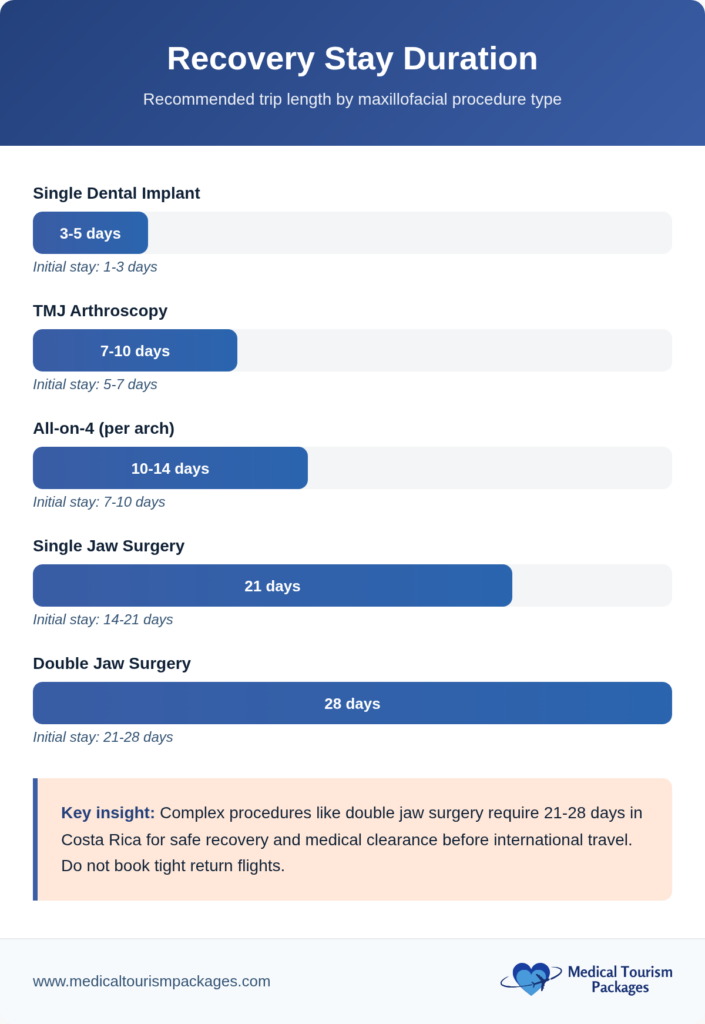
Plan your trip length based on procedure complexity and required monitoring periods. The table below shows recommended timelines for common procedures.
| Procedure | Initial Stay | Total Trip |
|---|---|---|
| Single Dental Implant | 1–3 days | 3–5 days |
| All-on-4 | 7–10 days | 10–14 days |
| Single Jaw Surgery | 14–21 days | 21 days |
| Double Jaw Surgery | 21–28 days | 28 days |
| TMJ Arthroscopy | 5–7 days | 7–10 days |
Do not book tight return flights. These durations include necessary follow-up appointments and clearance for international travel. Major procedures require no-fly periods. This prevents complications from cabin pressure changes.
What Recovery Accommodations Are Available?
Costa Rica pioneered the surgical retreat model for post-operative patients. Facilities like Las Cumbres Inn in Escazú provide professional nursing staff. They offer medical-grade meal preparation with soft foods for jaw surgery patients. They coordinate transportation to all follow-up appointments.
These specialized accommodations allow professional monitoring during the critical first 72 hours post-surgery. This is when complications like hematomas or infections are most likely to manifest. Stay within 15-20 minutes of your surgical facility in San José or Escazú. This ensures quick access for post-operative visits.
Read our comprehensive guide for American medical tourists in Costa Rica for more planning tips.
What Types of Maxillofacial Procedures Are Available in Costa Rica?
Costa Rican maxillofacial surgeons perform the full spectrum of procedures. These range from routine dental implants to complex craniofacial reconstruction. The country’s established MedTech infrastructure and hospital facilities support both outpatient and high-complexity surgical cases.
| Procedure | Purpose | Technology/Technique | Success Metrics |
|---|---|---|---|
| Orthognathic Surgery | Corrects jaw misalignment | BSSO, Le Fort I, titanium stabilization, 3D planning | 94.1% satisfaction, 97.8% psychological improvement |
| TMJ Treatment | Resolves joint pain and dysfunction | Conservative to surgical ladder, custom 3D prostheses | Stable 2-year outcomes in complex cases |
| Facial Reconstruction | Repairs trauma, cancer, congenital defects | Distraction osteogenesis, custom implants | JCI hospital ICU support available |
| Cleft Palate Repair | Improves speech and aesthetics | Alveolar bone grafting, rhinoplasty | 33% average speech improvement |
| Dental Implants | Replaces missing teeth | All-on-4, zygomatic implants, CAD/CAM | 95% long-term success rate |
What Is Orthognathic Surgery?
Orthognathic surgery corrects severe jaw misalignment through precise bone repositioning. Surgeons use bilateral sagittal split osteotomy for the lower jaw. They use Le Fort I advancements for the upper jaw. High-grade titanium plates and screws stabilize the bones. This allows wire-free recovery.
This means you can maintain better oral hygiene immediately after surgery. You also maintain better nutritional intake. Costa Rican facilities in San José often employ surgery-first approaches. Realignment occurs before or instead of lengthy pre-surgical orthodontics. This significantly shortens treatment timelines for international patients.
What Is TMJ Disorder Treatment?
TMJ disorder treatment follows a conservative-to-surgical ladder. Mild cases respond to arthrocentesis or arthroscopy. Severe degeneration requires total joint replacement. Costa Rican surgeons use customized TMJ prostheses. These are designed through 3D modeling of your unique anatomy.
One documented case involved a 22-year-old male with severe jaw asymmetry. This resulted from childhood osteomyelitis. Surgeons performed single-stage bimaxillary realignment and TMJ reconstruction with a custom prosthesis. The patient achieved substantial improvement in facial symmetry and chewing function. This remained stable over two years of follow-up.
What Are Dental Implant Specialties?
Costa Rican clinics specialize in high-complexity implant cases. Zygomatic implants address severe bone loss. They anchor in the cheekbone rather than the jaw. All-on-4 full-arch restorations replace an entire dental arch with just four strategically placed implants.
CAD/CAM technology allows clinics to provide temporary restorations on the same day as surgical placement. This is critical for international patients who cannot remain in-country for extended periods. Leading facilities in San José and Escazú use this technology routinely.
What Are the Advantages of Maxillofacial Surgery in Costa Rica?
Costa Rica offers benefits that extend beyond simple cost savings. The country combines affordability with clinical quality that matches or exceeds standards in developed nations.
Key advantages include:
- 60-70% cost reduction versus U.S. prices – A $40,000 American procedure costs $12,000-$18,000 in Costa Rica. This creates savings of $22,000-$28,000 on major surgeries alone.
- JCI-accredited hospitals with Western-equivalent standards – Facilities like CIMA and Clínica Bíblica in San José and Escazú meet the same safety protocols required in top U.S. hospitals.
- Advanced surgical technology – Leading centers use 3D imaging, Cone Beam CT scanners, and virtual surgical planning software. These reduce operative risk.
- Experienced surgeons with high trauma volume – Continuous exposure to complex reconstructive work builds superior technical skills through daily practice.
- Premium implant brands with international warranties – Top clinics use Straumann, Nobel Biocare, and Zimmer Biomet products. These have the same specifications as U.S. materials.
- Telemedicine infrastructure for post-operative follow-up – The sector shows 23% compound annual growth in telehealth adoption. This addresses the post-operative gap for patients who return home.
These combined advantages result in high patient satisfaction. Clinical outcomes rival North American academic centers. The significant savings enable access to complex procedures. These are often financially out of reach in the United States.
What Are the Disadvantages of Maxillofacial Surgery in Costa Rica?
Understanding the limitations helps you plan realistically for maxillofacial surgery abroad. Costa Rica presents specific challenges that require careful consideration.
Key disadvantages include:
- Extended recovery stays add non-clinical costs – Complex procedures like double jaw surgery require 21-28 days in-country. This adds $2,000-$4,000 for housing, meals, and local transportation.
- Standard surgical risks apply – Hardware failure, infection, and malocclusion can occur even with expert technique. JCI protocols minimize these complications but cannot eliminate them entirely.
- Similar pricing to other medical tourism markets – Mexico and Colombia offer comparable rates for jaw surgery. Costa Rica’s advantage lies in JCI-accredited infrastructure rather than lowest cost.
While surgical fees show dramatic savings, the total cost of care including recovery lodging reduces your overall financial advantage. This applies compared to single-visit procedures. All maxillofacial surgery carries inherent risks regardless of location.
Is Maxillofacial Surgery in Costa Rica Right for You?
Costa Rica delivers the most value when you need complex maxillofacial procedures. This applies if you face financial barriers in your home country. The 60-70% cost reduction makes treatments accessible. Double jaw surgery or TMJ replacement become available when U.S. prices put them out of reach. This is a high-standard clinical destination. It rivals North American academic centers in specific surgical specialties.
Success requires thorough due diligence. Verify surgeon credentials through international professional societies. Confirm facility accreditations directly on JCI or AAAASF websites. Adhere strictly to recommended post-operative stay durations in San José or Escazú. Cutting recovery short can lead to complications. These eliminate financial savings.
The patients who achieve the best outcomes invest time in research. They choose JCI-accredited facilities for complex procedures. They plan realistic recovery timelines.
Costa Rica continues integrating artificial intelligence and digital surgery into its clinical offerings. The regional robotic surgery market projects growth to $2.62 billion by 2026. This technological evolution positions Costa Rica as a leading destination for oral and maxillofacial surgery. This applies throughout the Americas through the next decade.
What Questions Do Medical Tourists Ask Most Often About Maxillofacial Surgery in Costa Rica?
How long should I stay in Costa Rica after maxillofacial surgery?
You should stay 7-28 days after maxillofacial surgery before flying home. Simple dental implants need 3-5 days total. Single jaw surgery requires 21 days. Double jaw surgery requires 28 days. This allows suture removal and initial healing before flight. US, Canada, and EU citizens do not need a visa for stays up to 90 days.
Are Costa Rica hospitals accredited to international standards?
Yes, Costa Rica has multiple JCI-accredited hospitals. Joint Commission International (JCI) is the same standard used by top US hospitals. Hospital CIMA maintains direct affiliation with Baylor Medicine International. Hospital Clínica Bíblica was the first JCI-accredited facility in Central America. These hospitals meet the same patient safety standards as US medical centers.
Do Costa Rica maxillofacial surgeons speak English?
Yes, most specialized maxillofacial surgeons in Costa Rica are fluent in English. Surgeons at JCI-accredited facilities complete training at US and European institutions. International patient coordinators communicate clearly throughout your treatment journey. This removes language barriers that complicate medical tourism in many other countries.
What happens if I have complications after returning home?
Costa Rica’s leading maxillofacial surgeons work with your domestic primary care physician. They ensure seamless postoperative follow-up after you return home. Many surgical packages include telemedicine follow-up appointments. You can contact your surgeon directly for any postoperative concerns. Hospital affiliations create pathways for high-level consultation in rare cases of complications.
Is it safe to fly after maxillofacial surgery?
Yes, it is safe to fly after the recommended waiting period. Surgeons recommend a 21-28 day stay for major jaw surgery before flying home. Cabin pressure changes and swelling risk require adequate healing time before flight. Your surgeon will clear you for flight after verifying your healing progress. Simple implant procedures allow much shorter stays of 3-5 days.
What training do Costa Rica maxillofacial surgeons have?
Costa Rica maxillofacial surgeons are board-certified specialists with extensive fellowship training. They complete a six-year medical degree followed by a four-year orthopedic residency. After residency, they pursue a one to two-year fellowship in maxillofacial surgery. Fellowship training often occurs at premier centers in the United States or top Latin American institutions. They are members of international professional societies and Costa Rican medical associations.
Ready to Start Your Maxillofacial Surgery Journey in Costa Rica?
Medical Tourism Packages coordinates your entire maxillofacial surgery journey in Costa Rica. We connect you with JCI-accredited hospitals in San José and Escazú. We arrange your travel and accommodations. We provide bilingual support throughout your treatment. Get a free consultation to discuss your surgical goals. Receive a personalized quote.
Contact us today to start planning your affordable maxillofacial surgery in Costa Rica.