Book Appointment Now

Joint Revision Surgery in Colombia: Costs, Top Hospitals, and What Medical Tourists Need to Know
 By
By
Joint revision surgery in Colombia costs $8,500–$13,500 at JCI-accredited hospitals—60–80% less than US prices of $35,000–$65,000, with fellowship-trained surgeons and Stryker, Zimmer Biomet, and DePuy Synthes implants.
Colombia’s top orthopedic hospitals—certified by JCI—perform revision hip, knee, and shoulder procedures for international patients. Costs range from $8,500 to $13,500, versus $35,000 to $65,000 in the US. Surgeons are fellowship-trained in the US, Europe, or Argentina.
Our network connects you with board-certified revision surgeons across Bogotá, Medellín, and Cali—each at JCI-accredited hospitals verified for accreditation, implant sourcing, and patient outcomes. Below, you will find cost comparisons, hospital profiles, surgeon credentials, safety data, and a full recovery timeline.
What Is Joint Revision Surgery?
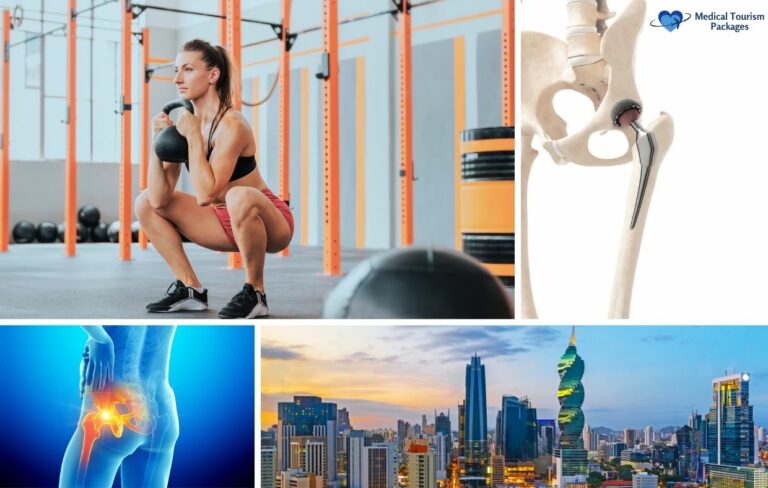
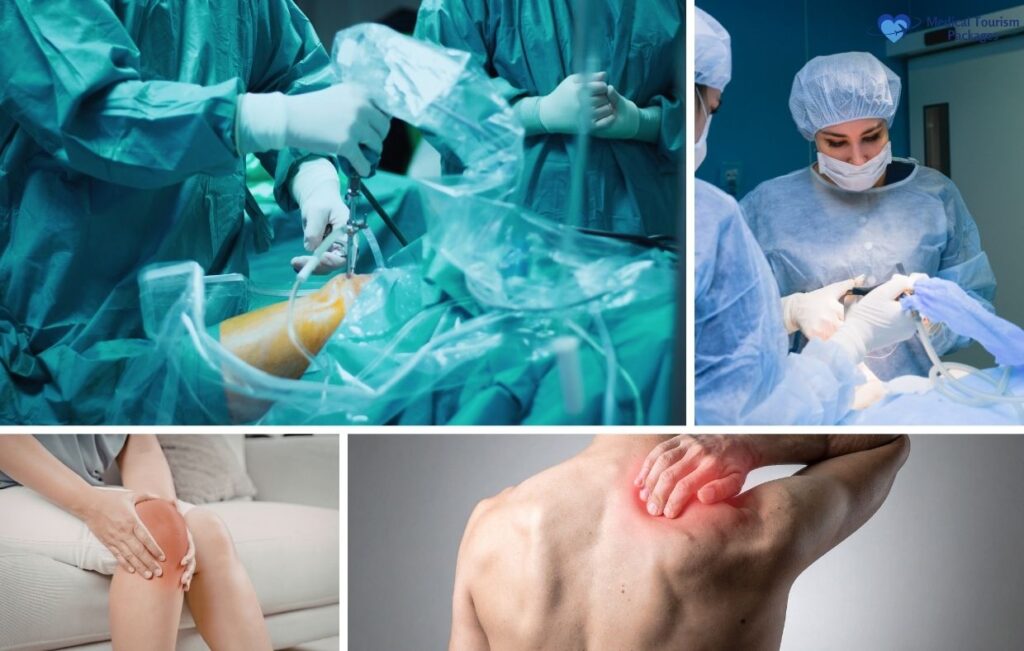
Joint revision surgery, formally called revision total joint arthroplasty, removes a failing implant and rebuilds the joint. It is performed when a primary joint replacement has worn out, become infected, or stopped functioning correctly. The most commonly revised joints are the hip, knee, and shoulder.
For more information about orthopedic surgery options in Colombia, read our complete guide to orthopedic surgery in Colombia. You can also explore our comprehensive guide for American medical tourists in Colombia for planning tips.
How Does Joint Revision Surgery Differ from a Primary Replacement?
Revision surgery is more complex than the original procedure. The surgeon works around existing hardware, scar tissue, and compromised bone. This affects surgical duration, recovery expectations, and implant requirements.
| Primary Arthroplasty | Revision Arthroplasty | |
|---|---|---|
| Bone Condition | Natural, intact bone | Often compromised by wear or prior surgery |
| Soft Tissue | Virgin tissue planes | Significant scar tissue from prior procedure |
| Surgical Duration | 1–2 hours | 3–6+ hours |
| Hospital Stay | 1–2 nights | 3–5+ nights |
| Implant Type | Standardized components | Specialized, long-stemmed, or custom components |
| Weight-Bearing | Often immediate | Frequently delayed; bracing may be required |
Why Do Joint Replacements Fail?
Understanding your implant failure is the starting point for any revision consultation. There are four common failure modes. Each requires a different surgical response.
- Aseptic loosening: Wear debris triggers an immune response. The body resorbs bone around the implant. This makes the components unstable over time.
- Periprosthetic joint infection (PJI): Bacteria colonize the implant surface. The surface has no blood supply. The immune system cannot clear the infection without removing the hardware.
- Mechanical wear: The bearing surfaces of the implant wear down over time. The polyethylene liner typically fails first. It requires replacement before underlying metal components are damaged.
- Instability and dislocation: Incorrectly positioned components or insufficient soft tissue tension cause repeated dislocation. Revision corrects alignment and restores stability.
How Much Does Joint Revision Surgery Cost in Colombia?
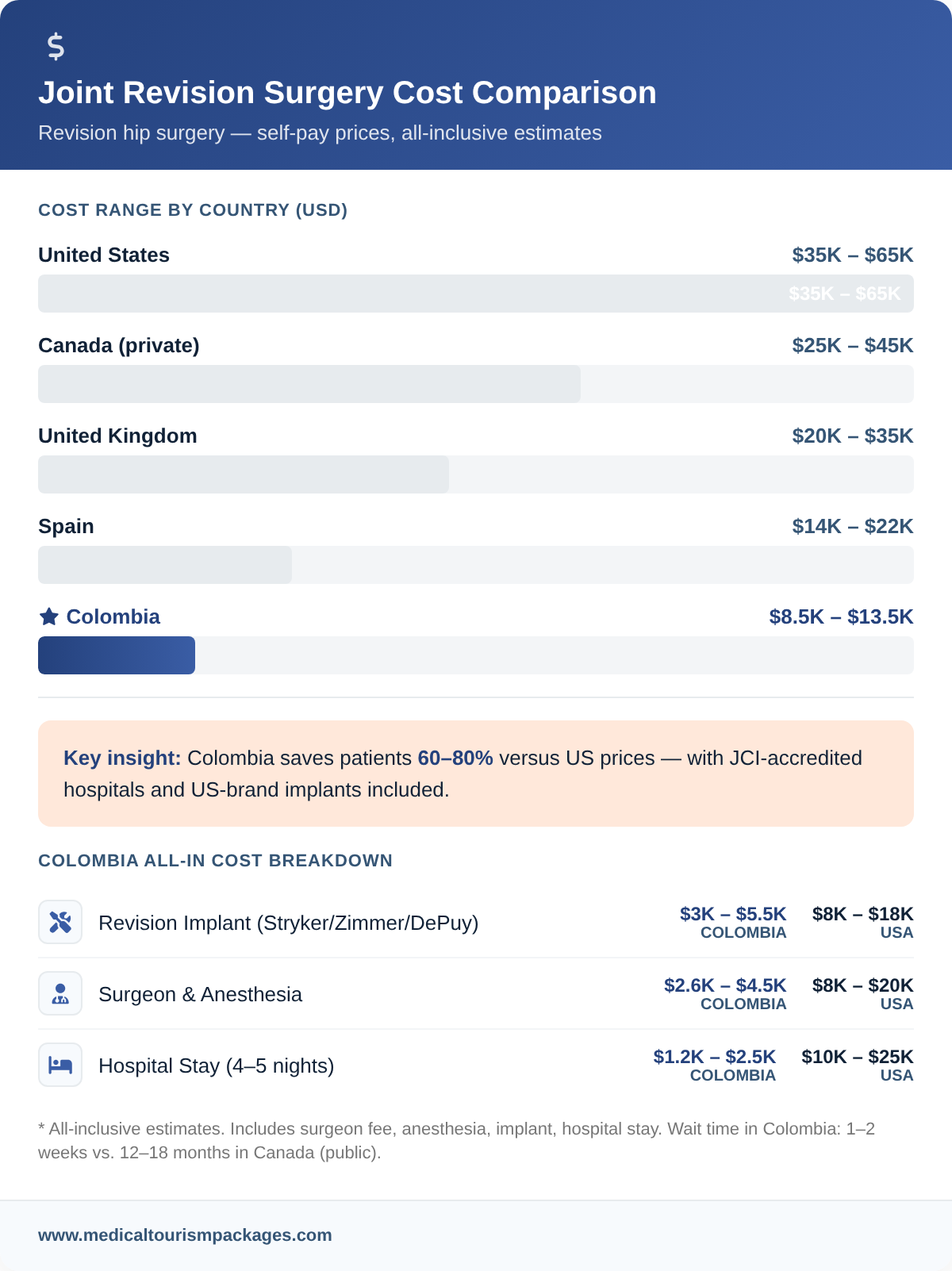
Colombia offers savings of 60% to 80% compared to US self-pay prices. Those savings come from lower operational overhead, lower malpractice premiums, and a lower cost of living. There is no reduction in clinical quality. The implants, the technology, and the accreditation standards are the same as those found in top US facilities.
How Do Colombia’s Prices Compare to the USA, Canada, UK, and Spain?
The table below shows all-in procedure costs across the most common destinations for medical tourists. Canada and the UK appear cheaper through their public systems. However, public wait times for revision surgery run from six to eighteen months. Colombia’s private hospitals schedule procedures within one to two weeks of consultation.
| Colombia | USA | Canada | UK | Spain | |
|---|---|---|---|---|---|
| Revision Hip | $8,500–$13,500 | $35,000–$65,000 | $25,000–$45,000 | $20,000–$35,000 | $14,000–$22,000 |
| Revision Knee | $9,000–$14,000 | $35,000–$60,000 | $22,000–$35,000 | $16,000–$22,000 | $12,000–$20,000 |
| Revision Shoulder | $12,000–$18,000 | $50,000–$90,000 | $25,000–$45,000 | $18,000–$28,000 | $15,000–$22,000 |
| Est. Wait Time | 1–2 weeks | 2–4 weeks | 12–18 months (public) | 6+ months (public) | 2–4 weeks |
What Are the Best Hospitals for Joint Revision Surgery in Colombia?
Colombia’s leading orthopedic hospitals are concentrated in Bogotá, Medellín, and Cali. All of the institutions listed below hold Joint Commission International (JCI) accreditation. JCI is the same standard applied to top-tier US hospitals. It is the benchmark most medical tourists use to evaluate care quality abroad.
Which Hospitals in Bogotá Specialize in Revision Arthroplasty?
Bogotá is Colombia’s medical capital and home to its most advanced orthopedic centers. The three institutions below handle the most complex revision cases in the country.
| Hospital | Accreditation | Orthopedic Focus | Standout Feature |
|---|---|---|---|
| Fundación Santa Fe de Bogotá | JCI Academic Medical Center | Complex joint revision | 20+ JCI Clinical Care Program Certifications, highest outside the USA; Mako robotic platform |
| Fundación Cardioinfantil – LaCardio | JCI Accredited | Orthopedic and trauma | Preferred for patients with cardiac comorbidities alongside orthopedic needs |
| Clínica del Country | JCI Accredited | Minimally invasive joint surgery | 98% success rate; dedicated bilingual international coordinators |
Which Centers in Medellín and Cali Are Recommended?
Medellín and Cali offer strong alternatives to Bogotá. They are particularly good for patients who prefer a smaller city environment during recovery. Each institution below is JCI-accredited and experienced in managing international patients.
| Hospital | City | Accreditation | Standout Feature |
|---|---|---|---|
| Hospital Pablo Tobón Uribe | Medellín | JCI Accredited | 2,000+ international patients annually; dedicated international patient office |
| Clínica Las Américas Auna | Medellín | JCI Accredited | Primary hub for arthroscopic surgery and sports medicine |
| Fundación Valle del Lili | Cali | JCI Academic Medical Center | Ranked number one hospital in Colombia |
| Centro Médico Imbanaco | Cali | JCI Accredited | High volume of US and Caribbean patients; rigorous outcomes tracking |
Is Joint Revision Surgery in Colombia Safe?
Yes, joint revision surgery in Colombia is safe at JCI-accredited hospitals. Clinical safety standards are directly comparable to top US facilities. Operating theaters use laminar flow ventilation. Pre-operative antibiotic protocols are mandatory. Robotic-assisted systems reduce soft tissue trauma through precise implant placement.
What Do the Outcomes Data Show?
Colombian quaternary centers publish outcomes data that meet or exceed international benchmarks. The figures below come from high-volume Colombian institutions. They provide a realistic picture of what patients can expect.
| Metric | Rate per 100 Surgeries (Colombia) | Contextual Benchmark |
|---|---|---|
| 1-Year Revision Rate (THA) | 2.42 | Matches international norms |
| 30-Day Mortality (THA) | 2.15 | Higher in elderly and high-comorbidity patients |
| ICU Admission Rate | 3.41 | Higher for complex revision cases |
| Periprosthetic Fracture (1-year) | 0.62 | Below global average |
| General Success Rate | 90%–98% | Exceeds many US benchmarks |
The 30-day mortality and ICU admission figures are higher in elderly patients and those with significant comorbidities. They are not elevated in the general revision population. Patients in good baseline health consistently achieve the 90% to 98% success rate.
What Implants and Technology Are Used?
Colombia’s top hospitals source implants from the same global manufacturers as US surgical centers. There is no risk of receiving unapproved components at an accredited facility. The three main systems in use are:
- Stryker hardware paired with the Mako robotic arm
- Zimmer Biomet implants used alongside the ROSA Knee System
- DePuy Synthes components standard across accredited surgical suites in Bogotá, Medellín, and Cali
For bearing surfaces, Colombian surgeons use highly cross-linked polyethylene liners and ceramic interfaces. Both reduce wear debris and lower long-term implant failure rates.
How Do You Choose the Right Revision Surgeon in Colombia?
Surgeon selection is the most important decision a revision patient makes. Surgeons who perform high volumes of revision procedures produce fewer complications. When evaluating a surgeon, ask specifically how many revision arthroplasties they perform annually. Do not ask about total joint procedures overall. A surgeon trained in primary replacement is not automatically qualified for complex revision work.
What Qualifications Do Colombia’s Revision Surgeons Hold?
Colombia’s leading revision surgeons are fellowship-trained in the United States, Europe, or Argentina. Many hold memberships in international orthopedic associations including SCCOT and AOSpine. When selecting a surgeon in Bogotá, Medellín, or Cali, look for these qualifications:
- Fellowship training specifically in revision arthroplasty (not just primary replacement)
- Membership in SCCOT (Colombian Society of Orthopedics and Traumatology) or international equivalents
- High annual volume of revision procedures (ask for this number specifically)
- Experience with robotic-assisted platforms (Mako or ROSA systems)
- Hospital affiliation with a JCI-accredited institution
What Should You Ask During a Pre-Surgery Consultation?
Before committing to any surgeon or facility, use this checklist to make a confident decision.
- Which robotic platform is used? Confirm whether the center operates Mako, ROSA, or another navigation system for your specific procedure.
- What implant brand and model will be used? Verify it is a Stryker, Zimmer Biomet, or DePuy Synthes component from the same supply chains as US hospitals.
- What protocol is followed for PJI cases? Confirm whether a two-stage or single-stage revision approach is used and why that applies to your case.
- Is billing bundled or itemized? Colombian centers typically offer a single all-in price covering surgeon, anesthesia, implant, and hospital stay.
- Is a remote pre-travel consultation available? Leading centers offer video consultations and accept digital imaging in advance so your surgical plan is finalized before you fly.
What Does the Surgical Journey Look Like for International Patients?
Colombia’s leading orthopedic hospitals are built to manage international patients from first contact through to discharge. The process is more structured than many patients expect. It begins well before you board a flight.
What Happens Before You Travel?
The pre-travel pathway at JCI-accredited centers follows a clear sequence. Your surgical plan is fully in place before you arrive. Your dedicated bilingual coordinator manages each step.
- Submit existing imaging (X-rays, MRI, or CT scans) through the hospital’s secure patient portal in DICOM format.
- Your surgical team reviews the files and returns a formal clinical opinion.
- A video consultation with your surgeon is scheduled to discuss the plan.
- Your coordinator confirms surgical scheduling, pre-operative requirements, and accommodation and airport logistics.
What Is the In-Country Timeline from Arrival to Departure?
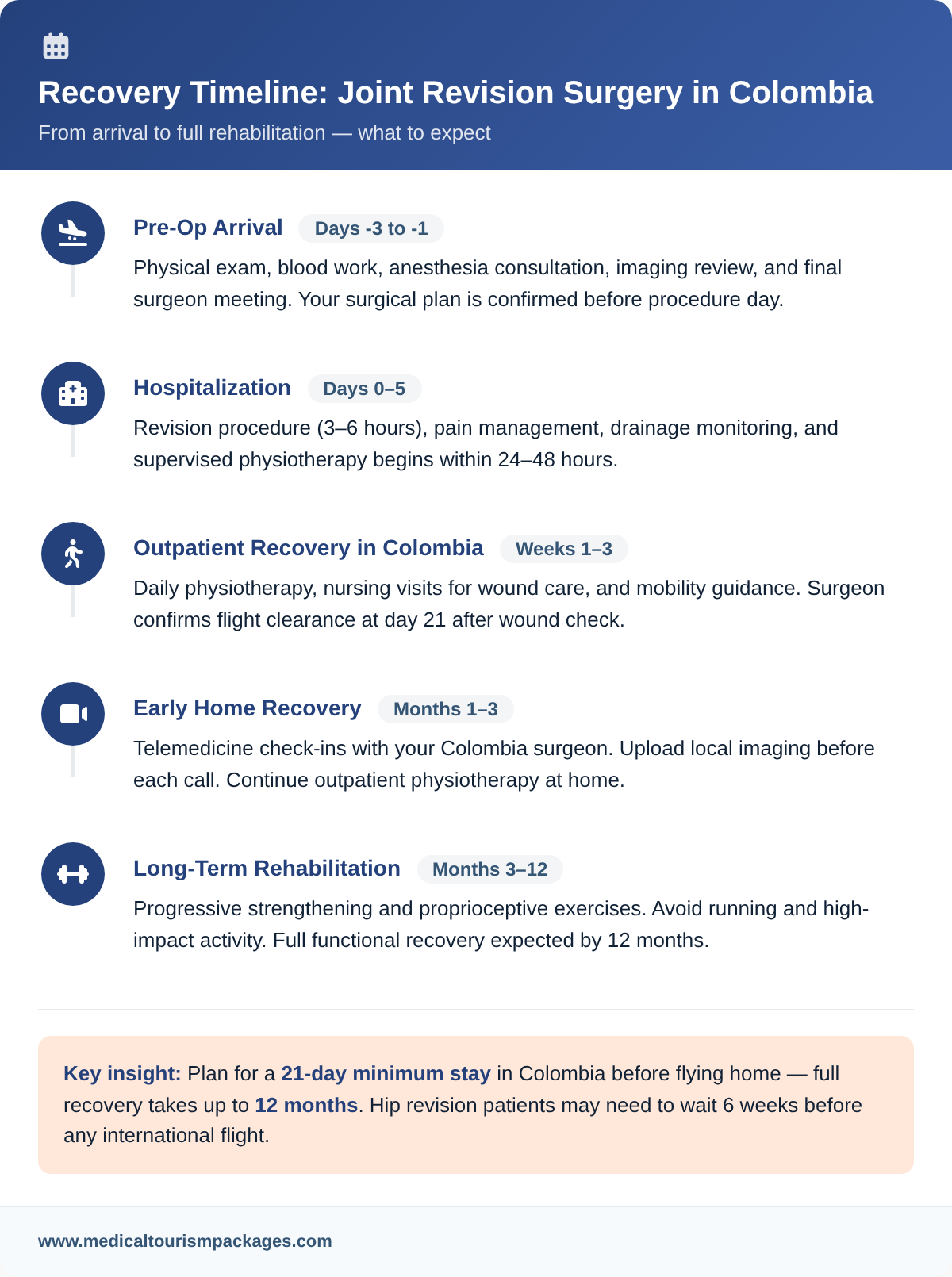
Most revision patients spend three to four weeks in Colombia from arrival to departure clearance. The table below outlines what each phase involves so you can plan your time accordingly.
| Phase | Timeframe | Key Activities |
|---|---|---|
| Pre-Op Arrival | Days −3 to −1 | Physical exam, blood work, anesthesia consultation, imaging review, surgeon meeting |
| Surgery and Hospitalization | Days 0–5 | Revision procedure (3–6 hours), pain management, drainage monitoring, early mobilization |
| Outpatient Recovery | Weeks 1–3 | Daily physiotherapy, nursing visits for wound care, mobility progression |
| Departure Clearance | Day 21+ | Surgeon confirms wound stability and DVT risk is within safe limits for flight |
What Is Recovery Like After Joint Revision Surgery in Colombia?
Recovery from revision surgery is longer and more demanding than recovery from a primary replacement. Colombian hospitals keep revision patients for three to five days. This is longer than the US average. It ensures stability before discharge. Physiotherapy begins within the first 24 to 48 hours of surgery and continues daily throughout the in-country window.
What Does the Full Recovery Timeline Look Like?
Full recovery takes up to 12 months and moves through four distinct phases. The goals and activities at each stage protect the implant while restoring function progressively.
| Phase | Timeframe | Goals | Key Activities |
|---|---|---|---|
| Hospitalization | Weeks 0–2 | Control pain and swelling; begin early mobility | Pain management, drainage monitoring, ankle pumps, static quad sets, supervised physiotherapy |
| Early Rehab in Colombia | Weeks 0–12 | Progress from partial to full weight-bearing | Stationary cycling, balance training, swimming once wounds are healed, weaning from walker to cane |
| Home Recovery | Months 1–3 | Consolidate strength; maintain implant stability | Telemedicine check-ins, local imaging for remote surgical review, continued outpatient physiotherapy |
| Long-Term Rehabilitation | Months 3–12 | Return to daily activities; build full musculoskeletal function | Progressive strengthening, proprioceptive exercises, avoid running and high-impact activity |
When Is It Safe to Fly Home?
Flying too soon after revision surgery significantly increases the risk of deep vein thrombosis (DVT) and pulmonary embolism. Your surgeon will not clear you for departure until the following conditions are met.
- Wait a minimum of 3 to 4 weeks before any international flight. This is based on wound stability and DVT risk assessment.
- Hip revision patients may need to wait 6 weeks. The joint capsule requires additional time to tolerate the 90-degree seating position in economy class.
- Follow all in-flight precautions including compression stockings, adequate hydration, and foot pumps every 15 to 20 minutes while seated.
- Continue anticoagulants for at least 6 weeks post-revision. Do not discontinue blood thinners before your surgeon confirms it is safe.
What Are the Advantages and Disadvantages of Joint Revision Surgery in Colombia?
Every medical tourism decision involves trade-offs. Colombia’s clinical case is strong, but there are practical limitations worth understanding before you commit to traveling.
What Are the Advantages of Choosing Colombia?
Colombia offers a strong combination of cost savings and clinical quality for revision surgery patients.
- 60%–80% cost savings compared to US self-pay prices
- JCI-accredited quaternary hospitals in Bogotá, Medellín, and Cali
- Same Stryker, Zimmer Biomet, and DePuy Synthes implants used in American operating rooms
- Longer hospital stays than the US average, enabling more intensive early rehabilitation
- Fellowship-trained surgeons with US, European, or Argentine training
- English-speaking coordinators available at every major center
What Are the Disadvantages to Consider?
There are real limitations to factor into your decision before traveling to Colombia for revision surgery.
- Elderly patients and those with significant comorbidities face a higher 30-day mortality rate (2.15 per 100) and elevated ICU admission rate (3.41 per 100). These patients should discuss individual risk with their home-country physician first.
- Revision implants last 10 to 15 years regardless of where surgery is performed. This is shorter than the 15 to 25 year lifespan of a primary replacement.
- Some US and Canadian doctors decline to manage complications from surgery performed abroad. Arrange a willing local physician before you travel.
Is Colombia the Right Destination for Your Joint Revision Surgery?
Colombia is not the only destination for joint revision surgery abroad. However, few countries match its combination of clinical infrastructure and cost advantage. JCI-accredited hospitals operate across Bogotá, Medellín, and Cali. Surgeons are fellowship-trained. Implants come from the same global supply chains as US surgical centers. Hospital stays are longer than the US average, giving patients more supported early recovery before traveling home.
The savings are real and significant. A procedure costing $35,000 to $65,000 in the United States runs $8,500 to $13,500 in Colombia. That gap exists because of lower operational costs, not lower standards. Colombia is the right choice if you are medically stable, have a clearly identified implant failure, and are prepared to commit to the full in-country recovery window. You can also explore our knee replacement guide for Colombia if you are considering primary replacement first.
What Questions Do Medical Tourists Ask Most Often About Joint Revision Surgery in Colombia?
How long should I stay in Colombia after joint revision surgery?
You should stay at least 3 to 4 weeks in Colombia after joint revision surgery. Hip revision patients may need to stay 6 weeks. This allows time for wound healing, daily physiotherapy, and DVT risk assessment. Your surgeon will issue a formal departure clearance before you fly. US, Canadian, and most EU citizens do not need a visa for stays under 90 days.
Are Colombian hospitals accredited to international standards?
Yes, Colombia has multiple JCI-accredited hospitals. Joint Commission International (JCI) is the same standard used by top US hospitals. Fundación Santa Fe de Bogotá holds more than 20 JCI Clinical Care Program Certifications—the highest number outside the United States. Hospitals in Bogotá, Medellín, and Cali meet the same patient safety standards as US medical centers.
Do Colombian orthopedic surgeons speak English?
Yes, most specialist orthopedic surgeons in Colombia speak English. All JCI-accredited hospitals maintain dedicated international patient offices. These offices have English-speaking coordinators who manage your full patient journey. Language barriers are rarely an issue at leading centers in Bogotá, Medellín, and Cali.
What happens if I have complications after returning home?
Colombia’s leading orthopedic surgeons work directly with your home-country physician. They provide detailed discharge summaries and imaging records for seamless follow-up. Most surgical packages include telemedicine follow-up appointments after you return. Before traveling, arrange a local physician willing to manage post-operative care. This is an essential step for all medical tourists.
Is it safe to fly after joint revision surgery?
Yes, it is safe to fly after the recommended waiting period. Surgeons require a minimum 3 to 4 week stay before international flights. Hip revision patients may need to wait 6 weeks. Cabin pressure and blood clot risk require adequate healing time. Wear compression stockings, stay hydrated, and perform foot pumps every 15 to 20 minutes during the flight.
What training do Colombian revision surgeons have?
Colombian revision surgeons are board-certified specialists with extensive fellowship training. They complete a medical degree followed by an orthopedic residency. After residency, they pursue fellowship training specifically in revision arthroplasty. Fellowship programs are often completed in the United States, Europe, or Argentina. Many surgeons hold memberships in SCCOT and international orthopedic associations.
Ready to Start Your Joint Revision Surgery Journey?
Medical Tourism Packages coordinates your entire joint revision journey in Colombia. We connect you with fellowship-trained surgeons at JCI-accredited hospitals in Bogotá, Medellín, and Cali. We arrange your travel and accommodations and provide bilingual support throughout your treatment. Get a free consultation to discuss your orthopedic needs and receive a personalized quote.
Contact us today to start planning your affordable joint revision surgery in Colombia.