Book Appointment Now




Hip Arthroscopic Surgery in Panama: Costs, Hospitals, and What Medical Tourists Need to Know
 By
By
Hip arthroscopy in Panama costs $5,500–$11,500—60–80% less than the US—performed at JCI-accredited hospitals with Johns Hopkins affiliation.
Panama City’s private hospitals perform over 50,000 international procedures annually. Orthopedic surgery is a core specialty. Fellowship-trained surgeons lead these programs. Total costs run 60–80% below US rates, and Panama uses the US dollar—no conversion needed.
Our network connects you with board-certified hip surgeons across Panama City—each verified for JCI-accreditation, fellowship credentials, and procedure volume. Below, you’ll find cost comparisons, hospital profiles, surgeon selection criteria, risk data, and a full recovery timeline.
What Is Hip Arthroscopic Surgery?
Hip arthroscopy is a minimally invasive joint procedure. The surgeon makes two or three small incisions around the hip. Each incision is approximately 1 cm. A thin camera called an arthroscope enters through one incision. Surgical instruments enter through the others. The surgeon repairs damage inside the joint without opening it. Most patients go home the same day or after one night in hospital.
Surgeons recommend hip arthroscopy when a patient has persistent mechanical hip pain. The pain must not have improved with physical therapy or injections. The most common reason for the procedure is femoroacetabular impingement (FAI).
What Conditions Does Hip Arthroscopy Treat?
FAI occurs when the hip joint bones are abnormally shaped. This causes friction during movement. There are three types:
- Cam impingement: The femoral head is not round and jams against the socket
- Pincer impingement: The acetabular rim over-covers the femoral head
- Mixed-type: Combines both types and is present in over 70% of FAI cases
Left untreated, FAI leads to labral tears and cartilage breakdown. Both are significant precursors to early-onset osteoarthritis.
How Is Hip Arthroscopy Different from Open Hip Surgery?
Hip arthroscopy is notably different from open hip surgery. The table below shows the key differences.
| Attribute | Hip Arthroscopy | Open Hip Surgery |
|---|---|---|
| Incision size | 2–3 punctures (~1 cm each) | Single large incision (10–20 cm) |
| Hospital stay | Same-day or one night | 2–5 days |
| Recovery time | 2–4 months | 4–6 months or longer |
| Scarring | Minimal | Moderate to significant |
What Happens During Hip Arthroscopy?
The procedure takes 60–120 minutes under general anesthesia. A regional nerve block is often added for pain control. Once the decision for surgery is made, the surgeon follows a four-step sequence:
1. Diagnostic exploration: A 70-degree arthroscope evaluates the labrum, cartilage, and joint structures
2. Acetabuloplasty: Excess bone on the acetabular rim is trimmed to correct Pincer impingement
3. Labral repair: The torn labrum is reattached to the socket rim using suture anchors
4. Femoroplasty: The femoral head-neck junction is reshaped to correct Cam impingement
Labral repair is strongly preferred over debridement. Repair preserves the labrum’s function. It is also associated with better long-term outcomes and a significantly lower risk of conversion to total hip replacement.
Why Do Patients Choose Panama for Hip Arthroscopic Surgery?
Panama’s private hospital sector treats over 50,000 international patients every year. Orthopedic surgery is one of its core specialties. Facilities are modern and surgeons are internationally trained. Costs are a fraction of what patients pay at home.
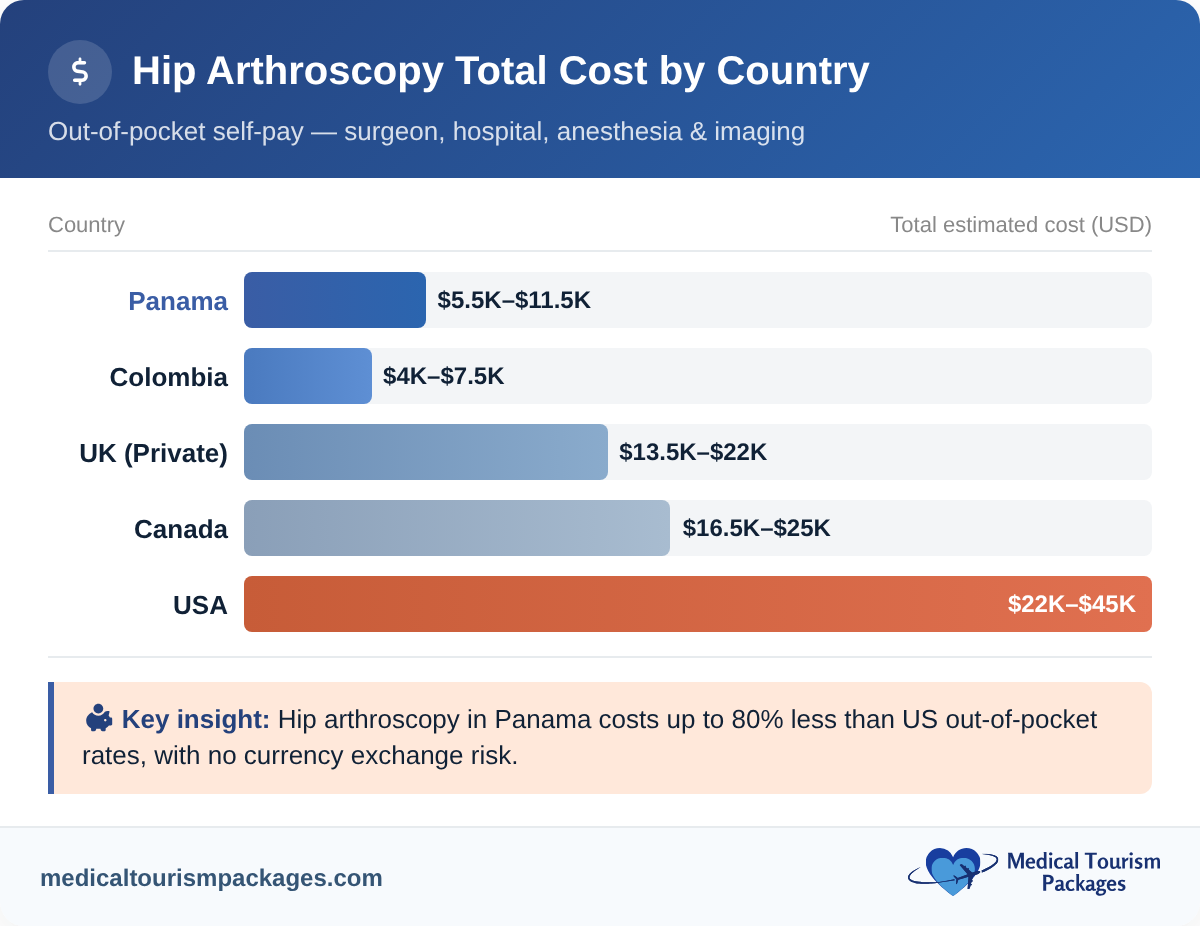
For US patients, out-of-pocket hip arthroscopy costs run $22,000–$45,000 at home. In Panama, the same procedure costs $5,500–$11,500. For Canadian and UK patients, the driver is often time. Both public systems require waits of 6–12 months for elective orthopedic procedures. Panama’s private hospitals can schedule surgery within weeks.
For more on Panama’s orthopedic options, see our guide to hip replacement surgery in Panama and our overview of spine surgery in Panama.
Which Hospitals in Panama Perform Hip Arthroscopy?
Panama City hospitals hold international accreditations that give patients a reliable benchmark for quality. Here is what each leading facility offers:
| Hospital | Accreditation / Affiliation | Key Distinction |
|---|---|---|
| Hospital Punta Pacífica | Johns Hopkins Medicine International | Only Johns Hopkins-affiliated hospital in Central America |
| Clínica Hospital San Fernando | JCI-accredited; Tulane Medical Center + Baptist Health South Florida | First hospital in Panama to receive JCI accreditation |
| The Panama Clinic | TEMOS-accredited (Germany); JCI certification in process | Hospitality-first model with dedicated international patient coordinators |
| Hospital Nacional | High-volume orthopedic program | 80-bed facility specializing in complex joint reconstruction |
What Credentials Do Panama’s Hip Arthroscopy Surgeons Have?
Surgeons at these Panama City facilities are board-certified domestically and fellowship-trained abroad. High procedure volume is a particularly important credential in hip arthroscopy. The hip joint is deep and technically demanding. Surgeons who perform this procedure frequently produce consistently better outcomes.
Leading hip arthroscopy surgeons in Panama complete fellowship training at centers in the US, Europe, and Latin America. Many complete advanced rotations at US institutions such as Baylor Scott & White or the Hospital for Joint Diseases in New York. Board-certified surgeons with this fellowship training lead programs at all four major Panama City hospitals.
How Much Does Hip Arthroscopy Cost in Panama?
Hip arthroscopy in Panama costs $5,500–$11,500 out of pocket. This represents a 60–80% saving versus the United States. Panama runs on the US dollar. There is no currency conversion, no exchange rate risk, and no surprise fees at checkout.
How Does Panama’s Cost Compare to Other Countries?
The table below breaks down costs by component and compares Panama against the US, UK, Colombia, and Canada.
| Cost Component | Panama | USA | UK | Colombia | Canada |
|---|---|---|---|---|---|
| Surgeon fee | $1,500–$2,500 | $4,000–$8,000 | $3,000–$5,000 | $1,200–$1,800 | $3,500–$5,000 |
| Hospital / facility | $2,500–$5,000 | $15,000–$25,000 | $8,000–$12,000 | $1,800–$3,000 | $10,000–$15,000 |
| Anesthesia | $600–$1,000 | $2,000–$4,000 | $1,500–$2,500 | $400–$700 | $1,500–$2,500 |
| Pre-op MRI / imaging | $300–$600 | $1,200–$2,500 | $700–$1,200 | $250–$450 | $800–$1,200 |
| PT per session | $40–$80 | $150–$300 | $100–$200 | $30–$60 | $120–$200 |
| Total estimated | $5,500–$11,500 | $22,000–$45,000 | $13,500–$22,000 | $4,000–$7,500 | $16,500–$25,000 |
⚠️ US and Canada figures are based on 2024–2025 self-pay averages.
What Additional Costs Should Medical Tourists Budget For?
Your surgical quote covers the procedure itself. It does not cover everything associated with the trip. Before finalizing your budget, account for these additional costs:
- Round-trip airfare to Panama City (Tocumen International Airport, PTY)
- A minimum 14-night hotel stay near your hospital
- Ground transfers between your hotel and hospital
- Post-operative medications (not always included in the discharge package)
If your surgeon determines that an allograft labral reconstruction is needed, confirm the full cost in writing. This add-on is not always included in the standard quote. Colombia offers lower total procedure costs for patients where budget is the primary driver. See our comparison guide on hip arthroscopic surgery in Colombia for full cost details.
How Do You Choose the Right Hip Arthroscopy Surgeon in Panama?
Choosing the right surgeon matters more in hip arthroscopy than in many other orthopedic procedures. The hip joint is deep, access is restricted, and the margin for error is narrow. Accredited hospitals are a good starting point. The surgeon’s individual credentials and volume are ultimately what determine your outcome.
What Credentials Should a Hip Arthroscopy Surgeon in Panama Have?
When reviewing a surgeon’s background, verify these four things:
- Board certification in Panama: Confirms the surgeon has met formal orthopedic training and licensing requirements
- Fellowship training in the US, Canada, or Europe: Indicates advanced specialization beyond standard residency
- High annual hip arthroscopy volume: Surgeons performing this procedure frequently produce better results
- Active privileges at a JCI or internationally accredited facility: Ensures adherence to international patient safety standards
One important caveat: there is no centralized public database for surgeon-specific complication rates in Panama. You will need to request this data directly from the hospital before booking.
What Questions Should You Ask During a Consultation?
A virtual consultation is your best opportunity to evaluate the surgeon before committing. Come prepared with these questions:
- How many hip arthroscopies do you perform per year?
- What is your complication rate for this procedure?
- What does your standard rehabilitation protocol look like after hip arthroscopy?
- How long do you recommend I stay in Panama before flying home?
- What happens if I need follow-up care after I return home?
- What specific repairs do you anticipate based on my MRI findings?
A surgeon who answers these questions clearly demonstrates both experience and transparency. If answers are vague or deflected, look elsewhere.
What Are the Risks of Hip Arthroscopy in Panama?
Hip arthroscopy has a strong safety profile. The minor complication rate across published literature is approximately 7.9%. The major complication rate is 0.45%. JCI-accredited hospitals in Panama City report complication rates at or below the global benchmark of 4.7% for joint procedures. Leading facilities use HEPA-filtered operating rooms with strict perioperative antibiotic protocols.
What Complications Can Occur and How Common Are They?
Most complications are temporary and resolve without further intervention. The table below outlines what patients should be aware of.
| Complication | Incidence Rate | Typical Resolution |
|---|---|---|
| Traction-related nerve paresthesia | ~7.9% (minor) | Temporary; resolves within days to weeks in most cases |
| Infection | Below 1% | Managed with antibiotics; rarely requires further intervention |
| Arthrofibrosis (joint stiffness) | ~2% | Resolves with dedicated physical therapy in most cases |
| Failed repair requiring revision | 2–3% within two years | Revision arthroscopy or alternative surgical approach |
| Major complications | 0.45% | Managed based on severity; may require further surgery |
If a complication arises after you return home, contact your Panama surgical team first. Most JCI-accredited facilities provide remote follow-up as a standard part of care. Your surgeon can assess the situation through photos, imaging, or a video consultation. For urgent symptoms—swelling, fever, sudden pain increase, or signs of infection—seek local care immediately. Notify your Panama surgeon at the same time.
What Does Recovery Look Like After Hip Arthroscopy in Panama?
Recovery begins before you leave Panama City. Physical therapy starts within 24 hours of surgery while you are still in hospital. This ensures you are comfortable with your exercises and mobility aids before traveling home. You should plan for a minimum 14-night stay in Panama:
- 2 days of pre-operative consultations and testing
- 1–2 days in hospital after surgery
- Approximately 10 days of local recovery before your return flight
Two movements are strictly prohibited for the first 8 weeks post-op: long-axis hip distraction and active straight-leg raises. Both place stress on the labral repair before it has adequately healed.
What Does the 12-Week Rehabilitation Protocol Look Like?
The 12-week rehabilitation protocol is structured in three phases. Each phase has specific weight-bearing and exercise goals.
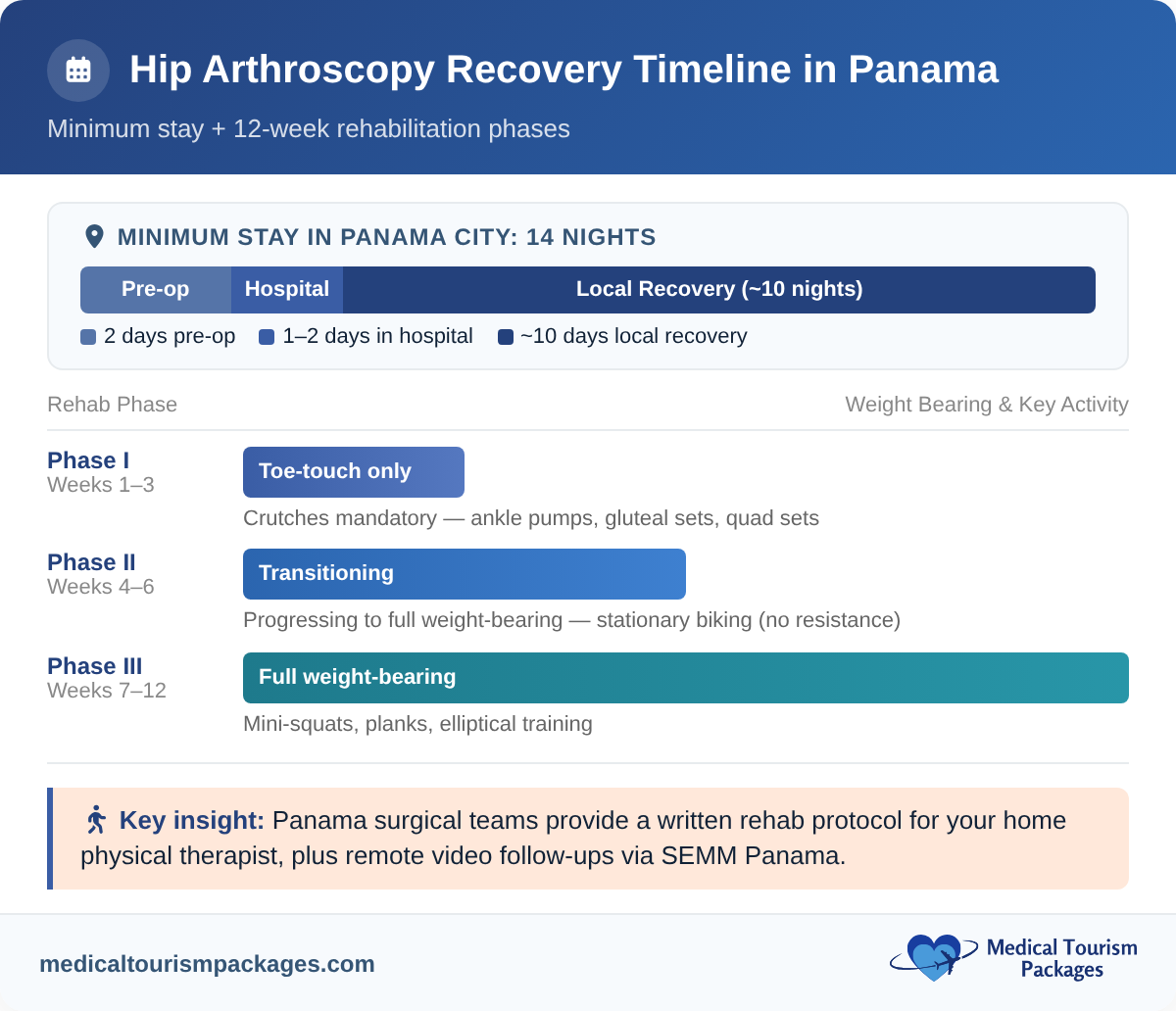
| Phase | Weeks | Weight-Bearing Status | Key Exercises |
|---|---|---|---|
| Phase I | 1–3 | Toe-touch only (~20 lbs); crutches mandatory | Ankle pumps, gluteal sets, quad sets |
| Phase II | 4–6 | Transition to full weight-bearing as gait stabilizes | Stationary biking with no resistance |
| Phase III | 7–12 | Full weight-bearing | Mini-squats, planks, elliptical training |
Can Rehabilitation Be Continued Remotely After Returning Home?
Yes, you can continue rehabilitation at home after returning from Panama City. Two resources make this practical:
- Written Rehabilitation Protocol document: Your Panama surgical team provides this before you leave. It is a formal document for your local physical therapist. It outlines your specific procedure, repair type, and full phase-by-phase exercise progression.
- SEMM Panama telehealth platform: Enables direct video follow-ups with your Panama surgeon. They can review incision healing, assess range of motion, and adjust your protocol remotely.
Before you travel, confirm that a physical therapist in your home city is willing to follow an external post-arthroscopy protocol. That handoff is as important as the surgery itself.
Is Hip Arthroscopic Surgery in Panama Right for You?
Panama is a strong option for patients with a confirmed hip diagnosis who have already tried conservative treatment without success. The ideal candidate:
- Has a confirmed FAI or labral tear diagnosis supported by MRI imaging
- Has attempted conservative management such as physical therapy or injections
- Is in general good health for general anesthesia
- Can commit to a minimum 14-night stay in Panama City
To help you weigh the decision, here is a summary of the advantages and limitations.
Pros
- 60–80% cost savings versus US out-of-pocket prices
- US-dollar pricing with no currency exchange risk
- JCI-accredited and Johns Hopkins-affiliated hospitals in Panama City
- Surgeons fellowship-trained in the US and Europe
- Visa-free entry for US citizens for up to 180 days
- 3-hour direct flight from Miami; Tocumen International Airport (PTY) also serves Houston, Atlanta, Toronto, and Bogotá directly
Cons
- No specialized 24/7 nursing recovery houses; most patients recover in hotels, which is less supported than options available in Costa Rica or Mexico
- No centralized public database for surgeon-specific complication rates
- Complaint resolution is handled internally by hospitals with no centralized ombudsman
- Colombia offers lower total procedure costs for patients where budget is the primary driver
If Panama fits your profile, the next steps are straightforward. Contact the International Patient Services department at your target hospital. Request your surgeon’s annual hip-preservation procedure volume before committing. Confirm that a physical therapist at home is prepared to follow a specialized post-arthroscopy rehabilitation protocol before you depart.
What Questions Do Medical Tourists Ask Most Often About Hip Arthroscopy in Panama?
How Long Should I Stay in Panama After Hip Arthroscopy?
You should stay a minimum of 14 nights in Panama after hip arthroscopy. Plan for 2 days of pre-operative consultations and testing. Then allow 1–2 days in hospital after surgery. After that, count on approximately 10 days of local recovery in Panama City before your return flight.
US citizens do not need a visa for stays up to 180 days. Panama City is a 3-hour direct flight from Miami, with connections through Tocumen International Airport (PTY) from Houston, Atlanta, Toronto, and Bogotá.
Are Panama Hospitals Accredited to International Standards?
Yes, Panama has multiple internationally accredited hospitals. Clínica Hospital San Fernando was the first JCI-accredited hospital in Panama. Hospital Punta Pacífica is the only hospital in Central America affiliated with Johns Hopkins Medicine International. The Panama Clinic holds TEMOS accreditation from Germany and is pursuing JCI certification.
Joint Commission International (JCI) is the same standard used by top US hospitals. These Panama City facilities meet the same patient safety standards as US academic medical centers.
Do Hip Arthroscopy Surgeons in Panama Speak English?
Yes, most specialized hip arthroscopy surgeons in Panama are fluent in English. Many completed fellowship training at English-speaking institutions in the US, Canada, and Europe. International patient coordinators at all four major Panama City hospitals communicate clearly throughout your treatment journey.
This removes the language barriers that complicate medical tourism in many other countries. All major hospitals in Panama City have dedicated international patient services departments.
What Happens If I Have Complications After Returning Home?
Contact your Panama surgical team first if complications arise after you return home. Most JCI-accredited facilities provide remote follow-up as a standard part of care. Your surgeon can assess the situation through photos, imaging, or a video consultation via the SEMM Panama telehealth platform.
For urgent symptoms—significant swelling, fever, sudden increase in pain, or any sign of infection—seek local care immediately. Notify your Panama surgeon at the same time. The Johns Hopkins affiliation at Hospital Punta Pacífica also creates pathways for high-level consultation in rare complex cases.
Is It Safe to Fly After Hip Arthroscopy?
Yes, it is safe to fly after the recommended waiting period. Surgeons recommend a minimum 14-night stay in Panama City before flying home. This allows adequate healing time before your flight. Cabin pressure changes and the risk of blood clots require you to reach a stable recovery stage before traveling.
Your surgeon will clear you for flight after verifying your healing progress. Keep your hip elevated during the flight where possible. Walk and perform ankle pumps during the flight to reduce swelling.
What Training Do Hip Arthroscopy Surgeons in Panama Have?
Hip arthroscopy surgeons in Panama are board-certified orthopedic specialists. They complete a medical degree followed by a formal orthopedic residency in Panama. After residency, many pursue fellowship training specifically in hip preservation or sports medicine.
Fellowship training often occurs at premier centers in the United States, Canada, or Europe. Many Panama City surgeons complete advanced rotations at US institutions such as Baylor Scott & White or the Hospital for Joint Diseases in New York. Board-certified surgeons with this level of training lead all major hip arthroscopy programs in Panama City.
Ready to Start Your Hip Arthroscopy Journey in Panama?
Medical Tourism Packages coordinates your entire hip arthroscopy journey in Panama. We connect you with fellowship-trained orthopedic surgeons, arrange your travel and accommodations, and provide bilingual support throughout your treatment. Get a free consultation to discuss your hip pain and receive a personalized quote.
Contact us today to start planning your affordable hip arthroscopy in Panama.